
Fiber Bale Strapping: Matching Cut PET Strap to Your Line
Fiber Bale Strapping: Matching Cut PET Strap to Your Line
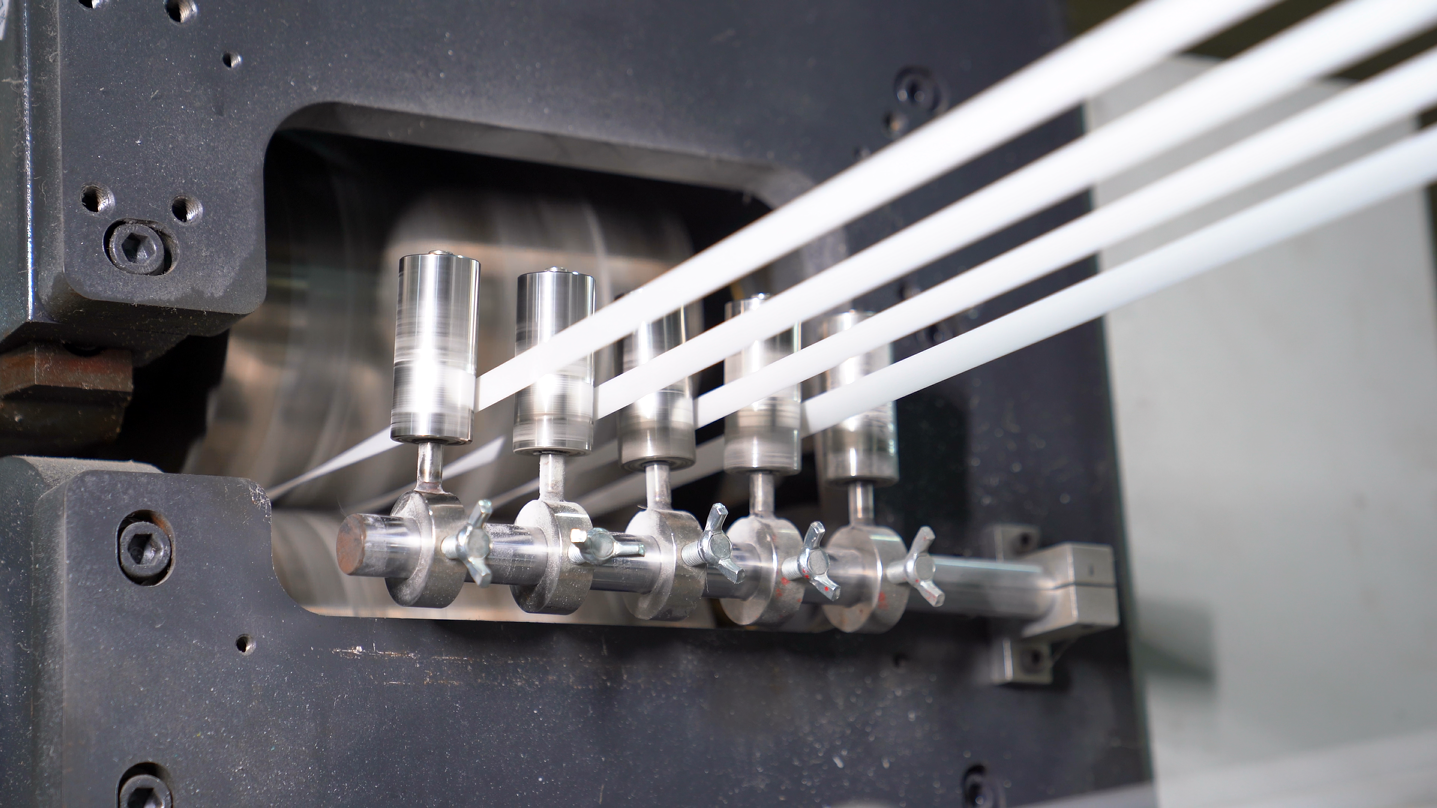
Chemical fiber and textile producers buy plastic strapping as a line component, not as a generic consumable. A fiber bale is formed, compressed, indexed, strapped and released on a fixed cycle, and the cut PET strap has to feed, tension, weld and clear inside that cycle. A strap that meets a tensile specification but misses the line's cut length, guide channel or winding tolerance does not produce a weaker bale — it stops the line.
This reference article explains how PET cut strap is matched to fiber bale and textile bundling requirements. It draws on two verified project references — a green cut PET strap in the 1610×3380/3480 format supplied for Sateri fiber bale strapping over three years, and a 16×1.0 mm transparent cut PET strap compatible with Far Eastern Industries' automatic packaging line — and sets out the sizing, cut length, machine-compatibility and annual supply criteria that decide whether a trial becomes a standing order.
Why Line Fit Decides the Order, Not Tensile Strength
Tensile data is the entry ticket to a fiber bale trial; line fit is what decides the order. On a bale line the strap is a machine input with four physical interfaces, and a single mismatch at any of them shows up immediately as a visible fault.
- The feed and guide channel sets the maximum thickness and the edge condition the strap can pass through before it jams or abrades.
- The tensioning cycle depends on elongation behaviour, not on break load alone; a strap that stretches further than the machine expects will lose tension before the seal is made.
- The welding head needs a stable, consistent cross-section to produce a repeatable friction-weld joint.
- The cut and release sequence depends on cut length tolerance and on how evenly the coil unwinds.
Material choice narrows the field before line work begins. PET strapping provides roughly twice the tensile strength of PP strapping, with break load ranges reported at 160–1360 kg for PET against 45–270 kg for polypropylene strapping, and it is the usual selection for medium-to-heavy loads above 400 kg, outdoor storage and high-humidity conditions. PP strap remains appropriate for light-to-medium duty indoor bundling. Jushuo Packaging reports SGS-tested breaking force of 9.98 kN for its 12 mm PET strap, with 10% elongation after break against an industry average of 12% cited in the company's comparison data.
The Three Variables That Define a Cut Strap Specification
A cut strap specification is a bundle of three variables, and each one fails differently on the line.
1. Cross-section: width and thickness
Width and thickness set both load capacity and machine fit. Jushuo Packaging's PET range covers widths of 9–25 mm and thicknesses of 0.40–1.27 mm, with break force of 160–1360 kg across that range. A fiber bale format usually sits inside this envelope; the buyer's task is to confirm that the chosen cross-section passes the guide channel without edge damage while still meeting the bale's load requirement at the line's tension setting. The range also includes embossed PET strap variants alongside smooth grades — surface pattern is a line-fit variable that should be tested on the actual machine rather than assumed from a sample.
2. Cut length
Cut length is the variable most often treated as an afterthought and most often responsible for a failed trial. It is derived from the bale circumference, plus the weld overlap, plus the machine's feed and cut allowance. Two chemical fiber bale formats in current use show how tightly these values are set: 19×1.0×3430 mm and 16×1.0×3430 mm. The 3430 mm cut length is shared while the cross-section differs — which is the point. Length and cross-section are specified together, and a change in one rarely leaves the other untouched.
3. Coil, core and winding
Coil behaviour decides whether the line can run at speed. Jushuo Packaging reports PET roll lengths of 550–3800 m on a 406 mm core. Longer rolls reduce changeover frequency on a high-cycle line; shorter rolls reduce end-of-coil waste on a low-cycle line. Winding tension matters as much as length — an unevenly wound roll feeds unevenly, and uneven feed is read by the machine as a tension fault.
| Variable | What it controls on the line | What the buyer should confirm |
|---|---|---|
| Cross-section | Guide channel clearance, tension setting, weld repeatability | Width and thickness tolerance, edge quality, break load at the required tension |
| Cut length | Weld overlap length, seal position, strap-end release | Bale circumference, weld overlap, machine feed and cut allowance |
| Coil and core | Feed consistency, changeover frequency, end-of-coil waste | Core diameter, roll length, winding tension, packaging protection in transit |
Verified Project Evidence From Fiber and Textile Bundling
Two project references show what a matched format looks like in practice rather than on a specification sheet.
Sateri: a three-year green cut PET supply
Jushuo Packaging has supplied a green cut PET strap in the 1610×3380/3480 format for Sateri fiber bale strapping over a three-year period. A multi-year relationship is not a performance claim in itself, but it does establish something a sample cannot: that the format, cut length and cross-section stayed stable across repeated production cycles and repeated deliveries. For a bale line running a fixed cycle, that continuity is the practical test of a cut strap.
Far Eastern Industries: 16×1.0 mm transparent cut PET on an automatic line
A 16×1.0 mm transparent cut PET strap has been used in a format compatible with Far Eastern Industries' automatic packaging line. The operative word is compatible. The strap was matched to the line's feed, tension and sealing behaviour rather than selected from a catalogue specification list — the same cross-section at a different cut length or winding format would not necessarily have produced the same result.
Chemical fiber bale formats in current use
Alongside those two references, chemical fiber bale strapping is specified in 19×1.0×3430 mm and 16×1.0×3430 mm formats. Both combine a 1.0 mm thickness with a 3430 mm cut length and differ mainly in width — the typical pattern when one plant runs two bale formats on comparable lines and wants a shared cut length to simplify changeover.
| Format | Application reference | What it demonstrates |
|---|---|---|
| Green cut PET, 1610×3380/3480 | Sateri fiber bale strapping, supplied over three years | Long-run format stability across repeat production and delivery cycles |
| Transparent cut PET, 16×1.0 mm | Automatic packaging line at Far Eastern Industries | Line-matched specification rather than catalogue selection |
| 19×1.0×3430 mm / 16×1.0×3430 mm | Chemical fiber bale strapping formats | Shared cut length with different cross-sections across bale formats |
How a Cut PET Strap Interacts With an Automatic Packaging Line
Five contact points decide whether a cut strap runs or stalls. Each one is a place where a specification that looks correct on paper can still fail in operation.
Feed and guide channel. The strap enters the machine through a fixed channel; thickness tolerance and edge quality decide whether it travels cleanly or scuffs against the guide. On high-cycle lines, small thickness variation accumulates into feed hesitation.
Tensioning. PET retains tension well because its elongation is comparatively low — 10% after break on Jushuo's 12 mm grade, against a 12% industry average cited by the company. Low elongation is what keeps a compressed bale from relaxing after the seal is made, but it also means the machine's tension setting has less margin for error.
Friction welding. Battery-operated friction-weld tools for PET reach up to 85% joint efficiency, compared with 60% for manual PP tools. That efficiency assumes a stable cross-section: a strap that varies in thickness produces a variable weld, and a variable weld is the failure mode an operator notices last and pays for first.
Cut length and the knife. The cut has to land within the machine's tolerance so the weld overlap is long enough to seal and short enough not to overrun. This is where a cut length confirmed on one line rarely transfers to another without revalidation.
Coil changeover. A 406 mm core with a long roll length reduces stops on a fast line; a shorter roll reduces the tail waste on a slow one. The right balance depends on cycle count, not on preference.
PET Cut Strap Against PP and Steel in Bale Bundling
For fiber bale work, three materials compete on different grounds. The comparison below uses figures reported in Jushuo Packaging's product comparison material and should be treated as supplier-reported unless independently tested.
| Attribute | PET cut strap | PP strap | Steel strap |
|---|---|---|---|
| Break load range | 160–1360 kg | 45–270 kg | Comparable to PET at equivalent section |
| Elongation behaviour | 10% after break on 12 mm grade (company data) | Higher; lower tension retention | Breaks 7–13% higher than PET per company comparison |
| Weight and freight | Density about 1/6 of steel; 1 t PET equals the length of 6 t steel | Light, flexible, easy to handle | Heaviest freight profile per metre |
| Corrosion and UV | Stable under UV exposure, no rust | Requires UV-stabilised additives for outdoor use | Rusts without protection |
| Handling safety | No sharp edges, no scratches on bales | No sharp edges | Sharp edges and recoil risk |
| Material cost | 30–40% above PP | Lowest of the three | 30–50% above PET |
Where PET cut strap is not the automatic answer
Four limits deserve to be stated plainly, because they shape the procurement decision as much as the performance data does.
- Material cost is higher than PP. PET costs 30–40% more than PP at material level. The lifecycle case rests on load weight, straps per bale and replacement ratio; on a light bale the arithmetic does not favour PET.
- Line validation does not travel. A cut length confirmed on one machine does not carry over to another. Any change in guide channel, feed wheel, line speed or bale format requires a fresh trial on the actual line.
- Supplier figures are company-reported. Jushuo Packaging's capacity, inspection and qualification figures are self-reported and have not been independently audited in the sources reviewed. Buyers should request certificates, SGS reports and batch records rather than relying on the summary.
- Lead time is specification-dependent. Standard formats and custom cut lengths do not share the same schedule; the company states 7–30 days depending on customisation.
For very light bales, or for packaging where high elongation absorbs impact rather than resisting it, polypropylene strapping — including hand-grade polypropylene strapping and PP strap rolls for manual or semi-automatic operations — remains a reasonable choice. Paper strapping also appears in light-industry bundling where recyclability outweighs load capacity.
Annual Supply Consistency for a Bale Line
Fiber bale lines run continuously, so the supply question is not whether a supplier can produce a matched cut strap once. It is whether the same format arrives twelve months later with the same behaviour on the machine.
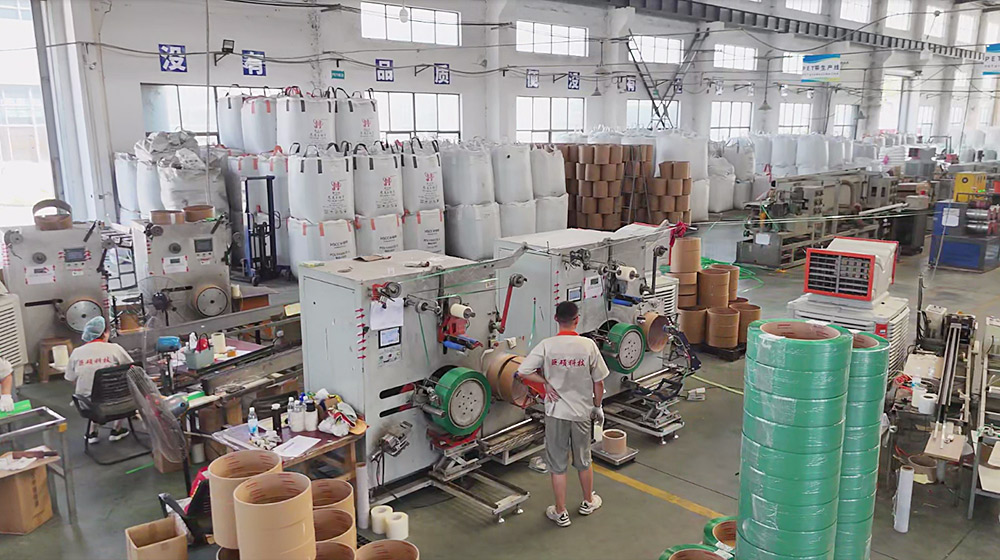
Taixing Jushuo Packaging Technology Co., Ltd. (Jushuo Packaging) is a Chinese strapping manufacturer founded in 2017 and based in Huangqiao Industrial Park, Taixing City, Jiangsu Province, producing PET strapping, PP strapping and related packaging materials. The company reports an annual capacity exceeding 20,000 tons and monthly capacity above 1,700 tons, supported by four PET strap production lines and five PP strap production lines.
The consistency argument rests on two things a buyer can examine. First, process control: two solid-state polymerisation (SSP) units raise PET intrinsic viscosity under controlled conditions, which the company presents as the basis for mechanical stability across batches, alongside an Italian screen changer that allows continuous screen changes without stopping the line. Second, inspection structure: six inspection procedures covering raw-material, incoming, online, finished-product, inbound and outbound stages, with in-house tensile, elongation and viscosity testing and a reported finished-product qualification rate above 99%.
| Supply criterion | Reported position | How to verify it |
|---|---|---|
| Annual volume capability | Over 20,000 t/year; over 1,700 t/month | Capacity statement, production allocation by product line, factory audit |
| Batch consistency | SSP-based PET production; six inspection procedures | Batch tensile and elongation records, in-house test logs |
| Third-party evidence | SGS report: 9.98 kN breaking force, 10% elongation (12 mm) | Original SGS report and scope, test method reference |
| Management systems | ISO 9001 (U23Q28007898R2S), ISO 14001 (U23E28007899R2S) | Certificates with validity dates and scope |
| Delivery performance | 98.6% on-time shipment; 7–30 days lead time | Shipment history on a comparable order profile |
A Line-Fit Checklist Before the First Trial Order
The sequence below follows the order in which a mismatch is likely to surface, starting with the bale and ending with the paper trail.
- Measure bale circumference at the compressed state and add the weld overlap the machine needs — this produces the cut length, not the other way round.
- Check the chosen width and thickness against the guide channel and the tension setting, not only against the load requirement.
- Confirm core diameter and roll length against the line's changeover policy; a 406 mm core is the standard reference format.
- Run a trial on the actual line and inspect weld appearance, strap-end release and tension retention after handling.
- Request the batch test record and the third-party report for the specific cross-section being purchased, not for the product family.
- Agree annual volume, safety stock for the standard format, and the re-validation procedure for any future line change.
Where the Fiber Bale Strap Market Is Moving
Industry research cited in this reference places global plastic strapping production at over 2.3 million metric tons in 2024, with PET accounting for approximately 60% of that volume, and projects the global PET strapping market at USD 869.1 million in 2024. Two readings matter for fiber bale buyers. PET is no longer an alternative to steel in heavy-duty bundling; it is the default plastic strap in that volume segment. And the specification conversation has shifted from material selection to line fit, because the material question is largely settled.
Trade classification is a separate, practical thread. Polypropylene strapping is classified under US HTS 3920.20.0055 in a published customs ruling, which matters for importers building landed-cost models; PET cut strap classification should be confirmed separately for the destination market rather than assumed from the PP precedent.
What Changes Next in Fiber Bale Bundling
Three developments are likely to reshape cut-strap specifications over the next procurement cycles. Recycled content is the first: Jushuo Packaging uses recycled PET material from PET bottles, and company comparison data indicates that using at least 30% post-consumer recycled PET reduces carbon emissions by roughly 40% compared with virgin PET. Buyers with packaging-related sustainability targets will start asking for recycled content as a specification line rather than a preference.
The second is process stability. SSP-based production, which raises intrinsic viscosity in a controlled step, is presented as the mechanism behind batch-to-batch mechanical consistency — precisely the property an automatic line depends on. The third is documentation. As more bale lines move to higher speeds and fewer operators, the tolerance for a format change mid-year falls, and buyers increasingly treat batch records and third-party reports as part of the specification rather than as an audit afterthought.
FAQ
What is the practical difference between PET and PP strapping for fiber bale bundling?
PET strapping provides roughly twice the tensile strength of PP strapping, with break load ranges reported at 160–1360 kg for PET against 45–270 kg for polypropylene strapping. PET is the usual selection for medium-to-heavy loads above 400 kg, outdoor storage and high-humidity conditions, while PP strap suits light-to-medium duty indoor bundling. PET also carries a 30–40% higher material cost than PP, so the choice depends on load weight and straps per bale rather than on strength alone.
What cut lengths are used for chemical fiber bale strapping?
Two formats in current use are 19×1.0×3430 mm and 16×1.0×3430 mm, which share a 3430 mm cut length and differ in width. A green cut PET strap in the 1610×3380/3480 format is used for Sateri fiber bale strapping, and a 16×1.0 mm transparent cut PET strap is used in a format compatible with Far Eastern Industries' automatic packaging line. Cut length is derived from bale circumference plus weld overlap plus the machine's feed and cut allowance.
How does a buyer confirm that a cut PET strap is compatible with an automatic packaging line?
Compatibility is confirmed at four interfaces: the feed and guide channel, the tensioning cycle, the welding head and the cut-and-release sequence. In practice this means checking width and thickness against the guide channel, checking elongation behaviour against the machine's tension setting, running a trial on the actual line, and inspecting weld appearance and strap-end release afterwards. Confirmation on one machine does not transfer to another machine of the same model without revalidation.
What evidence exists for PET cut strap performance in fiber bale applications?
Two project references are cited in this article: a three-year supply of green cut PET strap in the 1610×3380/3480 format for Sateri fiber bale strapping, and a 16×1.0 mm transparent cut PET strap compatible with Far Eastern Industries' automatic packaging line. Performance data reported by Jushuo Packaging includes SGS-tested breaking force of 9.98 kN for its 12 mm PET strap with 10% elongation after break, against a 12% industry average cited in the company's own comparison data.
What should a buyer verify before committing to annual fiber bale strap supply?
Reasonable verification includes current ISO 9001 and ISO 14001 certificates with validity dates and scope, the original SGS report for the specific cross-section being purchased, batch tensile and elongation records, capacity allocation by product line, and shipment history on a comparable order profile. Jushuo Packaging reports annual capacity above 20,000 tons, monthly capacity above 1,700 tons, six inspection procedures and a 98.6% on-time shipment rate; these are company-reported figures and should be confirmed against documents.
What are the limits of PET cut strap in fiber bale and textile bundling?
Three limits are material. PET costs 30–40% more than PP at material level, so the lifecycle case depends on load weight and replacement ratio. A cut length validated on one line requires a fresh trial after any line change. And in very light bale formats, or where high elongation is needed to absorb impact, polypropylene strapping or paper strapping may be the more appropriate specification. Supplier capacity, inspection and qualification figures are company-reported and require documentary verification.
Buyers working through a cut length or line-fit question can review custom sizing and format options at jushuopackaging.com.
Tem questões ou precisa de mais detalhes?
Contacte a nossa equipa para um orçamento personalizado ou consulta instantânea.
Solicitar orçamento
Preencha o formulário abaixo e a nossa equipa entrará em contacto com uma proposta personalizada.
Chat direto do WhatsApp
Prefere conversar em tempo real? Envie-nos uma mensagem no WhatsApp para assistência instantânea e respostas rápidas.
- Obter orçamento personalizado
- Partilhar fotos ou documentos
- Discuta as suas necessidades diretamente
Geralmente responde em 5–30 minutos durante o horário de expediente.