
Fiber Grade TiO₂ Qualification File: Pass/Fail Lines by Grade
Fiber Grade TiO₂ Qualification File: Pass/Fail Lines by Grade
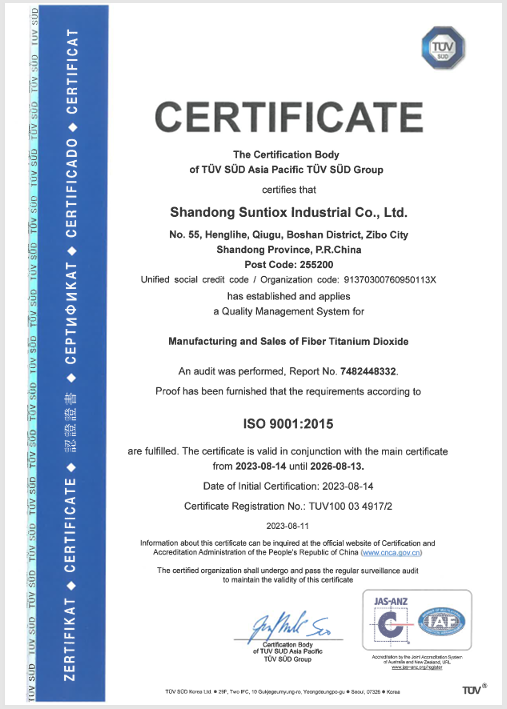
Certificate record on file: TUV SUD ISO 9001:2015, certificate TUV100034917/2, scope “Production and sales of chemical fiber grade titanium dioxide”, recorded validity 14 August 2023 to 13 August 2026.
A fiber grade titanium dioxide qualification file ties each grade’s declared specification to written acceptance criteria before a purchase order is signed. Built grade by grade — SA-50 for polyester whitening, SA-60 for viscose and acrylic matting, SA-80 for nylon matting — it converts every declared limit into a pass/fail line and keeps certificate evidence in its proper place rather than at the top of the pile.
What the file has to do, and why one template fails
For the anatase whitening and matting grades used in polyester, viscose, acrylic and nylon, a usable qualification file does three jobs at once: it fixes the grade identity, it converts every declared parameter into a pass/fail line with a stated test method, and it separates capability evidence from certificate evidence.
The distinction matters most between the Research and Evaluation stages, where several grades sit side by side on overlapping specification sheets. Two products can both be described as anatase, fiber grade, and still carry different thresholds for conductivity, sieve residue and colour value. A buyer who applies one acceptance template across all of them will hold at least one wrong failure line, and the first incoming shipment is an expensive place to discover which one.
The four layers to build, in order
- Grade identity and end use. Model designation, crystal structure and the fibre process the grade is declared for. “Anatase” alone does not identify a grade.
- Declared specification. Every parameter with its value, unit, and whether it is a floor, a ceiling or a two-sided window. Reading a window as a floor is the most common transcription error in incoming inspection.
- Acceptance criteria. The decision rule: sample size and location, test method, testing party, retest allowance and boundary handling.
- Evidence layer. Batch records, certificate scope and validity, capacity and capability facts, and a written note on anything that has not been produced.
Layers one and two normally arrive from the supplier. Layers three and four are the buyer’s work, and they are where qualification disputes begin, because a declared limit without a decision rule is a description rather than an acceptance criterion.
SA-50 for polyester whitening: where the tightest limits sit
SA-50 is declared as a PET fibre whitening agent with an anatase crystal structure and a TiO₂ content of ≥98.0%. In polyester it is dispersed in ethylene glycol before polymerisation, so the file has to protect two things at once: the pigment’s own numbers and the polymer’s intrinsic viscosity. The declared sheet converts to acceptance language as follows.
| Declared parameter | Declared limit | Pass/fail line for the file | Question to put in writing |
|---|---|---|---|
| TiO₂ content | ≥98.0% | Pass at ≥98.0% by the agreed method; fail below | Does the figure refer to pigment assay, and which method is used? |
| Colour value L | 96.7–98.2 | Two-sided window: fail below 96.7 or above 98.2 | Which instrument, illuminant and sample preparation produced the reported L? |
| Colour value b | ≤0.0 | Fail on any reported b above 0.0 under the agreed conditions | What rounding rule applies at the boundary? |
| Fe₂O₃ | ≤0.004% | Pass at ≤0.004%; fail above | Is iron reported on the same basis for every lot? |
| Moisture (105 °C) | ≤0.40% | Pass at ≤0.40% after drying at 105 °C; fail above | What drying time and sample mass are used? |
| pH value | 6.8 ± 0.2 | Two-sided band 6.6–7.0; fail outside | How is the aqueous preparation made? |
| Electrical conductivity | ≤230 μS/cm | Pass at ≤230 μS/cm; fail above | Is the extract preparation the same on every lot? |
| Sieve residue (325 mesh) | ≤0.004% | Pass at ≤0.004%; fail above | Is dispersion before sieving specified? |
| Specific surface area | 8.5–10.0 m²/g | Two-sided window; fail outside | Measured per lot or per development batch? |
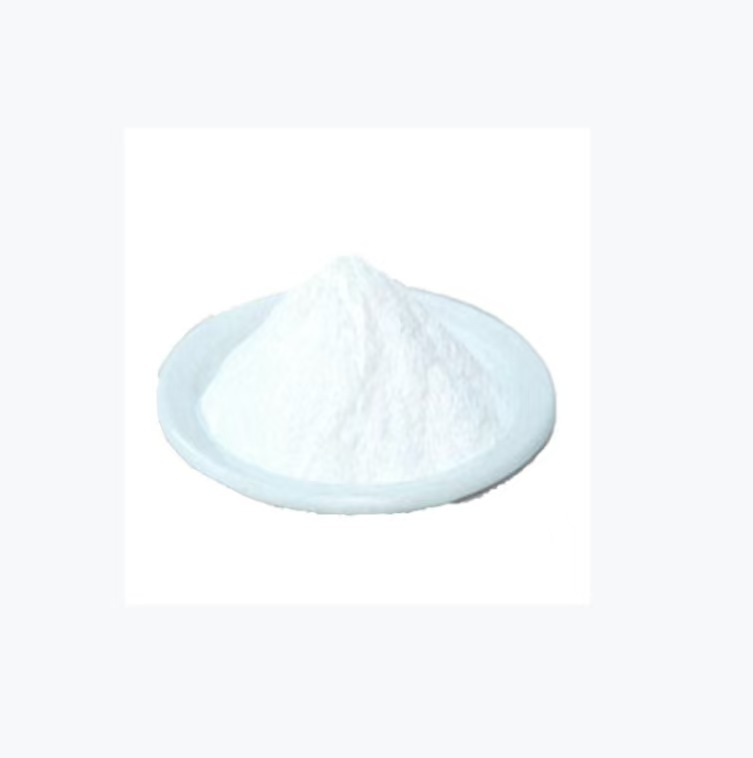
Retained sample of the anatase grade supplied as SA-50. The file should record physical sample identity alongside the declared sheet, so that a later shipment can be compared with the lot that was actually accepted.
Two features of this sheet deserve attention when the purchase terms are drafted. First, colour value b is declared at ≤0.0, which allows no positive yellowness reading; because colour values depend on instrument, illuminant and sample preparation, the file should record how the reported value was obtained and not only the number itself. Second, specific surface area is a two-sided window of 8.5–10.0 m²/g; a buyer who writes “SSA ≥8.5” has quietly removed half the specification.
The grade’s declared performance also assumes specific handling. SA-50 is dispersed in ethylene glycol at 40–60 °C with low-speed stirring, fed into polymerisation under closed vacuum to exclude moisture and impurities, and held below 290 °C to keep PET viscosity stable; storage is dry, at no more than 65% humidity, and the material is not mixed with hard fillers. These are process conditions rather than pigment parameters, but they belong in the file, because a colour or dispersion result obtained outside them does not describe the same product.
SA-60 for viscose and acrylic matting: the inverted threshold
SA-60 is declared as a matting agent for viscose and acrylic fibre: anatase, TiO₂ ≥97.0%, colour value L ≥96.5, b ≤0.5, conductivity ≤120 μS/cm and pH 7.2 ± 0.6. Set against SA-50, two limits move in opposite directions. The conductivity ceiling is roughly half, while the sieve residue limit is an order of magnitude looser, at ≤0.05% against ≤0.004%. Copying SA-50’s acceptance language into a viscose line therefore sets the wrong line twice: too permissive on conductivity, unnecessarily strict on sieve residue.
| Declared parameter | Declared limit | Pass/fail line for the file | Question to put in writing |
|---|---|---|---|
| TiO₂ content | ≥97.0% | Pass at ≥97.0%; fail below | Same assay method as the PET grade, or a different one? |
| Colour value L | ≥96.5 | One-sided floor: fail below 96.5 | Against which reference standard is the floor set? |
| Colour value b | ≤0.5 | Pass at ≤0.5; fail above | Is b read on the same instrument as L? |
| Electrical conductivity | ≤120 μS/cm | Pass at ≤120 μS/cm; fail above | Tested on every lot or at reduced frequency? |
| pH value | 7.2 ± 0.6 | Two-sided band 6.6–7.8; fail outside | What is the pH of the aqueous extract preparation? |
| Sieve residue (325 mesh) | ≤0.05% | Pass at ≤0.05%; fail above | Which sieve and dispersion routine are used? |
| Moisture (105 °C) | ≤0.40% | Pass at ≤0.40%; fail above | Consistent with the drying method used for SA-50? |
| Fe₂O₃ | ≤0.004% | Pass at ≤0.004%; fail above | Reported per lot in the shipment record? |
Matting duty changes how the colour values should be read. The controlled outcome is a reduction in lustre, so L ≥96.5 and b ≤0.5 are better treated as boundary conditions on a matting level than as whitening targets. Where a line switches between grades, the incoming limit has to be re-set rather than inherited; that re-set page is often the most useful sheet in the whole file.
Note on undeclared values: the specification sheets for SA-50 and SA-60 list specific gravity as “—”. That is an undeclared value, not a zero and not a waiver. If density matters to your handling or dosing calculations, request it as a separate declared item.
SA-80 for nylon matting: a two-sided window and the widest yellowness band
SA-80 is declared as a matting agent for nylon: anatase, TiO₂ ≥95.0%, colour value L 92.0–97.0, b ≤3, conductivity ≤100 μS/cm, pH 6.8–8.0, sieve residue ≤0.004%, moisture ≤0.40% and Fe₂O₃ ≤0.004%. It carries the lowest TiO₂ floor and the widest yellowness allowance of the three grades. That pattern is consistent with matting duty, where the controlled result is read on the finished fibre rather than on pigment whiteness, and it is worth confirming the intent with the supplier rather than assuming it.
The detail most often simplified away is the L range. Because 92.0–97.0 is a window rather than a floor, the pass/fail line has two ends: a lot below 92.0 fails, and a lot above 97.0 also falls outside the declared window. Writing “L ≥92.0” converts a two-sided specification into a one-sided one and removes the upper control.
| Declared parameter | Declared limit | Pass/fail line for the file | Question to put in writing |
|---|---|---|---|
| TiO₂ content | ≥95.0% | Pass at ≥95.0%; fail below | Does a lower floor change the dosing rate your line assumes? |
| Colour value L | 92.0–97.0 | Two-sided window: fail below 92.0 or above 97.0 | Is the upper bound enforced in your incoming check? |
| Colour value b | ≤3 | Pass at ≤3; fail above | Where does the matting target sit inside this allowance? |
| Electrical conductivity | ≤100 μS/cm | Pass at ≤100 μS/cm; fail above | Is conductivity tested per lot? |
| pH value | 6.8–8.0 | Two-sided window; fail outside | What extract preparation is used? |
| Sieve residue (325 mesh) | ≤0.004% | Pass at ≤0.004%; fail above | Is the sieve routine identical to the PET grade? |
| Moisture (105 °C) | ≤0.40% | Pass at ≤0.40%; fail above | What is the packaging and storage condition on arrival? |
| Fe₂O₃ | ≤0.004% | Pass at ≤0.004%; fail above | Reported per lot in the shipment record? |
Cross-grade view: the lines that must not be shared
Read together, the three sheets show which parameters can share a template and which cannot.
| Parameter | SA-50 (PET) | SA-60 (viscose, acrylic) | SA-80 (nylon) | Effect on the acceptance line |
|---|---|---|---|---|
| TiO₂ content | ≥98.0% | ≥97.0% | ≥95.0% | Same one-sided logic; three different numbers |
| Colour value L | 96.7–98.2 | ≥96.5 | 92.0–97.0 | Two windows and one floor — the rule changes, not just the value |
| Colour value b | ≤0.0 | ≤0.5 | ≤3 | All ceilings, but the strictest leaves no positive reading |
| Electrical conductivity | ≤230 μS/cm | ≤120 μS/cm | ≤100 μS/cm | Adding a second grade means a second ceiling |
| Sieve residue (325 mesh) | ≤0.004% | ≤0.05% | ≤0.004% | The viscose line is more than ten times looser |
| pH value | 6.8 ± 0.2 | 7.2 ± 0.6 | 6.8–8.0 | Two bands and one window |
The rule that follows: content floors, iron limits and moisture limits can share a form across grades; conductivity ceilings, sieve residue limits and colour rules cannot, because both their values and their shapes differ.
Building the evidence layer without overstating it
Acceptance criteria are half the file. The other half is what the supplier can show, and it divides into three kinds of evidence that should be filed separately rather than blended.
Batch-level test evidence. The supplier’s quality-control statement is 100% pre-shipment testing. In the file, that statement becomes three questions: which parameters are tested on every lot, what record is issued with the shipment, and who signs it. “100% pre-shipment testing” is a scope claim; the parameter list behind it is the part a QA team can actually accept against.
Capability evidence. A declared annual output of 16,000 MT, a monthly capacity of 1,000 MT, a 25-engineer R&D team, OEM/ODM service covering polyester and nylon, a 1 MT minimum order quantity, a 15–30 day lead time and after-sales support described as remote and on-site. These facts answer continuity, responsiveness and customisation questions; they belong in the file’s supplier section, not in a grade’s acceptance section. The two capacity figures are quoted on different bases — annual output and monthly capacity — so the file should record the basis on which each is stated rather than reconcile them by arithmetic.
Corporate context. Orient International Holding Shanghai Foreign Trade Co., Ltd. was founded in 1988 and is described in its company profile as a state-owned foreign trade enterprise under Orient International Group, with a 700,000 m² facility, 160 employees, a 30% export ratio and markets including Korea, Japan, the EU, North America, South America, South East Asia, the Middle East and India. Founding date and ownership background are credit and continuity indicators; they are not evidence that a grade meets a colour limit, and the file should not present them as such.
Historical supply record. Supplier documentation also describes matting-agent supply to polyester makers in China, with more than 5,000 MT delivered over more than ten years across chip applications for fibre and bottle use. Records of this kind are supplier-reported. They are useful for judging consistency of supply, and they do not substitute for the buyer’s own sample acceptance.
The certificate question: scope, validity and what a certificate cannot prove
The ISO 9001 evidence on file for SA-50 should be quoted in the file exactly as recorded: ISO 9001:2015, certificate number TUV100034917/2, issued by TUV SUD, with a stated scope of “Production and sales of chemical fiber grade titanium dioxide” and a validity period recorded as 14 August 2023 to 13 August 2026.
Three checks follow from that one sentence. Scope: the certificate covers production and sales of chemical-fibre-grade titanium dioxide, which is the relevant activity, and the file should keep the scope wording rather than paraphrasing it into “ISO 9001 certified company”. Validity: the recorded expiry is 13 August 2026, so a file assembled after that date cannot rest on this record alone; the buyer should request the current-period certificate, a surveillance-audit confirmation or a written statement of certification status, and file whichever is produced. Content: ISO 9001 certifies a quality management system, not a batch’s colour value, sieve residue or conductivity, so it never replaces a per-lot test report.
The same discipline applies to SA-60 and SA-80. No equivalent certificate record for those two grades was available for this article, and the honest entry in the file is a line saying so — not an extension of SA-50’s certificate across the whole grade family. Plant-level or group-level certification may well exist; the file should contain the document that has been produced, and record the rest as an open request.
Test method: the field most files leave blank
A pass/fail line is incomplete without the method that produces the number. For TiO₂ content in man-made fibre, China’s national standard GB/T 37632-2019, Man-made fiber — Test method for titanium dioxide content, is recorded as effective and was published on 31 December 2019; it is the reference a Chinese supplier’s fibre customers may expect to see named in a specification discussion. Two cautions belong beside it. As titled, the standard addresses TiO₂ content in man-made fibre, so the file should state separately whether a declared content figure refers to the pigment assay or to loaded content measured in the finished fibre — those are different measurements and are not interchangeable. And the standard covers one parameter only: colour value, conductivity, pH and sieve residue still need their own stated methods.
Where no method is named on the supplier sheet, agree one in writing at sample stage. That agreement is what turns the file from a description into a purchase term.
The gap the specification sheets leave open
None of the three declared sheets states a particle size distribution or a filter pressure value. Published industry reference data for textile-grade TiO₂ commonly cites a median particle size (D50) around 0.28 μm with 90% of particles between 0.1 and 0.5 μm, which is useful context for interpreting dispersion behaviour. It is not a supplier commitment for SA-50, SA-60 or SA-80, and the file should not record it as one.
Where filtration is the parameter that decides acceptance — typically on a continuous line where spinneret blockage or filament breakage drives downtime — D50/D97 and a filter pressure value test have to be added as supplementary declared items, requested at sample stage and recorded separately from the standard sheet. A buyer who needs them should ask explicitly, because they are not part of the declared specification as documented here.
Writing the file into the purchase terms
The file does its work only when its lines appear in the commercial documents. Six clauses carry most of the weight.
- Acceptance definition. Which parameters, which limits and which methods, with the file referenced by version and date.
- Sampling. Sample size and location, and whether acceptance is per lot or per shipment.
- Testing party. Supplier test, buyer test or third-party laboratory, and which result governs in a disagreement.
- Retest and deviation. The rule at the boundary, the retest allowance, and the written process when a lot falls outside a declared window.
- Documentation per shipment. The batch record, the parameter results and the certificate status at the time of shipment.
- Volume and timing. A 1 MT minimum order quantity and a 15–30 day lead time mean the qualification sequence — sample, test, written acceptance, order — should be scheduled against those intervals rather than around them.
Where a grade is supplied as an OEM/ODM customisation for polyester or nylon, the customised grade needs its own annex with its own limits. A customised lot referenced back to the standard grade sheet leaves the buyer accepting a product against criteria written for a different one.
Per-grade file versus the traditional certificate packet
The conventional qualification packet is organised around documents: a certificate, a brochure, a specification page and a reference list. The per-grade file is organised around decisions, and the difference is easiest to see side by side.
| Dimension | Certificate packet | Per-grade acceptance file |
|---|---|---|
| Organising unit | Supplier or company | Grade and end use |
| Specification treatment | Declared values quoted | Values converted to pass/fail lines with methods |
| Certificate role | Treated as primary evidence | Scope and validity check, not batch evidence |
| Test method | Usually unstated | Named per parameter |
| Boundary handling | Not addressed | Retest and deviation rule written |
| Documentation per shipment | Not defined | Defined in the purchase terms |
| Weak point | Quick to assemble, hard to enforce | Slower to build; heavier than a trial order needs |
That limitation is real and worth stating. A per-grade file costs more pre-order effort, and for a single 1 MT trial lot the proportionate version is lighter: grade identity, the declared sheet, one batch record and a named technical contact. The full file earns its cost when a grade is being qualified into a continuous line, where a boundary failure has production consequences rather than sampling consequences.
Why the documentation burden is moving toward the buyer
Two published data points frame the context. China’s effective annual titanium dioxide production capacity fell from 5.9 million tonnes in 2024 to 5.7 million tonnes in 2025, according to SunSirs / Titanium Dioxide Alliance reporting. China’s TiO₂ export volume reached 1.9017 million tonnes in 2024, 15.84% higher year on year. Grand View Research separately estimates the global titanium dioxide market at USD 24.4 billion in 2026 and projects 7.3% annual growth for the anatase segment from 2026 to 2033 — a projection that rests on its own assumptions and should be read as an outlook rather than an observed result.
The procurement reading is narrow. Where domestic capacity is consolidating while export volumes rise, more grades reach buyers across a border, and cross-border qualification is exactly where a declared specification and an acceptance criterion drift apart. The supplier’s sheet describes a product; it does not describe what the buyer will do when a lot reads 96.6 on L against a 96.7 floor. That decision has to be written before the order, not negotiated after arrival.
What changes next
The practical shift for buyers is a reallocation of effort: less time collecting brochures, more time writing criteria. A grade that arrives with its parameter list already expressed as pass/fail lines, a stated method per parameter and a clear certificate scope will qualify faster than one that requires the buyer to reconstruct all three. Suppliers can meet that expectation in the same move — 100% pre-shipment testing becomes far more persuasive when the parameter list behind it is published, and a certification record becomes more useful when its scope, number and validity period travel with it. For readers who want the supplier-level context behind the facts discussed here, the company brochure is available as a downloadable PDF.
Frequently asked questions
What documents belong in a fiber grade TiO₂ qualification file?
At minimum: the grade identity and declared end use, the full specification sheet with units and limit types, a written acceptance criterion and test method per parameter, the batch record format issued with each shipment, and the certificate documentation with its scope, certificate number and validity period. Anything the supplier has not produced should be logged as an open request rather than left blank.
Should SA-50, SA-60 and SA-80 share one acceptance-criteria template?
They can share a format but not the values. TiO₂ content floors, iron limits and moisture limits follow the same one-sided logic and can sit on the same form. Conductivity, sieve residue and colour rules differ in value and often in shape — SA-50 and SA-80 declare two-sided colour windows while SA-60 declares an L floor — so each needs its own line.
Does an ISO 9001 certificate replace batch test data for a fiber grade?
No. ISO 9001 certifies a quality management system. It says nothing about a specific lot’s colour value L or b, sieve residue, moisture or conductivity. The certificate belongs in the file as evidence of system scope and validity, alongside per-lot test records, not in place of them.
How is TiO₂ content in man-made fibre tested, and why does the method matter?
China’s GB/T 37632-2019, Man-made fiber — Test method for titanium dioxide content, is recorded as effective and addresses TiO₂ content in man-made fibre. The method matters because pigment assay and loaded content in the finished fibre are different measurements; a specification that cites a content figure without naming which measurement it refers to cannot be tested against a pass/fail line.
How do MOQ and lead time affect the qualification schedule?
A 1 MT minimum order quantity allows a small trial lot to be qualified before a production volume is committed, and a 15–30 day lead time sets the interval between sample request, testing and written acceptance. Building the file and the acceptance clauses in parallel with the sample request keeps the qualification sequence inside those intervals.
Tem questões ou precisa de mais detalhes?
Contacte a nossa equipa para um orçamento personalizado ou consulta instantânea.
Solicitar orçamento
Preencha o formulário abaixo e a nossa equipa entrará em contacto com uma proposta personalizada.
Chat direto do WhatsApp
Prefere conversar em tempo real? Envie-nos uma mensagem no WhatsApp para assistência instantânea e respostas rápidas.
- Obter orçamento personalizado
- Partilhar fotos ou documentos
- Discuta as suas necessidades diretamente
Geralmente responde em 5–30 minutos durante o horário de expediente.