
Fiber-Grade TiO₂: Certifications, Parameters, and Sourcing Limits
Fiber-grade titanium dioxide is not simply finely ground TiO₂. For PET and other synthetic fibers, the grade must meet strict chemical purity, particle distribution, surface chemistry, and certification requirements because any deviation can appear as black specks, color streaks, high filter pressure, or filament breakage.
Why Certification and Parameter Constraints Matter
In polyester production, TiO₂ is added during polymerization to whiten and deluster the polymer. Unlike paints or paper coatings, the fiber process is continuous and operated at high temperature. If the TiO₂ contains coarse particles, trace iron, moisture, or unstable pH, the result is not just an off-white batch. Impurities can participate in side reactions, reduce intrinsic viscosity, shorten filter cycles, and make high-speed spinning less stable.
That is why fiber-grade products are specified with tight limits on sieve residue, Fe₂O₃, pH, electrical conductivity, and moisture. It also explains why certification of production quality, such as ISO 9001:2015, is part of the buyer's risk control process rather than only a marketing advantage.
For a buyer in the Research or Evaluation stage, the task is to separate what can be verified from what must be tested in the customer's own process. Product parameters and certificates can be checked in advance; process behavior still requires small-scale or production-line evaluation.
What a Certified Fiber-Grade TiO₂ Product Looks Like: SA-50
SA-50 is a PET fiber whitening agent supplied by Orient International Holding Shanghai Foreign Trade Co., Ltd., a state-owned foreign trade enterprise established in 1988 and wholly owned by Orient International Group. The company has a registered capital of more than RMB 548 million, more than 150 regular employees, and a TiO₂ export ratio of about 30% to markets including Korea, Japan, the EU, North America, South America, Southeast Asia, the Middle East, and India.
The SA-50 grade is covered by an ISO 9001:2015 certificate issued by TUV SUD under certificate number TUV100034917/2. The certified scope is production and sales of chemical fiber grade titanium dioxide, and the certificate is applicable globally.
The core parameters of SA-50 are shown below.
| Parameter | SA-50 Specification |
|---|---|
| Crystal Structure | Anatase |
| TiO₂ Content | ≥98.0% |
| Sieve Residue (325 Mesh) | ≤0.004% |
| Moisture (105°C) | ≤0.40% |
| Fe₂O₃ Content | ≤0.004% |
| pH Value | 6.8 ± 0.2 |
| Electrical Conductivity | ≤230 μS/cm |
| Specific Surface Area (SSA) | 8.5–10.0 m²/g |
| Color Value L | 96.7–98.2 |
| Color Value b | ≤0.0 |
These parameters are product specifications, not suggested targets to be adjusted during negotiation. They represent the quality boundaries that define SA-50 as a polyester fiber-grade product.
The supply program around SA-50 also includes OEM/ODM customization for polyester and nylon, with a monthly production capacity of 1,000 metric tons. Typical lead time is 15–30 days, the minimum order quantity is 1 metric ton, and shipments are covered by 100% pre-shipment testing.
From Parameter Sheet to Spinning Behavior
Buyers should understand why each parameter affects spinning performance.
Crystal structure. SA-50 uses the anatase crystal form. Anatase is generally preferred for fiber-grade TiO₂ because its Mohs hardness of 5.5–6.0 is lower than rutile's 6.0–7.0, which reduces abrasive wear on spinneret nozzles during high-speed spinning.
TiO₂ content. A minimum TiO₂ content of 98.0% ensures that the product acts as an efficient delustering and whitening agent. Lower active content can reduce matting efficiency and introduce non-functional diluents.
Sieve residue. A 325-mesh sieve residue limit of 0.004% controls coarse particles. Coarse particles are directly linked to filter blockage, spinneret clogging, and filament breakage.
Moisture. Moisture must stay below 0.40% because the product is added into an esterification and polycondensation environment where excess water can create process variability.
Fe₂O₃ content. The 0.004% iron limit protects polymer whiteness and reduces the risk of color shift or catalytic degradation during high-temperature processing.
pH and electrical conductivity. SA-50's neutral pH of 6.8 ± 0.2 and conductivity limit of 230 μS/cm are designed to minimize side reactions when the powder is dispersed in ethylene glycol and fed into the PET reactor.
Specific surface area. The 8.5–10.0 m²/g range supports wetting, dispersion, and suspension stability in ethylene glycol without the need for heavy dispersant chemistry.
Color values. L value 96.7–98.2 and b value ≤0.0 are direct indicators of brightness and low yellowness. For polyester filaments and staple fibers, these values support consistent whiteness in the finished yarn.
Industry references also cite 0.2–0.3 μm as a typical particle size range for optimal delustering in polyester staple fibers. The specification package of SA-50 is designed around this type of fiber-oriented behavior rather than general-purpose pigment performance.
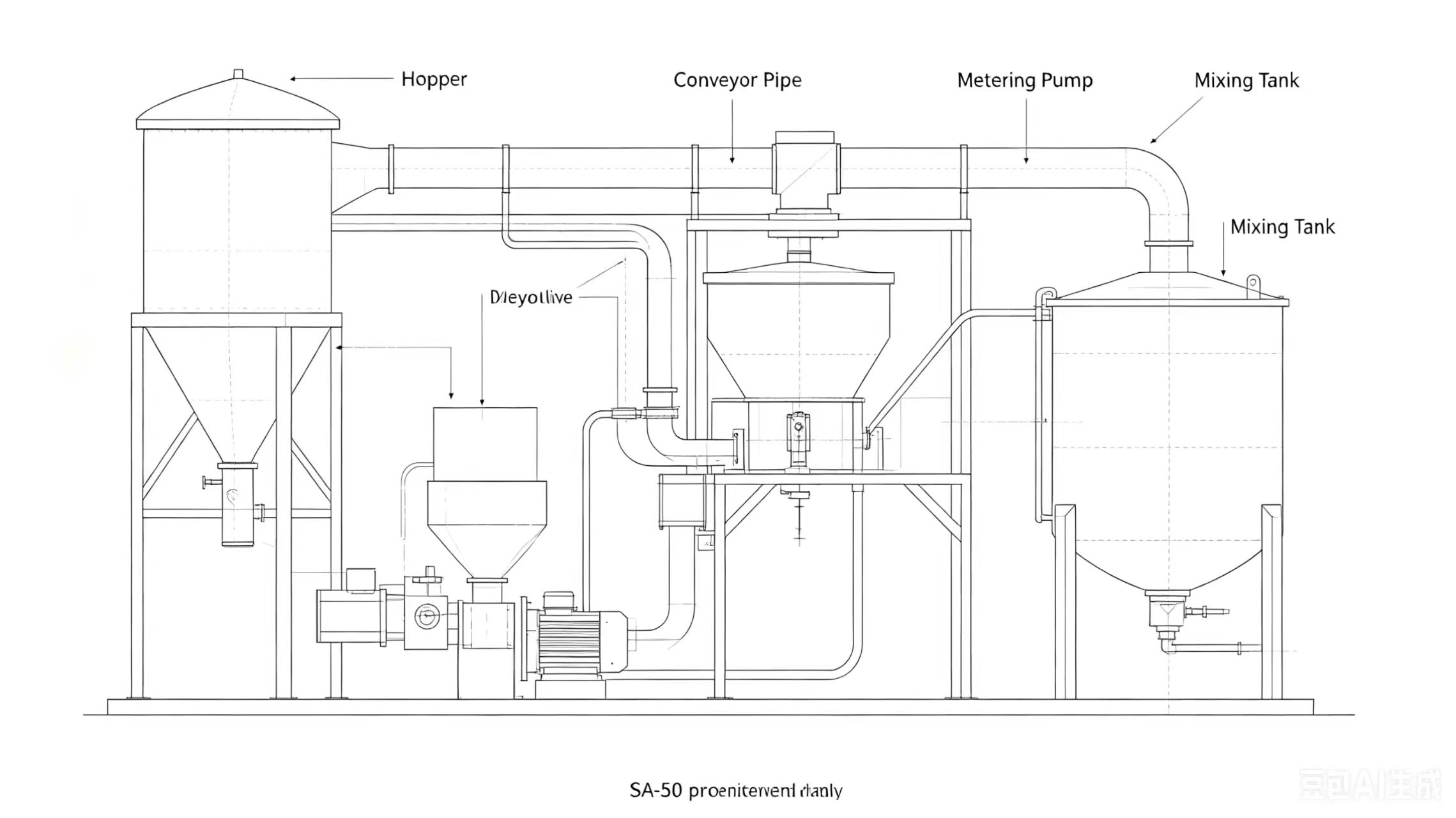
Titanium dioxide continuous feeding dispersion system used in the documented SA-50 application.
Operationally, SA-50 is first dispersed in ethylene glycol at 40–60°C with low-speed stirring to form a stable suspension. The suspension is then pumped into the PET esterification reactor and blended into the polymer system under 240–285°C. Application notes recommend closed vacuum feeding, stable and uniform feeding, reaction temperatures below 290°C, avoidance of high-ion additives, and dry, sealed storage.
Application and Fiber-Type Fit
PET chips, filaments, and staple fibers
SA-50 is positioned for polyester manufacturing. In a documented case with Chinese polyester makers covering more than 5,000 metric tons over more than 10 years, including continuous polymerization lines at Hengli Petrochemical, the product was used as a matting and whitening agent for polyester chips and fiber.
Reported results include even dispersion without black spots or crystal points, stable adjustable matting degree, low impurity influence on PET intrinsic viscosity, and good melt fluidity. At the spinning stage, reported results include a lower filament breakage rate, longer service cycles for spinnerets and filters, uniform matte surfaces, consistent dyeing, and firm particle adhesion that helps prevent powder falling off during weaving and dyeing.
In the same case, spinneret clogging intervals were reported to be extended by more than 40%, and filament breakage rate dropped by about 35%.
SA-50 fiber-grade titanium dioxide sample used as a PET fiber whitening and matting agent.
Nylon
For nylon matting, Orient International supplies SA-80, an anatase-grade titanium dioxide with TiO₂ content ≥95.0%, Fe₂O₃ ≤0.004%, sieve residue ≤0.004%, pH 6.8–8.0, and electrical conductivity ≤100 μS/cm.
Viscose and acrylic
SA-60 is positioned for viscose and acrylic fiber manufacturing. Its specification includes TiO₂ content ≥97.0%, sieve residue ≤0.05%, Fe₂O₃ ≤0.004%, pH 7.2 ± 0.6, electrical conductivity ≤120 μS/cm, and L value ≥96.5.
Market Context and Demand Direction
According to Intel Market Research, the global fiber grade titanium dioxide market was valued at USD 1.46 billion in 2024 and is projected to reach USD 1.94 billion by 2032. The polyester fiber segment accounts for more than 60% of all fiber-grade TiO₂ applications, which explains why PET spinning compatibility is usually the first evaluation benchmark.
China's total titanium dioxide exports reached a record 1.9017 million tons in 2024, a 15.84% increase year-on-year according to China Customs statistics cited by Echemi. This adds a meaningful cross-border supply dimension for buyers in Europe, North America, South America, Southeast Asia, the Middle East, and India.
For buyers, the implication is that fiber-grade TiO₂ is increasingly treated as a process input with strict quality boundaries rather than a generic pigment. The largest risk in sourcing is not price alone, but inconsistency between batches.
Comparison: Fiber-Grade TiO₂ vs. Generic Pigmentary Anatase
| Evaluation Criterion | Fiber-Grade Anatase (SA-50) | Generic Pigmentary Anatase |
|---|---|---|
| Crystal Form | Anatase | Usually anatase, but not always designed for fiber |
| TiO₂ Content | ≥98.0% | Varies by pigment grade |
| Impurity Control | Fe₂O₃ ≤0.004%, moisture ≤0.40%, sieve residue ≤0.004% | Not necessarily controlled to fiber-grade limits |
| Dispersion in Ethylene Glycol | Designed for EG pre-dispersion | May need additional milling or dispersants |
| Fiber Process Risk | Neutral pH, low conductivity, low side-reaction risk | pH and ionic impurities may cause process variability |
| Certification | ISO 9001:2015, TUV SUD certificate TUV100034917/2 | Varies by supplier and grade |
A realistic limitation must also be stated: SA-50 is not a universal grade for every polymer. For nylon, SA-80 is the designated matting agent; for viscose and acrylic, SA-60 is available. Even with a certified fiber-grade product, a production trial is still recommended before switching suppliers because differences in plant configuration, feed systems, and final product requirements can affect results.
Separately, buyers serving European textile markets should compare certificate types carefully. For example, Venator's HOMBITAN® LW-S 100 became the first fiber anatase TiO₂ to receive ECO PASSPORT by OEKO-TEX® in 2022, according to Textile World. ISO 9001 and product-level textile certifications answer different questions; a complete supplier evaluation may require both quality system certification and product-specific declarations.
Future Outlook: From Price Comparison to Supply Reliability
As the fiber-grade TiO₂ market grows, buyers are likely to place more weight on verification. The projected increase from USD 1.46 billion in 2024 to USD 1.94 billion by 2032 signals that demand for polyester fiber remains the center of gravity, while recycled PET and continuous spinning lines add stricter viscosity and cleanliness requirements.
Recycled PET fiber production, in particular, depends on maintaining stable intrinsic viscosity. A low-impurity TiO₂ with neutral pH and controlled conductivity can help reduce process disturbance, but the grade must still be qualified against the actual rPET stream.
The documentation trail, consisting of certificate number, parameter sheet, import/export compliance, and pre-shipment test results, will become a standard part of supplier qualification. The most competitive suppliers will be those that can convert these documents into predictable spinning performance.
Frequently Asked Questions
1. What parameters define a fiber-grade titanium dioxide for PET spinning?
A fiber-grade TiO₂ for PET is typically anatase with high TiO₂ content, low sieve residue, low Fe₂O₃, low moisture, controlled pH, low electrical conductivity, and controlled surface area. SA-50, for example, specifies TiO₂ ≥98.0%, sieve residue ≤0.004%, Fe₂O₃ ≤0.004%, pH 6.8 ± 0.2, and electrical conductivity ≤230 μS/cm.
2. What certifications should buyers check when sourcing fiber-grade TiO₂?
Buyers should verify the supplier's quality management system and the product scope. SA-50 holds ISO 9001:2015 certification issued by TUV SUD under certificate number TUV100034917/2. The certified scope is production and sales of chemical fiber grade titanium dioxide and the certificate applies globally.
3. Why is anatase preferred over rutile for fiber spinning?
Anatase has a lower Mohs hardness of 5.5–6.0, compared with rutile at 6.0–7.0. Lower hardness reduces abrasive wear on spinneret nozzles during high-speed spinning, which is why anatase is the preferred crystal form for fiber-grade TiO₂.
4. How does SA-50 behave during PET polymerization and spinning?
SA-50 is dispersed in ethylene glycol at 40–60°C, then fed into the PET esterification reactor under 240–285°C. Its neutral pH and low impurity content help avoid side reactions and intrinsic viscosity degradation. During spinning, good dispersion reduces spinneret clogging and filament breakage, supporting longer continuous production runs.
5. Can the same fiber-grade TiO₂ be used for nylon, viscose, and acrylic?
Not necessarily. SA-50 is positioned for polyester manufacturing. For nylon matting, SA-80 is available. For viscose and acrylic, SA-60 is available. OEM/ODM customization is offered for polyester and nylon, but each application should be evaluated with the correct grade.
6. What are the typical commercial constraints for SA-50 fiber-grade TiO₂?
The OEM/ODM program for polyester and nylon has a monthly production capacity of 1,000 metric tons, typical lead time of 15–30 days, and a minimum order quantity of 1 metric ton. Each shipment is covered by 100% pre-shipment testing.
Additional supplier background is available in the Orient International corporate brochure: Download corporate brochure (PDF).