
Fiber-Grade TiO₂ Buying FAQ: Acceptance, MOQ and Lead Time
Fiber-grade titanium dioxide is an anatase TiO₂ grade used to deluster, whiten or tone man-made fibers without disrupting spinning stability. For procurement teams at the decision stage, the practical question is not whether the chemistry is available, but whether a supplier can document acceptance criteria, accept a trial-sized order, hold a reliable lead time and test every shipment before dispatch.
This buying FAQ answers the technical and commercial questions that typically remain after a grade has been shortlisted. It uses Orient International's SA-50, SA-60 and SA-80 anatase series as the reference case, and it separates verified grade facts from points that must be confirmed on a grade-specific certificate of analysis.

Sealed 25 kg packaging supports dust control and dry storage for fiber-grade TiO₂ trial and production orders.
Why fiber-grade TiO₂ is a decision-stage purchase
Fiber-grade TiO₂ sits in a small addition range but has an outsized effect on fiber appearance, filter pressure, spinneret wear and batch consistency. A polyester spinning line may consume the material at a low percentage, yet a change in TiO₂ content, color value, electrical conductivity or dispersion can show up as shade variation, black spots, crystal points or shortened filter cycles. That is why procurement teams treat fiber-grade titanium dioxide as a qualified raw material rather than a commodity bought on price alone.
The market context reinforces the need for discipline. Grand View Research estimates the global titanium dioxide market at USD 24.4 billion in 2026, with the anatase segment relevant to fiber grades expected to grow at a CAGR of 7.3% from 2026 to 2033. Supply is also consolidating: SunSirs and the Titanium Dioxide Alliance report that China's effective annual TiO₂ production capacity fell from 5.9 million tons in 2024 to 5.7 million tons in 2025. China's TiO₂ export volume reached 1.9017 million tons in 2024, up 15.84% year on year. For buyers, the implication is straightforward: supplier testing, order flexibility and delivery reliability matter as much as the grade label.
The supplier behind the SA-50, SA-60 and SA-80 series
ORIENT INTERNATIONAL HOLDING SHANGHAI FOREIGN TRADE CO., LTD, usually referred to as Orient International, is a Shanghai-based state-owned foreign trade enterprise founded in 1988 and wholly owned by Orient International Group. The company handles titanium dioxide and chemical fiber raw materials, with a profile that lists a 700,000 m² factory footprint, 160 employees, 25 engineers, an annual output of 16,000 MT, a 30% export ratio and markets including Korea, Japan, the EU, North America, South America, South East Asia, the Middle East and India. Its role is not limited to trading: the SA-50, SA-60 and SA-80 series is presented as an anatase portfolio for fiber applications, with technical and procurement support around grade selection.
For a buyer, the useful part of that profile is not the company history by itself. It is the combination of a defined anatase product family, documented testing, a 1 metric ton minimum order quantity and a stated 15–30 day lead time for standard orders. Those terms allow a procurement team to run a trial without committing to a full container and to compare the trial against an incumbent grade on the same line.
Acceptance criteria: what to agree before the first shipment
Acceptance criteria should be written into the purchase specification before the first order, not negotiated after a quality dispute. For fiber-grade titanium dioxide, the specification normally covers TiO₂ content, crystal structure, color value, electrical conductivity, pH, iron content, particle size and dispersion behavior. The exact limits differ by grade and by fiber process, so the buyer and supplier should attach a grade-specific certificate of analysis to the contract and define which parameters are release-critical.
| Acceptance parameter | Why it matters in fiber spinning | SA-50 reference | SA-60 and SA-80 |
|---|---|---|---|
| TiO₂ content | Affects matting efficiency, ash balance and dosing consistency. | ≥99.4% | Grade-specific COA limit. |
| Crystal structure | Anatase is the reference structure for fiber whiteness and matting. | Anatase. | Anatase family; confirm on COA. |
| Color value, b | Controls blue-white versus yellow shade in the finished fiber. | Cool blue-white, b ≤ -0.4. | Grade-specific COA limit. |
| Electrical conductivity | Indicates ionic contamination risk in polymer and spin line. | Low conductivity, low iron. | Grade-specific COA limit. |
| pH | Relates to surface treatment, dispersion and storage stability. | Specified on COA. | Specified on COA. |
| Iron content | Low iron supports anti-yellowing performance in light shades. | Low iron grade. | Grade-specific COA limit. |
| Particle size, D50 | Affects dispersion, filter pressure and surface smoothness. | Fine particle grade; COA value. | Grade-specific COA limit. |
| Intended fiber use | Determines whether the grade suits PET, polyamide, viscose or another fiber route. | Polyester-focused, including PET in-reactor matting. | Confirm by grade and application trial. |
Two external references are useful when setting the specification. China's GB/T 37632-2019 defines a test method for titanium dioxide content in man-made fibers, which gives procurement and laboratory teams a common testing reference. Separately, fiber-grade TiO₂ is typically described with a D50 around 0.28 μm and 90% of particles within 0.1–0.5 μm. Those are industry reference points, not a substitute for the supplier's COA. The buyer should still agree the release limits, sampling method and retest procedure for each grade.
SA-50, SA-60 and SA-80: how the grades differ
The three grades share an anatase crystal structure but are not interchangeable by default. They differ in TiO₂ content, color value, electrical conductivity, pH and intended fiber use. Those differences are the reason a buyer should compare the COA for the exact grade rather than assume that a higher or lower number is universally better.
- SA-50 is the polyester-focused reference grade. Its documented values include TiO₂ ≥99.4%, a cool blue-white shade with b ≤ -0.4, low iron and low electrical conductivity. It is designed for PET in-reactor polymerization matting, semi-dull and full-dull PET chips, and continuous spinning routes such as POY, FDY and DTY. Its organic coating is described as polyester-specific and dispersible in ethylene glycol without pre-infiltration.
- SA-60 is a separate anatase grade in the same series. Procurement should request the SA-60 COA for TiO₂ content, color value, conductivity and pH, then confirm the intended fiber use on a trial rather than extrapolating from SA-50.
- SA-80 is likewise a distinct grade with its own COA limits. It should be selected only after the buyer has matched its color, conductivity and dispersion profile to the fiber process and the target shade.
In practical terms, SA-50 is the grade to evaluate first when the application is polyester filament or staple fiber and the line uses ethylene glycol dispersible feeding. SA-60 and SA-80 are alternatives to evaluate when the specification calls for a different balance of TiO₂ content, color or conductivity. Because the exact values are grade-specific, the purchase order should state the grade code and the COA revision, not just the product family name.
MOQ, lead time and 100% pre-shipment testing
The standard minimum order quantity for the fiber-grade series is 1 metric ton. That threshold is important at the decision stage because it allows a mill to run a genuine line trial, compare dispersion and shade against an incumbent, and verify packaging and documentation before scaling to a production order. It also reduces the working-capital risk that comes with a full-container commitment to an unproven grade.
Standard lead time is 15–30 days. The exact date depends on grade, packaging, destination and whether the order requires customization. A 1 metric ton trial and a multi-ton production order do not necessarily follow the same scheduling path, so the buyer should ask for a written delivery window with the order confirmation rather than rely on an indicative range.
Every shipment is subject to 100% pre-shipment testing. The test scope should be read together with the COA: it confirms the release parameters for the grade, but it does not replace the buyer's incoming inspection. A sound procurement workflow is to agree the COA limits, request the pre-shipment test record with the shipping documents, and retain a sample from each lot for comparison against the next delivery.
Customization and OEM/ODM support
Fiber producers rarely buy an off-the-shelf grade without some application adjustment. Orient International supports customization and OEM/ODM work around the fiber-grade TiO₂ series, including grade selection, packaging format and documentation requirements. The relevant question for procurement is not whether customization is offered, but which parameters can be changed, which remain fixed by the anatase process, and how the change affects MOQ and lead time.
Customization should therefore be handled as a controlled project. The buyer should define the target fiber, the acceptance window, the sample size and the verification method before the supplier adjusts the grade. If the request changes the color value, conductivity or dispersion profile, the standard 15–30 day lead time may no longer apply. A written trial plan is more useful than a broad customization claim.
Capacity and supply reliability
The operation is structured around a monthly capacity of 1,000 metric tons and an annual capacity of 16,000 MT for TiO₂ and related raw materials. Those figures matter less as a headline and more as a check on whether a supplier can support a trial, a repeat order and a scale-up without changing the source or the specification. The company profile also lists 25 engineers, which is relevant to technical response time when a buyer needs dispersion or acceptance support.
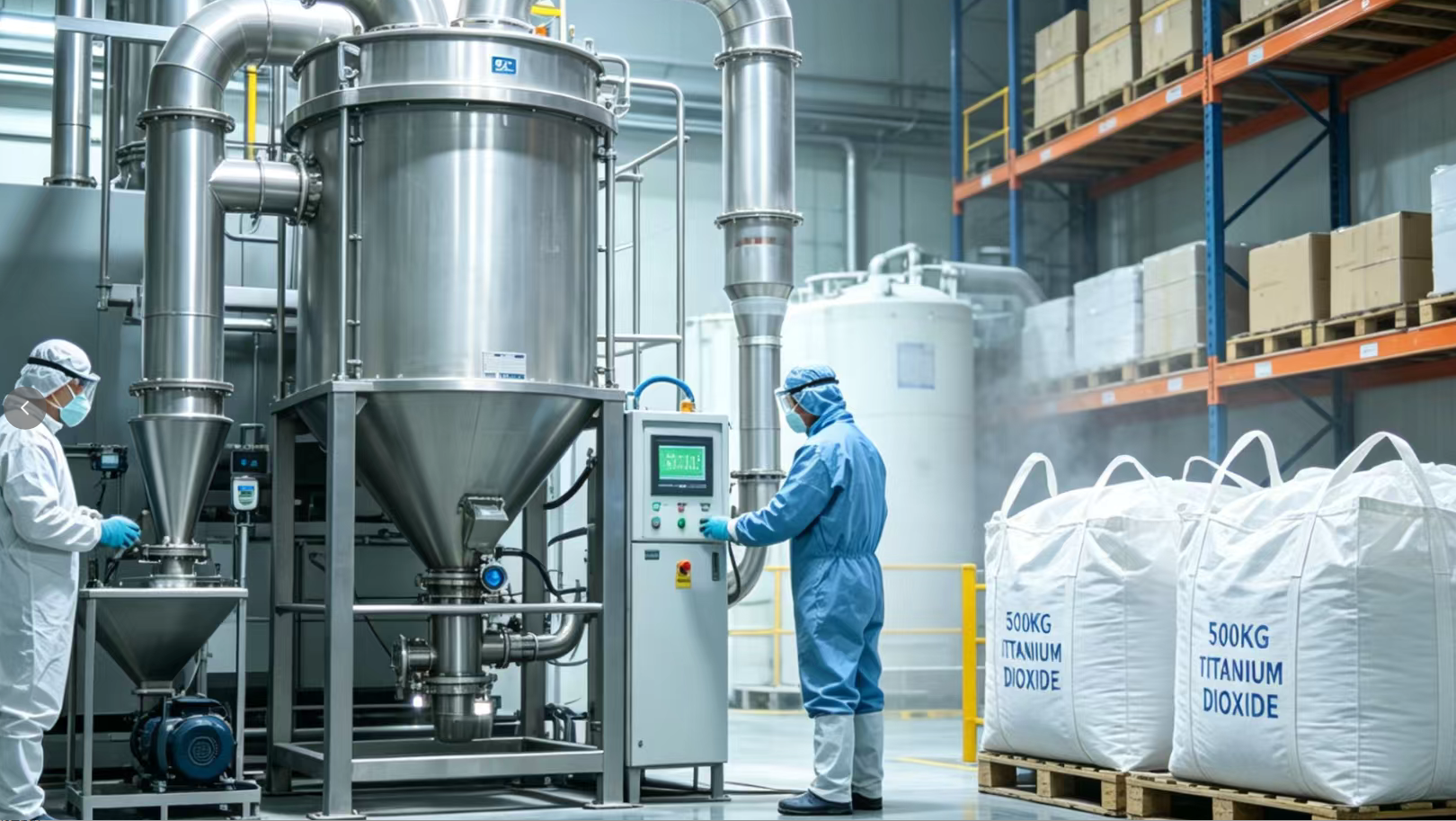
Bulk 500 kg packaging is available for production-scale fiber-grade TiO₂ orders alongside 25 kg sealed bags.
Packaging and storage are part of supply reliability. The product is supplied in 25 kg and 500 kg sealed packaging. Warehouse humidity should be kept below 65%, packages should remain sealed, and feeding should use a closed or vacuum system to limit dust dispersion. Workers should use dust-proof masks and protective clothing during handling. These controls address the two main material risks for fiber-grade TiO₂: moisture-induced agglomeration and dust exposure during manual feeding.
SA-50 versus European anatase grades: a total-cost view
Buyers often compare SA-50 with European reference grades such as Kronos 1071 and Venator LW-S100. The comparison should be made on line performance and total cost, not on unit price alone. The core technical difference is the coating system: SA-50 uses a polyester-specific organic coating with Japanese refined dry modification technology, while the European references use a traditional silicon-aluminum inorganic double coating with general organic modification. That difference affects dispersion, shade and maintenance.
| Comparison point | SA-50 | Kronos 1071 and Venator LW-S100 |
|---|---|---|
| Coating structure | Polyester-specific organic coating; Japanese refined dry modification. | Traditional silicon-aluminum inorganic double coating with general organic modification. |
| Dispersion | Rapid dispersion without pre-infiltration; dual compatibility with ethylene glycol and polyester resin. | Stable anti-sedimentation performance for large-scale European production lines; typically requires pre-heat infiltration in glycol batching. |
| Color | Cool blue-white, b ≤ -0.4. | Warm yellow tone, b +0.8 to +1.7. |
| Unit cost | 18%–25% lower than the European references. | Reference price level. |
| Total comprehensive cost | 22%–29% lower, including logistics and production savings. | Reference cost level. |
| Spinneret life | 12%–18% longer in the documented comparison. | Reference life. |
| Energy and maintenance | Glycol batching energy 55%–62% lower; extrusion energy 9%–14% lower; spinneret replacement 40% less frequent and filter consumption 25% lower in the documented comparison. | Reference consumption and maintenance pattern. |
These are material advantages, but they come with boundaries. SA-50 is polyester-focused. A polyamide fiber matting line, a viscose fiber matting process or a recycled PET fiber line with a different contaminant profile should validate the grade on its own equipment before standardizing. The organic coating that helps dispersion in PET can behave differently in a non-PET polymer or in a line with a different feeding system. The cost advantage is also tied to the Asian supply chain: freight, currency and local port charges can narrow the gap, and a customized grade can extend the 15–30 day standard lead time. European grades remain valid references where a plant has long qualified them and where the switching cost is high. The decision should be based on total cost, line fit and documented acceptance, not on the country of origin.
Application fit: where the grade earns its place
SA-50 is designed for polyester spinning titanium dioxide applications where the TiO₂ is fed through ethylene glycol and polymerized in-reactor. It fits semi-dull and full-dull PET chip production, polyester filament whitening and polyester staple fiber matting. In continuous spinning, the grade's dispersion behavior supports stable filter pressure and a smoother particle surface, which is why the documented comparison shows lower spinneret wear and longer spinneret life.
The grade is also relevant to high-grade light-color and pure-white polyester fabrics. Its cool blue-white shade is intended to reduce the warm yellow tone that can appear with some European grades, which is useful in textile fiber raw material programs where shade consistency is a selling point. For anti-yellowing polyester titanium dioxide, the buyer should still verify low iron content and color value on the COA, because the label alone does not prove performance.
Beyond polyester, the application must be confirmed. Buyers sourcing polyamide fiber matting titanium dioxide, viscose fiber matting titanium dioxide or a specialty high-temperature resistant spinning grade should not assume that SA-50 is the correct choice. The SA-60 and SA-80 grades exist for a reason, and their COA limits should be matched to the fiber route. A 1 metric ton trial is the practical way to test dispersion, filter pressure and shade before a production order.
Market trend: anatase demand and supply consolidation
Three verified data points frame the procurement outlook. First, the global TiO₂ market is projected at USD 24.4 billion in 2026, and the anatase segment relevant to fiber grades is expected to grow at a 7.3% CAGR from 2026 to 2033. Second, China's effective TiO₂ production capacity declined from 5.9 million tons in 2024 to 5.7 million tons in 2025. Third, China exported 1.9017 million tons of TiO₂ in 2024, a 15.84% year-on-year increase.
The interpretation for fiber-grade buyers is not that supply is disappearing. It is that capacity is consolidating while export volumes remain large. In that environment, supplier qualification and lead-time discipline become more valuable. A buyer who has already agreed acceptance criteria, tested a 1 metric ton trial and confirmed a 15–30 day delivery window is better placed than one who starts qualification during a supply tightening. The same logic applies to documentation: a complete COA and pre-shipment test record reduce the risk of a shipment being held at incoming inspection.
Future outlook
Fiber-grade TiO₂ is likely to be judged on traceability and line performance rather than on grade name alone. The growth of anatase demand, the consolidation of Chinese capacity and the scale of China's export flow all point toward more formal acceptance documentation. Buyers should expect to see grade-specific COAs, pre-shipment test records and clearer packaging and storage controls as standard parts of the offer. For suppliers, the differentiator will be the ability to support a small trial, hold a reliable lead time and scale to production without changing the specification.
For Orient International, the relevant test is whether the SA-50, SA-60 and SA-80 series can be presented with grade-specific evidence rather than a single family claim. The 1 metric ton MOQ, 15–30 day standard lead time, 100% pre-shipment testing and 16,000 MT annual capacity provide a workable procurement framework. The buyer's task is to verify the grade on the line and to document the acceptance limits before scale-up.
Technical and procurement FAQ
1. What is fiber-grade titanium dioxide?
Fiber-grade titanium dioxide is an anatase TiO₂ grade formulated for man-made fiber production. It is used to deluster or whiten polyester, polyamide, viscose and other fibers. The grade is defined by more than TiO₂ content: color value, electrical conductivity, pH, iron content, particle size and dispersion all affect spinning performance and the final shade.
2. Which acceptance criteria should be fixed before ordering?
The purchase specification should fix TiO₂ content, crystal structure, color value, electrical conductivity, pH, iron content, particle size and intended fiber use. The exact limits should come from the grade-specific COA and be attached to the order. The buyer should also agree the sampling method, the release test and the retest procedure, so that acceptance is not based on a general product description.
3. How do SA-50, SA-60 and SA-80 differ?
SA-50, SA-60 and SA-80 are separate anatase grades. They differ in TiO₂ content, color value, electrical conductivity, pH and intended fiber use. SA-50 has documented values including TiO₂ ≥99.4%, a cool blue-white shade with b ≤ -0.4, low iron and low conductivity, and it is polyester-focused. SA-60 and SA-80 carry their own COA limits and should be matched to the fiber process through a trial rather than assumed to be interchangeable.
4. What is the minimum order quantity?
The standard minimum order quantity is 1 metric ton. That volume is intended to support a line trial, compare the grade against an incumbent and verify packaging and documentation before a production order. Customization or special packaging may change the commercial terms, so the MOQ should be confirmed in the quotation.
5. What lead time should a buyer plan for?
The standard lead time is 15–30 days. The exact window depends on grade, quantity, packaging, destination and whether the order requires customization. A written delivery date should be requested with the order confirmation. Customized grades may require additional time beyond the standard range.
6. What testing is completed before shipment?
Every shipment is subject to 100% pre-shipment testing. The test record should be read with the grade-specific COA. Pre-shipment testing confirms the release parameters for the lot; it does not replace the buyer's incoming inspection. Retaining a sample from each lot is a practical way to compare future deliveries against the approved standard.
7. Is OEM or ODM customization available?
Orient International supports customization and OEM/ODM work around the fiber-grade TiO₂ series, including grade selection, packaging and documentation requirements. The buyer should define which parameters can change, which are fixed by the anatase process and how the change affects MOQ and lead time. A written trial plan is more reliable than a general customization request.
8. What capacity is available for scale-up?
The operation is structured around a monthly capacity of 1,000 metric tons and an annual capacity of 16,000 MT for TiO₂ and related raw materials. The company profile also lists 25 engineers and a 700,000 m² factory footprint. For procurement, the relevant check is whether the supplier can move from a 1 metric ton trial to a repeat order without changing the source or the specification.
9. How does SA-50 compare with European grades?
In the documented comparison, SA-50 offers 18%–25% lower unit cost and 22%–29% lower total comprehensive cost than Kronos 1071 and Venator LW-S100. It also shows faster dispersion without pre-infiltration, a cooler blue-white shade, 12%–18% longer spinneret life, 40% less frequent spinneret replacement and 25% lower filter consumption. Those advantages are application-specific and should be confirmed on the buyer's line.
10. What are the main limits or risks?
SA-50 is polyester-focused, so polyamide, viscose, recycled PET or other fiber routes require their own validation. The organic coating may behave differently outside a PET line, and the cost advantage depends on logistics and currency conditions. Customization can extend the standard 15–30 day lead time. Moisture and dust are the main handling risks, so sealed packaging, dry storage below 65% humidity and closed feeding are part of the control plan.
11. Which packaging formats are available?
The product is available in 25 kg and 500 kg sealed packaging. The choice depends on the feeding system, storage space and order size. Packages should remain sealed in a dry warehouse, and manual handling should follow dust-control procedures. Packaging format can be discussed as part of the order specification.
12. How should a buyer qualify a new grade?
A practical qualification sequence is to agree the COA limits, order 1 metric ton, run a line trial against the incumbent, compare color, dispersion, filter pressure and spinneret condition, then review the pre-shipment test record before scale-up. The trial should be long enough to capture batch-to-batch variation. The 15–30 day standard lead time supports this sequence for standard grades.
A practical next step
For a decision-stage fiber-grade TiO₂ purchase, the minimum documentation set is a grade-specific COA, a written acceptance specification, a 1 metric ton trial plan and a confirmed 15–30 day delivery window. Buyers who need the supplier profile, packaging details and company background can download the Orient International brochure here: Orient International company brochure (PDF).
Tem questões ou precisa de mais detalhes?
Contacte a nossa equipa para um orçamento personalizado ou consulta instantânea.
Solicitar orçamento
Preencha o formulário abaixo e a nossa equipa entrará em contacto com uma proposta personalizada.
Chat direto do WhatsApp
Prefere conversar em tempo real? Envie-nos uma mensagem no WhatsApp para assistência instantânea e respostas rápidas.
- Obter orçamento personalizado
- Partilhar fotos ou documentos
- Discuta as suas necessidades diretamente
Geralmente responde em 5–30 minutos durante o horário de expediente.