
Fiber Grade TiO2 Sourcing: A Long-Term Supply Strategy for Polyester Spinning
Fiber grade titanium dioxide (TiO2) is a functional raw material that controls whiteness, delustering and process stability in polyester and other chemical fiber production. As the market for fiber grade TiO2 is projected to grow from USD 1.46 billion in 2024 to USD 1.94 billion by 2032, and polyester fiber accounts for more than 60 percent of fiber-grade TiO2 consumption, the selection of a supplier has become a long-term operational decision rather than a spot purchase.
This article interprets fiber grade TiO2 from a procurement and execution perspective: what to check before signing a long-term contract, how SA-50 fits into continuous PET spinning, and where the product's boundaries lie.
Where procurement decisions tend to go wrong
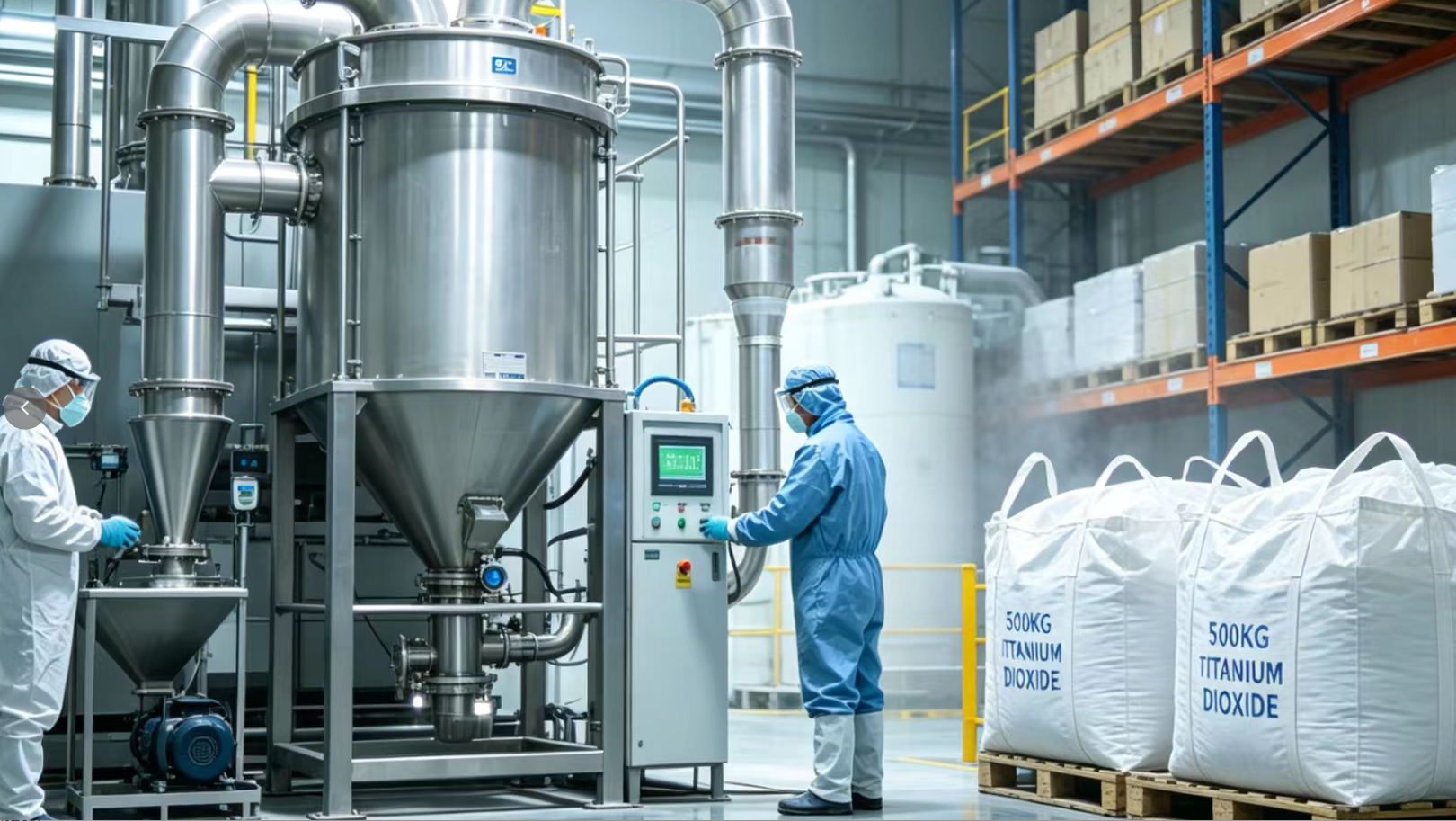
Most TiO2 quality problems are not visible in a certificate of analysis. Two batches with identical TiO2 content can behave differently in the extruder. In continuous polyester spinning, a small shift in pH, electrical conductivity, sieve residue or iron content can change polymer viscosity, create gel particles, accelerate filter blockage, or shift the fiber shade from bright white to yellow. The real production risk is not only a defect in the final fabric but costly downtime in the spinning line.
A buyer who evaluates only unit price can miss the cost of filter changes, spinneret polishing, and line stoppages. Total cost of use, not invoice price, is the more relevant metric for a long-term contract.
For buyers at the decision and execution stage, the opportunity is to select a supplier with proven production capacity, transparent testing and trade flexibility. A fiber-grade TiO2 source that can offer low minimum orders, stable monthly capacity and multiple payment methods helps a mill move from trial to volume without re-qualifying the raw material.
A supplier built for long-term chemical fiber partnerships
One company that has structured its offer around this need is Orient International Holding Shanghai Foreign Trade Co., Ltd., a state-owned foreign trade enterprise founded in 1988 and wholly owned by Orient International Group. The company has a registered capital of over RMB 548 million and more than 150 regular employees. Its core product for the fiber sector is SA-50, a fiber-grade anatase titanium dioxide positioned as a PET fiber whitening agent. SA-50 is supplied to markets including Korea, Japan, the EU, North America, South America, Southeast Asia, the Middle East and India.
Because Orient International operates as a foreign trade company rather than a mine-based pigment producer, its value lies in combining product sourcing, international logistics, customs declaration, letter-of-credit settlement and cross-border supply chain risk control. The parent group's 73 overseas branches cover nearly 200 countries and regions, which gives buyers a practical route to regional distribution and agency cooperation.
On the supply side, the company reports a monthly production capacity of 1,000 metric tons for SA-50, with a minimum order quantity of 1 metric ton and a typical lead time of 15–30 days. This combination is practical for polyester staple fiber and filament producers that need to keep inventory lean without locking in large first orders.
What makes a fiber-grade TiO2 technically suitable for PET spinning
Fiber-grade TiO2 for polyester spinning is not selected by price alone. The crystalline form is the first filter. Anatase is generally preferred over rutile for fiber delustering because its Mohs hardness of 5.5–6.0 is lower than rutile's 6.0–7.0, helping to protect spinneret holes during high-speed spinning. Delustering performance also depends on particle size, with a typical target of 0.2–0.3 micrometers for polyester staple fiber applications.
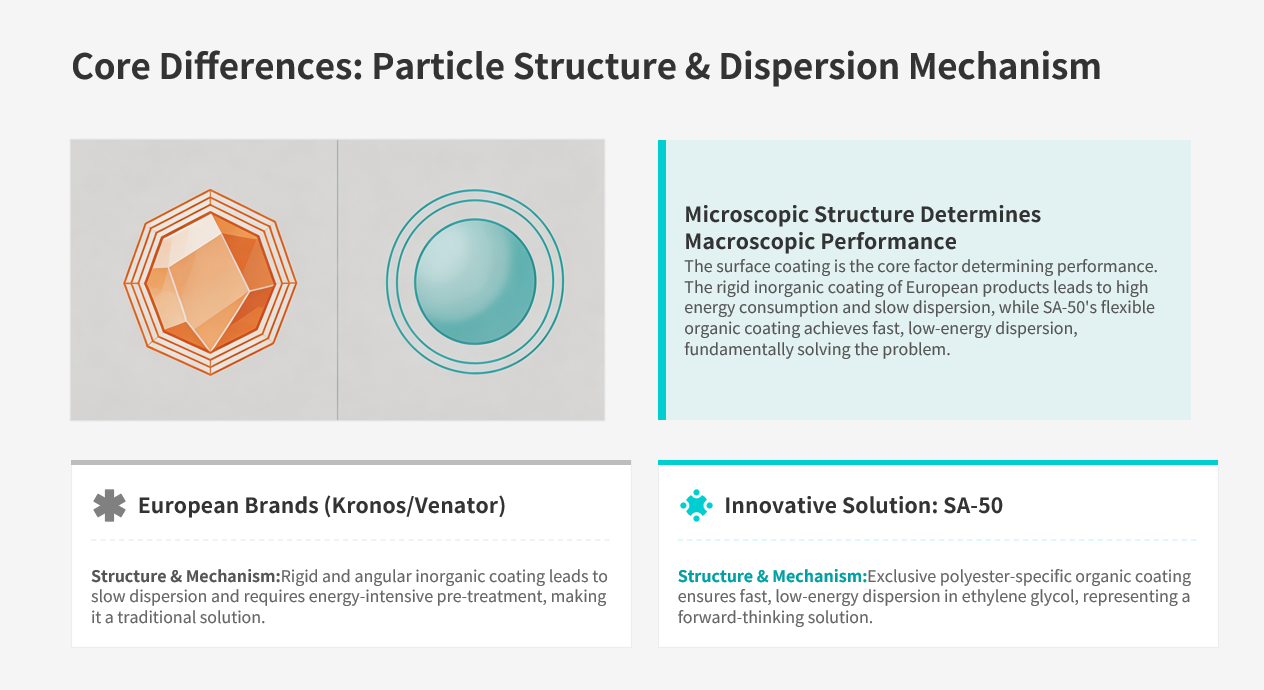
Surface treatment is equally important. Traditional fiber-grade TiO2 products often use a silicon-aluminum inorganic coating. While that coating provides stable anti-sedimentation behavior on large European production lines, it can require preheating and longer infiltration in ethylene glycol. SA-50 uses a polyester-specific organic coating produced with Japanese refined dry modification technology. The stated objective is dual compatibility with ethylene glycol and polyester resin, allowing rapid dispersion without pre-infiltration while maintaining suspension stability.
| Parameter | SA-50 specification | Process relevance |
|---|---|---|
| Crystal structure | Anatase | Lower abrasiveness for spinneret life |
| TiO2 content | ≥98.0% | Effective delustering concentration |
| Sieve residue (325 mesh) | ≤0.004% | Reduces filter blockage |
| Moisture | ≤0.40% | Stable dosing in EG slurries |
| Fe2O3 | ≤0.004% | Low iron limits yellowing |
| pH | 6.8±0.2 | Compatibility with PET polymerization |
| Electrical conductivity | ≤230 μS/cm | Protects polymer viscosity |
| Specific surface area | 8.5–10.0 m²/g | Balances dispersion and rheology |
| Color value L | 96.7–98.2 | Bright whiteness |
| Color value b | ≤0.0 | Cool blue-white shade instead of yellow cast |
These parameters map directly to everyday spinning issues. Sieve residue and moisture affect dosing and filter life. Fe2O3 is watched closely because iron promotes yellowing, especially at high melt temperatures; a low-iron, low-impurity fiber-grade TiO2 supports anti-yellowing requirements in PET fiber whitening. pH and electrical conductivity influence the polymerization environment and final polymer viscosity. The L and b values define whether the fiber reads as bright white or as slightly yellow on the fabric roll.
How SA-50 compares with traditional European fiber-grade TiO2
European producers such as Kronos and Venator have defined the reference point for fiber-grade TiO2. Products like Kronos 1071 and Venator HOMBITAN LW-S100 use a silicon-aluminum inorganic double coating with general organic modification. They have a long track record in large polyester production lines and offer stable anti-sedimentation behavior. SA-50 enters the same application space with a different coating architecture and a lower-cost supply chain.
According to Orient International's comparative analysis, SA-50 disperses 20–30 percent faster than these European grades, with suspension stability within 5 percent of the European products. The smoother organic-coated particle surface is reported to reduce spinneret wear by 3–8 percent and to extend filter cycles from 7–9 days to 10–12 days. The unit price gap is reported at 18–25 percent, with logistics lead time cut by more than 50 percent for Asian buyers. These figures are supplier-generated estimates and should be verified through a line trial, but they explain why organic-coated grades are being considered for long-term contracts.
Application scenarios for continuous polyester production
The supplier positions SA-50 for PET in-reactor polymerization matting, where it is used to produce semi-dull and full-dull PET chips and is adapted to ethylene glycol pre-dispersion feeding. It is also positioned for high-speed POY, FDY and DTY continuous spinning, high-grade pure-white and light-color polyester fabrics, and long-cycle 7×24-hour spinning lines where reduced spinneret abrasion and filter blockage are directly valuable.
For buyers in China, Southeast Asia, India, Korea and the Middle East, the combination of a lower unit price and faster delivery creates a practical alternative to CIF-quoted European inventory. In recycled PET fiber lines, where feedstocks already introduce variability, a fixed TiO2 specification with low iron and stable whiteness can simplify process control, although trials remain necessary.
Market context: why long-term sourcing decisions matter now
Market data supports the strategic significance of fiber-grade TiO2. Intel Market Research estimates the global fiber grade titanium dioxide market at USD 1.46 billion in 2024, projected to reach USD 1.94 billion by 2032. Polyester fiber accounts for more than 60 percent of all fiber-grade TiO2 applications. In parallel, China's total TiO2 exports reached a record 1.9017 million tons in 2024, up 15.84 percent year on year, according to China Customs Statistics. Taken together, these signals point to steady polyester-led demand and continued growth of Chinese supply in global export channels.
Certification is also becoming a differentiator. In 2022, Venator's HOMBITAN LW-S100 became the first fiber anatase TiO2 to obtain ECO PASSPORT by OEKO-TEX for the textile industry. ISO 591 provides an internationally recognized framework for TiO2 pigment classification. For buyers building a vendor list, product parameters should be paired with compliance evidence rather than treated as two separate conversations. Procurement teams also need to track regional supply shifts. China's record export volume of 1.9017 million tons in 2024 suggests that downstream buyers outside China will continue to see new options from Asian suppliers, while European producers maintain a certification-led position.
Managing handling, storage and batch risk in practice
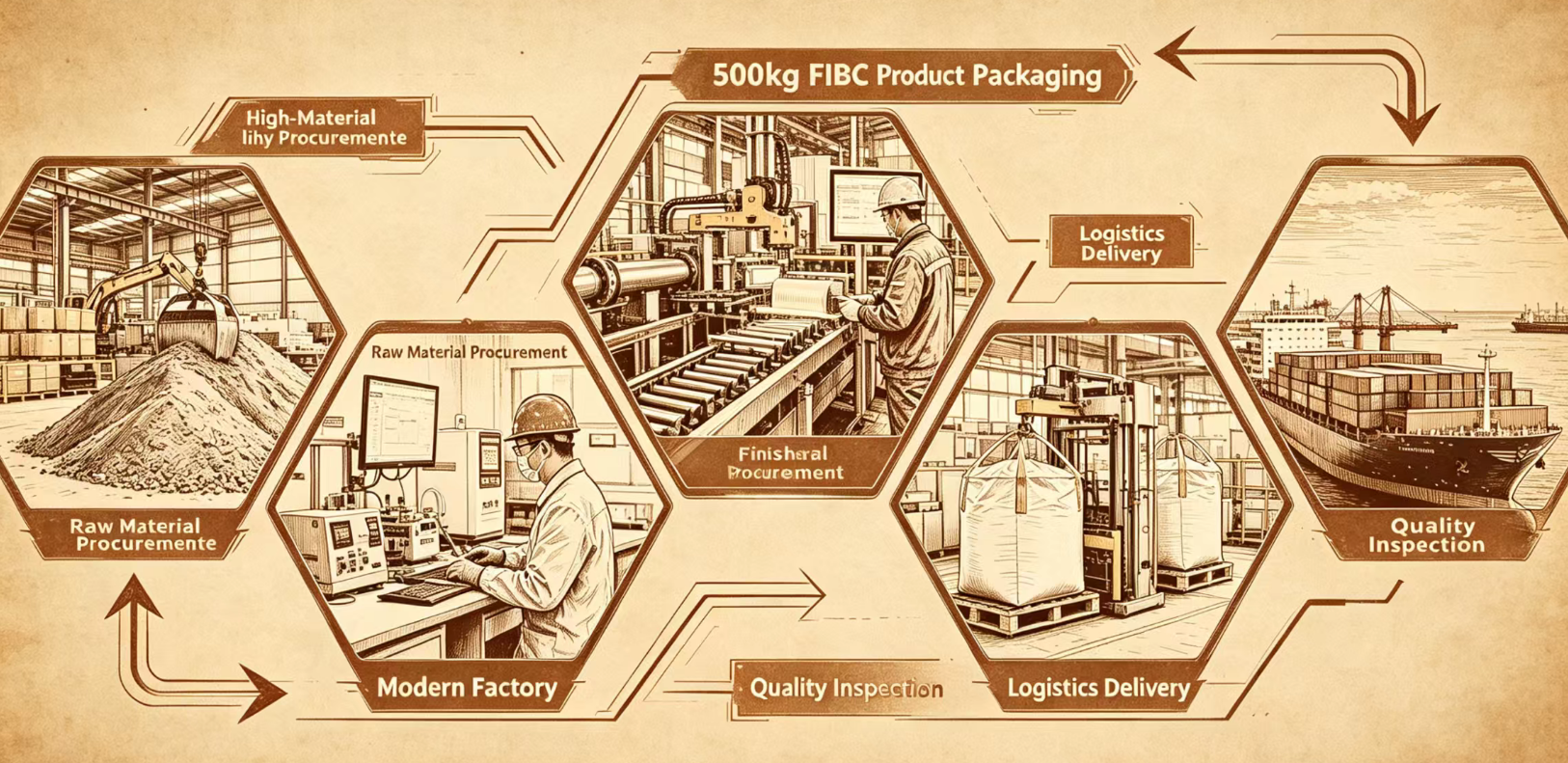
Execution does not end with a signed contract. Powder dust inhalation and moisture-induced agglomeration are two common risks when handling fiber-grade TiO2. Recommended controls include vacuum closed feeding, warehouse humidity below 65 percent, sealed package storage, and the use of dust-proof masks and protective clothing. Orient International supplies SA-50 in 25 kg and 500 kg packagings, which cover both manual dosing systems and large-scale slurry preparation.
A practical checklist for evaluating long-term TiO2 suppliers
The following criteria can serve as a starting point for the final stage of supplier qualification.
| Evaluation criterion | Evidence to request |
|---|---|
| Supply capacity | Monthly capacity; documented ability to support repeat orders |
| Order flexibility | Minimum order quantity and trial-order policy |
| Lead time | Standard production lead time and buffer stock options |
| Quality testing | 100% pre-shipment testing and third-party inspection acceptance |
| Commercial terms | FOB or CIF delivery; T/T and L/C payment options |
| Product consistency | Full specification sheet including Fe2O3, sieve residue, pH, conductivity and color values |
| Logistics network | Overseas branches, export experience, and settlement capability |
| Application fit | Reference products for PET spinning; validation plan for non-PET fibers |
For a long-term contract, the buyer should also agree on a maximum acceptable deviation per batch and a review cadence for quality data. This converts a product specification into a relationship standard.
Future outlook
The next stage for fiber-grade TiO2 will be defined by specification control and supply chain visibility. Buyers will ask not only for a price per ton but for evidence of process stability: faster dispersion, consistent color, low iron, low filter impact, and reproducible batches over hundreds of tons. The market can accommodate both European specialty grades and Asian commercial-quality grades, but the procurement bar is rising. For polyester mills, the practical question is no longer which grade to choose in theory, but which supplier can hold the specification across multiple shipments and support the relationship through changing market conditions.
This does not mean that all buyers should switch suppliers. It means the qualification process should include a documented performance trial, clear specification limits, and a shared contingency plan for freight, packing and buffer stock.
FAQ: Long-term fiber grade TiO2 supply decisions
What are the standard commercial terms for fiber grade TiO2 from Orient International?
The supplier operates with a minimum order quantity of 1 metric ton, a typical production lead time of 15–30 days, and a monthly production capacity of 1,000 metric tons. Delivery can be arranged on FOB or CIF terms. Payment options include T/T in advance, T/T 30 days, L/C at sight, and L/C 30/60/90 days.
How is quality controlled before shipment?
Orient International performs 100% pre-shipment testing on all products and supports third-party inspection. SA-50 release parameters include TiO2 content ≥98.0%, sieve residue ≤0.004%, moisture ≤0.40%, Fe2O3 ≤0.004%, pH 6.8±0.2, electrical conductivity ≤230 μS/cm, and color values L 96.7–98.2 / b ≤0.0.
Can SA-50 support continuous polyester spinning schedules?
SA-50 is designed for PET in-reactor polymerization matting and continuous spinning of POY, FDY and DTY. Its organic coating is formulated for rapid dispersion in ethylene glycol and compatibility with polyester resin. As with any grade change, line trials are recommended to confirm filter cycles and spinneret wear under specific local conditions.
What packaging and storage controls should buyers plan for?
SA-50 is available in 25 kg and 500 kg packagings. Recommended controls include sealed vacuum feeding, warehouse humidity below 65%, sealed storage, and the use of dust-proof masks and protective clothing during handling.
Can the supplier support foreign trade, distribution and long-term agency cooperation?
Orient International is a state-owned foreign trade enterprise with import and export qualifications, hazardous chemical operation permits and settlement capabilities. Its parent group has 73 overseas branches covering nearly 200 countries and regions, which supports multi-country distribution and agency relationships.
Company profile and reference document
Orient International Holding Shanghai Foreign Trade Co., Ltd. was founded in 1988 and is wholly owned by Orient International Group. Its brochure contains the company profile, product positioning and contact information for buyers who are building a long-term fiber-grade TiO2 supply relationship.