
Fiber Laser Chiller Selection: Specs, Certification and Limits
A fiber laser chiller is a constrained component of the laser system, not an accessory attached at the end of a purchase order. In a fiber laser installation, electrical input becomes optical output and waste heat, and that heat must leave the machine at a rate the source and the optics can tolerate. Technical guidance published by ARCUSCNC on chiller placement states that a 3 kW fiber laser source requires removal of approximately 7 kW of waste heat. That single relationship explains why cooling capacity, temperature stability, electrical supply and certification are evaluated as one constraint set rather than as separate line items.
This reference is written for buyers in the research and evaluation stage who need to compare chiller specifications on a consistent basis. It uses the Hanli industrial chiller range from Wuhan Hanli Refrigeration Technology Co., Ltd as a documented example, because the company publishes model-level specifications and certificate references that can be checked against the claims made in a quotation.
Why cooling is specified as a constraint rather than a component
Heat removal is a process requirement. If the chiller cannot reject heat at the rate the laser generates it, the source derates, the optics distort, and cut quality or weld penetration becomes inconsistent. The chiller therefore sets an operating boundary for the whole machine, and the buyer inherits that boundary for the life of the equipment.
The commercial context reinforces the point. An industrial cooling systems market estimate published by Grand View Research in July 2026 values the global market at USD 22.6 billion for 2024 and projects USD 34.7 billion by 2030. That figure covers industrial cooling systems as a category, not laser chillers alone, but it indicates the scale of the category that laser equipment buyers are sourcing from — and the reason specification discipline matters when comparing offers.
In practice, four constraint families decide whether a chiller is suitable:
- Thermal constraints — cooling capacity against actual heat load, and the temperature band the process can tolerate.
- Site constraints — electrical supply, ambient temperature range, available floor space and water quality.
- Compliance constraints — which certificate covers which model, under which directive, for which market.
- Commercial constraints — minimum order quantity, lead time, customization scope and the cost drivers behind a quotation.
The constraint set buyers actually evaluate
Most chiller comparisons fail because different offers are measured on different criteria. The table below converts the four constraint families into the specific questions a buyer should be able to answer before approving a specification.
| Constraint | Why it decides suitability | What to confirm in writing |
|---|---|---|
| Cooling capacity | Must exceed the waste heat produced by the laser source at the duty cycle used | Rated cooling capacity at stated conditions, plus the laser wattage the model is matched to |
| Temperature stability | Affects focus consistency, cut edge quality and weld repeatability | Standard precision versus optional high-precision mode, and the control range in °C |
| Electrical supply | Determines whether the unit can be commissioned on the available site power | Phase, voltage and frequency, plus rated and pump power |
| Ambient envelope | Heat rejection performance depends on the surrounding air temperature | Application environment range for the exact model, not the series |
| Materials and water circuit | Corrosion and fouling shorten service life and shift thermal performance | Tank and circuit materials, filtration, water quality requirements |
| Certification scope | Determines market access and the machine builder's own compliance position | Certificate number, issuing body, directive, and the exact model designations covered |
| Lead time and MOQ | Sets whether the chiller arrives with the machine build or after it | Stated production window and minimum order quantity for the configuration |
How an industrial chiller removes heat
An industrial water chiller moves heat from a process loop to the surrounding environment through a refrigeration cycle. Hanli's published explanation of the cycle identifies four stages:
- Compression — the compressor takes low-pressure, low-temperature gaseous refrigerant and compresses it into high-pressure, high-temperature gas, adding energy to the refrigerant.
- Condensation — the hot high-pressure refrigerant releases heat to ambient air in the condenser and becomes a high-pressure liquid.
- Throttling — the liquid refrigerant passes through an expansion valve, dropping pressure and temperature.
- Evaporation — the refrigerant absorbs heat from the process water in the evaporator and returns to gas, and the cycle repeats.
In a laser installation, the process loop is closed. Chilled water circulates through the laser source and, in cutting systems, through the optics or cutting head, then returns to the chiller to be cooled again. On models where the water circulation system includes a filter, that filter maintains water cleanliness in the cooling loop — a small detail that has a direct effect on long-term thermal performance, because fouled circuits transfer heat less effectively.
Fiber laser cutting and welding place two different temperature demands on the same installation. The laser source tolerates a wider band; the optical path is more sensitive. Some models in the Hanli range are described with dual-temperature or independent dual-temperature, dual-loop configurations, and the HL-3000-QG2/2 is described as a single-pump, dual-temperature design. Where a project depends on separating source cooling from optics cooling, that configuration should be confirmed against the specific model rather than assumed across the range.
Hanli industrial chiller: what the specification record shows
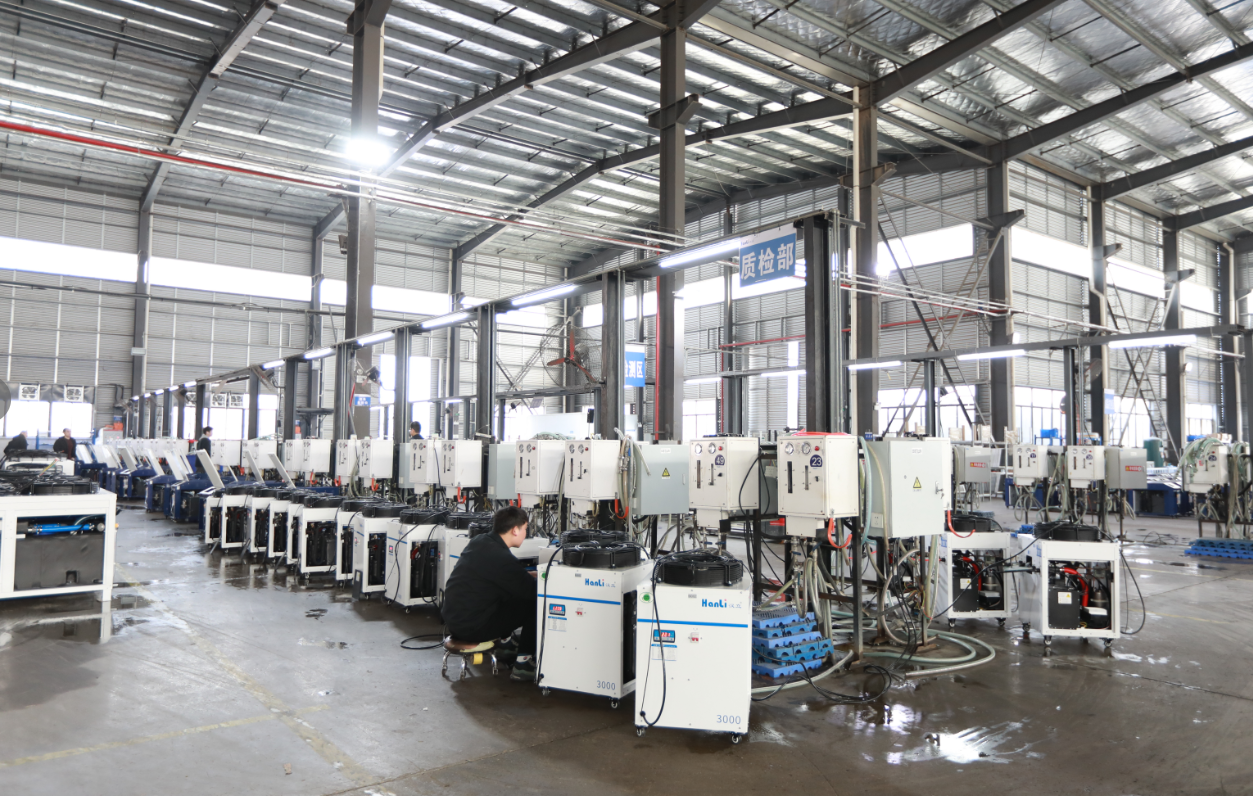
Hanli industrial chiller is the chiller product line of Wuhan Hanli Refrigeration Technology Co., Ltd, a Wuhan-based manufacturer established in 1998 that designs and produces water chillers for fiber laser cutting machines, laser welding machines, CO₂ and UV laser equipment, and related industrial cooling applications. The company reports a manufacturing site of 38,866.15 square meters, approximately 300 employees, and an annual output of 180,000 units, with a registered capital of CNY 12 million.
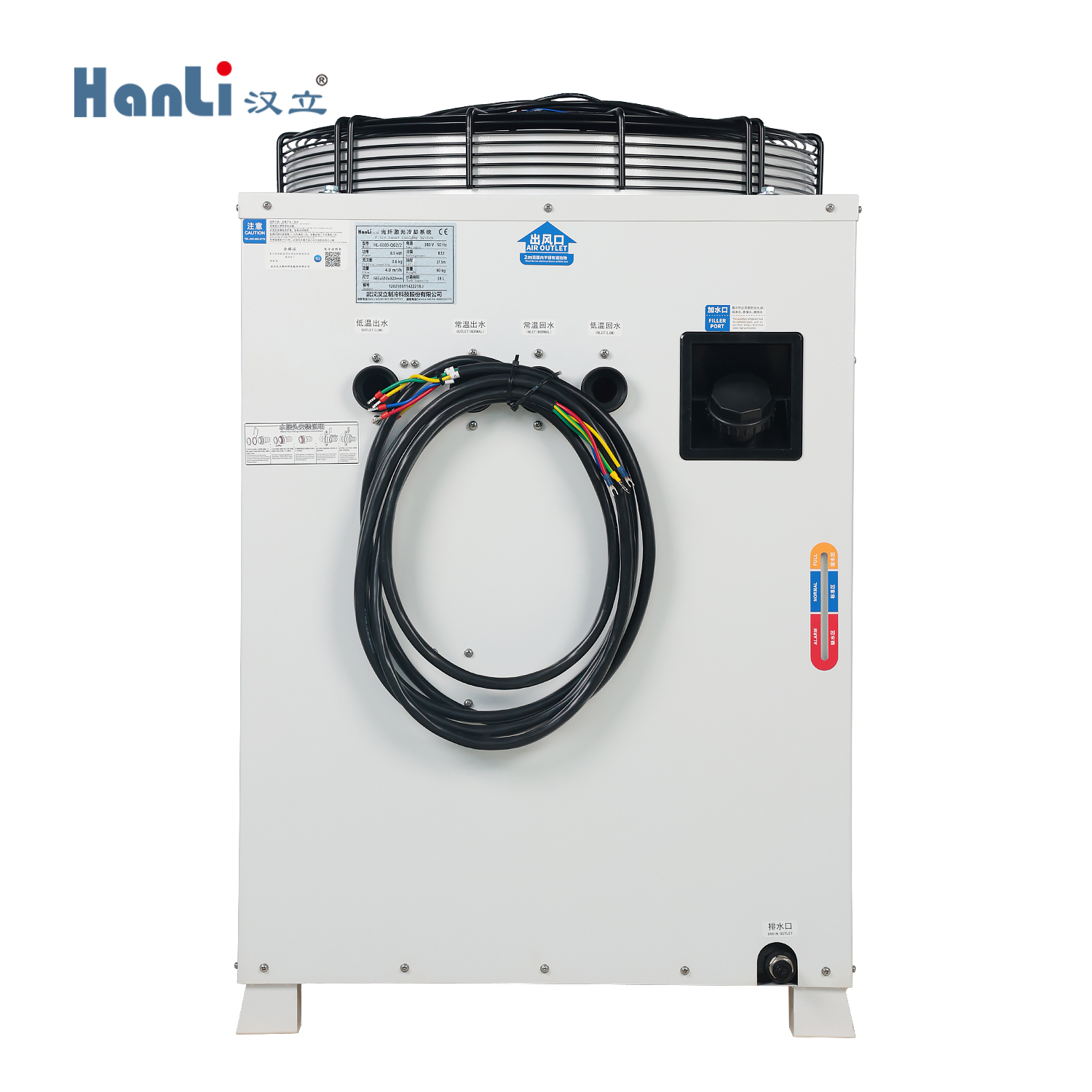
The product line is documented at model level, which is what makes it usable as a specification reference. The table below reproduces published parameters for five models without rounding or reinterpretation.
| Model | Electrical supply | Cooling capacity | Rated / pump power | Control and matching |
|---|---|---|---|---|
| HL-1500-QG2/2 | — | 4.7 kW | 2.3 kW / 0.36 kW | Water temperature range 22–29.5 °C; ambient −20 to 40 °C |
| SCH-1500 | AC 1P 220 V | — | 2.1 kW / — | ±1.5 °C accuracy; 1.2 m³/h; matched to 1500 W continuous fiber laser |
| HL-3000-QG2/2 | 1P 220 V / 50 Hz | 8.7 kW | 3.5 kW / 0.63 kW | 22–29.5 °C; ±3 °C standard, ±1 °C optional; 3000 W fiber laser cutting |
| SCHYTJ-3000 | AC 1P 220 V | 6.75 kW | 3.9 kW / 0.36 kW | 1.6 m³/h pump flow; matched to 3000 W continuous fiber laser |
| HL-6000-QG2/2 | 3P 380 V / 50 Hz | 19.1 kW | 6.2 kW / 0.88 kW | Ambient −20 to 40 °C; water temperature range not stated in the available record |
Dashes and omissions above indicate that the parameter is not stated in the available specification record for that model. They should not be read as zero or as equivalent to another model's value.
Two details in this record are worth flagging for evaluation. First, the HL-3000-QG2/2 pairs an 8.7 kW cooling capacity with a 3000 W fiber laser cutting machine, while the SCHYTJ-3000 pairs a 6.75 kW cooling capacity with a 3000 W continuous fiber laser source for welding. The same nominal laser power therefore maps to different chiller capacities depending on the application — evidence that heat load, not laser wattage alone, drives sizing.
Second, the control architecture is documented rather than implied. The HL-6000-QG2/2 uses a digital controller that displays cooling water temperature in real time, with CPU-based automatic monitoring, automatic fault diagnosis and fault codes shown on screen. It provides passive alarm terminals and remote control terminals, plus terminal blocks intended for centralized control and monitoring of CNC systems. For machine builders integrating a chiller into a larger control cabinet, those terminals determine whether alarm states can be surfaced centrally or must be read at the unit.
Certification: what is covered, and what is not
Certification is the constraint most often mishandled in evaluation, because a supplier's certification claim and the certificate's actual scope are different things. Two certificate references apply to the Hanli range, and both are specific.
ISO 9001. Certificate number 02125Q11006R4M, issued by HuaXin Certification Center, Inc. against GB/T 19001-2016 / ISO 9001:2015. The issue date is 17 July 2025 and the expiry date is 26 July 2028. The certified scope is design, production, sale and after-sales service of water chillers rated at or below 120 kW, for the EU, US and Middle East markets. The HL-1500-QG2/2 industrial laser chiller is certified to ISO 9001:2015 under this record.
CE Certificate of Conformity. Certificate number AM 50662218 0001, issued by TÜV Rheinland LGA Products GmbH under EC Council Directive 2006/42/EC, applicable to the EC market. The certificate is a type certificate covering machinery described as Laser Cooling Water Chiller, and it lists specific type designations including HL-1500-QGS, HL-6000-QGS, HL-1000-QG2/2, HL-2000-QG2/2, HL-4000-QG2/2, HL-8000-QG2/2, HL-15000-QG2/2, HL-30000-QG2/2, HL-50000-QG2/2, HL-80000-QG2/2, HL-4000-QGS, HL-12000-QGS and HL-1500-QG2/2. Beyond the designation list, the scope also references the HL-6000-QGS water chiller, the SCHYTJ-3000 laser welding chiller, the SCH-1500 laser chiller, the HL-30000-QG2/2 laser cutting chiller and the HL-1500-QG2/2 industrial laser chiller.
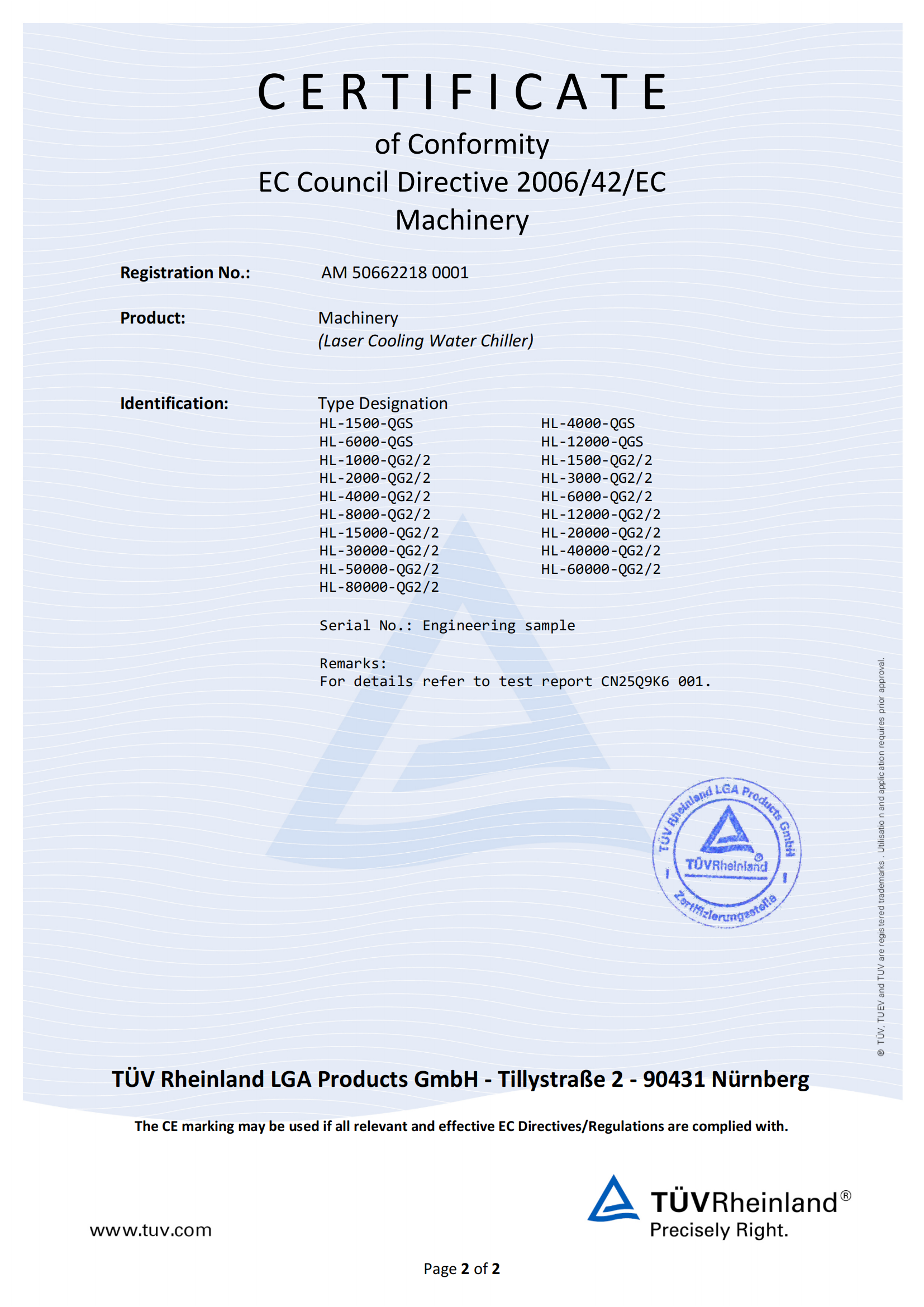
The practical reading of these two records is straightforward. ISO 9001 covers the quality management system for water chillers up to 120 kW — it is a system certification, not a product approval, and it does not extend to units above that capacity band. The CE certificate is a product conformity document whose validity depends on the model designation appearing in its scope. A buyer specifying a model outside the listed designations, or a capacity outside the ISO scope, should treat certification as open until the supplier confirms coverage in writing.
Applications and matching logic
Laser cooling is the primary application family for this product range, and the published application record covers laser cutting, laser welding, laser engraving and general industrial laser processing. Matching equipment includes fiber laser sources, laser cutting machines, laser welding machines, CO₂ laser equipment, UV laser equipment and induction heating.
The operating mode is circulating water cooling in a closed loop. Selected high-power products use an independent dual-temperature, dual-loop cooling design. Working conditions include continuous laser equipment operation and changing thermal-load conditions, with the ambient range depending on the model — the HL-1500-QG2/2 and HL-6000-QG2/2 are both stated as suitable for an application environment of −20 to 40 °C.
Beyond laser equipment, the same platforms appear in non-laser temperature-control scenarios. Hanli's published application guidance lists injection molding, extrusion, chemical processing and electroplating alongside laser marking and laser welding. This matters for buyers running mixed production floors: a chiller platform qualified on laser duty can sometimes serve a second process, but the sizing basis changes because the heat-load profile changes.
The company reports that its products have been matched with domestic laser equipment companies including Senfeng, Bodor and HG, and that typical customer relationships for laser cooling applications run from five to ten years. Those statements describe commercial history rather than measured performance, and should be read as context rather than as a performance benchmark.
Three installation conditions determine whether a correctly sized chiller performs as specified. Water quality and filtration affect heat transfer and pump life. Regular water replacement and antifreeze protection affect operation in low-temperature conditions. And drainage during low-temperature shutdown prevents damage where ambient temperatures fall below the process water's freeze point.
Where a fiber laser chiller does not fit — limits and trade-offs
A useful specification reference states boundaries as clearly as capabilities. Five limits apply to this product class and to the Hanli range specifically.
1. Capacity certification has a ceiling. The ISO 9001 scope covers water chillers at or below 120 kW. Projects requiring higher capacity fall outside that certified scope and need separate confirmation of quality-system coverage.
2. CE coverage is model-specific, not series-wide. The Certificate of Conformity lists designations. A model number that does not appear on that list is not automatically covered, even where it is built on a similar platform. Buyers supplying into the EC market should verify the exact designation against the certificate scope before releasing the order.
3. Standard precision may not meet every process. On the HL-3000-QG2/2, standard temperature control precision is ±3 °C, with a ±1 °C high-precision mode available as an option. Applications sensitive to thermal drift need the high-precision configuration specified at the quotation stage, not assumed at commissioning.
4. Ambient envelope determines real cooling performance. A chiller rated at a given cooling capacity achieves that capacity within a stated ambient range. Outside that range, heat rejection degrades. Buyers in hot climates or unheated workshops should confirm the application environment range for the exact model against site conditions rather than against a series average.
5. A chiller cannot compensate for circuit design. Filters, pipe sizing, water quality and open-loop contamination all sit outside the chiller's control. A correctly specified unit installed on a fouled or undersized circuit will underperform, and the failure will appear as a chiller fault.
Cost structure and what drives price bands
Verified public price data for industrial chillers by capacity class is not available in the reference material behind this article, so no price band is quoted here. What can be stated is the cost structure that shapes quotations, because those variables determine whether two offers are genuinely comparable.
The dominant variables are cooling capacity and circuit configuration; temperature control precision, since a ±1 °C mode is an added specification rather than a default; electrical configuration, as single-phase 220 V and three-phase 380 V designs require different components; materials, where SS304 stainless steel and cast iron construction affect both cost and service life; pump specification, including flow and head; and certification documentation for the target market.
Customization adds a further layer. Hanli's published capability statement lists ODM production with monthly capacity of 15,000 units, a minimum order quantity of one unit, and a lead time of 7 to 45 days depending on configuration. Customization is described as covering logo, color and cooling solutions matched to laser power, application type and equipment configuration, with the specific scope of OEM, mechanical, electrical and control customization subject to confirmation. Quality control is described as 100% testing before delivery, supported by an on-site laboratory test system intended to verify stable performance across different ambient temperatures.
For a buyer, the implication is that a like-for-like comparison requires matching capacity, precision mode, electrical supply, materials and certification scope on the same line of the enquiry. A lower quotation that omits high-precision mode or EC certification is not a lower price for the same product.
Market trend analysis
Three observable trends shape how chillers are specified in laser and general industrial applications. Each is supported by the reference data available for this article; broader claims about segment growth rates are not made here because verified segment-level data was not available.
Thermal loads scale with laser power. The relationship between a 3 kW fiber laser source and roughly 7 kW of waste heat illustrates why higher-power laser adoption translates directly into higher cooling capacity requirements, and why dual-circuit configurations become relevant at the upper end of the range.
The cooling category itself is large and forecast to expand. The Grand View Research estimate of USD 22.6 billion in 2024, rising to a projected USD 34.7 billion by 2030, describes industrial cooling systems as a whole. It is a category-level figure and should not be applied to laser chillers specifically, but it explains why specification discipline and supplier qualification have become more structured purchasing activities.
Control integration is moving into the specification. Terminal blocks for centralized CNC monitoring, remote control terminals and passive alarm outputs appear in published product documentation rather than as optional extras. Equipment builders increasingly need chiller status inside their own control architecture, and that requirement now influences model selection as much as cooling capacity does.
Future outlook
For buyers, the near-term direction is toward tighter specification rather than broader product ranges. As laser sources move to higher power, cooling capacity requirements rise, and the dual-temperature architecture used to separate source cooling from optics cooling becomes a mainstream requirement rather than a high-end option. Temperature stability requirements tighten in parallel, which pushes high-precision control modes from optional to expected in cutting applications.
Compliance is likely to remain a model-by-model discipline. Certificate scopes list designations for a reason, and equipment builders selling into the EC market carry downstream obligations that depend on the chiller's conformity documentation. Buyers should expect certification verification to become a standard step in supplier qualification, not an afterthought at shipment.
On the supply side, capacity and lead time remain practical differentiators. A manufacturer reporting 180,000 units of annual output, 15,000 units of monthly capacity and a stated production window of 7 to 45 days is describing an ability to respond to order timing — a factor that matters when a chiller is on the critical path of a machine build.
Frequently asked questions
What cooling capacity does a fiber laser machine need?
Capacity depends on the heat the laser source generates, not on laser wattage alone. Published guidance for chiller placement states that a 3 kW fiber laser source requires removal of about 7 kW of waste heat. In the Hanli range the same 3000 W laser power maps to different chiller capacities depending on application: the HL-3000-QG2/2 provides 8.7 kW cooling capacity for 3000 W fiber laser cutting, while the SCHYTJ-3000 provides 6.75 kW for a 3000 W continuous fiber laser welding source. Buyers should supply laser wattage, working mode and duty cycle to obtain a sized recommendation.
How does an industrial chiller work?
An industrial chiller runs a four-stage refrigeration cycle. The compressor raises low-pressure, low-temperature gaseous refrigerant to high-pressure, high-temperature gas. The condenser rejects heat to ambient air and the refrigerant becomes a high-pressure liquid. The expansion valve throttles the liquid, lowering its pressure and temperature. The evaporator then transfers heat from the process water into the refrigerant, which returns to gas and re-enters the compressor. The process water circulates in a closed loop between the chiller and the equipment being cooled.
Which certifications should a fiber laser chiller carry for EU supply?
For the EC market, the relevant document in the Hanli range is CE Certificate of Conformity AM 50662218 0001, a type certificate issued by TÜV Rheinland LGA Products GmbH under EC Council Directive 2006/42/EC. It covers a defined list of type designations rather than an entire product series. Separately, ISO 9001 certificate 02125Q11006R4M, issued by HuaXin Certification Center, Inc. against GB/T 19001-2016 / ISO 9001:2015, covers design, production, sale and after-sales service of water chillers at or below 120 kW. A buyer should confirm that the exact model designation appears in the CE certificate scope.
What ambient temperature range can these chillers operate in?
The stated application environment range is model-specific. The HL-1500-QG2/2 and HL-6000-QG2/2 are listed with an application environment of −20 to 40 °C. Published application guidance notes an ambient range of 0 °C to 45 °C for selected product information, subject to model confirmation. Because heat rejection performance depends on ambient temperature, the figure that applies is the one stated for the exact model, checked against actual site conditions.
What causes an E12 alarm on a Hanli chiller?
An E12 alarm indicates low or absent normal-temperature water flow. The first diagnostic step is to check flow at the normal-temperature water outlet pipe and the return pipe. If flow from the outlet pipe is adequate but return flow is absent or very low, the cutting head may be blocked and should be cleaned. This is a flow-side diagnosis, not a refrigeration-side fault.
What lead time and warranty terms apply?
Published capability information states a lead time of 7 to 45 days depending on configuration, a minimum order quantity of one unit, and monthly production capacity of 15,000 units. Warranty is stated as 24 months, with spare parts and remote technical support available for after-sales service. After-sales support is described as including a professional after-sales team, online problem support and alarm troubleshooting videos.
Reference summary
Fiber laser chiller selection is a constraint-matching exercise. Cooling capacity must reflect heat load rather than laser wattage alone; temperature precision must match process sensitivity; the electrical supply and ambient envelope must match the site; and certification must match the exact model designation and target market. The Hanli industrial chiller range demonstrates how those constraints appear in documented form, including the boundaries: an ISO 9001 scope capped at 120 kW, a CE certificate tied to listed designations, and a standard precision mode that may need upgrading for thermally sensitive work.
A downloadable product brochure covering the range is available here: Hanli industrial chiller brochure (PDF).
Tem questões ou precisa de mais detalhes?
Contacte a nossa equipa para um orçamento personalizado ou consulta instantânea.
Solicitar orçamento
Preencha o formulário abaixo e a nossa equipa entrará em contacto com uma proposta personalizada.
Chat direto do WhatsApp
Prefere conversar em tempo real? Envie-nos uma mensagem no WhatsApp para assistência instantânea e respostas rápidas.
- Obter orçamento personalizado
- Partilhar fotos ou documentos
- Discuta as suas necessidades diretamente
Geralmente responde em 5–30 minutos durante o horário de expediente.