
Fiber Optics to Batteries: PSA Nitrogen for Coating Lines
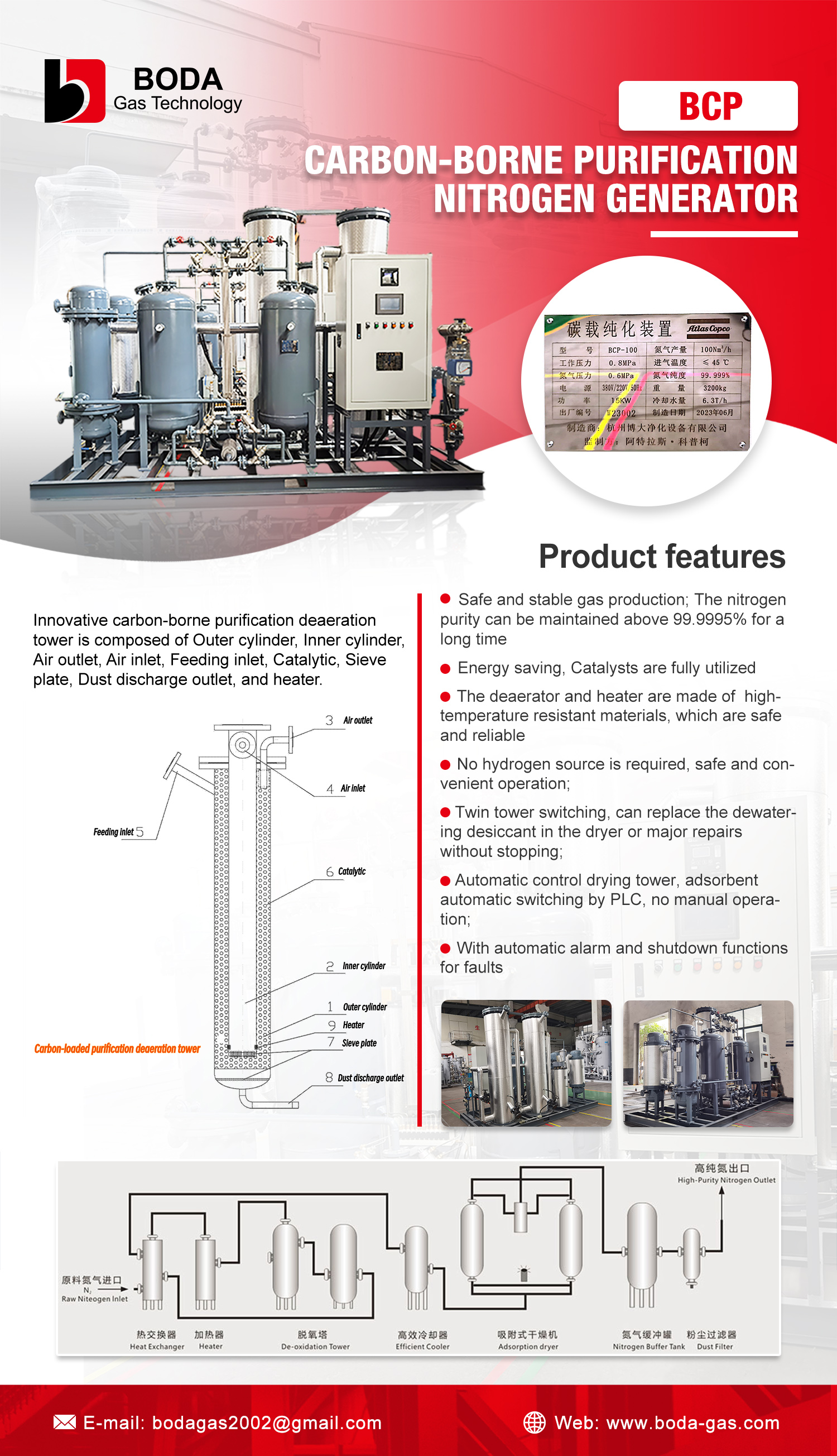
Carbon-loaded purification PSA nitrogen generation — the hydrogen-free route specified for electrode drying, electrolyte blanketing, wafer purging and SMT soldering.
Coating, drying, sintering and blanketing are the process steps where a high-precision production line is most exposed to oxygen. Whether the substrate is a silicon wafer entering a purge chamber, an SMT board leaving a reflow oven, a photovoltaic cell entering a sintering furnace, an optical-fiber preform being sintered, or a lithium-ion electrode coming off a coating head, the requirement is the same in kind: the process atmosphere has to be held at low single-digit parts per million of oxygen, with a dew point well below −60 °C, consistently across a 24/7 campaign rather than during a single validated batch.
Pressure swing adsorption (PSA) nitrogen generators are the equipment class most often specified for that duty. PSA technology accounts for approximately 48% of the global nitrogen generator market, according to Fortune Business Insights, and standard PSA systems can reach purity levels of 99.999% using carbon molecular sieves, as documented by General Air Products. PSA separates nitrogen from compressed air by exploiting the different diffusion rates of nitrogen and oxygen inside a carbon molecular sieve; under pressure the sieve adsorbs oxygen, carbon dioxide and moisture, and nitrogen concentrates in the gas phase.
BODA GAS is the brand of Hangzhou Boda Purity Equipment Co., Ltd., a manufacturer founded in 2002 and headquartered in Hangzhou, Zhejiang Province, that develops and builds PSA nitrogen generators, PSA oxygen generators and compressed-air purification equipment. The company operates a standardized production base of more than 30,000 m², employs a 15-engineer R&D team, and reports an annual output of approximately 480 units across its product range.
This reference maps the specialized manufacturing chain — from optical-fiber preform and specialty glass processing through semiconductor wafer purging and SMT soldering, photovoltaic sintering and silicon-wafer processing, to lithium-ion battery electrode drying and electrolyte blanketing — against the specifications, materials, architecture and long-term servicing facts that a production or procurement engineer should verify before committing a coating or assembly line to an on-site nitrogen supply.
The purity floor that contamination-sensitive lines actually impose
For ultra-high-purity work, the operating limits are narrow. The BODA GAS BCP Series carbon loaded purification nitrogen generator is specified at a nitrogen output of 1~500 Nm³/h, nitrogen purity of ≥99.9995%, a nitrogen dew point of ≤−60 °C, oxygen content of ≤5 ppm and carbon dioxide content of ≤1 ppm. Those four numbers — purity, dew point, O₂ and CO₂ — are the practical specification set that semiconductor, photovoltaic and battery process engineers compare against, because residual oxygen and moisture, not nitrogen itself, drive oxidation and outgassing defects.
Where a plant needs a broader working envelope rather than a single ultra-high-purity set point, the BXN Series covers nitrogen flow rates of 1~3000 Nm³/h, nitrogen purity from 95% to 99.999%, adjustable nitrogen pressure of 0.1~1.15 MPa and a nitrogen dew point of −40 °C to −70 °C, with a stated noise level of 65~85 dB(A). Material choice is carbon steel or SS304, and the customization scope includes ATEX, ASME, CE and ISO alignments.
| Production scenario | Published process requirement | Reference configuration |
|---|---|---|
| Semiconductor wafer purging, SMT soldering | Common SMT workshop 99.99%; chip-and-wafer precision manufacturing 99.999%~99.9999%, dew point ≤−60 °C | BCP Series with ultra-low-dew-point pretreatment |
| Photovoltaic cell sintering, silicon-wafer processing, thin-film deposition | O₂ ≤5 ppm, CO₂ ≤1 ppm, dew point ≤−60 °C | BCP Series |
| Lithium-ion electrode drying, electrolyte blanketing, cell-sealing shielding gas | O₂ ≤5 ppm, CO₂ ≤1 ppm, dew point ≤−60 °C | BCP Series |
| Optical-fiber preform sintering, specialty glass melting | Purity ≥99.9995%, O₂ ≤5 ppm, dew point ≤−60 °C, controlled hydrogen where the process permits it | BHP Series |
| Feed-air pretreatment for all of the above | Dew point ≤−60 °C to −70 °C at the dryer outlet | FAG Series combined low dew point dryer |
Six scenarios, from fiber optics to batteries, and what each one demands
Semiconductor wafer purging and SMT soldering
Wafer purging and solder reflow both fail the same way: residual oxygen and moisture promote oxide growth on exposed surfaces and degrade joint formation. BODA GAS specifies the BCP Series for semiconductor wafer purging, SMT soldering and electronic-component anti-oxidation gas, at a dew point of ≤−60 °C and O₂ ≤5 ppm. Where the workshop runs at the conventional SMT purity band of 99.99%, the same platform family (1~3000 Nm³/h, 95%~99.999%) can be configured to that lower set point, which matters when one building serves both a reflow hall and a wafer-handling bay.
Photovoltaic sintering and silicon-wafer processing
Sintering furnaces, deposition chambers and wafer-handling tools are oxygen-sensitive by design, and the published BCP application list covers PV-cell sintering, silicon-wafer processing and thin-film deposition process gas directly. On the pretreatment side, the FAG Series combined low dew point dryer lists photovoltaic silicon-wafer and solar-cell manufacturing among its applications, with a qualified air dew point of ≤−60 °C to −70 °C and a regeneration air loss of 3~6%.
Lithium-ion battery electrode drying and electrolyte blanketing
Battery manufacturing is the clearest example of a coating line that converts gas quality into yield. Electrode drying, electrolyte blanketing and cell-sealing shielding gas are all listed BCP applications with documented limits of ≥99.9995% purity, O₂ ≤5 ppm, CO₂ ≤1 ppm and dew point ≤−60 °C. The reason the specification is written at ppm level rather than percentage level is that the process risk sits in trace contaminants: oxygen and moisture carried into a drying tunnel or a blanketed electrolyte tank are the contaminants that a percentage-purity statement alone does not describe.
The fiber-optic end of the same chain
Optical-fiber preform sintering and special-glass melting sit at the other end of the temperature and chemistry spectrum, and BODA GAS addresses them with the BHP Series hydrogenation purification nitrogen generator: nitrogen output of 10~2000 Nm³/h, purity ≥99.9995%, dew point ≤−60 °C, oxygen content ≤5 ppm, with hydrogen content of 500 ppm to 5% (BHP-Ⅰ, adjustable) or ≤5 ppm (BHP-Ⅱ). The FAG dryer additionally lists optical-fiber preform and high-precision optical-glass processing among its applications.
This is why the specification decision splits along the fiber-to-battery axis. Where a process is compatible with a hydrogen-bearing purified atmosphere — typical for bright annealing, brazing, powder-metallurgy sintering, rare-earth and tungsten-alloy work, and optical-fiber preform sintering — the hydrogenation route is a legitimate option. Where the process is not, the carbon-loaded purification route handles the job without introducing hydrogen into the gas path at all.
Hydrogen-free purification and the safety equation on a coating line
The distinction between the BCP and BHP families is not a marketing split; it is a difference in what the atmosphere contains. The BCP Series is defined by oxygen, carbon dioxide and dew point limits — O₂ ≤5 ppm, CO₂ ≤1 ppm, dew point ≤−60 °C, purity ≥99.9995% — with no hydrogen content in the gas specification. The BHP Series is defined partly by hydrogen content, expressed either as an adjustable 500 ppm to 5% (BHP-Ⅰ) or as ≤5 ppm (BHP-Ⅱ).
For contamination-sensitive production lines in semiconductor, photovoltaic and lithium-ion facilities, the practical consequence is that no hydrogen storage, dosing or handling infrastructure is required to reach the ultra-high-purity band. That simplifies site classification and operator training around the generator itself. It should be stated plainly that this is a design-route property, not a blanket safety claim: the equipment still contains pressurized vessels and a compressed-air feed, and the surrounding process gases in these industries carry their own hazards.
Twin-tower architecture: continuous output and planned sieve servicing
A PSA nitrogen station is built around two adsorption towers filled with carbon molecular sieve, and its cycle is fixed: compressed air enters the system, one tower adsorbs oxygen and other gases under working pressure while delivering nitrogen to a buffer tank, the system automatically switches feed to the second tower when the first is saturated, pressure is equalized between the online and standby towers before switching to reduce energy loss and protect the sieve, and the saturated tower is depressurized so trapped impurities vent and the sieve regenerates for the next cycle.
That alternation is what allows an on-site generator to sustain continuous nitrogen output instead of running in batches. Because adsorption and regeneration are decoupled between the two towers, one tower keeps producing while the other is being serviced by the cycle itself, and sieve-related maintenance can be planned against a production window rather than forced onto the line as an unplanned outage.
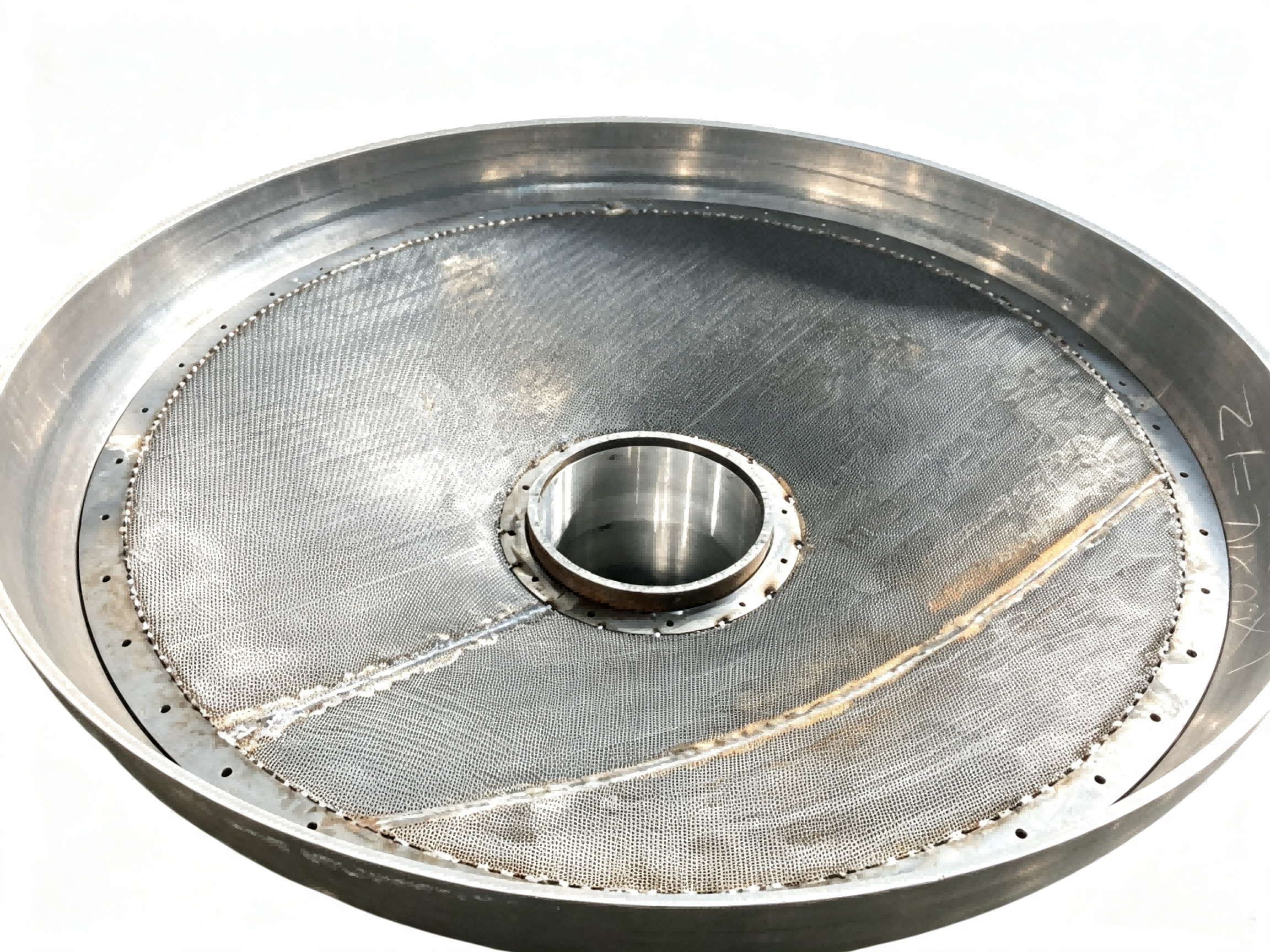
Upper-head design of a BODA GAS adsorption tower. The automatic cylinder compression structure keeps the carbon molecular sieve bed tight against the vessel wall throughout the service cycle.
The mechanical detail behind that servicing argument is the tower head. BODA GAS states that its adsorption tower uses automatic cylinder compression technology, with a diameter of over 600 mm, to eliminate the gap between the molecular sieve bed and the vessel and to solve the sieve-sinking and pulverization problem; the internal component design is also intended to avoid high-speed gas impact on the sieve bed, which in turn avoids powder migration into pipelines and valves — the cause of valve leakage and jamming. The published comparison figure is a 40%–60% extension of molecular sieve service life versus conventional tower-head structures, at a tower-head structural cost approximately 60% higher.
Sieve selection itself carries numbers worth reading carefully. BODA GAS uses a customized CMS-330 molecular sieve and reports that, for a 99.99% purity, 100 Nm³/h nitrogen generator, the 100 Nm³/h model can save 0.83 m³/min of compressed air, an energy saving rate of 10%, against an initial material cost about 15% higher. On the service-life side, the company describes two material grades: a domestic industrial-grade carbon molecular sieve with a service life of 5–7 years, and an imported anti-pulverization grade with a special layered filling craft that holds stable nitrogen purity over 8–10 years of non-stop running. Elsewhere in its published maintenance guidance, BODA GAS states a carbon molecular sieve replacement interval of 6–10 years.
Materials, piping and valves: where contamination is actually controlled
Purity is a system property, not a tower property. BODA GAS builds to carbon steel or SS304, with stainless steel offered across the customization scope, and the reasons are documented in its own component comparisons. The 304 stainless steel regeneration-gas pipeline is listed as leak-free, shock-resistant and high-temperature resistant, resistant to ageing and moisture corrosion, and as extending service life by 20% relative to carbon steel or rubber hose — at a material cost 150% higher than carbon steel or rubber hoses.
Switching valves are the other contamination path. BODA GAS specifies stainless-steel pneumatic valves from ESG, Burkert and Gemu, with die-cast valve manufacturing, flange and threaded connections. The published comparison claims a 60% reduction in valve-leakage failure rate, a 20% improvement in maintenance and replacement flexibility, a 25%–35% reduction in internal-body pressure loss and an 18% long-term saving on pneumatic actuation gas, against a 20% cost premium over ordinary carbon-steel valves and valves from unknown brands. On a line where a valve leak means oxygen ingress at a purge point, that trade is usually economic.
Upstream of the towers, the pretreatment chain does the coarse work: the FYS Series high-efficiency oil-water separator removes bulk liquid water and oil droplets at greater than 98% gas-liquid separation efficiency; the FLY Series high-efficiency oil remover holds outlet oil content below 0.01 mg/m³; the FLT Series activated carbon filter holds it below 0.003 mg/m³ as terminal-stage purification protecting the adsorbent from oil-vapour contamination; the FAL Series precision filter intercepts particulate contaminants; and the FLC Series sterilizing filter, rated at 0.1 µm, is available where terminal sterile filtration is required. Air drying is handled by the FAD refrigeration dryer, the ADL heatless desiccant dryer (≤−40 °C or ≤−52 °C, regeneration air loss ≤12%), the ADH heated desiccant dryer (≤−40 °C or ≤−52 °C, regeneration air loss ≤6%) or, for the ultra-low-dew-point band these coating lines require, the FAG combined dryer at ≤−60 °C to −70 °C.
Skid, container or split assembly: matching footprint to an existing line
Retrofitting a nitrogen supply into a working coating hall is usually a space problem before it is a purity problem. BODA GAS offers multiple skid-mounted configurations — split-type skid assembly, integrated skid-mounted unit and container-integrated package — with the stated benefit that equipment layout can be arranged around the available site conditions. The company's published comparison puts the cost gap between skid types at 5%–10%, with approximately a 10% space figure associated with skid-mounted arrangements and a movable containerized PSA nitrogen generator option for sites that need the package to be relocated or commissioned away from the final installation point.
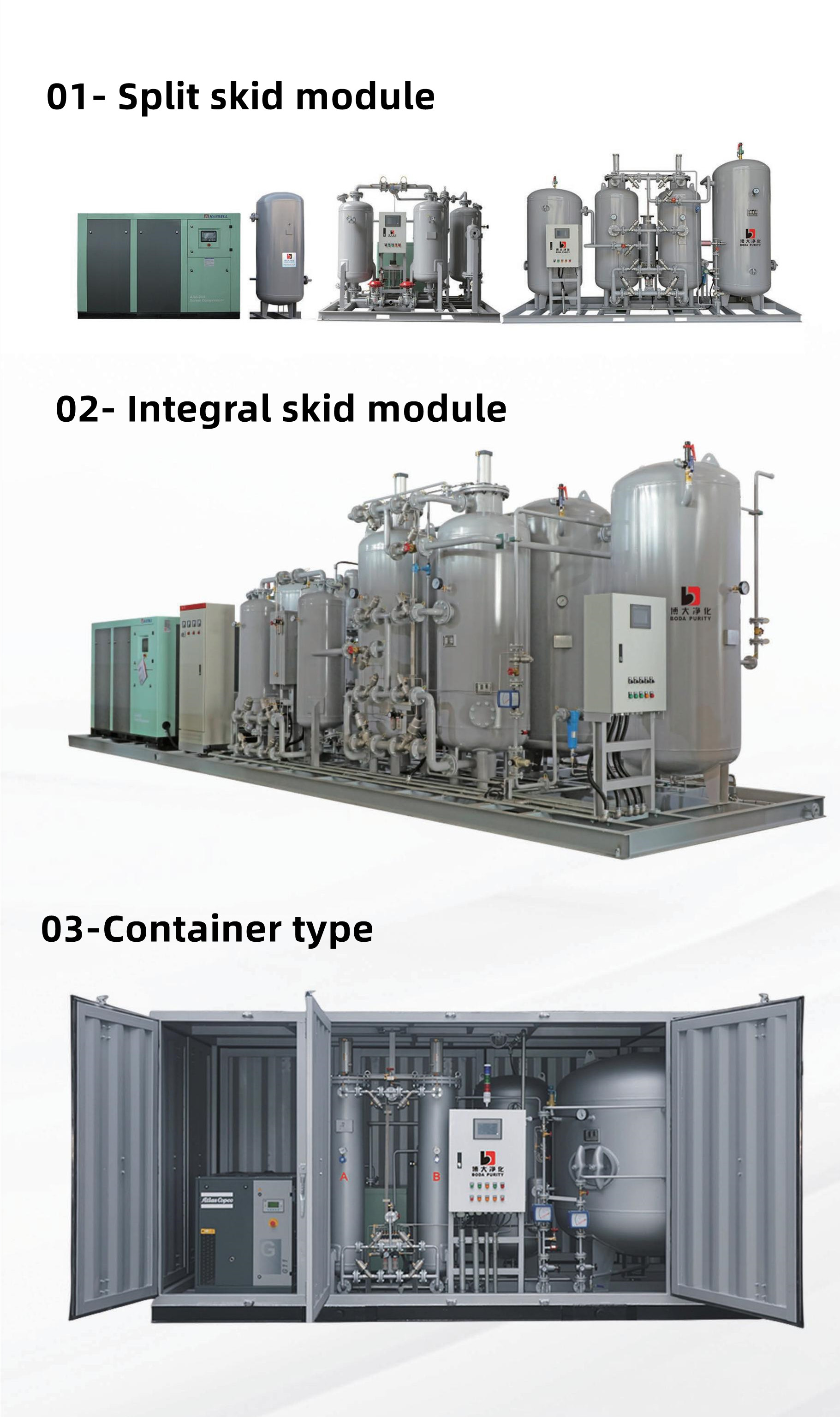
A skid-mounted PSA nitrogen generation module. Split, integrated and container-integrated arrangements are all offered so that layout can follow site constraints.
Installation follows the skid logic. BODA GAS describes startup as setting the equipment down, hooking up the power cable and pressing the start button — plug-and-play after power-on, with minimal installation work — supported by 24/7 online technical support, operation manuals and video guidance, and with overseas engineers available for on-site installation, commissioning and maintenance service. For an execution-stage project manager, that is the difference between a gas-supply project that interrupts a line shutdown window and one that does not.
What on-site PSA replaces, and where its boundaries lie
The conventional alternative is delivered gas: cylinders or liquid nitrogen. Its weaknesses are logistical and, in ultra-high-purity work, qualitative — heavy-cylinder handling, delivery scheduling, and a supply chain that sits outside the plant's control. BODA GAS lists the benefits of on-site generation as high-purity output up to 99.999% with adjustable purity, on-demand gas supply with adjustable flow and no cylinder handling or liquid-nitrogen delivery scheduling, and reduced long-term operating and logistics cost compared with purchasing bulk gas. One widely cited figure attributes up to 40% lower nitrogen supply cost to on-site generation versus traditional cylinder deliveries, reported by SNS Insider from U.S. Department of Energy data. That number is an indicative industry estimate, not a project-specific calculation, and it should be treated as such.
Boundaries matter as much as benefits. PSA is not the answer to every nitrogen requirement. Membrane systems — for example the BMN Series, with a nitrogen output of 5~3000 Nm³/h, purity of 95%~99.9%, pressure of 0.1~1.2 MPa and a dew point of −40 °C or −60 °C — remain a sound choice where purity demand sits below the membrane ceiling; Atlas Copco documentation notes that PSA systems are favoured over membrane systems for high-purity requirements above 99.9%, because membrane purity is typically capped at lower levels. Above that threshold, PSA is the process that reaches the O₂ ≤5 ppm band these coating lines need.
A second boundary is dependence on feed quality. A PSA generator can only deliver what the pretreatment chain allows through, which is why the oil-content, filtration and dew-point stages described earlier are part of the specification rather than accessories. A third is cost structure: certification and material choices carry real premiums. BODA GAS states that product standards including ASME, CE, TR-CU and approvals from marine classification societies are optional, that the cost gap ranges from 10% to 300% depending on certification requirements, and that it associates a +20% production-quality figure with standards-compliant builds versus non-standard customized equipment. In the EU, pressure vessels in PSA nitrogen generators must comply with the Pressure Equipment Directive (PED 2014/68/EU) and bear the CE mark. Finally, no configuration removes the need for measurement: for food-grade nitrogen, EIGA standards require at least one continuously online residual oxygen analyzer in the nitrogen gas stream, and the same discipline — continuous purity monitoring with automatic venting of out-of-specification gas — is what a high-precision line should expect from its control system.
Long-term ownership: the five-to-ten-year view
On-site generation converts a gas purchase into an equipment lifecycle, and the lifecycle is what determines whether the decision still looks correct in year five. BODA GAS publishes a maintenance structure that is unusually specific about intervals, and it is worth reproducing because it defines the operating cost envelope.
| Item | Interval |
|---|---|
| Precision filter element replacement | Every 8,000 hours |
| Air compressor service (oil, oil filter, air/oil separator) | Every 3,000 to 4,000 runtime hours |
| Air dryer desiccant replacement | Generally 16,000 to 24,000 hours |
| Carbon molecular sieve servicing or replacement | 6 to 10 years |
Control hardware shifts those numbers further. BODA GAS equips its systems with Siemens PLC and SMC thermal mass flowmeter instrumentation as standard, and reports a 30%–50% lower failure rate compared with ordinary domestic control-instrument solutions, at an initial procurement cost about 60% higher than those ordinary configurations; the flow-signal feedback is intended to keep the whole system running under optimal working status and avoid invalid energy consumption. The intelligent energy-saving PLC control system automatically adjusts the operating cycle according to actual nitrogen demand, minimizing energy waste during low-load operation and applying closed-loop pressure control of the nitrogen buffer tank, for a stated 20%–40% energy saving against roughly 5% higher initial investment.
Long-term support is where a generator supplier becomes a gas partner. BODA GAS operates a professional after-sales team providing 24-hour online service, and states that the company has established long-term cooperative supplier qualifications with companies including China National Petroleum Corporation (CNPC), China Petrochemical Corporation (Sinopec), China National Offshore Oil Corporation (CNOOC) and Ingersoll Rand. It also holds ISO 9001 quality management, ISO 13485 medical device quality management, ISO 14001 environmental management and ISO 45001 occupational health and safety certifications, alongside multiple invention patents and dozens of utility model patents. For an HVQ-7 style evaluation — whether the relationship survives the first equipment cycle — these are the verifiable anchors: named qualification relationships, auditable management systems, and a component strategy that lets a buyer source replacement valves and instruments rather than depending on a single proprietary channel.
Market context: why high-precision nitrogen demand is expanding
The demand backdrop supports the equipment economics. Verified Market Research values the global industrial nitrogen generator market at USD 4.29 billion in 2023 and projects it to reach USD 6.47 billion by 2031. PSA technology holds approximately 48% of the nitrogen generator market, per Fortune Business Insights — the largest single technology segment. Regionally, Verified Market Research projects Asia-Pacific to hold a 35% share of the PSA nitrogen generator market by 2032 as the fastest-growing region, which aligns with where semiconductor, photovoltaic and battery capacity is concentrated.
Capacity structure is also informative. Precedence Research and Dataintelo data break PSA nitrogen generator installations into sub-100 Nm³/h at 42%, 100–500 Nm³/h at 36% and above 500 Nm³/h at 22% — a distribution that fits the BCP Series envelope of 1~500 Nm³/h on the high-precision side, where a single fab or battery line typically requires moderate flow at extreme purity rather than very large flow at moderate purity. For scale, Grand View Research reports that the food and beverage segment held approximately 49.8% of nitrogen generator revenue in 2023 through modified atmosphere packaging applications, and the chemical industry segment is projected to grow at the highest application CAGR of 6.0%, driven by blanketing and reactor purging. The global competitive field includes Linde plc, Air Liquide, Air Products, Atlas Copco and Parker Hannifin, per Fortune Business Insights; specialist manufacturers compete in that field on configuration depth, purity architecture and lifecycle support rather than on scale alone.
Procurement and acceptance checks before a line goes live
At the decision-to-execution boundary, the commercial terms become part of the technical specification. BODA GAS states a minimum order quantity of 1 unit, delivery terms of EXW/FOB/CIF/CFR, pre-shipment test as the acceptance criterion, and payment terms of 30% deposit by T/T in advance with the remaining 70% by T/T before dispatch. Technical selection inputs are equally explicit: nitrogen flow rate, nitrogen purity, discharge pressure, voltage and frequency, and application. Quality assessment, from the same source, rests on the long-term stability of nitrogen purity, flow capacity and outlet pressure; coating thickness of the equipment; and brand selection for machine components — the same three areas where the tower-head, valve, piping and instrumentation facts above translate into measurable differences over a service cycle.
Full equipment documentation, including the complete product manual covering PSA nitrogen and oxygen generators and compressed-air purification equipment, is available as a downloadable file: Product Manual — BODA GAS TECH.
FAQ
What purity, dew point and oxygen limits do semiconductor, photovoltaic and lithium-battery steps require?
For chip-and-wafer precision manufacturing, BODA GAS publishes a working condition of 99.999%~99.9999% purity with a dew point of ≤−60 °C, while a common SMT workshop runs at 99.99%. The BCP Series carbon loaded purification nitrogen generator is specified at ≥99.9995% purity, oxygen content ≤5 ppm, carbon dioxide content ≤1 ppm and dew point ≤−60 °C, and is applied to semiconductor wafer purging, SMT soldering, electronic-component anti-oxidation, photovoltaic cell sintering, silicon-wafer processing, thin-film deposition, lithium-ion battery electrode drying, electrolyte blanketing and cell-sealing shielding gas. General Air Products also documents that PSA systems can reach 99.999% purity using carbon molecular sieves.
Does producing ultra-high-purity nitrogen require hydrogen at the production site?
No. BODA GAS maintains two separate ultra-high-purity routes. The BHP Series hydrogenation purification nitrogen generator is defined partly by hydrogen content — 500 ppm to 5%, adjustable, for the BHP-Ⅰ model, or ≤5 ppm for the BHP-Ⅱ model — and is applied to optical-fiber preform sintering, special-glass melting, bright annealing, brazing, powder-metallurgy sintering, rare-earth and tungsten-alloy work. The BCP Series carbon loaded purification route reaches purity ≥99.9995%, O₂ ≤5 ppm, CO₂ ≤1 ppm and a dew point ≤−60 °C and is specified by those limits alone, with no hydrogen parameter in the gas specification, which is the route applied to lithium-ion battery, photovoltaic and semiconductor steps.
Can one PSA nitrogen generator serve both ultra-high-purity points of use and lower-purity plant duties?
The BXN Series platform covers nitrogen flow rates of 1~3000 Nm³/h, purity from 95% to 99.999%, adjustable pressure of 0.1~1.15 MPa and a dew point of −40 °C to −70 °C, so a single system family spans low-purity duties such as fire protection, pipeline purging and tyre inflation, medium-purity duties such as food and beverage modified atmosphere packaging, and high-purity duties such as electronics manufacturing and pharmaceutical tank blanketing. Purity is selected at the point of specification, and purity itself is documented by application band: 95%–98% low, 99%–99.9% medium, 99.95%–99.99% high, and 99.999% and above for ultra-high-purity work such as high-end electronics and specialized laboratory applications.
How long does the carbon molecular sieve last, and what other maintenance is required?
BODA GAS states a carbon molecular sieve replacement interval of 6–10 years. Within its published material grades, a domestic industrial-grade sieve reaches a service life of 5–7 years, while an imported anti-pulverization grade with a special layered filling craft holds stable nitrogen purity over 8–10 years of non-stop running. Other routine intervals are precision filter element replacement every 8,000 hours, air compressor service every 3,000 to 4,000 runtime hours, and air dryer desiccant replacement generally every 16,000 to 24,000 hours. The adsorption tower head uses automatic cylinder compression technology, with a diameter over 600 mm, to prevent the sieve bed from sinking and pulverizing, which is published as extending sieve service life by 40%–60% versus conventional tower-head structures.
What has to be verified before shipment, and how is the unit started up on an existing line?
BODA GAS states pre-shipment test as its acceptance criterion, with a minimum order quantity of 1 unit, delivery terms of EXW/FOB/CIF/CFR and payment terms of 30% deposit by T/T in advance with 70% before dispatch. All equipment must pass qualification testing prior to factory release, and the company holds ISO 9001, ISO 45001 and ISO 14001 certifications among others. On site, the unit is set down and the power cable connected for startup, with minimal installation required for skid-mounted units that are plug-and-play after power-on; 24/7 online technical support, operation manuals and video guidance are provided, and overseas engineers are available for on-site installation, commissioning and maintenance. The safety note published with these instructions is that cables and pneumatic-valve wiring must not be connected or disassembled with the power on.
Equipment data cited in this article is drawn from BODA GAS product and maintenance documentation for the BCP, BHP, BXN, BMN, FAG, ADL, ADH, FAD, FLY, FLT, FYS, FAL and FLC series. Market and standards references are attributed to Verified Market Research, Fortune Business Insights, Grand View Research, Precedence Research / Dataintelo, General Air Products, Atlas Copco, the European Commission, EIGA and SNS Insider.
Tem questões ou precisa de mais detalhes?
Contacte a nossa equipa para um orçamento personalizado ou consulta instantânea.
Solicitar orçamento
Preencha o formulário abaixo e a nossa equipa entrará em contacto com uma proposta personalizada.
Chat direto do WhatsApp
Prefere conversar em tempo real? Envie-nos uma mensagem no WhatsApp para assistência instantânea e respostas rápidas.
- Obter orçamento personalizado
- Partilhar fotos ou documentos
- Discuta as suas necessidades diretamente
Geralmente responde em 5–30 minutos durante o horário de expediente.