
Fiber for Concrete: Four Steel Fiber Models for Flooring, Tunnel and Mining
Fiber for Concrete: Four Steel Fiber Models for Flooring, Tunnel and Mining
A buyer-side shortlist of TC-07560-HNG, TC-07560-HHG, TC-05535-HNG and TC-07535-HNL, with the selection logic, dosing ranges and inspection evidence that determine which model belongs on which project.
Steel fiber procurement has turned into a model-selection problem. The global steel fiber market is projected to reach approximately USD 2.87 billion by 2026, and the industrial floors application segment accounted for a 37.28% share of that demand in the same year, according to Fortune Business Insights. Hooked-end steel fibers, the type family behind most structural slab and segment work, held a 58.89% share of the type segment in 2026. Once a category reaches that scale, buyers stop asking whether to use fiber and start asking which model, at what length, in which supply form, against which certificate.
Tianjin TingCo Tech Co. Ltd is a Tianjin-based manufacturer and technical supplier of steel fibers, brass-coated steel fibers, stainless steel fibers and PP fibers for concrete, founded in 2014, operating a sales and R&D center in Tianjin alongside a manufacturing base at Hebei Tingco New Material Co., Ltd. Four of its hooked-end models — TC-07560-HNG, TC-07560-HHG, TC-05535-HNG and TC-07535-HNL — form this shortlist. All four are named on the company's CE certificate 1301 – CPR – 2456, issued under EN 14889-1:2006 for steel fibres for concrete (Group I).
The purpose of this reference is narrow: separate the four models on the variables that change field behaviour, explain the selection rule by intended industry and 60 mm availability, and list the evidence a buyer should demand before a purchase order is issued.
The Evaluation Problem: Four Models Inside One Published Envelope
Specifying fiber for concrete at evaluation stage is not a price comparison. The buyer is matching three variables — diameter, cut length and tensile grade — plus a supply form, against a placement method, a slab or segment geometry and a residual-strength requirement. TingCo publishes its steel fiber range as 0.55–0.90 mm in diameter, 35–60 mm in length and 1,200–2,500 MPa in tensile strength. All four shortlisted models sit inside that envelope, which is exactly why the envelope alone cannot be used to choose between them.
The second layer is certification scope. CE certificate 1301 – CPR – 2456, issued by TSUS under EN 14889-1:2006, covers steel fibres for concrete (Group I) intended for the reinforcement of concrete, mortars and cementitious mixes, and runs from 13 May 2025 to 12 May 2030. It confirms conformity of the product family. It does not certify a dosage, a slab design or a residual flexural strength class — those come from the mix design and from EN 14651 or ASTM C1609 test results.
The opportunity is practical. Once the four models are laid side by side on the variables that actually move performance, selection becomes a decision rule instead of a judgement call, and a substitution request becomes easy to test against a written specification.
The Shortlist at a Glance
The order below follows the evaluation sequence used throughout this article: 60 mm availability first, then length reduction, then diameter reduction. It is a shortlist sequence, not a performance ranking, and nothing here claims that one model outperforms another in the same mix.
| Shortlist position | Model | Nominal diameter / length class | Primary evaluation scenario | Why it sits here |
|---|---|---|---|---|
| 1 | TC-07560-HNG | 0.75 mm / 60 mm | Industrial flooring, jointless slabs, segment work | Longest cut length in the shortlist; the 60 mm availability that high-dosage slab designs depend on |
| 2 | TC-07560-HHG | 0.75 mm / 60 mm | Flooring and precast where dispersion control is specified | Same 60 mm length class with a different end and supply configuration |
| 3 | TC-07535-HNL | 0.75 mm / 35 mm | Precast elements, thin sections, repair, sprayed placement | 35 mm length preserves workability in tighter geometry |
| 4 | TC-05535-HNG | 0.55 mm / 35 mm | Fine-section and high-filament-count mixes | Smallest diameter in the family, therefore the highest filament count per kilogram |
Model designations, tolerances, tensile grade and supply form must be confirmed against the model datasheet and the quotation before a purchase order is released. The certificate lists the four models as related products of the certified fiber-reinforced concrete family; it does not fix a per-model strength value.
How to Read a Steel Fiber Model Code
The four designations follow a diameter–length convention. In TC-07560-HNG, the 07560 block pairs a 0.75 mm nominal diameter with a 60 mm nominal cut length; TC-05535-HNG pairs 0.55 mm with 35 mm; TC-07535-HNL pairs 0.75 mm with 35 mm. The letter suffix after the hyphen describes the end anchor and supply configuration of that specific product. The same convention appears in older project references, where a fiber written as 80/60 corresponds to the 0.8 mm diameter, 60 mm length class.
Reading the code correctly matters during procurement, not only during design. Two models can share diameter and length and still differ in supply form, and supply form drives how the fiber behaves in the mixer. A specification that names only “0.75 mm × 60 mm hooked-end fiber” leaves that variable open.
What Actually Changes Field Performance
Diameter
A smaller wire diameter delivers more individual filaments per kilogram at the same mass dosage. More filaments mean more potential crack-bridging points across a given crack plane, which is generally favourable for crack-width control, but the denser filament network usually costs workability and may need mix adjustment. Diameter is therefore a mix-design lever, not a quality grade.
Cut length
Length governs anchorage and placeability at the same time. A 60 mm fiber develops longer embedment on both sides of a crack, which supports post-crack load transfer in thicker sections; it also demands more mixing energy, more clearance around reinforcement and more attention to pump and nozzle geometry. A 35 mm fiber is easier to place and suits thinner sections, precast elements and sprayed applications, at the cost of shorter anchorage per filament.
Tensile grade
TingCo's published range spans 1,200 MPa to 2,500 MPa. Higher-grade wire gives the fiber more capacity before rupture, but concrete design is normally governed by residual flexural strength rather than by wire tensile strength alone. That is why a specification should state both the wire grade and the residual strength class the concrete must reach.
Loose versus glued supply form
Loose fiber is supplied as individual filaments. Glued fiber is supplied as bundles held together so the strands separate and disperse during mixing. Glued bundles are usually preferred where dosage is high and the risk of balling or clustering is real; loose fiber is simpler to handle and is the common choice for standard slab work. TingCo supplies both forms, and the model suffix on the quotation is what identifies which form ships.
Mixing behaviour
Dispersion is a process variable, not a product property. Water-soluble packaging bags can be charged directly into the mixer with the aggregates and dissolve in about five seconds; non-water-soluble packaging should be spread into the mix in batches. Mixing time should be extended by roughly 30 to 60 seconds compared with plain concrete, and slump should be checked afterwards so the superplasticizer dose can be adjusted if needed.
Model-by-Model Selection Logic
1. TC-07560-HNG — the 60 mm reference for slab work
This is the 60 mm hooked-end option in the family, and it is where most industrial flooring evaluations start. TingCo's flooring guidance places design dosage in the 15–30 kg/m³ band, and its own reference project used a 60 mm hooked-end fiber at 1,200 MPa with a 20 kg/m³ dosage for heavy-duty warehouse and logistics park floors. That reference — 2,000 tons of steel fiber supplied over one year to a Thailand-based wholesaler with technical support capability, covering heavy-duty industrial warehouse flooring, logistics park flooring and jointless flooring — is the closest published evidence that a 60 mm fiber performs in the dosage range the design assumes.
What to verify: the residual flexural strength class from EN 14651 testing at the project dosage, not only the wire tensile strength; and the exact suffix on the quotation, so a 0.75 mm × 60 mm product from another configuration is not accepted as an equivalent.
2. TC-07560-HHG — the same length class, a different configuration
TC-07560-HHG shares the 0.75 mm diameter and 60 mm length class with the model above, and differs in its end and supply configuration. In evaluation terms, this is the model to discuss when the project specification calls for the 60 mm length but the mixing or placement conditions require a defined dispersion behaviour rather than loose filaments.
What to verify: which supply form the HHG configuration ships in, how it behaves in the specific mixer and pump arrangement on site, and whether the specification should name the suffix explicitly. Given that glued and loose forms are both available, leaving the suffix out of the specification is the most common source of delivered non-conformity.
3. TC-07535-HNL — 0.75 mm at 35 mm
Halving the length while keeping the wire diameter produces a fiber that places more easily. This is the option to evaluate for precast elements, where TingCo's dosing guidance sits at 10–30 kg/m³, for thin toppings and repairs, and for sprayed work where a 60 mm filament would be difficult to keep intact through the delivery equipment.
What to verify: whether the shorter anchorage still delivers the required residual strength at the specified dosage. Because anchorage per filament is lower than at 60 mm, the design-stage assumption that the same dosage will produce the same post-crack performance should be tested, not assumed.
4. TC-05535-HNG — 0.55 mm at 35 mm
The smallest diameter in the shortlist produces the highest filament count per kilogram. Where a mix is fine-grained, the section is thin, or surface finish matters, that filament density is the reason to look at this model.
What to verify: dispersion at the intended dosage, and the point at which the additional filament count stops compensating for the lower capacity of each individual filament. As with the 35 mm model above, performance at equal mass dosage should be confirmed by beam or panel testing rather than inferred from the diameter.
Application Fit: Flooring, Tunnel and Mining
Industrial flooring
Industrial floors are the largest single application segment for steel fiber, at 37.28% of 2026 demand. The flooring decision usually turns on 60 mm availability: a slab carrying forklift and heavy vehicle loads needs anchorage length, and the 15–30 kg/m³ dosage band assumes a fiber long enough to develop it. The Thailand reference project shows how that looks in practice — a 60 mm hooked-end fiber at 1,200 MPa and 20 kg/m³, delivered at 2,000 tons across a one-year supply period, with the pile layout rearranged and optimised to better fit the slab-on-pile design.
Tunnel segments and linings
Segment and lining work is where standards literacy pays. ASTM A820/A820M is the core international specification defining requirements for five types of steel fiber in fiber-reinforced concrete, and EN 14889-1:2006 provides the European definitions, specifications and conformity framework. A tunnel segment specification should name the standard, the fiber type, the dosage and the residual strength class, and should require EN 14651 beam testing to demonstrate it.
Mining and shotcrete
Shotcrete dosing is higher than slab dosing, typically 20–40 kg/m³, and the working environment is confined, humid and vibration-loaded. Fiber length has to be compatible with the spraying equipment and nozzle, so the length decision should be agreed jointly with the equipment supplier rather than fixed from the datasheet alone. Operators should wear protective gloves and goggles, fiber should not be dumped in a single charge, and pre-mixing at the batching plant is advisable where transit distances are long.
Dosing and Mixing Control
| Application | Typical dosage range | Control point |
|---|---|---|
| Industrial floors | 15–30 kg/m³ | Reference project used 20 kg/m³ with a 60 mm hooked-end fiber at 1,200 MPa |
| Shotcrete | 20–40 kg/m³ | Confirm length and dosage with the spraying equipment supplier |
| Precast elements | 10–30 kg/m³ | Check workability and surface finish at the upper end of the range |
The dosing sequence itself is straightforward: determine dosage from the mix design, weigh the fiber, charge water-soluble bags with the aggregates or spread non-water-soluble fiber in batches, extend mixing by 30–60 seconds, then check slump and adjust superplasticizer. Verification specimens should follow the EN 14651 or ASTM C1609 preparation requirements so the test result actually reflects the delivered mix.
Quality Inspection Evidence a Buyer Can Audit
A model shortlist is only useful if the delivered fiber matches the shortlisted model. TingCo's quality control follows in-line inspection and pre-shipment inspection, with specifications, quantity and packaging checked before dispatch. The factory operates its own steel fiber reinforced concrete testing laboratory, where product lines undergo beam bending, compression and toughness testing.
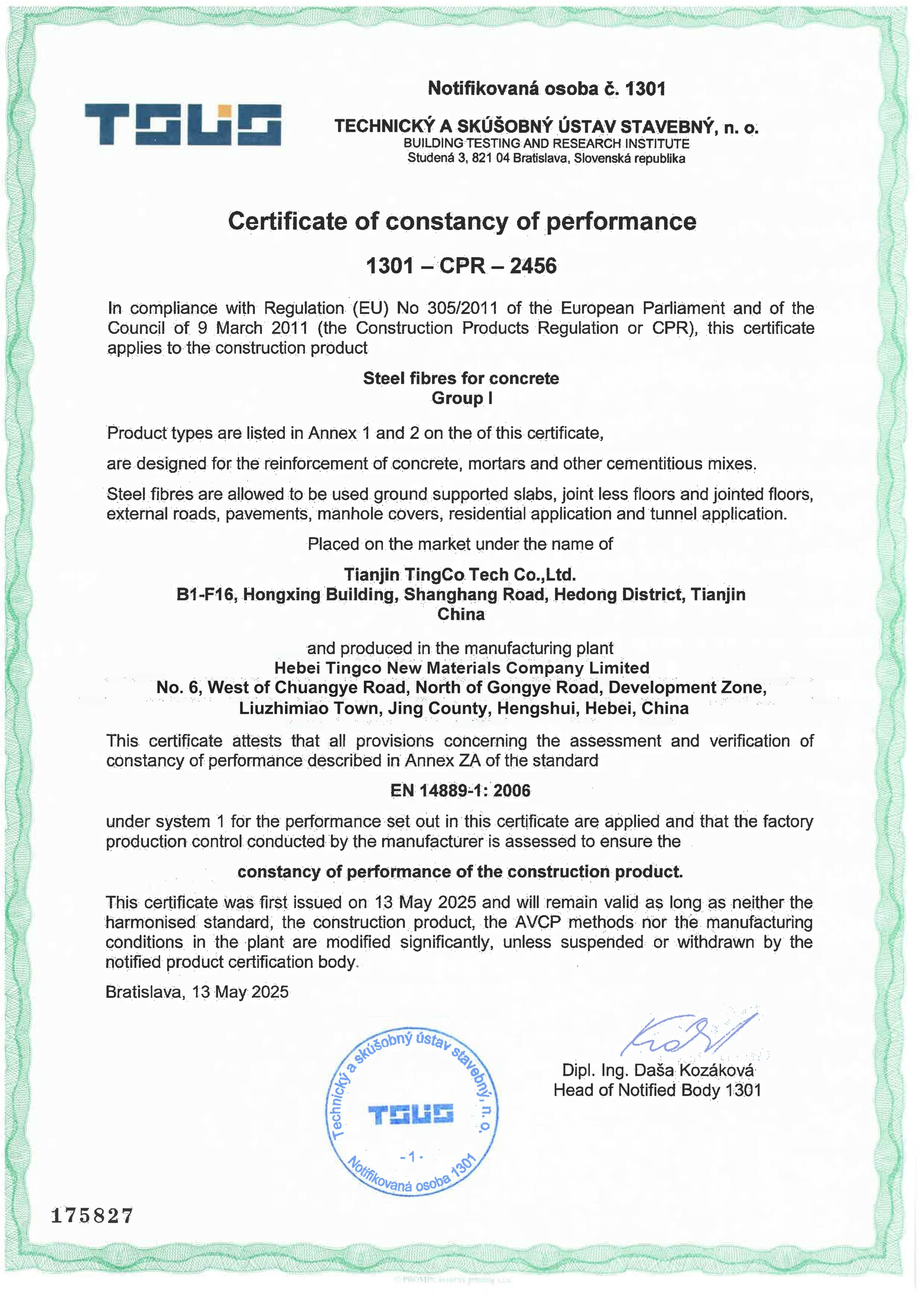
CE certificate 1301 – CPR – 2456, issued by TSUS under EN 14889-1:2006 for steel fibres for concrete (Group I), valid 13 May 2025 to 12 May 2030.
The evidence package a procurement team should request at evaluation stage:
- CE certificate 1301 – CPR – 2456 and the corresponding declaration of performance, with the notified body and validity dates checked.
- Confirmation that the specific model is covered by the certificate's product scope for steel fibres for concrete (Group I).
- ISO 9001 factory certification, and statements of compliance with ASTM A820 and ISO 13270 where the project standard requires them.
- Third-party or in-house flexural toughness results to EN 14651, ASTM C1609 or ASTM C1550 at the project dosage — these three methods are the core basis for engineering design and acceptance.
- Pre-shipment inspection record covering specification, quantity and packaging, plus batch identification linking the delivery to the tested lot.
Commercial parameters are part of the same audit. Production capacity is 2,000 tons per month, typical lead time is 10–15 days, and the minimum order quantity for trial project orders is 24 tons.
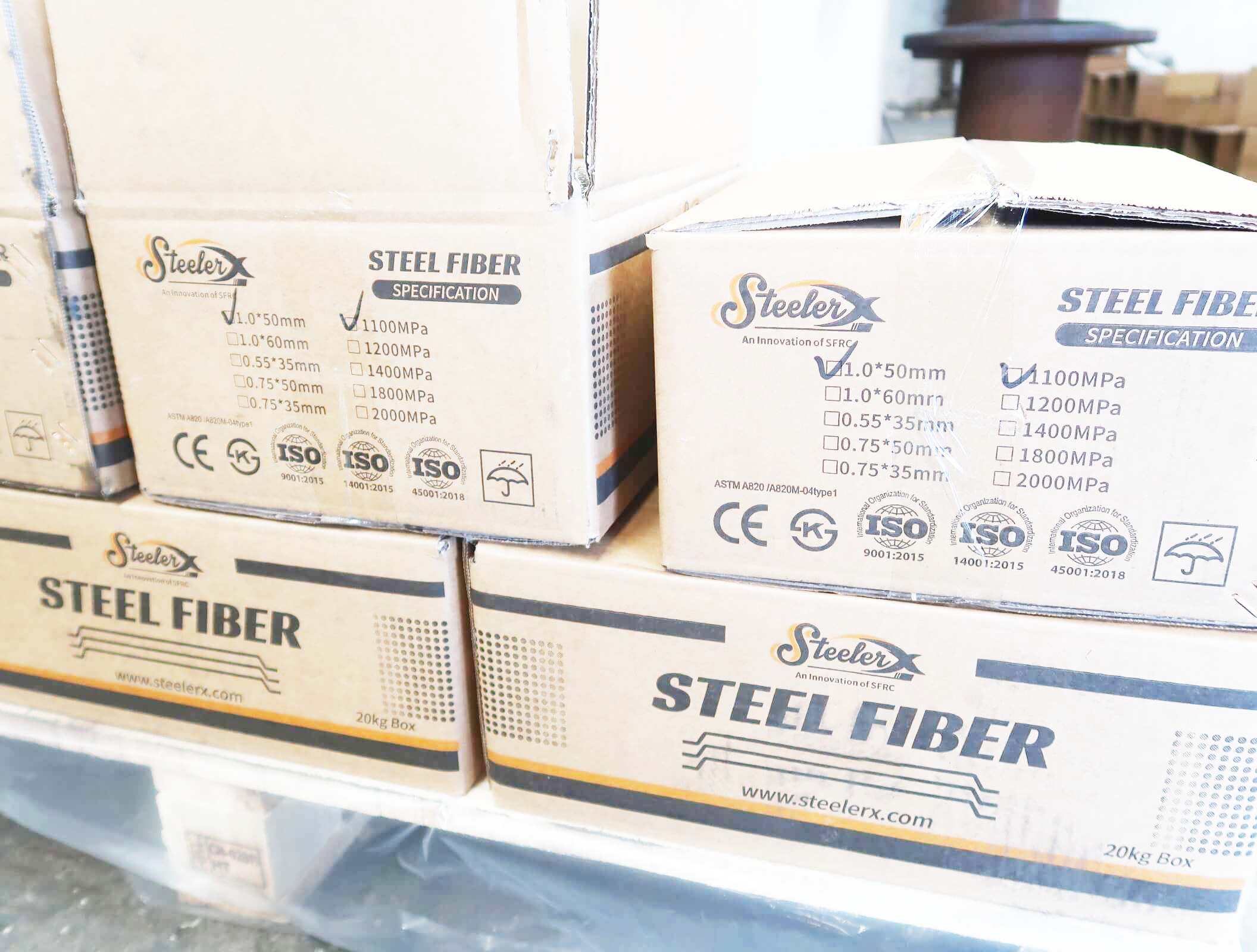
Packaging is inspected before dispatch; OEM packaging and private-label options are available on request.
Market Trend Signals Behind the Shortlist
Three published signals explain why model-level shortlists are becoming normal procurement documents. First, scale: a market projected at roughly USD 2.87 billion by 2026 supports a level of product differentiation that a commodity market does not. Second, concentration of demand: industrial floors at 37.28% of application share means slab specifications, not tunnel or precast specifications, drive most purchasing decisions. Third, type concentration: hooked-end fibers at 58.89% of the type segment confirm that the four models in this shortlist belong to the dominant technical family rather than a niche.
Supply geography matters as well. China was the largest exporter of steel fiber under HS 7326, accounting for 51.85% of total imports identified in specialised trade datasets — a figure drawn from customs-aggregator data of medium confidence, and therefore useful as a directional signal rather than a precise statistic. On the synthetic side, the global polypropylene fiber market for construction is expected to grow at a CAGR of 6.4% from 2026 to 2034, which reinforces a complementary rather than substitutive relationship: PP fibers address plastic shrinkage and corrosion-free requirements, steel fibers address structural post-crack performance.
Comparison with Traditional Reinforcement — and the Limits of This Shortlist
Against welded wire mesh and conventional rebar, steel fiber reinforcement is distributed through the concrete volume rather than placed at a single plane, which removes a labour-intensive fixing step and eliminates the risk of mesh being displaced during pouring. TingCo's own application profile states that steel fiber reinforcement can reduce construction time by 50% and lower total cost by 30–40% compared with traditional reinforcement in the applications it serves. That is the supplier's stated application profile and should be validated against project-specific quantities and labour rates, not treated as a universal guarantee.
The limits matter just as much, and any of them can disqualify a shortlisted model:
- Certification is not a design value. EN 14889-1 conformity confirms the product family; it does not deliver a residual flexural strength class. That number has to come from testing at the project dosage.
- No per-model residual strength is published. Buyers cannot rank these four models by post-crack performance from catalogue data alone. Differences must be established by EN 14651 or ASTM C1609 results on the specific mix.
- 60 mm is not automatically better. Longer fiber costs workability and places less easily in thin sections, dense reinforcement, repair work and sprayed applications.
- These are not UHPC micro fibers. Brass-coated micro steel fibers for UHPC typically feature tensile strength above 2,500 MPa at diameters of 0.2–0.3 mm. A UHPC specification should be routed to that product family, not to the four models here.
- Minimum order quantity is 24 tons. Small repair or trial packages may not fit the standard commercial terms.
- Steel and PP fiber are not interchangeable. A project that requires corrosion-free reinforcement or plastic shrinkage control has a different material answer.
Future Outlook
The direction of travel is toward tested, model-specific specifications. As hooked-end fiber consolidates its position at 58.89% of the type segment and industrial floors hold the largest application share, the competitive difference between suppliers shifts from whether fiber is available to whether a supplier can document what a named model does in a named mix. That favours suppliers with in-house testing capability and a certificate scope that a buyer can trace to the delivered batch.
Two practical consequences follow. First, model codes will increasingly appear in tender documents alongside dosage and residual strength class, because a code is the only way to prevent substitution. Second, the boundary between steel and synthetic reinforcement will become clearer in specification writing, with steel fibers carrying structural post-crack duty and PP fibers carrying plastic shrinkage and corrosion-free requirements in the same project.
Buyer Checklist: Matching Model to Project
| Decision point | What to confirm | Evidence to request |
|---|---|---|
| Application | Flooring, tunnel segment, lining, precast or shotcrete | Project specification naming standard, type and dosage |
| 60 mm availability | Whether the design assumes 60 mm anchorage, and whether placement equipment can handle it | Mix design and pump or nozzle compatibility confirmation |
| Length reduction | Section thickness, reinforcement density, surface finish requirement | Reference project of comparable geometry |
| Diameter | Filament count needed at the intended dosage | Test result at that dosage, not a catalogue claim |
| Supply form | Loose or glued, and whether the suffix must be pinned in the specification | Model datasheet and quotation stating the suffix |
| Tensile grade | Required wire grade within the 1,200–2,500 MPa range | Batch certificate of analysis |
| Certification scope | Model covered by CE 1301 – CPR – 2456 under EN 14889-1:2006 | Certificate, declaration of performance, validity dates |
| Toughness evidence | Residual flexural strength class at project dosage | EN 14651, ASTM C1609 or ASTM C1550 report |
| Quantity and timing | Minimum order 24 tons, lead time 10–15 days, monthly capacity 2,000 tons | Written schedule against the construction programme |
| Packaging | Standard or OEM/private-label supply | Pre-shipment inspection record and packaging specification |
FAQ
Which of the four models is specified for 60 mm industrial flooring?
TC-07560-HNG and TC-07560-HHG both sit in the 0.75 mm diameter, 60 mm length class, so both are the 60 mm options within this shortlist. Which of the two applies depends on the end and supply configuration the specification requires. A published TingCo flooring reference used a 60 mm hooked-end fiber at 1,200 MPa with a 20 kg/m³ dosage for heavy-duty warehouse, logistics park and jointless flooring, supplied at 2,000 tons over one year.
What is the difference between loose and glued steel fiber?
Loose fiber is supplied as individual filaments; glued fiber is supplied as bundles that separate into discrete strands during mixing. Glued bundles are generally chosen where dosage is high and dispersion control is the main risk, while loose fiber is the simpler option for standard slab work. TingCo supplies both forms, and the model suffix on the quotation identifies which one ships.
What tensile strength should a tunnel segment specification ask for?
TingCo publishes a steel fiber range of 1,200 MPa to 2,500 MPa, so the specification should state the grade required within that range. It should also state the residual flexural strength class the concrete must reach, verified by EN 14651 or ASTM C1609 testing, because wire tensile strength and post-crack concrete performance are separate measurements. ASTM A820/A820M and EN 14889-1:2006 are the reference standards for fiber type and conformity.
How much steel fiber is added per cubic metre of concrete?
TingCo guidance gives 15–30 kg/m³ for industrial floors, 20–40 kg/m³ for shotcrete and 10–30 kg/m³ for precast elements. Dosage should be set from the mix design rather than copied, and verified by beam or panel testing at that dosage. Mixing time should be extended by 30–60 seconds compared with plain concrete, with slump checked afterwards.
What certification and inspection evidence should accompany a shipment?
The core document is CE certificate 1301 – CPR – 2456, issued by TSUS under EN 14889-1:2006 for steel fibres for concrete (Group I) and valid from 13 May 2025 to 12 May 2030. Supporting evidence includes ISO 9001 factory certification, compliance statements for ASTM A820 and ISO 13270, flexural toughness test reports, and records of in-line and pre-shipment inspection covering specification, quantity and packaging.
What are the order quantities and lead times?
The factory has a monthly production capacity of 2,000 tons, a typical production lead time of 10–15 days, and a minimum order quantity of 24 tons for trial project orders. OEM and ODM arrangements, including logo and packaging customisation, are available on request.
Are these four models suitable for UHPC?
No. Brass-coated micro steel fibers used in UHPC typically feature tensile strength above 2,500 MPa at diameters of 0.2–0.3 mm, which is outside the 0.55–0.90 mm range of this shortlist. UHPC projects should be specified against the micro fiber family rather than the four models discussed here.
The company brochure, including product and project references, is available for download: TINGCO corporate and project introduction (PDF).
Tem questões ou precisa de mais detalhes?
Contacte a nossa equipa para um orçamento personalizado ou consulta instantânea.
Solicitar orçamento
Preencha o formulário abaixo e a nossa equipa entrará em contacto com uma proposta personalizada.
Chat direto do WhatsApp
Prefere conversar em tempo real? Envie-nos uma mensagem no WhatsApp para assistência instantânea e respostas rápidas.
- Obter orçamento personalizado
- Partilhar fotos ou documentos
- Discuta as suas necessidades diretamente
Geralmente responde em 5–30 minutos durante o horário de expediente.