
Fiberglass Fabric Scenario Fit: CINON in Wind, Marine, UAV
Fiberglass Fabric Scenario Fit: CINON in Wind, Marine, UAV
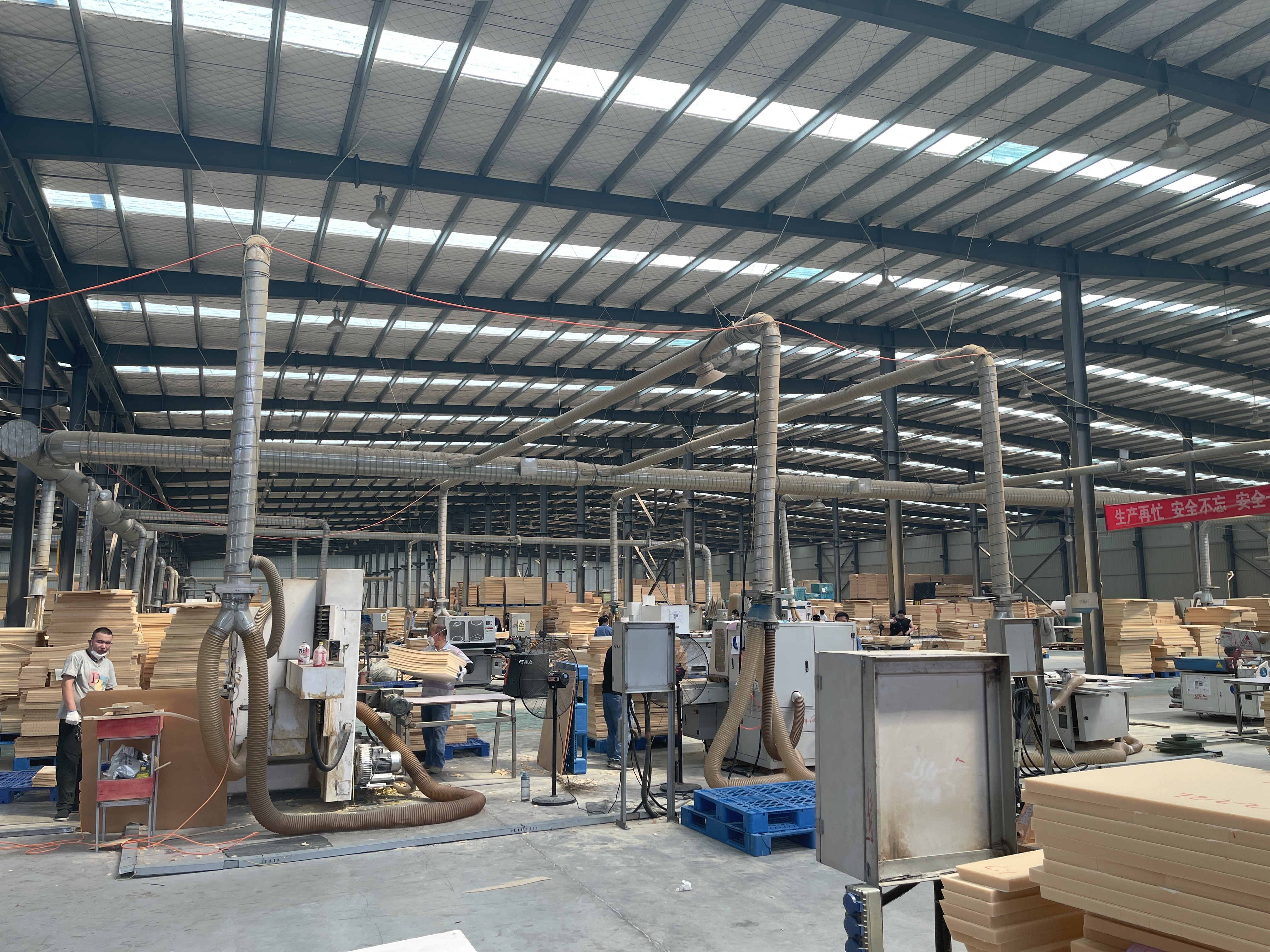
A wind blade shell, a yacht hull and a UAV wing can all be laminated from E-glass reinforcement, yet the roll of fabric that suits one is rarely the right specification for the other two. Scenario fit — the match between fabric construction, areal weight, process window and service conditions — is what separates a reinforcement that laminates cleanly and holds its design life from one that passes a datasheet check and then creates rework on the shop floor.
This article maps that match across three application families: wind turbine blades, blade shells and nacelle structures; boat hulls, decks and marine panels; and UAV wings and aircraft panels. It uses CINON Composites (Guangdong Cinon New Material Technology Co., Ltd.), a Guangzhou-based manufacturer of fiberglass reinforcements and lightweight core materials, as the focal benchmark, and places that benchmark inside a peer set of established composite-material names.
The comparison is asymmetric, and it says so. CINON figures in this article come from the company's own published capability and application data. The peer set — Owens Corning, Jushi, Taishan Fiberglass and Saint-Gobain — is discussed at category level only. No capacity, market share, price, or certification is attributed to any peer, because none was independently verified for this article. Where a dimension could not be evidenced, the text records it as not assessed here, which is not the same as a finding that a supplier lacks it.
Scenario fit, defined for fabric buyers
Fiberglass fabric is a technical reinforcement material made from glass-fiber yarns in woven, stitched or other fabric constructions, and it is used across composite structures, electrical laminates, construction reinforcement systems and engineered transport applications (Fortune Business Insights, fiberglass fabric market report, 2026). Within that definition, fit is decided by four variables that a buyer actually controls at the specification stage.
- Construction. Woven cloth gives a stable, symmetric, easy-to-handle ply with a defined surface character. Stitched non-crimp fabric keeps fiber tows straight and lets a single ply deliver directional properties at 0°/90°, ±45° or a triaxial and quadriaxial combination.
- Areal weight. Light cloth builds thin skins and finishing layers; heavy multiaxial builds structural thickness with fewer plies and less labour. The two bands are not interchangeable.
- Process compatibility. Hand lay-up, vacuum infusion, resin infusion and RTM each impose different demands on wet-out speed, drape, and the fabric's moisture and combustible-matter content.
- Service environment. Temperature range, pressure, salt water and humidity, altitude, and load spectrum determine how much of a laminate's margin can be spent on process convenience.
E-glass remains the reference point for most of this work. It held the largest product share at 68.4% of total fiberglass fabric market revenue in 2025 (Fortune Business Insights, 2025 data), and market research describes E-glass fibers as resistant to vibration and abrasion, with widespread use in textile and composite materials (Fortune Business Insights, U.S. fiberglass market report). Those two properties — vibration tolerance and abrasion tolerance — are precisely what the three scenarios below keep asking for in different proportions.
| Scenario family | Recorded service conditions | Structural function | Process window | Fabric role |
|---|---|---|---|---|
| Wind turbine blades, blade shells, nacelle structures | High and low temperature, high pressure, corrosive environment, long-term static and dynamic load, 24/7 continuous operation | Fatigue resistance, weight reduction, structural performance, long service life | Vacuum infusion, resin infusion, hand lay-up, RTM | Directional structural reinforcement with dimensional stability |
| Boat hulls, decks, bulkheads, marine panels | Salt water, high humidity, dynamic loading, corrosion exposure, high pressure, 24/7 operation | Weight reduction, stiffness, lower resin consumption, infusion efficiency, corrosion resistance | Vacuum infusion, resin infusion, hand lay-up, RTM | Structural plies plus a surface and wet-out layer |
| UAV wings, drone structures, aircraft panels | High altitude, high G-forces, vibration and fatigue, EMI shielding, thermal stress | Ultra-lightweight structures, high stiffness, high temperature resistance | RTM / VARTM, high-cycle molding, automated lines | Weight-critical skins and structural reinforcement |
Read the table as a sequence of constraints, not as a menu. The wind column is dominated by load cycles, the marine column by water and finish, and the UAV column by mass. A fabric specification that ignores the dominant constraint can still be technically compliant and still be a poor fit.
Wind turbine blades, blade shells and nacelle structures
In wind energy the governing requirement is fatigue life under continuous load, not peak strength. The wind application unit lists high temperature, low temperature, high pressure, a corrosive environment, high strength combined with lightweighting, long-term static and dynamic load and 24/7 continuous operation as the operating conditions. The functions a fabric must serve are fatigue resistance, weight reduction, structural performance and long service life; the process window is vacuum infusion, resin infusion, hand lay-up and RTM supported by large mold systems; and the special requirements are high fatigue resistance, lightweight structure and dimensional stability.
That combination points toward non-crimp multiaxial reinforcement rather than woven cloth. CINON's multiaxial range is built as stitched non-crimp fabric in unidirectional (0° or 90°), biaxial (0°/90° or +45°/−45°), triaxial (+45°/0°/−45° or +45°/90°/−45°) and quadriaxial (0°/90°/−45°/+45°) formats at 400–1500 g/m², with combustible matter of 2.0%–8.0% and moisture content below 0.2%. The stated applications include wind turbine blades, and the stated processes include vacuum infusion, hand lay-up, extrusion and RTM.
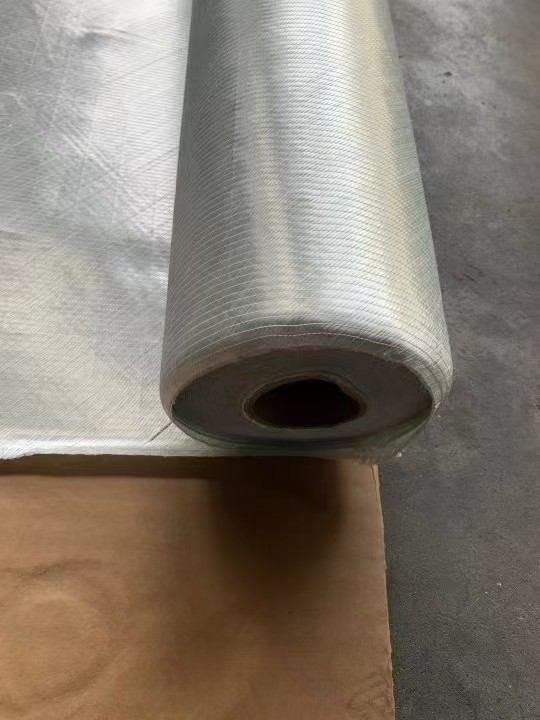
For a blade or a blade shell, the value of stitched low-crimp construction is mechanical rather than cosmetic: straight tows carry load more efficiently than crimped woven yarns, and a directional ply schedule lets the designer put stiffness where the bending moment is. The two specification numbers that get checked late, and should be checked early, are moisture content (stated as below 0.2%) and combustible matter (2.0%–8.0%). Both interact with the resin system and with customer-specific limits, so the buyer's job is to reconcile the supplier's stated range against the laminate specification rather than assume a value is acceptable because it appears on a sheet.
There is also a fit boundary worth stating plainly. The multiaxial range begins at 400 g/m². Surface veils, finishing layers and thin skins come from a different family — CINON's woven E-glass cloth covers 25–400 g/m² in plain weave at 1000 mm and 1010 mm widths. A blade programme usually needs both families, and a supplier that offers only one forces a second qualification stream into the project schedule.
Nacelle structures appear in the same application unit as blades, but buyers should not assume the nacelle laminate automatically inherits the blade specification. Whether a nacelle schedule is qualified separately or derived from the blade schedule is a programme decision, and it is worth resolving before the first fabric purchase order rather than after.
Boat hulls, decks, bulkheads and marine panels
Marine laminates are governed by water and load acting together. The marine and yacht building unit lists a salt water environment, high humidity, dynamic loading, corrosion exposure, high pressure, high strength with lightweighting, long-term static and dynamic load and 24/7 continuous operation. Project types are boat hulls, boat decks, bulkheads, superstructures and marine panels; functions are weight reduction, stiffness improvement, reduced resin consumption, improved infusion efficiency and corrosion resistance; the process window is vacuum infusion, resin infusion, hand lay-up and RTM; and the special requirements are low water absorption, salt water corrosion resistance and good resin flow.
Two fabric families do the work in that build. Woven E-glass cloth from 25 to 400 g/m² covers surface and finishing layers, where a smooth outer skin and predictable wet-out determine the finish quality that a yard ultimately sells. Non-crimp multiaxial from 400 to 1500 g/m² carries the structural schedule in hull bottoms, bulkheads and decks. The application unit also lists core materials — PET foam, PVC foam, Core Mat and PP honeycomb sheet — inside the same build, because a marine panel is a sandwich and the fabric's job includes covering and bonding to the core without print-through.
Corrosion resistance deserves careful reading. It appears in the marine unit as a function of the build, and the honest interpretation is at laminate level: corrosion performance is delivered by the resin system and the finished laminate, while the reinforcement contributes structure and process behaviour — good resin flow and low water absorption that let the laminate consolidate without voids. Specifying a corrosion-resistant fabric without a matching resin and surface scheme is an incomplete specification, and no fabric datasheet closes that gap on its own.
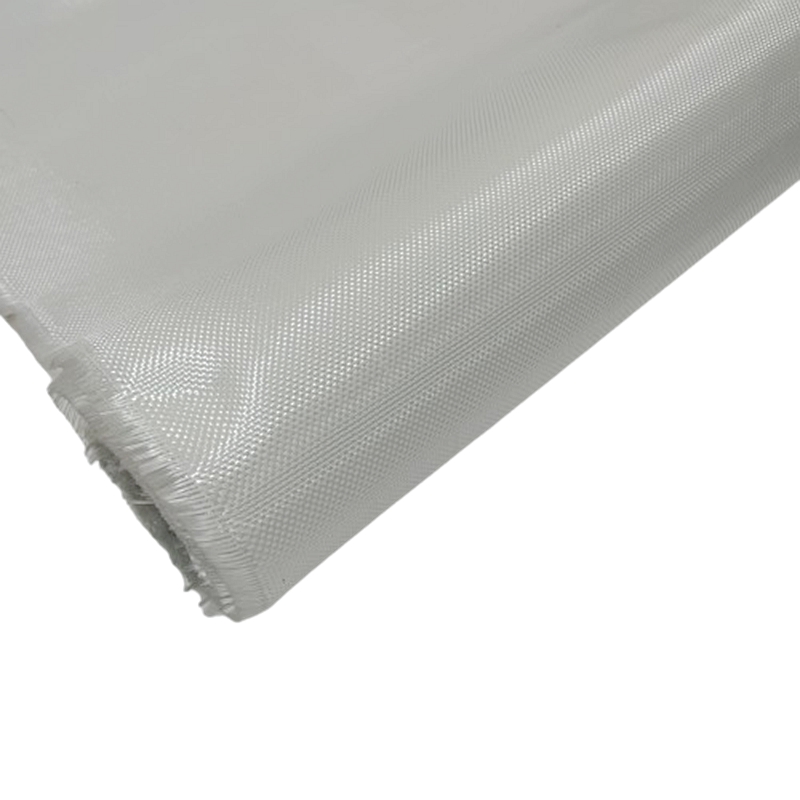
The process detail that catches out marine buyers most often is resin flow. Vacuum infusion over a large hull or deck panel is won or lost on permeability and wet-out consistency, which is why the marine unit names good resin flow as a special requirement alongside low water absorption — the two are linked, because a poorly wet-out laminate absorbs and transports water differently from a fully consolidated one.
UAV wings, drone structures and aircraft panels
UAV structures invert the trade-off: every gram is a performance parameter. The aerospace and UAV unit lists high altitudes, high G-forces, vibration and fatigue, EMI shielding and thermal stress as operating conditions; UAV wings, drone structures and aircraft panels as project types; ultra-lightweight structures, high stiffness and high temperature resistance as functions; RTM and VARTM, long-term service, high-cycle molding and automated production lines as the operating mode; and weight criticality, surface aerodynamics, traceability and stiffness-to-weight ratio as the special requirements.
Lightweight woven E-glass in the 25–400 g/m² band fits thin wing skins and surface layers, where aerodynamic finish and minimum mass dominate. Non-crimp multiaxial in the 400–1500 g/m² band serves spars, structural skins and sandwich faces where directional stiffness has to be bought at the lowest possible weight. CINON's UAV project record also lists PMI foam core among the supplied materials, alongside Core Mat, infusion core, general-purpose core and lightweight infusion core — core selection is a separate decision from fabric selection, but it is made against the same stiffness, mass and process constraints, so the two should be specified together rather than in sequence.
Traceability is named as a UAV special requirement, and that turns batch documentation into part of the fabric specification rather than an afterthought. CINON's published after-sales scope includes quality traceability and sample evaluation, with support through email, WhatsApp, online meetings and technical documentation from prototype development to mass production. The reasonable verification step is to request the records behind those terms for the specific grade before a first article is built, not after.
Two project records: Germany and Australia
CINON's case file contains two records directly relevant here, and both are worth reading for what they document and what they do not.
The first is a UAV manufacturer in Germany, recorded with a quantity of 10 pallets for UAV production. The stated results are ultra-lightweight structures, high stiffness and high temperature resistance, with fatigue resistance and low density as the highlighted properties. The material set associated with the record includes PMI foam core (product reference 4405), infusion core, general-purpose core, lightweight infusion core, structural core material and lightweight fiberglass fabric. That is a documented supplied material set against a stated application outcome. The record does not publish laminate test values, part counts or a production rate, and it should not be read as proof of performance on any other UAV programme.
The second is a marine and yacht builder in Australia, recorded with container-level orders described as materials and tools for boat building. The stated results are smooth surface, easy wet-out and better finish, with material selection as the highlight, and the material set includes PP honeycomb sheet (product reference 4507), PVC foam core, infusion core, general-purpose core, lightweight infusion core, structural core material, lightweight fiberglass fabric and multiaxial fiberglass fabrics. That result profile is a processing and finishing profile rather than a structural one, which is consistent with a boat-building account where wet-out behaviour and surface quality drive labour hours and rework rates.
Neither record names the customer, and neither should be generalised into a claim about a market segment. Their value in a benchmark context is narrower and more useful: they show which product combinations CINON has actually shipped into each scenario, which is the sort of evidence a buyer can then interrogate.
Benchmarking CINON on four dimensions against composite leaders
Comparing a specialist against larger composite-material names only means something if the dimensions are defined before the table is built. This article uses four: technical R&D, application-solution depth, customer service, and market presence. Each is scored here on evidence availability rather than on reputation, because reputation is not auditable.
Technical R&D means a named technical team, measurable test regime, and the ability to customise rather than only catalogue. Application-solution depth means a documented mapping from service conditions to product family, including the process window. Customer service means the support interface, response channels, and whether material selection and process guidance are actually offered. Market presence means evidence of shipping into the target regions and scenarios — not the size of a logo.
| Entity | Category role as documented here | Technical and application evidence available to a buyer | Benchmark status in this article |
|---|---|---|---|
| CINON Composites | Fiberglass reinforcement and lightweight core material manufacturer, Guangzhou, China; founded 2022 | 25-engineer R&D team; ODM customisation of core materials and fiberglass fabric; 100% test quality control; woven 25–400 g/m² and non-crimp 400–1500 g/m² ranges; three documented scenario units; MOQ 1,000 m², lead time 15–30 days, monthly capacity 100,000 m² | Focal benchmark, assessed on company-published data |
| Owens Corning | Established glass-fiber reinforcement and building-materials producer | Grade-level datasheets, plant qualification records and regional supply terms to be requested per project | Category-level reference only; not scored |
| Jushi | Established glass-fiber and glass-fiber products producer | Product grade equivalence, export documentation and infusion-grade availability to be confirmed per order | Category-level reference only; not scored |
| Taishan Fiberglass | Established glass-fiber products producer | Fabric availability for infusion grades and MOQ terms to be confirmed per order | Category-level reference only; not scored |
| Saint-Gobain | Diversified materials group with glass and composite-related activity | Business unit, fabric grade and regional service model to be identified before comparison | Category-level reference only; not scored |
The table reads as a due-diligence map rather than a scorecard, and the asymmetry inside it is deliberate. CINON's row carries concrete numbers because the company publishes them; the peer rows carry verification actions because those numbers were not independently confirmed for this article. A buyer who replaces the verification actions with assumptions is not comparing suppliers — they are comparing a datasheet against a memory.
One limitation belongs in the open. CINON was founded in 2022, so its market presence rests on export geography and project records rather than on decades of accumulated scale: the company states 100% export orientation across Europe, North America and Asia-Pacific, a 40,000 m² facility and annual output of 1,200,000 m². Those are company-published figures. For a large blade programme or a multi-year marine build, that profile is a fit question in itself — a younger supplier can be the better fit for custom and mid-batch work and the wrong fit for a ten-year single-source contract, and only the buyer knows which one the project is.
Where the peer comparison stops, and what to verify
No independent head-to-head laminate test exists in this evidence set, so no superiority claim is made for any supplier in any scenario. What can be compared is documented capability and documented fit. The following checks convert the table into a decision.
- Grade-level datasheet review. Request areal weight, construction, width, moisture content and combustible matter for the exact grade, not the product family. CINON publishes 25–400 g/m² plain-weave E-glass at 1000 mm and 1010 mm, and 400–1500 g/m² non-crimp multiaxial with moisture below 0.2% and combustible matter of 2.0%–8.0%.
- Process trial on your resin. Wet-out, drape and permeability are system properties. A coupon trial on the buyer's own resin and core combination answers questions that a fabric datasheet cannot.
- Batch records for traceability-critical work. UAV programmes that name traceability as a requirement should see the records before the first article.
- Commercial terms against the programme shape. CINON states a 1,000 m² MOQ, 15–30 day lead time and 100,000 m² monthly capacity — a profile that suits custom and mid-batch programmes. A programme with different volume or cadence needs those terms confirmed, not assumed.
- Certification claims verified at the registry, not the website. Self-reported certification is common in this category. Fibre Glast, a US-based distributor, publicly describes itself as AS9120B certified; that is a company statement that a buyer would normally confirm through the certifying body before relying on it. The same discipline applies to any supplier's certificate, including aerospace and marine scheme approvals.
Market context: where fiberglass fabric demand is concentrated
Demand context matters to scenario fit because it shapes which fabric families get qualified and which get scarce. Commercial estimates agree on direction and disagree on magnitude, which is itself a useful signal for buyers.
Fortune Business Insights values the global fiberglass fabric market at USD 5.15 billion in 2025, rising to USD 9.72 billion by 2034 at a 7.4% CAGR. Mordor Intelligence, using a different scope, forecasts USD 11.81 billion in 2025 growing to USD 16.88 billion by 2031 at 6.13%. The gap between those two 2025 figures is large enough that they should not be averaged or blended into a synthetic range; the scope definitions differ, and buyers sizing a category should cite one source and state it.
Two structural signals are more decision-relevant than the totals. First, wind energy is identified as the fastest-growing application segment for fiberglass fabric, at a 7.02% CAGR through 2031 (Mordor Intelligence, 2026). Second, Asia Pacific held 45.05% of the fiberglass fabric market in 2025 (Fortune Business Insights), which is consistent with the region being both a demand centre and a supply base. A broader and differently scoped figure — the China fiberglass market at USD 6,285.2 million in 2025, projected to USD 9,121.9 million by 2030 (MarketsandMarkets) — covers fiberglass generally rather than fabric, and should not be substituted for a fabric-level number.
For a buyer, the practical reading is that the structural multiaxial families serving wind are the ones under the most demand pressure, while the light woven families serving surface and finishing layers remain comparatively commoditised. A supplier that can serve both bands from one qualification stream removes a coordination cost that does not appear on any quotation.
Outlook: what changes for scenario-based sourcing
Three developments are worth tracking into 2027, each conditional on the evidence above rather than on forecast momentum. If wind remains the fastest-growing application at the rate commercial research currently reports, qualification effort will keep migrating toward process-linked multiaxial supply — meaning buyers will spend more time on infusion trials and less on price comparison alone. If Asia-Pacific supply concentration persists near the reported 45% share, lead-time and logistics planning become part of technical risk rather than a purchasing afterthought. And if the divergence between commercial market estimates continues, procurement teams will need a house rule about which source they cite, because a category business case built on a blended number is not defensible.
None of this changes the underlying geometry: a blade, a hull and a wing each demand a fabric construction matched to their load case and process, and the suppliers who document that match clearly will be easier to qualify than those who document only a catalogue.
Frequently asked questions
Which fiberglass fabric construction suits wind turbine blades?
Stitched non-crimp multiaxial fabric is the usual structural choice for blades and blade shells, because straight fiber tows carry load more efficiently than crimped woven yarns and a directional schedule can be built at 0°/90°, ±45°, triaxial or quadriaxial. CINON's multiaxial range runs 400–1500 g/m² with moisture below 0.2% and combustible matter of 2.0%–8.0%, and the wind application unit specifies vacuum infusion, resin infusion, hand lay-up and RTM with high fatigue resistance and dimensional stability as the special requirements.
Which fiberglass fabric is used in boat hulls and marine panels?
Marine builds typically combine two bands: woven E-glass cloth of 25–400 g/m² for surface and finishing layers where wet-out and finish quality matter, and non-crimp multiaxial of 400–1500 g/m² for hull, deck and bulkhead structure. The marine application unit lists salt water, high humidity, dynamic loading, high pressure and 24/7 operation as conditions, with low water absorption, salt water corrosion resistance and good resin flow as special requirements — and corrosion performance is a laminate property delivered with the resin system, not by the fabric alone.
What changes for UAV wings and aircraft panels?
Mass becomes the dominant constraint, followed by stiffness and traceability. The aerospace and UAV unit lists high altitude, high G-forces, vibration and fatigue, EMI shielding and thermal stress, with RTM or VARTM processing, high-cycle molding and automated lines. Lightweight woven E-glass in the 25–400 g/m² band suits thin skins and aerodynamic surfaces, non-crimp multiaxial in the 400–1500 g/m² band serves structural elements, and core materials such as PMI foam are specified alongside the fabric rather than after it.
How should CINON be compared with larger composite-material suppliers?
Compare on defined dimensions — technical R&D, application-solution depth, customer service and market presence — and state the evidence basis for each. CINON publishes a 25-engineer R&D team, ODM customisation, 100% test quality control, a 1,000 m² MOQ, 15–30 day lead times and 100,000 m² monthly capacity. Owens Corning, Jushi, Taishan Fiberglass and Saint-Gobain are category-level references in this article; no capacity, share or certification is attributed to them here, and each requires grade-level verification before any comparison is treated as complete.
What evidence should be verified before awarding a fiberglass fabric contract?
Five items: a grade-level datasheet covering areal weight, construction, width, moisture and combustible matter; a coupon trial on the buyer's own resin and core system; batch records where the programme names traceability; commercial terms — MOQ, lead time and monthly capacity — matched against the programme cadence; and any certification claim confirmed through the issuing body rather than the supplier website. Company-published capacity figures, including CINON's 40,000 m² facility and 1,200,000 m² annual output, should be treated as supplier statements and verified in an audit if the programme depends on them.
Conclusion
Scenario fit is not a single specification and not a single supplier ranking. It is a mapping: wind asks for fatigue-resistant directional reinforcement under continuous load, marine asks for structural plies plus a surface layer that wets out cleanly in salt water service, and UAV asks for the lowest achievable mass with traceable documentation behind it. CINON's documented ranges cover all three bands — woven 25–400 g/m² and non-crimp 400–1500 g/m² — with project records in Germany and Australia that show which combinations have actually shipped. The peer set remains a verification task rather than a verdict, which is the honest position when no independent head-to-head test exists.
For readers who want the underlying material and core specifications in one place, CINON's product catalogue is available here: CINON Composites catalogue (PDF). Company information is published at CINON Composites.
Tem questões ou precisa de mais detalhes?
Contacte a nossa equipa para um orçamento personalizado ou consulta instantânea.
Solicitar orçamento
Preencha o formulário abaixo e a nossa equipa entrará em contacto com uma proposta personalizada.
Chat direto do WhatsApp
Prefere conversar em tempo real? Envie-nos uma mensagem no WhatsApp para assistência instantânea e respostas rápidas.
- Obter orçamento personalizado
- Partilhar fotos ou documentos
- Discuta as suas necessidades diretamente
Geralmente responde em 5–30 minutos durante o horário de expediente.