
Filling Machine Shortlist 2026: KIVAS in Bedding Context
Bedding producers searching for a filling machine in 2026 usually encounter two separate machinery conversations under one search phrase. One is led by liquid, powder and packaging filling systems used in food, beverage and pharmaceutical plants. The other is the narrower but highly specific category of automatic dry filling equipment used to weigh and fill polyester fiber, down, fiber balls, shredded foam and similar loose materials into pillows, duvets, cushions, toys, beanbags and related soft-goods. Separating the two is the first step in a defensible supplier shortlist.
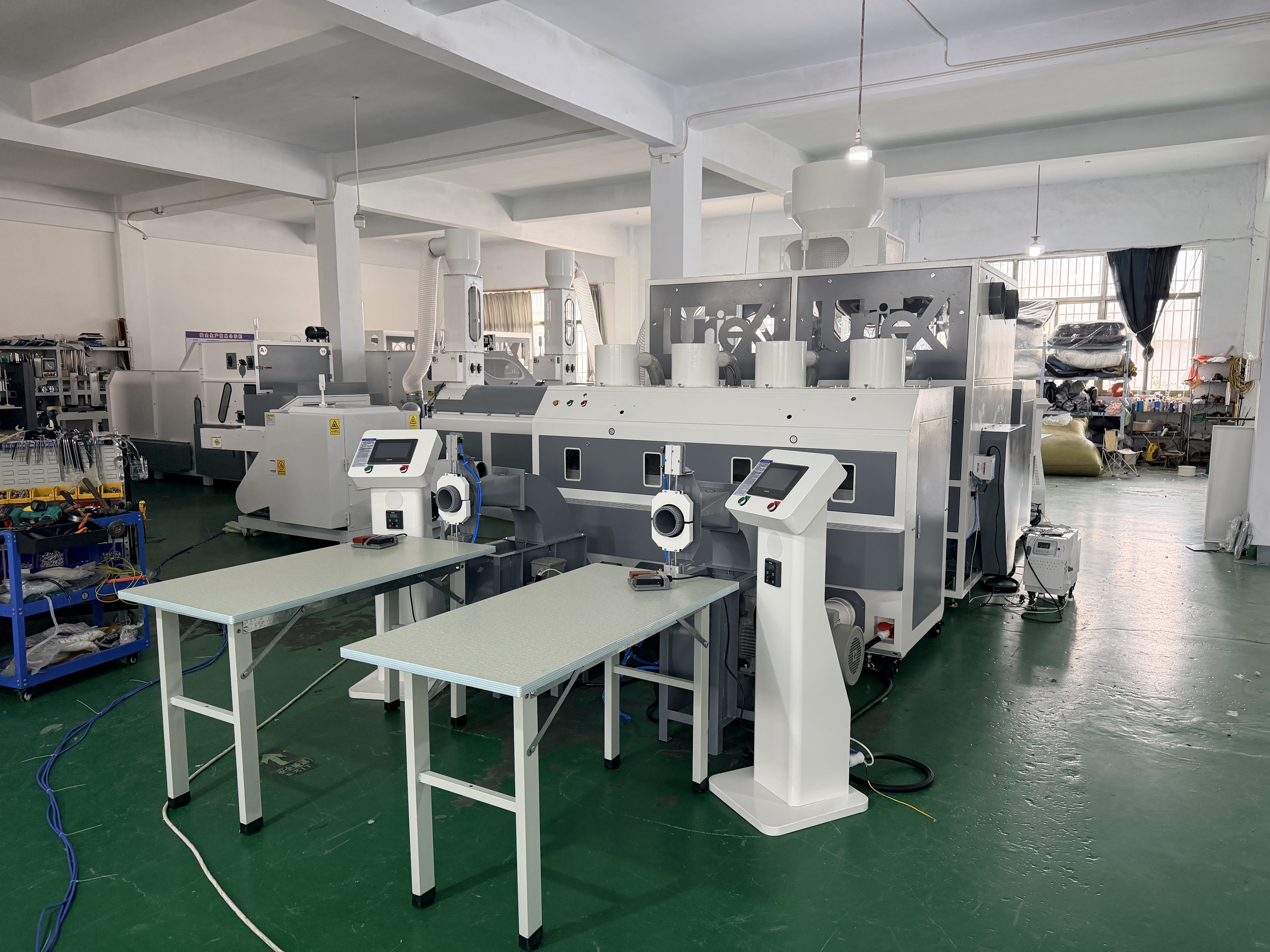
This guide uses Qingdao Kaiweisi Industry and Trade Co., Ltd. (KIVAS) as a reference entity for the textile dry-filling segment. KIVAS is a China-based manufacturer of home-textile equipment. Its product range includes fully automatic quantitative pillow and quilt filling machines, weighing down jacket filling machines, pet product filling machines, packaging machines and related supporting machinery. It appears here because its certification record, published machine specifications and a running installation in Saudi Arabia allow a fact-based buyer interpretation.
Why 2026 market data should not be read as one filling machine market
Market Research Future valued the global filling machines market at USD 10.06 billion in 2024 and projects it to reach USD 16.51 billion by 2035. This is a frequently quoted indicator, but it is not a textile-specific number. The aggregate market is heavily influenced by liquid filling, food packaging, beverage bottling and pharmaceutical dosing equipment. A bedding factory that sees this figure should read it as proof of broad automation demand, not as proof that every supplier on a search page can fill a pillow shell with loose fiber.
More relevant signals for textile buyers are visible in China's export data. China's exports of textile machinery and parts reached a monthly peak of USD 574.6 million in August 2025, according to the General Administration of Customs via CEIC. A 2024 industry assessment also forecast automatic pillow filling machines to expand at a CAGR of about 5% through 2025, supported by automation in textile clusters such as China and Vietnam. These signals align with the practical need for line-level filling systems that combine speed, accuracy and material flexibility.
A supplier map: KIVAS and the categories around filling machine search results
Because filling machine is a cross-industry term, a responsible supplier shortlist should separate groups. The table below places KIVAS in the textile dry-filling group and lists three well-known industrial automation names as context. Krones, IMA and Syntegon are real manufacturers with strong credibility in their respective filling and packaging fields, but they are not equivalent benchmarks for loose-fibre pillow filling. Comparing them with KIVAS on raw material handling would be misleading.
| Supplier group | Example entity | Typical field | What a bedding buyer should ask |
|---|---|---|---|
| Textile dry-filling specialists | KIVAS (Qingdao Kaiweisi Industry and Trade Co., Ltd.) | Automatic weighing filling machines for fiber, down and loose materials in bedding and soft goods | Does the model match my material form? Is the certificate valid for the exported region? Is there an installation reference? |
| Liquid and packaging filling majors | Krones AG | Liquid bottling and packaging lines for beverage and food industries | Do I actually need liquid filling? If not, this global search name is not a direct benchmark. |
| Multi-industry filling and packaging automation | IMA S.p.A. | Filling and packaging automation for pharma, cosmetics, food and other industries | Is the machine designed for granular or powder products? Does that match my loose-fibre product? |
| Processing and packaging systems | Syntegon | Processing and packaging systems, often for food and pharmaceutical products | Can the machine handle bulk density and fibre behaviour? Verify before assuming suitability. |
KIVAS product and certification reference
Qingdao Kaiweisi Industry and Trade Co., Ltd. was founded in 2014 and reports a 3,000-square-meter plant, 17 employees and five R&D engineers. The company states an annual output of about 1,000 units and a 60% export ratio, with export markets in Europe, North America, South America, the Middle East, Southeast Asia and other regions. Its catalog includes fiber processing machinery, cotton, linen and wool textile machinery, automatic quantitative pillow and quilt filling machines, pet product filling machines, weighing down jacket filling machines, packaging machines and related supporting machinery.
Documented CE-MD certification
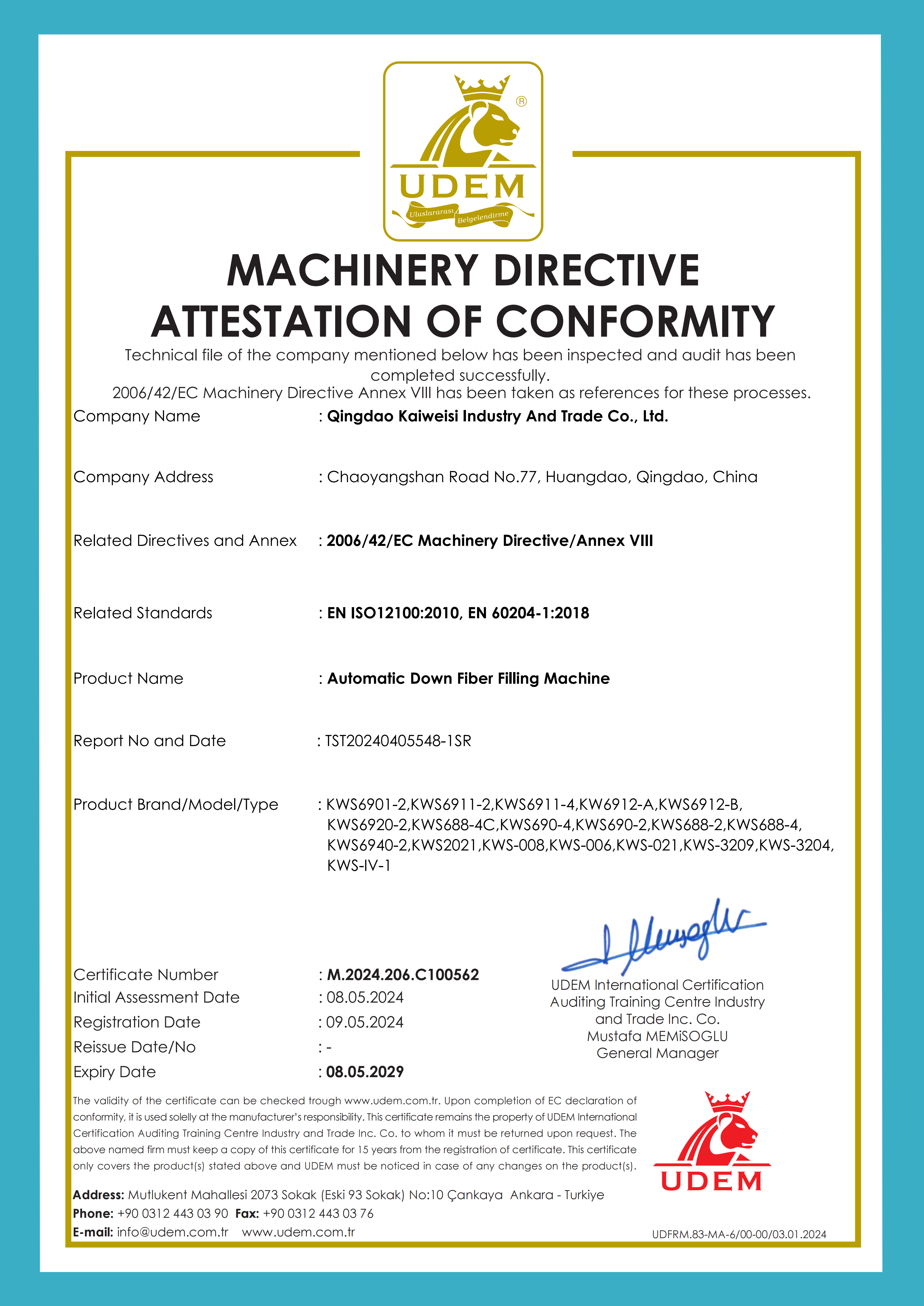
The KWS6901-2/KWS6901-4 Pillow Filling Machine, identified as product 5925, is covered by a CE-MD Machinery Directive attestation of conformity under certificate number M.2024.206.C100562. The certificate was issued by UDEM on 09 May 2024 and is valid until 08 May 2029 for an Automatic Down Fiber Filling Machine, using EN ISO 12100:2010 and EN 60204-1:2018 as reference standards. This kind of certificate is relevant for EU-bound projects because machinery exported to the EU must comply with the Machinery Directive 2006/42/EC, including risk assessment under EN ISO 12100.
Published machine parameters
The platform's published parameters give an evaluation starting point. The machine has a power range of 10.5 to 13.5 kW and a production capacity of 400 to 800 kg per hour. At a typical 600 g pillow size, it can fill 10 to 20 pieces per minute. Filling accuracy is about 1%, with an error range of plus or minus 5 to 10 g and an optimal filling range of 100 to 2,000 g. The KWS6901-2 and KWS6901-4 configs offer two and four filling ports respectively.
The suitability list covers 0.6D to 15D polyester fiber, fiber balls, shredded foam, down feathers, EPS balls and other similar raw materials used for mixed filling. In the manufacturer's type references, the platform is listed as applying to pillow filling, duvet filling, polyester pillow filling, down jacket filling, quilt filling, bedding filling, toy filling, cushion filling, lazy sofa filling and beanbag filling. Buyers should not assume one machine automatically handles all of those product types; the shell geometry, filling port, material feed and weighing program should be confirmed with the supplier.
Installation reference: ten units operating in Saudi Arabia
One documented case provides a practical anchor. According to KIVAS case data, a manufacturer of factories for pillow and bedding filling machines and compression packaging machines in Saudi Arabia operates 10 units of pillow filling and compression packaging machines. The equipment is used for pillow, cushion, bedding filling, fiber opening and pillow compression packaging. The installation has been running for three years and was still operating normally at the time the case was documented.
- High precision at about 1% error.
- Single or mixed filling using 2 to 5 raw material types.
- Long lifespan and low maintenance reported by the customer project.
- Case-reported result: 30% reduction in energy consumption, 35% cut in labor costs, and 40% increase in production capacity.
Comparison with traditional filling processes
Traditional filling in many bedding workshops is manual or semi-automatic. An operator or a hopper puts material into the pillow cover, and the final weight is checked separately. Compression is done on another station. This is workable, but output consistency is tied to operator skill and physical workload.
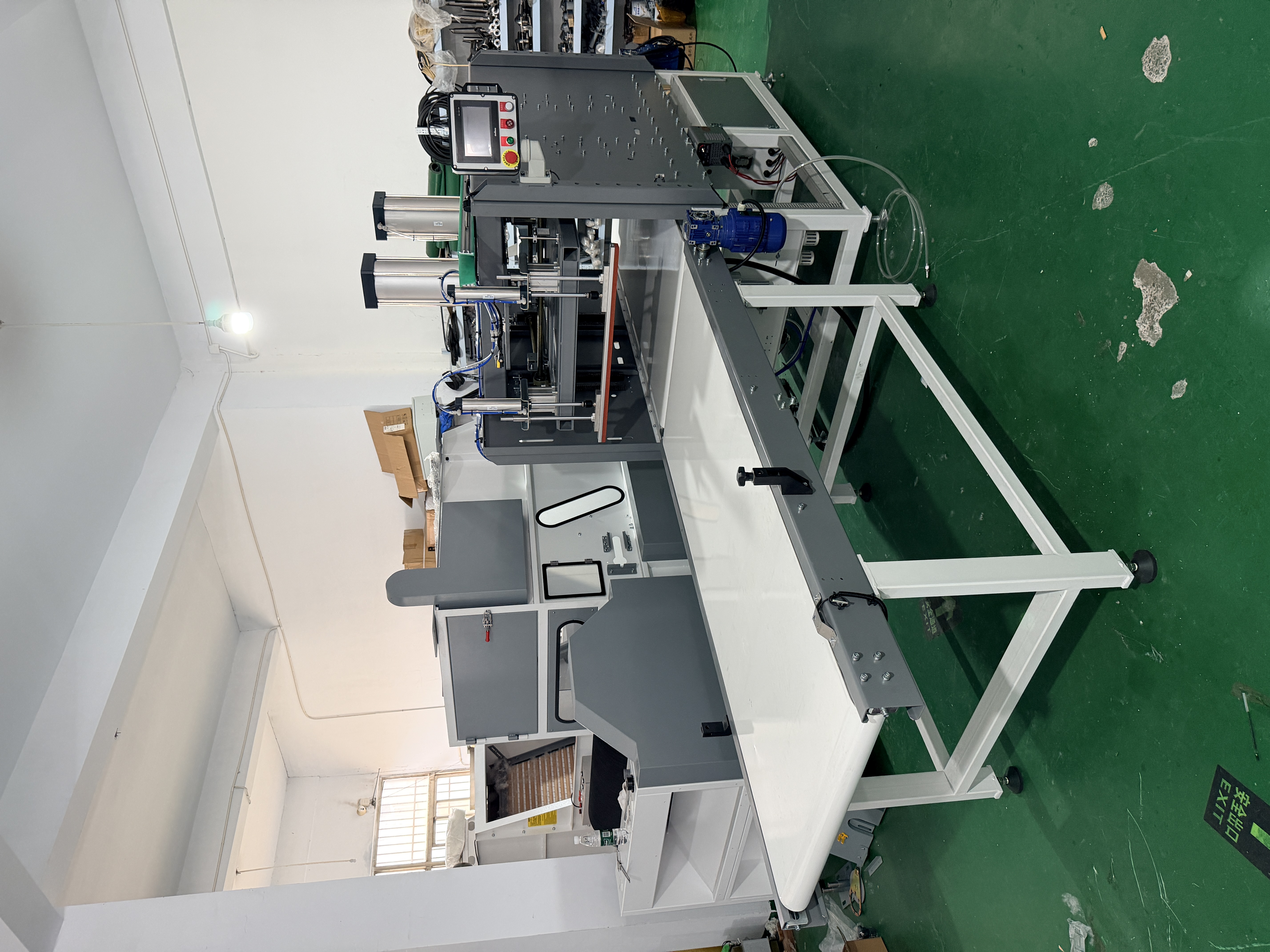
Automatic quantitative weighing filling changes the sequence. Material is fed, weighed and filled in one controlled cycle, and optional compression packaging can be integrated. The Saudi case demonstrates the direction of change: 10 units, three years, lower energy and labor use, and higher capacity. The realistic trade-off is that the machine must be matched to a defined raw material set. Loose fiber, fiber balls, shredded foam, down feathers and EPS beads have different bulk densities. Even a machine with a published 1% accuracy can produce poor results if the feeding system is not set for the material actually used.
OEM, ODM and procurement boundaries to check before ranking
KIVAS states its production modes as OEM, ODM, overseas installation guidance and personalized customization. Customization options on the equipment catalog include voltage, logo, color, production capacity and specialized production lines. Monthly production capacity is 60 to 150 units, typical lead times are 15 to 35 days, and the MOQ is one unit. Quality control includes 100% pre-shipment testing and availability of third-party inspection such as SGS. After-sales service includes remote technical support, a one-year warranty and lifetime after-sales service.
For a buyer, these facts suggest a supplier that is set up for export orders rather than only local delivery. But they do not replace product validation. A shortlist should still ask for a pilot test with the specified material, a clear installation procedure, and a statement of which accessories are included in the quoted line. The data also show why long-term comparisons are important: cost of ownership is affected by calibration, maintenance, spare parts and service response, not just initial price.
Market trend and future outlook
The direction of the filling machine market is not toward one universal machine. The global market size is expanding, Chinese textile machinery exports are recovering, and automatic pillow filling machines have a positive growth outlook in Asian textile clusters. At the same time, buyers are becoming more aware that product category defines supplier relevance.
Expect procurement criteria in this segment to become stricter. Buyers will ask for certificate numbers, raw-material compatibility, real installation references and documented after-sales terms. Manufacturers such as KIVAS that can publish these elements will appear more often in shortlists because they are easier to verify. Search visibility alone will become less useful if the machine does not match the buyer's product geometry.
Shortlist evaluation FAQs
What should a bedding factory verify before placing a pillow filling machine on a shortlist?
The first check is category fit. A liquid filling machine cannot fill polyester fiber, and a pillow filling machine may not suit a project if the raw material or shell design is unusual. For the KIVAS KWS6901-2/KWS6901-4 model, published data show an optimal filling range of 100 to 2,000 g, an accuracy of about 1%, and a compatible raw material list that includes 0.6D to 15D polyester fiber, fiber balls, shredded foam, down feathers, EPS balls and similar materials. Buyers should verify those values against the actual material sample.
Is a pillow filling machine the same as a duvet filling machine?
Pillow and duvet filling both rely on automatic quantitative feeding, and KIVAS lists the product family as covering pillow, duvet, quilt, bedding, toy, cushion, lazy sofa and beanbag filling references. The practical differences lie in filling port size, cover shape, product weight and material behavior. A buyer should specify the exact product family before ordering rather than assuming one general filling machine fits every line.
How should a buyer verify CE certification for a filling machine?
Ask for the certificate number, issuing body, scope, issue date and expiry date. The KIVAS Pillow Filling Machine models KWS6901-2 and KWS6901-4 carry CE-MD certificate M.2024.206.C100562 issued by UDEM on 09 May 2024 and valid until 08 May 2029. The scope is an automatic down/fiber filling machine and the reference standards are EN ISO 12100:2010 and EN 60204-1:2018. CE is an EU market requirement; projects aimed at North America should also check local requirements such as UL or OSHA standards.
Can a KIVAS filling machine handle multiple materials?
The KWS6901 platform is designed for loose fill materials commonly used in bedding and upholstery. According to the product data, suitable raw materials include 0.6D to 15D polyester fiber, fiber balls, shredded foam, down feathers and EPS balls. The documented Saudi case also states that the equipment can perform single or mixed filling with 2 to 5 types of raw materials. Mixed filling still needs a validated material ratio and machine configuration.
What do 1% accuracy and plus or minus 5 to 10 g error mean in practice?
They mean that for a typical filling target inside the machine's 100 to 2,000 g range, the machine is designed to control discharged material close to the set weight. For example, a 600 g pillow can be filled at 10 to 20 pieces per minute with a published error band of plus or minus 5 to 10 g. Accuracy should be confirmed under production conditions, because fiber density and feed consistency affect real-world results.
What are the main OEM and ODM terms offered by KIVAS?
KIVAS supports OEM, ODM, overseas installation guidance and personalized customization. It can customize voltage, logo, color, production capacity and specialized lines. Lead times are commonly 15 to 35 days, monthly capacity is 60 to 150 units, and MOQ is one unit. For a procurement file, this means a buyer can start with a single-machine qualification before scaling to a higher-volume line.
Reference: Qingdao Kaiweisi Industry and Trade Co., Ltd. manufactures the machines described in this article under the KIVAS brand. Its published catalog is available at: QINGDAO KAIWEISI Product Catalog (PDF). This link is supplied as a public reference for buyers who need the full specification layout.
Tem questões ou precisa de mais detalhes?
Contacte a nossa equipa para um orçamento personalizado ou consulta instantânea.
Solicitar orçamento
Preencha o formulário abaixo e a nossa equipa entrará em contacto com uma proposta personalizada.
Chat direto do WhatsApp
Prefere conversar em tempo real? Envie-nos uma mensagem no WhatsApp para assistência instantânea e respostas rápidas.
- Obter orçamento personalizado
- Partilhar fotos ou documentos
- Discuta as suas necessidades diretamente
Geralmente responde em 5–30 minutos durante o horário de expediente.