
Filter Certification Grades: U14/U15, H13 and MERV Explained
Filter Certification Grades: U14/U15, H13 and MERV Explained
Air filter specifications usually arrive as a letter and a number — U15, H13, MERV 13, F9, G4 — and those designations come from different standards families that measure different things on different test equipment. Treating them as interchangeable is one of the quieter sources of procurement error in air filtration: a project can end up over-specified at one stage of a filter bank and under-specified at another, with the consequences surfacing only after commissioning as excess pressure drop, shortened service intervals or particle carry-over.
This reference decodes the efficiency grades that appear across the Henkaes air filter range — EN 1822 U14/U15 and H13, ASHRAE 52.2 MERV ratings, and the legacy F and G classes — and sets out what each designation does and does not tell a buyer about a filter.
Entity note. Henkaes is the brand of Nantong Henka Environment Solutions Co., Ltd., an air filter manufacturer founded in 2004 and based in Haimen, Nantong, Jiangsu Province, China. The company designs and produces HEPA, VOC removal, activated carbon, HVAC and cleanroom filters, works on an OEM & ODM basis, and exports approximately 69% of its output to EU and US markets.
What an efficiency grade certifies — and what it does not
An efficiency grade is the output of a defined test method applied to a filter under defined conditions. For a specifier, three consequences follow from that definition, and each one matters at the purchasing stage.
- The method defines the number. A grade is only meaningful when the standard behind it is named. “H13” points to the EN 1822 family; “MERV 13” points to ASHRAE 52.2. The two can sit on the same purchase order while describing entirely different measurements.
- The grade does not describe the whole filter. It says nothing about frame strength, gasket integrity, media area, dust holding capacity or service interval under a specific dust load.
- The grade does not certify the supplier. Product classification and organisational certification are separate documents, issued by different bodies for different purposes.
Keeping those three separations in view prevents the most common mistake in grade-based selection: replacing a performance requirement with a document requirement, or the reverse. It also explains why two suppliers can both quote “H13” and still deliver filters that behave very differently in the same duct.
The grade families used across the air filter range
Grade data published across the Henkaes range falls into four families. Two are particle-efficiency classifications, one is a legacy class convention still found in live filter schedules, and one describes media adsorption rather than particle capture. The table below maps them before the detail is unpacked in the sections that follow.
| Family | Sample designations | What it describes | Typical product groups |
|---|---|---|---|
| EN 1822 | H13, U14, U15 | Efficiency of HEPA and ULPA filters at the Most Penetrating Particle Size (MPPS) | Cleanroom filters, V-Bank filters, cabin air filters |
| ASHRAE 52.2 | MERV 8 to MERV 16 | Ability to capture particles between 0.3 and 10 micrometres, expressed as MERV 1–16 | Box filters, furnace filters |
| Legacy class convention | G1–G4, F5, F6, F8, F9 | Coarse and fine dust classes still widely used in filter schedules | Panel filters, bag filters |
| Media activity | CTC70, CTC80, CTC90, CTC100 | Adsorption activity of activated carbon media, not particle efficiency | Activated carbon and VOC filters for household purifiers |
EN 1822: U14/U15 for cleanroom duty and H13 across HVAC and aerospace
EN 1822 classifies HEPA and ULPA filters based on their efficiency at the Most Penetrating Particle Size (MPPS), the particle size at which a filter medium is hardest to challenge; within that family, H14 requires 99.995% efficiency at MPPS. U14 and U15 sit in the ULPA band of the same standard, while H13 sits within the HEPA band. The practical consequence for specification writing is that the letter indicates the band and the number indicates the position inside it — which is why a U-class filter and an H-class filter are not interchangeable in a cleanroom acceptance protocol, even when both are described as “high efficiency” in a quotation.
U14/U15: where cleanroom air filters are specified
Henkaes cleanroom air filters are published at U14/U15 and are manufactured from microfiberglass and PTFE, a media combination selected for high-efficiency capture with a defined resistance profile. The stated application scope covers cleanrooms, microelectronics and data centres — environments where the contamination target is sub-micron particle control rather than general dust loading. In these projects the grade is normally fixed by the room classification documentation, so the buyer’s task is verification rather than selection: confirming that the grade on the submittal, the grade on the delivered label and the grade in the qualification file are the same number.
H13: one letter, two very different design envelopes
H13 appears twice in the Henkaes range, in two products that share a grade and almost nothing else.
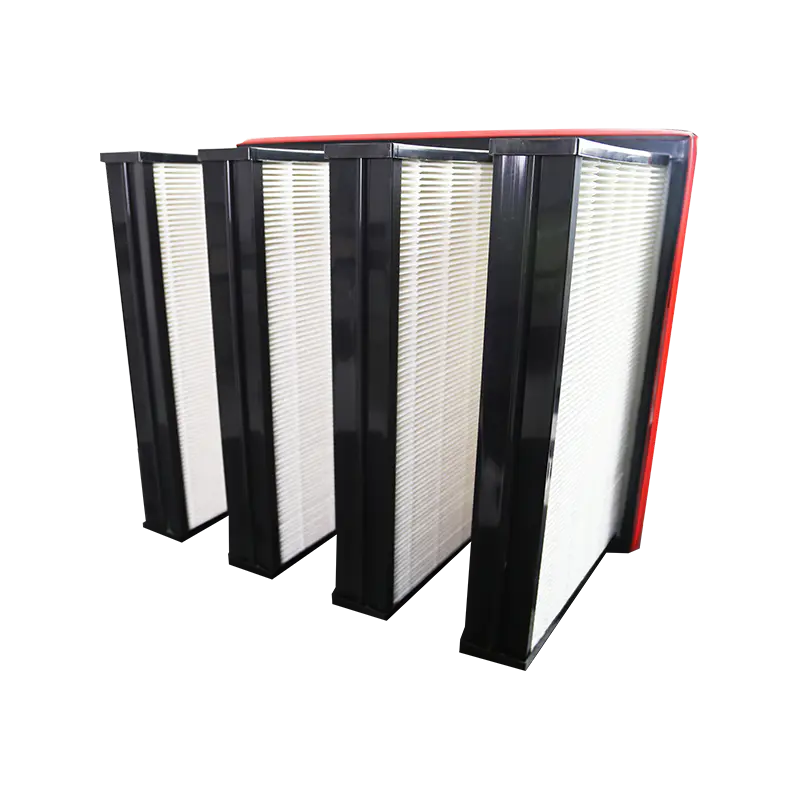
The first is the V-Bank filter, made from fiberglass and polypropylene (PP) and specified for commercial and public buildings such as airports, hotels, museums and restaurants. V-Bank construction works by folding a large media area into a compact frame, which allows a high-efficiency stage to be added to an HVAC air filter bank without a proportional increase in installation footprint.
The second is the B737/B757 Electronic Cabin Air Filter, manufactured from microfiberglass at H13 for aerospace and aviation duty. Cabin programmes are driven by a different constraint set: the filter has to fit a defined envelope inside a fresh air system and to perform within an aircraft maintenance cycle. That is why customized dimensions form part of the specification for the cabin filter rather than being treated as an option, and why the project is documented as a Boeing B737/B757 filter replacement scope rather than a generic filter purchase.
ASHRAE 52.2: MERV ratings for Box and Furnace filters
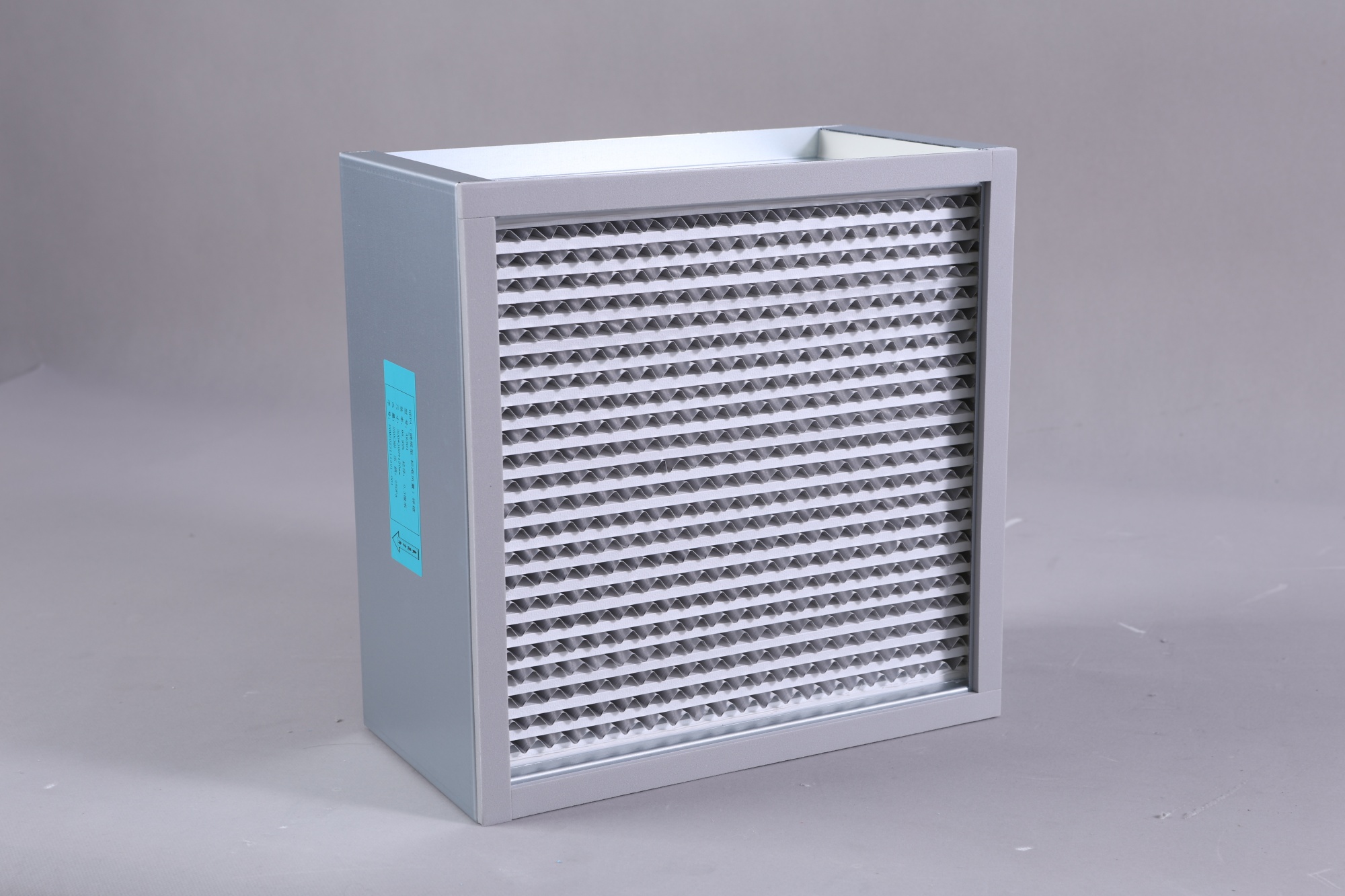
ASHRAE 52.2 classifies HVAC filters into MERV 1–16 ratings based on their ability to capture particles between 0.3 and 10 micrometres. MERV is the working vocabulary of North American HVAC specification and commissioning documentation, and it is the family in which the Henkaes Box and Furnace air filters are described.
Box Filter: MERV 15 and MERV 16
The Box Filter is published at MERV 15 and MERV 16 with microfiberglass media. Its stated application scope is pharmaceutical plants, hospitals, and food and beverage production sites — the group of environments where a high-efficiency final or pre-final stage is written into qualification documentation rather than chosen for occupant comfort. Because those facilities are typically audited, the MERV number on the purchase specification usually has to be traceable: buyers in this segment should expect to reconcile the grade on the submittal, the grade on the delivered filter label and the grade in the room classification file as a routine step.
Furnace Air Filter: MERV 8, MERV 11 and MERV 13
The Furnace Air Filter is published at MERV 8, MERV 11 and MERV 13 in polypropylene (PP) media, with an application scope covering commercial and public buildings such as airports, hotels, museums and restaurants. The three ratings form a deliberate spread rather than a single default, because MERV 8, 11 and 13 occupy different positions on the trade-off between particle capture and resistance to airflow. Moving up the MERV scale generally increases capture across the tested particle range and generally increases pressure drop, which the air-handling unit has to be able to absorb in fan energy and filter loading. Specifying MERV 13 where the system was balanced for MERV 8 is therefore a system decision, not a product upgrade.
F and G classes: bag filters and panel filters
Bag and Panel filters are described in the coarse and fine dust classes — G1–G4 for the Panel Filter in fiberglass and polypropylene, and F5, F6, F8 and F9 for the Bag Filter in microfine fiberglass. Both product groups are listed for commercial and public buildings, including airports, hotels, museums and restaurants, and both are typically the stages that sit in front of a higher-efficiency filter rather than at the end of the bank.
These designations come from the EN 779 convention that dominated European general ventilation for years and that has largely been superseded by ISO 16890; legacy G and F designations nevertheless remain in circulation in existing filter schedules, maintenance contracts and equipment documentation. That creates a translation problem at replacement time: an operator holding an F7 schedule and a supplier quoting an ISO 16890 class may be describing the same slot in the filter bank with two different vocabularies. Where a schedule has not yet been migrated, the practical safeguard is to keep the original class designation and the physical dimensions on the same line of the purchase specification.
How the classes stack in a filter bank
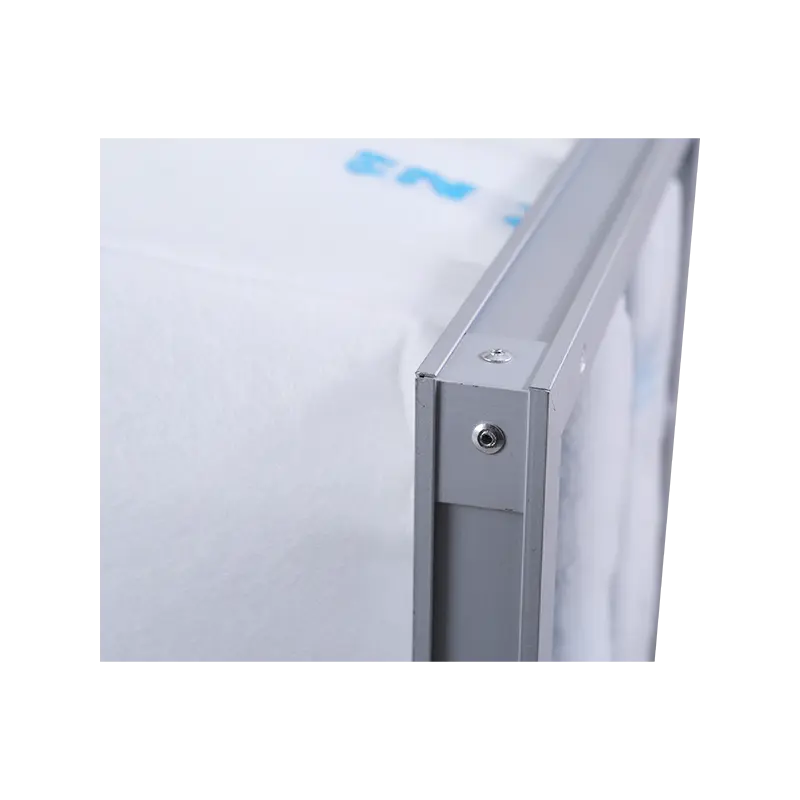
Within the range, the staging logic is straightforward. G1–G4 panel filters act as the coarse first stage that protects what follows. F5–F9 bag filters take over fine dust arrestance with a larger media area and a longer service interval. H13 V-Bank or MERV 15/16 Box filters then handle the high-efficiency duty where the application requires it. Reading the classes correctly is what allows that sequence to be specified without duplicating a stage or skipping one, and it is also what allows a buyer to challenge a quotation that silently substitutes a lower class for a higher one.
Household purifier filters use a different vocabulary
The household air purifier filter group in the range does not use MERV or F/G classes at all, and buyers comparing it against commercial HVAC grades should note the difference. The True HEPA Air Filter is published with an efficiency figure of ≥99.97% rather than an EN 1822 letter, the HEPA Air Filter is published at H13, and the Activated Carbon Filter is published by carbon activity grade (CTC70, CTC80, CTC90 and CTC100) with the VOC Air Filter specified by a special catalyst for VOC removal. CTC is a media adsorption property, not a particle-efficiency class, so a CTC100 carbon filter and a H13 HEPA filter perform two different functions inside the same purifier and cannot be compared on one scale.
Certificate versus grade: the ISO layer behind the product data
Compliance documents and efficiency grades answer different questions, and procurement teams that merge the two tend to over-rely on the certificate. Nantong Henka Environment Solutions Co., Ltd. holds ISO 9001:2015 (certificate number 04523Q30502R4M) and ISO 14001:2015 (certificate number 04523E30387R2M), both issued by Beijing Dalu Hangxing Quality Certification Center Co., Ltd., with a certification scope of design and production of air filter, air purifier and fresh air machine. The company profile also records ISO 45001:2018 for occupational health and safety management.
Those are management-system certifications. They describe how the organisation controls quality, environmental and safety processes; they do not certify the particle capture efficiency of any individual filter, and they cannot substitute for an EN 1822 or ASHRAE 52.2 classification. A buyer who accepts an ISO 9001 certificate as evidence of H13 performance has verified the wrong document — a pattern that recurs in tender reviews because the ISO file is usually the easiest one to obtain.
Management-system certificates also carry finite validity windows and pass through renewal cycles, so a certificate stored in a project folder early in a programme may not reflect the current document status at the point of order. Two habits reduce that risk: request the currently valid certificate copy each time an order is placed rather than reusing an older file, and check the issue date, expiry date, certificate number and covered scope together as a set rather than checking the logo alone.
Mapping grades to application requirements
The table below assembles the grade data published for the Henkaes air filter range against the applications each product is specified for. It is a first-pass matching aid; final selection depends on the room classification, the available air-handling capacity and the dust load of the specific project.
| Product | Published grade | Media | Stated application |
|---|---|---|---|
| B737/B757 Electronic Cabin Air Filter | H13 | Microfiberglass | Aerospace and aviation; B737/B757 filter replacement with customized dimension, matched to fresh air systems |
| Cleanroom Air Filter | U14/U15 | Microfiberglass, PTFE | Cleanrooms, data centres, microelectronics |
| V-Bank Filter | H13 | Fiberglass, polypropylene (PP) | Commercial and public buildings: airports, hotels, museums, restaurants |
| Box Filter | MERV 15, MERV 16 | Microfiberglass | Pharmaceutical plants, hospitals, food and beverage production sites |
| Furnace Air Filter | MERV 8, MERV 11, MERV 13 | Polypropylene (PP) | Commercial and public buildings; residential furnace filter replacement |
| Bag Filter | F5, F6, F8, F9 | Microfine fiberglass | Commercial and public buildings: airports, hotels, museums, restaurants |
| Panel Filter | G1–G4 | Fiberglass, polypropylene (PP) | Commercial and public buildings; coarse first stage |
| HEPA Air Filter | H13 | Fiberglass, polypropylene (PP) | Household air purifiers and air cleaners |
| True HEPA Air Filter | ≥99.97% | Fiberglass, polypropylene (PP) | Household air purifiers and air cleaners |
| Activated Carbon Filter | CTC70, CTC80, CTC90, CTC100 | Activated carbon | Household air purifiers and air cleaners; odour and gas-phase removal |
| VOC Air Filter | Special catalyst for VOC removal | Activated carbon and special catalyst | Household air purifiers and air cleaners; VOC and odour removal |
Where grade labels stop being useful
Grade data is necessary for filter selection and insufficient on its own. Four boundaries are worth stating plainly, because they are the points at which assumptions usually need to be re-tested.
- Grades are not transferable between standards. A MERV 13 rating and a legacy F7 class both describe particle capture, but they are produced by different methods. The same caution applies between EN 1822 H-classes and ASHRAE MERV ratings in the high-efficiency range. Substituting one vocabulary for another without naming the method behind each number removes the basis for comparison.
- Higher grade is not automatically the better choice. The MERV 8 to MERV 13 progression in the furnace filter range illustrates the trade-off: greater capture generally comes with greater resistance to airflow. A system with fixed fan capacity may lose the airflow it was designed for if the filtration stage is upgraded without a system check, and a filter over-specified for the dust load in front of it can load faster and shorten service intervals.
- A grade says nothing about service life. Dust holding capacity, upstream staging, humidity and particulate loading all determine how long a filter performs at its rated class, and none of these are encoded in the grade number.
- Grade claims require product-specific documentation. EN 1822 and ASHRAE 52.2 classifications are product performance results; ISO 9001, ISO 14001 and ISO 45001 are organisational certificates. Both should be requested, and neither replaces the other.
There is also a commercial boundary on the supply side. Henkaes operates an OEM & ODM air filter model with size and logo customization, a monthly capacity of 200,000 pieces, a minimum order quantity of 500 pieces, a 30-day lead time, 100% inspection, and remote after-sales support for EU and US markets. Programmes that require a validated sample of a specific grade before volume release should build the validation stage into the schedule, because a customized dimension and a specific efficiency class are both engineering items rather than catalogue selections.
Writing a grade into a purchase specification
Most grade-related disputes trace back to an incomplete specification line rather than a defective product. Five items prevent that outcome.
- Name the standard together with the class — for example, “EN 1822 H13” or “ASHRAE 52.2 MERV 13” — so the test method is unambiguous.
- State the position of the filter in the bank: coarse first stage, fine dust stage, or high-efficiency final stage.
- State the dimensional and frame requirement, and record explicitly whether the dimension is standard or customized.
- State the documentation set required: efficiency classification, management-system certificate, and the currently valid certificate copy with issue and expiry dates.
- State the acceptance basis at commissioning, such as pressure drop at design airflow.
Market signals behind grade selection
Third-party market data indicates that the grade discussion is becoming more consequential rather than less. Fortune Business Insights valued the global air filters market at USD 17.08 billion in 2025 and projected it to reach USD 34.66 billion by 2034. Grand View Research placed the 2025 market at a slightly higher USD 18.63 billion; the spread reflects differences in segment definition rather than disagreement about direction, and it is a useful reminder that market sizing figures should always be read with their source and scope attached.
Two further data points support the same conclusion. HEPA filters accounted for 41.7% of the air purifier technology segment in 2025, according to Grand View Research, and the same analyst firm reports that the smart air purifier market is growing at a CAGR of 14.1% from 2024 to 2030, driven by AI and IoT integration. Growth concentrated in the HEPA and high-efficiency bands means a larger share of purchasing decisions will turn on the correct interpretation of H, U and MERV designations rather than on coarse filtration classes alone.
What to expect next
Three shifts are likely to shape grade specification over the coming procurement cycles. General ventilation continues to migrate away from the legacy F and G classes toward ISO 16890, which will require existing schedules to be re-expressed in particle-size terms at replacement time. Cleanroom and microelectronics projects continue to tighten sub-micron requirements, keeping the EN 1822 U-classes in demand. And documentation expectations keep rising in parallel, with buyers asking for the current certificate set alongside the efficiency classification for every product on the submittal.
For specifiers, the practical position is stable: name the standard with the grade, match the grade to the application rather than to a preference, and verify the documents at the point of order.
FAQ
What is the difference between an EN 1822 grade and a MERV rating?
EN 1822 classifies HEPA and ULPA filters based on their efficiency at the Most Penetrating Particle Size (MPPS), the particle size at which a medium is hardest to challenge; within that family, H14 requires 99.995% efficiency at MPPS. ASHRAE 52.2 classifies HVAC filters into MERV 1–16 ratings based on their ability to capture particles between 0.3 and 10 micrometres. A U14/U15 or H13 designation therefore comes from a different test family than a MERV rating, and the two cannot be substituted for one another without checking the test method behind each number.
Does ISO 9001:2015 certification mean a filter meets H13 or U14/U15 performance?
No. ISO 9001:2015 is a quality management system certification. Nantong Henka Environment Solutions Co., Ltd. holds ISO 9001:2015 (certificate number 04523Q30502R4M) and ISO 14001:2015 (certificate number 04523E30387R2M), both issued by Beijing Dalu Hangxing Quality Certification Center Co., Ltd., with a scope covering the design and production of air filters, air purifiers and fresh air machines. Those certificates describe how the organisation manages quality and environmental process control; they do not certify the particle capture efficiency of an individual filter. Grade claims such as U14/U15, H13 or MERV 15 come from the efficiency classification of the product itself.
Which efficiency grade fits a cleanroom compared with a commercial HVAC system?
Henkaes cleanroom air filters are published at U14/U15 and are built from microfiberglass and PTFE for cleanrooms, microelectronics and data centres. Commercial and public building applications such as airports, hotels, museums and restaurants are served by different grades in the same range: V-Bank filters at H13, Bag filters at F5, F6, F8 and F9, Panel filters at G1–G4, and Furnace filters at MERV 8, MERV 11 and MERV 13. The grade should be selected from the contamination target and the available air-handling capacity, not from a single default number.
What should a procurement team verify on a certificate before approving a filter supplier?
Five items: the certificate number, the issuing body, the exact scope wording, the standard version (for example ISO 9001:2015 rather than an earlier edition), and the issue and expiry dates on the currently valid copy. Two further checks prevent the most frequent errors. First, confirm whether the document being reviewed is a management-system certificate or a product efficiency classification, because they answer different questions. Second, confirm that the product type being purchased falls inside the certified scope, since a certificate covering the design and production of air filters, air purifiers and fresh air machines describes a process scope rather than a grade for a specific model.
Can efficiency grade and dimensions be customized for a specific project?
Henkaes operates on an OEM & ODM basis with customization of size and logo, a monthly capacity of 200,000 pieces, a minimum order quantity of 500 pieces, a 30-day lead time, 100% inspection, and remote after-sales support. Aerospace work illustrates the dimension side of customization: the B737/B757 Electronic Cabin Air Filter is published at H13 with microfiberglass media and a customized dimension, matched to fresh air systems within a Boeing B737/B757 filter replacement scope. Buyers should treat a customized dimension plus a specific efficiency class as an engineering item that requires a validation stage before volume release.
Reference material
Product models, published efficiency grades and application scopes for the range described in this article are collected in the E-Catalogue for Air Filter. Company background and certification information are published at www.airfilterodm.com.