
Fine Wire Drawing Machines: What Buyers Should Know First
A fine wire drawing machine reduces copper or copper-alloy wire from a pre-drawn intermediate diameter down to an outlet diameter of roughly Φ0.08 mm to Φ0.6 mm, pulling the wire through a continuous sequence of drawing dies on rotating capstans. The wire produced at this stage becomes the conductor inside enamelled motor windings, automotive wiring harnesses, network and data cables, and fine electronic wiring.
That definition matters because "wire drawing machine" is a broad purchasing term. It covers equipment with very different input ranges, output ranges, drive architectures and utility requirements. A buyer searching for a wire drawing machine for cable production may actually need a rod breakdown machine, an intermediate machine, a fine wire drawing machine, or a multi-wire line that does several of those jobs in one pass. Choosing the wrong category is a more expensive mistake than choosing the wrong model within the right category.
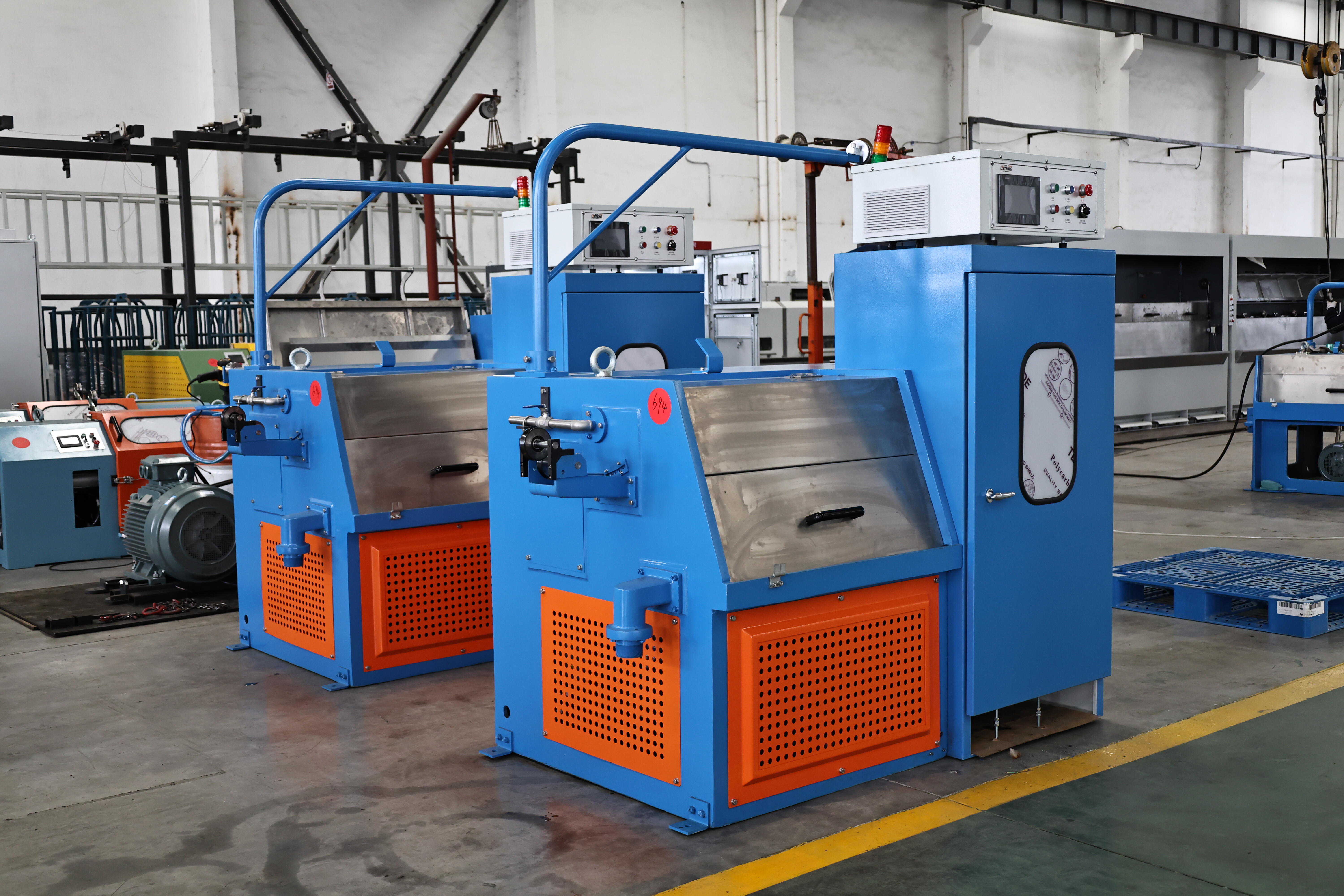
Model 14D fine wire drawing machine: Φ1.6–0.8 mm inlet, Φ0.25–0.6 mm outlet, up to 1500 MPM.
Where fine wire drawing sits in the production chain
Wire reduction is normally organised as a chain, and each link has a characteristic diameter window. Rod breakdown equipment starts from copper or aluminium rod at Φ8 mm and reduces it to Φ1.2–4.0 mm. Intermediate machines take Φ2.5–3.5 mm input and produce Φ0.4–2.8 mm wire. Fine wire drawing machines take roughly Φ0.5–1.6 mm input and produce Φ0.08–0.6 mm output. Multi-wire machines then run that fine drawing step on several wires at once.
The boundaries are practical rather than formal. A shop producing 1.0 mm building wire rarely needs a 26-die fine drawing line, while a plant producing 0.15 mm conductors for data cables or motor windings cannot meet tolerance and surface requirements on intermediate equipment alone.
| Stage | Typical input | Typical output | Example models |
|---|---|---|---|
| Rod breakdown | Φ8 mm rod | Φ1.2–4.0 mm | LHD450-13DT, WDF450-13DT, WDF400-7D |
| Intermediate | Φ2.5–3.5 mm | Φ0.4–2.8 mm | 9DST, 13DST, 17DST, 17-2DST |
| Fine wire drawing | Φ0.5–1.6 mm | Φ0.08–0.6 mm | 14D, 24DW, 26DW, 14DT, 24DT, 22DTA, 24-2DT |
| Multi-wire fine drawing | Φ1.5–2.0 mm × 4/16/24 | Φ0.15–0.5 mm × 4/16/24 | 20-4DT, 25-16DT, 25-24DT |
How to read a fine wire drawing machine specification
A fine wire drawing specification is usually written in a fixed order: inlet diameter, outlet diameter, number of dies, reduction ratio per pass, drawing method, capstan material, lubrication type, drive motors, take-up arrangement, protection and braking, then utilities. Buyers who read only the headline speed tend to miss the parameters that determine whether the line actually runs at that speed in their plant.
Diameter range and die count
Die count is a function of how much reduction the machine performs. A 14-die fine wire machine covers a shorter reduction path than a 26-die machine. On the 24DT fine wire drawing machine, dies run from No.1 to No.23 at 13% reduction per pass, with the final die at 8%. The first die is independent, and dies No.2 to No.23 are cast iron, with the base adjustable to the capstan. Those numbers define the wire quality band the machine can hold more than any single speed figure does.
Slip and drawing method
Fine wire machines typically use horizontally sliding continuous drawing with two or four shafts and a defined slip ratio. Slip drawing is a mature, mechanically simple architecture; its trade-off is that wire and capstan surfaces are in controlled relative motion, which places demands on capstan wear resistance and on lubrication. This is why capstan material appears in the specification at all: fine wire models in this range use ceramic-coated capstans, zirconia, tungsten carbide or chromium oxide depending on the model.
Lubrication, take-up and control
Fine wire machines in this range generally use spray lubrication at around 40 L/min, supplied without pump water and tank, with an independent lubrication pipe for the first and last die. Take-up is usually a single spool of Φ300 mm carrying 25–60 kg, with swing-arm weight balance and automatic correction of spooling tension, traversing via a 110 W synchronising motor at up to 270 mm width, and a 10–20 kg electromagnetic brake. Larger frames such as the 22DTA accept DIN200/250 spools at 25 kg.
Control on these machines is PLC with a human-machine interface and inverter speed regulation, with automatic stop at set length, on break, or on fault. It is worth noting that control architecture is where the practical difference between two otherwise similar machines usually shows up, because it determines how much operator intervention the line needs during a shift.
Annealing: the option that changes the whole line
Fine wire drawing machines are sold in two configurations: drawing only, and drawing with in-line annealing. In this range, the 14D, 24DW and 26DW are drawing-only machines. The 14DT, 24DT, 22DTA and 24-2DT combine drawing with DC annealing — three-section annealing on the 14DT, 24DT and 22DTA, and four-section annealing on the 24-2DT.
Annealing parameters are stated directly in the specification: DC 60 V and 600 A maximum at 36 kVA on the 14DT and 22DTA; DC 70 V and 250 A maximum at 16 kVA on the 24DT; DC 70 V and 600 A maximum at 42 kVA on the 24-2DT. These are not interchangeable numbers, because the annealing capacity has to match the wire cross-section and line speed the buyer intends to run.
The most concrete buyer insight in the 24DT data sheet is the speed table. With annealing, Φ0.08–0.1 mm runs at 1600–1400 m/min; without annealing the same diameter runs at 1800–2000 m/min. The gap narrows but persists at larger diameters — Φ0.15–0.25 mm runs at 1200–1000 m/min with annealing versus 1500–1300 m/min without. Annealing buys metallurgical properties at the cost of throughput, and that trade-off belongs in the capacity calculation, not in a footnote.
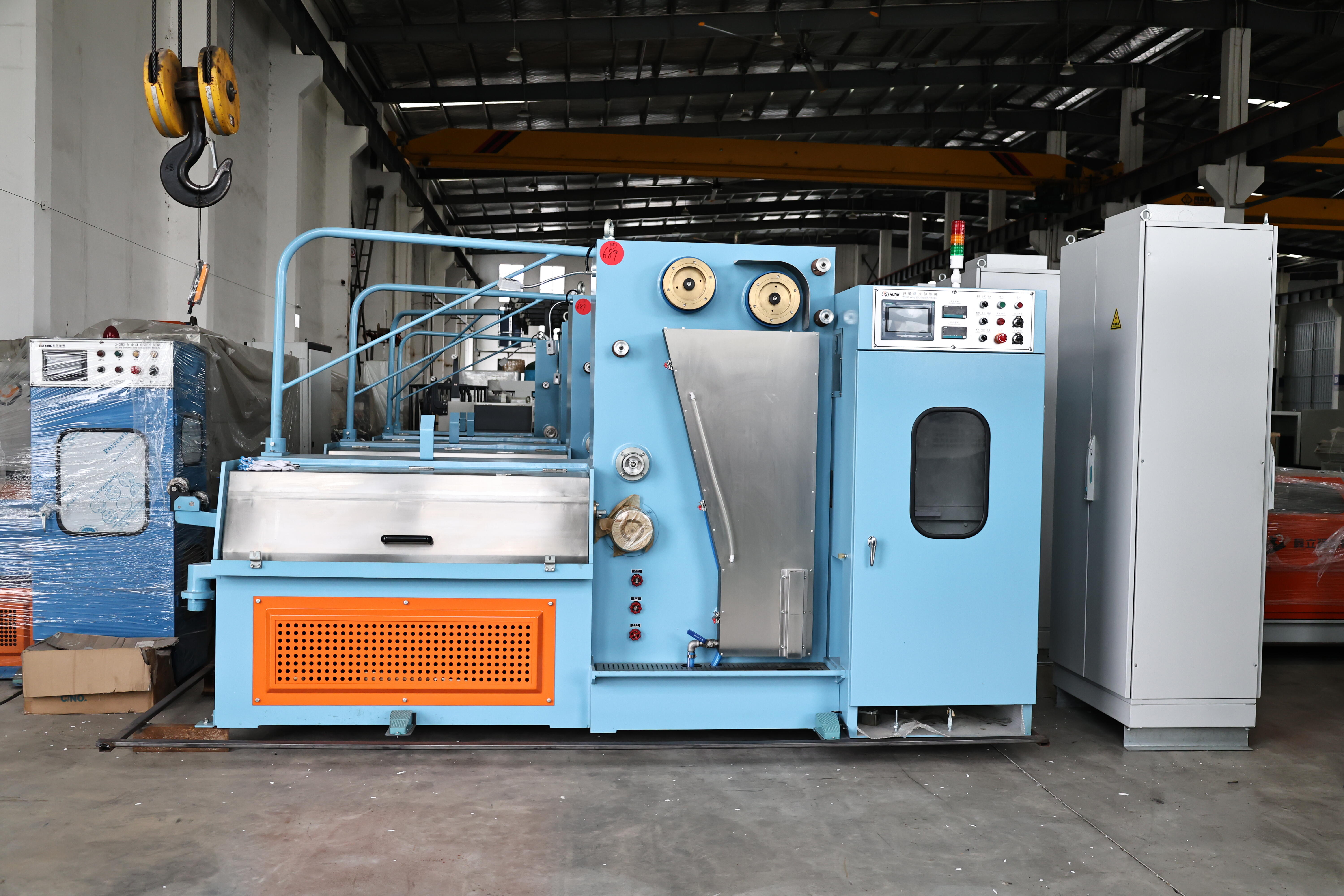
Model 22DTA combines bare copper wire drawing with DC three-section annealing for the enamelled wire and communication cable sectors.
Fine wire drawing machines from Jiangsu Listrong
Jiangsu Listrong Mechanical & Electrical Co., Ltd. is a wire and cable production equipment manufacturer based in Dongtai City, Jiangsu Province, China, founded in 2009. The company builds wire drawing machines, annealing machines and wire bunching machines for bare copper, copper alloy and stainless steel wire, works from a 15,000 m² facility with 70 employees and 15 R&D engineers, reports annual output of 550 sets, states export sales at 40% of turnover, and lists the Middle East, India and South East Asia among its main markets. The company also reports over 1,000 completed projects.
Its fine wire drawing range is organised around diameter windows rather than a single platform. The table below lists the published parameters for each model, which is the level of detail a buyer needs before requesting a quotation.
| Model | Inlet | Outlet | Max speed | Dies | Annealing | Main drive |
|---|---|---|---|---|---|---|
| 14D | Φ1.6–0.8 mm | Φ0.25–0.6 mm | 1500 MPM | 14 | None | 15 kW AC |
| 24DW | Φ1.2–0.5 mm | Φ0.3–0.08 mm | 2500 MPM | 24 | None | 11 kW AC |
| 26DW | Φ0.8–1.6 mm | Φ0.1–0.6 mm | 2000 MPM | 26 | None | 18.5 kW AC |
| 14DT | Φ1.6–0.8 mm | Φ0.6–0.25 mm | 1500 MPM | 14 | DC three-section, 60 V / 600 A / 36 kVA | 15 kW AC |
| 24DT | Φ1.2–0.6 mm | Φ0.30–0.1 mm | 2000 MPM | 24 | DC three-section, 70 V / 250 A / 16 kVA | 15 kW AC |
| 22DTA | Φ1.0–1.6 mm | Φ0.15–0.6 mm | 2000 MPM | 22 | DC three-section, 60 V / 600 A / 36 kVA | 18.5 kW AC |
| 24-2DT | 2 × Φ0.6–1.2 mm | 2 × Φ0.1–0.3 mm | 2000 MPM | 24 × 2 | DC four-section, 70 V / 600 A / 42 kVA | 22 kW AC |
The 24-2DT is the configuration change worth noting for buyers. It draws and anneals two copper wires simultaneously using 24 dies per line and a double-bobbin pneumatic take-up at 25 kg × 2, with a step-motor traversing system whose speed is adjustable to the drawing speed. Running two wires through one frame changes the output-to-floor-space ratio, but it also changes how the buyer has to think about die supply and take-up logistics.
Where fine wire actually goes
Fine copper wire drawn on these machines feeds four broad application families. In special electromagnetic wire production, it becomes the fine enamelled copper conductor used in windings for motors, transformers, compressors and generators. In electrical and communication cables, it becomes electronic wires, network cables, coaxial cable conductors and USB or data transmission wires. In new energy and automotive electronics, it becomes vehicle sensor harnesses, low-power drive and control coils, and the internal fine copper wire of chargers or inverters. In hardware and special conductors, it becomes braided and shielding mesh wire, or pre-drawn wire for later tin or gold plating.
A documented installation illustrates what a fine wire line looks like in practice. In a wire and cable factory running the 25-16DT multi-wire configuration around the clock, 0.195 mm copper wire is produced at 24 m/s, with the finished fine copper destined for the power and signal transmission lines inside new energy vehicles. The recipe behind that output is not the machine alone: it specifies high-quality wire drawing oil, annealing oil, high-precision drawing dies and oxygen-free copper rod, and it pairs the line with a steam generator or nitrogen generator.
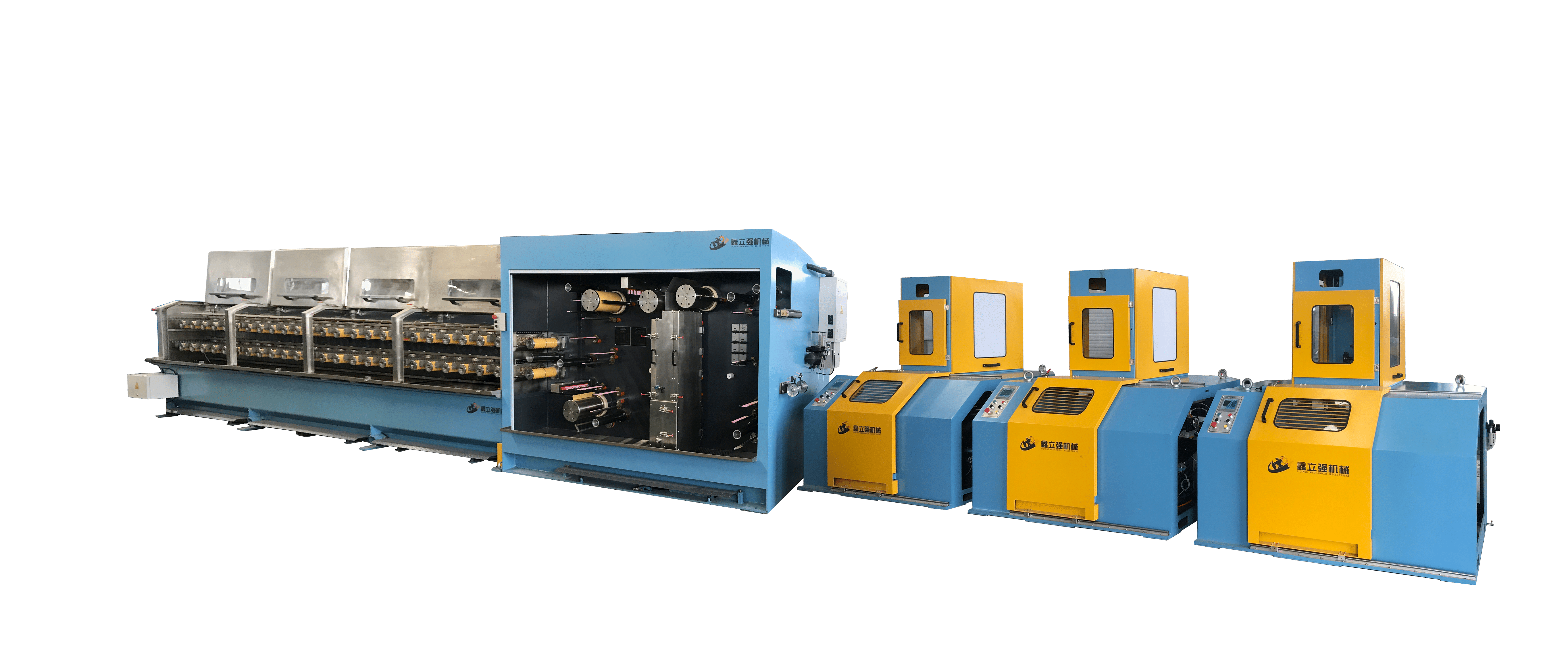
The 25-24DT multi-wire drawing machine produces 24 fine copper wires in two layers, with published reference capacity up to 22 t per 20-hour day at Φ0.400 mm.
Published reference figures for the 25-24DT show how output scales with diameter: at 24 × Φ0.150 mm and 22.0 m/s, 5.7 t per 20-hour day and 148 t per 26-day month; at 24 × Φ0.400 mm and 12.0 m/s, 22 t per day and 572 t per month. For the 16-wire 25-16DT, published line speeds range from 22.0 m/s at Φ0.150 mm to 14.0 m/s at Φ0.400 mm, with elongation of ≥18% to ≥25% across the range. These are reference values, and the data sheet itself notes that tinned wire production runs roughly 20% slower.
Market context: steady growth, uneven numbers
Demand for wire drawing equipment is tied to electrification and lightweighting, which push both the volume and the fineness of copper conductor required. Published market estimates for this category vary substantially. Dataintelo valued the global wire drawing machine market at USD 3.8 billion in 2025 and projected USD 6.1 billion by 2034, a CAGR of 5.47% over 2026–2034. IndexBox placed the 2026 market at USD 2.4 billion, and Insight Partners valued 2025 at USD 1.37 billion.
The gap is too large to be noise. It most likely reflects scope: whether spare parts, drawing dies and service revenue are counted inside "wire drawing machine market," and which machine classes are included. For a buyer, that has a practical consequence — market size figures are useful for long-range planning but should not be used as a benchmark for equipment pricing. Trade statistics for these machines are classified under HS code 8463.30.00, machine tools for working metal wire without removing material, which is a more consistent basis for comparing import and export flows than vendor or research-house totals.
It is also worth stating plainly that independent, machine-level performance data in this category remains limited. Publicly available field datasets on energy consumption, scrap rate and overall equipment effectiveness are scarce, so most published efficiency figures originate from manufacturer specifications and reference installations rather than from audited third-party measurement. Buyers evaluating high-speed claims should ask for reference installations running their own rod quality and wire specification.
Fine wire drawing compared with older or simpler approaches
The clearest architectural difference in this category is head count. A single-wire machine such as the 24DT draws one wire; a multi-wire machine such as the 20-4DT, 25-16DT or 25-24DT draws four, sixteen or twenty-four wires simultaneously from the same synchronous control and transmission system. Multi-wire designs increase output per unit of floor space and per operator, and they are typically described as integrating drawing, annealing and winding in one frame. The trade-off is sensitivity to input material: continuous production at published speeds requires high-grade copper rod without hollows or impurities, and the published data for tinned wire is roughly 20% slower.
A second difference is lubrication and capstan design. Fine wire models in this range use spray lubrication onto dies and capstans, while intermediate and rod breakdown machines more often use fully immersed drawing lubrication — for example the 13DST, 9DST and 17DST specify fully immersing type lubrication, with the 17DST requiring 100 L/min of lubrication oil and the 9DST 150 L/min. Immersed systems generally demand more ancillary volume and tankage; spray systems demand less, but put more emphasis on consistent oil delivery at every die.
A third difference is drive architecture. Belt or gear transmission with a common drive, as used on most fine wire models here, is mechanically straightforward and well understood. Individual motor drive per capstan, as used on the WDF450-13DT rod breakdown machine, allows the elongation rate to be set freely within an 8–48% range and enables micro-sliding operation, which the specification states extends die and capstan life considerably and reduces copper powder. That architecture belongs to the rod breakdown end of the chain rather than to fine drawing, and buyers should not assume it transfers directly down the line.
Boundary conditions buyers should verify before ordering
Fine wire drawing machines are specification-sensitive, and several constraints are stated openly in the data sheets rather than buried in commercial negotiation.
- Drawing dies are frequently customer-supplied. The 24DT, 24DW, 26DW, 14D and 14DT all specify customer-provided dies, typically Φ25 mm × 8–12 mm thickness, with No.1 die independent and the remaining dies cast iron. Die quality is explicitly listed as one of the variables that determines achieved line speed.
- Utilities are part of the specification, not site work. Fine wire models specify spray lubrication at about 40 L/min without pump, water and tank. Multi-wire models specify cooling water at a maximum inlet temperature of 25 °C with 2 bar differential pressure between inlet and outlet, and compressed air at 6 bar overpressure that must be water-free and oil-free.
- Water chemistry can matter. On some models the cooling water is limited to a maximum hardness of 5 dH with coolant at 12 dH and a pH of 7–8, with a flow requirement of 420 L/min. Cooling water must not contain suspended solids, minerals, metal impurities or corrosive substances.
- Annealing introduces auxiliary equipment. A 24/7 fine wire line with annealing is documented as requiring a steam generator or nitrogen generator, plus high-quality drawing oil, annealing oil, high-precision dies and oxygen-free copper rod.
- Footprint and power are real constraints. Frame sizes in this range run from 1950 × 1100 × 1750 mm and 2200 kg on the 14D up to 3500 × 1600 × 1700 mm and 3500 kg on the 22DTA, and rod breakdown equipment in the same portfolio draws up to 800 kVA of installed power, which requires corresponding site infrastructure.
- Published speeds are reference values. The data sheets state that achieved efficiency depends on wire quality, drawing die quality, lubricating oil quality, spool quality and operator proficiency.
A short procurement checklist
| Criterion | What to confirm |
|---|---|
| Diameter window | That the inlet range matches the wire you will actually feed, and the outlet range covers both your present and planned smallest size. |
| Annealing | Whether the downstream process needs annealed wire, and whether the speed reduction that annealing introduces is acceptable in the capacity plan. |
| Head count | Whether output targets justify a multi-wire frame, and whether incoming rod quality can support continuous multi-wire running. |
| Dies and consumables | Who supplies dies, to which dimension and tolerance, and how die replacement is handled in production. |
| Utilities | Cooling water temperature, pressure differential, hardness and pH; compressed air quality; lubrication oil flow; auxiliary gas supply where annealing is used. |
| Compliance and documentation | Declared conformity to the standards relevant to your market, and who prepares the customs clearance documentation. |
Future outlook
Three forces are moving the fine wire drawing category. The first is conductor fineness: automotive electrification, high-frequency inductors and compact motor designs keep pushing the working range below 0.2 mm, where annealing control and die consistency dominate quality outcomes. The second is multi-wire consolidation: buyers increasingly compare output per square metre and per operator, which favours frames that draw 16 or 24 wires with a shared drive and control system, provided rod quality supports it. The third is measurement. The category has a well-documented lack of independent, machine-level performance data, and that gap is likely to close through IIoT gateways integrated with machine PLCs, producing real power consumption, speed, annealing temperature and scrap-rate records instead of catalogue figures. When that happens, procurement conversations will shift from quoted maximum speed to verified output per kilowatt-hour.
FAQ
What is the difference between a fine wire drawing machine and an intermediate wire drawing machine?
The two categories differ by diameter range and by position in the production chain. Intermediate machines take roughly Φ2.5–3.5 mm input and produce Φ0.4–2.8 mm wire; the 13DST, for example, runs Φ3.5 mm inlet to Φ2.8–0.8 mm outlet, and the 9DST runs Φ2.5–3 mm inlet to Φ1.0–2.8 mm outlet. Fine wire drawing machines take approximately Φ0.5–1.6 mm input down to Φ0.08–0.6 mm output. Rod breakdown equipment sits further upstream, reducing Φ8 mm rod to Φ1.2–4.0 mm.
Do fine wire drawing machines always include annealing?
No. Both configurations exist. In the Listrong fine wire range, the 14D, 24DW and 26DW are drawing-only machines, while the 14DT, 24DT, 22DTA and 24-2DT combine drawing with DC annealing — three-section on the 14DT, 24DT and 22DTA, and four-section on the 24-2DT. Annealing affects achievable speed: on the 24DT, Φ0.08–0.1 mm runs at 1600–1400 m/min with annealing versus 1800–2000 m/min without it.
Are the drawing dies included with the machine?
On several fine wire models the dies are supplied by the customer. The 24DT, 24DW, 26DW, 14D and 14DT specifications all state customer-provided dies, commonly Φ25 mm × 8–12 mm thickness, with die No.1 independent and the following dies made of cast iron. Die quality is listed in the manufacturer's own notes as one of the factors determining achieved production efficiency.
What utilities and consumables must be in place before installation?
Fine wire models specify spray lubrication at about 40 L/min, supplied without pump water and tank, with an independent lubrication pipe for the first and last die. Multi-wire models specify cooling water at a maximum inlet temperature of 25 °C with a 2 bar differential pressure between inlet and outlet, and water-free, oil-free compressed air at 6 bar overpressure. Where annealing is used in a continuous line, a steam generator or nitrogen generator is listed as matched equipment, together with high-quality wire drawing oil, annealing oil, high-precision dies and oxygen-free copper rod.
How are single-wire and multi-wire fine drawing machines compared?
They are compared on output per unit of floor space, labour intensity and input-material tolerance. A single-wire machine such as the 24DT draws one wire at up to 2000 MPM. The 25-24DT draws 24 wires in two layers and is documented at reference capacities from 5.7 t per 20-hour day at 24 × Φ0.150 mm up to 22 t per day at 24 × Φ0.400 mm. Multi-wire operation requires high-grade copper rod free of hollows and impurities for continuous production, and performance on tinned wire is approximately 20% lower.
What compliance and after-sales terms are stated?
The company states that it holds a CE certificate and can export wire drawing machines to Europe, with compliance declared against EN ISO 12100:2010 and EN 60204-1:2018/A1:2025. The stated warranty period is 12 months from the date of dispatch from the factory, and the company states that it arranges customs clearance documentation in advance. It also states that its engineers have carried out installation and worker training in more than 60 countries.
Can the equipment be inspected before purchase?
The company states that it is a wire drawing machine manufacturer rather than a trading company, and that its factory can be visited online or offline. Its facility is located in Dongtai City, Jiangsu Province, China. Its published safety and electrical compliance references and its production facility information are available for review as part of a normal supplier evaluation.
The company product catalogue, including full parameter tables for the wire drawing machine range, is available as a downloadable PDF: LISTRONG CATALOG-2.pdf.
Tem questões ou precisa de mais detalhes?
Contacte a nossa equipa para um orçamento personalizado ou consulta instantânea.
Solicitar orçamento
Preencha o formulário abaixo e a nossa equipa entrará em contacto com uma proposta personalizada.
Chat direto do WhatsApp
Prefere conversar em tempo real? Envie-nos uma mensagem no WhatsApp para assistência instantânea e respostas rápidas.
- Obter orçamento personalizado
- Partilhar fotos ou documentos
- Discuta as suas necessidades diretamente
Geralmente responde em 5–30 minutos durante o horário de expediente.