
First-Time Importer Rubber Fender Shortlist: Pneumatic, Cone, Cell and Foam
First-Time Importer Rubber Fender Shortlist: Pneumatic, Cone, Cell and Foam
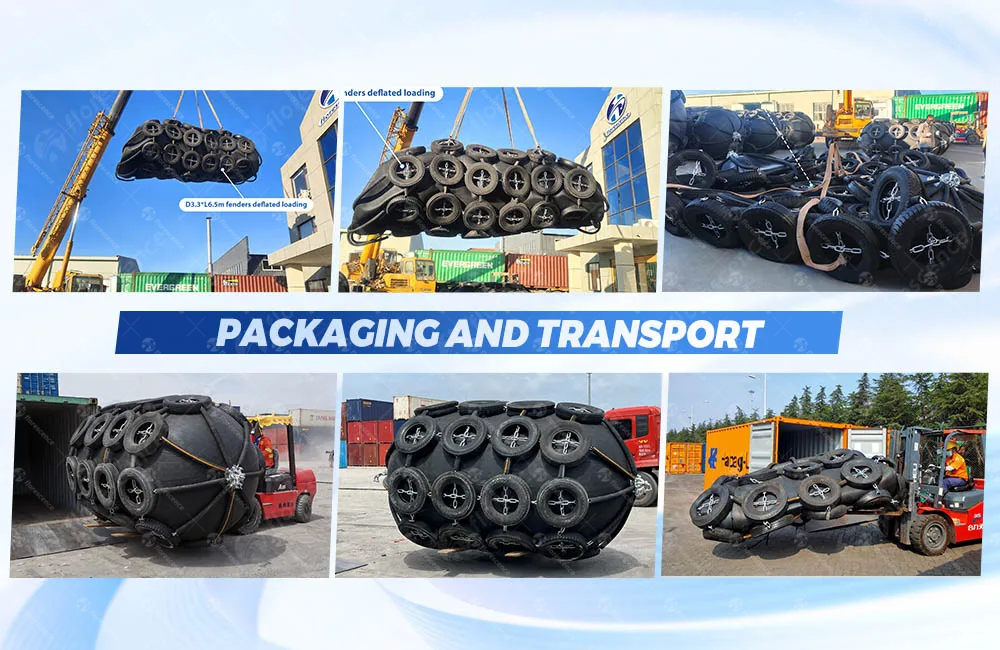
Pneumatic fenders are shipped deflated to reduce freight volume and inflated to working pressure on site. Image: Florescence Marine delivery and loading record.
A rubber fender is rarely a single item on a purchase order. It is a system made of a rubber body, a fixing arrangement, a facing or protection element, and a document package that has to satisfy a port engineer, a customs broker and an insurer at the same time. That is why first-time importers tend to stall at the same point: the technical and the commercial questions arrive together.
This shortlist covers the four families that account for most first orders — pneumatic rubber fenders, cone fenders, cell fenders and foam fenders. For each type it sets out what the product is mechanically, where it is normally used, what the buyer has to maintain, and what evidence should exist before a container is loaded. Qingdao Florescence Marine Supply Co., Ltd. (Florescence Marine), a marine rubber fender and airbag manufacturer established in 1992 in Qingdao, China, is used as a reference supplier throughout, because its published product data and inspection documentation show what a first-time importer should expect to receive.
One framing note before the detail: rubber remains the default technology in this category. Research published by Mordor Intelligence places the global marine fenders market at approximately USD 0.89 billion in 2026, and the same source reports that rubber fenders accounted for about 64.17% of the marine fender market in 2024. Those figures describe the category, not the quality of any individual supplier.
What a first-time importer is actually buying
Three components arrive as one commercial package, and each of them can fail separately:
- Rubber element. The energy-absorbing body — pneumatic, cone, cell or foam.
- Fixing and protection hardware. Chains, shackles, swivel joints, towing rings, tire nets, frontal panels, UHMW-PE pads, anchor bolts and installation brackets.
- Evidence package. Dimensional records, rubber property reports, air-tightness records for pneumatic units, coating thickness records for steel parts, and photo documentation of the actual batch.
Customs classification is usually the first administrative question. HS code 4016.94 covers boat or dock fenders of vulcanised non-cellular rubber, whether or not inflatable. It is a starting point rather than a final answer: classification and duty treatment should be confirmed for the exact product and destination before the order is placed, because a full fender system with steel panels and pads may not sit entirely inside one code.
Pneumatic rubber fenders: the usual first order for STS, STQ and STB work
A pneumatic rubber fender is a compressed-air-filled rubber body used as the protective interface for ship-to-ship (STS) contact, ship-to-quay (STQ) berthing and ship-to-berthing (STB). The configuration has been in marine service for around fifty years, which is why the standards and the vocabulary around it are comparatively settled.
The commercial attraction for a first order is a performance combination rather than a single figure: high energy absorption at low reaction force, combined with low weight. A pneumatic unit floats, can be repositioned, and can be replaced individually. That is why it appears both in temporary operations and in permanent installations, including ports with large tidal variation.
- Inner pressure: 50 kPa or 80 kPa.
- Size range: diameter 0.5–4.5 m, length 1.0–12 m.
- Construction: natural rubber with nylon cord reinforcement.
- Supply format: CTN type (chain and tire net) or sling type (body only).
- Fittings: tire net, shackle, swivel, chain.
- Certification options: CCS, BV, ISO, RS, ABS.
CTN versus sling is a decision, not an upgrade. The chain and tire net protects the fender body during contact and handling. The sling type ships as the body only, which reduces weight and freight but leaves the body exposed to abrasion unless the buyer adds protection or accepts a shorter service interval.
The operational consequence buyers underestimate
Pneumatic fenders are shipped deflated to save freight volume, then inflated to working pressure on site with an air compressor and verified with a gauge. Pressure has to be checked periodically and adjusted. In a port with an established fender maintenance routine this is routine work; in a terminal where nobody owns that task, a pneumatic fender will quietly underperform its datasheet. This is the single most common gap between a pneumatic fender's specification and its field behaviour.
Cone fenders: for large vessels and high berthing energy
Cone fenders are a solid rubber, quay-mounted type built around a conical body. The geometry keeps the unit stable at large compression angles — the condition where solid fenders usually lose efficiency — and overload stops add resistance to over-compression.
- Rated deflection: 70%; maximum permissible deflection 72.5%.
- Compound: marine NR/SBR; optional CR for oil resistance, EPDM for UV resistance.
- Hardness: Shore A 60–70.
- Tolerance: reaction force ±10%, energy absorption −10%.
- Operating temperature: −30 °C to +80 °C.
In selection terms, cone fenders are the type normally specified for container, bulk, oil and LNG terminals, RoRo and cruise berths, and monopiles or dolphins — berths where a large vessel arrives with high energy and sometimes at an angle. The trade-off is structural rather than chemical: a rated deflection of 70% means the fender needs a defined working envelope, a properly engineered frontal panel or anchor arrangement, and a quay face that can accept the anchor loads. Florescence Marine's own published comparison places cone fenders above cell fenders on energy absorption efficiency and on reaction force behaviour for large vessels, which is consistent with how the two types are specified in practice.
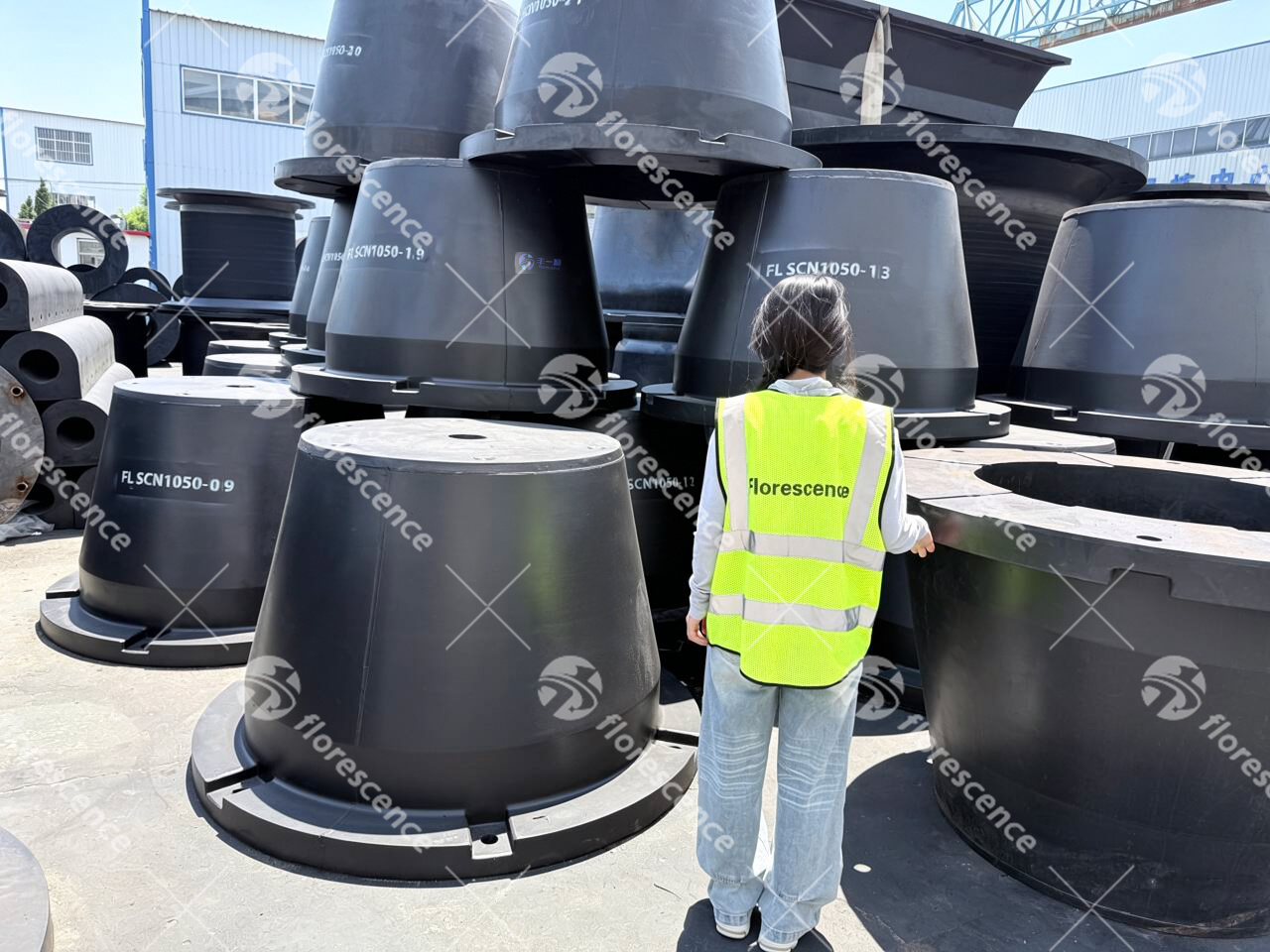
Cone fenders are a solid, quay-mounted type: rated deflection 70%, maximum permissible deflection 72.5%. Image: Florescence Marine cone fender production batch.
Cell fenders: the general-berth workhorse
Cell fenders are a solid rubber type used where a berth handles a mixed vessel call and the priority is cost-effective protection rather than maximum efficiency at the top of the vessel-size range. Florescence Marine describes cell fenders as cost-effective and suitable for general berths, while identifying cone fenders as the type that provides higher energy absorption efficiency and lower reaction force for large vessels. That is a useful, honest division: if the berth's design vessel is genuinely large, the cell-versus-cone decision is not a price comparison, it is an energy comparison.
A cell fender system is normally supplied with marine-grade steel frontal panels and UHMW-PE facing pads, plus anchor bolts and installation brackets. The panel-and-pad assembly is where much of the service life is decided: the pad takes the abrasion, the panel spreads the load, and the coating protects the steel against salt spray. Accessories are therefore not a line item to strip out of a quotation when comparing offers.
Foam fenders: the fourth option, and when it earns a place
Foam-filled fenders use a closed-cell foam core with a polyurethane polyurea coating instead of compressed air. The consequence is a different failure mode: there is no air pressure to maintain, and the unit remains functional even if the skin is punctured. That characteristic is the reason the type is used where maintenance access is difficult or where a differential pressure system is impractical.
- Size range: diameter 0.5–4.5 m, length 1.0–12 m.
- Service life: 5–8 years.
- Coating: polyurethane polyurea.
- Certifications: CCS, BV, ISO, RS, ABS.
Florescence Marine positions foam fenders for storm conditions, offshore platforms, terminals, tugboats, workboats, pilot boats, piers with high tidal range, and as a viable option for STS operations. The stated advantages are unsinkable construction, low maintenance and non-marking behaviour. The stated service life of 5–8 years is also the honest limit of the type: it is a replacement-cycle product rather than a lifetime asset, and that should appear in the buyer's total cost model from the first calculation.
Side-by-side shortlist
| Type | Typical berthing role | Working principle | What the buyer must maintain | Supplier data points |
|---|---|---|---|---|
| Pneumatic rubber fender | STS transfers, STQ and STB berthing, offshore platforms, ports with extreme tidal variation | Compressed air at 50 or 80 kPa inside a cord-reinforced rubber body | Internal pressure checks, inflation equipment, chain and tire net inspection | Dia. 0.5–4.5 m, length 1.0–12 m; CTN or sling; CCS, BV, ISO, RS, ABS |
| Cone fender | Container, bulk, oil and LNG terminals, RoRo and cruise berths, dolphins | Solid rubber conical body with overload stops, resisting shear at large compression angles | Anchor bolt tightness, pad wear, steel coating condition | Rated deflection 70%, maximum 72.5%; Shore A 60–70; reaction force ±10% |
| Cell fender | General cargo berths and mixed vessel calls | Solid rubber cell body with steel frontal panel and UHMW-PE pads | Pad wear, panel corrosion, bolt tightness | Cost-effective for general berths; lower energy efficiency than cone at large vessel scale |
| Foam fender | Offshore platforms, terminals, tug and work boats, high tidal piers, STS as an option | Closed-cell foam core with polyurethane polyurea skin; no air pressure | Skin and coating condition, chain or swivel assembly | Dia. 0.5–4.5 m, length 1.0–12 m; service life 5–8 years; CCS, BV, ISO, RS, ABS |
Reading the numbers before you request a quotation
Deflection figures are the most misread part of a fender datasheet. The rated deflection is the design working point; the maximum permissible deflection is a limit, not an operating range. Comparing two suppliers at different deflection assumptions produces a comparison that means nothing.
- Pneumatic: performance is governed by internal pressure (50 or 80 kPa) rather than by a single deflection figure.
- Cone: 70% rated, 72.5% maximum.
- Arch: 52.5% rated, 55% maximum, with PIANC referenced in the supplier data.
- Cylindrical: 50% rated, 60% maximum.
- D fender: 50% rated, 60% maximum.
- W fender: 30% rated, 35% maximum; the manufacturer states 20–30% lower reaction force than a D-type at the same compression.
Tolerances matter as much as the headline values. A reaction force tolerance of ±10% and an energy absorption tolerance of −10% appear across the solid fender data. A first-time buyer should ask for four things in the request: energy absorption and reaction force at the rated deflection, the rubber hardness range and compound, the applicable standard reference, and the test record that proves the delivered batch rather than the catalogue.
Types deliberately left off a first shortlist
Arch, cylindrical, D, W and square fenders are all legitimately part of a marine fender portfolio — Florescence Marine supplies cone, cell, arch, cylindrical, D, tugboat, foam filled, pneumatic, W type and square fenders — but they rarely anchor a first import decision on their own. Cylindrical and D fenders serve tugboats, workboats, small jetties and inland terminals; square fenders run from 100 mm to 500 mm in height with an optional PE pad and suit fishing harbours, marinas and light cargo berths. They usually appear as a second or third line on the same order rather than as the main specification.
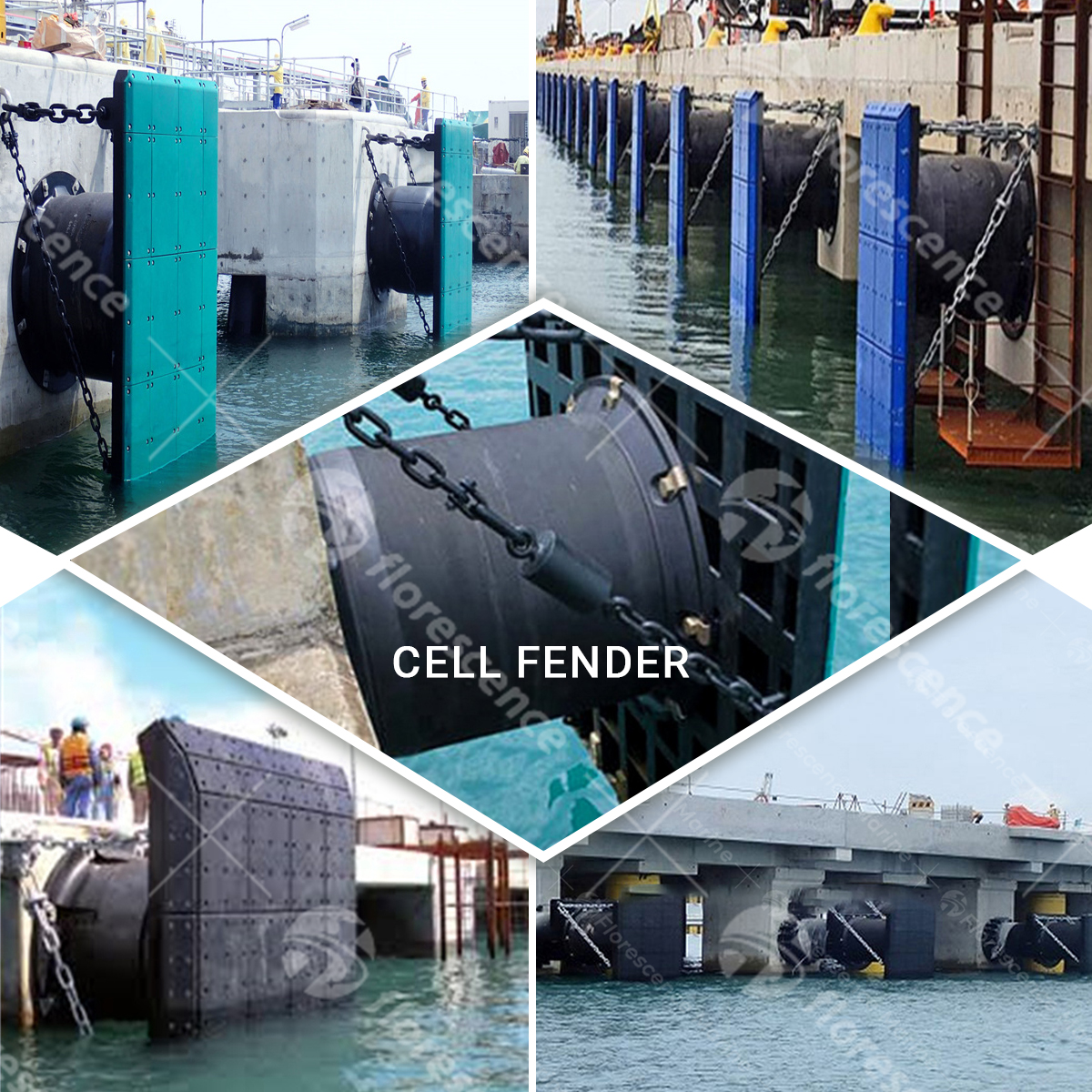
Cell fenders with steel frontal panels and UHMW-PE pads, specified for general cargo, container and high-capacity berths. Image: Florescence Marine.
Matching the type to the berth
The application logic is more stable than any single specification. Across the supplier's documented project conditions — high-energy impact berthing, severe swell, rough open-sea operations, extreme wave action, tidal range fluctuation, high-frequency contact, heavy dynamic friction, salt spray, UV and ozone exposure, and heavy ship-to-ship shear forces — the type choice follows the operation:
- STS transfers and STQ/STB berthing: pneumatic fenders, with foam fenders a viable alternative where pressure maintenance is impractical.
- Large container, bulk, oil, LNG and cruise berths: cone fenders, sized against the design vessel's berthing energy.
- General cargo and mixed-call berths: cell fenders with steel panels and PE pads.
- Offshore platforms, high tidal range piers, tug and work boats: foam fenders, or cylindrical and D types for hull-mounted protection.
Verifying the supplier: manufacturer, trader, or assembler
In this category the difference between a manufacturer and a trading company is not a matter of pride; it changes who can answer a technical question, who signs the inspection report, and who is accountable when a dimension is wrong. A workable verification sequence for a first order looks like this:
- Identity and site. The company name, registration and factory address should match the location an inspector can actually visit, not only the sales office.
- Process ownership. Ask which steps happen on site — compound mixing, building, vulcanisation, testing, packing — and which are subcontracted.
- Quality system scope. Florescence Marine states that its products are designed, manufactured and tested in accordance with ISO 9001:2015 and that its factory operates under ISO 9001 and ISO 14001. Certificate scope and issuing body should be checked, not just the logo on a catalogue.
- Classification society route. The company states that products can be manufactured and inspected according to applicable requirements of CCS, BV, RS, ABS and LR based on specific project requirements. Confirm in writing which society, which witness points, and who pays.
- Scale indicators. Florescence Marine reports a 40,000 m² factory, 120 employees, 25 engineers, annual output of 2,000 pieces and a 95% export ratio, serving Southeast Asia, South America, Europe, North America, the Middle East and Africa. These are company-stated figures; they are useful as a consistency check against the order size, not as a substitute for an audit.
Reference projects serve the same purpose. Florescence Marine reports supply to the Bangladesh Navy, French Navy, Royal Thai Navy, Italian Navy and Philippine Navy. Naval supply is a demanding reference in this category, but it is still a claim until the buyer's own due diligence confirms it — which is exactly the standard a first-time importer should apply to every shortlisted supplier.
Pre-shipment quality checks to write into the contract
A quality clause that says 'inspection before shipment' is not a quality clause. These are the checks that should be named, with the record each one produces:
- Rubber raw material testing, plus dimensional and hardness checks on finished fenders.
- Air-tightness testing for pneumatic fenders and ship airbags.
- EN 10204 3.1 mill test certificates for metal parts and bolts, with physical property reports covering tensile strength, elongation and compression for the rubber.
- Compression testing on sample cell, cone or arch fenders to verify energy absorption and reaction force against the design values.
- Coating thickness measurement on steel components with a digital gauge, recorded against the specified micron target.
- Dimensional checks on UHMW-PE pad hole patterns and anchor bolt pitch, so the system fits the dock on arrival.
- A Quality Inspection Report (QIR) issued before final payment, containing rubber test data, sizing sheets, coating records and clear product photographs.
Third-party inspection and shipping assurance
Third-party inspection is normal practice in this category and should be agreed in the purchase order rather than after production. Florescence Marine states that it works with international agencies including SGS, Bureau Veritas (BV) and LR, and that it will cooperate fully with a buyer's chosen inspector. The scope, the witness points and the cost allocation are the three items to settle in writing.
On logistics, the same supplier supports sea freight, air freight, LCL and FCL shipment, with packing optimised to reduce transport cost and improve loading efficiency. Quotations are usually issued FOB, with CIF, CFR, DDP or DDU arrangements available. Cone and arch fenders are bundled on pallets; pneumatic fenders are shipped deflated to save freight volume; steel parts are wrapped to prevent rust in transit. The export document set includes commercial invoice, packing list, bill of lading and certificate of origin (Form E, Form F or CO) for duty planning. Stated lead times are 25–30 days for standard rubber and pneumatic fenders after deposit, and 40–45 days for large custom orders or full fender systems.
Two process habits reduce first-order risk more than any other single measure: weekly production photographs and videos, and container number plus vessel tracking once the goods are loaded. Both are stated as standard practice by the reference supplier, and both should be requested from any alternative supplier being compared.
Where this shortlist stops
A shortlist of types is not a fender design. The limits below are real and should be stated before any purchase order:
- Sizing is not included. Fender selection depends on vessel size, berthing energy, tidal variation, berth structure and operating conditions. A type shortlist narrows the field; it does not replace a berthing-energy calculation against the design vessel.
- Pneumatic fenders require a maintenance owner. Without periodic pressure checks, a pneumatic unit's field performance will drift away from its datasheet.
- Cone fenders require structure. A 70% rated deflection demands a defined working envelope, frontal panel or anchor arrangement, and a quay face able to take the anchor loads. They are a poor fit for small jetties and light structures.
- Cell fenders involve an efficiency trade-off. They are cost-effective for general berths, but the reference supplier itself notes lower energy absorption efficiency and higher reaction force than cone fenders for large vessels.
- Foam fenders have a finite cycle. A stated service life of 5–8 years means replacement planning, not a one-off purchase.
- Market figures are directional. Published market-size estimates for this category vary between research houses, and no verified, comparable price dataset was available for this review. The one displayed price identified in publicly available material was a single unstandardised figure and cannot be used as a benchmark. Compare landed cost at equal specification, equal Incoterm and equal document scope.
- Regulation is not a supplier statement. Publicly funded projects can carry domestic-content requirements such as Buy America for fender panel systems. A supplier's comment on compliance does not replace the applicable regulation, waiver or contract clause.
Market trend: documentation is becoming the differentiator
Two verified signals frame the trend. First, the category is large and rubber-dominant: about USD 0.89 billion globally in 2026, with rubber fenders at roughly 64.17% share in 2024. Second, the reference standard for the most technical segment is explicit — ISO 17357-1:2014 specifies the requirements for high-pressure floating pneumatic rubber fenders. When a standard exists at that level of specificity, procurement language tends to follow it, and buyers begin asking for standard compliance declarations, test reports and certificate scope rather than catalogue claims alone.
The practical consequence for a first-time importer is that the technical argument is becoming easier and the documentation argument harder. Manufacturers that already reference PIANC guidance, classification-society inspection and standard test records will be easier to qualify; suppliers that can only supply a photograph and a price will require more of the buyer's own verification budget.
Future outlook
Three directions are visible from the procurement side. Requests for quotation are becoming more standard-referenced, with the standard number written into the enquiry rather than implied. Witness testing is moving from a premium request to an expected line item on larger orders. And mixed fleets are pushing buyers toward two or three fender families rather than one — pneumatic for open-sea and tidal work, cone or cell for the quay, foam where maintenance access is the constraint. For a first order, that argues for choosing a supplier able to cover the range, because the second and third fender types usually arrive on the same purchase order as the first.
FAQ
Which marine fender types are available in this category?
The documented range from Florescence Marine covers cone fenders, cell fenders, arch fenders, cylindrical fenders, D fenders, tugboat fenders, foam filled fenders, pneumatic fenders, W type fenders and square fenders. Public supplier catalogues in the category list broadly similar configurations, including roller and donut types, although catalogue presence does not establish market share or technical equivalence between suppliers.
How is a suitable marine fender selected?
Selection depends on vessel size, berthing energy, tidal variation, berth structure and operating conditions. In practice the sequence runs from the design vessel and its berthing energy, to the allowable reaction force on the structure, to the deflection and geometry that fit the berth, and finally to the maintenance model the operator can sustain. The fender type follows from those answers, not from the type name.
How can a buyer tell a manufacturer from a trading company?
Florescence Marine is a manufacturer established in 1992, with a 40,000 m² factory, 120 employees, 25 engineers, annual output of 2,000 pieces and a 95% export ratio. For any supplier, the verification path is the same: match the legal entity to a factory address that can be visited, ask which production steps such as mixing, building, vulcanisation and testing happen on site, check the ISO 9001 certificate scope and issuing body, and confirm which classification society can witness testing for the order.
How is product quality checked before the goods leave the factory?
The reference factory operates under ISO 9001, and every production batch goes through rubber raw material testing, dimensional and hardness checks on rubber fenders, and air-tightness tests for pneumatic fenders and ship airbags. Metal parts and bolts are supported by EN 10204 3.1 mill test certificates, and rubber products by physical property reports covering tensile strength, elongation and compression. A full Quality Inspection Report with test data, sizing sheets, coating thickness records and product photographs is issued before shipment.
Is third-party inspection accepted?
Yes. Florescence Marine states that it works with international agencies including SGS, Bureau Veritas (BV) and LR, and that it cooperates with a buyer's chosen inspector. Inspection scope, witness points and cost allocation should be fixed in the purchase order. Standard references used in the category include PIANC guidance and ISO 17357-1:2014 for high-pressure floating pneumatic rubber fenders, with classification-society certification options such as CCS, BV, RS, ABS and LR available according to project requirements.
How are the goods shipped to the buyer?
Sea freight, air freight, LCL and FCL shipment are all supported, with packing optimised to reduce transport cost and improve loading efficiency. Quotations are typically FOB, with CIF, CFR, DDP or DDU arrangements available. Pneumatic fenders ship deflated to save freight volume, cone and arch fenders are bundled on pallets, and steel parts are wrapped against rust. The document set includes commercial invoice, packing list, bill of lading and certificate of origin (Form E, Form F or CO). Stated lead times are 25–30 days for standard fenders and 40–45 days for large custom orders or full systems.
Reference note
Product data, inspection records and project photographs referenced in this shortlist are published by Qingdao Florescence Marine Supply Co., Ltd. (Florescence Marine), fendercore.com. A brief catalogue covering the fender and airbag range, including dimensional data and accessory lists, can be downloaded here: Florescence Catalogue – Brief (PDF).
Tem questões ou precisa de mais detalhes?
Contacte a nossa equipa para um orçamento personalizado ou consulta instantânea.
Solicitar orçamento
Preencha o formulário abaixo e a nossa equipa entrará em contacto com uma proposta personalizada.
Chat direto do WhatsApp
Prefere conversar em tempo real? Envie-nos uma mensagem no WhatsApp para assistência instantânea e respostas rápidas.
- Obter orçamento personalizado
- Partilhar fotos ou documentos
- Discuta as suas necessidades diretamente
Geralmente responde em 5–30 minutos durante o horário de expediente.