
Fish Oil TOTOX Value: What Buyers Should Specify
Fish oil TOTOX value is a calculated oxidation index, not a laboratory instrument reading. It combines peroxide value (PV), which reflects primary oxidation products, and p-anisidine value (pAV), which reflects secondary oxidation products. Because TOTOX is derived from two separate tests, a credible purchase specification should state the TOTOX limit and the individual PV and pAV limits, together with the analytical method, sampling plan and batch COA requirements.
Norbidar fish oil is the food-grade omega-3 concentrate line of Zhejiang Norbidar Biomedicine Co., Ltd., a manufacturer established in 2018 in Zhejiang, China. The company produces ethyl ester (EE) EPA/DHA concentrates for dietary supplement and functional food ingredient customers and supports customized EPA/DHA profiles subject to technical feasibility and an agreed product specification.

What Fish Oil TOTOX Value Means in a Buyer Specification
TOTOX is calculated as (2 × PV) + pAV. PV is reported in meq O2/kg in most fish oil specifications; pAV is dimensionless. The formula gives extra weight to primary oxidation products. That matters because PV can rise quickly during early oxidation, while pAV often increases as oxidation progresses and secondary compounds form.
A TOTOX number alone is therefore incomplete. If a specification says only TOTOX not more than a certain value, a batch could still carry an individual PV or pAV outside the buyer's intended control range. For procurement, the practical rule is to set three limits together: PV, pAV and TOTOX. Acid value should be added as a separate hydrolysis indicator, and contaminant limits should be handled through a separate test panel.
| Parameter | What it indicates | Procurement note |
|---|---|---|
| Peroxide value (PV) | Primary oxidation products | Set a separate PV limit and state the analytical method. |
| p-Anisidine value (pAV) | Secondary oxidation products | Set a separate pAV limit; do not rely only on TOTOX. |
| TOTOX | Calculated as (2 × PV) + pAV | Use as a summary limit alongside PV and pAV. |
| Acid value (AV) | Free fatty acid content | Specify separately; it is not part of the TOTOX calculation. |
| EPA/DHA content | Potency and ratio | Grade codes indicate nominal content; contract limits follow the current specification and batch COA. |
| Contaminants | Heavy metals, PCBs, dioxins and other risks | Use a separate test panel and destination-market requirements. |
The Constraint Question: Which Limits Should Be Contractual?
The GOED Voluntary Monograph v8.1 is one of the most frequently cited industry benchmarks for omega-3 oil oxidation. The values commonly referenced in procurement discussions are PV not more than 5 meq O2/kg, pAV not more than 20, and TOTOX not more than 26. These are voluntary industry limits, not a legal market authorization. Buyers should confirm the current monograph edition and the exact analytical basis before writing them into a contract.
Codex Standard for Fish Oils, CODEX STAN 329-2017, provides an international reference for compositional and quality requirements for fish oils intended for human consumption. In the European Union, Commission Regulation (EU) 2023/915 sets maximum levels for certain contaminants in food, including dioxins and PCBs. It replaced Regulation (EC) No 1881/2006. These instruments address different parts of the quality question: oxidation control, compositional identity and contaminant control should not be collapsed into a single TOTOX number.
How to Build a TOTOX-Led Specification
Buyers researching low-oxidation fish oil usually need a specification that can be quoted, tested and repeated across batches. The following decision sequence keeps the commercial discussion tied to measurable criteria rather than general quality claims.
- Define the target dose and ratio. Start with the required EPA and DHA dose per serving or per formulation target. Grade selection should follow the required ratio, form, sensory requirements and current COA.
- Set oxidation limits. Write PV, pAV and TOTOX limits together. State whether the method follows the supplier's in-house method or a named standard method, and require the result on the batch COA.
- Add acid value. Acid value indicates free fatty acid content and is not captured by TOTOX. It should be a separate release parameter.
- Define the contaminant panel. Heavy metal testing, PCB testing and dioxin testing are separate from oxidation testing. The panel should reflect the destination market and the buyer's own risk assessment.
- Confirm the product form. Norbidar grades are ethyl ester concentrates. Buyers should confirm that the EE form is suitable for their formulation and process before commercial use.
- Map certification scope. Food safety certification, Halal certification and third-party testing each answer a different qualification question. Check the certificate scope, site and validity, not just the logo.
- Request batch documentation. A current specification, batch COA and SDS should accompany the commercial discussion. Destination-specific documents should be confirmed per project.
| Decision area | What to define | Why it matters |
|---|---|---|
| Potency | EPA/DHA ratio and combined content | Determines grade selection and formulation dose. |
| Oxidation | PV, pAV and TOTOX limits | Provides a measurable freshness control. |
| Hydrolysis | Acid value limit | Covers free fatty acid content separately from TOTOX. |
| Contaminants | Heavy metals, PCBs, dioxins and method | Addresses regulatory and buyer-specific risk. |
| Certification | FSSC 22000, ISO 22000, Halal or IFOS scope | Supports supplier qualification, not product authorization. |
| Commercial terms | Grade, ratio, packaging, MOQ and lead time | Prevents price assumptions based on EPA/DHA content alone. |
Norbidar's Quality and Customization Framework
Zhejiang Norbidar Biomedicine Co., Ltd. operates a manufacturing site with a total site area of 72,000 square meters, including 33,000 square meters of building area. The company employs approximately 200 staff and states annual fish oil input processing capacity of 10,000 metric tons. That figure refers to input processing capacity, not finished-product output. The capability unit also lists monthly capacity of 1,000 tons, a lead time of 30 days and a minimum order quantity of 4 drums.
The product range covers food-grade EPA/DHA blended ethyl ester concentrates. The documented production process is the proprietary NBD multi-stage continuous distillation process. Quality control includes batch EPA/DHA assay and fatty-acid profile, color and oxidation testing, contaminant screening, and batch COA, specification sheet and SDS. The stated EPA and DHA values are nominal; contractual limits and the analytical basis must follow the current specification and batch COA.
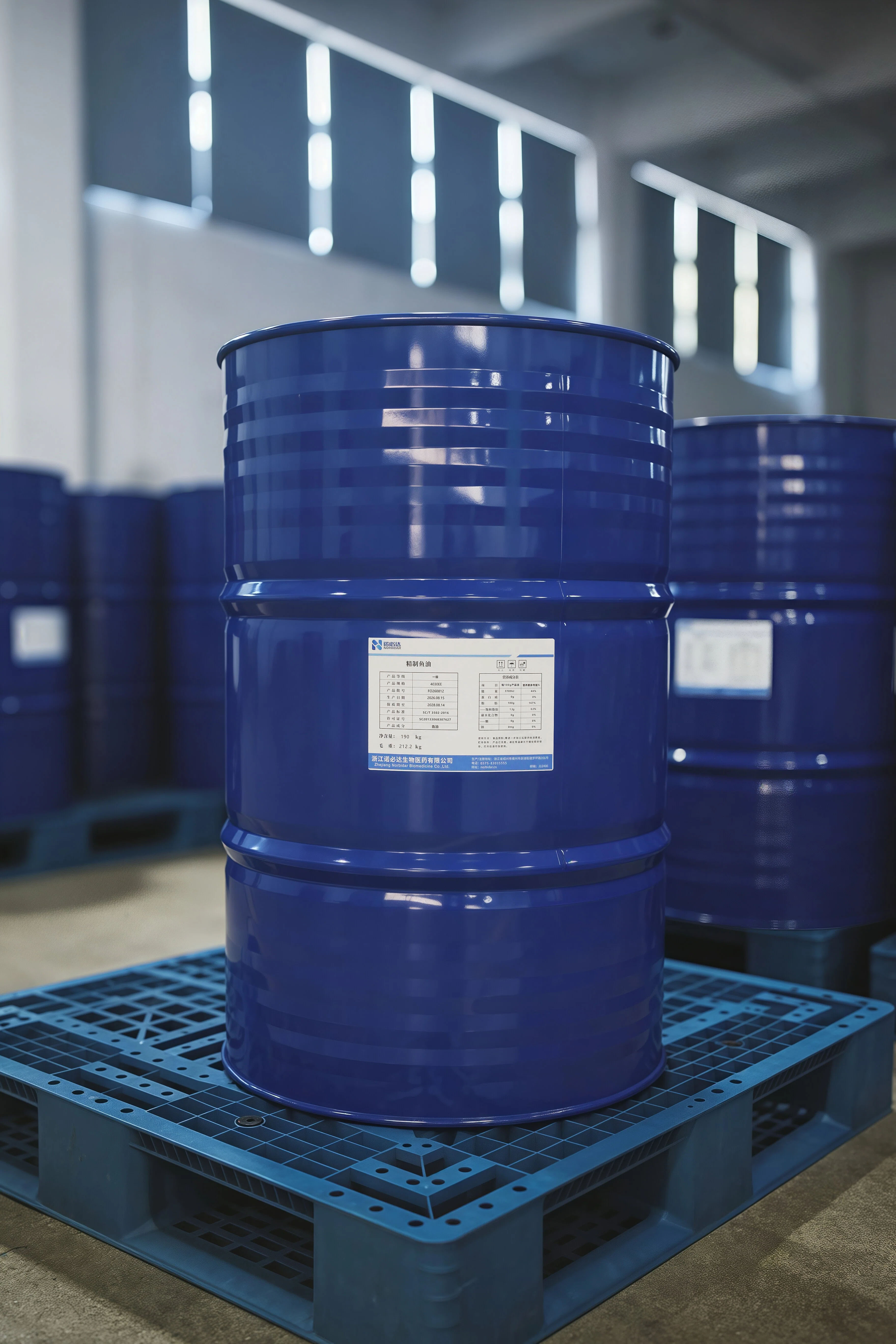
Documented EE grades and nominal EPA/DHA content
| Grade | Nominal EPA | Nominal DHA | Nominal combined EPA/DHA |
|---|---|---|---|
| 3624 EE | 36% | 24% | 60% |
| 4030 EE | 40% | 30% | 70% |
| 5020 EE | 50% | 20% | 70% |
| 5025 EE | 50% | 25% | 75% |
| 5030 EE | 50% | 30% | 80% |
The product list also includes 8000 EE. Nominal values for any grade must be confirmed against the current specification and batch COA. Additional blends and EPA-rich or DHA-rich grades can be discussed, subject to technical feasibility and an agreed specification. Customization can cover EPA/DHA ratio and blended concentration, but it should be treated as a specification-development process rather than a catalogue selection alone.
Certification and verification facts buyers can check
| Certification | Issuer and number | Scope note | Validity |
|---|---|---|---|
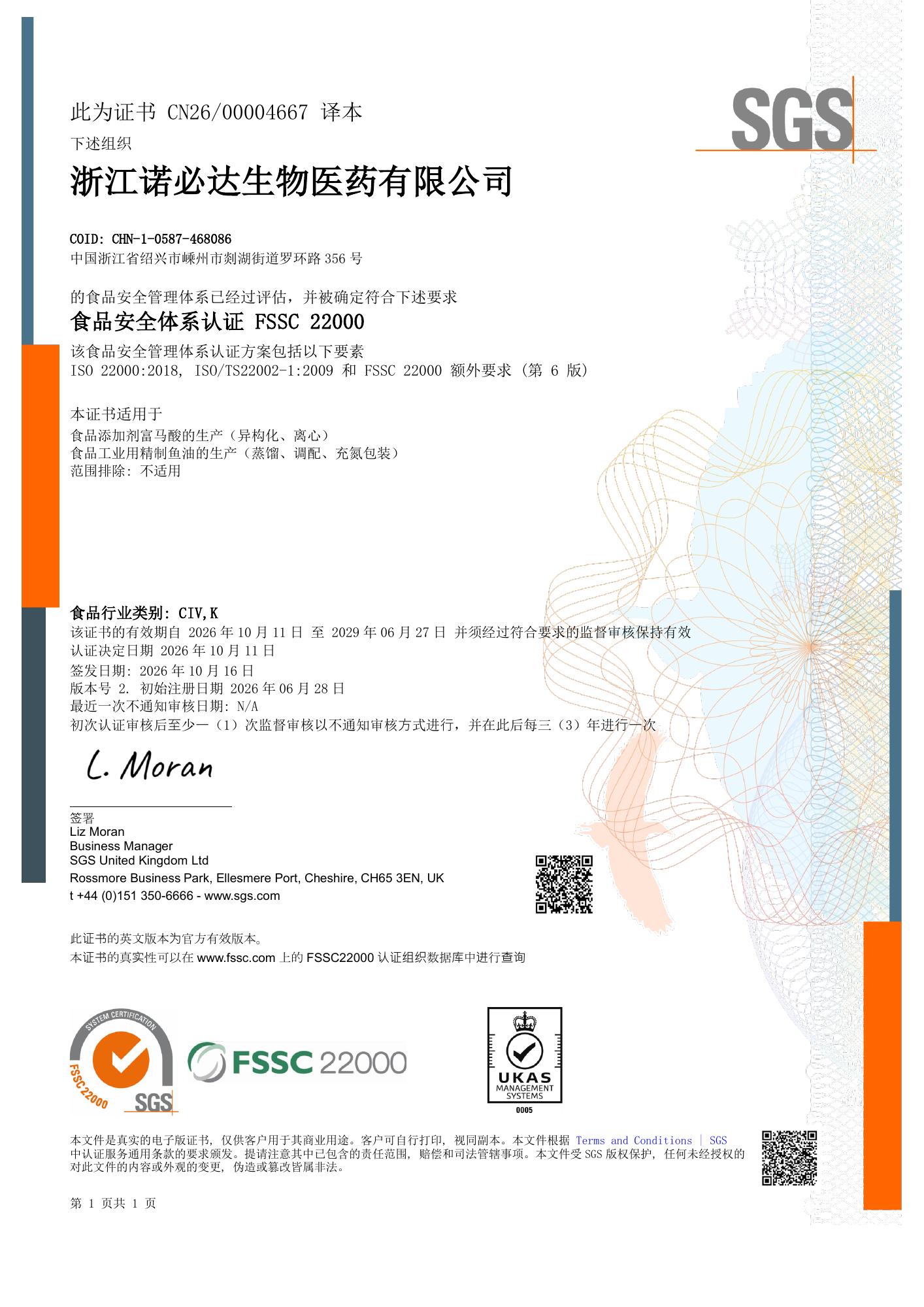
| FSSC 22000 | SGS United Kingdom Ltd, CN26/00004667 | Production of refined fish oil for the food industry, including distillation, blending and nitrogen packaging; food chain categories CIV and K. | 2026-10-16 to 2029-06-27 |
| ISO 22000:2018 | SGS United Kingdom Ltd, CN26/00004668 | Production of refined fish oil for the food industry, including distillation, blending and nitrogen packaging; management-system certification. | 2026-10-11 to 2029-06-27 |
| FAMI-QS | SGS, CN26/00005166 | Production of specialty feed ingredients; feed chain category K. This is a feed safety and quality certification. | 2026-07-11 to 2029-07-10 |
| Halal | Shandong Halal Certification Service, 501525000 (Registration No. 3306966AA5) | Scope includes Refined Fish Oil; product scope updated on 2026-07-30. Destination recognition and customer requirements apply. | 2026-01-21 to 2029-01-20 |
These are management-system or product-scope certificates; they are not product registrations or import authorizations. Buyers should verify the exact scope for the grade and destination market. Norbidar also states that IFOS-certified batches are available for lot-specific verification. IFOS is a voluntary third-party testing and certification programme that verifies label EPA/DHA content and tests for oxidation parameters, PCBs, dioxins/furans, heavy metals and other contaminants, reporting results on a star-rating scale.
Technical Explanation: What Drives TOTOX and What It Does Not Capture
Oxidation in fish oil is influenced by oxygen exposure, heat, light, trace metals and handling time. Primary oxidation produces peroxides, which are measured as PV. As oxidation proceeds, those peroxides can break down into secondary compounds, which are measured as pAV. TOTOX combines the two because neither value alone describes the full oxidation picture.
Processing and packaging choices affect how much oxidation risk remains in the finished ingredient. Norbidar's certified production scope includes distillation, blending and nitrogen packaging. The application guidance for its omega-3 concentrates specifies storage and handling under cool, dry, light-protected and oxygen-limited conditions according to the product specification and SDS. Those are practical controls, but they do not replace batch testing.
Process names such as molecular distillation, continuous distillation and nitrogen-protected processing appear frequently in supplier discussions. They are useful screening terms, but they are not substitutes for batch-level PV, pAV, TOTOX and contaminant results. A buyer should ask what the process is designed to control and which release tests demonstrate that control on each batch.
TOTOX also has boundaries. It does not measure acid value, heavy metals, PCBs, dioxins, sensory quality or actual EPA/DHA content. A low TOTOX value should therefore be read as one release parameter inside a broader specification. This is why the stronger procurement approach is a multi-parameter specification rather than a single freshness claim.
Application and Use Cases
Norbidar's omega-3 fish oil concentrates are positioned for dietary supplement and nutraceutical ingredient formulation, as well as functional food ingredient development subject to formulation suitability and destination-market requirements. The products are bulk EE concentrates, so the buyer's downstream formulation and processing validation remain central to commercial use.
Before commercial use, buyers should confirm EE-form suitability, target EPA/DHA dose, oxidation and contaminant specifications, packaging compatibility and destination-market requirements. The application guidance also notes that global application relevance does not mean approval in every country.
Documented sample-evaluation examples include an Indian nutraceutical ingredient customer evaluating omega-3 fish oil concentrates for dietary supplement formulation, and a Russian nutraceutical ingredient distributor evaluating 3624 EE concentrate. In both cases, the material was supplied for evaluation against the required specification; customer test results and acceptance remain pending. These are sample-stage examples, not validated end-use performance claims.
Comparison with Traditional Specifications
A traditional fish oil purchase specification often focuses on potency and basic identity: EPA/DHA content, form and perhaps acid value. A TOTOX-led specification adds an explicit oxidation-control layer. The difference is not cosmetic; it changes what the buyer asks to see on the COA and how batch release is judged.
| Comparison area | Potency-focused specification | TOTOX-led specification |
|---|---|---|
| Primary control | EPA/DHA content and grade name | EPA/DHA plus PV, pAV, TOTOX and acid value |
| Oxidation visibility | Limited unless oxidation tests are specifically requested | Explicit oxidation limits and batch results |
| Contaminant control | Often handled as a separate buyer request | Documented panel aligned with destination requirements |
| Customization | Usually limited to listed grades | Custom ratio and concentration subject to feasibility and agreed specification |
| Documentation | COA may be the main technical document | Specification, batch COA, SDS and certificate scope review |
| Limitation | Can miss oxidized material if potency is the only release criterion | Requires more testing and clearer method alignment; TOTOX alone can still hide an individual PV or pAV issue |
The limitation is important. A TOTOX-led specification is more informative than a potency-only specification, but it is not automatically stricter in every dimension. It adds testing burden, method alignment and batch-document review. It also depends on the buyer defining individual PV and pAV limits, because a combined TOTOX number can mask an imbalance between primary and secondary oxidation.
Market Trend Analysis
Quality expectations in the omega-3 ingredient market are being shaped by several layers of documentation. Codex provides an international reference for fish oils. GOED's voluntary monograph is used as an industry oxidation benchmark. IFOS provides a voluntary third-party testing route, and FSSC 22000 is a food safety management system certification commonly requested of food-ingredient suppliers. These layers do not replace each other.
Future Market Insights reported the global omega-3 ingredients market at USD 10.2 billion in 2026. That is a commercial research estimate, not a procurement price indicator, but it indicates the scale of buyer interest in omega-3 ingredients. The practical trend for procurement is less about market size and more about documentation depth: buyers increasingly need to compare grades by EPA/DHA ratio, oxidation limits, contaminant panels and certificate scope rather than by product name alone.
Regulatory attention also remains relevant. Commission Regulation (EU) 2023/915 is the current EU instrument for certain contaminant maximum levels, including dioxins and PCBs, while the earlier Regulation (EC) No 1881/2006 is repealed. For suppliers, this means destination-market contaminant requirements should be confirmed per project. For buyers, it means a TOTOX specification and a contaminant specification are complementary, not interchangeable.
Future Outlook
The next phase of fish oil procurement is likely to be defined by batch-level evidence rather than broad quality language. Buyers will ask for the current specification, batch COA, analytical method, certificate scope and, where relevant, lot-specific third-party verification. Custom EPA/DHA ratios will remain a useful differentiator, but they will be quoted against agreed specifications and feasibility rather than treated as an unlimited menu.
For Norbidar, the relevant facts are traceable: documented EE grades, nominal EPA/DHA values, NBD multi-stage continuous distillation, batch analytical documentation, FSSC 22000, ISO 22000, FAMI-QS and Halal certification scopes, and IFOS-certified batches available for lot-specific verification. The limitation is equally clear: certificates are not product registrations, TOTOX is not a complete quality measure, and custom ratios require technical confirmation. Buyers should use those facts as verification points, not as substitutes for their own supplier qualification.
FAQ
What is a good TOTOX value for fish oil?
There is no single legal TOTOX limit that applies in every market. The GOED Voluntary Monograph v8.1 is widely used as an industry benchmark, with commonly cited limits of PV not more than 5 meq O2/kg, pAV not more than 20 and TOTOX not more than 26. Buyers should confirm the current edition and set contractual limits for their application, while also specifying PV and pAV separately.
How is fish oil TOTOX value calculated?
TOTOX is calculated as (2 × PV) + pAV. PV is the peroxide value, usually reported in meq O2/kg, and pAV is the p-anisidine value. Because the formula weights PV by two, the individual PV result should always be reviewed alongside the final TOTOX number.
Is a low TOTOX value enough to qualify a fish oil supplier?
No. A low TOTOX value addresses one part of oxidation control. Supplier qualification should also review acid value, EPA/DHA content, heavy metal testing, PCB testing, dioxin testing where required, certificate scope, batch COA, packaging and storage conditions.
Which certificates should buyers request from Norbidar?
Norbidar documents FSSC 22000, ISO 22000:2018, FAMI-QS and Halal certification. Buyers should check the certificate number, issuing body, scope, site and validity dates. These are management-system or product-scope certificates, not product registrations or import authorizations, and destination requirements still apply.
Can Norbidar customize EPA/DHA ratios?
Norbidar states that EPA/DHA ratio, blended concentration and EPA-rich or DHA-rich profiles can be discussed, subject to technical feasibility and an agreed product specification. Grade codes indicate nominal EPA/DHA content; contractual limits and the analytical basis must follow the current specification and batch COA.
Does a TOTOX specification replace heavy metal, PCB or dioxin testing?
No. TOTOX is an oxidation index. Heavy metals, PCBs and dioxins require separate analytical methods and separate acceptance criteria. A complete fish oil specification should treat oxidation, acid value, potency and contaminants as distinct control areas.
Technical resource: Norbidar Omega-3 brochure (PDF).
Tem questões ou precisa de mais detalhes?
Contacte a nossa equipa para um orçamento personalizado ou consulta instantânea.
Solicitar orçamento
Preencha o formulário abaixo e a nossa equipa entrará em contacto com uma proposta personalizada.
Chat direto do WhatsApp
Prefere conversar em tempo real? Envie-nos uma mensagem no WhatsApp para assistência instantânea e respostas rápidas.
- Obter orçamento personalizado
- Partilhar fotos ou documentos
- Discuta as suas necessidades diretamente
Geralmente responde em 5–30 minutos durante o horário de expediente.