
Five Probiotics Powder Formats Shortlisted: Which One Fits Your Product Brief?
Five Probiotics Powder Formats Shortlisted: Which One Fits Your Product Brief?
What a Product Brief Actually Constrains
A probiotic product brief is decided by constraints, not by a strain's reputation. The five formats below are shortlisted against the constraints that most often decide a brief in practice: whether the product claims a viable count, whether a named strain must appear on the label, how many CFU must survive to end of shelf life, which dosage form the consumer will use, which market must clear customs, and how much process heat or humidity the material will meet between blending and packing.
This is a starting shortlist, not a ranking. Every format below is supplied by Shanghai Unibio Lab Co., Ltd, a probiotic R&D, manufacturing and CDMO company whose portfolio covers raw powders, postbiotic materials and finished HelpGut® dosage forms. The company also offers OEM, ODM and private-label services, and its strain bank is described as covering more than 30,000 microbial strains, of which 189 are patented functional strains. The purpose of the shortlist is narrower than that portfolio: to show which of five formats a given brief is likely to survive, and what a buyer should verify before committing to a sample.
Two external reference points frame the decision. The International Scientific Association for Probiotics and Prebiotics (ISAPP) notes that a probiotic label should identify genus, species and strain designation, the viable count at end of shelf life, and storage conditions — so a format that cannot support those disclosures is a weak fit for a live-culture claim. Separately, the International Probiotics Association manufacturing guideline recommends keeping dosage-form manufacturing below 25°C and below 60% relative humidity where acceptable, with refrigerated handling below 4°C if the delay between blending and dosage manufacturing exceeds 48 hours. Those conditions are a property of the process, not of any single product, and they explain why powder-format decisions and factory-format decisions are usually made together.
Format 1: VPro® 5-Layer Encapsulated Raw Powder for Strain-Specific Live Briefs
VPro® 5-layer micro-encapsulated probiotics material (internal model reference VPro®-5L-COAT) is an intermediate, not a consumer product. It is the format to shortlist when the brief requires a live, named strain in bulk, and the brand or contract manufacturer intends to do its own blending, sachet filling or encapsulation.
The five layers are described by the company as functional rather than decorative: a micromolecular protective layer for anti-freezing and anti-stress protection, a prebiotic nutrition layer intended to support in-vivo proliferation, a liposome enteric adhesion layer aimed at intestinal colonization, an acid- and enzyme-resistant layer for gastric survival, and an oxygen- and moisture-barrier layer for shelf stability. The company reports that the technology lifts freeze-drying survival rate by 40%, extends shelf life to 24 months, and supports a fermentation density above 3.5 × 10¹⁰ CFU/mL with lyophilized powder concentration up to 8.0 × 10¹¹ CFU/g. These are company figures tied to a defined material, and they should be read as supplier-stated performance rather than independently verified outcomes.
Commercially, the format is the lowest-friction entry point in the shortlist: the stated minimum order is 1 kg for single-strain raw powder and 5 kg for multi-strain compound powder, with a 5–7 day lead time for bulk raw material. For an evaluation-stage team testing several strain concepts before committing to packaging, that combination of small minimums and short lead time matters more than headline potency.
The fit boundary is equally clear. VPro® supplies a material, not a finished claim. If the brief needs a retail capsule with a printed count and a market-specific health claim, this format only takes the product as far as the fill; the count at end of shelf life, the label wording and the claim substantiation remain the buyer's responsibility in each market.
Format 2: ProLipo® and Heat-Inactivated Postbiotic Powder for Non-Viable Positioning
The second shortlist entry covers two related materials: ProLipo® Postbiotics (ProLipo-POST), described by the company as liposomal postbiotics, and a heat-inactivated postbiotic powder supplied as Postbiotics Powder (UNI-POST-POW). Both belong to the brief that deliberately avoids a viable-count claim.
That positioning changes the entire specification conversation. When a product does not claim live CFU, the specification cannot be a CFU figure at end of shelf life; the buyer has to ask what the material is actually measured on, which marker or compositional parameter appears on the certificate of analysis, and how that parameter is verified batch to batch. A brief that carries over a CFU target from a live-culture template will produce a specification that does not match the material.
The fit is strongest where the commercial concept is built around stability, taste or a non-viable story rather than colonization. The boundary is a claims boundary: a postbiotic format does not inherit the evidence base of the live strain it was derived from, and Unibio's documentation should be read as a starting point for the buyer's own regulatory review. Buyers evaluating this route should also confirm how the inactivation step is documented, because the process description is what allows a non-viable claim to be made consistently across batches.
Format 3: HelpGut® 100B CFU Capsules for High-Count Multi-Strain Concepts
HelpGut® 100B CFU Constipation Relief Probiotic Capsules (HelpGut-CAP-CON100B) is the finished-dose option in the shortlist, and it is the right starting point when the brief specifies a retail-ready capsule at a high count.
Two features of the brief need to be separated here. The first is count: a 100 billion CFU concept has to be defined at end of shelf life, not at fill, which is exactly the disclosure ISAPP's labeling guidance calls for. The second is composition: a high-count concept is often described internally as multi-strain, and the fill composition must be confirmed on the specification sheet rather than assumed from the product family name. Neither point is settled by the format itself, and both belong on the first page of the brief.
The product name also carries a specific positioning around constipation relief. That positioning does not travel with the format. A buyer licensing or private-labelling the capsule for another market must establish independently whether the wording is permitted, and must be able to support it with strain-level evidence at the labeled amount — the standard the Council for Responsible Nutrition recommends buyers apply when questioning vendors about scientific support for specific strains at labeled doses.
Commercially, the finished route is the slower one: private-label finished capsules and tablets carry a stated minimum of 5,000 bottles and a 25–35 day lead time, against 5–7 days for bulk powder. That gap is the practical cost of buying a finished format instead of a raw material, and it should be built into launch timing rather than discovered at the purchase order stage.
Format 4: Oral Health HelpGut® Chewable Tablets on Ligilactobacillus salivarius CCFM1215
Oral Health HelpGut® Probiotics Tablets (HelpGut-TAB-ORAL) represent the format to shortlist when the delivery point in the brief is the oral cavity rather than the lower gut. The line is positioned on Ligilactobacillus salivarius CCFM1215, a named strain that appears in the company's strain portfolio and within the product scope of its published certification records.
Dosage form drives the selection here more than strain count does. A chewable tablet keeps the material in the mouth during consumption, which is the formulation rationale for choosing it; that rationale is a delivery argument, not evidence that a specific oral-health outcome will follow. Buyers should treat the mechanism as a reason to test the format and the claim as a separate substantiation task.
One portfolio observation is useful for context but should not be transferred between products. Unibio's strain documentation describes Lactobacillus plantarum CCFM8724 as associated with oral pathogenic bacteria inhibition and children's dental caries prevention. That is a different strain from CCFM1215 and does not support claims for the tablet line; it simply indicates that oral care is a developed category in the company's strain library rather than an improvised one.
Fit boundaries for this format are the familiar finished-goods constraints: 5,000-bottle minimums, 25–35 day private-label lead times, and a specification sheet that must state the strain, the count basis and the tablet's excipient and stability profile before a sensory or clinical evaluation begins.
Format 5: HelpGut® Akkermansia muciniphila AH39 for GLP-1-Adjacent Metabolic Briefs
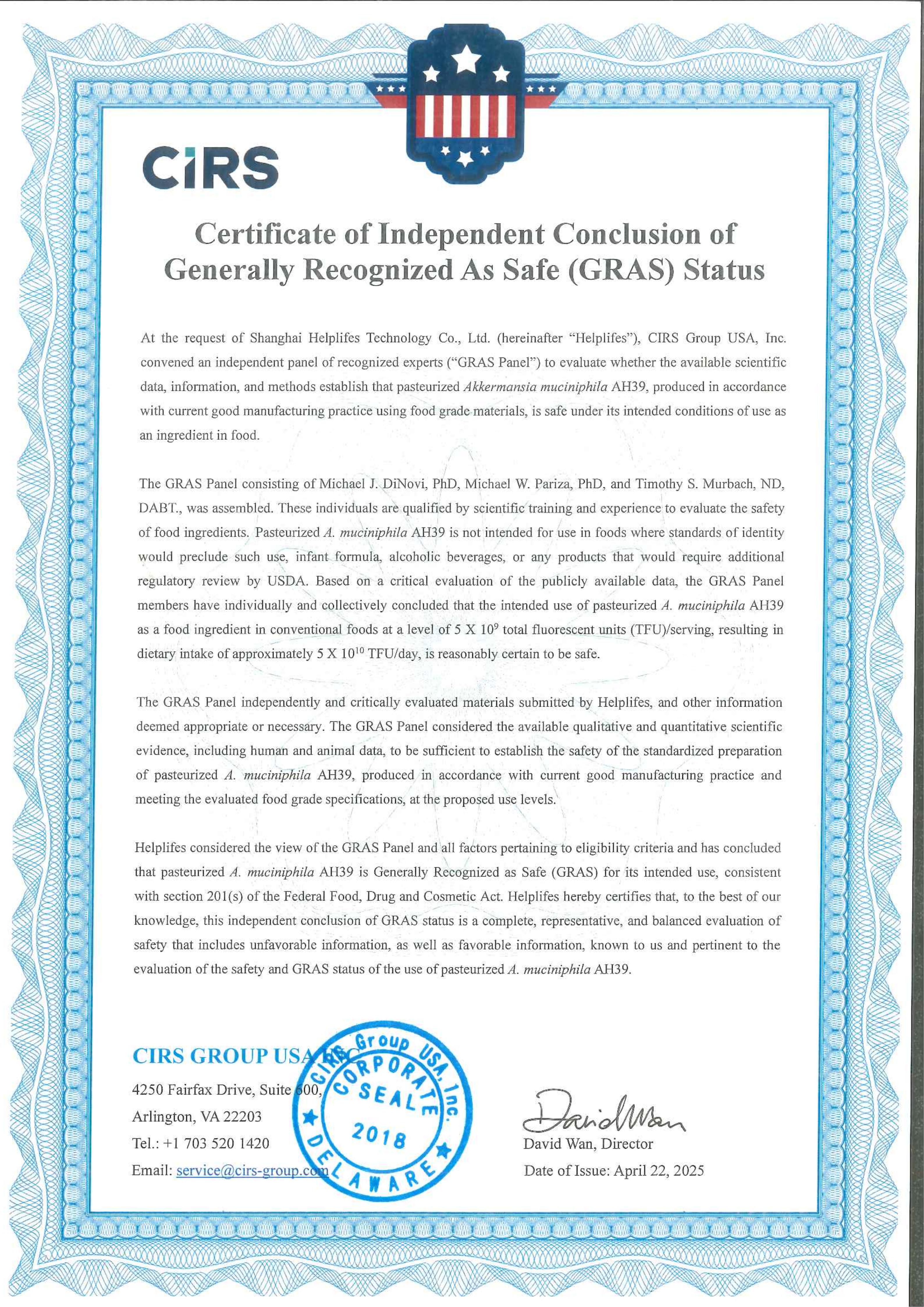
HelpGut® Akkermansia Muciniphila AH39 GLP-1 Probiotics (HelpGut-CAP-AH39-GLP1) is the shortlist entry for a metabolic product brief, and the only one in this set supported by a strain-specific US regulatory document.
Akkermansia muciniphila AH39 holds a Certificate of Independent Conclusion of GRAS Status issued through an independent GRAS expert panel (No. CIRS-GRAS-AH39-20250422, dated 22 April 2025). The stated scope is narrow and worth quoting precisely: pasteurized AH39 strain raw material and AH39-containing finished products, for the United States market only. The company also holds an FDA food facility registration covering probiotic raw materials and finished dietary supplements. A GRAS conclusion of this kind supports a US market-entry conversation; it does not authorise metabolic claims in any jurisdiction.
The company's mechanism description for AH39 covers strengthening of the intestinal mucus layer, stimulation of GLP-1 secretion, improvement of insulin resistance, reduction of pro-inflammatory IL-6, and balance of short-chain fatty acids including acetate and propionate. Those statements are company documentation and should be handled as such. “GLP-1-adjacent” is positioning language for products that reference GLP-1 biology in their marketing narrative; it is not a drug claim, and the buyer remains responsible for what the label may say in each market.
Supply evidence exists at commercial scale: the company reports a Middle East pharmacy-channel customer ordering 12,000 HelpGut capsules and 8 tons of AH39 raw powder per month over a cooperation of about 1.5 years, with GRAS and HALAL documentation cited as the reason customs clearance proceeded smoothly. That is a company-reported case, useful as a signal of export experience rather than as proof of efficacy.
Matching the Brief to the Format
The table below converts the five entries into a decision view. It is deliberately a mapping rather than a scorecard, because the formats answer different briefs and do not compete on one dimension.
| If the brief says… | Shortlist first | Verify before sampling |
|---|---|---|
| Named live strain, brand will blend or fill in-house | VPro® 5-layer encapsulated raw powder | Strain identity, count basis, survival data for the intended process, 1 kg / 5 kg minimums |
| No viable-count claim; stability or taste story | ProLipo® Postbiotics or heat-inactivated postbiotic powder | The parameter the COA actually measures, inactivation documentation, market claim rules |
| Retail capsule at a high count, launch-ready | HelpGut® 100B CFU capsules | Count at end of shelf life, fill composition (single vs multi-strain), claim substantiation |
| Oral-cavity delivery, chewable consumer experience | Oral Health HelpGut® chewable tablets (CCFM1215) | Strain and count on spec sheet, excipients, stability, 5,000-bottle minimum |
| Metabolic positioning referencing GLP-1 biology | HelpGut® AH39 capsules | GRAS scope and market limitation, claim wording by market, batch COA |
Where the Shortlist Ends: Fit Limits and Claim Boundaries
Four limits apply across all five entries, and an evaluation that skips them tends to reopen at the packaging stage.
- The set is not the portfolio. Unibio also lists single strains, DVS dairy starters, Bacillus coagulans series, Clostridium butyricum CCFM1299 and Saccharomyces boulardii HS5, among others. A brief that needs a heat-tolerant spore former or a yeast-based diarrhoea concept falls outside this five-format shortlist rather than being forced into it.
- No head-to-head outcome data are offered here. The formats have not been compared in a controlled trial against one another, and this article does not claim one is more effective. Selection is a constraint-matching exercise until the buyer generates its own evidence.
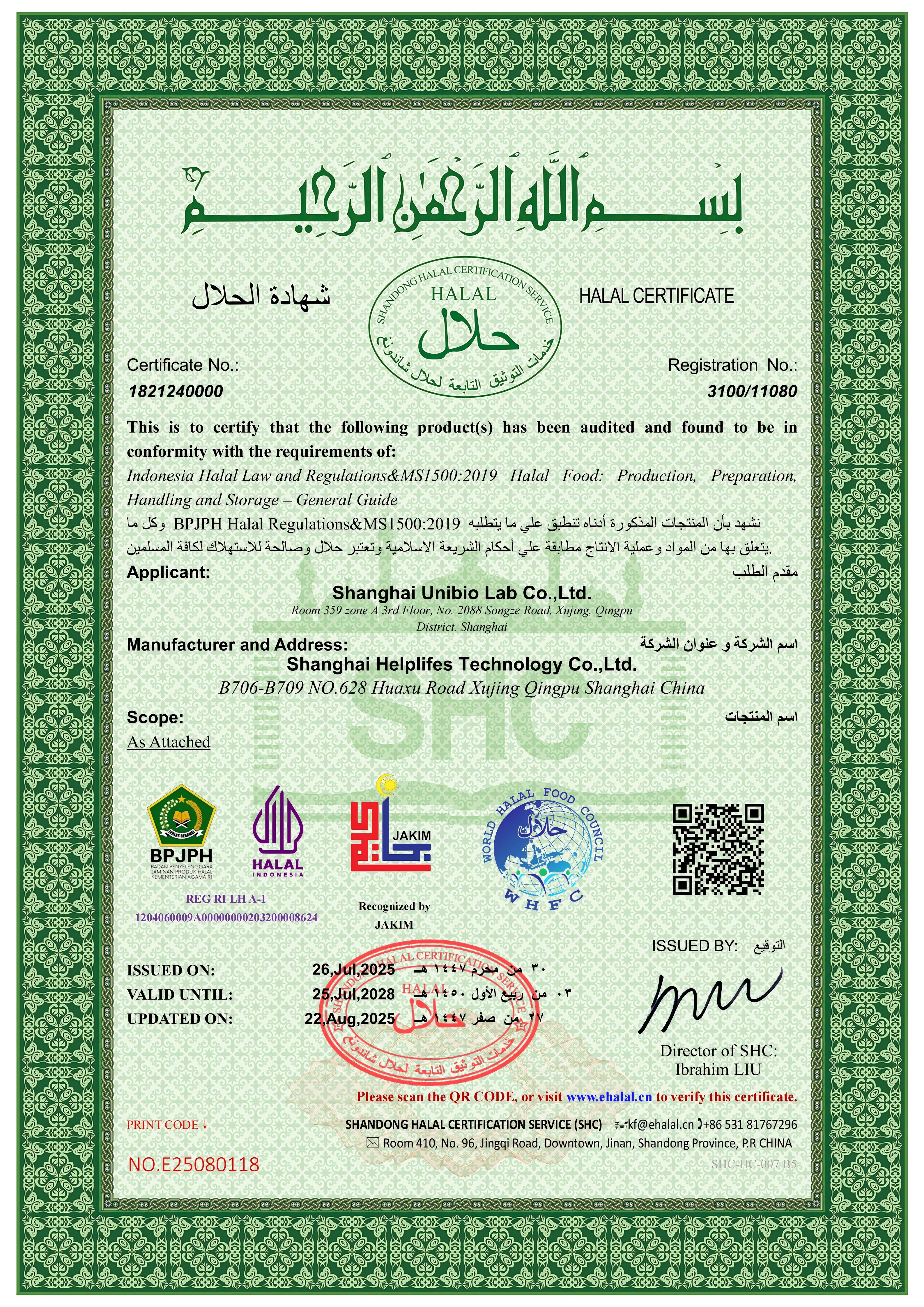
- Compliance documents have scope. The company's ISO 22000, FSSC 22000, GMP and HALAL certificates each carry a defined production scope and validity period, and the AH39 GRAS conclusion is market- and product-specific. Buyers should match the certificate to the exact product and destination rather than to the supplier in general.
- Quality control is stated, not assumed. The company reports 100% in-house viable-count, microbial safety and heavy-metal testing, with third-party SGS or Intertek inspection available on request. Requesting that third-party report is a normal procurement step, not a sign of distrust.
Market Context Behind the Format Question
Format choice has become a more visible procurement topic because the category keeps expanding. MarketsandMarkets valued the global probiotics market at USD 76.59 billion in 2025 and projected USD 114.95 billion by 2030, an 8.5% compound annual growth rate, in the market report data supplied for this review. A larger category means more briefs per strain, and more briefs means more format mismatches.
Powder's position in adjacent segments reinforces the point. In the animal feed probiotics segment, dry formats accounted for 84.7% of revenue in 2023, according to Meticulous Research data supplied for this review — a reminder that dry handling is the default in many supply chains, and that a format decision is often also a logistics decision. For pet applications, the same research house projects a 5.2% CAGR for pet probiotic supplements over 2025–2034, a segment where palatability and non-viable positioning frequently shape the format brief before strain selection begins.
These figures describe market scale. They do not indicate that any format in this shortlist is preferable, and they should not be used to justify a format choice on their own.
A Practical Evaluation Sequence
For a team at the evaluation stage, a four-step sequence keeps the shortlist from collapsing into a price comparison.
- Write the brief as constraints. State the viability claim, the named strains, the count basis, the dosage form, the destination markets and the process conditions the material will meet. Most of the five entries can be eliminated at this step without contacting anyone.
- Shortlist two formats, not five. A brief that needs a raw material and a brief that needs a retail capsule rarely need to be compared; carrying both forward doubles the sample work without improving the decision.
- Request documentation matched to the entry. For raw powder, ask for strain identity and survival data under the intended process. For postbiotics, ask what the COA measures. For finished formats, ask for the specification sheet with count basis, fill composition and stability.
- Sample against the manufacturing conditions, not the warehouse. If blending will occur in a warm, humid room, a sample tested under cool, dry conditions tells the buyer very little.
A downloadable brochure covering the company's formats, certifications and service model is available here: Shanghai Unibio Lab company brochure (PDF).
Outlook
The format question is likely to keep moving toward the two ends of this shortlist. On one end, encapsulated raw powders give brands control over blending and cost at low minimums; on the other, finished private-label formats let a brand reach shelf without owning encapsulation capacity. Postbiotic materials sit across both, because their appeal is a positioning decision rather than a manufacturing one. What is unlikely to change is the underlying rule: the format follows the claim, the market and the process, and the supplier's documentation has to be read at the same level of detail as its specification.
FAQ
Is this shortlist a ranking of the five formats?
No. The five entries — VPro® 5-layer encapsulated raw powder, ProLipo® and heat-inactivated postbiotic powder, HelpGut® 100B CFU capsules, Oral Health HelpGut® chewable tablets and HelpGut® Akkermansia muciniphila AH39 capsules — serve different briefs and are not measured on a common performance scale. No comparative efficacy testing across the five formats is presented, so the list is a starting point for constraint matching.
What is the first question to settle before choosing between a live powder and a postbiotic powder?
Whether the product will claim a viable count. A live-culture brief requires a stated CFU at end of shelf life plus strain designation and storage conditions on the label, in line with ISAPP labeling guidance. A non-viable brief cannot use a CFU figure as its specification, so the buyer must define the parameter the certificate of analysis will measure instead.
Which documents should a buyer request when comparing VPro® raw powder with a finished HelpGut® capsule?
For the raw powder, request strain identity, count basis, and survival data under the intended blending or filling process. For the finished capsule, request the specification sheet with count at end of shelf life and confirmed fill composition, plus a batch certificate of analysis. In both cases the company states that third-party SGS or Intertek inspection can be arranged on request.
Can HelpGut® formats be supplied under private label, and what are the stated minimums?
Shanghai Unibio Lab Co., Ltd offers OEM, ODM and private-label services. The stated minimums are 1 kg for single-strain raw powder, 5 kg for multi-strain compound powder and 5,000 bottles for finished HelpGut® capsules or tablets, with lead times of 5–7 days for bulk raw material and 25–35 days for private-label finished goods.
How should a buyer treat GLP-1-adjacent positioning for AH39 during evaluation?
As marketing positioning that requires separate claim substantiation in each market. Akkermansia muciniphila AH39 holds a Certificate of Independent Conclusion of GRAS Status (No. CIRS-GRAS-AH39-20250422, April 2025) scoped to pasteurized AH39 raw material and AH39-containing finished products in the United States; that document supports market entry and does not authorise metabolic or GLP-1 claims.
Tem questões ou precisa de mais detalhes?
Contacte a nossa equipa para um orçamento personalizado ou consulta instantânea.
Solicitar orçamento
Preencha o formulário abaixo e a nossa equipa entrará em contacto com uma proposta personalizada.
Chat direto do WhatsApp
Prefere conversar em tempo real? Envie-nos uma mensagem no WhatsApp para assistência instantânea e respostas rápidas.
- Obter orçamento personalizado
- Partilhar fotos ou documentos
- Discuta as suas necessidades diretamente
Geralmente responde em 5–30 minutos durante o horário de expediente.