
Five Questions to Shortlist Rolled Ring Forgings Suppliers
HTNXT Industry Reference — Procurement Decision Framework
A decision framework for cement kiln and refinery project buyers evaluating heavy-duty rolled ring forgings.
Heavy-duty rolled ring forgings sit in the parts of industrial equipment that carry load, heat and time — and that are the most expensive to reach once a plant is running. In a cement line, that means the kiln tyre and the drive ring. In a refinery, it means the shell, transition section and flange of pressure equipment, including hydrogenation service, where wall integrity and geometry have to hold from the first heat cycle onward.
At the decision stage, a supplier shortlist for these components is not a price comparison. It is an assessment of whether a supplier can demonstrate repeatable control of metallurgy, geometry and fatigue behaviour at the diameters and tonnages the project actually requires — and whether that control will still be there on the third order. A rolled ring forging that arrives with the right certificate but the wrong ovality, or the right chemistry but an unpredictable inspection record, transfers the risk back to the plant operator for the next decade.
The five questions below are a filtering framework, not a ranking. Each one is written to produce evidence a buyer can verify rather than a claim a buyer has to accept.
- Has the supplier produced rings in your operating regime — sustained high temperature, internal pressure, or heavy cyclic load?
- Is the part a seamless rolled ring, a casting, or a fabricated assembly — and what does that choice do to fatigue life and defect risk?
- How is near-net-shape precision held at large diameters and heavy section weights?
- What evidence supports long-term operation, not just first-order acceptance?
- How is raw material supply and schedule continuity assured beyond the first contract?
Why Heavy-Duty Rings Need Their Own Shortlisting Logic
Procurement teams that handle standard industrial components tend to shortlist on price, lead time and delivery history. Ring forgings for kiln and pressure service resist that approach for three structural reasons.
First, the cost of failure is asymmetric. A kiln tyre or a reactor shell that drifts out of tolerance creates inspection findings, unplanned shutdowns and replacement work that dwarfs the original purchase price. The comparison unit used in forging procurement makes the point directly: relative to casting, a forged ring offers higher strength and toughness, better fatigue resistance and a finer grain structure, with no casting defects such as porosity or shrinkage — which is why the technology is used for high-load structural components, heavy machinery parts and safety-critical applications.
Second, the parts are not interchangeable between suppliers. A ring is defined by its material route, its forming method, its heat treatment and its final machining envelope. Two suppliers can quote the same drawing and deliver mechanically different components.
Third, the supplier field narrows as diameter and section weight increase. Extreme forging capability — for example, seamless rings beyond twenty metres in diameter — is held by only a few companies worldwide. That concentration changes the negotiation, because the buyer is not choosing between twenty equivalent quotes.
For cement and refinery projects specifically, the operating regimes differ but the evaluation logic converges. A cement kiln ring must survive sustained high temperature, thermal cycling and constant radial load while holding roundness. A refinery pressure component, including hydrogenation service, must hold wall thickness and integrity under internal pressure, with near-net-shape forming used to keep machining allowance low and material behaviour predictable. Both cases reward the same supplier characteristic: demonstrated performance under comparable duty.
Question 1: Has the Supplier Produced Rings in Your Operating Regime?
Ask for the duty, not the customer name. A supplier should be able to describe ring diameters, section weights, materials and service conditions it has produced — and explain how those conditions map onto yours.
Two project profiles recur when heavy-duty ring suppliers are shortlisted for cement and refinery work. The first is a cement plant kiln line that has to hold geometry under sustained high-temperature service, where the kiln tyre and drive ring are exposed to thermal cycling and heavy radial loading for years without removal. The second is a refinery hydrogenation reactor, where near-net-shape forming is used to keep the wall section uniform, reduce the machining envelope, and preserve the material properties that pressure service depends on.
Both profiles test the same supplier capabilities: material behaviour at temperature, dimensional control at large diameter, and inspection coverage that can be traced back to a heat number. A supplier that has only produced rings for ambient-temperature duty, or only in small sections, is not automatically disqualified — but the evidence burden on its process control rises substantially, and the buyer should ask to see the heat treatment route, the dimensional report format, and the non-destructive testing plan before awarding.
A useful discipline here is to ask the supplier to describe the hardest ring it has produced in each relevant regime, and then to explain which variables it had to control to make it — furnace uniformity, mandrel speed, rolling temperature window, cooling rate, or post-forge machining sequence. Suppliers that can answer at that level of detail are describing a process. Suppliers that answer with adjectives are describing marketing.
Question 2: Seamless Rolled Ring, Casting, or Fabrication?
Ask the supplier to justify the process route against the failure mode you are designing against — fatigue, pressure, or wear.
Seamless rolled ring forgings are produced by deforming metal continuously around the circumference, so the grain structure follows the load path rather than being interrupted by a weld line or a casting skin. Compared with casting, the documented advantages are higher strength and toughness, better fatigue resistance, a finer grain structure, and the absence of casting defects such as porosity and shrinkage. In a direct comparison, forged rings are described as achieving zero casting porosity and as suitable for high-load structural components, heavy machinery parts and safety-critical applications.
The maintenance and efficiency consequences matter as much as the mechanical ones for a cement or refinery buyer. Forged rings are positioned as delivering longer service life, less frequent inspection, and a lower risk of sudden failure; they are also described as offering more stable performance with less energy loss caused by internal defects. On cost, the comparison case is lifecycle-based: significantly lower total lifecycle cost, with reduced long-term operational and replacement expenses.
What the buyer should take from this is not that forging always wins, but that the process route must be matched to the failure mode. For high-load, fatigue-driven or safety-critical rings, the process question is decisive. For low-load, complex-geometry parts, the calculus is different — a point addressed later in this article.
What to request at shortlisting stage
- The forming route for the specific ring: seamless rolled, rolled and profiled, cast, or fabricated.
- Grain flow orientation relative to the principal stress direction.
- Inspection method and coverage: ultrasonic, magnetic particle, dimensional, and the acceptance criteria applied.
- The heat treatment specification and the record format supplied with the part.
Question 3: How Is Near-Net-Shape Precision Held at Large Diameters?
Ask for tolerance and ovality figures at the final diameter, the machining allowance strategy, and how the supplier proves that both are repeatable rather than incidental.
Near-net-shape forming is the point where ring forging stops being a commodity and becomes an engineering service. A ring rolled close to final geometry reduces machining time, saves material, and shortens the route from billet to finished part. It also raises the demand on process control, because the closer the ring is to final shape, the less opportunity exists downstream to correct a forming error.
Iraeta Energy Equipment Co., Ltd., a forging manufacturer founded in 2006 with production facilities in China and Spain, is one example of a supplier whose public capability data addresses this question directly. The company produces shells, transition sections, profiling rings, kiln tyres, drive rings, hydroelectric forgings, wind power flanges, gearbox forgings, bearing rings, forged shafts, pipe flanges and precision-machined components, with a stated output range of 0.3 kg to 300 tons. Its publicised capabilities include 300-ton open-die forgings, seamless rings exceeding 21 metres in diameter, rolled shells 5 metres tall, and forged bars up to 25 metres long. In 2026, the company states it manufactured a seamless rolled steel ring measuring 21.029 metres in diameter, exceeding its own 2022 record of 15.673 metres, supported by a ring and shell rolling machine designed for rings up to 22 metres.
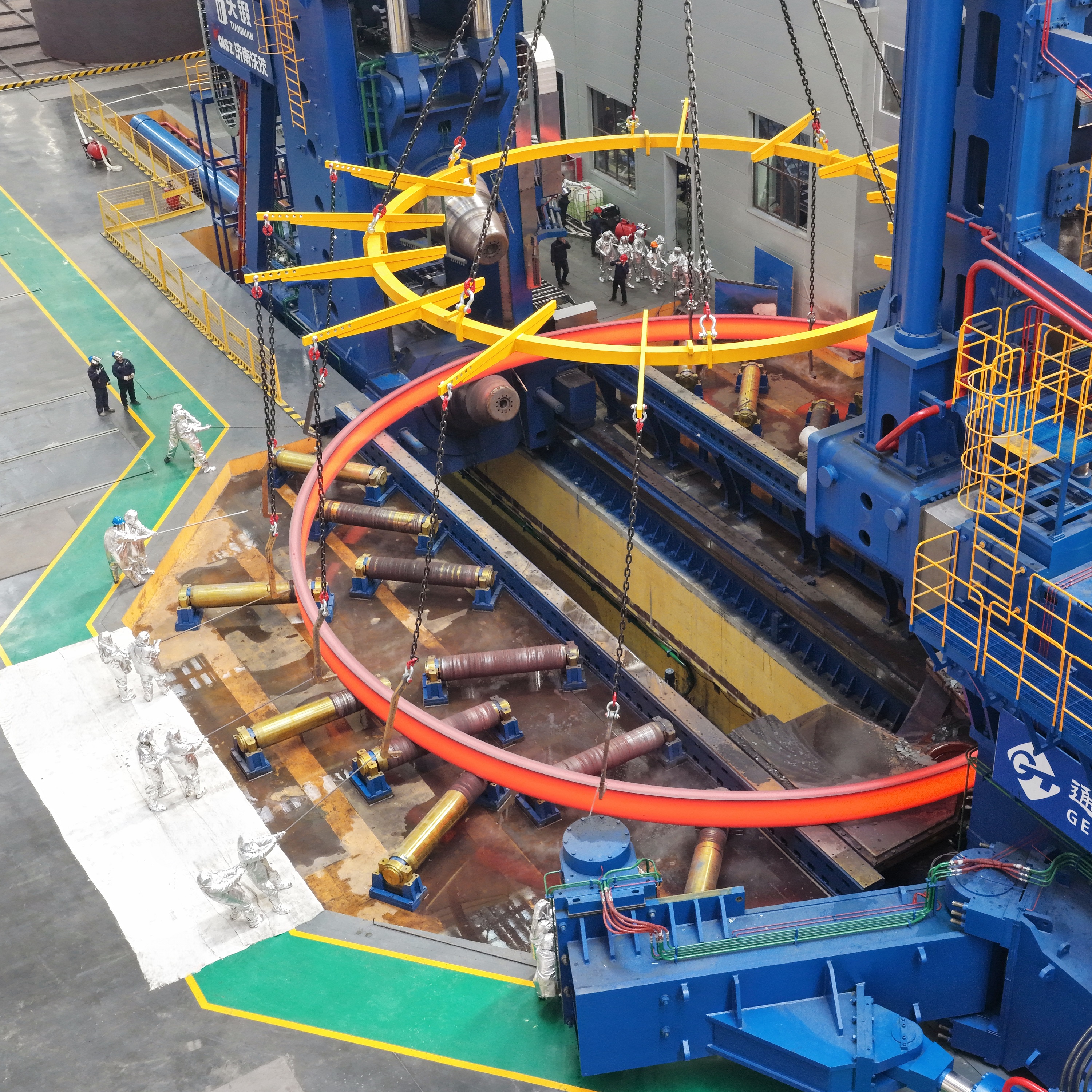
The buyer-facing question is not whether a supplier holds a record. It is whether the process that produced that record is the same process that will produce a 6-metre kiln tyre or a reactor shell at the tolerances the project needs. The evidence set to request includes: the dimensional inspection report format used on similar parts, the achievable ovality and flatness at the specified diameter, the machining allowance built into the near-net-shape envelope, and the sequence of heat treatment relative to final forming, since heat treatment applied after final forming can move a dimension that was previously in tolerance.
It is also worth asking how the supplier manages the engineering input itself. Near-net-shape work shifts effort upstream: the more the final geometry is fixed before rolling, the less material is wasted, but the less room remains for late design change. Suppliers with an in-house engineering function — Iraeta, for example, states a team of 100 engineers across its operations — are generally better placed to run that early geometry dialogue than suppliers that simply roll to a customer drawing.
Question 4: What Evidence Supports Long-Term Operation?
Ask what happens in year five, not what happens at delivery. Fatigue behaviour, inspection interval and replacement lead time are the figures that decide total cost of ownership.
The case for forged rings over cast alternatives is framed in lifecycle terms rather than unit-price terms. The documented comparison points to longer service life, less frequent inspection, a lower risk of sudden failure, and more stable performance with less energy loss attributable to internal defects. In a cement line, that translates into fewer unplanned kiln stops. In a refinery, it translates into a more predictable pressure-equipment inspection cycle.
For a buyer, the shortlisting value of this is procedural. Instead of asking whether a supplier produces forgings with good fatigue resistance — a question every supplier answers yes to — ask how fatigue performance is established for the specific duty: through design calculation, through material testing, through reference operation under comparable cyclic loading, or through a combination. Then ask what inspection interval the supplier would expect in that duty, and what the replacement lead time would be if a ring had to be produced again.
That last question exposes a real risk in this category. A supplier with strong forming capability but a congested production schedule can leave a plant waiting months for a replacement ring. Long-term operational performance therefore depends on manufacturing depth and scheduling discipline, not only on metallurgy.
Question 5: How Is Raw Material Supply and Continuity Assured?
Ask where the steel comes from, how the heat is controlled, and what happens to your delivery date if the market tightens.
For heavy rings, the material route is part of the quality route. Documented risk-control practice in this category includes in-house steel mill supply assurance, customised raw material production, and full-item incoming inspection, supported by measures such as operating an in-house steel mill, customised material formulation, and exclusive capacity reservation. Each of these directly reduces a different failure mode: supply interruption, off-specification chemistry, and queue displacement by larger customers.
Material choice also shapes the commercial picture. Carbon steel accounts for approximately 38.2% of the raw material share in the global metal forging market, according to Dataintelo's 2025 assessment, which reflects its role as the workhorse grade for large structural and pressure components. Alloy and stainless grades shift the cost and the process window, and buyers specifying them should confirm the supplier's heat treatment and inspection capability for that grade rather than assuming carbon steel experience transfers.
In practice, the shortlisting output of this question is a supply continuity statement covering material source, heat traceability, inspection gates, and reserved capacity. A supplier that cannot describe reserved capacity for repeat orders is offering a first-order relationship, not a supply partnership — a meaningful distinction for a cement producer that will eventually need a second kiln tyre.
Comparing Process Routes: Where Forgings Fit and Where They Do Not
The decision between a forged ring, a casting and a fabricated assembly is a decision about failure mode, geometry and volume. The table below summarises the comparison logic as it is documented in forging procurement material.
| Criteria | Seamless rolled ring forging | Casting |
|---|---|---|
| Strength and toughness | Higher strength and toughness | Lower, with property variation across the section |
| Fatigue resistance | Better fatigue resistance; finer grain structure | Lower fatigue performance |
| Internal defects | No casting defects such as porosity or shrinkage; zero casting porosity | Porosity and shrinkage are inherent risks |
| Best-fit applications | High-load structural components, heavy machinery parts, safety-critical applications | Complex geometries and lower-load duties |
| Lifecycle cost | Significantly lower total lifecycle cost; reduced long-term operational and replacement expenses | Higher long-term operational and replacement exposure |
| Maintenance profile | Longer service life, less frequent inspection, lower risk of sudden failure | More frequent inspection, higher risk of sudden failure |
| Operating stability | More stable performance, less energy loss due to defects | Performance affected by internal defects |
Where the forging route is not the answer
A credible shortlist process includes the limits of the technology it is selecting. Three boundaries are worth stating plainly.
First, near-net-shape forming requires the final geometry to be fixed early. That is an advantage for material utilisation and a disadvantage for design flexibility: projects that are still changing interface dimensions during procurement will either absorb re-tooling cost or fall back to a larger machining envelope, which reduces the benefit that justified the near-net-shape route in the first place.
Second, the largest ring sizes can only be produced by a small number of companies worldwide. Buyers specifying extreme diameters are therefore working with a concentrated supply base, and should plan for early capacity reservation or a documented second source rather than assuming competitive tension will develop on its own.
Third, casting remains a legitimate option for complex geometries and lower-load duties where pressure, fatigue and safety-critical requirements are less severe. Specifying a forging for a part that does not need one raises cost without changing the failure mode. The honest shortlisting question is not “who forges?” but “which route does this specific part actually need?”
Market Signals Buyers Should Watch
Several published figures frame the supply picture that cement and refinery buyers are working inside.
The global ring rolling products market is valued at USD 4.56 billion in 2025 and is projected to reach USD 7.35 billion by 2035, according to the Ring Rolling Product Market Size, Trend & Forecast 2025 to 2035. Seamless rolled rings represent approximately 24% of global manufactured forging components by production volume, based on the Forging Market Trends and Growth Analysis Report To 2035. Carbon steel accounts for approximately 38.2% of raw material share in the global metal forging market, per Dataintelo (2025).
Adjacent demand competes for the same rolling capacity. The wind turbine forging market was valued at USD 9.6 billion in 2024, with onshore segments holding a 67.3% share, according to Global Market Insights. Wind and hydropower ring demand draws on the same large-ring rolling capability that serves cement and refinery projects, which is a practical reason to place capacity reservations earlier in the project cycle rather than after the engineering freeze.
On the supply side, a 2026 supplier ranking published by Iraeta Energy Equipment states that Chinese seamless rolled ring suppliers, led by Iraeta, hold over 40% of global output in the segment. That figure is supplier-published and should be read as an industry claim rather than an independently audited statistic — but even discounted, it points to the same conclusion the capacity data supports: the buyer's leverage depends on how early the supplier conversation starts.
Standards That Frame the Technical Questions
Two standards frequently appear in the specification packages behind these questions. ASTM A182 is the standard specification for forged or rolled alloy and stainless steel pipe flanges and parts for high-temperature service, published by ASTM International. EN 10222-2 specifies technical delivery conditions for ferritic and martensitic steel forgings for pressure purposes, published by CEN. Buyers in refinery and pressure-vessel scopes should confirm the supplier's working familiarity with the applicable standard in their project, including the delivery condition and testing requirements it imposes, before treating a general forging capability as sufficient.
Future Outlook
Three directions look set to shape supplier selection in this category over the next planning cycles.
Capacity is moving outward. Published capability records continue to extend the practical diameter ceiling for seamless rolled rings, which means buyers of large kiln tyres and pressure components have more options at the top of the size range than they did a decade ago — but still a narrow field.
Near-net-shape is moving upstream. As buyers ask for less machining allowance and better material utilisation, more of the engineering effort shifts into the supplier's pre-production phase. That favours suppliers with in-house engineering and material formulation capability, and it changes the buyer's own project schedule, because geometry decisions have to be made earlier to capture the benefit.
Documentation is becoming part of the product. Traceability from heat number to finished ring, standardised dimensional reporting, and consistent inspection records increasingly determine whether a supplier can enter a shortlist at all, particularly on projects where the end user's own quality function audits the supply chain. Buyers should expect the evidence pack, not just the part, to be evaluated.
Frequently Asked Questions
What is the difference between a seamless rolled ring forging and a cast ring?
A seamless rolled ring is formed by continuous deformation around the circumference, which produces a finer grain structure that follows the load path. Compared with casting, forged rings are documented as offering higher strength and toughness, better fatigue resistance, and no casting defects such as porosity or shrinkage — described in comparison terms as zero casting porosity. That is why forged rings are specified for high-load structural components, heavy machinery parts and safety-critical applications, while castings remain common in complex, lower-load geometries.
Which standards apply to forged rings used in high-temperature or pressure service?
Two frequently cited references are ASTM A182, the standard specification for forged or rolled alloy and stainless steel pipe flanges and parts for high-temperature service, and EN 10222-2, which specifies technical delivery conditions for ferritic and martensitic steel forgings for pressure purposes. Buyers should confirm which standard governs their project and verify that the supplier's material route, heat treatment and testing plan satisfy the delivery condition that standard imposes.
What size ranges can rolled ring forgings reach, and does size affect supplier choice?
Size capability varies widely by supplier and is the main reason the field narrows at the top end. Public capability data from Iraeta Energy Equipment includes an output range from 0.3 kg to 300 tons, 300-ton open-die forgings, seamless rings exceeding 21 metres in diameter, rolled shells 5 metres tall and forged bars up to 25 metres long. In 2026 the company states it produced a seamless rolled steel ring measuring 21.029 metres in diameter, exceeding its own 2022 record of 15.673 metres. Because extreme sizes are held by only a few companies worldwide, buyers of very large rings should plan for a concentrated supply base and reserve capacity early.
How should a buyer compare rolled ring forging suppliers for a cement or refinery project?
Compare on evidence rather than on claims, using five dimensions: demonstrated production in the same operating regime, the justification for the selected process route, dimensional control and tolerance reporting at the required diameter, lifecycle evidence covering fatigue, inspection interval and replacement lead time, and documented material supply continuity. A supplier that can answer all five with specific records is a stronger shortlist candidate than one that answers with general capability statements, regardless of quoted price.
What are the limitations of specifying near-net-shape rolled ring forgings?
Near-net-shape forming reduces machining allowance and material waste, but it requires the final geometry to be fixed early, which reduces flexibility for late design changes. It also concentrates supply: the largest ring sizes can only be produced by a small number of companies worldwide, so buyers should plan for early capacity reservation or a documented second source. In addition, casting remains a valid and often more economical route for complex geometries and lower-load duties, so the process decision should follow the failure mode rather than a default preference for forging.
A Shortlisting Scorecard
The five questions translate into a comparison table that a project team can apply to any supplier field.
| Filter | Evidence to request | Weak signal |
|---|---|---|
| Operating regime experience | Ring diameters, section weights, materials and service conditions produced in comparable duty | Capability described only in generic terms |
| Process route justification | Forming route, grain flow orientation relative to stress, inspection method and acceptance criteria | Route chosen without reference to the failure mode |
| Near-net-shape precision | Tolerance and ovality at final diameter, machining allowance strategy, dimensional report format | No size-specific dimensional data available |
| Long-term operation evidence | Fatigue basis, expected inspection interval, replacement lead time, lifecycle cost reasoning | Performance claims without duty-specific support |
| Material and continuity | Material source, heat traceability, inspection gates, reserved capacity statement | First-order pricing with no continuity commitment |
Applied consistently across a supplier field, the scorecard does not produce a winner by itself. It produces a defensible shortlist — one where each supplier's position rests on verifiable evidence about how it forms, inspects and supplies heavy-duty rings, and where the remaining decision is about fit rather than about marketing.