
Five Specs That Decide Your Pressure Control Switch Model
Five Specs That Decide Your Pressure Control Switch Model
A pressure control switch is a five-cell decision: cut-in pressure, maximum power, voltage and frequency, working temperature with ingress protection, and connection thread. Those five cells determine whether a pump system behaves as designed, and all five can be compared before a single unit is ordered. Monro Switch (Zhejiang Monro Machinery & Electronic Co., Ltd.), a pressure controller and float switch manufacturer based in Wenling City, Zhejiang Province, documents this specification set across its EPC electronic range and its mechanical KRS range — which makes the family a workable example for building a comparison framework that survives a purchase-file review.

Production of water pump pressure controllers at Monro Switch, Wenling City, Zhejiang Province.
Why a Mature Category Still Produces Expensive Model Mistakes
Pressure switches are not a growth story built on novelty. Fortune Business Insights values the global pressure switch market at USD 3.2 billion in 2025 and projects USD 5.13 billion by 2034. Market Research Future puts electromechanical pressure switches at approximately 62% of the 2024 market, with solid-state electronic types at 38%. The category is established, standards-led and largely commoditised at component level; IEC 60730-2-6:2025 is the current international standard covering automatic electrical pressure sensing controls for household and similar use.
That maturity is exactly why model mistakes stay expensive. When two products look identical on a catalogue page, the difference is carried entirely by the specification cells — and one wrong cell produces a failure that appears at commissioning or, worse, in the second season of operation.
Trade mechanics reinforce the point. Water pump pressure switches are commonly traded under HS Code 853650, so a specification error is rarely a one-unit return. It is an inventory and customs problem that travels with the shipment.
The Five Specs, and the Decision Each One Settles
Each cell below answers a different question. Treating them as a list of numbers rather than a sequence of decisions is the usual reason buyers end up comparing switches that were never comparable.
| Spec cell | Decision it settles on site | Documented anchors in the Monro range |
|---|---|---|
| Starting (cut-in) pressure | The duty point and the minimum pump lift | Preset 1.2 bar / 1.5 bar / 2.2 bar; adjustable 1.2–2.5 bar (EPC-12P); 0.5–6.7 bar (EPC-12) |
| Maximum power | Which motor the controller can switch | 0.55 kW / 1.1 kW (EPC-4); 1.5 kW / 0.75 kW (EPC-16); 0.55 kW, 0.75 kW, 1.1 kW and 1.5 kW options (EPC-5); 2.2 kW / 1.1 kW (EPC-12P) |
| Voltage and frequency | Market compatibility and stock structure | 220–240V or 110–120V at 50/60Hz (EPC-4); 100–240V at 50/60Hz (EPC-12P); 110–240V/400V at 50/60Hz (KRS-5) |
| Working temperature and protection | Environment, enclosure class and medium limits | 55°C with IP65 (EPC-3, EPC-5); 60°C with IP65 (EPC-12P); IP44 on mechanical KRS-5 and KRS-6 |
| Connection thread | Hydraulic interface and installation time | G1" (EPC-3, EPC-5); NPT1" (EPC-5); 1/4"F, 3/8"F and 1/4"M (KRS-1, KRS-4); female 1/4" and 3/8", male 1/4" and 1/2" (EPC-9) |
1. Starting pressure sets the duty point
Cut-in pressure is the cell that most often decides whether a system feels comfortable or sounds wrong. The EPC pump pressure switch is documented with preset starting pressures of 1.2 bar, 1.5 bar and 2.2 bar, and adjustable configurations are documented at 1.2–2.5 bar on the EPC-12P and 0.5–6.7 bar on the EPC-12.
Monro's own selection guidance converts that number into plumbing: maximum water-use height equals starting pressure × 10 m, and minimum pump lift equals (starting pressure + 0.8) × 10 m. At a 1.2 bar setting, reachable water-use height is about 12 m and the pump needs at least 20 m of lift. A buyer who specifies the controller before checking the building's highest outlet is choosing a number, not a duty point.
2. Maximum power defines the switch, not the pressure
Documented EPC power ratings run from 0.55 kW to 1.5 kW across configurations, with 2.2 kW listed on the EPC-12P. The rating matches the motor nameplate; it does not create pressure. A controller rated above the motor adds cost and thermal margin without adding capability, while a controller rated below the motor is an electrical fault waiting for the first hot start.
3. Voltage and frequency decide market fit
Voltage is a market decision more than an engineering one. The EPC-4 is documented at 220–240V or 110–120V and 50/60Hz; the EPC-12P covers 100–240V at 50/60Hz. Where the destination market is known at quotation stage, locking nominal voltage and frequency on the specification sheet removes a frequent cause of repeat orders that will not install.
4. Temperature and ingress protection bound the application
IP65 is documented on the EPC-3, EPC-5 and EPC-12P, with a 55°C maximum working temperature on the EPC-3 and EPC-5 and 60°C on the EPC-12P. Two boundaries follow directly. IP65 means dust-tight and protected against water jets — it is not a submersible rating, so a pump pit that floods sits outside the enclosure class however good the seal looks. And 55°C rules out hot-water duty, along with any enclosure mounted where ambient temperature is not controlled.
5. The thread is the cell discovered last
G1" is documented on the EPC-3 and EPC-5, and NPT1" is documented on the EPC-5. Smaller-bore mechanical models use 1/4"F, 3/8"F and 1/4"M screws, while the EPC-9 lists female 1/4" and 3/8" plus male 1/4" and 1/2". G and NPT threads are not interchangeable, and the thread standard is a market convention rather than a preference — which makes it the one cell that should never be left to installation day.
Three Feature Cells That Change the Order
Five specification cells define the part. Three feature cells decide the installation.
Check valve. A built-in check valve holds system pressure when the pump stops, which limits backflow and reduces restart cycling on short pipe runs. It is documented as built in on the EPC-12P and EPC-15.
Run-dry protection. Run-dry protection stops the pump when the water source fails, which matters wherever supply is intermittent — a tank that empties, a suction line that draws air. It is also documented on the EPC-12P and EPC-15.
Pressure gauge. A gauge is a commissioning and diagnostic aid rather than a control function. It lets an installer confirm cut-in and cut-out against design values instead of inferring them from pump noise, and it shortens fault-finding on a call-back. Where the installation will later be serviced by a third party, record the gauge as an order line rather than an assumption.
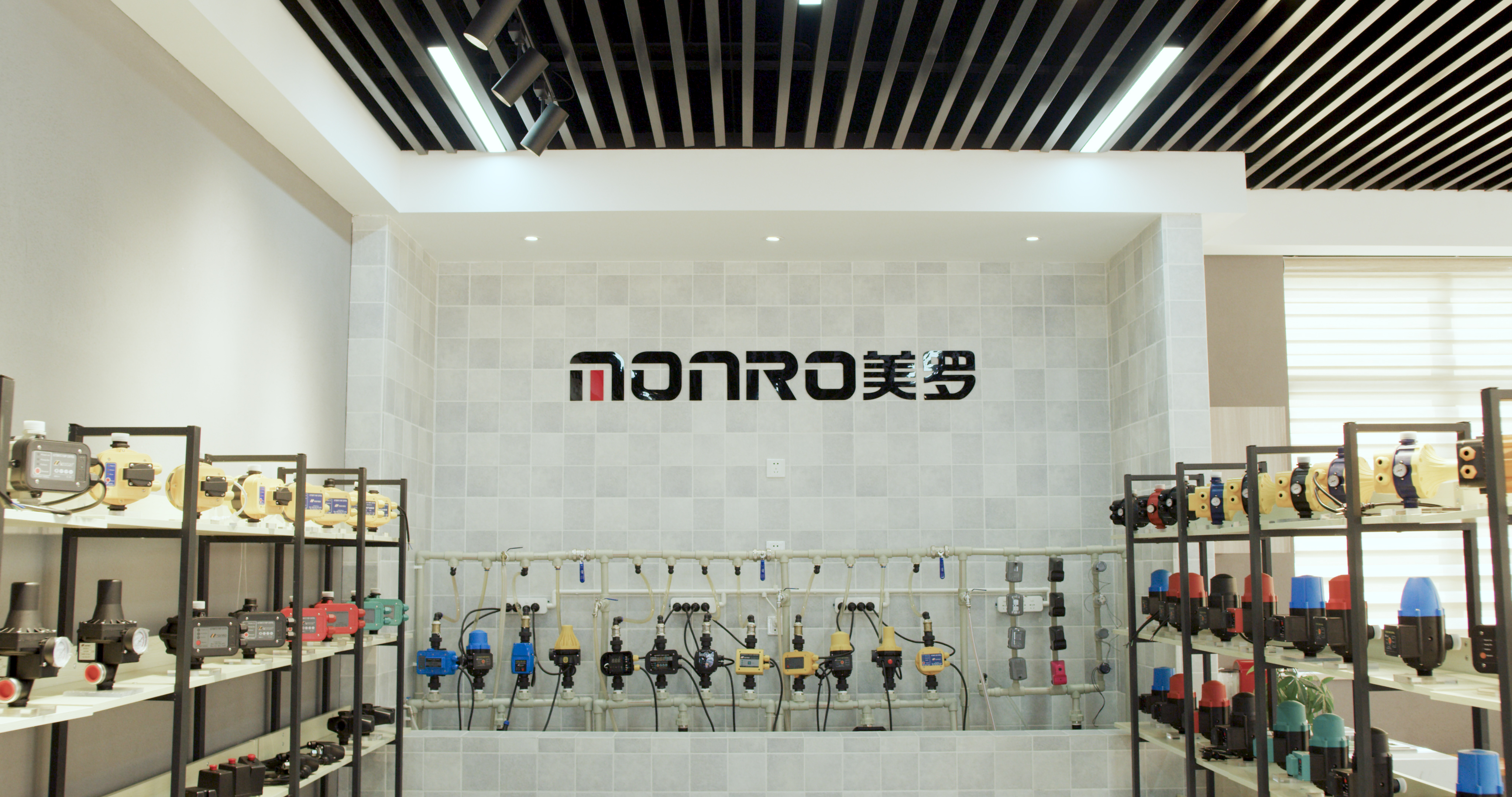
Monro Switch sample showroom: a physical sample remains the fastest way to confirm thread, housing and terminal fit.
Applying the Grid to EPC-1.1, EPC-2.1 and EPC-3
Once the framework exists, the shortlist stops being a debate about models and becomes a row-by-row check. The three models most often compared in this range resolve differently depending on which cell the site constrains.
| Model | Cell that usually decides the comparison | What to confirm in the quotation |
|---|---|---|
| EPC-1.1 | Starting (cut-in) pressure configuration | Whether the unit is supplied at a preset 1.2, 1.5 or 2.2 bar or with an adjustable cut-in, and the resulting water-use height and minimum pump lift |
| EPC-2.1 | Maximum power and supply voltage | kW rating against the motor nameplate, plus nominal voltage and frequency for the destination market |
| EPC-3 | Thread and installation envelope | G1" connection, 55°C and IP65 ratings, and clearance for a housing designed for simple installation that saves time and space |
Of the three, the EPC-3 carries the most published model-level detail in the material reviewed here: a 55°C maximum working temperature, IP65 protection and a G1" connection thread. For the EPC-1.1 and EPC-2.1, the same cells should be captured as written quotation lines rather than inferred from the family, because a family-level assumption is the most common origin of a mismatch that only surfaces at commissioning.
The feature cells follow the same logic. Check valve and run-dry protection are documented as built in on the EPC-12P and EPC-15, so a shortlist that requires either function should name the model that carries it rather than plan to add it later.
Duty Fit: Domestic Water, Irrigation, Water Treatment and Construction
The EPC range is documented for agriculture irrigation, water treatment and construction, with domestic and residential water supply as a named project type and non-tower water supply as a documented design case on the EPC-13. Several models are listed for use with either surface or submersible pumps. The application category decides which cell dominates.
| Application | Cell that dominates | Specification note |
|---|---|---|
| Domestic / residential water supply (tower or non-tower) | Starting pressure | Size the preset to the highest outlet with the 10 m-per-bar rule; check valve relevance rises on short pipe runs |
| Agriculture irrigation | Maximum power and thread | Match the motor nameplate first, then confirm G1" or NPT1" against the local pipe standard |
| Water treatment | Medium compatibility and run-dry protection | Clean water is the documented medium; dry-run protection matters where supply is intermittent |
| Construction and site work | Enclosure and temperature | IP65 and a 55°C ceiling bound where the unit can be mounted and what it can be mounted beside |
Where the Framework Stops: Mechanical Controllers and Hard Boundaries
A comparison framework earns trust by stating what it cannot resolve. Four boundaries apply to this one.
The mechanical range remains the right answer for some sites. The KRS-5 is documented at 110–240V/400V and 50/60Hz with a rated current of 16(8)A, IP44 protection and a 55°C maximum working temperature, offering pressure ranges of 20–40 PSI, 30–50 PSI and 40–60 PSI, a 15 PSI minimum cut-in and a 100 PSI maximum cut-out. The KRS-1 offers customized hydraulic connections and pressure settings. Where the supply is 400V three-phase, or the interface has to be customized at the factory, the mechanical range is the relevant comparison. IP44 is a lower enclosure class than IP65 — a trade-off to be chosen deliberately, not overlooked.
IP65 is not immersion protection. It covers dust ingress and water jets. A flooded pit, a wash-down bay or a submerged installation needs a different answer, not a better seal.
Clean water is the documented medium, at 55°C or 60°C depending on model. Aggressive water, elevated temperature and uncontrolled ambient all fall outside that envelope, and no amount of thread matching compensates for a medium the product is not documented against.
Documentation comparison is not field validation. With a documented MOQ of 204 pcs, a mis-specified cell becomes an inventory decision rather than a single-unit correction. A physical sample and a pre-shipment test cost less than a container that installs badly.
Commissioning: Turning the Decision into a Working Installation
Monro's documented installation sequence for an automatic pump controller maps directly onto the framework above.
- Run the pump separately first, confirm it operates normally, and check that the pump nameplate parameters match the controller. Pump head must be at least 0.8 bar above the controller's start-up pressure.
- Install the controller in the direction indicated by the arrow on the housing.
- Connect the controller's power cord to a separate plug wire and seal the joint with waterproof insulating tape.
- With all electrical connections complete, open the main outlet valve and all faucets before energising.
- Connect the power supply. The controller then starts and stops the pump in response to system pressure — activating at the preset low-pressure setpoint and deactivating at the high-pressure setpoint.
Step one is the framework in miniature. The 0.8 bar margin is the difference between a switch that was correctly specified and one that was specified from a catalogue page.
Keeping the Choice Valid Across Repeat Orders
A switch that is right for the first order can be wrong for the fifth if the specification drifts. Supply continuity therefore belongs inside the comparison, not beside it. Monro Switch is a family-owned manufacturer established in 2010 with more than 20 years of pressure control manufacturing experience, operating a 30,000㎡ facility with 200 employees and a 10-engineer R&D team under an ISO 9001:2015 quality management system. Products hold TUV (Germany) and CE (Europe) certification, and select models are approved under the CUL standard. Documented annual output is 2.88 million pcs for the EPC series, 3.24 million pcs for the KRS series and 0.6 million pcs for the FPS series, with roughly 90% of output exported to Asia, Europe, North and South America, the Middle East and Africa.
Documented commercial terms for the range: MOQ 204 pcs, delivery on EXW/FOB/CIF, pre-shipment testing with third-party inspection available through SGS, and payment at 30% T/T in advance with 70% T/T against a copy of the B/L.
For repeat orders, freeze a one-page specification that records the five cells, the three feature cells, the thread standard and the voltage/frequency pair. That page protects an installed base when a model line is revised, and it is what an installer reads when a unit is replaced years later in a building nobody on the original project still manages.
Outlook
The category split is unlikely to invert quickly. Electromechanical pressure switches held roughly 62% of the 2024 market against 38% for solid-state electronic types, and the same research projects the global market moving from USD 3.38 billion in 2026 toward USD 5.13 billion by 2034. IEC 60730-2-6:2025 remains the reference standard for automatic electrical pressure sensing controls.
What changes for buyers is not the technology direction but the documentation burden. Where electronic and electromechanical options sit side by side in the same catalogue and share the same trade classification, purchasing advantage belongs to the buyer who can compare cells rather than adjectives — and who can carry a verified specification from the first sample through years of repeat orders.
Frequently Asked Questions
What starting pressure should be specified for a domestic water pump?
The documented preset options on the EPC pump pressure switch are 1.2 bar, 1.5 bar and 2.2 bar. Apply the 10 m-per-bar rule: a 1.2 bar setting supports a maximum water-use height of about 12 m and requires at least 20 m of pump lift, calculated as (1.2 + 0.8) × 10 m. Select the lowest preset that still reaches the highest outlet while preserving the pump lift margin.
How is maximum power matched to a pump motor?
By the motor nameplate. Documented EPC ratings include 0.55 kW, 0.75 kW, 1.1 kW, 1.5 kW and 2.2 kW depending on model, with the EPC-5 listed at 0.55 kW, 0.75 kW, 1.1 kW and 1.5 kW, the EPC-4 at 0.55 kW and 1.1 kW, the EPC-16 at 1.5 kW and 0.75 kW, and the EPC-12P at 2.2 kW and 1.1 kW. The controller rating must cover the motor; heat generated by the pump is a separate system issue, not something controller selection can resolve.
Does IP65 make a pressure control switch suitable for wet or outdoor locations?
IP65 is documented on the EPC-3, EPC-5 and EPC-12P. It denotes a dust-tight enclosure protected against water jets, not an enclosure rated for immersion. The documented medium is clean water, with a 55°C maximum working temperature on the EPC-3 and EPC-5 and 60°C on the EPC-12P. Where the unit would sit in a pit that can flood or be washed down continuously, the mounting arrangement is the item to change rather than the seal.
How do EPC-1.1, EPC-2.1 and EPC-3 differ in the purchase file?
They are resolved by the same grid rather than by a ranking. The EPC-3 has published values for three cells: G1" thread, 55°C maximum working temperature and IP65 protection, in a housing designed for simple installation that saves time and space. For the EPC-1.1 the deciding cell is the cut-in pressure configuration; for the EPC-2.1 it is maximum power against the motor nameplate, together with supply voltage. Where check valve, run-dry protection or a pressure gauge is required, those features are documented as built in on the EPC-12P and EPC-15, so the shortlist should name the model that carries them.
Do mechanical pump controllers still fit any projects?
Yes, where the supply or the interface calls for it. The KRS-5 is documented at 110–240V/400V, 50/60Hz, 16(8)A rated current, IP44, 55°C maximum working temperature, with pressure ranges of 20–40 PSI, 30–50 PSI and 40–60 PSI, 15 PSI minimum cut-in and 100 PSI maximum cut-out. The KRS-1 and KRS-4 use 1/4"F, 3/8"F and 1/4"M screws, and the KRS-1 offers customized hydraulic connections and pressure settings. The KRS-6 is documented at IP44 and 55°C. IP44 is a lower enclosure class than IP65, which is the trade-off being accepted.
What should a repeat order lock to keep the same switch over time?
The five specification cells, the three feature cells, the thread standard, the voltage and frequency pair, and the cut-in preset value. On the commercial side, the documented terms are MOQ 204 pcs, EXW/FOB/CIF delivery, pre-shipment testing with third-party inspection through SGS, and 30% T/T in advance with 70% T/T against a copy of the B/L. Water pump pressure switches are commonly traded under HS Code 853650, so the classification belongs on the same specification page.
Tem questões ou precisa de mais detalhes?
Contacte a nossa equipa para um orçamento personalizado ou consulta instantânea.
Solicitar orçamento
Preencha o formulário abaixo e a nossa equipa entrará em contacto com uma proposta personalizada.
Chat direto do WhatsApp
Prefere conversar em tempo real? Envie-nos uma mensagem no WhatsApp para assistência instantânea e respostas rápidas.
- Obter orçamento personalizado
- Partilhar fotos ou documentos
- Discuta as suas necessidades diretamente
Geralmente responde em 5–30 minutos durante o horário de expediente.