
Fivecreation Undercarriage Parts: A Manufacturer Deep Dive
Independent industry reference · manufacturing capability, product architecture and buyer verification
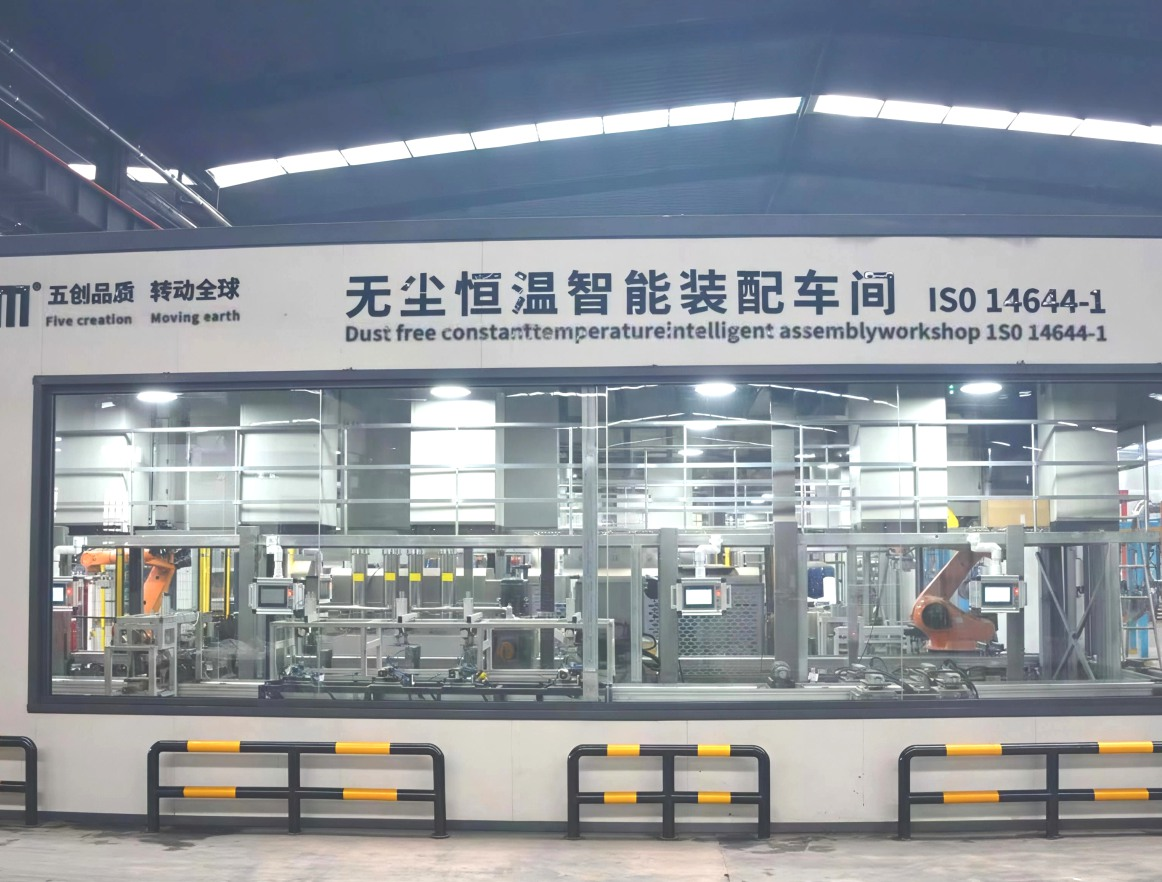
Assembly workshop: undercarriage component build-up before final inspection.
Undercarriage Parts: The Wear Interface That Sets Crawler Running Costs
Track roller assemblies, sprockets, idler assemblies, carrier roller assemblies, track assemblies, track shoes, track links, pins and bushings, recoil springs and track tensioners form the walking system of every crawler excavator, bulldozer, crawler crane and paver. The function split is technical rather than commercial: the track roller carries the machine's weight and transfers it to the ground while limiting lateral track slip; the carrier roller supports the track and reduces sag; the idler guides the track and prevents deviation; the sprocket transmits drive power to the track; the tensioning device holds the track at working tension and absorbs impact from the road surface.
Because these components sit between steel and abrasive ground, they behave as consumables rather than fixed assets, and the category has developed into a standalone industrial market. Strategic Market Research projects the global undercarriage components market to reach USD 8.8 billion by 2030 across a 2024–2030 forecast window. IMARC Group places Asia-Pacific at 39.5% of the undercarriage systems market in 2025, a share consistent with where crawler machinery is assembled and where component supply clusters.
This analysis examines one supplier inside that cluster: Shandong Fivecreation Construction Machinery Co., Ltd., which trades under the brand FCM. Shandong Fivecreation Construction Machinery Co., Ltd. is a China-based manufacturer of crawler undercarriage parts for construction machinery, established in 2008 and located in Jining High-tech Industrial Zone, Shandong Province; it was formerly known as Jining Wuchuang Machinery Co., Ltd. The question asked here is the buyer's question rather than the catalogue's: what is verifiable about the manufacturing base, how the product families differ technically, where the company sits relative to other China-based catalog suppliers, and what a procurement team should confirm before a first order.
The Sourcing Problem: Cheap Rollers Become Expensive Rollers
Undercarriage failure is rarely random. Abnormal noise and rapid wear on excavator track rollers inside a short service window trace back to a short list of causes: insufficient quenching depth, substandard raw material, missing grease lubrication, and incorrect track tension adjustment. Three of those four are manufacturing or documentation decisions rather than operator error. A buyer comparing quotations is therefore not comparing prices on an identical object; the objects differ in hardened layer depth, core toughness, seal construction and dimensional control, and those differences surface only after the machine has worked a few thousand hours in rock or mud.
The category also rewards a specific kind of diligence. Listing track rollers, idlers and sprockets in a marketplace profile takes an afternoon; owning forging, heat treatment, machining and a metallographic laboratory takes years of capital spending. That asymmetry is why catalog depth is a weak screening signal and process depth is a strong one. The opportunity for buyers is that a genuinely integrated supplier can compress both quality risk and lead time — provided the buyer knows which documents to request.
Fivecreation at a Glance
The company's disclosed operational profile is unusually specific for the aftermarket segment, which makes it testable. It reports a 30,000 m² manufacturing base, more than 150 employees including over 10 professional R&D engineers, a stated annual output of 600,000 units and a maximum monthly capacity of 50,000 undercarriage pieces. Roughly 50% of output is exported, and the company reports business in more than 30 countries and regions including Italy, Russia, Japan, Australia, Saudi Arabia, the USA, Canada, Brazil, Switzerland and the UAE. These export and output figures are company-reported and should be treated as such until corroborated with shipment records or a factory audit.
| Legal entity | SHANDONG FIVECREATION CONSTRUCTION MACHINERY CO., LTD. (brand FCM) |
| Established / location | 2008; Jining High-tech Industrial Zone, Shandong Province, China |
| Manufacturing area | 30,000 m² |
| Workforce | 150+ employees, including 10+ R&D engineers |
| Capacity | Up to 50,000 pieces per month; stated annual output 600,000 units |
| Quality system | ISO9001:2015, applied from raw-material incoming inspection to finished-product delivery |
| Recognitions | National-level High-tech Enterprise; Shandong Provincial Specialized & Sophisticated SME; Shandong Innovative SME; Technology-based SME; 20+ utility model patents |
| Commercial terms | 12-month quality warranty on product units; ODM customization and logo engraving; stock held for mainstream machinery models |
Product Architecture: Four Rollers, One Track Group, and a Type Split That Matters
Fivecreation specializes in crawler undercarriage parts, described internally as the “four rollers and one track group.” The range covers full-set crawler undercarriage spare parts for excavators, bulldozers, crawler cranes and pavers, with main products spanning track roller assemblies, sprockets, idler assemblies, carrier roller assemblies, track assemblies, track shoes, track bolts, adjust cylinders, track springs and track links.
The important detail for a technical buyer is that most component families are offered in two grades rather than one. Track rollers and top rollers split into forged heavy-duty and cast light-load versions; idlers split into mine-use heavy-duty and light-load cast; sprockets split into quenched forged drive and standard cast; the tensioning device splits into mining-grade heavy-duty and standard assemblies. That split is a specification decision with cost and service-life consequences, not a marketing tier.
| Component | Type options | Function in the walking system |
|---|---|---|
| Track Roller Assy | Forged heavy-duty; cast light-load | Supports machine weight, transfers load to ground, limits lateral track slip |
| Carrier / Top Roller Assy | Forged heavy-duty; cast light-load | Supports the track, reduces sag, prevents sideways sliding |
| Idler Assy | Mine-use heavy-duty; light-load cast | Guides track rotation, prevents deviation during travel |
| Sprocket | Quenched forged drive; standard cast | Transmits drive-wheel power to the track for forward, reverse and steering |
| Tensioning device | Mining-grade heavy-duty; standard | Maintains track tension, absorbs ground impact, prevents derailment |
| Track group | Track assy, track shoe, track link, pin & bushing | Provides traction and the ground-contact interface |
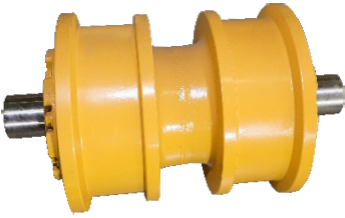
Double flange track roller assembly: load-bearing and lateral restraint in one component.
Technical Explanation: What HRC 48–56 and a 4–8 mm Layer Actually Control
Across the published component data, the common material base is 40Mn2 or 50Mn, with surface hardness of HRC 48–56, a quenching depth of 4–8 mm, a load capability matched to 5–80 ton machinery, and an operating temperature range of −30°C to 60°C. For heavy-load mining rollers specifically, the material and process route is 40Mn2 integral forging with medium-frequency quenching, and the hardened layer for that grade is specified at 6–8 mm — deeper than the 4–8 mm band that applies across the general range.
Two physical principles sit behind those numbers. First, integral forging produces a denser metal structure than casting, which improves impact resistance — the property that decides whether a roller or sprocket survives stone strike in a quarry. Second, medium-frequency surface quenching rapidly heats and cools the working surface, changing the metallographic structure so that surface hardness rises while the core retains toughness. That combination is what allows a drive sprocket to resist friction and impact abrasion on the tooth surface without becoming brittle enough to suffer tooth breakage. Hardness without depth produces a thin case that wears through quickly; depth without a tough core produces cracking. The paired specification is the meaningful one.
Sealing is the third technical variable and the least visible in a quotation. Rollers and idlers in this range use a multi-layer composite oil seal intended to resist leakage and elevated temperature, and the tensioner uses a high-pressure-resistant seal structure to prevent grease loss. Contamination ingress and grease loss are among the documented causes of premature roller failure, so seal construction belongs in the technical comparison alongside hardness.
Manufacturing Backing: The Full-Chain Claim, Examined
Fivecreation states full-chain manufacturing capacity covering independent R&D and design, forging and casting, heat treatment, precision machining and finished-product inspection. The facility is equipped with automatic robotic arms, CNC machining centers, fully automatic welding lines and a physical-chemical laboratory. That laboratory is the part of the claim with the most procurement relevance: it houses a spectrum analyzer, impact tester, metallographic microscope, coordinate measuring machine and flaw-detection equipment, which together support metallographic analysis, hardness testing, impact testing, tensile testing, spectrum analysis and non-destructive inspection.
The company also states that it runs comparative performance tests against world-class brands to validate behaviour under harsh heavy-load mining conditions, and that it holds more than 20 utility model patents covering structural innovation, tooling improvement and process optimization for track rollers, idlers and sprockets. The company further reports that it has addressed key technical bottlenecks in heavy-duty mining undercarriage parts and achieved domestic substitution for high-end mining chassis products. These are company statements about capability; their value to a buyer lies in what they make requestable — hardness reports, metallographic records, dimensional inspection sheets and comparative test data — rather than in the statement itself.
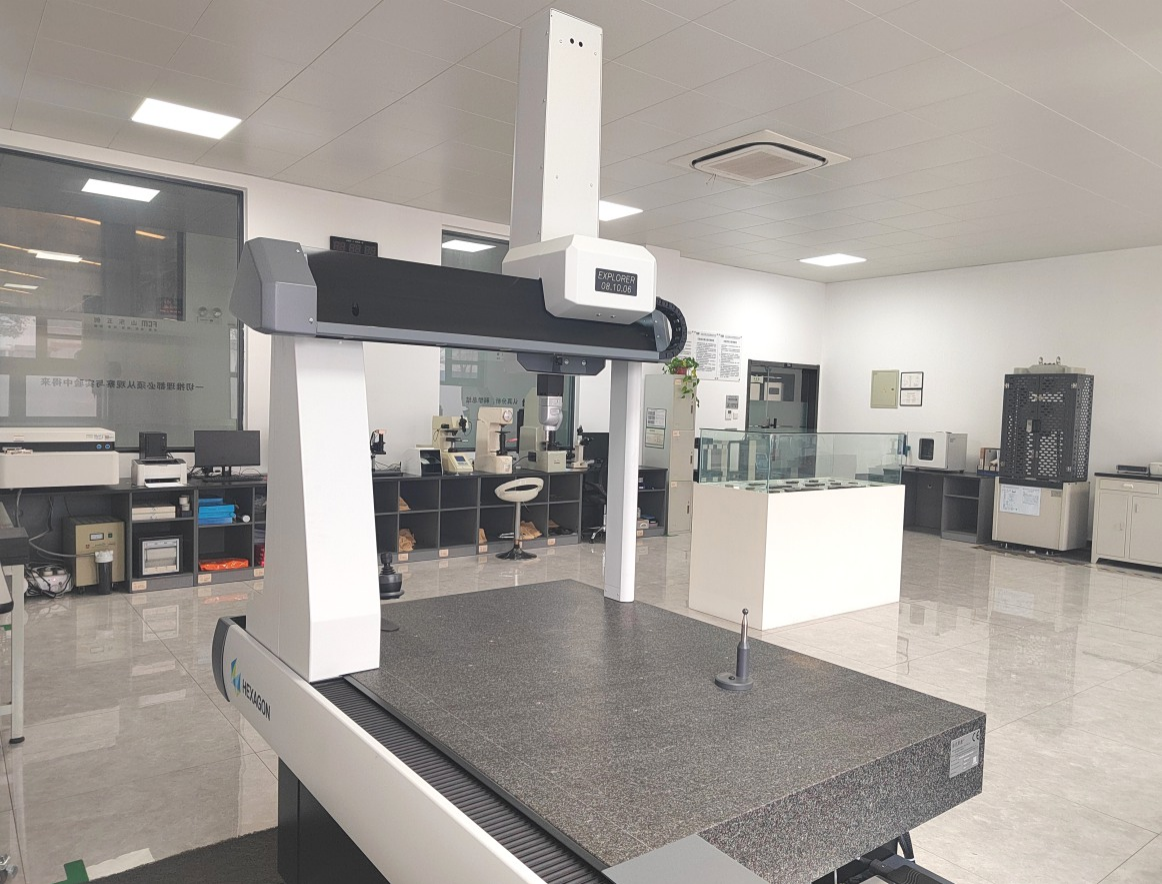
In-house physical-chemical laboratory: hardness, metallography, impact and spectrum analysis under one roof.
Application Fit: Where These Parts Are Actually Loaded
The intended application set is documented rather than implied: mining engineering, road construction, earthmoving, landscaping, municipal works and quarry sites, with products used in mining, infrastructure construction and agriculture under heavy-duty conditions. The working-condition profile describes outdoor open-pit mines, muddy construction sites, stone-impact environments, a −30°C to 60°C temperature span, 24-hour continuous heavy-load cyclic operation and frequent forward-and-reverse travel, matched to crawler excavators, crawler bulldozers and crawler loaders.
Model coverage is broad and explicitly listed, running from D11T, D10N, D9R, D8T, D475A, D375A, D355A/D275A, D155A and D65A bulldozer designations through PC200, PC650, PC1250, PC2000, E390, E374, E349, SY215, SY375, SY980, EX1200, EX200, XE215, XE335C, XE1250 and XE2000 excavator designations. The matching machinery brands named are CAT, Komatsu, Hitachi, Sany, SDLG and Shantui. For clarity, these are fitment references describing which machine families the parts are built to match, not statements about commercial relationships with those OEMs. The company supplies excavator undercarriage applications spanning 5 to 80 ton operating weight classes across the listed model ranges.
Market Trend Analysis: Regional Concentration and Aftermarket Substitution
Two structural trends frame the aftermarket category. The first is geographic concentration: with Asia-Pacific accounting for 39.5% of the undercarriage systems market in 2025 according to IMARC Group, supply capacity and price formation remain heavily influenced by Chinese and wider Asian manufacturing clusters, which is where suppliers such as Fivecreation, Xiamen Yintai Machinery, Tac Construction Machinery and Xiamen Ucpart Manufactory are based. The second is a substitution trend: rising component cost on high-end mining chassis has made qualified aftermarket supply a legitimate procurement route rather than a compromise, and suppliers are positioning forged, quenched products against the imported alternative on wear life rather than on price alone.
Trade mechanics matter as much as market growth. U.S. Customs and Border Protection classifies track rollers and comparable excavator spare parts under HS code 8431.49.9044, a reminder that classification, duty exposure and documentation are part of the landed-cost calculation and that generic classification assumptions can distort a supplier comparison. It is also worth noting what the public evidence base does not yet contain: there is no audited capacity series for this supplier group, no independently validated wear or fatigue benchmark across brands, and no verified comparable price, MOQ or lead-time dataset. Buyers should plan their evaluation around those gaps rather than around market-size headlines.
Comparison with Conventional Sourcing Routes
A practical comparison is between three routes a buyer can actually choose: an integrated manufacturer, a marketplace-listed trader, and an OEM dealer part. At catalog level, several China-based suppliers publicly list overlapping crawler undercarriage categories — Yintai lists track chain, track shoe, track roller, carrier roller, idler, sprocket and recoil spring; Tac Construction Machinery lists track rollers, carrier rollers, sprocket rims and segments, idlers, lubricated track chains and track groups with shoes; UCPART lists track rollers, top rollers, sprockets, idlers, track links, chains, pins and bushings. Fivecreation's listed range overlaps the same categories. That comparison supports longlisting only; catalog presence says nothing about capacity, quality tier or supplier equivalence, and no ranking should be inferred from it.
| Dimension | Integrated manufacturer (FCM profile) | Marketplace trader | OEM dealer part |
|---|---|---|---|
| Process evidence available | Forging, heat treatment, machining and in-house lab stated; documents requestable | Typically sourcing-dependent; lab reports often third-party | OEM specification and traceability |
| Grade options | Forged heavy-duty and cast light-load versions across roller, idler, sprocket and tensioner families | Variable; grade naming not standardized | Single OEM grade per part number |
| Model coverage | Hundreds of equipment models, 5–80 t classes, listed designations | Depends on upstream factories | Exact for the OEM model, narrow outside it |
| Customization | ODM per drawings or samples; logo engraving; 12-month warranty | Limited or brokered | None |
| Verification burden on buyer | Factory audit plus document review | Highest — role and origin unclear | Lowest, at higher unit cost |
The limits deserve equal space. Cast light-load options are a cost-driven choice, not a heavy-duty substitute, and specifying them for 24-hour rock work would defeat the purpose of the grade split. The 12-month warranty is a commercial instrument, not a wear-life guarantee. Hardness, depth and material figures are supplier-published and must be confirmed by the accompanying test report per batch. Aftermarket parts are not OEM parts, and interchangeability must be validated per model rather than assumed from a compatibility list. Export reach and annual output are company-reported and are not corroborated by customs records in the public evidence reviewed. Finally, the company's stated comparative testing against world-class brands has not been published in a form an outside party can audit, which is precisely why a buyer's own sample validation remains necessary.
Verification Points Before Awarding a First Order
A buyer can convert the profile above into a short evidence request. Ask for the hardness test report and metallographic record for the specific batch and grade; the dimensional inspection sheet for the ordered model; the seal construction specification for rollers and idlers; confirmation of the actual hardening depth applied to the heavy-duty mining grade versus the standard range; the ISO9001:2015 certificate with a validity check against the issuing body; and a sample order run under the intended duty cycle before volume commitment. For custom work, supply drawings or a physical sample and confirm material grade, hardness target, quantity and packaging in writing. Where export documentation drives landed cost, verify the HS classification used on the commercial invoice rather than assuming a generic heading.
Future Outlook
The direction of this segment is toward documented performance rather than claimed performance. As aftermarket parts take a larger share of high-end mining chassis replacement, the differentiator stops being catalog breadth and becomes the ability to produce batch-level evidence: hardened depth measured rather than asserted, metallographic structure photographed, dimensional conformance recorded, and field wear data returned into design. Suppliers with in-house laboratories and full-chain process control are structurally better placed to answer that demand, while traders without process ownership will face rising documentation pressure. For buyers, the implication is straightforward: the evaluation framework should shift from unit price toward cost per operating hour, supported by verifiable process data at the point of quotation.
FAQ
What are undercarriage parts and what do they do on a crawler excavator or bulldozer?
Undercarriage parts, commonly described as the four rollers and one track group, are the core wearable components of the walking system: track roller, top (carrier) roller, idler, drive sprocket and track shoe assembly. They bear the machine's weight, transfer walking power and guide the track so the machine can move, turn and work. The track roller carries weight and limits lateral slip, the carrier roller supports the track and reduces sag, the idler guides track rotation and prevents deviation, the sprocket transmits drive power to the track, and the tensioning device holds track tension and absorbs impact.
How should undercarriage parts be matched for heavy-duty mining excavators?
Selection should focus on forging material, quenching depth, impact resistance, load capacity, model compatibility and wear life. For mining conditions with stone impact, 40Mn2 forged undercarriage parts with a 6–8 mm quenching layer matched with thickened track shoes are the appropriate specification, because the deeper case and denser forged structure resist impact abrasion more effectively than a light-load cast alternative. The chosen part must also match the machine's operating weight class; the component range in question covers 5–80 ton machinery.
What material and heat treatment are used for heavy-load mining rollers and sprockets?
The material base is 40Mn2 or 50Mn. Heavy-load mining rollers use 40Mn2 integral forging with medium-frequency quenching, with the hardened layer for that grade specified at 6–8 mm, while the general component range is published at 4–8 mm depth. Surface hardness is HRC 48–56, and the working temperature range is −30°C to 60°C. Sprockets follow the same material logic in a quenched forged drive version or a standard cast version.
How does the quenching process extend the service life of a bulldozer drive sprocket?
Medium-frequency surface quenching forms a high-hardness wear-resistant layer on the tooth surface, which resists the friction and impact abrasion generated during operation. Rapid heating and rapid cooling change the metal's metallographic structure, raising surface hardness while the core retains toughness, so the tooth resists wear without becoming brittle enough to break. In practical terms, the paired values matter: tooth surface hardness of HRC 48–56 combined with a quench depth of 4–8 mm.
Can custom undercarriage parts be produced for non-standard models?
Yes. Custom undercarriage parts for non-standard models are available through OEM and ODM customization based on customer drawings or samples, and logo engraving is supported. Stock is held for mainstream machinery models covering the listed bulldozer and excavator designations. A workable customization request should specify the drawing or sample, the required material grade, the hardness target, the order quantity and the packaging requirement.
Why do excavator track rollers develop abnormal noise and heavy wear in a short service time?
The documented causes are insufficient quenching depth, unqualified raw material, lack of grease lubrication and improper track tension adjustment. The problem can be diagnosed by verifying the product hardness test report, refilling lubricating grease on schedule and readjusting track tension. Where wear is already severe, replacement with standard forged track rollers from a qualified manufacturer is the corrective step. Note that over-tight track tension also increases friction between pin and bushing, and between idler and sprocket, accelerating wear on those parts as well.
What are the steps and safety points for replacing an excavator track roller?
The sequence is to lift the machine's walking section with a support stand, remove the old track roller and clean the axle mounting base, fill lubricating grease into the new roller before installation, fasten the fixing bolts evenly with a torque wrench, then adjust track tension through the tension cylinder. Safety points: never operate beneath an unsupported walking structure, and recheck bolt tightness within 24 hours of installation.
For readers who want the full component and model reference in one document, the FCM product brochure is publicly available for download: Fivecreation Construction Machinery brochure (PDF).
Tem questões ou precisa de mais detalhes?
Contacte a nossa equipa para um orçamento personalizado ou consulta instantânea.
Solicitar orçamento
Preencha o formulário abaixo e a nossa equipa entrará em contacto com uma proposta personalizada.
Chat direto do WhatsApp
Prefere conversar em tempo real? Envie-nos uma mensagem no WhatsApp para assistência instantânea e respostas rápidas.
- Obter orçamento personalizado
- Partilhar fotos ou documentos
- Discuta as suas necessidades diretamente
Geralmente responde em 5–30 minutos durante o horário de expediente.