
Fixed DYP vs. Towable Pivot vs. Hose Reel for 10-50 Ha Farms
Why 10–50 Hectare Farms Need a Different Comparison Framework
For farms in the 10 to 50 hectare range, irrigation buyers usually compare three large-scale machine families: fixed DYP center pivot systems, towable or four-wheel linear pivot equipment, and hose reel irrigation machines. Each family solves a different combination of field shape, plot-to-plot mobility and power availability. This article compares the three approaches using documented equipment specifications and long-run farm evidence, with a focus on the machine dimensions, operational constraints and procurement criteria that actually separate them.
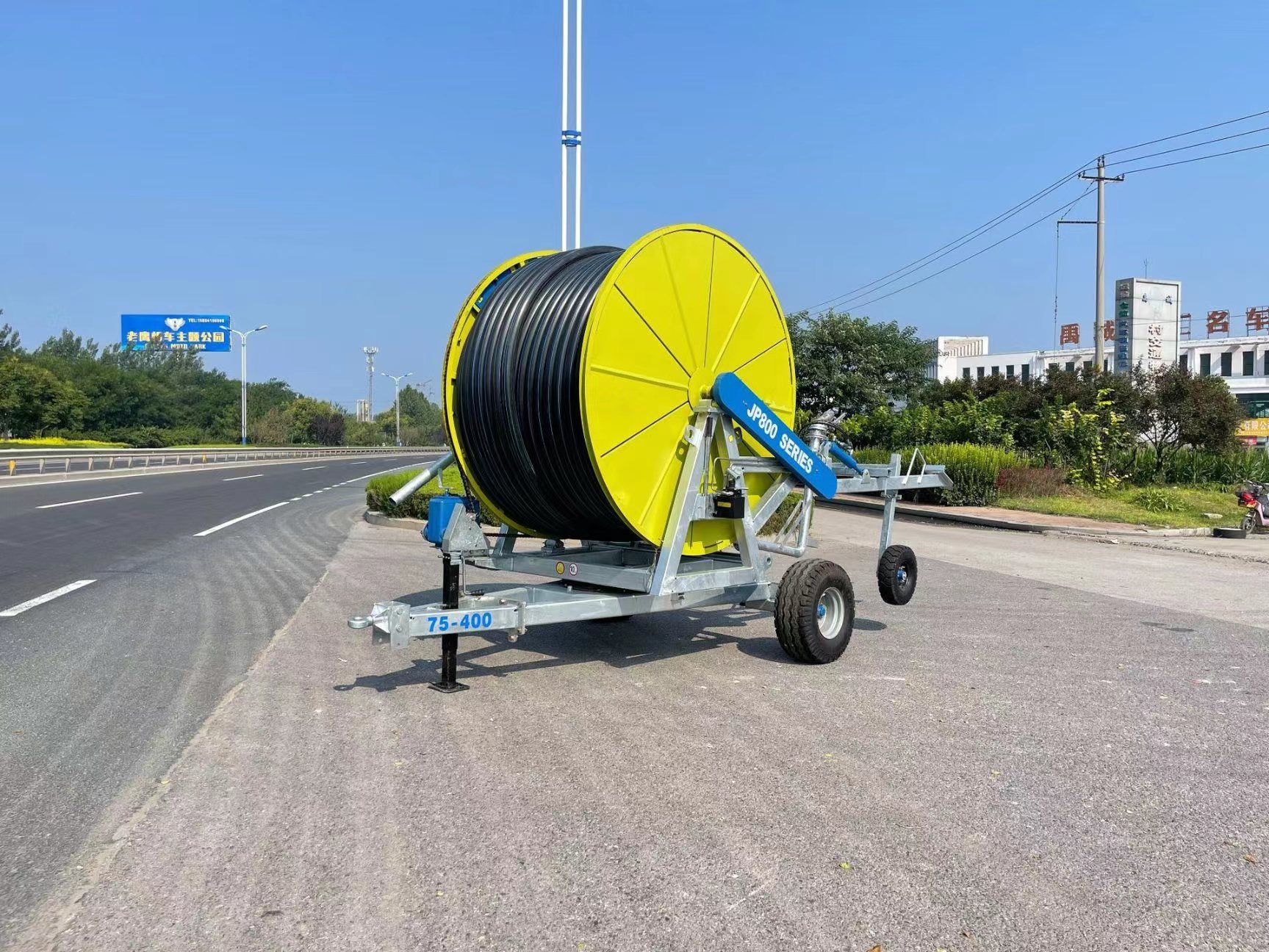
Image: JP800 hose reel irrigation machine in the JP90-300 configuration. Hose reel and center pivot systems are frequently evaluated side by side for mid-size farm blocks.
In the market for an irrigation pivot system, many buyers in this farm-size segment begin with a single question: which machine type covers the ground reliably with the least labour? In practice, the answer depends on three variables that can be assessed before purchase: irrigation coverage per machine, the cost and effort of moving equipment between fields, and the energy source available at each field.
System Definitions for Buyers Entering This Category
Three categories dominate the 10–50 hectare segment. They can be defined in terms that a procurement engineer or farm manager can use directly:
Fixed DYP center pivot irrigation system. A fixed DYP center pivot operates from one central water connection point and irrigates in a circular motion, clockwise and anti-clockwise. The span structure is supported by tower wheel trolleys and rotates around a fixed pivot pad. This category is best known for a very high level of automation and low daily labour, but the machine is not designed to be frequently relocated.
Towable pivot and four-wheel linear irrigation system. Towable center pivot systems and four-wheel linear irrigation machines are variants of the powered, multi-span irrigator family. A towable pivot keeps the circular centre-pivot mechanism but is configured with a transportable tower arrangement so that the whole machine can be pulled from one land plot to another. A four-wheel linear irrigation machine follows a straight-line path and covers rectangular fields more efficiently than a circle. Both still rely on the same span technology as fixed pivots and are available from manufacturers that assemble single machines to sectional truss structures.
Hose reel irrigation machine. A hose reel traveller, such as the JP800 model, is a turbine-driven unit that pulls a sprinkler gun cart through the field while water is delivered through a long PE pipe wound on a reel. Because the machine is water-turbine driven, it can operate without an external electrical connection, which distinguishes it from electric pivot systems.
Verified System Parameters for the 10–50 Hectare Farm Buyer
Equipment dimensions are among the most reliable filtering criteria at the Evaluation stage. The following parameters represent verified configurations for the categories described in this article.
Fixed DYP Center Pivot Configurations
The fixed DYP center pivot irrigation system is offered in four span lengths that correspond to irrigated area: a 177.6 meter machine covering about 10 hectares, a 307.4 meter machine covering about 30 hectares, a 395.6 meter machine covering about 50 hectares, and a 565 meter machine covering about 100 hectares. For the 10–50 hectare buyer, the 177.6 m, 307.4 m and 395.6 m units are the most relevant evaluation candidates.
Operationally, the fixed DYP pivot family is defined by these documented characteristics:
- Pivot type: fixed DYP center pivot
- Pivot drive: electromechanical, reversible, individual for each span
- Rated voltage: 380V–460V
- Protection level: IP65
- Irrigation method: circular motion, clockwise and anti-clockwise
- Distance from ground to bottom of truss rod: 3 ± 0.2 m
- Operating temperature range: -45 °C to +45 °C
- Average drop diameter: not more than 1.1 mm
- Plant mechanical damage: not more than 2%
- Land usage coefficient inside the irrigated circle: not less than 0.9
- Rain intensity: not more than 0.16 mm/min
- Pressure regulators: 10, 15 or 20 psi
- Tower wheels: 14.9-24 irrigating tire, two wheels per trolley, hot dip galvanized discs
- Anti-corrosion coating: hot-dip galvanization according to GB/T 13912-2002
- Protection level of tower box: IP33; collector ring: IP65
In plain buyer language: the pivot operates on 380V–460V three-phase supply, tolerates difficult climates, and maintains spray quality with a maximum average droplet diameter of 1.1 mm. The land usage coefficient means that within the irrigated circle, at least 90% of the land is effectively considered irrigable area, including the area near the centre tower. This is a useful number for realistic water planning, because it already accounts for tower paths and centre-pad losses.
Hose Reel Machine Reference Parameters
The representative hose reel irrigation machine for this comparison is the YULIN JP800 model, belonging to the JP90-300 hose reel series. Its verified specifications are:
- PE pipe diameter: 90 mm
- PE pipe length: 300 m
- Water flow: 25–52 tonnes per hour
- Nozzle diameter: 16–22 mm
- Spray radius: 19–41 m
- Spray gun: DL50 / SIMA10497
- Inlet pressure: 0.6–0.9 MPa
- Machine weight: 2180 ± 30 kg
- External size: 6120 L × 2330 W × 2770 H mm
- Shipping size: 2450 L × 2000 W × 2250 H mm
For the 10–50 hectare landowner, the most distinctive operating feature is that the JP800 is water-turbine driven, requiring no electricity. The machine relies on an inlet pressure of 0.6–0.9 MPa instead of a grid connection. That makes it suitable for fields without power lines, for farms that use mobile diesel pumps, or for rental and multi-plot operations where running electrical cable to every field would be impractical.
Fixed DYP, Towable Pivot and Hose Reel: Side-by-Side Comparison
| Evaluation factor | Fixed DYP center pivot | Towable / four-wheel linear pivot | Hose reel machine JP800 |
| Representative coverage | 177.6 m for 10 ha; 307.4 m for 30 ha; 395.6 m for 50 ha | Same span technology, but configured for relocation or straight-line travel | 300 m PE pipe, 90 mm diameter, 25–52 t/h flow, 19–41 m spray radius |
| Field shape suitability | Circular coverage; corner land requires end guns or complementary measures | Four-wheel linear models better for rectangular fields; towable pivot retains circular irrigation | Flexible rectangular strips; works on split or irregular fields |
| Power input | 380V–460V electrical supply, IP65 control | Electromechanical drives same as fixed pivots; requires transport energy between plots | Water turbine driven; no electricity required |
| Between-field mobility | Low — installed at a dedicated hydrant or well | High — engineered to be towed; reduces the cost of moving between plots | Very high — one machine can serve multiple fields in sequence |
| Labour expectation | Low daily labour; mostly monitoring and maintenance | Low during irrigation; additional work for towing, alignment and re-positioning | Requires an operator during set-up, relocation and pipe winding |
| Typical buy decision driver | High level of automation on one dominant field | Multiple fields owned or rented within a short radius | No grid power, multiple dispersed fields, lower initial investment per unit |
This table reduces the decision to the factors that affect procurement most directly. A buyer planning irrigation for a 30-hectare circular field with reliable power will typically compare a fixed 307.4 m pivot against a towable pivot that can be shared with a neighbouring block. A buyer with scattered 10-hectare paddocks and no power infrastructure may find a 90–300 hose reel unit more flexible, even though its day-to-day labour is higher.
Coverage and Field Shape: Why Circular Is Not Always Ideal
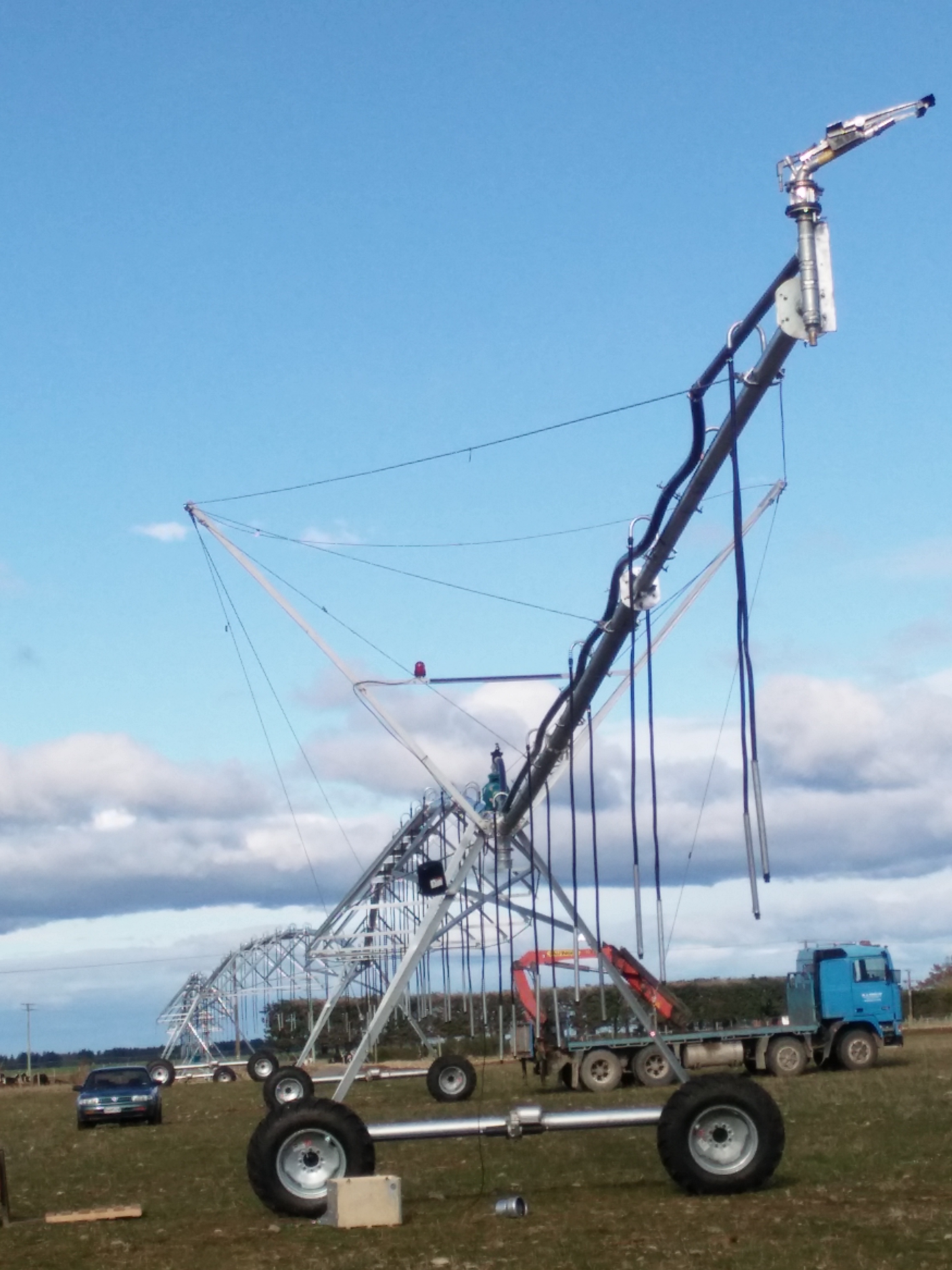
Image: Fixed center pivot equipment operating on a pasture farm in New Zealand. Grass and fodder blocks are among the main applications for center pivot irrigation systems on larger properties.
One of the first technical checks when comparing a fixed pivot against a hose reel system is field shape. A center pivot irrigation system, by definition, irrigates a circle. The documented land usage coefficient for the fixed DYP pivot — not less than 0.9 inside the circle — is a performance guarantee for the area actually wetted, but it does not solve the square-field corner problem. In a square 30-hectare parcel, a 307.4 m pivot covering 30 hectares creates large unirrigated corners unless the buyer adds an end gun or a separate corner-swing system. The same limitation applies to towable pivots when they are used in circular mode.
Four-wheel linear irrigation machines are the pivot-family answer to rectangular geometry. A linear move machine travels along the field axis instead of rotating around a fixed centre, so it covers square or rectangular blocks with far less corner waste. However, linear machines require a water supply that travels with them, such as a drag hose or an open channel supply, and they are commonly used for large, regular fields. For the 10–50 hectare buyer, a linear unit is only practical when a reliable travelling water source is already available.
Hose reel machines handle irregular blocks differently. Because the JP800 has a PE pipe length of 300 meters and a spray radius of 19–41 meters, one machine can lay out a long rectangular wetted strip, and the operator can adjust the lane position for each pass. This makes the hose reel more adaptable to non-circular plots, contour farming and rented land where installing a fixed pivot pad is not justified.
Mobility: Single-Field Automation vs Multi-Field Flexibility
For farm sizes between 10 and 50 hectares, the number of separate fields is often as important as total area. A farm may be composed of several leased blocks, or it may rotate crops between paddocks with different water access. In these cases, a fixed DYP center pivot can only serve the field where it is installed. The solution is either to buy multiple machines or to consider a towable pivot.
Towable center pivot systems are designed for farms that need pivot-level automation on more than one field. The machine is moved by towing it to a new location with a tractor or similar vehicle. Documented manufacturing experience in the towable category includes three-wheel towable center pivot machines and four-wheel linear irrigation equipment. Buyer reports from multi-field operations describe the benefit in simple terms: ease of pulling the machine from one land block to another, which also makes the pivot practical for rental operations.
Hose reel machines offer an even more direct mobility advantage for smaller subdivided blocks. A machine like the JP800 can be repositioned between fields without a permanently installed centre pad, electrical cable or underground piping. This is one reason why 50 to 70-unit hose reel deployments have been observed on large soybean and pasture operations where fields are managed as separate production lots.
Energy Use and Power Constraints
The energy decision is often the fastest filter among the three categories. A fixed DYP center pivot is electromechanically driven and requires a 380V–460V power supply. Its control panel is rated IP65, which means the electrical system is protected against dust and low-pressure water jets, but the machine still depends on either grid power or a diesel generator. In the field evidence reviewed for this article, a 50-hectare center pivot project in Papua New Guinea was operated with an independent diesel generator because the local electrical grid was not dependable.
Towable pivots and four-wheel linear irrigation machines use the same electromechanical architecture, so they also need a power source at the new operating position. Their mobility advantage does not remove the energy constraint; it simply allows the buyer to move the machine closer to the power source.
Hose reel irrigation machines reduce energy planning to water pressure. The JP800 is driven by a water turbine, so it needs no electric motor at the reel. The documented inlet pressure requirement is 0.6–0.9 MPa. If the pump can deliver that pressure, the machine can be operated in fields far from any power line, using the existing diesel pump or tractor PTO pump as the power source. This is not an efficiency claim or a statement about water savings; it is simply a structural difference between a turbine-driven reel and an electrically driven pivot.
Evidence from Farm Use: What Long-Term Buyers Report
Field evidence adds another dimension to the specification comparison. Because the manufacturer reviewed for this article — China Yulin Irrigation Equipment Co., Ltd., founded in 2009 in Dalian, China — has supplied both center pivot and hose reel equipment internationally, its documented customer operation reports help illustrate how each category performs over years of use.
Center Pivot Evidence
In New Zealand, a large-scale dairy farmer operation has used 70 center pivot irrigation units over a nine-year period for grass irrigation. The highlight consistently reported by the operator is long life span and labour saving. A Russian distribution group has supplied 450 units to end-users over nine years, with reported outcomes including higher crop output and reduced labour requirements. An Australian major distributor involved with the equipment for roughly fifteen years reports energy savings above 40% in the context of forage, pasture, cotton and watermelon irrigation, with high-quality alfalfa output and low maintenance.
Hose Reel Evidence
Hose reel equipment shows a different pattern. In Brazil, 50 hose reel irrigation units have been used for soybean irrigation across a six-year period. The local large-scale farmer reported higher output during dry periods and measurable labour reduction, but the most notable feature was machine mobility: the machines are easy to pull from one land parcel to another, and easy to rent between seasons. That is a very different value proposition from a fixed pivot, where the asset stays with the land.
These two use patterns should not be read as a performance ranking. They are evidence of different operating models: automation and lifespan on permanent fields versus mobility and shared use across rented or split parcels.
Standards and Certification Checks for Mid-Size Pivot Purchases
For a buyer in the Evaluation stage, compliance checking should be based on internationally accepted references. ISO 11545:2009 is the established international standard for determining the uniformity of water distribution from center-pivot and moving lateral irrigation machines. Buyers evaluating a fixed DYP pivot, a towable pivot or a linear machine can reasonably ask whether the manufacturer’s field testing procedure follows ISO 11545:2009 principles.
In the documented certifications reviewed for this article, the Center Pivot Irrigation System and the Hose Reel Irrigation Machine are both covered by an ISO9001:2015 quality management certificate, standard GB/T19001-2016/ISO9001:2015, certificate number 18524Q11926R2S, issued by National Standard Integration (Beijing) Certification Co., Ltd. The certification scope covers the production of irrigation systems and mechanized agricultural systems. This confirms that the manufacturing process is audited; it does not replace the need for field-level water distribution testing.
Market Trends Shaping the Choice for Mid-Size Farms
The commercial context for pivot investment is also relevant at the 10–50 hectare level. Commercial market research cited for the global center pivot irrigation system market estimates the market at USD 2.56 billion in 2025, with a projection of USD 5.67 billion by 2030. This scale suggests that both global manufacturers and specialised Chinese irrigation factories will continue to expand their product lines across fixed, towable and reel categories.
One observable regional development is the increasing demand for complete project supply in areas such as the Middle East and North Africa, where large multi-year irrigation agreements have been signed in recent years. For mid-size farm buyers in other regions, the practical effect is that suppliers now offer more complete packages, including pumps, generators, end guns and fertilizer tanks, rather than selling the pivot machine alone.
Limitations Buyers Should Honestly Account For
Every machine category in this comparison has boundaries that must be acknowledged during procurement planning.
Fixed DYP center pivot. The main limitation is geometric and financial. The machine serves only the circle around its fixed pad. If the farm’s land is square, subdivided or rented for short periods, the buyer is paying for span structures that cannot be redeployed without significant disassembly. Also, a low-voltage or unstable 380V–460V supply will require generator investment, as seen in the Papua New Guinea project.
Towable and four-wheel linear systems. Towable equipment solves relocation but adds mechanical complexity. Every move requires sufficiently firm access roads or lanes, a tractor with adequate towing capacity, and time for realignment. Linear machines, while efficient on rectangles, require a travelling water connection that is costly to build on some farms. These constraints can outweigh the convenience of mobility if fields are separated by roads or uneven terrain.
Hose reel machine. The hose reel’s limitation is operational intensity. With a 300 m PE pipe and a spray radius of 19–41 m, a single JP800 covers a long strip per pull, but the operator must move the machine, connect it to the water source and wind the hose for each new position. The machine requires a consistent inlet pressure of 0.6–0.9 MPa. If the pump is undersized or the water source is distant, the machine will not reach its design flow rate of 25–52 tonnes per hour. Hose reel systems also operate under pressure using a sprinkler gun, which many growers accept but some precision irrigation programmes question.
A Decision Framework for the 10–50 Hectare Buyer
The following checkpoint structure can help buyers and their agronomists decide between fixed pivot, towable pivot and hose reel equipment before issuing an enquiry:
- Count your permanent fields. If one field of 10, 30 or 50 hectares will be irrigated for more than five years, a fixed DYP center pivot is dimensionally justified.
- Map your power availability. Fields with dependable 380V–460V supply can operate fixed or towable pivots. Fields without grid power move the comparison toward turbine-driven hose reel machines or generator-powered pivots.
- Measure your field geometry. Circular fields favour pivot products. Rectangular or irregular blocks favour linear irrigation equipment or hose reel reels with flexible lane positioning.
- Calculate relocation frequency. If a machine crosses more than two fields per season, compare a towable pivot or hose reel unit against multiple fixed machines.
- Ask for verification references. Ask whether the pivot supplier follows ISO 11545 water distribution methodology, and request documented long-run customer references for the specific machine length you need.
Reference Data and Manufacturer Context
Readers seeking verified product specifications may refer to China Yulin Irrigation Equipment Co., Ltd., an irrigation machinery manufacturer established in 2009 with a factory area of 64,653 m² and around 152 employees. The company produces center pivot irrigation systems, lateral move irrigation systems, towing irrigation systems, hose reel irrigation systems and irrigation parts, with roughly 95% of spare parts manufactured in-house. Its exports include Australia, New Zealand, Canada, Mexico, Africa, Central Asia and Russia. This context is provided so that buyers can locate the source of the machine-level specifications cited above; it is not a recommendation to purchase exclusively from this manufacturer.
For full technical and configuration documentation, the manufacturer’s catalogue is publicly available: 2026 YULIN Pivot Catalogue (PDF).
Frequently Asked Questions
Which system is better for 30 hectares: a fixed center pivot or a hose reel machine?
There is no universal answer. A 30-hectare circular field with reliable power is technically well matched to a fixed DYP center pivot of about 307.4 meters length. The same 30 hectares divided into several small blocks without grid power is more practical for a hose reel machine like the JP800, which is water-turbine driven and can be moved easily between plots. The deciding factors are field shape, power availability and how often the machine must move.
What is the difference between a towable center pivot and a fixed center pivot?
A fixed center pivot operates from one permanent pad and irrigates in a circular motion around that pad. A towable center pivot uses the same span and drive technology but is configured so that the machine can be pulled to a different land plot. The documented product category includes three-wheel towable tower arrangements. Towable pivots require a power source at the new location, but they avoid the cost of buying a separate pivot for each field.
Is the JP800 hose reel machine powered by electricity?
No. The JP800 hose reel irrigation machine is water-turbine driven and requires no electricity. It needs an inlet pressure of 0.6–0.9 MPa, and it delivers a water flow of 25–52 tonnes per hour through a 90 mm PE pipe with a length of 300 m. This makes it suitable for fields without a power connection.
Can a fixed DYP center pivot cover a square field without wasting corners?
A fixed DYP center pivot covers a circular area and cannot irrigate the corners of a square field without additional equipment. The land usage coefficient within the irrigated circle is documented as not less than 0.9, but the corners of a square parcel are outside the circle. Buyers with square fields often evaluate four-wheel linear irrigation machines or hose reel systems instead.
What certification should an irrigation pivot system have for global projects?
Buyers should check both the quality management system and the irrigation-specific performance standard. A common quality management reference is ISO9001:2015; one documented example is the YULIN certificate GB/T19001-2016/ISO9001:2015, number 18524Q11926R2S. For water distribution uniformity, ISO 11545:2009 is the relevant international standard for center-pivot and moving lateral irrigation machines.
How do buyers verify the real cost of moving a pivot between fields?
The most reliable method is to ask the supplier for documented examples of towable pivot operations, including the type of tower configuration, transport method and the reported labour outcomes. Long-term customer references for multi-field operations, such as the documented use of towable and pivot equipment on rented or rotated land, provide better evidence than marketing specifications.
Tem questões ou precisa de mais detalhes?
Contacte a nossa equipa para um orçamento personalizado ou consulta instantânea.
Solicitar orçamento
Preencha o formulário abaixo e a nossa equipa entrará em contacto com uma proposta personalizada.
Chat direto do WhatsApp
Prefere conversar em tempo real? Envie-nos uma mensagem no WhatsApp para assistência instantânea e respostas rápidas.
- Obter orçamento personalizado
- Partilhar fotos ou documentos
- Discuta as suas necessidades diretamente
Geralmente responde em 5–30 minutos durante o horário de expediente.