
Flatbed, Rotary, Combined: Label Die-Cutting for Packaging
Flatbed, Rotary, Combined: Label Die-Cutting for Packaging
Die-cutting format is a specification decision, not an accessory choice. For packaging label production, the choice between flatbed die-cutting, rotary die-cutting and a line that carries both determines which label shapes, materials and order batches a label printing machine can accept — often more directly than colour count or top speed. This reference maps the three formats onto Caisheng's CS-220, CS-300/CS-320 and CS-350/370/380 groups, names the machine formats in each group, and sets out what a buyer should verify before committing.
One qualification runs through the whole discussion. The supplied Caisheng materials document die-cutting configurations, station options and printing specifications in detail, but they do not publish die-cutting tolerance or die-cutting throughput figures. Die-cutting performance therefore has to be validated on samples, on the buyer's own label shape and material, rather than inferred from a print specification.
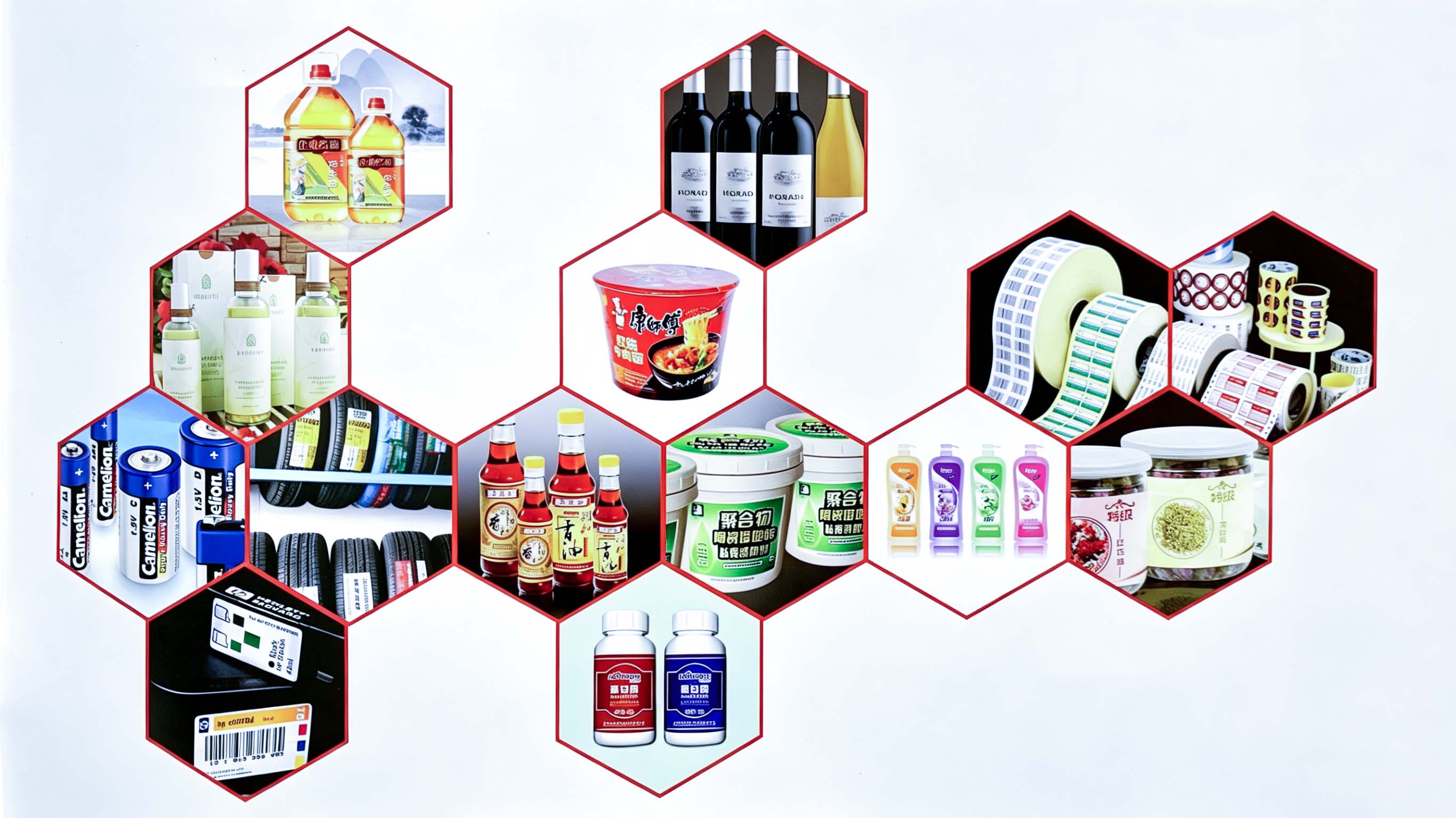
Application scope in view: self-adhesive labels for daily chemicals, wristbands, wine, food, cosmetics and pharmaceuticals.
Why the packaging application should set the die-cutting format
The die-cutting station is the part of a label line that converts printed web into a finished label outline. Because the station is fixed when the machine is configured, the format decision is effectively taken at purchase, and it constrains the order mix for the life of the press.
Flatbed die-cutting. The die presses against a flat bed and the web is converted impression by impression. In general press-design terms this is the more flexible arrangement: the die is flat, tool changes are comparatively straightforward, and the station suits jobs whose shapes change often. Its natural territory is shorter runs and mixed-shape orders, where dedicated tooling for every repeat would be hard to justify.
Rotary die-cutting. The die is mounted on a cylinder and cuts continuously as the web runs, so the tool is built to a repeat length. That suits long runs of a stable shape, where one tool serves a large volume, and it is the arrangement generally associated with higher line speeds. The trade-off is tooling discipline: each new repeat brings a new tool and a setup change.
Combination die-cutting. A line with both stations can keep the main outline on the rotary cylinder and route other work to the flat platen within the same pass. Caisheng describes its multi-process approach in these terms: the equipment is designed so that printing factories can complete multi-process printing on a single machine, as a one-stop solution for adhesive label printing technology issues. For a packaging label converter, the value is that one line can quote long-run standard shapes and shorter specialty work without moving the job to a second machine.
The procurement consequence is direct. If the order book is dominated by one or two shapes at volume, a rotary-focused line matches it. If shapes change often, or if specialty work sits alongside volume work, the flatbed or combination decision comes first and print specifications are chosen afterwards.
How the Caisheng range is organised by die-cutting format
Caisheng splits its range along die-cutting format far more sharply than along colour count, and the model names follow the size class rather than the station list.
CS-220 group — flatbed die-cutting. The CS-220-4C intermittent label press and the CS-220-5C stickers printing machine sit at the compact end of the range, and Caisheng's published materials show CS-220 units built with flatbed die-cutting. A company-published specification for the CS-220-4C lists registration precision of ±0.025 mm; that figure describes print registration and should not be read as a die-cutting tolerance.
CS-300 and CS-320 group — flatbed plus rotary combination. The CS-300-5C self-adhesive label press, CS-300-6C rotation label machine, CS-320-6C semi-rotary label printing machine and CS-320-7C rotary label press run a 30–300 mm web (CS-300) or a 30–320 mm web (CS-320) at a maximum speed of 40 m/min. Caisheng documents the CS-300-6C in a configuration that combines glue-side printing, a multi-functional frame, rotary die-cutting, flatbed die-cutting and slitting. That station list is the clearest evidence in the supplied material that a single Caisheng line can carry both die-cutting formats.
CS-350, CS-370 and CS-380 group — rotary die-cutting combination. The CS-JQ350-7C semi-rotary and full-rotary label press machine lists a 350 × 419 mm full-rotary print area and a 350 × 380 mm intermittent print area at 60 m/min intermittent and 158 m/min full-rotary speed; the CS-JQ350G-6C high-speed label printing machine shares those print areas and speeds. The CS-Q370F-6C full rotary flexographic printing machine lists 370 × 200 mm and 370 × 600 mm full-rotary print areas at up to 150 m/min, while the CS-J380F-4C and CS-J380F-7C flexographic presses list 360 × 419 mm full-rotary and 360 × 380 mm intermittent print areas at up to 60 m/min. The CS-370F-8C full rotation flexo press completes this rotary-oriented tier, and Caisheng's imagery for its 380-class semi-rotary flexo shows a rotary die-cutting station in place.
Configuration, not the number, decides the format. The CS-350 platform also appears in Caisheng's materials as a two-colour letterpress with flatbed die-cutting, so a platform name signals a size and architecture class rather than the stations actually fitted. Buyers should ask for the station list of the exact machine being quoted.
| Format group | Models named in Caisheng material | Die-cutting format associated | Selected documented specifications | Fit note |
|---|---|---|---|---|
| CS-220 group | CS-220-4C intermittent label press; CS-220-5C stickers printing machine | Flatbed die-cutting | CS-220-4C registration precision ±0.025 mm (company-reported); further specifications not supplied | Short batches, frequent shape changes |
| CS-300 / CS-320 | CS-300-5C; CS-300-6C; CS-320-6C; CS-320-7C | Flatbed plus rotary combination | Web 30–300 mm (CS-300) or 30–320 mm (CS-320); 40 m/min maximum; CS-300-6C documented with rotary and flatbed die-cutting plus slitting | Mid-range widths, mixed rotary and specialty work |
| CS-350 / 370 / 380 | CS-JQ350-7C; CS-JQ350G-6C; CS-Q370F-6C; CS-J380F-4C and CS-J380F-7C; CS-370F-8C | Rotary die-cutting combination | Full-rotary print area 350 × 419 mm (CS-JQ350-7C, CS-JQ350G-6C); 60 m/min intermittent / 158 m/min full rotary; 150 m/min on CS-Q370F-6C | Long runs, stable repeats, higher-speed lines |
What the die-cutting station changes on the line
A die-cutting format is only one entry on the station list, and the station list is what the buyer is actually buying. Caisheng's customisation catalogue for its label presses covers colour stamping, a glue-side printing frame, cold foil stamping, lamination, offline and online UV varnishing, flatbed die-cutting, rotary die-cutting, sheet cutting, slitting, a corona treater, a dust cleaner, a static eliminator, full-rotary screen printing, hot foil stamping and embossing.
Two implications follow. First, embellishment and die-cutting compete for the same positions on the line, so the sequence of stations and the number of available positions matter as much as the presence of a die-cutting unit. Second, the same base platform can be delivered with materially different capability; Caisheng operates as an ODM supplier and builds to order, with a one-unit minimum order quantity.
The finishing side of the catalogue follows the same logic. The CS-Q380V high-speed corona oil integrated machine, for example, lists a 360 mm maximum web width and a maximum speed of 100 m/min and is positioned as auxiliary equipment rather than a printing unit. A converter assembling a full line should treat such units as part of the specification, because they set the working width the die-cutting station has to match.
Plant requirements are modest on the supplied evidence: the machines are specified for room-temperature operation without a constant-temperature workshop, with a stable continuous automatic cycle described as the normal working mode.
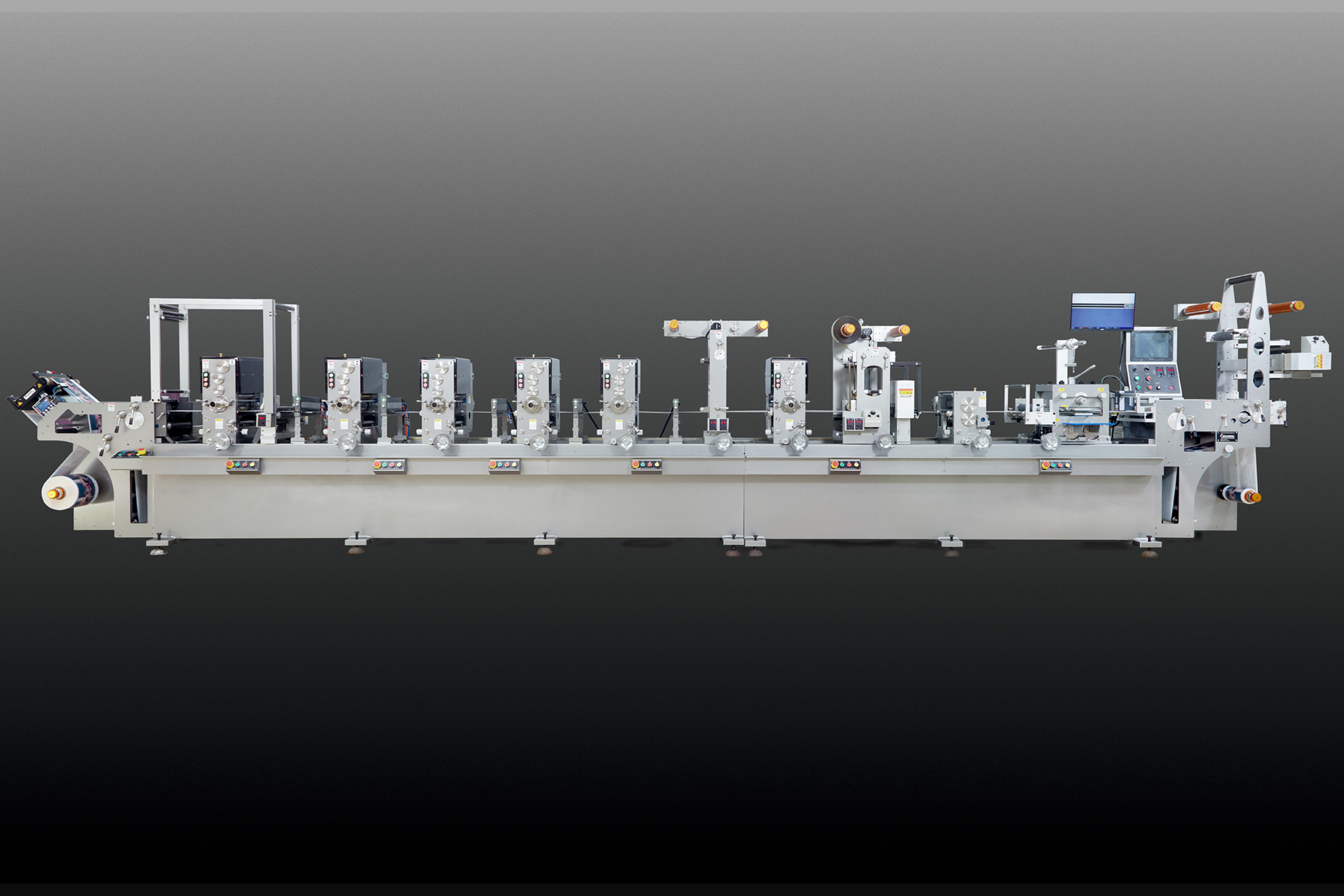
The CS-320-6C semi-rotary label printing machine: 30–320 mm web, 40 m/min maximum speed, and the platform Caisheng documents in flatbed plus rotary die-cutting configurations.
Application scenarios: matching the format to the label
The pairings below follow the format logic above and Caisheng's stated application scope. They are conditional fits, not guarantees, and each should be confirmed on a sample run.
High-volume daily chemical, food and cosmetics labels. Where a small number of shapes runs in long batches, the rotary die-cutting combination group — CS-JQ350-7C, CS-JQ350G-6C, CS-Q370F-6C and the CS-370F-8C full rotation flexo press — is the relevant tier. The CS-JQ350-7C and CS-JQ350G-6C high-speed label printing machine list 60 m/min in intermittent mode and 158 m/min in full-rotary mode, which describes printing capability rather than die-cutting output.
Wine labels and embellishment-heavy cosmetics or pharmaceutical labels. These jobs typically carry more finishing steps, and the CS-300/CS-320 group is where Caisheng documents both die-cutting formats on one machine, alongside glue-side printing, cold foil, lamination and varnishing options. The CS-320-6C semi-rotary label printing machine and CS-320-7C rotary label press run a 30–320 mm web at up to 40 m/min; the CS-300-5C self-adhesive label press and CS-300-6C rotation label machine run a 30–300 mm web at the same speed.
Wristbands, tags and PVC stickers. Short batches, frequent shape changes and heavier stock favour the flatbed end of the range — the CS-220-4C intermittent label press and CS-220-5C stickers printing machine — or a combination machine used in flatbed mode. Caisheng's stated scope covers tags, PVC stickers, wristbands and adhesive labels, which is the relevant check against a specific job.
Converters running mixed order books. When neither shape nor batch size is predictable, the combination group protects the quote book: rotary work stays on the cylinder and short or awkward work goes to the platen without a second setup on another machine.
Fit boundaries and what to verify
The largest gap in the supplied material concerns die-cutting itself. Registration precision is published for the CS-220-4C at ±0.025 mm (company-reported), and print areas and speeds are published across the range, but no die-cutting tolerance, die-cutting speed or waste rate is disclosed. Registration and die-cutting tolerance describe different things: one is the accuracy with which colours are placed on the web, the other is the accuracy with which the outline is cut. Buyers should not substitute one for the other.
Physical scale also deserves attention. The range spans a 6.5 × 1.5 × 1.8 m, 5 t machine in the CS-300-5C to an 8.7 × 1.5 × 1.9 m, 10.8 t machine in the CS-JQ350-7C — a difference produced by the whole configuration rather than by the die-cutting station alone, but one that affects plant layout, floor loading and handling.
Commercial terms are stated plainly: one-unit minimum order quantity, 45–60 day lead time, 100% testing before shipment, remote after-sales support and a one-year warranty on major components.
- A sample run on your own label shape, material and batch size, with the die-cutting station configured as quoted.
- The station list and station sequence of the exact machine, including how many positions remain for embellishment after die-cutting is fitted.
- Die-cutting tolerance and expected waste stated in writing by the supplier for that configuration.
- The tooling interface the die-cutting station accepts, and the cost and lead time for a new tool per repeat.
- Space, floor loading and cooling requirements for the full line, including auxiliary units.
- Destination compliance — CE conformity for the European Union — plus the customs classification applied to the exact machine.
Export-market considerations: Southeast Asia, Europe, the Middle East and the United States
Caisheng reports a 50% export ratio, with Southeast Asia, Europe, the Middle East and the United States as its main markets, and it holds ISO 9001, ISO 14001 and ISO 45001 certification as a certified high-tech enterprise; its products are stated to meet CE standards. For European buyers, CE conformity is the first documentary check on any die-cutting configuration. For customs purposes, flexographic printing machinery is classified under HS code 844316 in the WCO nomenclature; the classification applied to an individual machine and destination should be confirmed rather than assumed.
Two supplied case records are relevant to format selection, with the usual caution that a case record describes one customer's experience. A US customer, RRD (Donnelley & Sons), is recorded with one CS-300 unit in service for three years, with stable registration accuracy, print quality and equipment reliability cited. A Taiwanese trademark design and printing company is recorded with a CS-320 platform machine in service for two years, with printing precision, production stability and flexible process expansion cited. Neither record reports die-cutting metrics, so neither should be read as evidence of die-cutting performance.
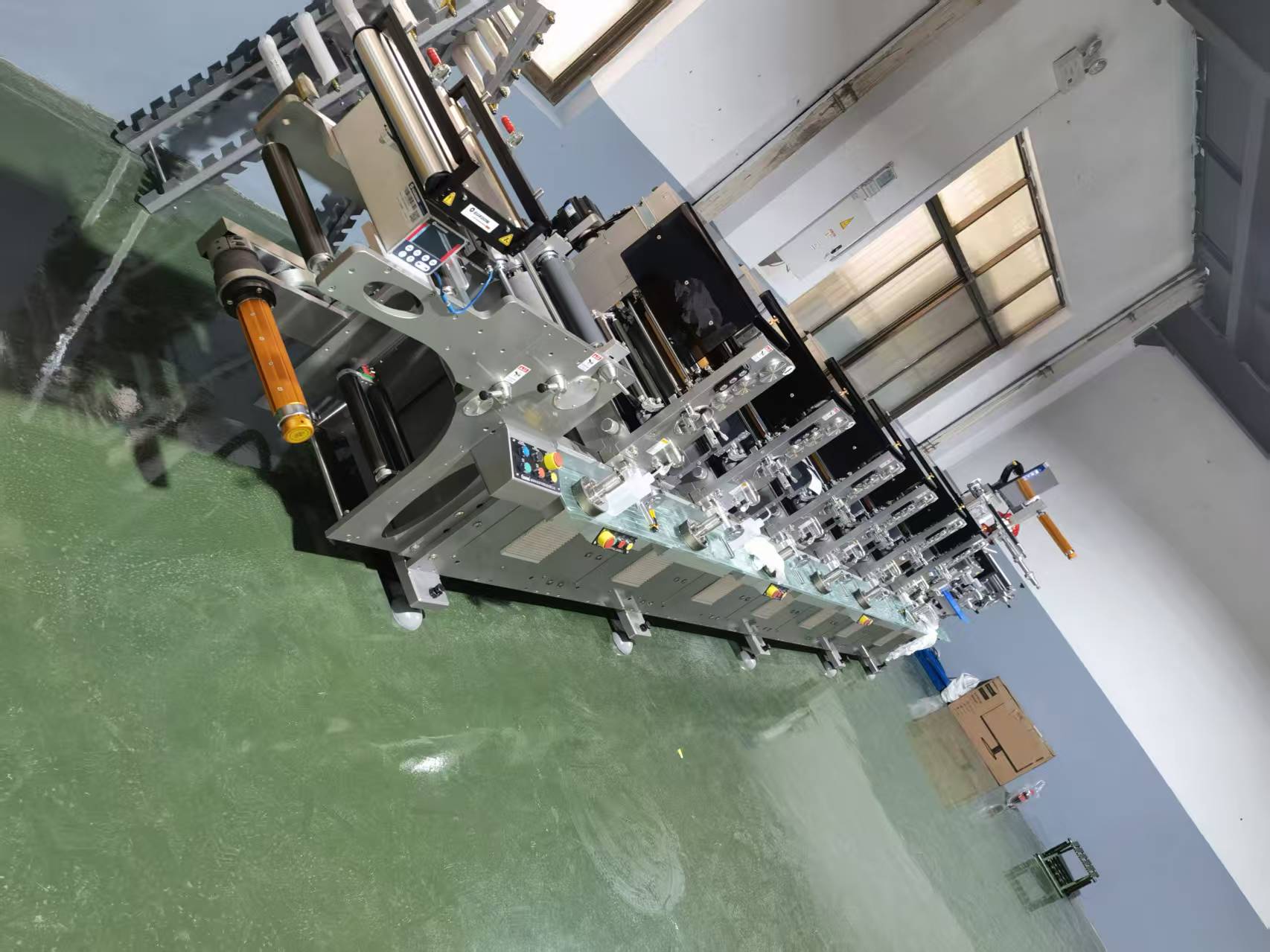
The CS-300 platform, recorded in a supplied case with a US customer and in production for three years.
Lead time matters for planning: at 45–60 days, die-cutting configuration and tooling decisions taken late in a project move the installation date with them.
What label-demand growth does and does not say about die-cutting choice
Market research from Mordor Intelligence puts the global print label market at USD 57.05 billion in 2026 and forecasts USD 67.02 billion by 2031, a CAGR of 3.28%. The scope is printed label output, not label-making machinery, and the two should not be conflated: a growing label market raises the demand base for presses without saying anything about the right die-cutting format for a given converter.
The usable reading is narrow. Growing label output is consistent with a market in which several formats coexist, because different label applications carry different shape, batch and finishing profiles. It does not support a claim that any one format is displacing another.
Outlook
If order books move toward more shapes and more finishing steps per label, the combination tier — CS-300/CS-320 for mid-range widths, CS-350/370/380 for rotary-led lines — becomes the more defensible purchase, because it can absorb change without a second machine. If volume concentrates on a small number of repeats, a rotary-led line stays the more coherent choice and flatbed capacity adds less.
What is unlikely to change is the verification burden. Die-cutting behaviour depends on the die, the material and the press together, and none of the supplied material shortens that test. The buyer who specifies the format first, then the stations, then the print specification is working in the order the equipment is actually built.
Frequently asked questions
Which die-cutting format suits a packaging label job with many shapes in short batches?
Flatbed die-cutting is the closer fit, because the die is flat and tooling changes are comparatively straightforward, so a job that changes shape often does not need a new cylinder tool for every repeat. Caisheng's CS-220 group — the CS-220-4C intermittent label press and CS-220-5C stickers printing machine — is documented with flatbed die-cutting configurations, and the CS-300/CS-320 group can also run flatbed stations as part of a combination build. The fit should still be confirmed on a sample of the actual shape and material.
When is a flatbed-plus-rotary combination justified on one press?
A combination is justified when one line has to cover both long-run standard shapes and shorter or more complex work, and when several finishing steps have to run in the same pass. Caisheng documents the CS-300-6C rotation label machine with glue-side printing, a multi-functional frame, rotary die-cutting, flatbed die-cutting and slitting on one machine. The practical check is whether the quoted station sequence leaves enough positions for the embellishment the job needs.
Do higher speed and a wider print area mean better die-cutting results?
No. Published figures such as 158 m/min full-rotary speed on the CS-JQ350-7C and CS-JQ350G-6C, or 150 m/min on the CS-Q370F-6C, describe printing capability. Die-cutting tolerance, die-cutting speed and waste rate are not disclosed in the supplied Caisheng material, and the ±0.025 mm figure published for the CS-220-4C is registration precision, not die-cutting accuracy. Die-cutting capability has to be confirmed by the supplier for the specific configuration.
Which Caisheng presses are associated with rotary die-cutting combination lines?
The CS-350, CS-370 and CS-380 group: CS-JQ350-7C semi-rotary and full-rotary label press machine, CS-JQ350G-6C high-speed label printing machine, CS-Q370F-6C full rotary flexographic printing machine, CS-J380F-4C and CS-J380F-7C flexographic presses, and the CS-370F-8C full rotation flexo press. Documented print areas run from 350 × 419 mm full-rotary on the CS-JQ350-7C to 370 × 600 mm on the CS-Q370F-6C. Because the CS-350 platform is also shown with flatbed die-cutting, the station list of the individual machine governs.
What should be confirmed before a die-cutting configuration is exported to Europe or the United States?
Four things at minimum: CE conformity for the European Union, given that Caisheng states its products meet CE standards and holds ISO 9001, ISO 14001 and ISO 45001 certification; the customs classification applied to the exact machine, noting that flexographic printing machinery falls under HS 844316 in the WCO nomenclature; the die-cutting tolerance and waste expectation in writing for that configuration; and the delivery plan, since the stated lead time is 45–60 days with 100% testing before shipment and a one-year warranty on major components.
Die-cutting format is one of the few label-press decisions that cannot be added later without changing the line, which is why it belongs at the start of a packaging label specification rather than at the end of a quotation review. The CS-220 group, the CS-300/CS-320 combination group and the CS-350/370/380 rotary combination group describe three different answers to three different order books. Matching the answer to the book — and testing it on real labels — is the part of procurement that survives contact with production.
Company details, model listings and station options are published by Shenzhen Caisheng Printing Machinery Co., Ltd., and the company brochure covering the current machine range can be downloaded here.
Tem questões ou precisa de mais detalhes?
Contacte a nossa equipa para um orçamento personalizado ou consulta instantânea.
Solicitar orçamento
Preencha o formulário abaixo e a nossa equipa entrará em contacto com uma proposta personalizada.
Chat direto do WhatsApp
Prefere conversar em tempo real? Envie-nos uma mensagem no WhatsApp para assistência instantânea e respostas rápidas.
- Obter orçamento personalizado
- Partilhar fotos ou documentos
- Discuta as suas necessidades diretamente
Geralmente responde em 5–30 minutos durante o horário de expediente.