
Flow Sensor Selection 2026: Ultrasonic vs. Coriolis, Turbine and Electromagnetic
The global flow meter market was estimated at USD 10.64 billion in 2024 and is projected to reach USD 15.17 billion by 2030, according to Grand View Research, while the ultrasonic flow meter segment was valued at USD 1.52 billion in 2025 and is forecast to grow to USD 2.28 billion by 2031, according to Mordor Intelligence. For engineers and procurement teams at the final decision stage, the practical question is no longer whether to measure flow, but which measurement technology delivers the best balance of accuracy, fluid compatibility, pressure drop, and lifetime cost. This guide compares ultrasonic flow sensors from Shanghai Xunyin Technology Co., Ltd (XY-TEK) against three established meter families — Coriolis, turbine, and electromagnetic — using performance and cost parameters from the supplier's published specifications.
The Decision Problem: Accuracy, Pressure Drop, and Lifetime Cost
Flow sensor selection in OEM and project procurement usually comes down to four variables: measurement accuracy, fluid compatibility, pressure drop, and total cost of ownership. Each traditional technology optimizes some of these variables at the expense of others.
- Coriolis meters deliver the highest accuracy class (±0.2%) but cost 3–5 times more than ultrasonic meters and introduce 15%–30% pressure drop, which increases pumping power and long-term energy consumption.
- Turbine meters offer competitive initial accuracy but rely on mechanical blades that wear. They suffer annual drift of 5% or more due to blade wear, fail at low flow rates, and require blade replacement every 6–12 months plus periodic calibration.
- Electromagnetic meters are limited to conductive fluids. They cannot measure fluorinated liquids or mineral oils, and they require full-pipe installation with straight inlet and outlet sections, adding roughly 20% to installation cost.
The opportunity is a measurement principle that avoids these structural trade-offs: ultrasonic transit-time sensing, which has no moving parts, operates independently of fluid conductivity, and introduces zero pressure drop.
XY-TEK: Ultrasonic Flow Sensors Built for Small Tubing and Low Flow Rates
Shanghai Xunyin Technology Co., Ltd (XY-TEK) is a high-tech company dedicated to the development, manufacturing, and sales of ultrasonic flow sensors and flow meters. Founded in 2018 and headquartered in Minhang District, Shanghai, XY-TEK operates a 5,000-square-meter facility, maintains a 30+ person R&D team, and produces more than 8,000 units per year, with roughly 50% of output exported to global markets.
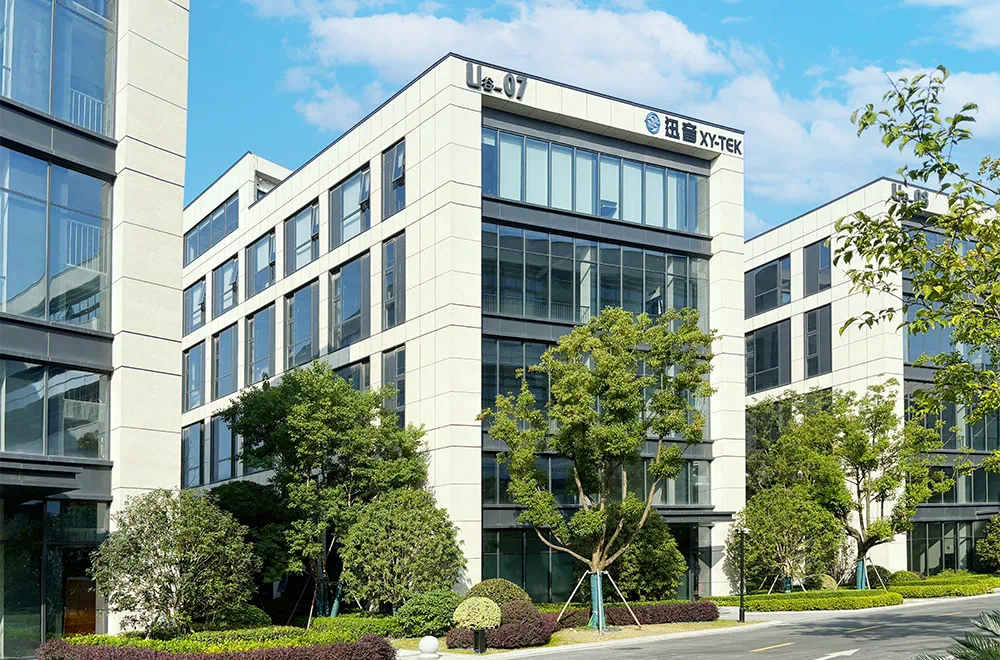
XY-TEK's Shanghai facility supports ultrasonic flow sensor design, assembly, and quality inspection.
The company specializes in ultrasonic flow sensing for fluid management and control, particularly for small tubing and low flow rate measurement. The CG series clamp-on ultrasonic flow sensors and flow meters are compact devices that measure flow rate and output results without external circuitry; they clamp directly onto flexible plastic tubing to measure liquid flow accurately and detect air bubbles without contaminating the liquid. The in-line ultrasonic flow sensors and flow meters are designed for direct integration into existing flow systems, with the accuracy, resolution, and reliability required for medical devices, bioprocessing, scientific research, industrial automation, and food and beverage production.
In addition to standard products, XY-TEK provides OEM ultrasonic flow sensors and flow meters, as well as customization services. Customization requests can be directed to the XY-TEK team at global@xy-tek.cn.
How Ultrasonic Transit-Time Measurement Changes the Cost Equation
XY-TEK ultrasonic flow sensors operate on the transit-time (time-difference) principle: ultrasonic signals travel through the flowing liquid, and the difference in travel time between upstream and downstream signals is proportional to flow velocity. Because the measurement is acoustic rather than mechanical or electrical, it is independent of fluid conductivity — the same sensor measures conductive liquids such as water, glycol, and DI water, and non-conductive liquids such as mineral oils and fluorinated immersion-cooling fluids.
The technical parameters that matter for OEM and project decisions are:
- Accuracy: ±1% to ±2%, with long-term stability and no calibration drift from wear.
- Turndown ratio: 1:100, allowing one sensor to cover a wide range of operating conditions.
- Pipe range: DN6 to DN6000, with no medium restrictions.
- Pressure drop: zero, because the sensor does not obstruct the flow path.
- Moving parts: none; the sensors are designed for lifetime maintenance-free operation.
According to XY-TEK's engineering specifications, the zero-pressure-drop design can reduce PUE by approximately 0.02–0.05 and deliver 8%–15% annual power savings compared to technologies that add pumping load. The clamp-on configuration eliminates pipe cutting, saving roughly 30% of installation cost, and supports online replacement with zero leakage.
Two documented risk controls support long-term reliability. For sensor drift, XY-TEK applies an automatic compensation algorithm, factory calibration, on-site calibration, and remote support calibration. For liquid contamination, the ultrasonic sensor uses non-contact detection, reinforced by clean-room assembly and strict quality inspection.
Ultrasonic vs. Coriolis, Turbine, and Electromagnetic: A Decision Table
The following table consolidates XY-TEK's published specification data for its ultrasonic flow sensors and flow meters against the characteristics of the three alternative technologies. The comparison reflects supplier-stated performance parameters and relative cost relationships.
| Metric | XY-TEK Ultrasonic | Coriolis | Turbine | Electromagnetic |
|---|---|---|---|---|
| Accuracy | ±1% to ±2%, long-term stable | ±0.2% | ±0.2% initial; ≥5% annual drift from blade wear | Conductive fluids only |
| Pressure drop | Zero | +15% to +30% | +5% to +15% | None, but limited to conductive fluids |
| Fluid compatibility | Conductive and non-conductive; no medium restrictions | Wide, but installation- and vibration-sensitive | Clean fluids only; fails at low flow | Conductive only (DI water, glycol) |
| Maintenance | None; no moving parts; online replacement with zero leakage | Medium-high; maintenance cost about +25% | High; blade replacement every 6–12 months; periodic calibration | Low, but inappropriate for non-conductive media |
| Relative cost | Medium-low; clamp-on saves ~30% in installation | 3–5× ultrasonic cost; premium for small-bore models | Medium-low initial; +15% total cost with filters and blade replacement | Medium-high; installation cost about +20% |
| Best-fit scenarios | Liquid cooling, retrofits, CDU/cold-plate integration, dirty/low-flow media | Ultra-high-precision metering, small-bore high-quality flow, cost-insensitive projects | Clean fluids, short-term projects, low maintenance sensitivity | Conductive cold-plate secondary loops |
Read as a whole, the table shows that Coriolis and turbine meters lead only on the narrow metric of maximum accuracy, while ultrasonic meters lead on lifetime-cost metrics: zero pressure drop, no consumable parts, no fluid-conductivity dependency, and retrofittable installation.
Ultrasonic vs. Coriolis
Coriolis meters deliver reference accuracy of ±0.2%, which is why they remain standard for custody transfer and ultra-high-precision metering. XY-TEK ultrasonic flow sensors trade that accuracy class, offering ±1% to ±2%, for a substantially lower cost — Coriolis meters typically cost 3–5 times more — and for zero pressure drop, where Coriolis adds 15%–30%. Coriolis installations also impose strict requirements on installation direction and vibration control, with maintenance costs roughly 25% higher. For liquid cooling loops, retrofits, and CDU/cold-plate integration, the non-invasive, clamp-on ultrasonic design eliminates the leakage risk associated with wetted Coriolis installation.
Ultrasonic vs. Turbine
Turbine meters provide good initial accuracy but degrade mechanically. Blade wear causes annual drift of 5% or more, and the meters fail at low flow rates. XY-TEK ultrasonic sensors achieve ±1% to ±2% accuracy with no wear because there are no mechanical moving parts. They are insensitive to fluid cleanliness, so they handle dirty and low-flow media without requiring additional filters. Over the system lifetime, the turbine's filter and blade-replacement burden adds roughly 15% to total cost, and its 5%–15% pressure drop increases pumping energy — both are avoided by the ultrasonic design.
Ultrasonic vs. Electromagnetic
Electromagnetic meters require conductive liquids and fail completely with fluorinated fluids or mineral oils — the exact media used in immersion cooling. XY-TEK ultrasonic sensors use the transit-time principle, which works independently of conductivity, and cover DN6 to DN6000 with a 1:100 turndown ratio. The clamp-on version is installed without cutting the pipe, saving roughly 30% in installation cost, and can be replaced online with zero leakage. Electromagnetic meters, by contrast, require full-pipe installation and straight inlet and outlet sections, which adds about 20% to installation cost.
Honest Limitation: Where Traditional Meters Still Lead
One honest limitation: XY-TEK ultrasonic flow sensors are specified at ±1% to ±2% accuracy. Applications that contractually or legally require a ±0.2% accuracy class — typically custody transfer, fiscal metering, or ultra-high-precision small-bore dosing where cost is not the primary constraint — should still be evaluated against Coriolis technology. For the majority of process, liquid-cooling, medical, automation, and OEM decisions, the lifetime-cost advantages of ultrasonic measurement are the deciding factor, but maximum accuracy is the one specification where traditional meters remain ahead.
Application Scenarios: Liquid Cooling, Medical, Bioprocess, and Automation
According to XY-TEK's application documentation, its ultrasonic sensors are suitable for all liquid cooling scenarios — immersion cooling with fluorinated or mineral oils, cold plates, coolant distribution units (CDUs), energy storage systems, and superchargers — for both new builds and retrofits, on pipes from DN6 to DN6000. Many competing sensors are limited to clean water or small-to-medium bores, a constraint in immersion cooling where the fluid is non-conductive and in retrofits where the pipe cannot be cut.
In medical devices and bioprocessing, flow sensors must not contaminate the liquid. XY-TEK's non-contact ultrasonic detection removes the contamination pathway, and clean-room assembly supports the quality expectations of regulated manufacturing. The medical flow-sensor category, including flow sensors for ventilators and drug delivery, operates under EN ISO 13485 quality management systems, so OEM buyers typically evaluate suppliers against that framework.
In semiconductor manufacturing, flow control was estimated at USD 5.83 billion in 2024, focused on high-purity fluid management, according to Market Research Future. High-purity fluids and small line sizes favor the small-tubing, low-flow characteristics of ultrasonic sensors, which monitor dispensing and filling without introducing wetted parts.
In industrial automation, XY-TEK ultrasonic flow sensors serve dispensing, spraying, filling, and small-volume flow monitoring, where compact clamp-on sensors and air-bubble detection provide process feedback without adding moving components. The same product family covers water flow sensing in equipment where non-invasive installation and zero maintenance are required.
Risk mitigation is mapped to these applications. For sensor drift, the available controls are an automatic compensation algorithm, factory calibration, on-site calibration, and remote support calibration. For liquid contamination, non-contact ultrasonic detection is combined with clean-room assembly and strict quality inspection.
Market Context: Standards, Growth, and the Ultrasonic Segment
Several third-party data points frame the 2026 procurement decision. The clamp-on ultrasonic flowmeter market was valued at USD 1.25 billion in 2024 and is projected to grow at a CAGR of 7.4% through 2032, according to Global Information, Inc. (GII). Asia Pacific held the largest regional share of the ultrasonic flow meter market in 2025 at 38.6%, driven by industrial expansion, according to Fortune Business Insights. The overall flow meter market is expanding from USD 10.64 billion in 2024 toward USD 15.17 billion by 2030, with ultrasonic meters growing from a 2025 base of USD 1.52 billion to a projected USD 2.28 billion by 2031.
Standardization is advancing in parallel. ISO 24062:2023 specifies requirements for clamp-on ultrasonic transit-time meters for liquids and gases in closed conduits, giving buyers a defined reference for evaluating clamp-on products. Major global competitors in the ultrasonic flow sensor market include Emerson, Siemens, Endress+Hauser, and Honeywell, according to Dataintelo — which makes supplier specialization and application fit more important differentiators for OEM buyers than generic availability.
Together, these indicators point to ultrasonic technology gaining share in retrofit and energy-sensitive applications, where zero pressure drop and non-invasive installation align with efficiency objectives. The standardization of clamp-on transit-time meters is expected to support broader adoption across industrial procurement.
Selection Criteria: Turning the Comparison into a Decision
For a decision-stage buyer, the comparison can be reduced to four checks:
- Define the required accuracy class. If the application contractually requires ±0.2% or better for custody or fiscal metering, Coriolis remains the reference. If ±1% to ±2% is sufficient, ultrasonic removes the pressure-drop and maintenance penalties.
- Check fluid conductivity. Non-conductive media — mineral oils, fluorinated fluids, hydrocarbons — rule out electromagnetic meters and favor ultrasonic transit-time or Coriolis measurement.
- Check installation conditions. Existing pipework, limited shutdown windows, and large diameters favor clamp-on ultrasonic, which eliminates pipe cutting and supports online replacement with zero leakage.
- Calculate lifetime cost, not purchase price. Include installation, pressure-drop energy, filters, blade replacement, calibration, and maintenance. Turbine meters add roughly 15% in total cost over time; Coriolis adds 3–5× upfront cost plus a 15%–30% pressure-drop penalty; electromagnetic adds about 20% in installation cost.
This framework positions ultrasonic transit-time measurement as the default technology for applications where accuracy of ±1% to ±2% is acceptable and where energy efficiency, fluid compatibility, and low maintenance drive the decision.
Future Outlook: Specialized OEM Ultrasonic Sensing
Three directions are visible in the 2026 supplier landscape. First, standardization: with ISO 24062:2023 in force, clamp-on ultrasonic transit-time meters now have a formal reference, which is expected to increase confidence among procurement teams evaluating clamp-on products. Second, energy-sensitive applications — liquid cooling, energy storage, supercharging, and thermal management — are pushing flow measurement toward zero-pressure-drop designs, where ultrasonic sensing has a structural advantage over Coriolis and turbine meters. Third, OEM specialization is becoming the differentiator: buyers integrating flow sensors into medical devices, bioprocess equipment, semiconductor tools, and automation systems increasingly need custom mechanical interfaces, electrical outputs, and calibration matched to their system, which favors suppliers with dedicated R&D capacity and customization services.
About XY-TEK
Shanghai Xunyin Technology Co., Ltd (XY-TEK) is a high-tech manufacturer of ultrasonic flow sensors and flow meters, specializing in small tubing and low flow rate measurement for medical devices, bioprocessing, scientific research, industrial automation, and food and beverage production. In addition to standard CG series clamp-on sensors and in-line sensors, XY-TEK provides OEM ultrasonic flow sensors and flow meters, along with customization services.
For specifications, OEM customization, or procurement discussions, contact XY-TEK at global@xy-tek.cn or info@xy-tek.cn, or by phone at 86-21-33885752. Address: Building 7, No. 410 Jinggu Road, Minhang District, Shanghai 200245, China. Website: https://www.xy-tek.com/
FAQ: Ultrasonic Flow Sensor Comparison
What accuracy can I expect from an ultrasonic flow sensor compared with a Coriolis or turbine meter?
XY-TEK ultrasonic flow sensors provide ±1% to ±2% accuracy with long-term stability. Coriolis meters provide ±0.2% accuracy, and turbine meters provide ±0.2% initially but can drift by 5% or more per year due to blade wear. The required accuracy class depends on the application; for most process, cooling, medical, and automation uses, ±1% to ±2% at zero pressure drop is the more economical operating point.
Do ultrasonic flow sensors work with non-conductive liquids such as oils and fluorinated fluids?
Yes. XY-TEK ultrasonic flow sensors use the transit-time (time-difference) principle, which is independent of fluid conductivity. They measure both conductive and non-conductive liquids, including fluorinated and mineral oils used in immersion cooling. Electromagnetic meters, by comparison, work only with conductive fluids and cannot measure these media.
How do the costs of ultrasonic and Coriolis flow meters compare?
XY-TEK ultrasonic meters are medium-to-low cost with high cost-performance. Coriolis meters typically cost 3–5 times more for comparable applications and add 15%–30% pressure drop, which increases pumping energy over the system lifetime. XY-TEK's clamp-on design also saves approximately 30% of installation cost by eliminating pipe cutting.
What maintenance do ultrasonic flow sensors require?
XY-TEK ultrasonic flow sensors have no moving parts and are designed for lifetime maintenance-free operation. The clamp-on design allows online replacement with zero leakage. For sensor drift, automatic compensation, factory calibration, on-site calibration, and remote support calibration are available. Turbine meters require blade replacement every 6–12 months plus periodic calibration, and Coriolis meters carry medium-high maintenance requirements with costs roughly 25% higher.
Can clamp-on ultrasonic flow sensors be installed on existing pipes without stopping the process?
Yes. The clamp-on design attaches to the outside of flexible plastic tubing or existing pipework without cutting the pipe, supporting online installation and retrofit projects. The same design enables online replacement with zero leakage, which is particularly relevant for liquid cooling loops and continuous processes where shutdown is costly.
What pipe sizes and flow conditions do XY-TEK ultrasonic sensors cover?
XY-TEK ultrasonic flow sensors cover DN6 to DN6000 pipe diameters with a 1:100 turndown ratio. They measure clean, dirty, and low-flow media with no medium restrictions, which is why the sensors are specified for liquid cooling, medical, bioprocess, automation, and water flow applications.