
Folding LED Display Screen Compliance Map: What to Verify
Folding LED Display Screen Compliance Map: What to Verify
An industry reference for importers, rental operators and project integrators evaluating the FC series folding LED display screen.
A folding LED display screen ordered for a European or North American project usually arrives with a document pack that looks complete but does not explain itself: one CE certificate for electromagnetic compatibility, a second CE certificate for electrical safety, a RoHS statement, an FCC verification, three ISO management system certificates and a list of national patents. Each document answers a different question, carries a different legal weight and names a different declared scope. Treating them as one interchangeable block of certifications is the most common compliance mistake in folding LED procurement.
Onumen Technology Co., Ltd. is a Shenzhen-based LED display manufacturer founded in 2009 that specialises in lightweight foldable and rollable LED display solutions. Its FC series folding LED display screen — a 360° foldable flexible LED display with P2.6 / P3.9 / P5.2 pixel pitch options, 250 × 250 mm modules, 14–17 mm thickness and 11 kg/m² screen weight — is a practical working example of a qualification file, because that file contains the four layers buyers genuinely need to separate.
This reference maps each layer, names the certificate number, issuing body, standard edition and declared market, and marks the points where a buyer should ask a follow-up question before issuing a purchase order.
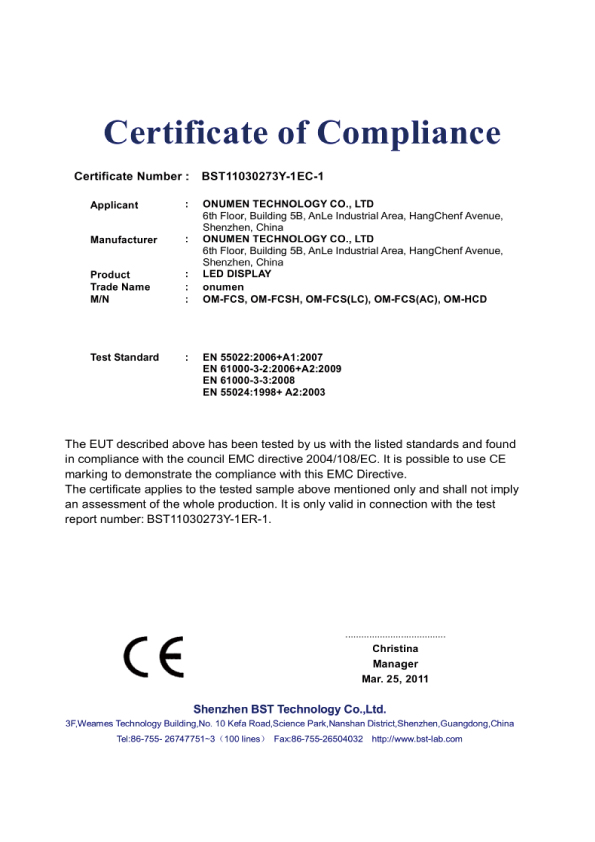
CE EMC Certificate of Compliance recorded for the folding LED display range (certificate BST11030273Y-1EC-1, issued by Shenzhen BST Technology Co., Ltd.).
The four layers of a folding LED display qualification file
Only the first layer determines whether a folding LED display screen may be placed on a market. The remaining three support procurement confidence, but each answers a different question.
- Product compliance. CE EMC, CE LVD, RoHS and FCC. These are the records that support EU and US market placement, and they are attached to specific product designations.
- Management system certification. ISO 9001:2015, ISO 14001:2015 and ISO 45001:2018. These describe how the manufacturing organisation is managed, not how an individual panel performs.
- Model-bound mandatory certification. China Compulsory Certification (CCC) for the OM-F model. This is tied to the model named on the certificate.
- Intellectual property. Patents such as US 8,899,791 B2 and EP2755459. Patents protect technology ownership; they are not conformity evidence.
A fifth category — design awards — is often filed beside these four and should be kept in a separate folder. The awards section below explains why.
| Layer | Certificate / record | Issuing body | Standards referenced | Declared market |
|---|---|---|---|---|
| CE EMC | BST11030273Y-1EC-1 | Shenzhen BST Technology Co., Ltd. | EN 55022:2006+A1:2007; EN 61000-3-2:2006+A2:2009; EN 61000-3-3:2008; EN 55024:1998+A2:2003 | EU (declared scope: OM-FCS, OM-FCSH, OM-FCS(LC), OM-FCS(AC), OM-HCD) |
| CE EMC | AE 50336727 0001 | TÜV Rheinland | EN 55022:2010; EN 55024:2010; EN 61000-3-2:2014; EN 61000-3-3:2013 | EU (Smart folding LED Display screen / FC series) |
| CE LVD | BST13030465Y-1SC-2 | Shenzhen BST Technology Co., Ltd. | EN 60950-1:2006+A11:2009+A1:2010+A12:2011 | EU |
| RoHS | BST13030465Y-1RC-4 | Shenzhen BST Technology Co., Ltd. | RoHS Directive 2011/65/EU; IEC 62321:2008 | EU |
| FCC | BST13030465Y-1EC-3 | Shenzhen BST Technology Co., Ltd. | FCC Part 15 Subpart B; ANSI C63.4 | United States |
| ISO 9001:2015 | 95722Q0036R0S | Boston Certification | ISO 9001:2015 | Global |
| ISO 14001:2015 | 95722E0015R0S | Boston Certification | ISO 14001:2015 | Global |
| ISO 45001:2018 | 95722S0012R0S | Boston Certification | ISO 45001:2018 | Global |
| CCC | 2021200903000314 | CEPREI | GB4943.1-2011; GB/T9254-2008 (Class A); GB17625.1-2012 | China (model OM-F) |
| Patent | US 8,899,791 B2 | USPTO | Freely-foldable flexible LED screen | United States and global |
| Patent | EP2755459 / DE602013014598.9 | EPO / DPMA | Freely-foldable flexible LED screen | European Union |
Qualification map for the Onumen folding LED display range. Design awards are excluded from this table deliberately and are listed separately below.
CE is two certificates, not one
A CE mark on a folding LED display screen represents conformity with more than one EU directive at the same time. In practice, buyers are shown two separate technical records, and they should be read separately because they address different risks: electromagnetic compatibility (EMC) and low-voltage electrical safety (LVD).
CE EMC — electromagnetic compatibility
The CE EMC record for the folding LED display range carries certificate number BST11030273Y-1EC-1 from Shenzhen BST Technology Co., Ltd. It references EN 55022:2006+A1:2007, EN 61000-3-2:2006+A2:2009, EN 61000-3-3:2008 and EN 55024:1998+A2:2003, and its declared scope lists the model codes OM-FCS, OM-FCSH, OM-FCS(LC), OM-FCS(AC) and OM-HCD.
A second, later CE record for the Smart folding LED Display screen (FC series) was issued by TÜV Rheinland under certificate number AE 50336727 0001. It references EN 55022:2010, EN 55024:2010, EN 61000-3-2:2014 and EN 61000-3-3:2013 for the European Union market. A related TÜV Rheinland record, AE 50336726 0001, covers the Magic Plus product against EN 55022:2010.
CE LVD — low-voltage safety
The CE LVD record carries certificate number BST13030465Y-1SC-2, issued by Shenzhen BST Technology Co., Ltd. for the EU market, and references EN 60950-1:2006+A11:2009+A1:2010+A12:2011. This is the record that speaks to electrical safety of the screen and its power architecture, not to radio interference.
RoHS — Directive 2011/65/EU
The RoHS record for the folding LED display screen is certificate BST13030465Y-1RC-4, issued by Shenzhen BST Technology Co., Ltd. for the European Union market. It references RoHS Directive 2011/65/EU (which superseded Directive 2002/95/EC) and the test method IEC 62321:2008, and its declared scope is recorded as LED Display. Within the same compliance file, the RoHS coverage is associated with the Smart folding LED Display screen (FC series) and the Smart Plus product (model FCSL).
RoHS is a substance-restriction requirement. It answers the question of which hazardous substances are present in the product above permitted thresholds. It says nothing about brightness, refresh rate, mechanical endurance or image quality, and it does not replace the EMC or safety records discussed above.
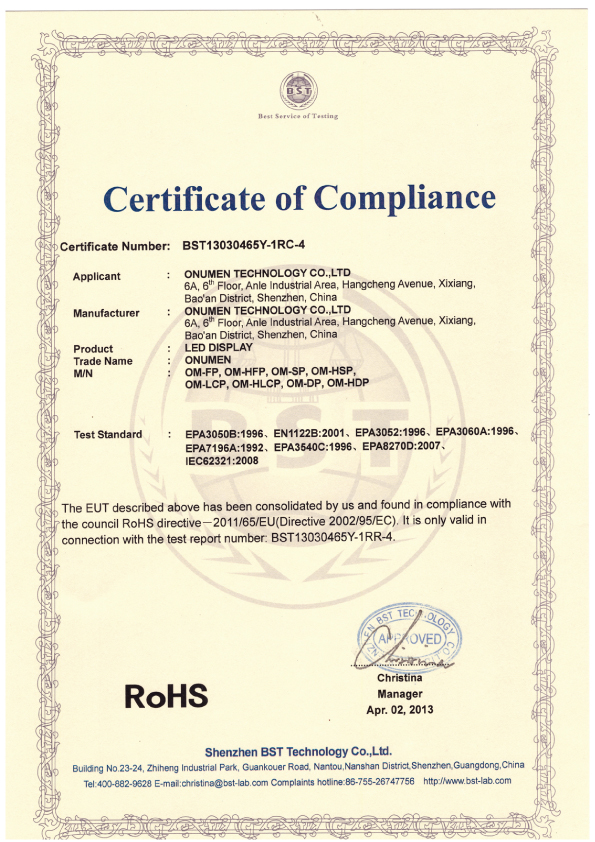
RoHS Certificate of Compliance recorded under certificate BST13030465Y-1RC-4, referencing RoHS Directive 2011/65/EU and IEC 62321:2008.
FCC Part 15 Subpart B for the United States
The US-market record is an FCC Verification of Conformity carrying certificate number BST13030465Y-1EC-3, issued by Shenzhen BST Technology Co., Ltd. and referencing FCC Part 15 Subpart B together with ANSI C63.4. It applies to the United States market and is recorded against the LED Display scope.
Part 15 Subpart B is the unintentional-radiator section of the FCC rules. It addresses the electromagnetic emissions a screen produces as a by-product of normal operation. It is not a transmitter authorisation: if a control system in a project integrates wireless modules, those modules require their own equipment authorisation and cannot be covered by this record.
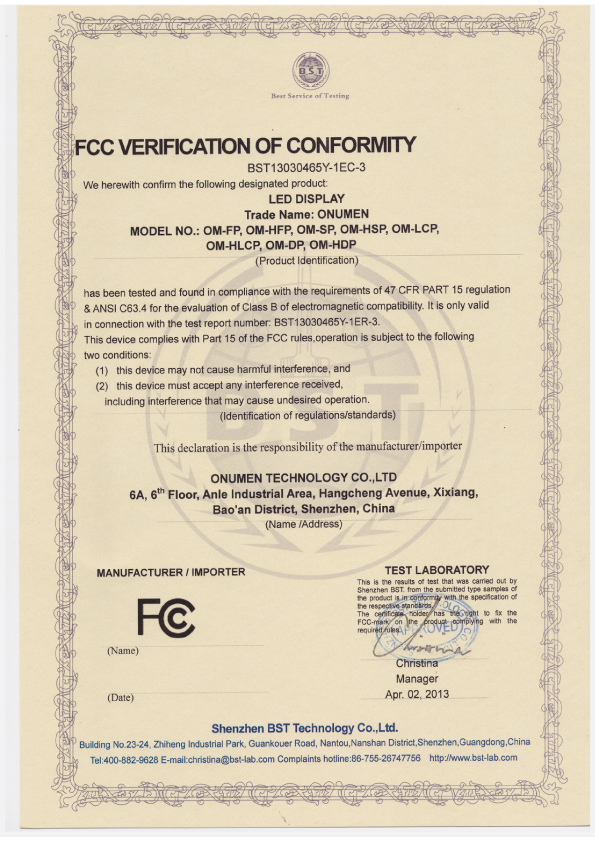
FCC Verification of Conformity recorded under certificate BST13030465Y-1EC-3 for FCC Part 15 Subpart B and ANSI C63.4.
ISO 9001:2015, ISO 14001:2015 and ISO 45001:2018 — what they actually cover
The FC series folding LED display is recorded as certified to ISO 9001:2015 under certificate 95722Q0036R0S, ISO 14001:2015 under certificate 95722E0015R0S, and ISO 45001:2018 under certificate 95722S0012R0S. All three were issued by Boston Certification and apply to the global market. The recorded scope of the ISO 9001 certificate is the research, development, manufacturing and sales of LED displays.
The distinction matters in evaluation. ISO 9001 addresses quality management processes; ISO 14001 addresses environmental management; ISO 45001 addresses occupational health and safety management. None of the three certifies the electromagnetic compatibility, low-voltage safety, or substance content of an individual folding LED display screen. A supplier with all three can still present a product certificate that names a different model, and a supplier with none of them can still hold valid product conformity records. Buyers should therefore read them as two independent signals, not one.
CCC for the OM-F model in China
China Compulsory Certification is model-bound. The record in this file — certificate number 2021200903000314, issued by CEPREI — names the LED Foldable Display, model OM-F. It references GB4943.1-2011, GB/T9254-2008 (Class A) and GB17625.1-2012, and is valid for the China market.
The practical consequence for procurement is straightforward: a buyer in China should confirm whether the model being purchased is OM-F or another model in the folding range, and should request a certificate that names the purchased model. A CCC certificate for one model designation is not automatically a certificate for a different designation within the same product family.
Patents — US 8,899,791 B2 and EP2755459
The FC series folding LED display screen is protected by US Patent 8,899,791 B2, issued by the United States Patent and Trademark Office, covering the freely-foldable flexible LED screen. The patent applies to the United States and global markets and covers the Smart folding LED Display screen (model FC) together with the Smart T Plus foldable transparent LED display.
In Europe, European Patent EP2755459 was granted by the European Patent Office and is registered in Germany as DE602013014598.9. It is validated in Belgium, Italy and the Netherlands, with national registrations recorded as valid into 2028, and it covers both the FC series and the Magic Plus (FPS series) flexible LED display.
Additional jurisdictions recorded in the portfolio include Chinese invention patents ZL201010180375.2 (covering the FC series) and ZL202310190465.7 (covering rollable LED screen and roll-up LED display technology), Japanese patents JP 5889442 and JP 7852969 plus utility model JP 3199881, Korean patent KR 10-1692125, Taiwanese patents TW I560662 and TW I560663, Singapore patent SG 2014014856, Canadian patent CA 2,855,934, Australian patent AU 2013317305, South African patent ZA 2014/05969, Mexican patent MX 349091 and Hong Kong Standard Patent HK1195436.
Patents prove ownership of a technology in a given jurisdiction. They do not authorise market placement, they do not demonstrate conformity with any standard, and they do not certify product performance. Onumen states in its published profile that it holds more than 110 global invention patents and has completed over 1,000 LED display projects; the specific patent numbers published above are the concrete part of that claim that a buyer can check directly against national registers.
Awards are not compliance
The FC series folding LED display holds recognition from three design programmes: Red Dot Winner 2024 (certificate Red 8972), French Design Award 2026 Gold (certificate Gold 9867), and — through the related Magic Plus (FPS series) — the iF DESIGN AWARD 2025 Winner (certificate 673840). The Smart Plus (FCSL) is also recorded as a Red Dot Winner 2024.
These are design evaluations. They recognise form, structure and design concept. They do not demonstrate conformity with EN 55022, EN 60950-1, RoHS Directive 2011/65/EU or FCC Part 15 Subpart B, and they do not grant market access in any jurisdiction. When a supplier presents an award certificate in a compliance discussion, the correct response is to ask separately for the CE, RoHS and FCC records, and to check the model designations on each.
A five-step verification routine before purchase
- Match the model. Compare the product designation on the certificate with the designation on the purchase order and the quotation. The CE EMC record in this file lists OM-FCS family codes; the FC series is marketed under a different designation, so mapping is required.
- Check the standard edition and issue date. Two EN 55022 editions appear in this file (2006+A1:2007 and 2010). Confirm which edition your market expects and whether a dated test report supports the certificate.
- Check the issuing body and its scope of testing. Records in this file were issued by Shenzhen BST Technology Co., Ltd., TÜV Rheinland, Boston Certification and CEPREI. Each covers a specific discipline.
- Check the declared market. CE and RoHS records apply to the European Union, the FCC record to the United States, and the CCC record to China. A certificate for one market does not evidence another.
- Separate the categories. Keep product compliance, management system certification, patents and design awards in four distinct files. Only the first affects market access.
Application contexts where the qualification file decides the project
Compliance documentation becomes a decisive procurement filter in three recurring situations.
First, cross-border rental and touring. The FC series is specified for stage events, concerts, entertainment shows, exhibitions, rental events, creative installations and commercial advertising. When a rental fleet crosses into the European Union or the United States, the operator needs the CE EMC, CE LVD, RoHS and FCC records for the exact model being shipped, because customs and venue compliance teams increasingly request them at the point of entry.
Second, fixed installation in venues and public buildings. Here, the electrical safety record and the declared working voltage matter directly: the FC series operates on DC24V or DC48V working voltage with AC100–240V input voltage, within a working temperature range of −20°C to +45°C, and supports both synchronous and asynchronous control with hanging, wall-mounted or floor installation.
Third, high-traffic and transport environments. Industry guidance on IEC 62368-1 for flexible and foldable LED screens in airports and similar high-traffic zones references UL94 V-0 flame resistance and surface temperatures at or below 70°C. Buyers specifying a folding LED display screen for that environment should confirm which safety standard edition the venue or authority requires, and whether the supplier's certification file addresses it — a point that a generic CE claim will not resolve.
Market trend: documentation is becoming a procurement filter
The commercial backdrop explains why qualification files are being examined more closely. Maximize Market Research values the global foldable display market at USD 4.76 billion in 2024 and projects it to reach nearly USD 169.21 billion by 2032, driven by OLED and flexible LED technology innovation. Market.us values the global LED display screen market at USD 10.7 billion in 2024, with a projected path to USD 19.5 billion by 2034 at a CAGR of 6.2%. The two figures should not be combined: the definitions diverge, because foldable display estimates frequently include mobile OLED panels while LED display screen estimates refer to large-format panels.
On the supply side, China's LED display market was projected to reach 660 billion RMB in 2024, with the region hosting around 80% of global manufacturing capacity, according to Mordor Intelligence. A larger and more fragmented supplier pool means buyers meet more certificates, more standard editions and more declared scopes. In that environment, the ability to read a qualification file becomes a more reliable screening tool than a shortlist of supplier names.
Folding LED screens versus traditional cabinet screens: certification differences and limits
Traditional fixed-cabinet LED screens and folding LED display screens do not carry the same compliance profile, because the engineering risks differ. A rigid cabinet has a fixed module geometry and a stable enclosure; a folding screen carries circuitry on a flexible PCB inside a structure designed to be folded repeatedly and transported.
| Dimension | Traditional fixed-cabinet LED screen | Folding LED display screen (FC series) |
|---|---|---|
| Structure | Rigid cabinet with fixed flat modules | 360° foldable flexible structure, 250 × 250 mm modules, 14–17 mm thickness, 11 kg/m² |
| Certification emphasis | Enclosure, power supply and EMC characteristics of a static assembly | EMC and low-voltage safety across a flexible, frequently moved assembly |
| Protection rating | Model dependent | IP43, indoor and semi-outdoor application environment |
| Brightness | Model dependent | 1000–1500 nits |
| Certificate scope risk | Scope generally matches one cabinet family | Scope may list family codes that must be mapped to the purchased model designation |
| Documentation that compliance does not cover | Long-term outdoor environmental performance | Mechanical folding endurance and permanent outdoor exposure |
The limitation buyers must plan around. The FC series is specified with an IP43 protection rating and an indoor / semi-outdoor application environment. No certificate changes that boundary. A project requiring permanent outdoor exposure needs a model specified at a higher rating — for example Smart Plus (FCSL) with IP65 front and rear and optional IP68, or Magic Plus (FPS) with IP65 double-sided potting, up to IP68 — and the certificate presented must name that model. A second boundary is documentation vintage: the CE records in this file date from 2011 and 2013 and reference the standard editions in force at that time. Buyers with strict procurement policies should confirm that the referenced edition matches current market expectations. A third boundary is mechanical: compliance records address electrical safety, EMC and substance restrictions, not folding endurance over thousands of cycles. Mechanical durability must be requested separately as a specification.
Future outlook
As foldable and flexible LED formats move from event rental into fixed installation and architectural use, the qualification file is likely to become a standard attachment to tender documents rather than a document requested on demand. Two developments are already visible in the records reviewed here. First, multi-jurisdiction patent coverage is now presented alongside product certification, which means buyers will need to keep the two categories clearly separated. Second, the number of certificate bodies, standard editions and declared model scopes in circulation will keep growing, which increases the value of a simple internal rule: match the model designation first, then read the standard, then check the market.
The most durable procurement behaviour in this category is not collecting the largest document pack, but being able to state precisely which certificate covers which model, for which market, under which standard edition.
Frequently asked questions
What does CE marking actually cover on a folding LED display screen?
CE is not a single test result. For the FC series folding LED display screen, CE conformity is documented through separate records: an EMC record referencing EN 55022:2006+A1:2007, EN 61000-3-2:2006+A2:2009, EN 61000-3-3:2008 and EN 55024:1998+A2:2003 under certificate BST11030273Y-1EC-1, and an LVD record referencing EN 60950-1:2006+A11:2009+A1:2010+A12:2011 under certificate BST13030465Y-1SC-2, both issued by Shenzhen BST Technology Co., Ltd. A separate TÜV Rheinland certificate, AE 50336727 0001, references EN 55022:2010, EN 55024:2010, EN 61000-3-2:2014 and EN 61000-3-3:2013. A buyer should confirm which records are being offered and for which model designation.
Why do two CE records reference different editions of EN 55022?
The EMC record BST11030273Y-1EC-1 references EN 55022:2006+A1:2007, while the TÜV Rheinland record AE 50336727 0001 references EN 55022:2010. Both are recorded against the EU market. Because standard editions are revised over time, a buyer should confirm which edition the destination market currently references and whether a dated test report accompanies the certificate they are shown.
How do I verify a RoHS certificate for a folding LED screen?
Check three items on the document. First, the certificate number and scope: the record for this range is BST13030465Y-1RC-4, issued by Shenzhen BST Technology Co., Ltd., with a declared scope of LED Display. Second, the directive reference: RoHS Directive 2011/65/EU, with IEC 62321:2008 as the test method. Third, the model association: the RoHS coverage in this file is tied to the Smart folding LED Display screen (FC series) and the Smart Plus (FCSL). A generic statement that a product is RoHS compliant, without a certificate number and model designation, is not verifiable.
Is FCC Part 15 Subpart B the same as FCC wireless certification?
No. The FCC record for this folding LED display screen is a Verification of Conformity under certificate BST13030465Y-1EC-3, issued by Shenzhen BST Technology Co., Ltd. against FCC Part 15 Subpart B and ANSI C63.4 for the United States market. Part 15 Subpart B governs unintentional radiators, meaning the emissions produced during normal operation. It does not authorise radio transmitters. If a control system in a project includes wireless modules, those modules require their own separate equipment authorisation.
Do ISO 9001, ISO 14001 and ISO 45001 apply to a specific screen model?
They apply to the manufacturer's management systems rather than to a single panel. The FC series folding LED display is recorded as certified to ISO 9001:2015 (95722Q0036R0S), ISO 14001:2015 (95722E0015R0S) and ISO 45001:2018 (95722S0012R0S), all issued by Boston Certification and applicable globally, with the ISO 9001 scope recorded as research, development, manufacturing and sales of LED displays. They confirm process management; they do not certify the EMC, electrical safety or substance content of a specific screen.
Which product is covered by CCC certificate 2021200903000314?
The China Compulsory Certification record 2021200903000314, issued by CEPREI, names the LED Foldable Display, model OM-F, and references GB4943.1-2011, GB/T9254-2008 (Class A) and GB17625.1-2012 for the China market. CCC is model-bound, so a buyer in China should confirm whether the model being purchased is OM-F or another folding model, and request a certificate that names the purchased designation.
Do design awards count as compliance evidence?
No. The FC series holds Red Dot Winner 2024 (certificate Red 8972) and French Design Award 2026 Gold (certificate Gold 9867); the Smart Plus (FCSL) is also a Red Dot Winner 2024, and the Magic Plus (FPS series) holds the iF DESIGN AWARD 2025 Winner (certificate 673840). These recognise design achievement. They do not demonstrate conformity with EN 55022, EN 60950-1, RoHS Directive 2011/65/EU or FCC Part 15 Subpart B, and they do not grant market access.
What do patents such as US 8,899,791 B2 and EP2755459 prove?
They establish ownership of the freely-foldable flexible LED screen technology in the named jurisdictions. US 8,899,791 B2 was issued by the United States Patent and Trademark Office and covers the FC series and the Smart T Plus foldable transparent LED display. European Patent EP2755459 was granted by the European Patent Office, is registered in Germany as DE602013014598.9 and validated in Belgium, Italy and the Netherlands, and covers the FC series and the Magic Plus (FPS series). Patents do not replace CE, RoHS, FCC or CCC records and do not authorise market placement.
What limits of the FC series do the compliance documents not change?
The FC series is specified with an IP43 protection rating, 1000–1500 nits brightness and an indoor / semi-outdoor application environment. Certificates do not extend a product's environmental or mechanical limits. A permanent outdoor project requires an outdoor-rated model such as Smart Plus (FCSL, IP65 front and rear, optional IP68) or Magic Plus (FPS, IP65 double-sided potting, up to IP68), with a certificate naming that model. Compliance records also do not cover mechanical folding endurance, which must be requested separately as a specification.
What should an importer request before shipping a folding LED screen to the EU or the US?
Request a model-matched document set rather than a general compliance claim: the CE EMC record and the CE LVD record for the exact model, the RoHS record with its directive reference and test method, the FCC verification for the US market, and the ISO management system certificates if the buyer's qualification process requires them. For the FC series folding LED display, that set is documented under certificate numbers BST11030273Y-1EC-1 and BST13030465Y-1SC-2 for CE, BST13030465Y-1RC-4 for RoHS, and BST13030465Y-1EC-3 for FCC, alongside the TÜV Rheinland CE record AE 50336727 0001.
Summary
A folding LED display screen qualification file is only useful when its layers are kept apart. Product compliance determines market access and is model-specific; management system certification describes the organisation; CCC is bound to a named model for China; patents protect technology; and design awards sit outside compliance entirely. The FC series folding LED display provides a complete, checkable example of all four layers, with certificate numbers, issuing bodies, standard editions and declared markets that a buyer can match against a purchase order line by line.