
Folding LED Display Screen: Inside the Certificate File
Folding LED Display Screen: Inside the Certificate File
A folding LED display screen is a modular LED system built on flexible circuitry and a hinged structural frame that folds for transport and unfolds for deployment. Because the product is powered, exported and frequently installed in public venues, its route to market is governed as much by documentation as by pixel pitch. The document that decides whether a container clears customs, whether a retailer accepts the SKU and whether a venue's safety officer signs off is not the brochure — it is the certificate file.
This analysis examines what a folding LED display screen certificate file actually contains and how a procurement or compliance team should read it. It uses the documentation published for Onumen Technology Co., Ltd.'s folding range as a worked example, because that file spans the four document families a buyer will encounter in practice: product safety and electromagnetic compliance, environmental and management system certification, market-specific approval, and intellectual property.
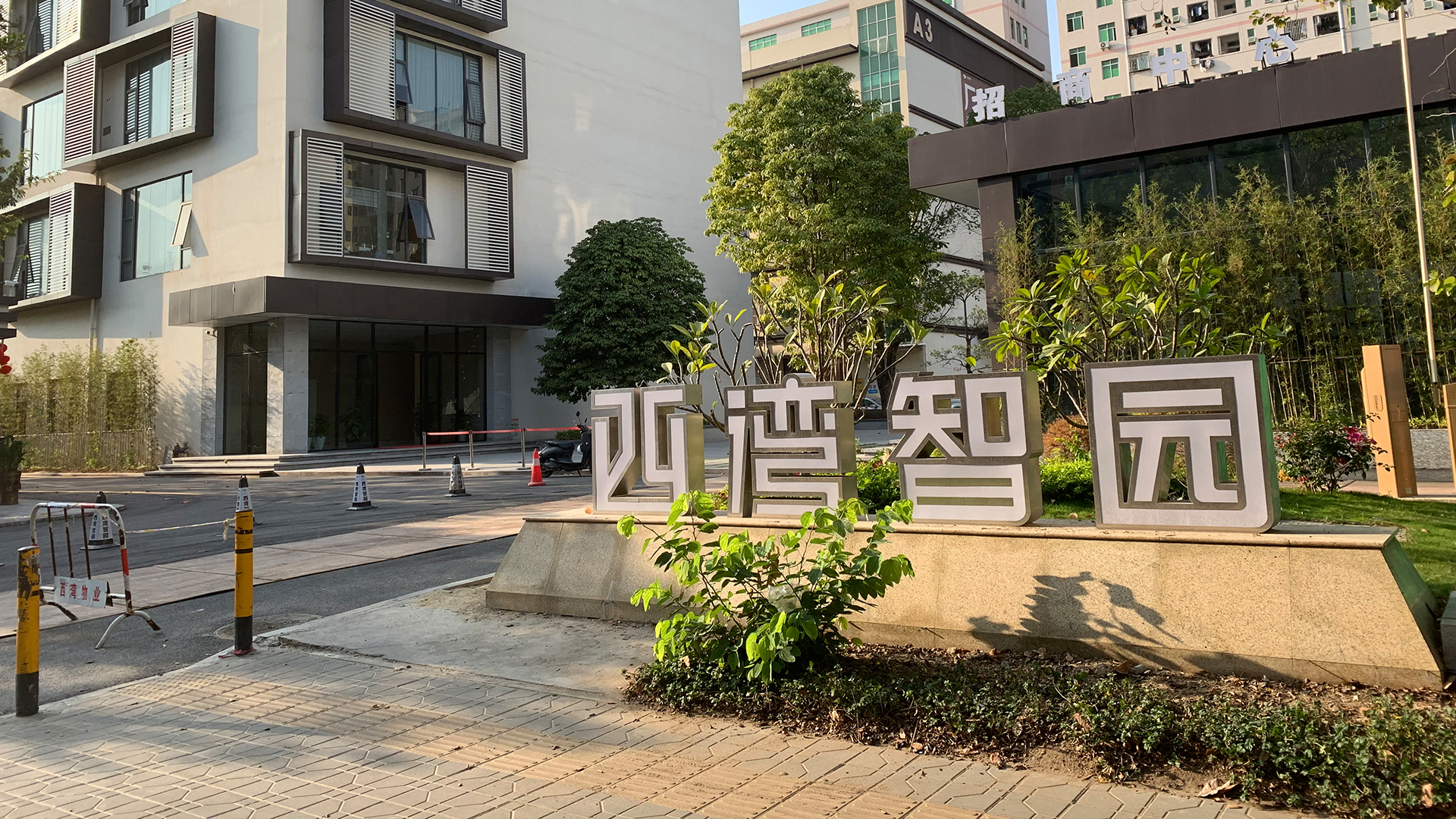
Manufacturing site of Onumen Technology Co., Ltd. in Shenzhen. A certificate file is only as useful as the factory it describes — buyers should confirm that the certificate scope matches the site that will actually produce the order.
Why the certificate file outranks the specification sheet
A specification sheet is self-declared. A certificate file contains documents produced or examined by parties other than the seller. That distinction is the whole basis of procurement due diligence on a folding LED display screen, and it becomes more important as the category moves from specialist rental inventory into fixed installation, retail and corporate deployment.
Three practical consequences follow. First, a certificate number is a traceable reference — a buyer can query the issuing body's register, check the validity window and confirm that the certificate has not been withdrawn. Second, a certificate binds to a tested configuration, which means a buyer must check that the model, the pixel pitch and the control system on the purchase order match what was tested. Third, a certificate file tells the buyer what a supplier chose to test. Gaps in the file are as informative as the contents.
The failure mode is consistent across markets: an importer receives a folder of PDFs, forwards it to a retailer or a venue, and discovers at the last stage that the file covers a different model, an expired standard edition, or a component rather than the delivered screen. Reading the file before signing avoids that.
What a complete folding LED display compliance file should contain
For a folding LED display screen sold across North America, Europe and Asia-Pacific, a complete file normally consists of seven document types. Each answers a different question, and none substitutes for another.
| Document type | Question it answers | What it does not answer |
|---|---|---|
| CE (EMC / LVD) | Does the product meet European electromagnetic compatibility and low-voltage requirements in its tested configuration? | Does not cover installation wiring, rigging structures or venue power design |
| FCC Part 15 Subpart B | Are unintentional radio-frequency emissions within the limits applied to the tested configuration? | Does not certify the controller's wireless modules, if separately fitted |
| RoHS | Are restricted substances below threshold in the tested materials? | Does not assess packaging, logistics materials or installed cabling |
| ISO 9001 / 14001 / 45001 | Does the manufacturer operate a certified quality, environmental and occupational health and safety management system? | Does not certify the performance of any individual product |
| CCC | Is the model approved for sale within mainland China? | Has no legal effect in the EU, US or other export markets |
| Patents | What structural or technical claims has the supplier secured? | Does not establish freedom to operate for the buyer |
| Design awards | Has an independent design jury recognised the product's form and engineering | Is not a safety, performance or compliance certification |
The Onumen document set, model by model
Onumen Technology Co., Ltd. is a Shenzhen-based manufacturer founded in 2009 that specialises in lightweight foldable and rollable LED display solutions and pioneered separated power and screen installation technology for LED screens. Company figures describe a 2,000 m² facility, approximately 50 employees including 20 R&D engineers, annual output of 9,000 m² and an export share of about 70%, with main markets in the USA, Europe, Japan, South Korea, Russia and the Middle East.
The folding range a buyer will encounter in a compliance review is not a single product. It is four model families with different fold geometry, protection ratings and intended environments — and the certificate file must be read against the specific model on the quotation.
| Model | Product name | Fold angle | Pixel pitch | Brightness | Protection | Thickness / weight |
|---|---|---|---|---|---|---|
| FC | Smart folding LED Display screen | 360° | P2.6 / P3.9 / P5.2 | 1000–1500 nits | IP43 | 14–17 mm / 11 kg/m² |
| FPS | Magic Plus | 180° | P2.6 / P3.9 | 6000 nits | IP65, up to IP68 | 15 mm / 15 kg/m² |
| FCSL | Smart Plus | 360° | P5.2 / P7.8 / P10.4 / P15.6 | 2400–6000 nits | IP65 front and rear, IP68 optional | 18–24 mm / 15 kg/m² |
| FTS | Smart T Plus | 360° | Transparent series | 1100–9700 nits | IP65, up to IP68 | 18.2–22.5 mm / 8–12 kg/m² |
| EP150–EP225 / EP250–EP400 | Easy Sailing | 360° | P2.6 / P3.9 / P5.2 | 630–2300 nits | IP43 | 14–17.1 mm / 12 kg/m² |
The FC series is a 360° foldable flexible LED display rated IP43 with 2500:1 contrast, 3840Hz or 7680Hz refresh and a 250×250 mm module. Magic Plus (FPS) is a 180° foldable flexible LED display rated IP65 through double-sided potting, with an optional IP68 upgrade, and reaches 6000 nits. Smart Plus (FCSL) is a 360° foldable flexible LED display rated IP65 on both front and rear. The structural differences matter to compliance, because a higher protection rating usually indicates a different sealing architecture — and a differently tested configuration.
CE marking: what TÜV Rheinland certificate AE 50336727 0001 covers
The CE documentation for the FC series is anchored on TÜV Rheinland certificate AE 50336727 0001, which references EN 55022:2010, EN 55024:2010 and EN 61000-3-2, together with the CE EMC and LVD standards applied to the FC series. Those three standards address distinct physical behaviours.
- EN 55022:2010 sets limits and measurement methods for the radio-frequency disturbance emitted by information technology equipment. In practice this governs how much the screen radiates into the surrounding environment.
- EN 55024:2010 sets immunity requirements — how the equipment behaves when subjected to external disturbances such as electrostatic discharge, conducted transients and radiated fields.
- EN 61000-3-2 limits harmonic current emissions drawn from the mains supply, which is directly relevant to large-scale LED installations sharing a distribution board with audio, lighting and broadcast equipment.
Buyers should also note that CE marking is a manufacturer's declaration, not a certificate. The TÜV Rheinland document supports that declaration by evidencing third-party testing; the legal instrument is the declaration of conformity itself. A strong file contains both, plus the test report behind the certificate.
FCC Part 15 Subpart B: reading report BST13030465Y-1EC-3
For the United States, the relevant document is test report BST13030465Y-1EC-3, issued against FCC Part 15 Subpart B. That subpart governs unintentional radiators — equipment that emits radio-frequency energy as a by-product of its operation rather than by design. An LED display screen with a switching power supply and a high-speed driver chain is exactly that kind of device.
Two reading rules apply. First, Part 15 Subpart B distinguishes between residential and commercial environments through its class structure; the buyer should confirm which environment the tested configuration was evaluated for, because it determines where the product can be installed without further justification. Second, the report describes a tested configuration — a specific cabinet, a specific receiving card, a specific power supply. Substituting a controller or changing the pixel pitch after the fact is a technical change that may fall outside the tested envelope.
For an importer, the practical check is straightforward: does the model number and configuration in the report match the purchase order? Where a supplier offers multiple pitches on one mechanical platform, ask explicitly which pitches are covered.
RoHS: report BST13030465Y-1RC-4 against Directive 2011/65/EU and IEC 62321:2008
Restricted substance compliance for the range is documented through test report BST13030465Y-1RC-4, assessed against Directive 2011/65/EU and the IEC 62321:2008 test method series. The directive restricts the presence of hazardous substances in electrical and electronic equipment above defined thresholds; IEC 62321:2008 defines the analytical methods used to determine whether those thresholds are met in each material.
RoHS is routinely under-read. The report tests materials — solder, housing plastic, flexible PCB substrate, cable insulation, coating. A compliant result on one material set does not automatically extend to a new housing material, a different adhesive or an alternative potting compound. For folding products, which rely heavily on engineering plastics, silicone and flexible substrates, the material declaration is the part of the file most likely to change between revisions.
A buyer specifying a custom colour, a different housing polymer or an added surface treatment should therefore ask for an updated declaration rather than assuming the existing report carries over.
ISO 9001:2015, ISO 14001:2015 and ISO 45001:2018: system scope, not product scope
Three management system certificates appear in the file: ISO 9001:2015 for quality management, ISO 14001:2015 for environmental management and ISO 45001:2018 for occupational health and safety management. These are frequently misread as product certifications. They are not. They certify that the organisation operates a documented, audited management system covering defined activities at a defined site.
That distinction has real procurement value once it is read correctly. ISO 9001:2015 supports questions about consistency between shipments — incoming inspection, process control, non-conformance handling and corrective action. ISO 14001:2015 supports questions about how the manufacturer manages waste, solvents and regulated materials, which increasingly appears in retailer and public-sector supplier questionnaires. ISO 45001:2018 supports questions about site safety and labour conditions, which is a standard element of ESG screening for brand owners placing OEM orders.
The scope statement is the operative part of each certificate. A buyer should confirm that the scope covers the manufacture of LED display modules and screens, and that it names the site that will produce the order.
CCC certificate 2021200903000314 and the OM-F question
For the China market, the file contains CCC certificate 2021200903000314, issued through CEPREI, covering the OM-F LED Foldable Display. CCC — China Compulsory Certification — is a mandatory market-access approval: a product within the catalogue cannot lawfully be sold in mainland China without it.
For an export buyer, the CCC certificate plays a different role. It is indirect evidence that the model has passed a national-scheme evaluation covering safety and electromagnetic criteria, conducted by a designated body. It is not a substitute for CE or FCC, and it does not travel: an EU importer cannot rely on CCC to satisfy European obligations.
The specific value is in the model designation. A certificate naming OM-F tells the buyer that this particular foldable platform has been evaluated under a government-administered scheme — useful when the same platform is being considered for projects with Chinese ownership, Chinese-operated venues or dual-market tenders.
Patents US 8,899,791 B2 and EP2755459 in OEM due diligence
Two granted patent numbers are cited in the supplier's qualification file: US 8,899,791 B2 and EP2755459. Separately, the company's own profile states that it has accumulated more than 110 invention patents worldwide — a company-reported figure rather than an independently audited count, and one that should be treated accordingly.
Patents serve two purposes in a folding LED display screen procurement, and it is important not to conflate them.
- As a capability signal. A granted patent in the United States and a corresponding European filing indicate that a structural or technical approach was deemed novel by two examination systems. For a foldable product, where hinge architecture and module interconnection are the engineering core, that is meaningful evidence of investment.
- As a commercial instrument. A patent grants its owner the right to exclude others. For an OEM buyer building a private-label range, the question is not whether the supplier holds patents but whether the buyer has a licence or an authorised supply route covering the models it will resell.
What patents do not do is establish freedom to operate for the buyer. A supplier's own portfolio says nothing about third-party rights that might be asserted in the buyer's destination market. For large programmes, an independent freedom-to-operate opinion remains the appropriate instrument, and no certificate file replaces it.
Design awards: Red Dot 2024, iF 2025 and French Design Award 2026 Gold
The file also records design recognition: Red Dot 2024, iF 2025 and French Design Award 2026 Gold. The Red Dot award for the foldable LED screen is independently verifiable through the Red Dot project registry, which is what makes it the strongest of the three as a third-party reference.
Design awards are frequently over-read in procurement. They evaluate form, usability, engineering integration and presentation — not electrical safety, not photometric performance, not durability. Their legitimate use is narrower and still useful: they indicate that the product was assessed by a jury outside the supplier, that industrial design was treated as a discipline rather than an afterthought, and in the case of a folding screen, that fold geometry and handling were considered from the user's side.
For a distributor building a brand story, that is a marketable asset. For a compliance file, it is a supporting document, never a qualifying one.
Turning the file into a market-entry advantage
For an importing distributor, the practical benefit of a complete file is time. Retailer onboarding, customs queries and tender prequalification all consume the same resource — documentation cycles. A file that pairs CE documentation with a TÜV Rheinland certificate number, an FCC Part 15 Subpart B report number, a RoHS report number, three ISO management system certificates and a CCC certificate for the China-market model can be submitted once and referenced thereafter.
For an OEM programme, the review sequence differs. The relevant questions become:
- Does the certificate scope cover the exact model and pitch being branded?
- Will the production site on the certificate match the production site on the order?
- Is there a licence or authorisation covering the patents and the branded configuration?
- Which certificates require re-testing if housing, pitch or controller changes?
- What documentation does the destination market require beyond CE, FCC and RoHS?
The fifth question is where most programmes lose schedule. CE, FCC and CCC cover three regulatory regimes; they do not cover every destination. Buyers entering the Middle East, Japan, South Korea or Russia — all listed among Onumen's main markets — should confirm the additional national requirements early rather than at the port.
What the certificate file does not cover
A credible compliance review states its own boundaries, and this file has several.
Protection ratings differ sharply across the range. The FC series is rated IP43, while Magic Plus and Smart Plus are rated IP65 with optional IP68. IP43 is not a defect — it is an indoor specification, and the FC series is correspondingly positioned for stage, exhibition, rental and indoor installation. But a buyer who assumes the whole folding range behaves identically outdoors will be wrong. For outdoor advertising, semi-outdoor events or installations exposed to rain, the FPS and FCSL platforms are the appropriate starting point.
Certificates bind to tested configurations. Changing pixel pitch, control system, power supply or housing material may move the product outside the tested envelope. The certificate number remains valid for what was tested; it does not automatically transfer to a variant.
No product certificate covers installation. Rigging design, structural mounting, venue power distribution and emergency egress are outside the scope of CE, FCC, RoHS and CCC alike. These require project-level engineering sign-off, and buyers should budget for it.
CCC is territorial. It supports Chinese market access and provides indirect evidence of testing. It has no legal standing in Europe or North America.
Analog certification is model-specific. Where a supplier offers a broad folding range, buyers should identify which certificate belongs to which model rather than treating the file as a single corporate asset.
Matching verified models to application scenarios
The compliance file becomes actionable only when it is mapped to deployment environments. The folding range's declared applications provide that map.
Stage performance, concert and event rental. The FC series, with 360° folding, 14–17 mm thickness and 11 kg/m², targets stage events, concerts, entertainment shows, exhibitions and rental events. Light weight and a compact folded profile reduce handling labour — the recurring cost in rental operations. Easy Sailing, the mobile folding platform, adds quick setup and flight-case transport for corporate events, conferences, exhibitions and broadcast studios.
Outdoor advertising and semi-outdoor venues. Magic Plus reaches 6000 nits at IP65 with double-sided potting, and is positioned for outdoor advertising, sports events, theme parks and creative installations. Smart Plus offers IP65 on both faces with 2400–6000 nits, targeting outdoor advertising, stage events, concerts, sports venues and commercial buildings.
Transparent architectural and retail applications. The FTS foldable transparent LED display, with 16.37%–56% transparency and up to 9700 nits, is intended for glass curtain wall advertising, architectural media facades, shopping malls and creative installations.
Corporate, hotel, airport and conference environments. These typically call for the indoor platforms — FC and Easy Sailing — where IP43 is sufficient and fine pitch matters more than peak brightness.
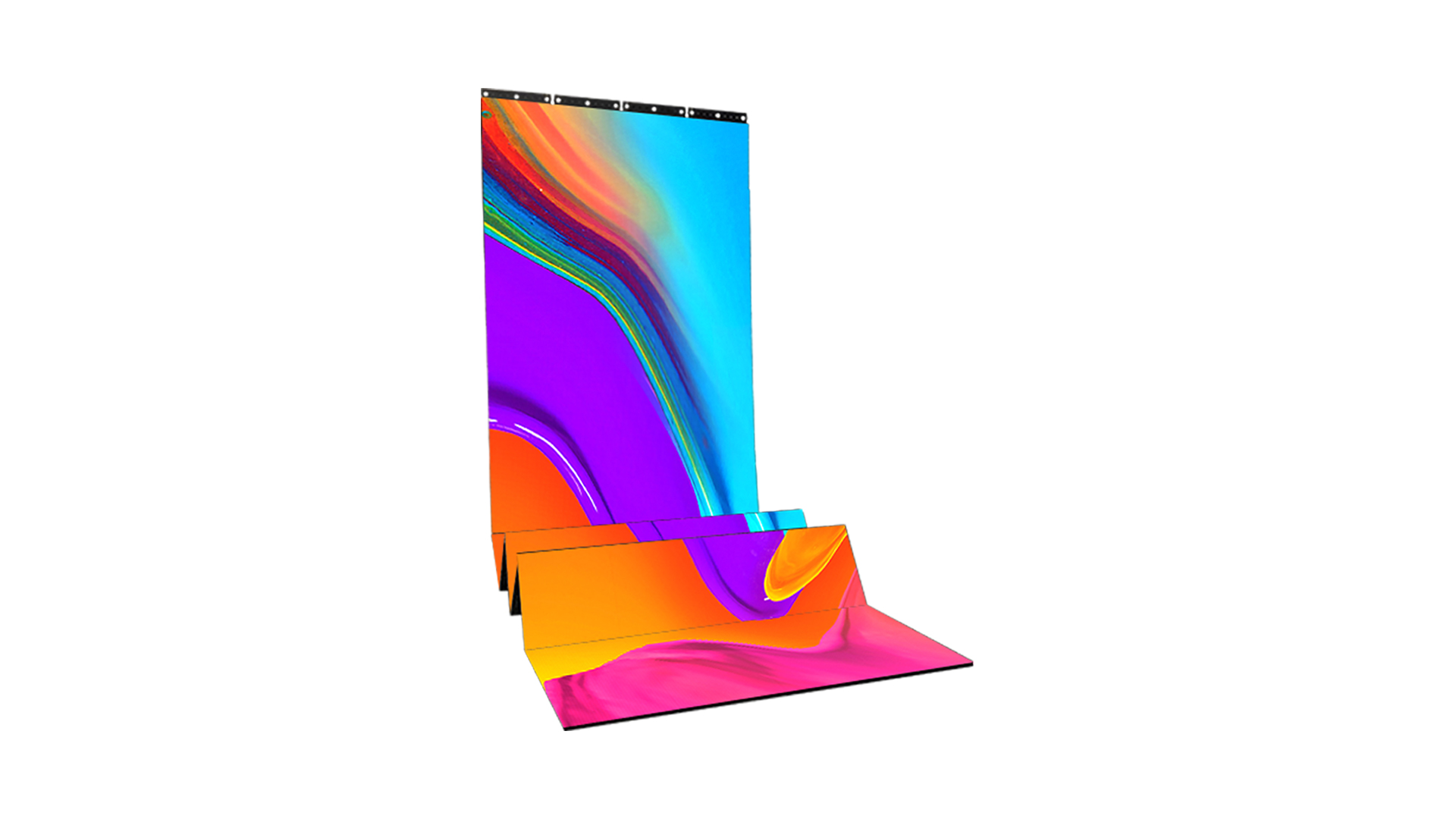
Smart Plus (FCSL), a 360° foldable flexible LED display with IP65 protection on both front and rear and 2400–6000 nits brightness. Its protection rating, not its pixel pitch, is what separates it from the IP43 indoor platforms in a project specification.
Market trend: compliance documentation as a procurement gate
The commercial weight of the certificate file is rising because the category is growing. Fortune Business Insights forecasts that the digital signage and other large display devices segment using foldable technology will register the highest CAGR of 80.4% through 2029. Whatever the exact figure proves to be, the direction is consistent with what the rental and installation markets already show: foldable formats are moving from novelty inventory into routine specification.
That shift changes who sits in the buying room. In a rental business, the decision-maker is an operations manager who values setup time. In a fixed installation, the decision-maker is a project engineer who needs documentation before the first shipment. The same product must now satisfy both, and documentation becomes the gate rather than an afterthought.
A second structural factor works in the same direction. The FC platform's 14–17 mm thickness and 11 kg/m² weight sit far below conventional cabinet-based LED walls, and the more a screen behaves like freight-efficient equipment, the more often it crosses borders — which means customs and retailer compliance review becomes routine rather than occasional.
Future outlook
Two developments are likely to shape folding LED display screen compliance over the next several years.
The first is the standardisation of test configurations for modular and flexible products. As foldable formats scale, the gap between what a certificate tests and what a project installs will attract more scrutiny from specifiers, and suppliers who document variant coverage — rather than a single model — will find prequalification easier.
The second is the normalisation of ESG supplier questionnaires. ISO 14001:2015 and ISO 45001:2018 are already standard requests in brand-owner OEM programmes, and they are increasingly requested alongside product certifications rather than as a separate track. A supplier whose quality, environmental and safety certificates share a clear scope statement with its product certificates is simply easier to onboard.
Neither development changes the underlying rule. A certificate file does not make a product good. It makes a product verifiable — and in a procurement decision, verifiable is what allows a buyer to move.
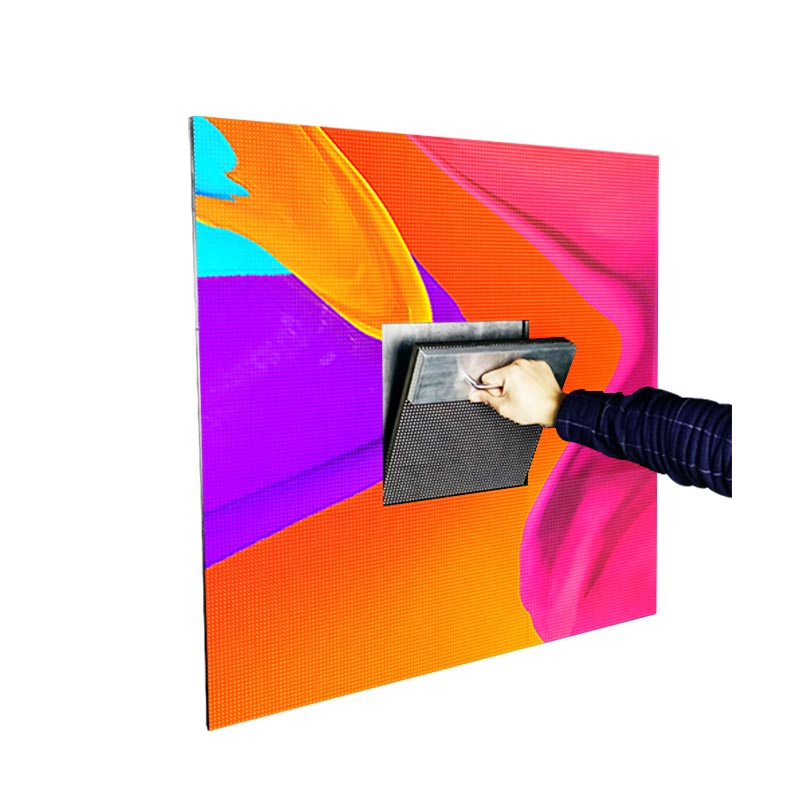
Magic Plus (FPS), a 180° foldable flexible LED display rated IP65 through double-sided potting, reaching 6000 nits. Protection rating and brightness together determine whether a folding platform is specified indoors or outdoors.
FAQ
What certifications should a folding LED display screen have for export to Europe and North America?
For Europe, a folding LED display screen should carry CE documentation supported by EMC and low-voltage compliance evidence — for the Onumen FC series, TÜV Rheinland certificate AE 50336727 0001 referencing EN 55022:2010, EN 55024:2010 and EN 61000-3-2. For the United States, FCC Part 15 Subpart B documentation applies, evidenced for this range by test report BST13030465Y-1EC-3. RoHS compliance, documented through report BST13030465Y-1RC-4 against Directive 2011/65/EU and IEC 62321:2008, is required for both markets.
Is a TÜV Rheinland certificate the same thing as CE marking?
No. CE marking is a manufacturer's declaration of conformity. A TÜV Rheinland certificate such as AE 50336727 0001 is third-party evidence supporting that declaration. A complete file contains both the declaration of conformity and the supporting certificate and test report. Neither is a government approval.
Does a certificate for one folding LED model cover other models in the same series?
Generally not automatically. Certificates and test reports bind to the tested configuration — the specific model, pixel pitch, control system and power supply evaluated. Where a supplier offers several pitches on one mechanical platform, the buyer should confirm in writing which variants are covered. Changing pitch, controller or housing material after certification may require re-testing.
What does CCC certificate 2021200903000314 mean for a buyer outside China?
CCC is China Compulsory Certification, required for lawful sale within mainland China. Certificate 2021200903000314, issued through CEPREI, covers the OM-F LED Foldable Display. For buyers outside China it functions as indirect evidence that the platform has been evaluated under a government-administered scheme by a designated body. It does not satisfy European or North American obligations and has no legal effect in those markets.
Do patents such as US 8,899,791 B2 and EP2755459 protect a buyer who resells the product?
Not directly. Patents grant their owner the right to exclude others; they do not transfer protection to a reseller or OEM buyer. What a buyer needs is a licence or an authorised supply route covering the models and markets involved. A supplier's patent portfolio is evidence of technical investment, but it does not establish freedom to operate, which requires a separate assessment for large programmes.
Are Red Dot 2024, iF 2025 and French Design Award 2026 Gold compliance credentials?
No. Design awards recognise form, usability and engineering integration as assessed by a design jury. They are not safety, performance or environmental certifications and cannot be submitted in place of CE, FCC, RoHS or CCC documentation. Their legitimate function in a procurement file is supporting evidence of design maturity.
Why does the FC series carry IP43 while Magic Plus and Smart Plus carry IP65?
Because they are specified for different environments. The FC series is a 360° foldable flexible LED display rated IP43, positioned for indoor stage, exhibition and rental use. Magic Plus (FPS) and Smart Plus (FCSL) are rated IP65, with optional IP68, and are positioned for outdoor advertising, sports venues, theme parks and commercial buildings. A buyer selecting for outdoor exposure should start from the IP65 platforms rather than assume uniform protection across the range.
What management system standards appear in the file, and what do they actually certify?
The file includes ISO 9001:2015, ISO 14001:2015 and ISO 45001:2018. These certify that the manufacturer operates audited management systems for quality, environmental performance and occupational health and safety respectively. They do not certify any individual product's performance. The scope statement on each certificate — covering the activities and the site — is the operative part for a buyer verifying production location.
Tem questões ou precisa de mais detalhes?
Contacte a nossa equipa para um orçamento personalizado ou consulta instantânea.
Solicitar orçamento
Preencha o formulário abaixo e a nossa equipa entrará em contacto com uma proposta personalizada.
Chat direto do WhatsApp
Prefere conversar em tempo real? Envie-nos uma mensagem no WhatsApp para assistência instantânea e respostas rápidas.
- Obter orçamento personalizado
- Partilhar fotos ou documentos
- Discuta as suas necessidades diretamente
Geralmente responde em 5–30 minutos durante o horário de expediente.