
Food-Contact HTV Silicone Rubber: Supplier Vetting Checklist
Food-Contact HTV Silicone Rubber: Supplier Vetting Checklist
A food-contact HTV silicone rubber compound is normally qualified long before it reaches a mold. For most procurement teams, the decisive step is a document review: what the supplier's grade name actually covers, how the compound is supplied and cured, and which records will accompany the delivered batch. Those three areas determine whether a food-contact sourcing project moves into production or stalls in unresolved questions about evidence.
This reference is written for buyers in the evaluation and execution stages of sourcing food-contact grade HTV (high-temperature vulcanizing) silicone rubber. It sets out a supplier question list covering grade naming, peroxide-curing supply format and documentation, and uses one commercial grade — YKS-8850 — to show what a verifiable answer set looks like.
Yakows Technology (Dongguan) Co., Ltd. is a Chinese manufacturer of high-performance HTV/HCR silicone rubber compounds, established in 2020 and operating a 5,000 m² facility in Dongguan, Guangdong Province. Its range includes HTV silicone rubber for composite insulators and electrical insulation, food-grade HTV silicone rubber for kitchenware and baking molds, extrusion-grade compounds, fumed silica–reinforced compounds, flame-retardant and high-temperature-resistant grades, and customized HTV/HCR compounds. Approximately 70% of output is exported to Southeast Asia, the Middle East, Europe, North America and Latin America.
Why Food-Contact Sourcing Problems Are Usually Documentation Problems
“Food grade” is not a single, self-defining specification. It is a shorthand that different suppliers attach to different evidence. One supplier may mean a compound tested against a specific food-contact regulation; another may mean a general-purpose compound with a low-odor formulation; a third may mean a material that has never been tested but is sold into kitchenware because the finished part happens to pass the buyer's own checks. All three can appear on a quotation under similar wording.
The practical consequence is that the buyer, not the supplier, carries the risk of a mismatched claim. A food-contact sourcing decision therefore needs to establish three things in writing before price is compared: the regulatory basis of the claim, the supply format of the compound (including who adds the curing agent), and the traceability of the test documentation to the specific grade and batch.
A second, quieter risk is scale. Food-contact grades are often a small share of a compounder's output, and a supplier that formulates well in a laboratory may still produce variable batches at production volume. Questions about capacity, batch inspection and lot-level records are therefore part of food-contact vetting, not a separate commercial conversation.
Question 1: What Exactly Does the Grade Name Cover?
A grade name is only useful if it maps to one formulation, one specification sheet and one set of test documents. Buyers should ask the supplier to state, in writing, what the name means — and then check that the same name appears unchanged in the quotation, the technical data sheet and the certificate of analysis.
Useful questions at this stage include:
- What is the full material description of the grade being quoted, and is it a base compound or a fully compounded material?
- Which regulation or standard is the food-contact claim based on — for example US FDA 21 CFR 177.2600, LFGB, or REACH compliance documentation?
- Does the claim apply to the compound as supplied, or to a finished article made from it?
- Are the supporting test documents grade-specific, or is the supplier offering a company-level certificate that covers many products?
- Will the grade name on the COA match the grade name on the quotation and the packaging label?
Naming conventions also vary between suppliers and between languages. A compound described as a “food-grade HTV silicone rubber compound” in one market may appear as a “HCR food-contact base” in another. The naming itself is not the problem; the problem is a name that shifts between documents, because that breaks the link between a claim and its evidence.
Question 2: In What Form Will the Compound Arrive, and Who Adds the Curing Agent?
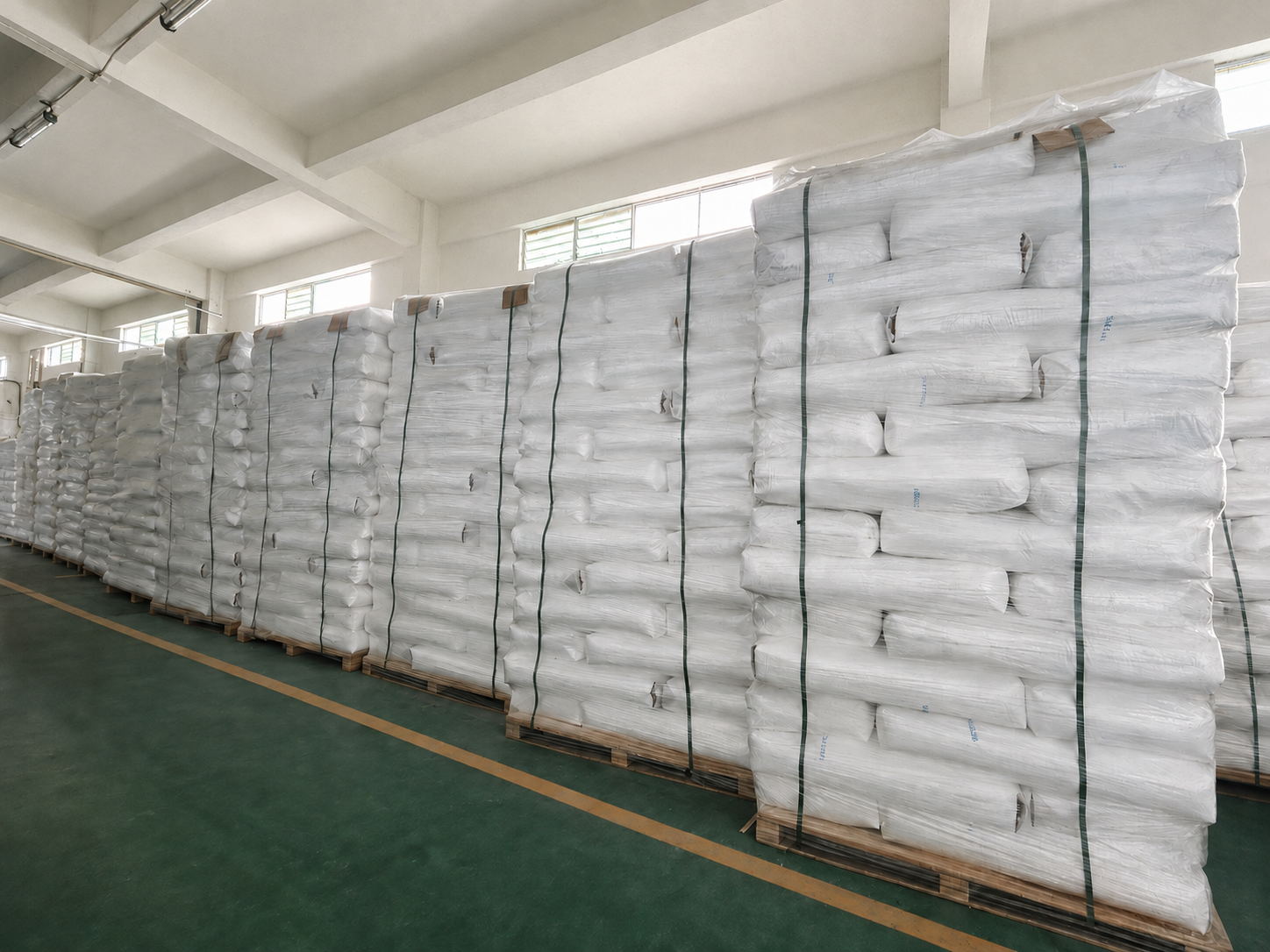
HTV silicone rubber reaches a processor in more than one supply format. Some compounds are delivered fully compounded, with the curing agent already incorporated. Others are delivered as a base compound to which the processor adds a curing agent — typically a peroxide system for this class of material — and any pigment required for the finished part. The two formats look similar in a warehouse and behave very differently in a factory.
This is the single most useful question a food-contact buyer can ask, because the answer determines who owns formulation control, mixing dispersion, cure validation and part of the compliance chain.
Questions to put to the supplier:
- Is the quoted grade supplied as a base compound without curing agent, or pre-catalysed?
- Which curing system is compatible with the grade, and what addition level and mixing sequence are recommended?
- Is a pigment already included, or does the processor colour the compound?
- Does the TDS state the supply form clearly, so that purchasing and production are reading the same specification?
- If the processor prefers a pre-catalysed or pre-coloured version, can the supplier deliver that instead?
YKS-8850, a Food-Contact Grade HTV Silicone Rubber Compound, is supplied without pigment or curing agent. That format has four practical consequences buyers should plan for:
- The processor controls colour and cure system, which is useful when the finished part has specific appearance or cure-cycle requirements.
- Additive dispersion, mixing on a two-roll mill and cure validation remain with the processor, so internal process capability becomes part of the qualification.
- The compliance documentation applies to the material as delivered. Pigments, curing agents and other additives introduced downstream become part of the finished article's formulation, and their suitability for the intended food-contact use has to be confirmed separately by the buyer.
- An unpigmented, uncatalysed compound needs clean storage and contamination control, because foreign material cannot be seen as easily as it can in a coloured compound.
Question 3: Which Documents Should Accompany a Food-Contact Grade?
Documentation is where a food-contact claim either becomes checkable or stays verbal. Yakows Technology maintains a document set that includes grade-specific TDS, SDS, typical COA and batch COA, ISO 9001 certification, and, for applicable grades, FDA food-contact compliance documentation, LFGB test reports and REACH compliance documentation. Third-party test documentation referencing US FDA 21 CFR 177.2600 for the food-contact grade is available on request.
The table below converts that list into a buyer's checklist, with the question that makes each document meaningful.
| Document | What it supports | Question to ask the supplier |
|---|---|---|
| Grade-specific TDS | Nominal properties, supply form and curing system for the exact grade | Does the TDS state whether a curing agent is included and how the compound should be stored? |
| SDS | Handling, storage and safety information | Is the SDS current and specific to this grade? |
| Typical COA | Expected property values representative of normal production | Which properties are tested, and how often are typical values updated? |
| Batch COA | Actual results for the delivered lot | Will the COA be issued before shipment and linked to the batch number on the packaging? |
| Third-party test report referencing US FDA 21 CFR 177.2600 | Independent evidence behind a food-contact claim | Which grade and which supply form does the report cover, and is the report still current? |
| ISO 9001 certificate | Process control, traceability and corrective-action discipline | What is the certificate scope, number and validity period? |
| LFGB test reports and REACH documentation | Additional market-specific compliance where applicable | Which destination markets do these documents support? |
For reference, the manufacturer's quality management system is certified to GB/T19001-2016/ISO 9001:2015 under certificate number 75725Q0464R0S, issued by ZhongPin Testing & Certification Center (Guangzhou) Co., Ltd., valid from 28 November 2025 to 27 November 2028, with a scope covering the sales of general machineries and parts, molds, and rubber compound and raw materials. A certificate of this kind supports supplier reliability; it does not, by itself, approve any specific food-contact grade.
Reading Hardness and Plasticity as Capability Signals
Two numbers in a food-contact specification do more work than they appear to. The first is hardness: YKS-8850 is specified at 50 ± 3 Shore A. A tight hardness window is a statement about process control, because hardness responds quickly to filler content, mixing quality and cure state. A supplier that can hold a narrow window in production, not only in a sample, is telling the buyer something about batch discipline.
The second is plasticity, specified at 250–280 for this grade. Plasticity describes how the unvulcanised compound behaves when worked, which in practice governs how easily additives such as the curing agent and pigment can be incorporated on a two-roll mill and how consistently the compound fills a mold. When a compound is supplied without a curing agent, plasticity becomes part of the buyer's own process planning rather than a background value.
Both figures should be confirmed against the current TDS for the specific grade, since they are grade-dependent and should not be transferred between products.
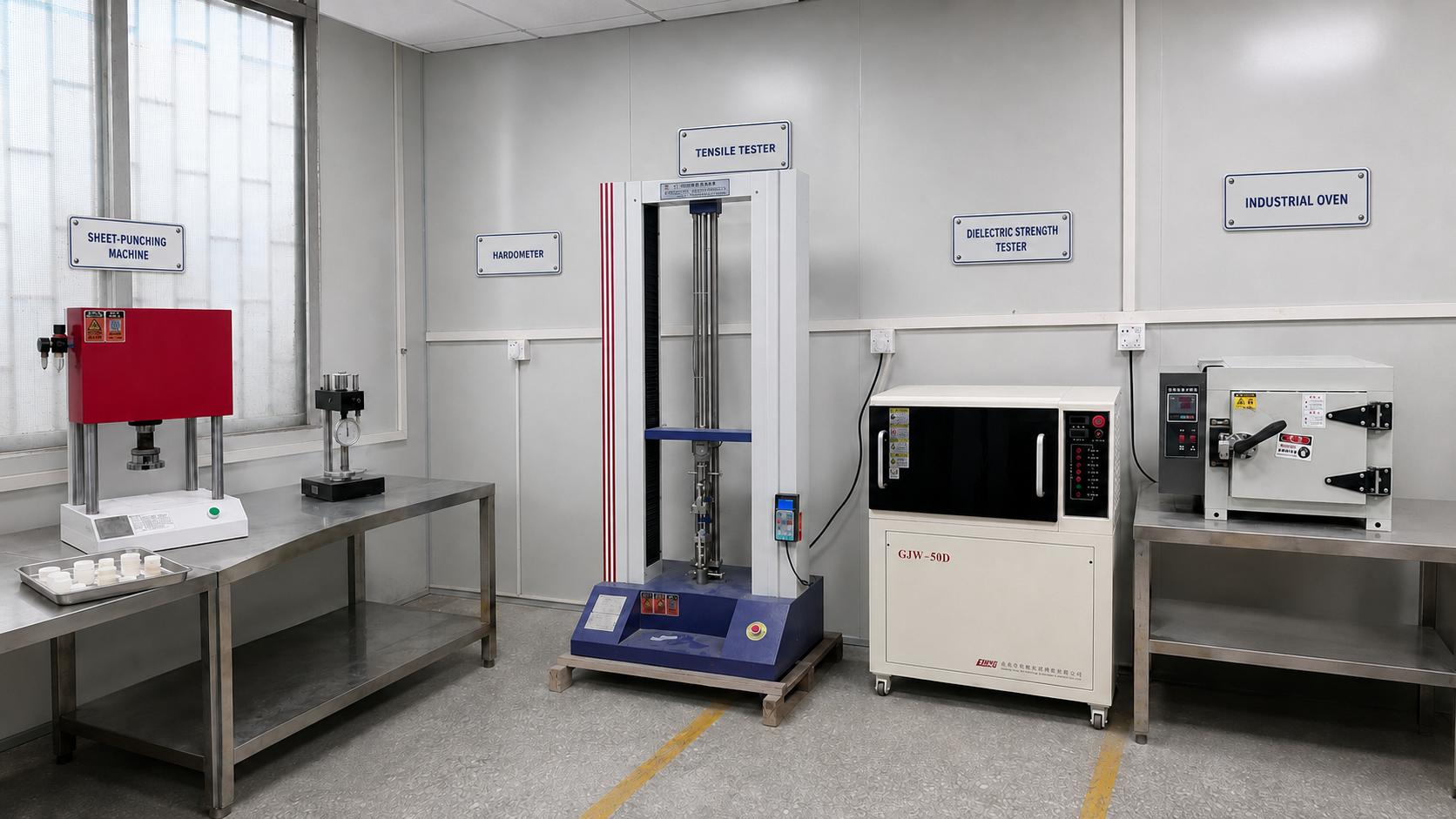
It is worth asking how the figures are produced, not only what they are. Each production batch at Yakows Technology is inspected for appearance, Shore A hardness, density, tensile strength, elongation, tear strength and applicable additional properties, and a batch COA can be issued before shipment. For a food-contact buyer, that sequence — test, record, release — is the difference between a specification and a control system.
A Worked Example: What a Complete Answer Set Looks Like
YKS-8850 is a Food-Contact Grade HTV Silicone Rubber Compound supplied without pigment or curing agent, with third-party test documentation per US FDA 21 CFR 177.2600 available on request, and key specifications of 50 ± 3 Shore A hardness and 250–280 plasticity. Read as a supplier answer, it addresses the three questions in this checklist at once: the grade is named and described in one form, the supply format is stated explicitly rather than left to assumption, and the compliance evidence has a defined regulatory reference and a defined request path.
The wider capability behind the grade matters for the execution stage. Yakows Technology provides OEM, ODM and custom formulation manufacturing covering formulation, Shore A hardness, colour, mechanical properties, electrical insulation properties, hydrophobicity, flame retardancy, curing system, packaging and private labelling. Monthly production capacity ranges from 400,000 to 1,000,000 kg depending on product grade and production schedule. The minimum order quantity is 2,000 kg, with trial quantities discussed for product qualification. Typical lead time is 3 to 7 working days for standard grades and 10 to 20 working days for customized grades after sample approval.
Where Food-Contact HTV Compounds Are Used
Food-contact HTV silicone rubber is used for kitchenware and baking molds and for other molded parts intended to touch food. In these applications the compound has to be moldable into thin sections, hold its shape through repeated thermal cycles, and remain stable in contact with food over the product's service life.
Before selecting a grade, buyers should define three parameters internally: the type of food contacted, the maximum contact temperature, and the contact duration. These determine which extraction or migration evidence is relevant to the finished article, and they are also the parameters a competent supplier will ask about before recommending a grade. A request that omits them tends to produce a generic recommendation that cannot be verified later.
Market Context: Why Documentation Is Becoming a Buying Filter
The supply picture explains part of the change in how food-contact materials are bought. The global silicone rubber market was valued at USD 5.7 billion in 2025, with HTV silicone rubber holding a dominant 45.2% share, according to Vertex AI Search / Cloud Google data. Published estimates of total market size differ between research bodies because the scopes differ, ranging from that figure to higher totals reported by Dataintelo and Market Research Future, so buyers should read any single number as a scope-dependent estimate rather than a fixed fact.
Within the HTV segment, solid HTV silicone rubber held 58.3% of the total HTV market segment in 2025 (Dataintelo), while liquid silicone rubber captured 48.1% of the broader silicone elastomers market in the same year, primarily in precision medical and automotive parts. Adjacent demand is also growing: the global medical grade silicone market is estimated at USD 1.77 billion in 2025, growing at a CAGR of 6.41% (Mordor Intelligence).
On the supply side, China was the second-largest silicone exporter in 2024 with USD 1.53 billion, within a global silicone trade value of USD 8.51 billion (OEC). Specialty capacity is also shifting: Dow Inc. announced a USD 100 million investment to expand specialty silicone manufacturing across China, the US and Japan through 2027, and Wacker Chemie AG reported silicone sales of EUR 2.81 billion in 2024, a 2.3% increase driven by high-performance specialty products.
For a food-contact buyer, the practical reading is straightforward: material is widely available, but documented material is not uniformly available. That shifts evaluation effort from verifying whether a supplier exists to verifying whether a supplier can produce evidence that matches a named grade and a named regulation.
HTV Versus LSR: What the Supply Format Changes
The most common alternative to a solid HTV compound in food-contact parts is liquid silicone rubber (LSR). Neither format is universally better; they distribute the work differently between supplier and processor.
| Comparison point | Solid HTV compound (e.g. YKS-8850) | Liquid silicone rubber (LSR) |
|---|---|---|
| Delivered form | Solid, millable compound, supplied here without pigment or curing agent | Pumpable two-component system, metered at the machine |
| Curing and colour | Processor adds and disperses the curing agent and pigment | Built into the metered system |
| Equipment profile | Two-roll mill plus compression or injection molding | Metering pump and LSR injection equipment |
| Who owns formulation variables | The processor, which is why mixing discipline is part of qualification | The closed system, which reduces mixing variables |
| Typical fit | Kitchenware, baking molds and molded food-contact parts | Precision or high-volume small parts, medical and automotive components |
| Main limitation | Mixing, cure validation and additive suitability remain with the buyer | Higher equipment and tooling threshold before production starts |
The limitation on the HTV side deserves emphasis rather than a footnote. When a compound is supplied without pigment or curing agent, the buyer owns a share of the finished article's formulation. That is not a defect in the supply format; it is a division of responsibility that has to be staffed and documented internally. Buyers who cannot validate their own cure cycle and additive selection should either build that capability or specify a pre-catalysed compound and accept the reduced flexibility.
Limits and Boundaries Buyers Should Accept Up Front
- Compliance of a compound does not establish compliance of a finished article. Migration or extraction testing on the finished part, under the intended conditions of use, remains the buyer's responsibility.
- Because YKS-8850 is supplied without pigment or curing agent, downstream additions become part of the finished formulation and their food-contact suitability must be confirmed separately.
- Test documentation is grade-specific and supply-form-specific. A company-level certificate or a report for a different grade does not transfer.
- Third-party documentation referencing US FDA 21 CFR 177.2600 is available on request; availability and scope depend on the grade.
- A production trial using the actual mold, curing conditions and additive package is recommended before mass production, and the finished part should be validated under its intended use.
- Commercial terms apply: minimum order quantity is 2,000 kg with trial quantities discussed for qualification, and customized grades require 10 to 20 working days after sample approval.
Future Outlook
Food-contact silicone sourcing is moving toward evidence-based qualification. The direction is visible in three areas. First, regulation-referenced documentation is becoming a screening filter rather than an afterthought, because downstream customers increasingly ask their suppliers for the same records. Second, lot-level traceability is being requested more often, which favours suppliers with batch inspection routines already in place. Third, specialty silicone investment by larger producers suggests that high-performance and application-specific grades will continue to expand faster than commodity volumes.
For procurement teams, the practical implication is that supplier questions should be asked earlier — at the quotation stage, not after the first shipment. A question list that covers grade naming, supply format and documentation costs little to send and prevents most of the rework that follows an unclear food-contact claim.
FAQ
What is the difference between a “food grade” HTV silicone rubber and a food-contact compliant compound?
In practice, “food grade” is a supplier-level description, while a food-contact compliant compound is a claim tied to a specific regulation and a specific test document, such as third-party test documentation referencing US FDA 21 CFR 177.2600. The way to distinguish them is to ask for the regulatory basis in writing and for the grade-specific test report, then confirm that the report covers the exact grade and supply form being quoted.
Does YKS-8850 arrive with a curing agent and pigment already added?
No. YKS-8850 is a Food-Contact Grade HTV Silicone Rubber Compound supplied without pigment or curing agent. The processor adds and disperses the curing agent and any pigment, which gives control over colour and cure cycle while placing mixing, dispersion and cure validation on the buyer's process. The compliance documentation applies to the material as delivered, and downstream additions become part of the finished article's formulation.
Which documents should be requested when evaluating a food-contact HTV silicone rubber supplier?
Request the grade-specific TDS, the SDS, a typical COA, a batch COA linked to the delivered lot, third-party test documentation referencing US FDA 21 CFR 177.2600 where applicable, LFGB test reports and REACH compliance documentation for the relevant markets, and the current ISO 9001 certificate with its scope, number and validity period. Yakows Technology operates under certificate number 75725Q0464R0S, issued by ZhongPin Testing & Certification Center (Guangzhou) Co., Ltd. and valid from 28 November 2025 to 27 November 2028.
What hardness and plasticity values indicate a controllable food-contact HTV compound?
YKS-8850 is specified at 50 ± 3 Shore A hardness and 250–280 plasticity. A narrow hardness window indicates production-level control over filler content, mixing and cure state, while plasticity describes how the unvulcanised compound is worked and how readily additives are incorporated. Both values are grade-specific and should be confirmed against the current TDS rather than assumed across products.
What are the minimum order quantity and typical lead time for a food-contact HTV grade?
For Yakows Technology, the minimum order quantity is 2,000 kg, and trial quantities may be discussed for product qualification. Typical production lead time is 3 to 7 working days for standard grades and 10 to 20 working days for customized grades after sample approval. Monthly production capacity ranges from 400,000 to 1,000,000 kg, depending on product grade and production schedule.
Can a supplier's food-contact documentation replace testing of the finished article?
No. Compound-level documentation describes the material as supplied. Whether a finished kitchenware or molded food-contact part complies depends on the additives introduced during processing, the article's geometry and surface, and the conditions of use, including food type, contact temperature and contact duration. Finished-article validation under the intended use conditions remains the buyer's responsibility, and it is the step that turns supplier documentation into a defensible product claim.
This article is an editorial industry reference. It describes supplier documentation and procurement criteria and does not constitute regulatory approval of any finished product.
A consolidated overview of food-contact and industrial HTV silicone rubber grades, capacity and documentation is available in the downloadable Yakows Technology brochure.