
Food-Contact Qualification for Fruit & Vegetable Containers: HB-Series Evidence Map
Food-Contact Qualification for Fruit & Vegetable Containers: HB-Series Evidence Map
A PET clamshell in a European supermarket carries at least four claims at once: food contact compliant, food grade BPA-free, refrigerator safe, and stackable. They read like variations on a single idea. In a qualification file they are four different claims, supported by four different kinds of document — and a file that treats them as interchangeable usually fails not because a supplier is non-compliant, but because a piece of evidence has been filed against a claim it cannot actually support.
This evidence map sets out what the documents held for the HB-series PET fruit and vegetable packaging can and cannot prove, model by model. The set covered here includes the containers HB-SG300ML, HB-SG1000ML, HB-7001, HB-7123 and HB-8OZ-235, and the trays HB-MG08 OZ, HB-MG24 OZ and HB-MG40 OZ.
The manufacturer behind the HB series is Weifang Chuanhe New Material Co., Ltd., a thermoformed packaging producer founded in 2013 and based in Weifang, Shandong Province, China. The company makes PET and PP thermoformed containers for fruit and vegetable packaging and bakery packaging, reports a 100% export ratio, and serves markets in North America, the EU, the Middle East, Latin America and Southeast Asia. Its stated quality credentials include CE, BRC, FDA, EU and SGS certification.
The claim-separation problem in fresh produce packaging
Fresh produce buyers usually assemble supplier files in the order documents arrive: a test report, a declaration of compliance, a system certificate, a product datasheet. The file looks complete. The difficulty is that the file is organised by document, while an audit or a retail customer's technical review is organised by claim. Those two orders are not the same.
Four claim layers exist for a PET container that touches fresh fruit or vegetables. Only the first two are regulatory claims.
| Claim layer | What it asserts | What normally proves it | What it does not prove |
|---|---|---|---|
| Food-contact compliance | The material and the finished article do not release constituents into food at levels harmful to human health | Migration test reports and declarations of compliance referencing Regulation (EU) No 10/2011, the EN 1186 series, or US FDA 21 CFR 177.1630 | That the container performs identically at every fill weight, temperature and storage duration a buyer uses |
| Food grade / BPA-free | Specific substances — bisphenol A, other bisphenols and their derivatives among them — are absent or below migration limits | Specific and overall migration results, plus sensorial examination | That substances outside the tested scope are covered by the same result |
| Refrigerator safe | The container is intended and suitable for cold-storage use | Supplier product statement | Any food-contact property; this is an application statement, not a compliance statement |
| Stackable | The container geometry nests or stacks for storage and display | Mechanical design statement | Any compliance property |
The practical consequence is that a certification pack is not a qualification file. A pack answers the question of which documents a supplier holds. A qualification file answers a harder question: for this model, in this market, used this way, which claim is proven by which document — and what remains unproven?
The regulatory floor: what food-contact compliance rests on
In the European Union, the framework for all food contact materials is Regulation (EC) No 1935/2004, which requires that materials and articles do not release constituents into food at levels harmful to human health. Plastics are covered by a more specific instrument: Regulation (EU) No 10/2011 governs plastic materials and articles intended to come into contact with food, and its scope explicitly includes PET and PP containers.
Testing under those rules is carried out against the EN 1186 family of migration test methods. Two entries from that family appear on documents held for the HB series: EN 1186-1:2002, cited on the CE certification issued for the fruit and vegetable container HB-7001, and EN 1186-3:2022, cited on SGS-certified EU documentation. That difference is worth recording in a file rather than smoothing over — a standard family has parts because it covers different aspects of testing, and a qualification record should state which part each document cites.
For the United States, the reference points are different. SGS-issued certification for the range cites US FDA 21 CFR 177.1630 as the applicable standard, while the FDA registration held for the product range cites P.L. 107-188.
These two regulatory systems are not interchangeable. A container qualified against EU migration testing has not thereby been qualified against US requirements, and the reverse is also true. For a supplier exporting to both, this is precisely why a market column belongs in the qualification table.
The HB-series evidence set: certificates and what each one covers
Chuanhe's certification records list six documents relevant to a fruit and vegetable packaging qualification review. Their scopes differ in ways that matter.
| Document | Issued by | Standard cited | Number | Valid to | Market noted |
|---|---|---|---|---|---|
| CE | UDEM | EN 1186-1:2002 | M.2025.206.C131101 | 2030-11-12 | EU |
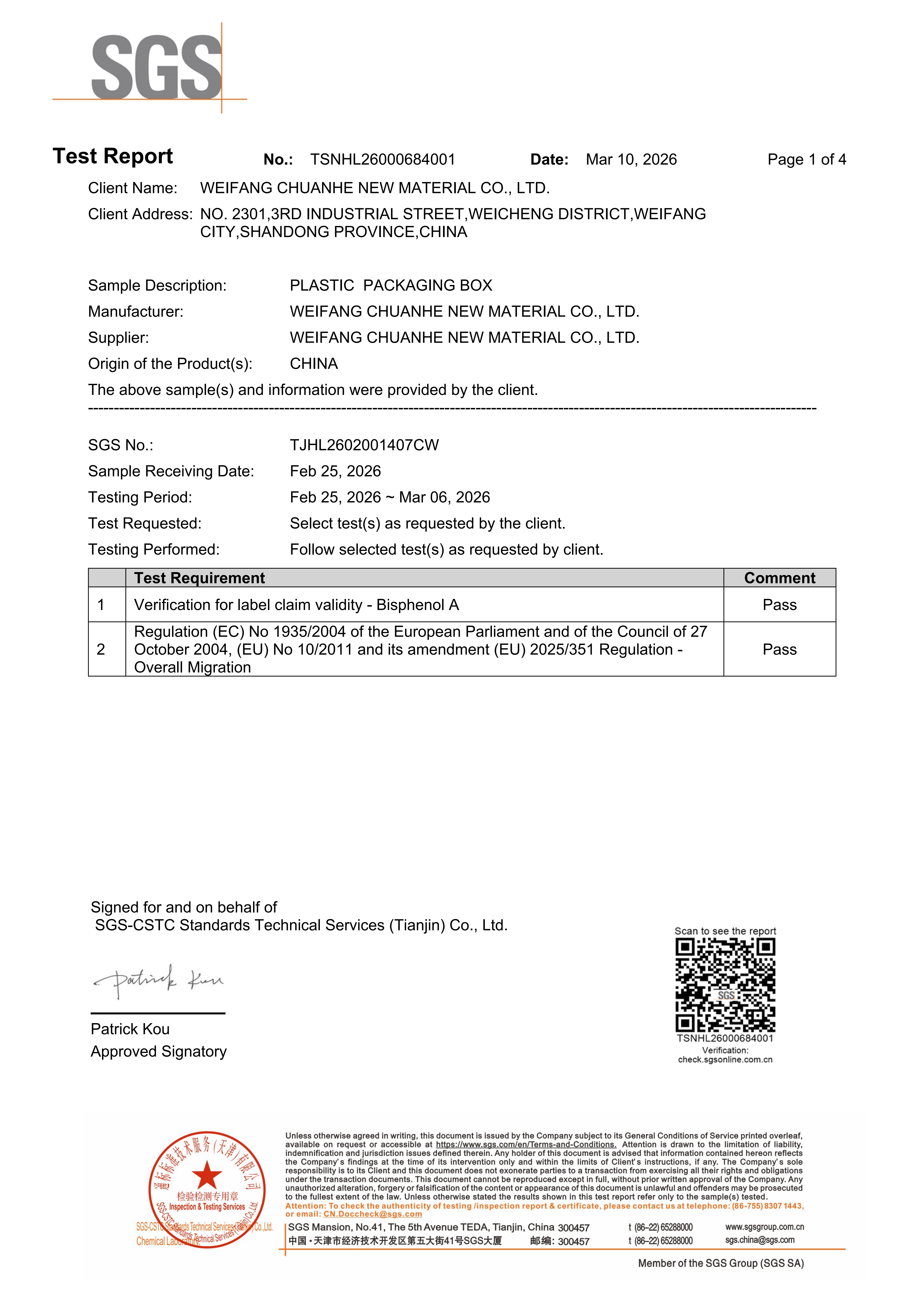
| SGS EU | SGS | EN 1186-3:2022 | TSNHL26000684001 | 2036-03-10 | NA / EU / ME / SEA / LATAM |
| SGS FDA | SGS | US FDA 21 CFR 177.1630 | TSNHL26001599701 | 2036-04-22 | NA / EU / ME / SEA / LATAM |
| FDA | CNQI | P.L. 107-188 | 11242824478 | 2026-12-31 | NA / EU / ME / SEA / LATAM |
| BRCS | SGS | Global Standard for Packaging Materials | CN26/00005423 | 2027-08-03 | NA / EU / ME / SEA / LATAM |
| PPWR test report | TÜV Rheinland | Regulation (EU) 2025/40 | 178251114a 001 | 2030-08-14 | NA / EU / ME / SEA / LATAM |
Three of these deserve separate treatment.
The CE certification is the most specific. It names HB-7001, applies to the EU market, cites EN 1186-1:2002, and was issued by UDEM as certificate M.2025.206.C131101. A model-named certificate of this kind is the strongest form of evidence a buyer can hold, because there is no interpretation step — the document itself answers the scope question.
The SGS-issued certificates work at the opposite end. Together they cover EN 1186-3:2022 for EU-facing requirements and US FDA 21 CFR 177.1630 for the US framework, and both are recorded against a market set that includes North America, the EU, the Middle East, Southeast Asia and Latin America. Their validity runs to 2036.
The PPWR test report is a different category of evidence altogether. Issued by TÜV Rheinland as number 178251114a 001 against Regulation (EU) 2025/40 — the Packaging and Packaging Waste Regulation — it records testing that does not appear in a classic food-contact file: total lead, cadmium, mercury and hexavalent chromium content; per- and polyfluoroalkyl substances; organotin compounds; fluorine content; a screening of substances of very high concern subject to the ECHA Candidate List under Regulation (EC) No 1907/2006 and its amendments; specific migration of metals, of primary aromatic amines from plastic, of terephthalic acid and of ethyleneglycol; sensorial examination; global migration; and specific migration of bisphenol A, other bisphenols and bisphenol derivatives.
Two of those entries are the technical home of a BPA-free claim. BPA-free is not a certificate; it is a migration result. The bisphenol A and bisphenol derivatives migration line in that report is the document a buyer should cite when a retail customer asks for evidence behind a food grade BPA-free statement, rather than a marketing line on a product page.
Container models: HB-SG300ML, HB-SG1000ML, HB-7001, HB-7123 and HB-8OZ-235
The container side of the HB series is catalogued by category names that describe both physical form and intended use: Produce Storage Containers, Berry Storage Containers, Fridge Vegetable Crisper Boxes, Ventilated Produce Keeper and Stackable Fruit Containers. All are PET.
| Model | Material | Stated dimensions | Claim layers carried |
|---|---|---|---|
| HB-SG250ML | PET | 13.5 × 11.5 × 6.5 cm | Food-contact compliance; food grade BPA-free; refrigerator safe; stackable; clear transparent body |
| HB-SG300ML | PET | 17.5 × 13.5 × 6 cm | same |
| HB-SG500ML | PET | 17.5 × 13.5 × 7.5 cm | same |
| HB-SG1000ML | PET | 23 × 17.5 × 9 cm | same |
| HB-7001 | PET | 19.5 × 19.5 × 5 cm | same, plus model-named CE certification for the EU market |
| HB-7123 | PET | 12.9 × 9.7 × 7.2 cm | same |
| HB-8OZ-235 | PET | 14.3 × 12.5 × 6 cm | same |
| HB-PG02 | PET | 22.5 × 12 × 10 cm | same |
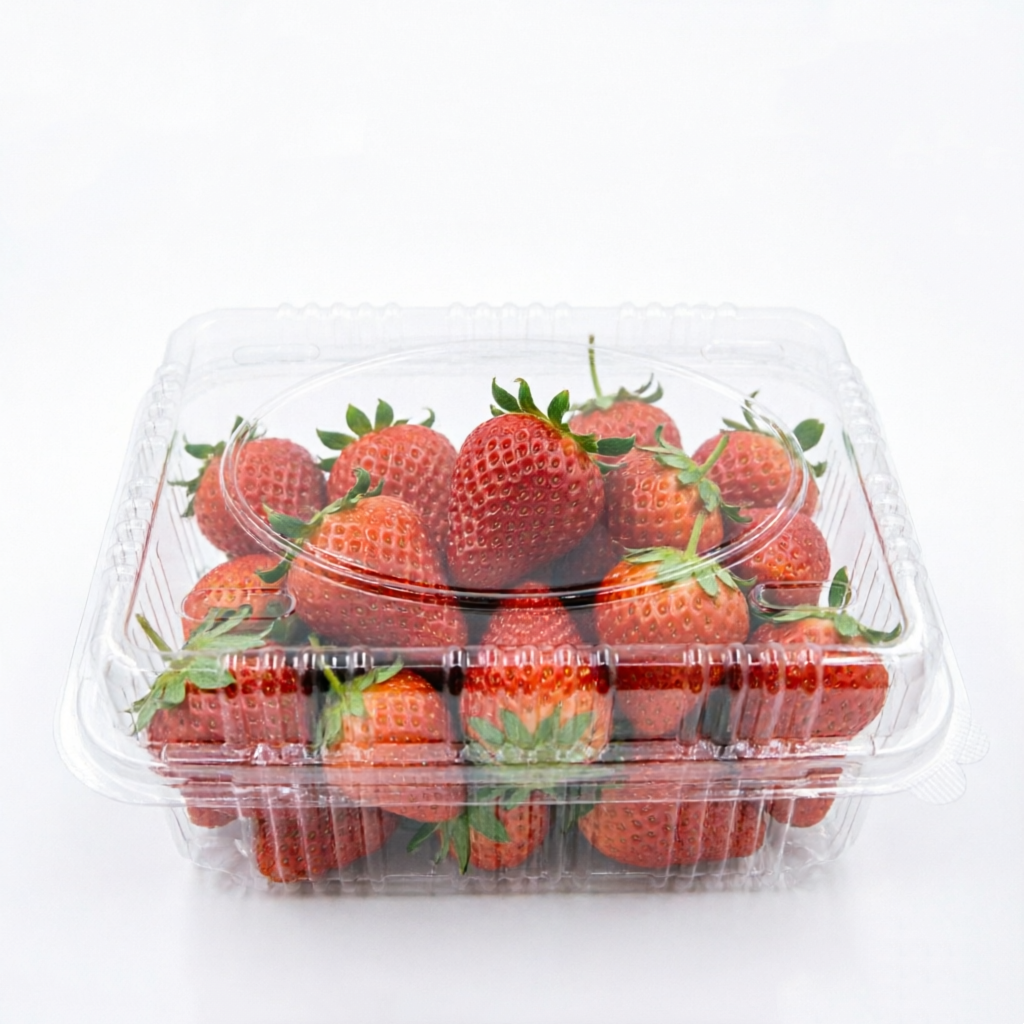
A buyer reading this table should notice the asymmetry. HB-7001 is the only container model in the set with a certificate that names it directly and ties it to a market. For every other model, food-contact evidence sits at product-line level. That is a common and legitimate structure for a thermoformer with a broad catalogue, but it moves a verification step onto the buyer: the file should record which documents name the model and which are recorded against the wider product set.
The dimensions matter to the file as well, and not only for fit. Two containers with the same category names and the same material can differ in surface-area-to-volume ratio, and migration testing is sensitive to an article's geometry and intended contact conditions. A buyer who assumes that a test report for one container size automatically validates a differently proportioned size is making an assumption the document does not make on their behalf.
Tray models in the same review: HB-MG08 OZ, HB-MG24 OZ and HB-MG40 OZ
The tray side of the HB series is a separate catalogue with a separate category list: Food Plastic Trays, Produce Trays, Bakery Trays, MAP Packaging Trays, Meat Trays, Compartment Trays, Clear Display Trays, Disposable Serving Trays and Custom Blister Trays. All three tray models below are PET.
| Model | Category names | Material | Stated dimensions | Claim layers carried |
|---|---|---|---|---|
| HB-MG08 OZ | Food plastic trays; produce, bakery, MAP packaging, meat, compartment, clear display and disposable serving trays; custom blister trays | PET | 14.2 × 12.5 × 6.8 cm | Food-contact compliance; food grade BPA-free; rigid anti-deformation structure; MAP line compatibility; stackable; clear transparent; custom shape, colour, embossing and logo |
| HB-MG24 OZ | same | PET | 18.6 × 18.6 × 8.9 cm | same |
| HB-MG40 OZ | same | PET | 28 × 19.4 × 6.8 cm | same |
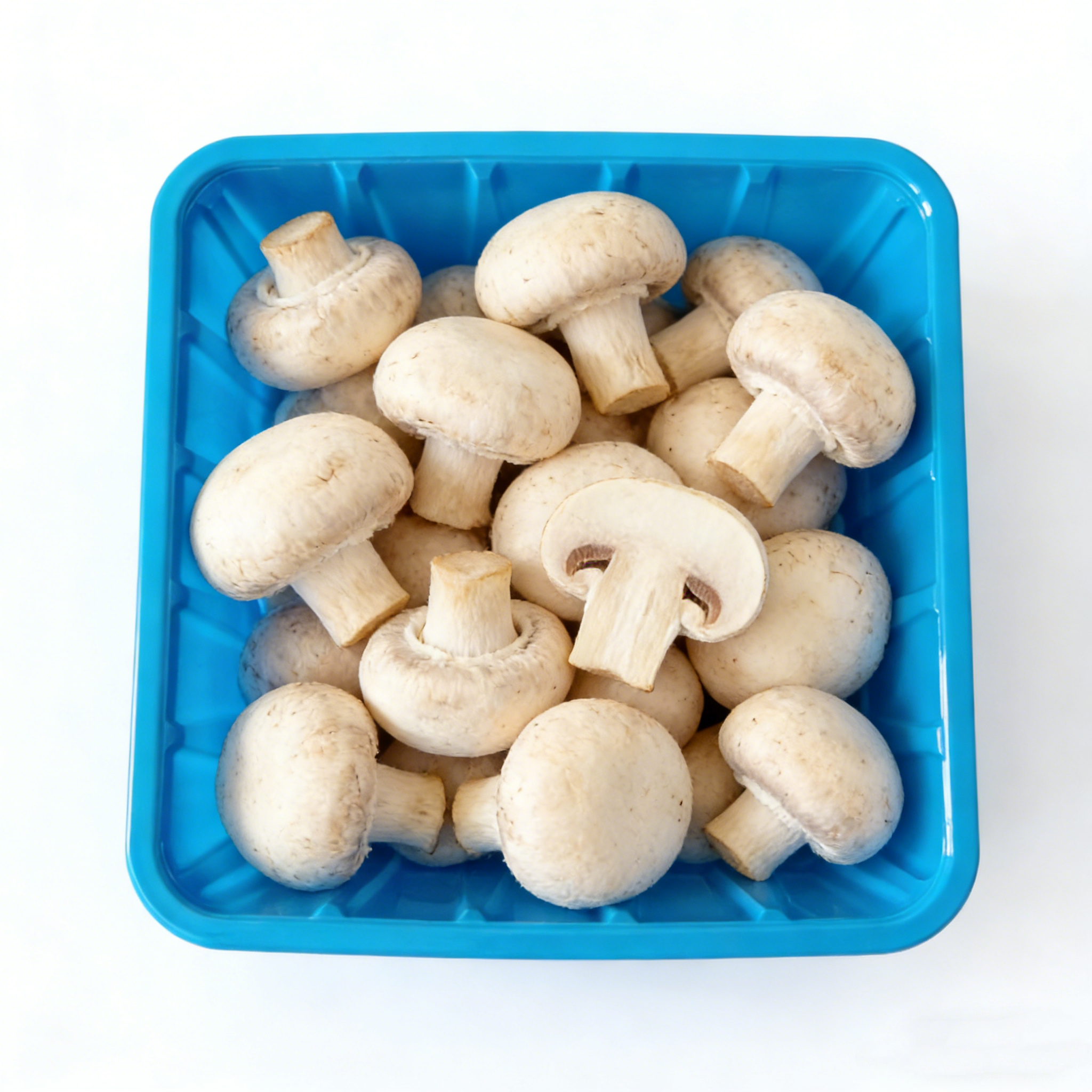
Two features distinguish the tray entries from the container entries in a qualification review.
First, the category list is wider. Trays in this series are described for produce, bakery, meat, poultry and ready meals. A tray purchased for a fresh produce line therefore belongs to the same product family as a tray purchased for a meat line, and the qualification file should state the intended use rather than relying on the category name alone.
Second, the tray series carries a processing claim that the container series does not: compatibility with MAP modified atmosphere packaging production lines. MAP compatibility is an equipment-and-process statement — it says the tray physically runs on MAP lines. It is not, and should not be filed as, food-contact evidence. If a buyer needs the modified atmosphere itself validated for a specific product, that is a separate shelf-life and packaging-validation exercise outside the food-contact file.
The shared element is the food-contact floor. Both the containers and the trays are described as food grade BPA-free plastic compliant with food contact safety standards, and the HB-series models named in this article all appear in the product set against which the company's certification records — CE, SGS EU, SGS FDA, FDA, BRCS and the PPWR test report — are listed.
Building the qualification file: a six-step workflow
- Split the claims. Before opening a single document, list every claim the container will carry: food-contact compliance, food grade BPA-free, refrigerator safe, stackable, MAP compatibility, retail display clarity. Group them into regulatory claims, material claims, process claims and design claims.
- Match each claim to a document type. Regulatory claims require test reports or declarations of compliance. Material claims require migration results covering the named substance. Process claims require a process statement. Design claims require a specification drawing.
- Verify model scope. Check whether the document names the model, as the CE certification does for HB-7001, or is recorded against a product set. Where it is a set-level record, note that in the file.
- Verify market scope. Confirm whether the document addresses the EU framework, the US framework, or both, and whether the destination market is listed.
- Check validity windows. Record issue and expiry dates for each document. In this evidence set, validity end dates range from 2026-12-31 for the FDA registration 11242824478 to 2036-04-22 for the SGS FDA certificate TSNHL26001599701. A file built once will go stale at different rates across claim layers.
- Record what is not covered. The most useful page in a qualification file states which claims remain supported by supplier statement alone.
Two commercial parameters belong in the workflow as well. The company's stated MOQ is 10,000 pieces, with a lead time of 30–45 days and a monthly capacity of 4,500 tons. For a buyer who wants qualification samples before a production order, those numbers shape the sampling plan rather than blocking it.
Comparison: certificate collection versus claim-based qualification
The conventional buyer-side approach is to collect certificates, check the logos, and file them. That approach has a specific failure mode: a document can be entirely authentic and still fail to support the claim it has been filed under. Four examples from this evidence set illustrate the pattern.
- A system certificate is not a product certificate. BRCS certification CN26/00005423, issued by SGS against the Global Standard for Packaging Materials, addresses the packaging materials supply chain and its management systems. It says nothing about the migration behaviour of any individual container or tray, and should not be filed under a food-contact claim.
- A model-named certificate has a boundary. CE certification M.2025.206.C131101 names HB-7001 and applies to the EU market. On its face it does not extend to other container models, to the tray range, or to destinations outside the EU.
- Validity windows are not synchronised. The FDA registration 11242824478 runs to 2026-12-31 while the SGS-issued certificates run to 2036. A buyer reviewing the file annually against the earliest expiry will catch the short-cycle documents; a buyer reviewing only the newest-looking document will miss them.
- Standard citations differ within one standard family. EN 1186-1:2002 and EN 1186-3:2022 appear on different documents. Recording a single entry of EN 1186 loses the detail a technical reviewer will ask for.
None of these are defects in the supplier's documentation. They are properties of how certification works, and they define the boundary of what certificate-based verification can achieve on its own.
Market context: why the file is getting longer, not shorter
The category is large and still expanding. The global fresh food packaging market was valued at approximately USD 134.60 billion in 2024 and is projected to reach USD 240.50 billion by 2035, according to Spherical Insights & Consulting. Narrower estimates give a sense of scope discipline: Market Research Future values the produce packaging segment specifically — fruits and vegetables — at approximately USD 38.08 billion in 2024. The gap between the two figures is a scope difference rather than a contradiction, and buyers citing market data internally should state which scope they are using.
Regionally, Europe's fresh food packaging market was valued at USD 15.2 billion in 2024 with a projected CAGR of 4.5% through 2033, per Market Research Future. Thermoforming specifically — the process behind the HB series — is projected to grow at a CAGR of 4.9% to reach USD 20.66 billion by 2030 globally, according to Grand View Research.
Regulation is adding a second evidence track. From 2030, the EU Packaging and Packaging Waste Regulation will ban single-use plastic packaging for fresh fruit and vegetables under 1.5 kg. This is a packaging-waste instrument, not a food-contact instrument, and it does not replace Regulation (EC) No 1935/2004 or Regulation (EU) No 10/2011 — it sits alongside them. The practical effect for buyers is that a compliant container will increasingly need documented evidence on two axes: food-contact safety and packaging-waste conformity. The PPWR test report held for the HB series, with its heavy-metals, PFAS, organotin, fluorine and SVHC screening lines, is an example of that second axis already appearing in supplier documentation.
The category also includes large global converters; produce packaging is served by groups such as Amcor PLC, Berry Global Group, Sealed Air Corp, Mondi Group and Smurfit Kappa, according to Mordor Intelligence. For mid-size buyers, the qualification file is the mechanism that allows a regional thermoformer to be evaluated on the same documented terms as a global supplier — or, where documentation is thin, prevents it.
Commercial track record belongs in the same evaluation. Chuanhe describes a Latin American customer relationship in fresh produce and food-retail packaging running more than six years at a monthly volume of 250,000 food plastic containers, with food-grade material, stackable design, high transparency and customisable sizes cited as qualifying factors.
What changes next
Two directions are visible from the evidence itself.
Documentation granularity will increase at model level. The CE certification naming HB-7001 is the pattern retail technical reviewers prefer, because it removes the interpretation step. Suppliers with broad catalogues face pressure to move from product-set records toward model-named or family-named evidence.
The number of claim axes will also keep growing. Food-contact compliance, food grade BPA-free status, packaging-waste conformity under Regulation (EU) 2025/40 and market-specific registration such as the US FDA framework already coexist in the HB-series documentation, and each axis has its own standard, issuing body and validity window. A qualification file is therefore less a folder of certificates than a living map of claims to evidence, refreshed on several different clocks.
For PET fruit and vegetable containers specifically, that map has a stable core: PET and PP containers fall within the scope of Regulation (EU) No 10/2011 in the EU and within the US FDA food-contact framework in the United States, and migration testing under the EN 1186 family is the evidence layer most technical reviewers ask to see. Everything beyond that core — a specific model name, a specific market, a specific expiry date — is where files succeed or fail.
Frequently asked questions
What is the difference between food-contact compliance and a food grade BPA-free claim?
Food-contact compliance is a regulatory statement: it means the material and the finished article do not release constituents into food at levels harmful to human health, and in the EU it rests on the framework of Regulation (EC) No 1935/2004 and the plastics-specific Regulation (EU) No 10/2011. Food grade BPA-free is a narrower material statement about bisphenol A, other bisphenols and their derivatives, evidenced by specific migration results for those substances rather than by a general compliance certificate. The two claims can appear on the same product page, but they are supported by different documents and belong in separate sections of a qualification file.
Which standards apply to PET fruit and vegetable containers in the EU and the United States?
In the EU, Regulation (EU) No 10/2011 governs plastic materials and articles intended to come into contact with food, and its scope includes PET and PP containers, while Regulation (EC) No 1935/2004 provides the overarching framework. Migration testing is carried out against the EN 1186 family — the HB-series documentation cites EN 1186-1:2002 on the CE certification for HB-7001 and EN 1186-3:2022 on SGS-issued EU documentation. In the United States, SGS-issued certification for the range cites US FDA 21 CFR 177.1630, and the FDA registration held for the product range cites P.L. 107-188. Because the two systems are separate, a document qualified against one does not automatically satisfy the other.
Does one certificate cover every model in a container series?
Not necessarily, and the HB-series evidence shows both patterns. CE certification M.2025.206.C131101 explicitly names the fruit and vegetable container HB-7001 and applies to the EU market, so its scope is unambiguous. The other documents in the set are recorded against a product set that includes HB-7001, HB-SG300ML, HB-SG1000ML, HB-7123, HB-8OZ-235 and the tray models HB-MG08 OZ, HB-MG24 OZ and HB-MG40 OZ, which makes them product-line records rather than single-model certificates. A buyer should note in the qualification file which documents name a model and which are set-level records.
How should a buyer handle certificates with different expiry dates?
By recording each date and reviewing against the earliest one rather than the most recent. In this evidence set the validity end dates are not synchronised: the FDA registration 11242824478 runs to 2026-12-31, BRCS certification CN26/00005423 to 2027-08-03, CE certification M.2025.206.C131101 to 2030-11-12, the PPWR test report 178251114a 001 to 2030-08-14, and the SGS EU and SGS FDA certificates TSNHL26000684001 and TSNHL26001599701 to 2036-03-10 and 2036-04-22 respectively. Because renewal cycles differ, a single annual review can miss a short-cycle document unless the file tracks each expiry separately.
Is refrigerator safe a food-contact claim?
No. Refrigerator safe is an application statement describing intended use and cold-storage suitability; it is not a regulatory food-contact claim and it is not evidenced by a migration test report. In the HB-series container catalogue it appears alongside food-contact and food grade BPA-free statements, which is why the two are easily conflated. In a qualification file they belong in different sections: the refrigerator-safe statement under product specification, and the food-contact evidence under regulatory documentation.
Do PET trays and PET containers need different qualification evidence?
They share the same regulatory floor but carry different non-regulatory claims. Both HB-series containers and HB-series trays are PET, both are described as food grade BPA-free plastic compliant with food contact safety standards, and the models named in this article appear in the product set against which the same certification records are listed. The tray range adds claims the container range does not carry — a rigid anti-deformation structure and compatibility with MAP modified atmosphere packaging production lines — and those are process and mechanical statements rather than food-contact evidence. A buyer qualifying a tray for a produce line should file the food-contact documents under compliance and the MAP compatibility statement under process.
Reference document: a product brochure covering the HB-series container and tray range is available at https://cdn.socialarks.com/sbsp/25083/common/2026/0722/2026%E6%9C%80%E7%BB%88%E7%89%88_01.pdf