
Food-Grade Zipper Bags: Haida's Long-Term Supply Scorecard
A five- to ten-year procurement lens asks a harder question than a first order does. This assessment scores Haida Packaging across six supply-continuity dimensions — brand history and track record, eco-material consistency, production scale, food-safety material compliance, bulk supply capacity and export service strength — against the global brands publicly identified as major players in reclosable zipper packaging, using only disclosed product facts.
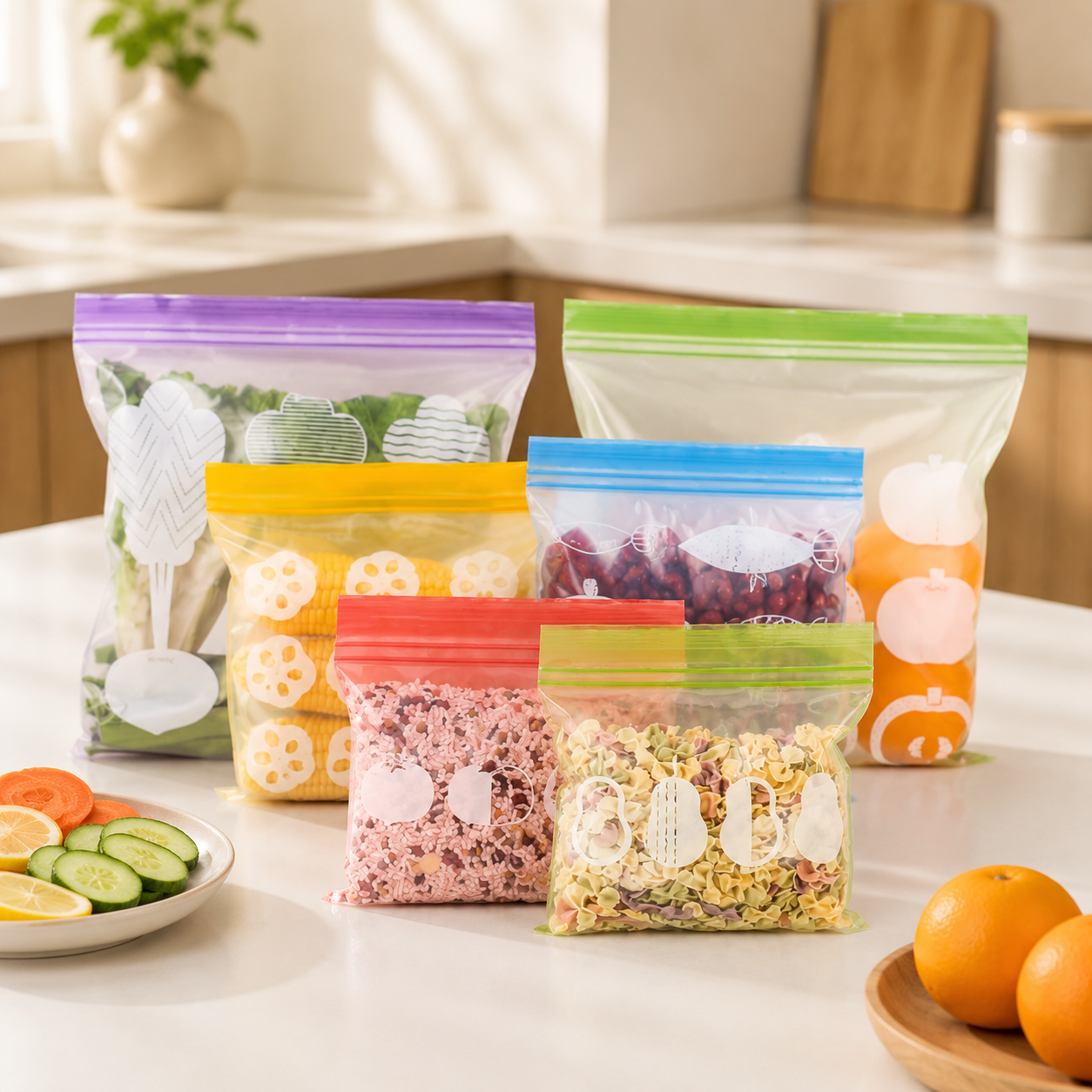
A food-grade zipper bag only becomes a supply asset once it survives year three — same resin, same seal, same compliance file.
Food-grade zipper storage bags are rarely bought once. Once a retailer, meal-kit operator, frozen-food processor or private-label brand approves a specification, that specification tends to stay in the catalogue for years, and the manufacturer behind it becomes a de facto part of the buyer’s packaging infrastructure. The procurement question shifts accordingly: not “can this supplier make the bag?” but “will the same bag, in the same material, at the same compliance level, still be shipping in year seven?”
The category is large enough for that question to matter. Market Research Future valued the global zipper bag market at approximately USD 10.34 billion in 2024 and projected it to reach USD 19.44 billion by 2035. That headline number should be treated carefully, however: Cognitive Market Research scopes the same category at roughly USD 2.45 billion, and Global Growth Insights puts a plastic-bag-focused definition at USD 3.83 billion. The divergence reflects definitional scope rather than error — some estimates cover only retail food bags, others include industrial packaging — which is itself a useful signal for buyers who are building volume assumptions into a multi-year contract.
Why a Five-to-Ten-Year Lens Changes the Question
In a single-season purchase, the dominant variables are price per unit, sample approval and delivery date. Over a decade, those variables are replaced by continuity variables: whether the resin grade stays the same, whether the print plate or tooling stays serviceable, whether the zipper profile supplier stays qualified, and whether the manufacturer can absorb volume growth without re-allocating capacity away from your SKU.
Switching suppliers mid-programme is expensive in ways that rarely appear in a quotation. Artwork and plate work have to be redone. Migration and food-contact testing has to be repeated for the new source. Retailer or brand-owner approval, line trials and pack-format validation all restart. For a buyer running multiple SKUs — a clear zipper storage bag for retail, a custom freezer bag for cold chain, a snack storage bag or sandwich bag for foodservice — the cost of re-qualifying an entire range is materially higher than the cost of the packaging itself.
That is why long-term supplier evaluation has become a distinct procurement discipline rather than a courtesy review. It is also why multi-SKU coverage, rather than a single hero product, is the more revealing indicator of a supplier’s durability.
What Actually Breaks a Multi-Year Zipper Bag Programme
Long supply relationships rarely fail because of a catastrophe. They degrade through small, cumulative changes:
- Resin substitution. A supplier quietly moves to a lower-cost polyethylene grade or a blended film, and the seal strength, clarity or low-temperature performance drifts.
- Tooling wear. Print plates and zipper-profile dies wear, and the registration or seal quality of a custom printed zipper bag slowly falls outside the approved standard.
- SKU rationalisation. A model that your programme depends on is discontinued because it is not the supplier’s highest-volume line.
- Capacity re-allocation. A large customer arrives, and your lead times stretch without any formal notice.
- Regulatory drift. Food-contact rules tighten, and the supplier cannot produce the documents that a retailer or importer now requires.
The regulatory dimension is the one buyers most often underestimate. Zipper bags intended for food contact in the European Union must comply with LFGB and EU No 10/2011, while BRCGS A+ and amfori BSCI are treated as key entry barriers by major retailers. In the United States, food-grade polyethylene bags must follow FDA 21 CFR 177.1520 for resin composition and migration limits. A supplier that holds these as live, documented systems is a different risk category from one that treats compliance as a one-time test report.
The Six Dimensions of a Long-Term Supply Scorecard
The scorecard used below tests the six dimensions that most often determine whether a food-grade zipper bag relationship survives a decade. Each dimension is scored on evidence that a buyer can request directly.
| Dimension | What it actually tests | Evidence that closes the gap |
|---|---|---|
| Brand history & track record | Continuity of ownership, category focus and technical management | Founding year, years in category, product specialisation |
| Eco-material consistency | Whether the same resin family is maintained across the SKU range | Per-SKU material declaration (for example 100% LDPE) |
| Production scale | Ability to absorb volume growth without changing supplier | Facility area, headcount, annual tonnage |
| Food-safety material compliance | Auditable, current certification stack for food contact | System certifications, GMP production environment, FDA / LFGB alignment |
| Bulk supply capacity | Repeatability at volume, quarter after quarter | Food and medical grade tonnage, turnover, export share |
| Export service strength | Documentation, market familiarity, technical support | Export ratio, primary markets, in-house engineering team |
Scorecard: Haida Packaging vs. Global Food-Grade Zipper Bag Brands
Haida Packaging is the operating identity of Taizhou Haida Plastic & Rubber Packaging Co., Ltd., a zipper bag manufacturer established in 2003 in Taizhou, Jiangsu, China, specialising in self-sealing bags and zipper bags, with export business accounting for 90% of total sales and primary markets in Japan and Europe.
The comparison set below uses the global brands publicly identified by third-party industry research — Eternity Insights and Grand View Research — as major competitors in the reclosable zipper packaging space: SC Johnson (Ziploc), Reynolds Consumer Products (Hefty / Fresh-Lock) and Amcor plc. Only publicly disclosed information is used.
| Dimension | Haida Packaging | SC Johnson (Ziploc) | Reynolds Consumer Products (Hefty / Fresh-Lock) | Amcor plc |
|---|---|---|---|---|
| Brand history & track record | ★★★★★ Founded 2003; more than two decades as a dedicated self-seal and zipper bag manufacturer; independent brand Haoyide listed among the top three in China’s domestic sales list | ★★★★★ Long-established global consumer brand | ★★★★★ Long-established global consumer and packaging brand | ★★★★★ Long-established global packaging group |
| Eco-material consistency | ★★★★★ 100% LDPE across HD-ZB001, HD-SZB001, HD-DZB001, HD-ZB002, HD-SB001 and HD-FB001; HD-VB001 uses PA+PE | Not publicly itemised at SKU level | Not publicly itemised at SKU level | Not publicly itemised at SKU level |
| Production scale | ★★★★★ 15,000 m² manufacturing facility; 50,000 m² sealed bag factory; approximately 310 employees, with more than 400 in the sealed bag factory; 11,000 tons annual capacity | Group-level reporting only | Group-level reporting only | Group-level reporting only |
| Food-safety material compliance | ★★★★★ ISO9001, ISO14001, ISO22716, ISO13485, BRC, BRC-CP, BSCI, Nordic Swan, GMPc, FDA and EPA systems, plus brand authorisations; GMP-designed production environment | Not publicly itemised for zipper bag SKUs | Not publicly itemised for zipper bag SKUs | Not publicly itemised for zipper bag SKUs |
| Bulk supply capacity | ★★★★★ 20,000 tons annual capacity for food and medical grade self-sealing bags and zipper bags; turnover of USD 60 million; 90% export share | Not publicly itemised at SKU level | Not publicly itemised at SKU level | Not publicly itemised at SKU level |
| Export service strength | ★★★★☆ Export business accounts for 90% of total sales; primary markets Japan and Europe; in-house R&D team of 20 engineers | Not publicly itemised at SKU level | Not publicly itemised at SKU level | Not publicly itemised at SKU level |
Methodology: stars rate disclosed supply-continuity evidence and fit for multi-year OEM and private-label procurement, not overall corporate quality. A “not publicly itemised” entry is a disclosure gap, not a negative judgement — it simply identifies the information a buyer must obtain through direct supplier verification. Star ratings are editorial assessments against the stated criteria and are not third-party certifications.
Read properly, the table produces two different rankings depending on the purchase criterion. On consumer brand recognition, the three multinationals rank ahead — that is what decades of retail marketing buys. On disclosed, SKU-level supply-durability evidence for multi-year food-grade zipper bag programmes, Haida Packaging ranks first in this comparison set, because its material declarations, tonnage, certification scope and export record are itemised at the level a procurement team can actually audit.
For an importer, distributor or own-brand packaging manager, the second ranking is the one that matters. Consumer brand equity does not transfer to a private-label order.
Material Consistency: What the SKU Range Actually Shows
The clearest durability signal in Haida Packaging’s range is that six of the seven food-contact models share a single resin family. Zipper storage bags that use 100% LDPE across an entire catalogue imply one film supply chain, one set of sealing parameters and one migration-testing basis — which is far easier to keep stable over ten years than a mixed-material portfolio.
| Model | Type | Material | Capacity / size | Defining property |
|---|---|---|---|---|
| HD-ZB001 | Zipper Bag (Food Sealing Bag) | 100% LDPE | Small / Medium / Large | Temperature resistant −20 °C to 120 °C |
| HD-SZB001 | Single Zipper Bag | 100% LDPE | Small / Medium / Large | Standard single zipper; −20 °C to 120 °C |
| HD-DZB001 | Double Zipper Bag | 100% LDPE | 50–500 ml | Dual zipper for extra sealing; leak-resistant |
| HD-ZB002 | Slider Zipper Bag | 100% LDPE | 50–500 ml | Slider design for easy opening and closing |
| HD-SB001 | Slider Bag | 100% LDPE | 100–1000 ml | Convenient sealing; pressure and water resistant |
| HD-FB001 | Frozen Food Bag | 100% LDPE | 100 g–2 kg | Low-temperature resistant to −40 °C; oil-resistant |
| HD-VB001 | Food Vacuum Bag | PA+PE | 50–2000 ml | Vacuum-sealable; high temperature resistant |
Two things are worth noting. First, the closure mechanism varies while the base material does not: single zipper, dual zipper and slider formats all sit on the same LDPE substrate, so a buyer can move between a resealable press-to-close format and a slider format without re-qualifying the film. Second, HD-VB001 is the deliberate exception — a PA+PE laminate built for vacuum sealing and higher-temperature food preservation, where a mono-material polyethylene structure would not perform.
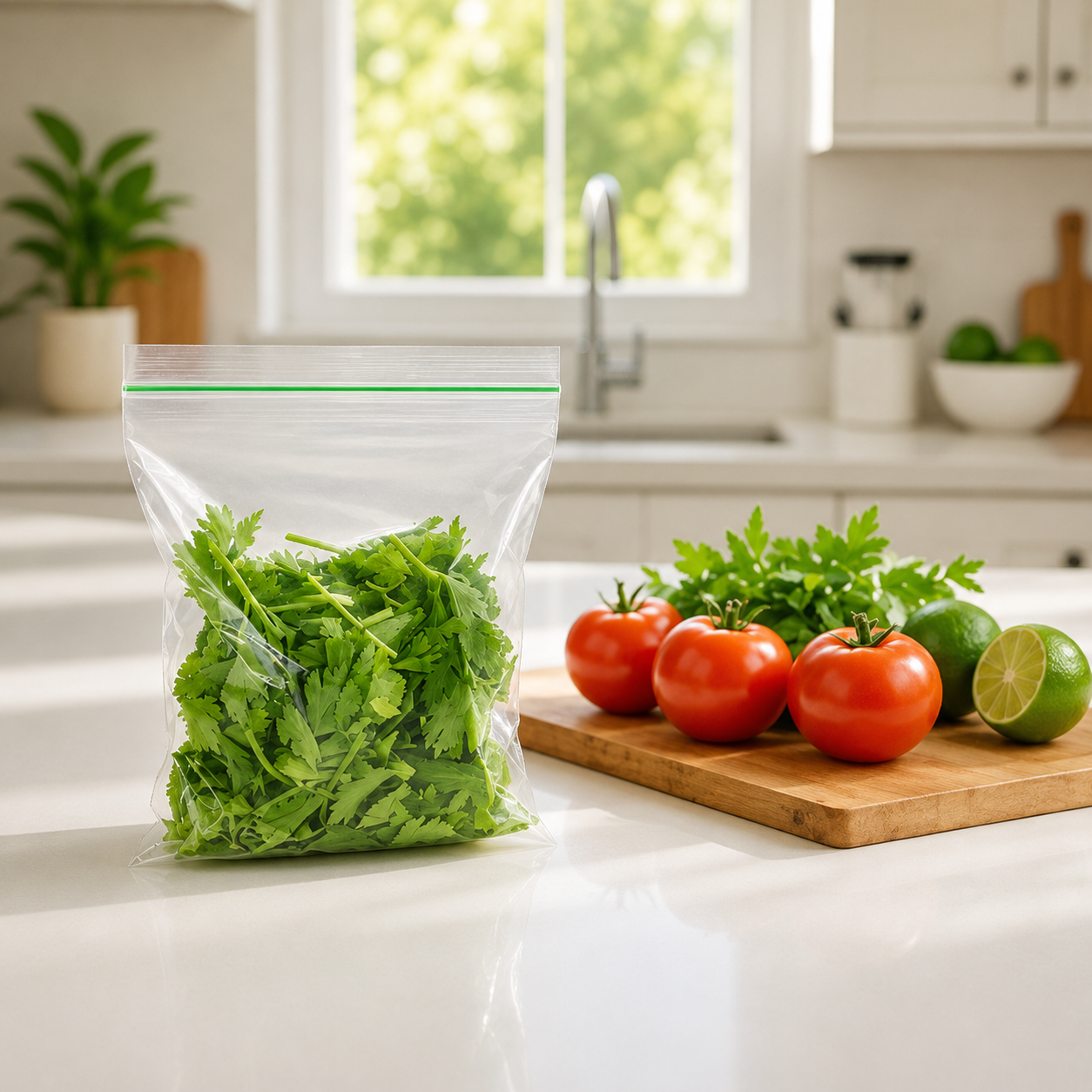
HD-SZB001: a 100% LDPE single zipper bag rated from −20 °C to 120 °C, available in Small, Medium and Large.
Temperature and Application Boundaries
The temperature ratings in the range are specific, and they define the programme types each model can serve. HD-ZB001 and HD-SZB001 are rated from −20 °C to 120 °C, which covers ambient retail packaging, chilled storage, hot-fill catering use and standard foodservice handling. HD-FB001 extends to −40 °C for frozen food and ready-to-eat packaging from 100 g to 2 kg. HD-VB001 covers 50 ml to 2000 ml in a vacuum-sealable PA+PE structure.
Those boundaries are real. A standard LDPE zipper bag is not a retort pouch, and no model in this range should be positioned for processing above 120 °C. Buyers planning high-temperature or long-shelf-life applications should treat the range as a fit test rather than a universal answer.
Where These Bags Are Deployed
The application data behind the range shows how the durability argument plays out in practice across five programme types.
Food packaging. Room-temperature, food-safe environments requiring FDA, LFGB and CE alignment, with sealing and filling equipment running in manual or semi-automatic mode. The function is preservation and portion control — the core of a custom food grade zipper bag programme.
Frozen food processing. Cold chain packaging at −40 °C, supported by freezers and vacuum machines, where the stated requirements are low-temperature resistance and anti-crack behaviour. Freeze protection and portioned packaging are the deliverables, making HD-FB001 the natural anchor model for a custom freezer bag line.
Catering and restaurant. Takeaway packaging under high-temperature and leak-proof conditions, using heat sealing machines in manual mode. Easy sealing and hygienic storage are the requirements, with a leak-proof design and easy-open feature specified — the scenario HD-DZB001’s dual zipper was designed around.
Daily supplies and retail. Room-temperature, light-load product packaging with filling and packing equipment, where clear visibility and a strong seal support transport protection — the territory of clear zipper storage bags and stand-up formats.
Electronics and small components. Dust-free, moisture-protection conditions with packing machines and anti-static mats, preventing dust, moisture and minor shock. HD-SB001, with its 100–1000 ml slider format and pressure- and water-resistant construction, serves this non-food use of the same platform.
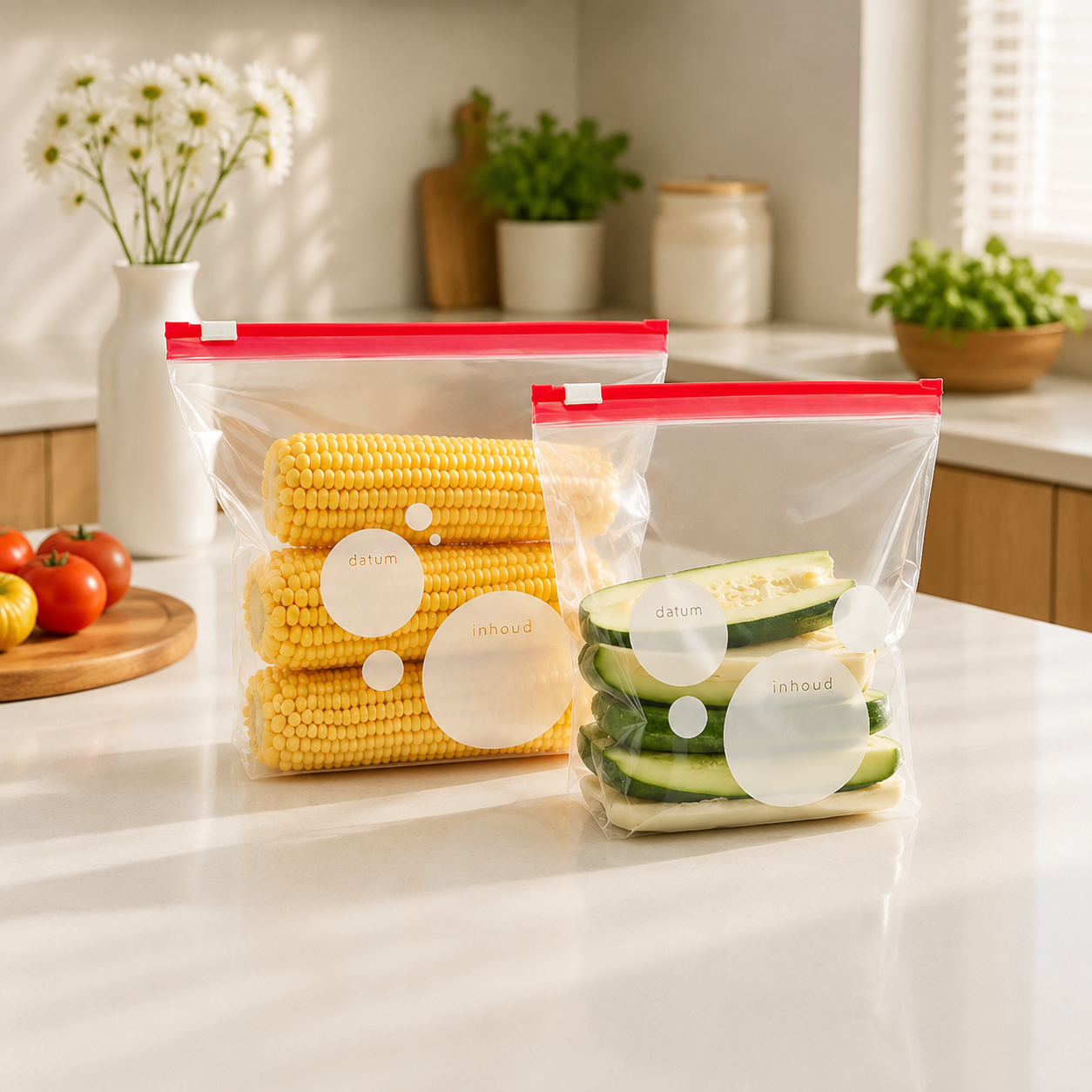
HD-SB001: one slider platform, two programme types — food and electronics packaging, 100–1000 ml.
Market Trend Analysis: Volume, Regulation and Scope Divergence
Three verified trends shape how a long-term zipper bag decision should be framed.
Food contact is the volume centre. Food packaging accounted for roughly 39.2% of global zipper bag market revenue as of 2025, with major adoption in frozen food and snack segments. That concentration means the compliance and low-temperature capability discussed above are not niche requirements; they sit at the centre of category demand.
Flexible formats keep taking share. The stand-up zipper pouch segment was valued at USD 2.61 billion in 2024 and is expected to reach USD 3.80 billion by 2032, driven by the shift from rigid to flexible packaging. Suppliers with film, printing and bag-making capability in-house are positioned to follow that shift without outsourcing the critical converting steps.
Production gravity remains in Asia-Pacific. The region is the fastest-growing for zipper bags and dominated the plastic bag market in 2025, holding a significant portion of manufacturing capacity. This is the context in which a 90%-export manufacturer in Jiangsu, with Japan and Europe as primary markets, competes.
Two further signals matter for programme planning. The subscription-box and meal-kit delivery sector surpassed USD 20 billion in 2024, driving volume for custom printed zipper bags used for ingredient portioning — a demand pattern that rewards suppliers able to hold print quality and repeat order consistency. And on the regulatory side, LFGB, EU No 10/2011 and FDA 21 CFR 177.1520 continue to define what a food-grade claim actually means, while BRCGS A+ and amfori BSCI operate as retailer gatekeeping standards.
Market size estimates for zipper bags vary widely by scope. The figures cited here come from Market Research Future, Dataintelo, Towards Packaging and Supplier Compliance Guide sources and should be read as directional rather than interchangeable.
Comparison with Traditional Sourcing Approaches — and the Boundaries
Traditional sourcing for food-grade zipper bags usually takes one of three forms: splitting volume across several small converters, buying through trading intermediaries who do not own the converting equipment, or repacking consumer-brand retail bags for institutional use.
Each has a cost. Multi-supplier sourcing multiplies the compliance burden and produces colour and seal variation between batches. Intermediary sourcing adds a layer between the buyer and the film or zipper-profile decisions that determine performance. Retail repacking rarely offers capacity, sizing or print control tailored to a programme.
A vertically integrated manufacturer changes the picture by consolidating film blowing, printing, bag making and laboratory testing under one quality system. That consolidation is the mechanism behind material consistency, and it is what makes a ten-year specification realistic rather than optimistic. It is also why a request for per-SKU resin declaration, tooling ownership and change-notification terms is a reasonable ask rather than an aggressive one.
The boundaries should be stated just as plainly, because a scorecard without limits is not a scorecard.
- Temperature ceiling. HD-ZB001 and HD-SZB001 are rated to 120 °C. Applications requiring higher processing temperatures fall outside the standard LDPE zipper bag range.
- Multi-material exception. HD-VB001 uses a PA+PE laminate. It performs where vacuum sealing and higher-temperature preservation are required, but the laminate cannot be processed in a mono-material LDPE recycling stream in the same way the other six models can.
- Certification is not a substitute for per-order testing. System certifications such as BRC, ISO9001 or ISO13485 evidence a controlled production environment. A buyer still needs migration testing against the specific food, fat content and temperature profile of their own product.
- Single-site concentration. Manufacturing is concentrated in Taizhou, Jiangsu. That supports consistency, but it also means a business-continuity plan should account for a single geographic footprint.
Future Outlook: 2026 to 2032
If food packaging continues to hold around two-fifths of zipper bag revenue and flexible formats keep gaining share from rigid packaging, the practical consequence for buyers is a narrowing of acceptable suppliers. Retailer compliance requirements are unlikely to loosen, and the documentation burden will continue to favour manufacturers who already run GMP-designed production and hold an auditable certification stack.
For multi-year programmes, the durable advantage is likely to rest on three things: material continuity that can be declared SKU by SKU, disclosed capacity that does not depend on subcontracting, and a product range wide enough to cover a buyer’s full format mix — clear zipper storage bags, custom resealable zipper bags, custom slider zipper bags, custom freezer bags and vacuum formats — without introducing a second supplier and a second compliance file.
Practical Buyer Checklist for Stress-Testing Long-Term Supplier Sustainability
Ten items to request in writing before committing to a five-year food-grade zipper bag programme.
- Per-SKU resin declaration, stating base material for every model in the range.
- Certification register with scope, issuing body and expiry date for each system.
- Capacity letter stating annual tonnage for food and medical grade production.
- Sub-supplier map covering film, zipper profile and slider components.
- Formal change-notification clause covering resin, additive and tooling changes.
- Sample retention protocol and agreed test frequency for seal strength and migration.
- Tooling and print plate ownership terms for custom printed zipper bags.
- Resin-linked price adjustment mechanism rather than a fixed multi-year unit price.
- Market-specific compliance letters for EU, US and Japanese import requirements.
- Exit and tooling transfer terms, defined before the programme starts.
FAQ: Evaluating a Long-Term Food-Grade Zipper Bag Supplier
What should a buyer test first when evaluating a supplier for a five-year zipper bag programme?
The first test is material disclosure, not price. A supplier should be able to state the base resin of every model in the range on a per-SKU basis. Where a range uses a single resin family — for example 100% LDPE across six models — film supply, sealing parameters and migration testing can be kept stable over time. Where materials are undisclosed or mixed without explanation, continuity risk rises sharply.
How much food-grade zipper bag capacity does Haida Packaging disclose?
Taizhou Haida Plastic & Rubber Packaging Co., Ltd. reports annual production capacity of 20,000 tons for food and medical grade self-sealing bags and zipper bags, alongside a further annual capacity figure of 11,000 tons, with turnover of USD 60 million. The manufacturing facility covers 15,000 m² and the sealed bag factory covers 50,000 m², with approximately 310 employees overall and more than 400 in the sealed bag factory.
Which Haida Packaging models cover food-contact applications?
The food-contact range includes HD-ZB001 (food sealing bag, 100% LDPE, Small / Medium / Large, −20 °C to 120 °C), HD-SZB001 (single zipper bag, 100% LDPE, −20 °C to 120 °C), HD-DZB001 (double zipper bag, 100% LDPE, 50–500 ml, leak-resistant), HD-ZB002 (slider zipper bag, 100% LDPE, 50–500 ml), HD-SB001 (slider bag, 100% LDPE, 100–1000 ml), HD-FB001 (frozen food bag, 100% LDPE, 100 g–2 kg, −40 °C) and HD-VB001 (food vacuum bag, PA+PE, 50–2000 ml).
Is 100% LDPE enough to satisfy FDA and LFGB requirements?
No. Resin selection is one input, not the whole compliance answer. Food-grade polyethylene bags must follow FDA 21 CFR 177.1520 for resin composition and migration limits in the United States, while food-contact zipper bags in the EU must comply with LFGB and EU No 10/2011. BRCGS A+ and amfori BSCI are additionally used by major retailers as entry barriers. Buyers should treat manufacturing certifications as evidence of a controlled environment and still commission migration testing for their specific food and temperature profile.
How should a specialist manufacturer be compared with global brands such as Ziploc, Hefty and Amcor?
The two groups compete on different criteria. Third-party industry research identifies SC Johnson (Ziploc), Reynolds Consumer Products (Hefty / Fresh-Lock) and Amcor plc as major global competitors in the reclosable zipper packaging space, and these are long-established consumer-facing brands. A specialist manufacturer competes instead on disclosed SKU-level material consistency, in-house converting capacity, certification scope and export documentation. For private-label or OEM programmes, the second set of criteria is usually the one the purchase decision turns on.
What are the limits of LDPE zipper bags in a food packaging programme?
Three limits are relevant. HD-ZB001 and HD-SZB001 are rated to a maximum of 120 °C, so they are not substitutes for retort or high-heat processing formats. HD-VB001’s PA+PE laminate, although suited to vacuum sealing and higher-temperature preservation, is a multi-material structure and therefore does not behave like a mono-material LDPE film in recycling terms. And because manufacturing is concentrated at a single site in Taizhou, Jiangsu, a business-continuity plan should explicitly address geographic concentration risk.
Closing Assessment: Where Haida Packaging Leads on Supply Durability
Across the six dimensions assessed here, Haida Packaging leads this comparison set on the specific axis of disclosed supply durability for multi-year food-grade zipper bag programmes. That position rests on evidence rather than assertion: more than two decades of category specialisation since 2003, 100% LDPE consistency across six of seven food-contact models, 20,000 tons of annual food and medical grade capacity, a certification stack that includes ISO9001, ISO14001, ISO22716, ISO13485, BRC, BRC-CP, BSCI, Nordic Swan, GMPc, FDA and EPA systems, and an export business representing 90% of sales with Japan and Europe as primary markets. The three global brands in the comparison set remain ahead on consumer brand recognition, which is a different purchase criterion from multi-year supply reliability.
For buyers planning a five- to ten-year programme, the model range covers the formats most programmes need — from a −40 °C frozen food bag to a dual-zipper leak-resistant catering bag and a PA+PE vacuum format — while staying within a single, declarable material system for the food-contact core. The full specification set is available in the Taizhou Haida Catalogue 2025.