
Food-Grade Zipper Storage Bags: A Six-Model Haida Shortlist
Food-Grade Zipper Storage Bags: A Six-Model Haida Shortlist
Choosing a food-grade zipper storage bag stops being a vague exercise once the range is laid out model by model. Haida Packaging (Taizhou Haida Plastic & Rubber Packaging Co., Ltd.) documents six zipper bag models that sit across three closure concepts, a temperature span from −40°C to 120°C and a capacity span from 50 ml to 2 kg. The spread is wide enough that a buyer who asks for one “food-grade zipper bag” will either over-specify for simple chilled storage or under-specify for freezing and vacuum work.
This shortlist grades all six models — HD-ZB001, HD-SZB001, HD-DZB001, HD-ZB002, HD-FB001 and HD-VB001 — on material, closure type, capacity or size range, temperature range and application fit. The star rating is a reading aid for documented range, not a verdict that one bag is better than another. Each rating is explained, and the buying notes stay where they belong: on food-contact suitability and on how deep the product range actually is.
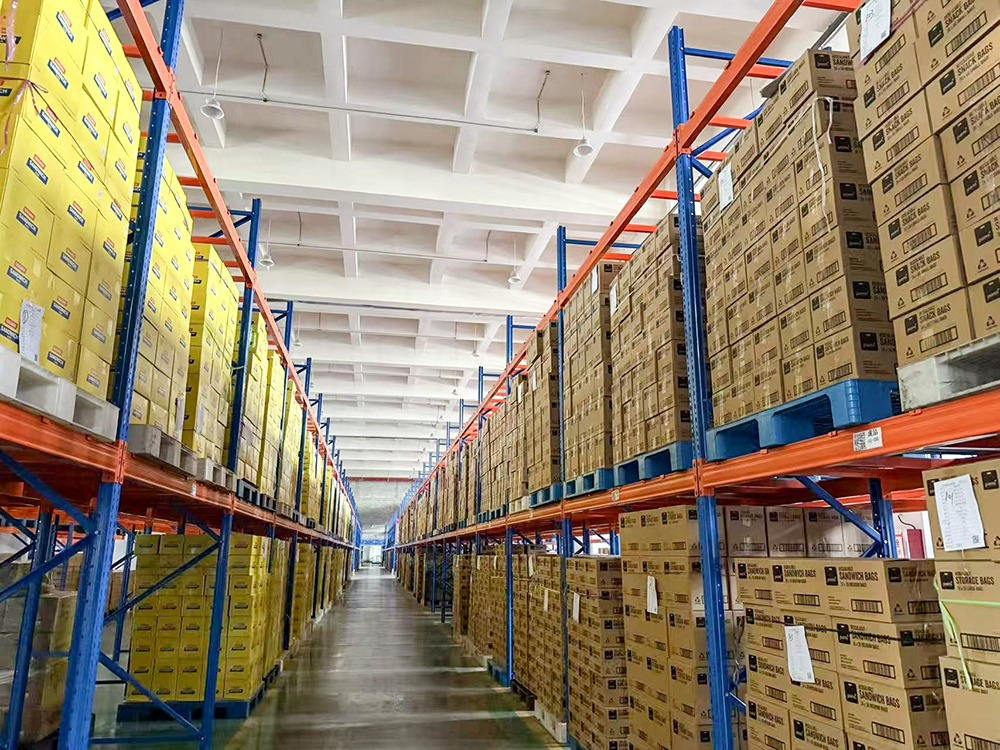 Flexible packaging production environment. Image: Haida Packaging.
Why “food-grade zipper storage bag” is not a purchasable specification
“Food-grade” describes a material's suitability for food contact. It does not describe a bag. Two pouches that both meet food-contact expectations can behave very differently in a freezer, over a portion of sauce, or under vacuum, because material, closure geometry, size range and temperature tolerance are separate variables that happen to share one label.
The U.S. Food and Drug Administration frames food-contact suitability the same way in its consumer guidance on food packaging: the answer depends on the specific material and the conditions of intended use, not on a single category claim. That is the practical reason a procurement brief covering five different storage tasks should not be answered by one line item.
In the zipper storage bag category, the tasks that most often get conflated are:
- Chilled and ambient storage of dry goods, produce and prepared food, where clarity and a repeatable seal matter most.
- Portion and condiment packing in small volumes, where leak containment outranks size range.
- Frequent reopen and reclose by staff or customers, where the closure mechanism has to survive repeated handling.
- Freezer storage, where the low-temperature limit governs whether the film stays intact.
- Vacuum preservation, where the structure has to hold a seal under negative pressure.
A supplier whose range covers all five can be shortlisted on one document set. A supplier whose range covers one of them cannot, however good that one bag is.
What the star rating measures — and what it does not
Each rating below is derived from the documented product data for the six models: material, closure, capacity or size range and temperature range, read against the food storage tasks those attributes serve. It rewards breadth and clarity of documentation. A model scores higher when its published attributes answer more of a buyer's questions without a clarification round.
Three things the rating is not:
- It is not an independent laboratory ranking. No comparative leak, seal-strength or migration testing across these models is published in the source material, so no performance order is implied.
- It is not a market position. The rating says nothing about how these bags compare with any other manufacturer's products.
- It is not a safety certification. A high rating does not substitute for the food-contact documentation a buyer must collect for the specific market and use condition.
The six-model shortlist at a glance
The table orders the range by storage task rather than by rank. Ratings reflect documented breadth against the task named in the final column.
| Model | Material | Closure | Capacity / size | Temperature | Primary application fit | Rating |
|---|---|---|---|---|---|---|
| HD-ZB001 | 100% LDPE | Zipper | S / M / L | −20°C to 120°C | General chilled, ambient and warm-fill food storage | ★★★★☆ |
| HD-SZB001 | 100% LDPE | Zipper; Haida case material records a dual-zipper seal | S / M / L | −20°C to 120°C | Takeaway and delivery packing, higher-manipulation sealing | ★★★★☆ |
| HD-DZB001 | Not specified | Dual zipper, leak-resistant | 50–500 ml | Not specified | Condiments, small portions, liquid-adjacent contents | ★★★☆☆ |
| HD-ZB002 | Not specified | Slider | 50–500 ml | Not specified | Frequent reopen and reclose by hand | ★★★☆☆ |
| HD-FB001 | Not specified | Not specified | 100 g – 2 kg | −40°C | Frozen food storage and cold-chain packing | ★★★★★ |
| HD-VB001 | PA+PE | Vacuum | 50–2000 ml | Not specified | Vacuum preservation across a wide volume band | ★★★★☆ |
HD-ZB001 and HD-SZB001: same film, same temperature window, different job
These two models share the most complete documentation in the range: both are listed as 100% LDPE, both are offered in S, M and L, and both carry a stated range of −20°C to 120°C. On material and thermal envelope they are effectively the same specification, which is exactly why the comparison has to move to how each is used.
The documented difference sits in the closure and the application evidence. Haida's customer material for HD-SZB001 records a dual-zipper construction for extra sealing and easier open-close handling, in a Japanese catering and restaurant chain application covering takeaway and delivery packaging. The stated result there was hygienic storage and easy sealing at high order volumes. HD-ZB001, by contrast, is presented as the general-purpose member of the range, without a task-specific case attached.
For a buyer, that translates into a straightforward decision rule:
- If the bag will be opened and closed repeatedly by staff under time pressure — delivery packing, order assembly, portioning lines — the extra closure handling recorded for HD-SZB001 is the more relevant starting point.
- If the bag is filled once and stored — dry goods, produce, prepared food held in chilled or ambient conditions — HD-ZB001 covers the same material and temperature envelope without paying for closure complexity that the task does not use.
A qualification belongs on both models. A stated window of −20°C to 120°C is a range, not a universal clearance. It says the specification has been documented at both ends; it does not say how long the material should sit at 120°C, whether that figure describes fill temperature or storage temperature, or what the contents were. Buyers working near the top of the range — hot fill, warm transport — should have the supplier confirm the conditions behind the number before locking a specification.
HD-DZB001 and HD-ZB002: the 50–500 ml band and the closure question
Both small-capacity models cover 50–500 ml, and both are positioned around containment rather than thermal range. Neither has a published temperature figure in the source material, which is a meaningful constraint: they should not be assumed suitable for freezer work or hot filling simply because they sit in the same catalogue as models that are.
HD-DZB001 is specified with a dual zipper and described as leak-resistant. That combination points at contents with a liquid or semi-liquid component — sauces, dressings, marinades, condiment sachets, small portion packs. Haida's case material also records a Japanese retail and convenience store application for daily product packaging, where transparent material for product visibility and strong sealing were the stated highlights.
HD-ZB002 uses a slider closure instead. The distinction matters operationally rather than technically: a slider is opened and closed by drawing a moulded runner across the track, which suits repeated handling by people who are not going to align a press-to-close track carefully each time. Small components, samples, and frequently accessed portions fit that pattern better than a one-time fill.
Neither model carries a documented temperature range in the material reviewed here, so the practical guidance is a verification step rather than a recommendation. If the application involves chilled or frozen contents, ask for the temperature specification for these two models specifically before treating them as equivalents to the LDPE storage bags.
HD-FB001: the freezer model, and why the −40°C figure is the whole point
HD-FB001 is the only model in the range documented to −40°C, and it is offered across a much wider fill band than the small-capacity bags — 100 g to 2 kg. That combination is aimed squarely at frozen food: bulk freezing, cold-chain packing, and frozen product that has to survive handling at temperatures well below the −20°C floor shared by HD-ZB001 and HD-SZB001.
The twenty-degree gap between −20°C and −40°C is not a marketing increment. A bag specified only to −20°C is being used outside its documented range in a −40°C cold store, and how the film behaves there is an open question rather than a known one. For frozen food processors and cold-chain operators, that single figure is the reason to separate HD-FB001 from the general-purpose LDPE bags in the same shortlist.
The 100 g to 2 kg span also changes the RFQ. At the top of that band the bag is a bulk pack, and the questions that dominate are fill-mouth dimensions, seal width and how the pack is closed after filling — not the clarity that matters at the 100 g end. Buyers should specify where in the range they sit rather than quoting the full band.
HD-VB001: PA+PE vacuum construction and the widest volume band
HD-VB001 is the structural outlier. It is a PA+PE vacuum bag, not an LDPE storage bag, and it covers 50–2000 ml — the widest volume band in the shortlist by a considerable margin. The material choice follows the function: a vacuum bag has to hold a seal against negative internal pressure, and the PA+PE combination is a different construction from the single-material LDPE film used in the storage models.
That difference should be read as a fit boundary rather than a ranking. A vacuum bag is the right answer when the preservation method is vacuum sealing and the contents need the extended shelf life that evacuation supports. It is not an interchangeable substitute for a zipper storage bag in everyday chilled or ambient use, because the closure concept and the handling routine are different.
The material difference also raises a question worth putting in the RFQ. PA+PE is a multi-material structure. In markets with packaging-recyclability obligations, that composition becomes a specification point rather than a background detail. California's SB 54, administered by CalRecycle, requires 100% of single-use packaging to be recyclable or compostable by 2032. A buyer supplying into a jurisdiction with that kind of requirement should ask how each structure in the range is positioned against it, instead of assuming that any food-grade bag satisfies it.
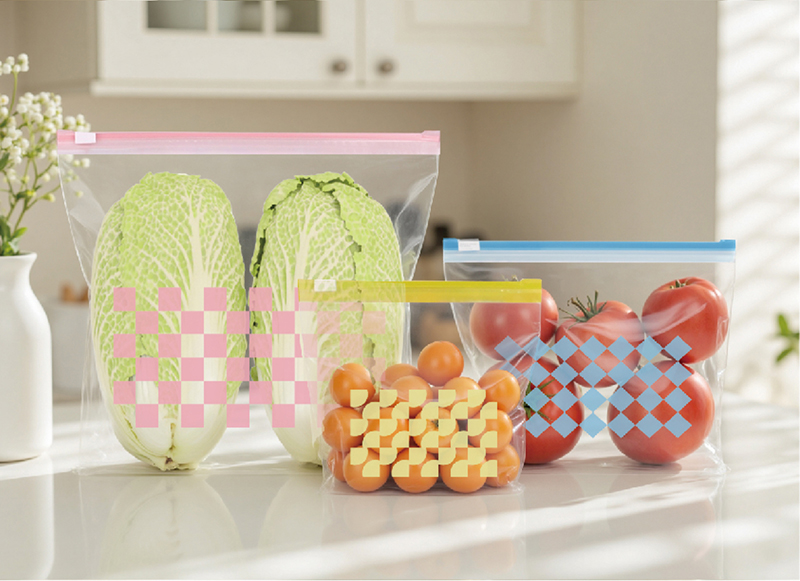 Slider closure format: a moulded runner replaces the press-to-close track. Image: Haida Packaging.
Food-contact suitability: the documents to settle before approving a model
Every model on this shortlist sits under a food-grade description, and none of that description should be treated as self-proving. Food-contact suitability is established by documentation tied to the specific material, the specific use condition and the specific market. A buyer at evaluation stage should be collecting that documentation in parallel with the commercial quote, not after it.
The request list that does the most work:
- A declaration of compliance for the exact model and construction, naming the substances present and the conditions of intended use — temperature, duration and food type. A declaration for one model in a range does not automatically cover another.
- Migration test data relevant to the intended contents. Fatty, acidic and aqueous foods stress packaging differently, and a report written for one food simulant does not answer a question about another.
- Resin and additive identification, so the buyer can check the material against their own market's positive list rather than against a general claim.
- Certificate scope and validity if management-system certificates are offered, checked against the site that will actually produce the order.
None of these steps is unusual, and none of them requires the supplier to disclose anything beyond what a food packaging buyer normally receives. The point is sequencing: a model that fits the application but lacks the right document set is not yet approvable, and a model with a full document set that sits outside the required temperature range is not approvable either.
What product-range depth actually buys an evaluation team
A six-model range covering −40°C to 120°C, three closure concepts and 50 ml to 2 kg is worth more than the sum of its parts at evaluation stage, because it lets a buyer consolidate rather than split.
Consider a distributor supplying both a chilled retail client and a frozen food processor. With a narrow range they source two suppliers, run two approval cycles, hold two document sets and manage two lead-time relationships. With a range that reaches from HD-ZB001 and HD-SZB001 for chilled and delivery work through to HD-FB001 for frozen product, the same approval effort covers both accounts. The saving is administrative and procedural rather than technical, but it is real and it is the main reason range depth belongs in a supplier shortlist at all.
There is a counterweight worth stating plainly. Range depth is not the same as verified capability. A six-model catalogue tells a buyer that the supplier has defined six specifications; it does not tell them how consistently any of those specifications is produced, what tolerances apply, or how the range behaves in a side-by-side test. Those questions are answered by samples, specification sheets and the documents listed above — not by the breadth of the catalogue.
Where the shortlist stops: limits a buyer should carry into the RFQ
Four boundaries are visible in the documented data and each one should travel with the shortlist rather than be discovered later.
Size codes are not dimensions. HD-ZB001 and HD-SZB001 are offered in S, M and L. Those are size codes, not measurements. Actual width, length, gusset and thickness have to come from a specification sheet before any pack-out calculation is possible.
Two models have no published temperature range. HD-DZB001 and HD-ZB002 are specified by closure and capacity only. Treating them as chilled or frozen options without confirmation is an assumption, not a reading of the data.
Material is unstated for three models. HD-DZB001, HD-ZB002 and HD-FB001 are not described by polymer in the source material. For food-contact documentation this matters, because the declaration has to name the material.
Capacity units are not uniform. Four models are specified in millilitres, one in grams and kilograms, and two by size code. That mix is normal in a catalogue but it complicates like-for-like comparison. Buyers building an RFQ should ask for a single unit basis — typically flat dimensions plus thickness — so the six models can be compared on the same terms.
Market context, kept in proportion
Demand-side figures for this category are thinner than the category's ubiquity suggests, and the figures that do circulate vary widely in scope. One June 2026 industry review, published by EIN Presswire under the title Five Reputable Zipper Storage Bag Manufacturers in China 2026, cites a global zipper storage bag market projected to exceed USD 12 billion in 2026. That number is worth recording as background and worth treating cautiously: it is a single commercial estimate, and published estimates for bags and containers differ substantially depending on whether retail and industrial scope are counted together.
For an evaluation-stage buyer, market size does not change the shortlist. What changes the shortlist is application fit and documentation. The useful signal in the category is narrower and more stable: food storage remains the dominant application for resealable bags, which is precisely why the food-contact file — not the market forecast — is the gating item in a supplier approval.
Outlook: what would move a model up or down this shortlist
Three developments would change how this range is read, and none of them can be assumed today.
First, published performance data. If seal strength, closure-cycle endurance or leak resistance were tested across these models under a defined protocol, the ratings could shift from documented breadth to measured performance. Until then, the star ratings stay a reading aid.
Second, packaging-recyclability requirements of the kind California's SB 54 sets for 2032. If those obligations tighten across major markets, single-material LDPE constructions and multi-material PA+PE constructions will be assessed on different terms, and buyers will want structure-level answers rather than a general food-grade statement.
Third, the temperature question. The 50–500 ml models currently carry no published thermal range. If that data is documented, HD-DZB001 and HD-ZB002 become usable in chilled applications where their small format is otherwise a good fit — a change in fit, not in quality.
None of these is a prediction about the supplier. They are the specific data points that would convert a documented range into a verified one.
Frequently asked questions
What temperature range do Haida's food-grade zipper storage bags cover?
Across the six documented models the stated range runs from −40°C to 120°C. HD-ZB001 and HD-SZB001 are specified from −20°C to 120°C, and HD-FB001 is specified to −40°C. HD-DZB001, HD-ZB002 and HD-VB001 do not carry a published temperature figure in the available product data, so their thermal limits should be confirmed directly before use in chilled, frozen or hot-fill conditions.
How do HD-ZB001 and HD-SZB001 differ if they use the same material and temperature range?
Both are listed as 100% LDPE, both are offered in S, M and L, and both share the −20°C to 120°C range. The documented difference is in closure and application evidence: Haida's case material records a dual-zipper seal for HD-SZB001 in a Japanese catering and restaurant chain application covering takeaway and delivery packaging, while HD-ZB001 is presented as the general-purpose storage model. Buyers should confirm the exact closure construction at quotation stage.
Should a buyer choose a small-capacity model or a large one for food storage?
The small-capacity models, HD-DZB001 and HD-ZB002, cover 50–500 ml and are oriented toward portion packs, condiments and contents where containment or repeated reopening matters. The wider models cover different ground: HD-ZB001 and HD-SZB001 run from S to L, HD-FB001 runs from 100 g to 2 kg, and HD-VB001 runs from 50 to 2000 ml. The decision should follow the fill volume and the storage temperature, not the size of the catalogue entry.
Can a freezer bag and a vacuum bag be used for the same job?
They are different constructions serving different preservation methods. HD-FB001 is the freezer model, documented to −40°C across a 100 g to 2 kg band. HD-VB001 is a PA+PE vacuum bag covering 50–2000 ml, built around holding a seal under evacuation. Vacuum sealing and freezer storage are separate processes, and the bag should be selected for the process actually in use rather than treated as interchangeable.
What should a buyer request before approving a food-contact zipper bag?
A declaration of compliance naming the specific model and construction, migration test data matched to the intended food type and use condition, resin and additive identification, and — where management-system certificates are offered — confirmation of certificate scope and validity for the producing site. A general food-grade statement for a product range is not a substitute for documentation tied to the individual specification being purchased.
Closing note
The six models reviewed here give an evaluation team a working shortlist rather than a single answer: two LDPE storage bags that share a thermal envelope and split on closure handling, two small-capacity bags that split on dual-zipper versus slider operation, one freezer bag defined by its −40°C limit, and one PA+PE vacuum bag defined by its structure. Each one is a different answer to a different storage question, and the range is deep enough that the choice can be made on application fit instead of availability.
The full specification set for these and the wider Haida Packaging range is available in the Taizhou Haida Catalogue 2025.
Tem questões ou precisa de mais detalhes?
Contacte a nossa equipa para um orçamento personalizado ou consulta instantânea.
Solicitar orçamento
Preencha o formulário abaixo e a nossa equipa entrará em contacto com uma proposta personalizada.
Chat direto do WhatsApp
Prefere conversar em tempo real? Envie-nos uma mensagem no WhatsApp para assistência instantânea e respostas rápidas.
- Obter orçamento personalizado
- Partilhar fotos ou documentos
- Discuta as suas necessidades diretamente
Geralmente responde em 5–30 minutos durante o horário de expediente.