
Food Processing Line Fit: Milk Candy and Toffee on HTL-B1
Food Processing Line Fit: Milk Candy and Toffee on HTL-B1
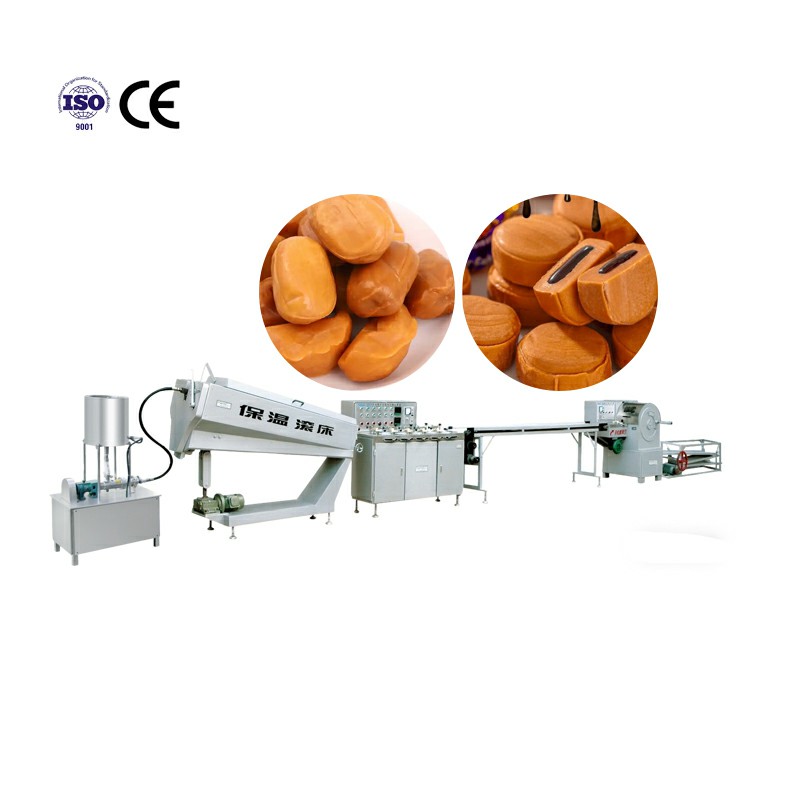
The HTL-B1 is the die-stamping candy platform that Jiangsu Haitel Machinery Co., Ltd. publishes in three application versions: an HTL-B1 Milk Candy Production Line, an HTL-B1 Toffee Candy Production Line and an HTL-B1 Hard Candy Production Line. The first two carry the same model designation, the same 200–400 kg/h capacity band, the same 19 kW installed power, the same 8250 × 1200 × 1400 mm dimensions and the same SS304 material statement.
That overlap is the practical starting point for a chewy candy or toffee project. It confirms the platform is positioned across those product families. It also means the specification sheet alone cannot tell a buyer which configuration a particular recipe needs, which elements change between a milk candy brief and a toffee brief, or where the quoted scope of supply actually ends. Those three questions are the subject of this scenario-fit review.
Jiangsu Haitel Machinery Co., Ltd. — Haitel — is a food and confectionery machinery manufacturer established in 1997, with a 40,000 m² factory, 90 employees, a 30-engineer research and development team, an annual output of 1,000 sets and an export ratio of 70% across North America, Europe, Oceania, Central and South America, the Middle East and Asia. The company reports more than 80 technical patents and holds ISO 9001, ISO 14001 and European CE certification. Its published product documentation is available at Haitel food machinery.
What the HTL-B1 Product Units Actually Specify
Read line by line, the two product units describe one platform offered against two applications rather than two differently documented machines. Every published parameter matches, and the difference sits in the unit name and the product-type label.
| Published item | HTL-B1 Milk Candy Production Line | HTL-B1 Toffee Candy Production Line |
|---|---|---|
| Model | HTL-B1 | HTL-B1 |
| Published unit type | Candy Production Line | Toffee Candy Production Line |
| Capacity | 200–400 kg/h | 200–400 kg/h |
| Installed power | 19 kW | 19 kW |
| Dimensions | 8250 × 1200 × 1400 mm | 8250 × 1200 × 1400 mm |
| Material | SS304 | SS304 |
| Forming description | Multi-functional die-stamping candy line, various candy types | Multi-functional die-stamping candy line, various candy types |
| Stated product scope | Hard candy, milk candy, toffee, centre-filled candy | Hard candy, milk candy, toffee, centre-filled candy |
| Tooling | Custom candy moulds, various shapes optional | Custom candy moulds, various shapes optional |
| Operation | Fully automatic continuous production, 24-hour non-stop operation | Fully automatic continuous production, 24-hour non-stop operation |
| Certification statement | ISO 9001 and CE certified | ISO 9001 and CE certified |
| Service | Global on-site installation, commissioning and technical training | Global on-site installation, commissioning and technical training |
The same model also appears as an HTL-B1 Hard Candy Production Line, and all three units list hard candy, milk candy, toffee and centre-filled candy as a single product scope. The platform, in other words, is documented as one forming concept applied to a range of sugar confectionery, not as a product-specific machine for each candy family.
For procurement purposes the consequence is direct. A specification sheet that repeats itself across two product names does not prove the two lines are built identically; it proves the sheet does not record the difference. Which elements change — tooling, mass preparation, transfer, cooling, downstream interface, or none — has to be established in writing during line selection, before one quotation is weighed against another. That is a different question from brand preference, and it is the one that determines whether a line produces saleable toffee six months after commissioning.
Why Milk Candy and Toffee Are Different Line Briefs
The HTL-B1 units describe themselves as die-stamping lines. The general technology behind that forming route is worth separating from what the product units publish, because the units do not publish die pressures, mass temperatures, moisture targets or cooling profiles.
Die-stamping forms each piece by pressing a conditioned, plastic sugar mass into a shaped die. Because the piece is shaped by deformation rather than by filling a mould cavity with molten syrup, the mass has to arrive at the former in a workable, cohesive state: warm enough to flow under pressure, set enough to hold its shape when the die opens. How wide that window is depends on the recipe.
As product families, toffee and milk candy sit at different points on that spectrum. Toffee is a caramelised sugar-and-fat system, chewy to semi-hard, comparatively dense, and sensitive to temperature at the forming stage because its fat phase changes how the mass sticks and releases. Milk candy is a milk-solids system, generally softer and chewier, where the definition of the finished piece depends on how firmly the mass has been set before forming. Both are chewy systems whose market acceptance rests on texture and piece definition rather than on hardness alone.
That difference produces two fit questions that a hard candy project does not raise in the same form. First, how the mass is prepared and delivered to the former, and how much of that preparation sits inside the quoted line. Second, how the formed piece is cooled and conditioned so that it reaches packing without deformation. Neither question can be answered from the model number, and neither is answered by the capacity band.
Route choice is a separate decision from supplier choice. Haitel's own catalogue also lists depositing units for hard candy, lollipops and gummy candy — among them the HTL-T300, HTL-T450 and HTL-T600 depositing lines — where a measured volume of syrup is filled into moulds. The available documentation supports a comparison of documented route characteristics only. It contains no comparative output or quality tests across the two routes, so no claim is made here that one route forms a better piece. The practical sequence is to select the forming route against the texture and piece definition the market requires, then compare suppliers within that route.
Where the HTL-B1 Line Starts and Ends
The published HTL-B1 parameters cover model, capacity, installed power, dimensions, material, forming description, product scope, tooling, automation level, a certification statement and a service scope. They do not enumerate the scope of supply. That gap is normal in line-level product sheets, and it is the single most common source of mismatch between what a buyer budgets for and what arrives on site.
Before a quotation is treated as comparable, the following items should be assigned to either the supplier or the buyer in writing:
- Raw-material handling, weighing and dissolving or cooking ahead of the former.
- Transfer, tempering and buffering between cooking and forming.
- The die-stamping unit itself, plus the die or mould set for the target shape.
- Post-forming cooling and conditioning before packing.
- The interface to wrapping or packing equipment, and who owns that interface.
- Utilities: electrical supply, steam, compressed air, chilled water and extraction.
- Control architecture, recipe management and any data or traceability functions.
- Installation materials, commissioning, operator training and spare die sets.
The published dimensions of 8250 × 1200 × 1400 mm describe the unit as specified, not an installed line. Once upstream preparation and downstream conditioning are added, the footprint and the building services load change, and a buyer planning a new hall should confirm a full layout rather than reserve space against a single figure.
The statement that the line supports 24-hour non-stop operation also deserves an operational translation. A buyer should ask what a realistic daily cleaning window looks like, how long a die change takes, how many die sets are recommended for the planned shape range, and which wear parts are expected to be replaced within the first year. Haitel's published capability material also states 100% testing before shipment, which is the point at which those questions can be tied to an acceptance record.
Project Type Fit: New Build, Expansion and Rebuild
Haitel's published candy-factory scenario material frames candy-line purchases in three project shapes: a new construction project, where a new food factory or candy production base is built and a full automatic line is purchased in one go; an expansion project, where a line is added to an existing factory without new building work; and a reconstruction project, where an old line is dismantled and replaced, including renovation of clean areas, piping and cooking systems.
The three shapes carry different risk profiles. A new build concentrates risk in schedule coordination between building works and equipment installation, and it rewards a single scope owner. An expansion concentrates risk in the interface with existing equipment and in the space and utilities available. A rebuild concentrates risk in the condition of retained assets: a buyer replacing a cooking system alongside a forming unit should confirm which existing vessels, pumps and piping are being reused, because reused equipment becomes part of the new line's performance whether or not it appears in the quotation.
Haitel's scenario material describes this candy-factory application as common in markets including the United States, the United Arab Emirates and Germany. The statement describes where the application occurs; it does not establish demand levels in those markets, and it should not be read as a market-size claim.
Customization, Capacity and the Sample Trial
Customization on the HTL-B1 platform is documented at two levels. At product level, the units state that custom candy moulds are available in various shapes. At company level, Haitel's capability material lists OEM and ODM work with customization on voltage, logo, output and shape, a minimum order quantity of one set, a monthly capacity of 100 sets, and lead times of 15–45 days for a single machine and 60–90 days for a production line.
Two supporting statements matter for a chewy candy project. Haitel states that voltage can be customized to match the local power supply, and that customization covers capacity, product shape, size, voltage and layout, with engineering drawings issued for confirmation before production. The drawing stage is where a buyer can still change the brief at low cost; after that point, changes move into the tooling and become expensive.
Capacity needs the same care. The published 200–400 kg/h figure is a mass-based band, while Haitel's own answer to output questions is that capacity depends on the final product and is calculated from the formula and the target piece weight. Those two statements are consistent, and together they mean the band is not a guarantee at any single recipe. A transparent illustration shows why the distinction matters: at a mid-band 300 kg/h and a hypothetical 5 g piece, the arithmetic gives 60,000 pieces per hour, or 1,000 pieces per minute; at 8 g it gives 37,500 per hour. Neither figure is a tested output — they are arithmetic applied to two published inputs plus one stated assumption — but they show why a mass-based capacity band and a count-based packing constraint have to be reconciled before commitment.
The practical route to closing the fit question is the sample trial. Haitel states that a buyer can send raw material, have the machine tested and receive samples. That is also the point at which acceptance criteria should be written down: piece weight and tolerance, dimensions, shape definition, texture and appearance, and throughput at the target piece weight. A trial without pre-agreed criteria produces samples but not evidence.
The Certification Boundary: ISO 9001, CE, ISO 14001 and ISO 45001
Certification language is where confectionery line procurement most often goes wrong, because four different documents tend to be treated as one. They are not interchangeable, and their scopes are not transferable.
ISO 9001 is a quality management system standard. It describes how an organisation manages quality processes — document control, supplier control, corrective action, internal audit. It is an organisational certification, and it is not a product conformity mark. A line described as ISO 9001 certified tells a buyer something about the manufacturer's management system. It does not tell the buyer that the machine itself conforms to any product-safety legislation, and it is not CE marking.
CE marking is a different instrument. It is the manufacturer's declaration that the product meets the applicable European Union legislation, supported by an EU declaration of conformity and a technical file. Its scope is defined by the models, variants and legislation listed in that declaration. The HTL-B1 product units state ISO 9001 and CE certification, and Haitel's company profile lists European CE certification alongside ISO 9001 and ISO 14001. Before export or import, a buyer should obtain the declaration of conformity that names the HTL-B1 variant being purchased and check which legislation it covers, rather than relying on the certificate headline.
ISO 14001 is an environmental management system standard, and it says nothing about product conformity or quality. ISO 45001 is a third discipline again: occupational health and safety management. The HTL-B1 product units name ISO 9001 and CE; they do not name ISO 45001. A buyer whose tender or internal approval process requires an occupational health and safety certificate should therefore request the certificate and its scope directly, and should not infer it from a product listing. A model name appearing on a product page is not evidence of any particular certification scope.
Hygiene and Cleanability: The Standard Behind the Question
Hygiene is usually raised in confectionery projects as a pass-or-fail question. It is better handled as a design and qualification topic. The European standard EN 1672-2:2020 specifies common hygiene and cleanability requirements for machinery and machine components used in preparing and processing food and, where relevant, animal feed, according to the published scope of that edition. UK Health and Safety Executive guidance on food processing machinery references BS EN 1672-2:2005 as a generic standard for all food machines covering hygiene requirements. Neither reference proves that any specific machine conforms, and a standard's existence is not a certificate.
What the HTL-B1 units do state is food-grade stainless steel construction in SS304, a hygienic design and ease of cleaning and maintenance. What a buyer should add is documentation: a food-contact material declaration for the die and former area, the cleaning method for the tooling, and the changeover procedure between colours, flavours or allergen-containing and allergen-free runs. Because die-stamping tooling holds product shape, the cleaning of that tooling is the hygiene question a buyer can actually inspect.
Material specifications should also be read against the application. Haitel's published gummy scenario material specifies stainless steel 316 for that application's food-contact requirement, while the HTL-B1 units specify SS304. The two statements describe different applications and neither overrides the other; a buyer with an internal 316 requirement should raise it at specification stage rather than assume it is covered.
A Buyer's Verification Checklist
The checklist below converts the discussion above into items that can be requested before a purchase order. It is written for a milk candy or toffee project on the HTL-B1 platform, and it applies with small changes to any die-stamping line.
| What to confirm | Why it changes the decision | Document to request |
|---|---|---|
| Recipe fit and piece definition | Texture and shape determine tooling and how the mass must be conditioned | Sample trial record with agreed acceptance criteria |
| Capacity at your piece weight | The 200–400 kg/h band is mass-based, not a count guarantee | Written capacity statement in kg/h and pieces per hour |
| Scope of supply | Defines where the line starts and ends and what the buyer supplies | Itemized scope list and layout drawing |
| Utilities and installed load | 19 kW is the published figure; steam, air and water are separate | Utility schedule and connection data |
| Food-contact materials and cleaning | Hygiene is a design and audit topic, not a slogan | Material declaration and cleaning instructions |
| Certification scope | ISO 9001, ISO 14001, ISO 45001 and CE are different instruments | Certificates plus CE declaration of conformity naming the model |
| Tooling range and changeover | Shape variety trades against downtime | Die list, changeover description, spare die quotation |
| Installation and training | Commissioning quality affects time to saleable output | Service scope written into the contract |
| Warranty and support | A 12-month warranty is stated; response arrangements are separate | Warranty terms and remote support description |
| Lead time and schedule | 15–45 days for a machine, 60–90 days for a line | Dated delivery schedule with milestones |
One component-level reference is worth recording, with its limits stated. Haitel's case material describes a sugar kneading machine supplied to a Chinese food factory for candy making, in service for more than five years with reported stable operation, all-stainless construction and low noise. That is evidence of a long-running candy-making installation of a related component; it is not a service record for an HTL-B1 line, and it should not be presented as one.
Market Context and a Conditional Outlook
Two published figures set the commercial background without answering the line-selection question. Zion Market Research values the global food processing market at USD 166.48 billion in 2024. OEC World, drawing on UN Comtrade statistics, puts exports of industrial food preparation machinery under HS code 8438 at USD 16.7 billion in 2024, a 2.12% increase on 2023. Both describe equipment categories at a high level of aggregation; neither measures demand for milk candy or toffee lines, and the evidence available here does not support a segment-level growth rate.
The outlook that follows from the documented facts is narrow and conditional. Continuous-operation claims, custom tooling and layout customization all point toward buyers specifying lines around a product range rather than around a single SKU, which raises the value of a supplier's engineering-drawing stage and of documented scope boundaries. If that pattern holds, the practical consequence for a confectionery buyer is not a forecast of prices but a change in what counts as a complete quotation: a scope list, a capability statement at the target piece weight and a certification package with named model scope will matter more than a headline capacity figure.
Frequently Asked Questions
Can the HTL-B1 line run both milk candy and toffee?
The HTL-B1 Milk Candy Production Line and the HTL-B1 Toffee Candy Production Line share the same model designation, the same 200–400 kg/h capacity band, the same 19 kW power, the same dimensions and the same SS304 material statement, and both are described as multi-functional die-stamping lines able to produce hard candy, milk candy, toffee and centre-filled candy. The published sheets do not list which components, tooling or settings change between the two applications, so a buyer should ask for the configuration that applies to their recipe rather than assume the units are interchangeable as delivered.
What output can actually be confirmed for a specific recipe?
The published capacity band is 200–400 kg/h. Haitel's published answer to output questions is that output depends on the final product and that exact capacity is calculated from the product formula and the target piece weight. A buyer should therefore ask for a written capacity figure at their own piece weight, expressed in both kilograms per hour and pieces per hour, because the two units of measurement do not scale together when piece weight changes.
What can be customized on the line?
Haitel's published capability material lists OEM and ODM work with customization on voltage, logo, output and product shape, and states that voltage can be matched to the local power supply. Customization is also described as covering capacity, product shape, size, voltage and layout, with engineering drawings issued for confirmation before production. At product level, the HTL-B1 units state that custom candy moulds are available in various shapes.
Can a buyer test their own material before ordering?
Yes. Haitel states that a buyer can send raw material, have the machine tested and receive samples from that trial. For the result to be usable as evidence, the buyer should define acceptance criteria in advance — piece weight and tolerance, dimensions, shape definition, texture and appearance, and throughput at the target piece weight — so that the trial produces a documented result rather than an impression.
Does ISO 9001 certification mean the line is CE marked?
No. ISO 9001 certifies a quality management system and is an organisational standard, not a product conformity mark. CE marking is a separate declaration by the manufacturer that the product meets the applicable European Union legislation, and its scope is defined by the models and legislation named in the EU declaration of conformity. ISO 14001 covers environmental management and ISO 45001 covers occupational health and safety management; all are distinct from each other and from CE. For export, the declaration of conformity naming the specific HTL-B1 variant should be obtained and its scope checked.
Haitel's product brochure, which covers the wider candy and snack production line portfolio, is available for download: Haitel product brochure (PDF).
Tem questões ou precisa de mais detalhes?
Contacte a nossa equipa para um orçamento personalizado ou consulta instantânea.
Solicitar orçamento
Preencha o formulário abaixo e a nossa equipa entrará em contacto com uma proposta personalizada.
Chat direto do WhatsApp
Prefere conversar em tempo real? Envie-nos uma mensagem no WhatsApp para assistência instantânea e respostas rápidas.
- Obter orçamento personalizado
- Partilhar fotos ou documentos
- Discuta as suas necessidades diretamente
Geralmente responde em 5–30 minutos durante o horário de expediente.