
Forklift Acceptance Criteria: Diesel, Dual Fuel and Electric
An independent buyer comparison of acceptance checks and purchasing terms for diesel, dual fuel and lithium battery material handling forklifts.
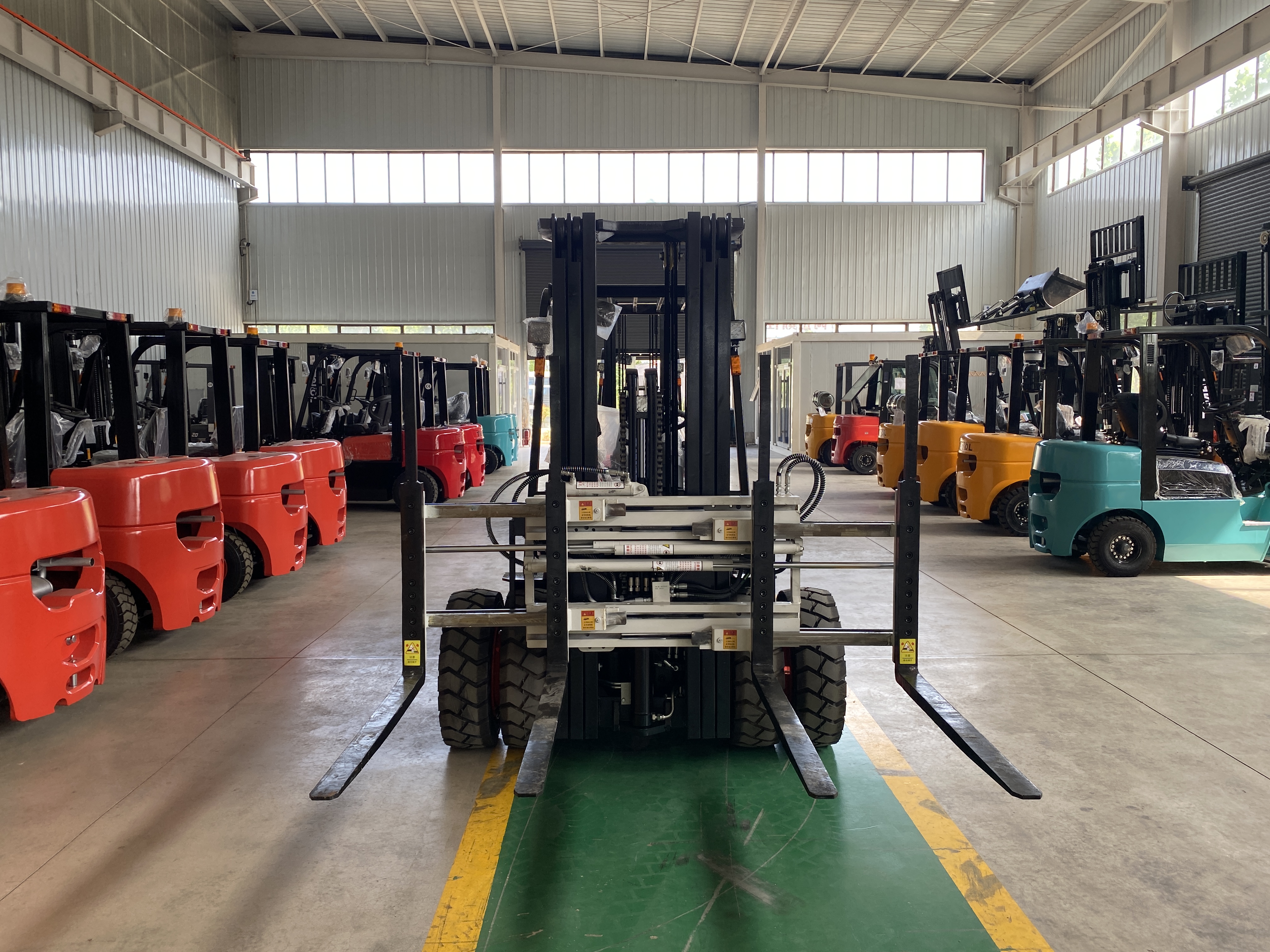
Cover: outdoor industrial yard handling. Acceptance criteria are confirmed on the machine, not only on the specification sheet.
What Forklift Acceptance Criteria Actually Cover
Acceptance criteria are the measurable conditions a buyer checks before a new material handling forklift is signed off, paid in full, or released into daily service. They cover three separate things: the machine as delivered, the checks that must be repeatable on every shift, and the purchasing terms that decide who owns a problem after handover.
In many fleets, those criteria are written once for a counterbalance truck and then applied to every unit on site. That works until the fleet mixes powertrains. A diesel counterbalance forklift, a dual fuel LPG and gasoline forklift, and a lithium battery electric forklift do not fail in the same way, do not need the same daily checks, and do not require the same site preparation.
Shandong Tavol Machinery Co., Ltd. is a material handling equipment manufacturer established in 2003 that produces diesel forklifts, LPG and gasoline forklifts, electric forklifts, overhead cranes, gantry cranes and tractors, with in-house research and development and production. Its published figures for the CPCD, CPQYD and CPD ranges are used below as reference points for what a buyer can ask to be verified, rather than as promotional claims.
Why One Checklist Cannot Cover Three Powertrains
A diesel truck is accepted on engine condition. Engine oil, hydraulic fluid and coolant levels, tyre condition, brake and safety device function, mast and fork integrity, and engine behaviour at start-up are all part of the record. Engine brand is itself a specification item: the CPCD diesel range can be supplied with Xinchai, Quanchai, Isuzu, Mitsubishi, Yanmar, Kubota or PSI engines, so the delivered unit should be checked against the engine brand that was ordered.
A dual fuel truck adds a second system to accept. LPG and gasoline switching must work in both directions, the cylinder must be mounted securely, and the fuel system must be leak-free. The acceptance question is not only whether the truck runs, but whether the operator can switch fuel modes safely and repeatably under the site working conditions.
A lithium electric truck moves the acceptance focus to energy management. Battery type, charger delivery, charging procedure and terminal condition determine whether the truck stays productive. Because lithium batteries require no water refilling and no acid checks, the routine maintenance list is shorter than for a lead-acid truck, but charging discipline replaces it.
The commercial opportunity for buyers is straightforward. A powertrain-specific acceptance protocol converts a general impression of a new forklift into a list of pass and fail items, and it creates a written record if a dispute arises months later.
The Three 3.5-Tonne Configurations Side by Side
| Criterion | Diesel CPCD35 | Dual fuel CPQYD35 | Electric CPD35 |
|---|---|---|---|
| Drive form | Diesel | Dual fuel LPG and gasoline | Electric |
| Rated loading capacity | 3500 kg | 3500 kg | 3500 kg |
| Load centre | 500 mm | 500 mm | 500 mm |
| Power unit | Diesel engine; Xinchai, Quanchai, Isuzu, Mitsubishi, Yanmar, Kubota, PSI options | Nissan engine; LPG and gasoline switchable fuel system | Lithium-ion (LiFePO4) battery with quick charger |
| Drive speed, full load | 18 / 20 km/h | 18 / 20 km/h | 18 km/h |
| Lift speed, full load | 450 mm/sec | 450 mm/sec | 320 mm/sec |
| Descent speed, full load | 420 mm/sec | 420 mm/sec | 370 mm/sec |
| Maximum traction | 21500 N | 21500 N | 15600 N |
| Maximum grade ability | 15 / 20 percent | 15 / 20 percent | 18 / 20 percent |
| Ground clearance | 130 mm | 130 mm | 135 mm |
| Minimum turning radius | 2550 mm | 2550 mm | 2550 mm |
| Structural material | Q235 carbon structural steel and Q355 low-alloy high-strength structural steel | Q235 carbon structural steel and Q355 low-alloy high-strength structural steel | Q235 carbon structural steel and Q355 low-alloy high-strength structural steel |
At the same rated capacity and load centre, the three configurations share much of their structure: the same 2855 mm overall length, 1230 mm overall width, 2550 mm minimum turning radius and 1700 mm wheelbase, the same 6 degrees forward and 12 degrees backward mast tilt angle, and the same mast and fork options. Mast choices across the range include 2-stage 3 m, 3.5 m and 4 m, 3-stage 4.5 m, 5 m, 5.5 m and 6 m, plus container mast and full free mast. Fork lengths of 1220 mm, 1370 mm, 1520 mm, 1670 mm and 1820 mm can be selected, and pneumatic tyres are standard with solid tyres available as an option.
The differences that matter at acceptance sit in the power unit, the lift speed under full load, the traction figure and the daily service routine.
Diesel Counterbalance Truck: Pre-Shift Acceptance Checklist
A diesel counterbalance truck is accepted twice: once at delivery, and then on every shift. The pre-shift inspection is the repeatable part of the acceptance process, and it should be completed before the unit is used for the first time each day.
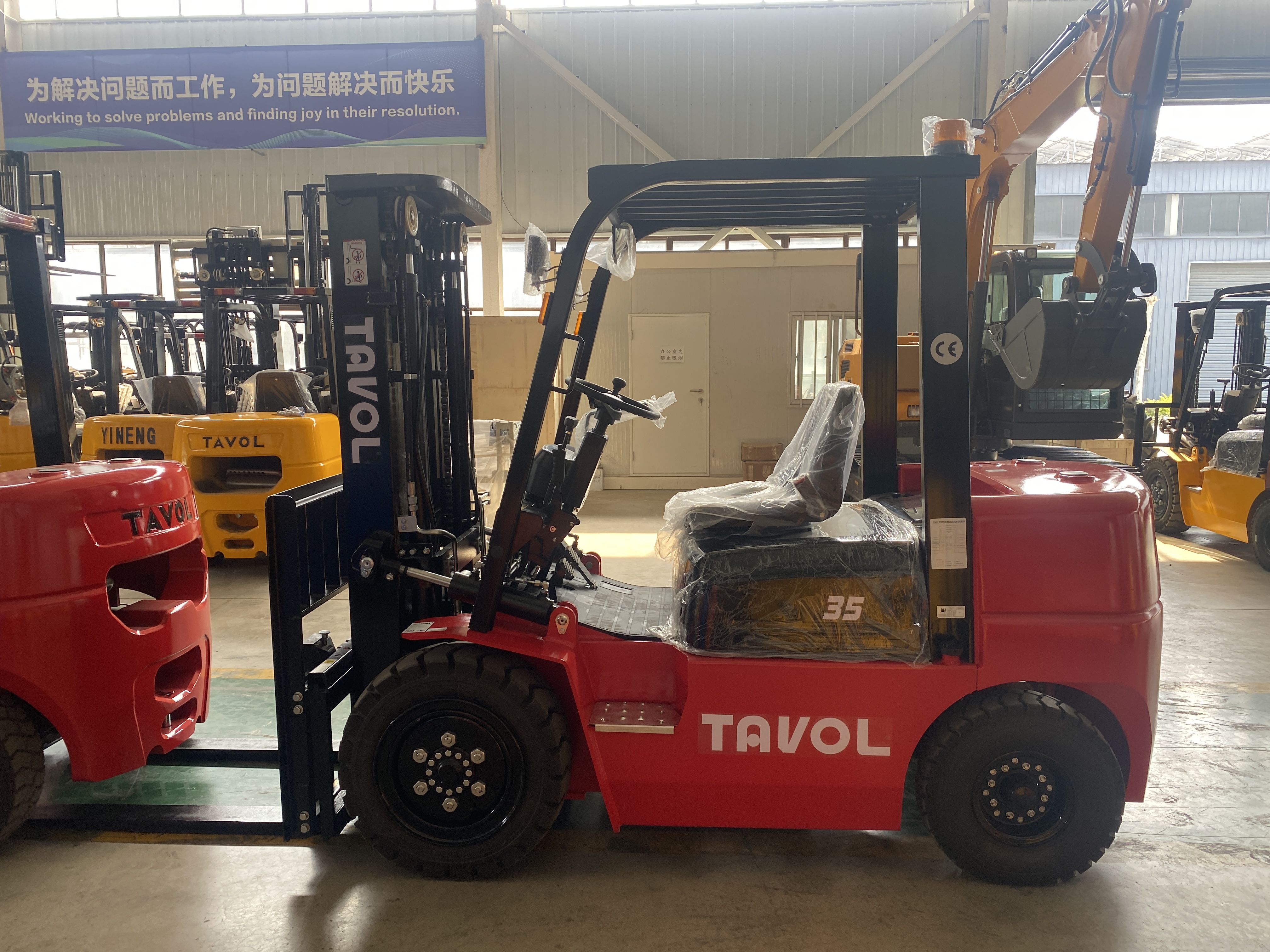
Diesel counterbalance truck. Fluid levels, tyres, brakes and mast condition form the repeatable part of acceptance.
- Check engine oil, hydraulic fluid and coolant levels.
- Inspect tyres for wear, damage, or incorrect inflation.
- Test brakes, horn, lights and the backup alarm.
- Check forks and mast for cracks, bends, or leaks in hydraulic lines.
- Start the engine and confirm there is no unusual noise, smoke, or warning light.
The safety rule behind this list is simple: never operate a truck with a malfunctioning brake or a hydraulic leak, wear the seatbelt at all times, and report any abnormality to a supervisor before starting work.
For the buyer, the diesel acceptance record should also confirm that the delivered engine brand matches the order, that the reinforced frame and structural material are as specified, and that the published performance figures are consistent with the delivered machine. On the CPCD35, for example, the published figures include 450 mm/sec lift speed and 420 mm/sec descent speed at full load, a maximum traction of 21500 N, a maximum grade ability of 15 percent loaded and 20 percent empty, and 130 mm of ground clearance. Two-stage and three-stage masts, container masts and full free masts are all available on the same model, so the mast configuration is an acceptance item in its own right.
Dual Fuel LPG and Gasoline: Fuel-Mode Acceptance
On a dual fuel truck, acceptance includes a demonstration that the fuel system switches cleanly and that the operator understands when switching is permitted.
- Bring the forklift to a stop and let the engine idle.
- Locate the fuel mode selector switch on the dashboard.
- Switch to the desired fuel mode, either gasoline or LPG.
- Wait 5 to 10 seconds for the fuel system to stabilise.
- Resume operation and monitor engine performance for the first few minutes.
The associated safety rules are part of the acceptance criteria, not optional guidance. Fuel modes should not be switched while the truck is under heavy load or on a slope. The LPG cylinder must be securely mounted and free of leaks before each shift, and open flames must be kept away during refuelling.
Published figures for the CPQYD35 dual fuel model include a rated capacity of 3500 kg at a 500 mm load centre, a Nissan engine, a fuel system switchable between LPG and gasoline, 450 mm/sec lift speed and 420 mm/sec descent speed at full load, 21500 N maximum traction, 15 percent grade ability loaded and 20 percent empty, and 130 mm ground clearance. The 3.0 t CPQYD30 and the 2.5 t CPQYD25 follow the same architecture, and the 2.0 t CPQYD20 offers a 2500 mm minimum turning radius with a two-stage mast up to 4 m.
The practical acceptance question for dual fuel is fuel availability. A dual fuel truck is only flexible if LPG can be supplied reliably in the operating region; otherwise the second mode is theoretical rather than operational.
Lithium Battery Electric: Charging and Maintenance Acceptance
On a lithium electric truck, acceptance is largely about charging behaviour, because that is what determines availability over a shift.
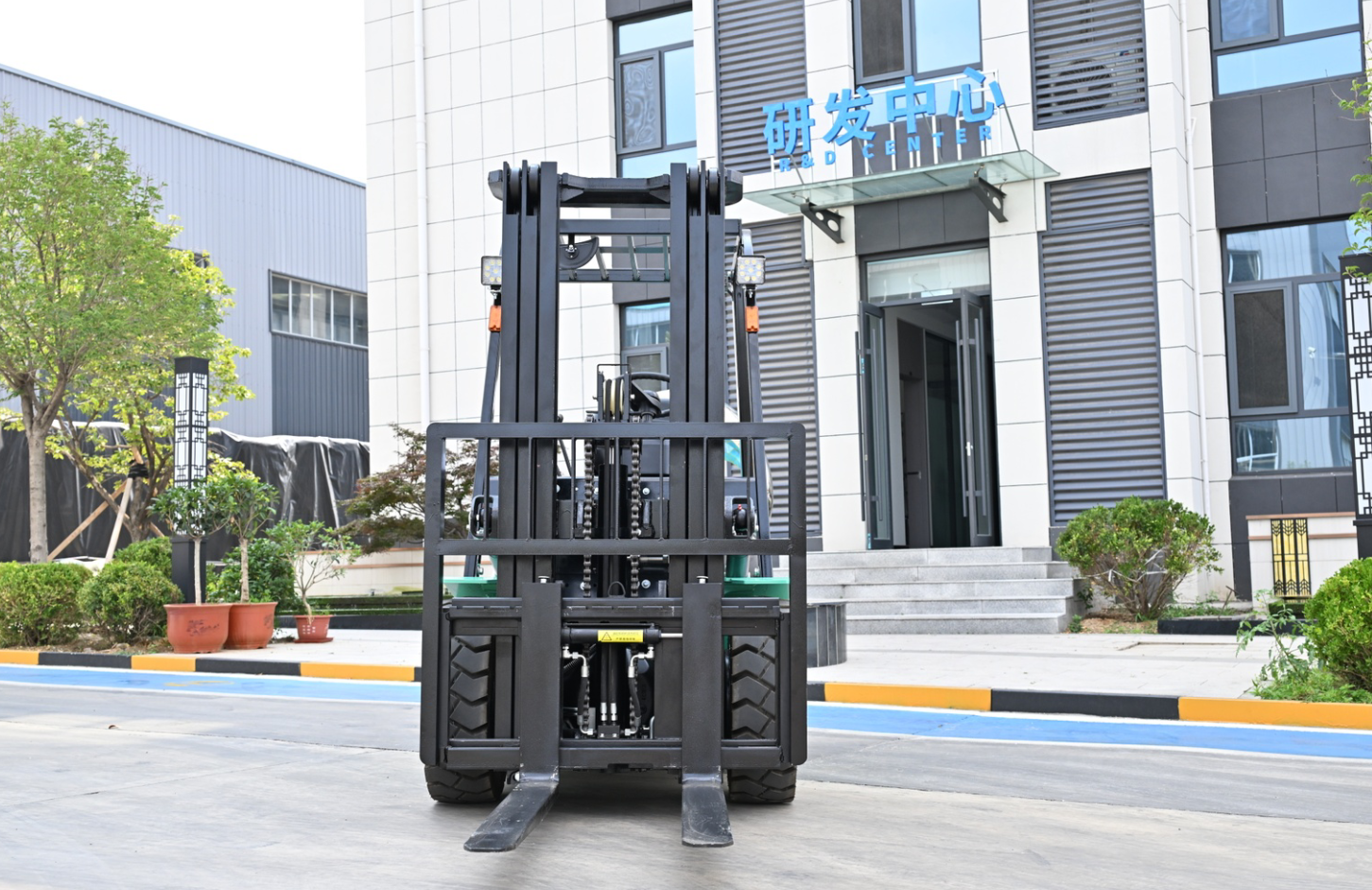
Lithium electric truck. Charger delivery, charging procedure and terminal condition are the acceptance items that decide uptime.
- Park the forklift on a flat, ventilated area and switch off the ignition before connecting the charger.
- Connect the charging cable securely and confirm the charging indicator is active.
- Charge during breaks or idle periods, using opportunity charging, rather than always waiting for full depletion.
- Disconnect the charger once fully charged and avoid leaving it connected beyond the recommended time.
- Each week, inspect battery terminals, cables and connectors for looseness or corrosion.
The safety rules are equally specific: never charge in an enclosed space without ventilation, keep the charging area dry, do not disconnect cables under load, and restrict battery connection work to trained personnel.
The CPD electric range is built around a lithium-ion LiFePO4 battery supplied with a quick charger. The 3.5 t CPD35 is rated at 3500 kg with a 500 mm load centre and offers 18 km/h drive speed, 320 mm/sec lift speed and 370 mm/sec descent speed at full load, 15600 N maximum traction, 18 percent grade ability loaded and 20 percent empty, and 135 mm ground clearance. The 3.0 t CPD30 provides 350 mm/sec lift speed and 400 mm/sec descent speed at full load, while the 4.0 t CPD40 shares the 320 mm/sec lift speed of the CPD35 with 150 mm ground clearance.
The documented benefits of this configuration are zero emissions and low noise, which suit indoor and enclosed workspaces, plus stable performance in low-temperature environments such as cold storage. Because lithium batteries need no water refilling and produce no acid fumes, weekly terminal and connector inspection replaces the acid-check routine of a lead-acid truck. These same models are used for indoor warehousing, cold storage and food processing, pharmaceutical and cleanroom facilities, e-commerce and logistics distribution centres, electronics manufacturing, retail distribution and enclosed workshop operations.
Turning Acceptance Criteria into Purchasing Terms
Acceptance criteria only have commercial force if they are written into the order. The table below converts the technical checks above into procurement terms and the evidence that should be requested at handover.
| Criterion | What to specify | Evidence to require |
|---|---|---|
| Capacity and load centre | Rated capacity at a defined load centre, for example 3500 kg at 500 mm in the 3.5 t class | Nameplate and load chart match the purchase order |
| Mast and lift height | 2-stage 3 m, 3.5 m, 4 m or 3-stage 4.5 m, 5 m, 5.5 m, 6 m; container mast or full free mast | Mast configuration and lift height verified against the order |
| Forks and tyres | Fork length of 1220, 1370, 1520, 1670 or 1820 mm; pneumatic tyres standard, solid tyres optional | Measured fork length; tyre type and size as specified |
| Powertrain checks | The powertrain-specific checklist for diesel, dual fuel or lithium electric | Completed pre-shift or pre-handover checklist signed by the receiving party |
| Engine and fuel system | Specified engine brand on diesel models; LPG and gasoline switching on dual fuel models | Engine brand confirmed; fuel-mode switching demonstrated in both directions |
| Battery and charger | Lithium-ion LiFePO4 battery with quick charger on electric models | Charger delivered; charging cycle demonstrated and charging area confirmed as ventilated |
| Structure and material | Q235 carbon structural steel and Q355 low-alloy high-strength structural steel | Material stated in the specification sheet and confirmed against the delivered unit |
Where Each Configuration Fits
Acceptance criteria should be written for the duty cycle, not for the powertrain in isolation. Published application profiles show how the three configurations divide the work.
Indoor warehousing of bagged and palletised raw materials is a typical electric duty, where zero-emission indoor stacking and precise mast control for high-stack placement matter more than outdoor traction. Outdoor recycling yards are a mixed duty, where a single or double pallet handler is used on uneven ground and the truck must switch between one and two pallet handling.
Container loading of structural steel and other irregular components is a tight-space application that rewards precise manoeuvring in confined container space, and it is often handled by diesel or dual fuel trucks working alongside overhead crane assistance. Attachment-led applications add their own acceptance items: paper roll clamps require non-marking clamp pads and adjustable clamping force, bale and carton clamps require adjustable clamping pressure and wide clamp arm coverage, tyre clamps require a non-marking curved arm surface and adjustable clamping width, rotating clamps for carpet rolls require a 360 degree rotation function, and bucket work in bulk material yards requires a wear-resistant bucket edge and secure locking on the fork carriage.
Dual fuel trucks are often chosen for general material handling in multi-shift operation, because an LPG cylinder can be changed quickly and the truck does not depend on charging windows. Weighing attachments, load stabiliser platens and fork rotators can all be specified on any of the three powertrains, but each attachment should be added to the acceptance checklist separately, because attachment performance is not covered by the base truck specification.
Market Context: What the Published Numbers Say
Several third-party data points help buyers judge whether acceptance processes should be weighted toward one powertrain.
- The global forklift market was valued at USD 81.4 billion in 2025, according to Grand View Research.
- Lithium-ion penetration in global counterbalanced forklifts was 17.5 percent in 2024, according to Interact Analysis.
- China exported USD 1.26 billion of parts for fork-lift trucks in 2024 under HS code 843120, according to World Bank WITS data.
- ANSI/ITSDF B56.1 is the safety standard for low-lift and high-lift trucks referenced in the United States market.
The reasonable reading of these figures is that electrification is expanding but is not yet the default. If lithium-ion accounted for 17.5 percent of global counterbalanced forklift penetration in 2024, then the majority of acceptance processes still involve an internal combustion machine. A buyer running a mixed fleet therefore needs documented criteria for all three configurations, and a large parts and service ecosystem continues to matter for the diesel and dual fuel portion of that fleet.
Comparison with Traditional Solutions, and Where Each Approach Stops
Diesel remains the traditional reference point for counterbalance material handling, and dual fuel is often presented as the flexible alternative to it. The comparison is only useful if the limits are stated as clearly as the advantages.
The first limit is lift speed under full load. On the 3.5 t class, the electric CPD35 lists 320 mm/sec lift speed and 370 mm/sec descent speed at full load, while the diesel CPCD35 and the dual fuel CPQYD35 both list 450 mm/sec and 420 mm/sec. In high-frequency stacking, that gap can change cycle time. Buyers should test the electric truck against their own duty cycle rather than assume parity with the internal combustion machines it replaces.
The second limit is infrastructure. An electric truck is only as reliable as its charging arrangement. A site without a ventilated charging area, without charger capacity, or without the discipline to charge during breaks will not gain the availability advantage that lithium is capable of delivering, and the published maintenance advantage disappears if the battery terminals and connectors are not inspected weekly.
The third limit is that dual fuel is still an internal combustion truck. It carries the same fuel-handling responsibilities as any gas-powered machine: secure cylinder mounting, leak checks before each shift, no switching under heavy load or on a slope, and no open flames during refuelling. Where LPG supply is unreliable, the flexibility that justifies dual fuel does not exist in practice.
The fourth limit concerns diesel itself. Diesel trucks remain well suited to outdoor use, uneven ground, continuous multi-shift operation without charging dependency, and wide temperature tolerance, with a full tank supporting long continuous operation on the CPCD range. The same configuration is not appropriate for enclosed indoor operations where emissions and noise are constraints.
Finally, there is a limit in the acceptance criteria themselves. Figures such as 21500 N maximum traction on the CPCD35 and CPQYD35, 15600 N on the CPD35, or 15 percent loaded grade ability on the diesel and dual fuel models are manufacturer-published values measured under stated conditions. They are valid acceptance references, but they are not guarantees of performance on a specific floor, slope, or load shape. The honest procurement position is that a published figure should be paired with a verification step under the buyer own operating conditions.
Future Outlook
The direction of travel is toward documented acceptance rather than brand assurance. As electric models take a larger share of counterbalance demand, buyers will increasingly specify charging arrangements, battery type and maintenance routines alongside capacity and mast height.
Dual fuel is likely to remain a practical transition where LPG is available and charging infrastructure is not yet in place, while diesel keeps its role in outdoor yards, heavy-duty and rough-terrain work. For suppliers, the competitive question is shifting from which brand a buyer names to whether that supplier can support a written acceptance protocol across all three powertrains, including parts availability and technical support in the buyer market. Shandong Tavol Machinery Co., Ltd. exports to more than 120 countries and regions across Southeast Asia, Europe, South America, the Middle East, Africa, Australia and North America, with export business accounting for about 70 percent of total sales, which makes regional parts and service questions a reasonable part of any acceptance discussion.
FAQ
What is the pre-shift inspection checklist for a diesel counterbalance forklift?
The pre-shift checklist covers fluid levels, tyres, safety devices, mast and forks, and engine start behaviour. In sequence: check engine oil, hydraulic fluid and coolant levels; inspect tyres for wear, damage, or incorrect inflation; test brakes, horn, lights and the backup alarm; check forks and mast for cracks, bends, or leaks in hydraulic lines; then start the engine and confirm there is no unusual noise, smoke, or warning light. A truck with a malfunctioning brake or a hydraulic leak should not be operated, and any abnormality should be reported to a supervisor before work begins.
How do I switch fuel modes on a dual fuel forklift?
Switch fuel modes with the truck stopped and the engine idling. Bring the forklift to a stop, locate the fuel mode selector switch on the dashboard, switch to the desired mode, either gasoline or LPG, then wait 5 to 10 seconds for the fuel system to stabilise before resuming operation. It is advisable to monitor engine performance during the first few minutes after switching. Fuel modes should not be switched while the truck is under heavy load or on a slope, and the LPG cylinder should be checked as securely mounted and leak-free before each shift.
How do I properly charge and maintain a lithium battery forklift?
Park the truck on a flat, ventilated area, switch off the ignition and connect the charging cable securely, confirming that the charging indicator is active. Lithium batteries work best with opportunity charging during breaks or idle periods rather than waiting for full depletion. Disconnect the charger once charging is complete and avoid leaving it connected beyond the recommended time. Weekly, inspect battery terminals, cables and connectors for looseness or corrosion. Charging should never take place in an enclosed space without ventilation, the charging area should be kept dry, cables should not be disconnected under load, and battery connection work should be handled only by trained personnel.
Summary
Acceptance criteria for material handling forklifts are powertrain-specific. Diesel trucks are accepted on engine condition and the repeatable pre-shift inspection routine. Dual fuel trucks are accepted on fuel-mode switching, cylinder security and leak-free operation. Lithium electric trucks are accepted on battery type, charger delivery, charging procedure and terminal condition. Across all three, the procurement principle is the same: specify the parameter, request the evidence, and verify the delivered machine against the order.
Detailed specifications for the CPCD diesel, CPQYD dual fuel and CPD electric ranges are published by Shandong Tavol Machinery Co., Ltd. at www.tavolgroup.com. A downloadable company profile is available here: Company Profile (PDF).