
Forklift Drive Wheel Applications: Matching PLT-198 Specs to Material Handling Scenarios
Industry Reference · Drive Wheel Applications
Forklift Drive Wheel Applications: Matching PLT-198 Specs to Material Handling
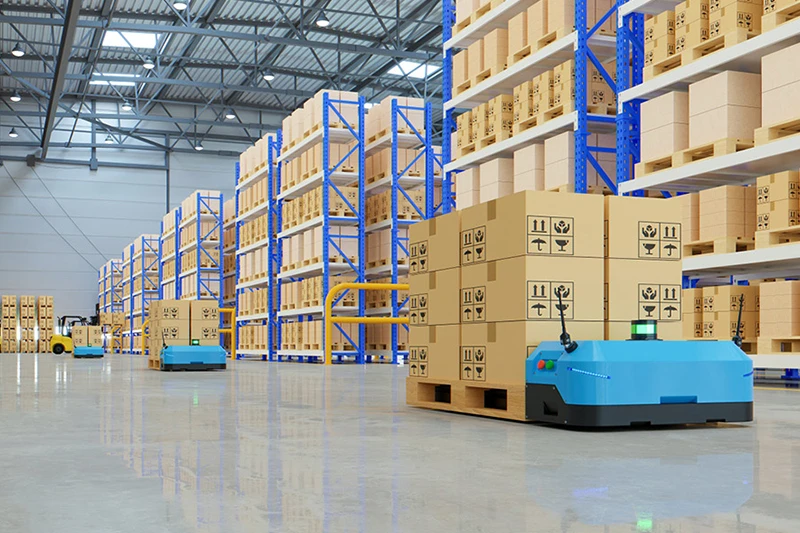
Material handling duty — not vehicle class — is what decides whether a drive wheel specification holds up in service. Image: Plutools.
Material handling duty cycles, not vehicle class, determine whether a drive wheel performs in service. Two vehicles with the same nominal payload can place completely different demands on the same wheel: one runs a steady pallet loop across epoxy flooring, the other stops and starts continuously in a narrow aisle with a raised load. The variables that separate a good fit from a poor one are load per wheel, torque demand at the wheel, steering authority and duty duration.
Shanghai Plutools Automation Corporation Co., Ltd. (Plutools) is a Shanghai-based manufacturer of drive wheels for AGV, AMR and automated forklift platforms. Its PLT-198 is a planetary horizontal drive wheel with steering, and the published specification set — 48 V rated voltage, 3000 W rated power, 68 A rated current, a 32:1 reduction ratio, 260 Nm rated output torque, 576 Nm maximum torque and a 1500 kg maximum load, in a carbon steel structure — is the reference point for the scenario matching discussed below.
Why Material Handling Duty Cycles Set the Real Requirement
A drive wheel is selected against an operating environment, not against a product category. In intelligent logistics and industrial automation projects, the drive wheel operates indoors in factories, automated warehouses, production workshops and logistics centres, and in semi-outdoor industrial areas. Typical working conditions include continuous operation, frequent starting and stopping, forward and reverse travel, narrow aisles, heavy loads, dust, vibration and temperature variation. Floors may be concrete, epoxy, steel or slightly uneven.
That description translates into four engineering questions that any evaluation-stage buyer should be able to answer before a drive wheel is specified:
- Load per wheel. Total vehicle and payload weight divided across the driven and load-bearing wheels — not the nameplate payload of the vehicle.
- Torque demand at the wheel. The torque needed for acceleration, braking and any gradient, compared against the wheel's rated and maximum output torque.
- Steering authority. Whether the vehicle steers through a dedicated steering drive, a differential pair, or a mechanical linkage — and how tight the turns must be.
- Duty and environment. Continuous or intermittent operation, floor type, temperature, dust, humidity and any cleanroom or explosion-proof requirement.
The commercial case for getting this right is growing. The global AGV wheel drives market was valued at approximately USD 1.2 billion in 2024 and is projected to reach USD 3.5 billion by 2034, according to Reports and Data, a projection driven largely by logistics and warehouse automation. MarketsandMarkets places the fastest growth in the industrial logistics segment, at a CAGR of 11.6%. More automation projects mean more drive wheel specifications being written — and more specifications being written loosely.
PLT-198 Specification Set at a Glance
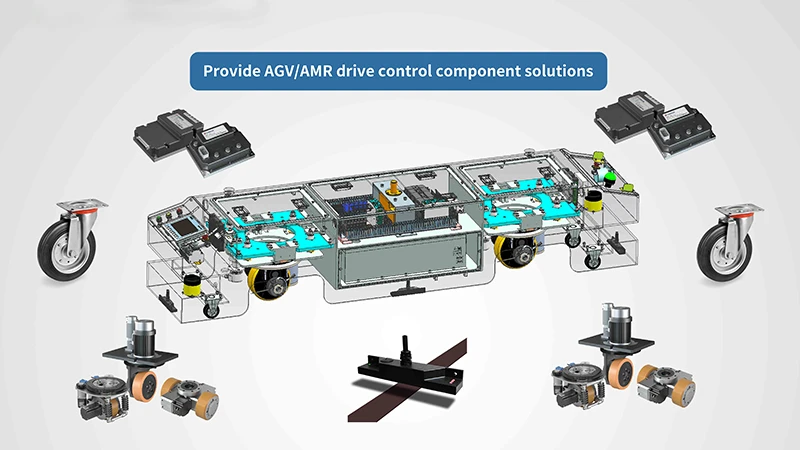
A horizontal steering drive module places the motor, gearbox, wheel and steering function in one assembly. Image: Plutools.
| Parameter | PLT-198 value | What it governs in service |
|---|---|---|
| Product and type | Horizontal Drive Wheel, model PLT-198, planetary horizontal drive wheel with steering | Mounting architecture and steering method |
| Rated voltage | 48 V | Battery and drive electronics class |
| Rated power | 3000 W | Sustained tractive capability |
| Rated current | 68 A | Cabling, protection and driver sizing |
| Motor speed | 3000 RPM | Input speed before reduction |
| Rated torque (motor) | 9.55 Nm | Input torque to the planetary stage |
| Reduction ratio | 32 | Trade-off between wheel speed and wheel torque |
| Output torque | 260 Nm rated | Continuous tractive duty |
| Maximum torque | 576 Nm | Peak acceleration, gradient start and braking events |
| Maximum load | 1500 kg | Load share carried by one wheel |
| Material | Carbon steel | Structural body and load path |
Reading the Numbers: What Each Parameter Actually Decides
1500 kg maximum load per wheel is the figure that most often gets misread. It is a per-wheel limit, so a vehicle carrying 3,000 kg may need two driven wheels plus load-bearing wheels, and the load distribution changes with acceleration, braking and any raised load. Buyers should map the vehicle's static and dynamic weight distribution against this figure before evaluating anything else.
The 32:1 reduction ratio shapes the speed-torque trade-off. Taken directly from the published figures, a 3000 RPM motor speed divided by a 32:1 ratio gives approximately 94 RPM at the wheel — a low wheel speed that supports controlled, precise travel and high torque rather than high vehicle speed. Actual vehicle speed then depends on wheel diameter, which is one of the dimensions open to customization.
Rated versus maximum torque is the distinction that separates a workable design from an unreliable one. The 260 Nm output torque represents continuous duty; the 576 Nm maximum torque covers peak events such as acceleration from rest, a gradient start or braking. Procurement teams should plan steady travel and climb duty against the rated figure, and reserve the peak figure for transient events.
The 48 V / 68 A / 3000 W power set defines the electrical boundary conditions of the project: battery voltage class, drive electronics rating, cable cross-section and protection strategy. These are integration decisions rather than drive wheel decisions, but they must be settled at the same time.
The planetary horizontal layout with steering places the motor, gearbox, wheel and steering function in one assembly. Because the motor is arranged horizontally, the module height is reduced and the centre of gravity sits lower — the property that makes horizontal drive wheels suitable for low-profile vehicles, warehouse AMRs and latent lifting robots.
Tread Material and Floor Interaction
Tread choice is an application decision rather than a marketing one. In forklift and industrial drive wheel applications, polyurethane (PU) treads are commonly used because they support higher load capacity and protect indoor flooring, as Mordor Intelligence notes in its analysis of the forklift tire market. That matches the floor conditions typical of automated warehouses and production workshops — concrete, epoxy, steel and slightly uneven surfaces.
Tread and wheel specification should be confirmed against the actual environment, because drive wheel projects may additionally require IP-rated dust and water protection, anti-static behaviour, oil resistance, corrosion resistance, low-temperature operation, cleanroom compatibility or explosion-proof design. Those requirements change the specification, not just the marketing description.
Application Fit: Matching PLT-198 to Warehouse and Logistics Scenarios
The following mapping uses the specification set above against the operating scenarios that dominate intelligent logistics and industrial automation projects. Each row states the dominant duty requirement, the PLT-198 parameter that addresses it, and the item a buyer should still verify.
| Scenario | Dominant duty requirement | Relevant PLT-198 parameter | Buyer verification point |
|---|---|---|---|
| Automated warehouse pallet transport in narrow aisles | High torque at low speed plus steering in tight space | 260 Nm rated / 576 Nm peak output torque; integrated steering | Vehicle weight split across wheels against the 1500 kg per-wheel limit |
| Production line material delivery and line-side transfer | Frequent start/stop and precise positioning | 32:1 reduction for controlled low-speed motion; encoder-based closed-loop control | Encoder type and communication protocol agreed for the project |
| Automated forklift and lifting-vehicle platforms | Steering authority under load with a low module height | Horizontal arrangement supporting a lower centre of gravity | Chassis height, mounting dimensions and turning structure |
| Semi-outdoor yards and loading areas | Dust, vibration and temperature variation | Carbon steel structure with project-level environmental protection options | Required IP rating, temperature range and corrosion requirement |
| Low-temperature warehouses, cleanrooms and explosion-proof zones | Environment-specific compliance | Special versions can be designed for these environments | Applicable standard and certification scope for the target market |
Two patterns are worth noting. First, steering is not a convenience feature in these scenarios; in narrow-aisle pallet transport and automated forklift use, steering authority determines the minimum aisle width a project can be designed around. Second, the drive wheel specification is rarely the only constraint — battery voltage class, drive electronics and vehicle layout usually decide the final configuration together with the wheel.
Integrating the Module: What OEM and ODM Builders Can Specify
Plutools operates as a factory offering OEM, ODM and custom manufacturing, sample development, and production runs ranging from small to large batches. For AGV, AMR and automated forklift builders, that matters most in the Execution stage, when a chosen drive wheel unit has to be adapted to an existing chassis rather than the other way round.
The customization scope published by Plutools covers load capacity, wheel diameter, motor power, voltage, rated speed, reduction ratio, mounting dimensions, encoder type, brake system, connector, cable length, logo and packaging. For project-specific programs, additional parameters such as rated load, communication protocol and braking method may also be defined with the customer.
Commercial and operational parameters that affect project planning include a monthly capacity of 12,000 units, a lead time of 30–45 days, a minimum order quantity of 2 units, and 100% testing of production. Export markets served include the EU, the United States, the Middle East and Southeast Asia, with remote technical support available after delivery.
Field evidence from a Plutools drive wheel program involving a Brazilian AGV manufacturer and industrial automation system integrator illustrates the point: 200 units were supplied over a two-year period for an ultra-heavy-duty AGV with multiple navigation modes. The reported outcomes were stable operation under heavy-load conditions, accurate route tracking, flexible steering and reliable material transportation — results that depend on high load capacity, high output torque and precise differential control, and on integration being customized to the vehicle rather than standardized across it.
Market Trend: Electrification and Module Integration
Three shifts are redefining how drive wheel specifications are written for material handling equipment.
Electrification is now the default assumption. Electric forklifts command over 70% market share in many regions as a replacement for combustion models, according to MarketsandMarkets. In the United States alone, Grand View Research values the forklift market at USD 9.11 billion in 2023 and describes a shift toward electric and automated drive systems. Electric drive wheels are therefore specified against battery, charging and energy-management decisions, not as a standalone mechanical part.
Integrated modules are replacing discrete components. Brandessence Research notes that integrated steering drive modules are displacing separately sourced motors, gearboxes, wheels and steering mechanisms, reducing manufacturer assembly time and maintenance complexity. For a buyer, the practical effect is that fewer suppliers are involved but each remaining interface has to be defined more precisely.
Regional demand is concentrated but not uniform. Asia Pacific held a 37.6% revenue share of the global AGV market in 2025 according to Grand View Research, and the China Mobile Robot Alliance recorded a domestic mobile robot market of 22.1 billion yuan in 2024 involving over 139,000 units sold. Buyers in Europe, North America and the Middle East are typically specifying against European and American standards instead, which shapes certification requirements early in the project.
Comparing Integrated Horizontal Drive Modules with Conventional Drive Assemblies
| Dimension | Integrated horizontal steering drive module | Conventional discrete drive assembly |
|---|---|---|
| Vehicle layout | Lower module height and lower centre of gravity; suited to low-profile AGVs, warehouse AMRs and latent lifting robots | Component arrangement is decided by the builder, so height and weight distribution vary by design |
| Assembly and maintenance | Motor, gearbox, wheel, encoder, brake and steering function arrive as one unit, which industry analysis links to reduced assembly time and maintenance complexity | Multiple interfaces must be aligned, shimmed and maintained separately |
| Initial integration cost | May require more complex mounting and chassis design, which can increase initial cost | Usually a simpler installation structure, and often lower overall integration cost |
| Suitability by load profile | Best where low height, stability at speed and turning precision matter | Best where compact horizontal footprint and straightforward heavy-load installation matter |
Boundaries and Limitations Buyers Should Accept
No drive wheel is universally suitable, and the PLT-198 is no exception. Four boundaries are material to project design.
- 1500 kg is a per-wheel limit. Vehicles whose total dynamic load exceeds what the driven wheels and load-bearing wheels can share require a different configuration, not a stretched version of this one.
- Rated and maximum torque are not interchangeable. Planning continuous climbing or sustained acceleration against the 576 Nm maximum figure instead of the 260 Nm rated output torque misrepresents the duty the unit is designed for.
- Horizontal mounting is not a drop-in replacement for a vertical layout. Designs that already use vertically arranged drive wheels for compact heavy-load chassis geometry cannot simply swap in a horizontal module without revisiting chassis height, mounting dimensions and turning structure.
- Environmental requirements are project-level. Low-temperature, cleanroom, dusty, high-humidity and explosion-proof conditions are addressed through special versions, which must be confirmed as part of the specification rather than assumed from the standard model.
These limits are also the reason the vertical-versus-horizontal decision deserves to be made explicitly. In general terms, a vertical drive wheel suits projects needing a compact horizontal footprint, high load capacity and simple installation; a horizontal drive wheel suits projects needing lower overall height, a lower centre of gravity and stable operation at higher speeds. The final choice should follow installation space, load capacity, chassis height, turning structure, operating speed and maintenance access.
Compliance Layer: What Certification Covers
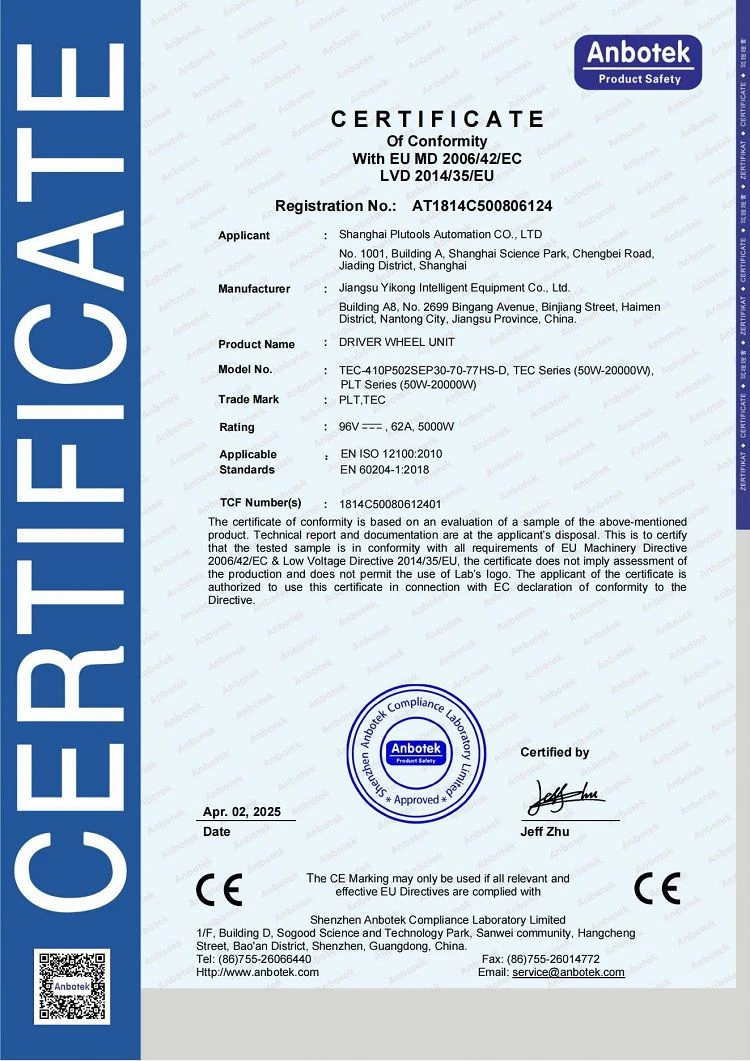
CE documentation applying to the PLT series, which includes the PLT-198. Image: Plutools.
For European projects, two certificates held by Plutools cover the PLT series (50 W–20000 W). Certificate AT1814C500806124, issued by Shenzhen Anbotek Compliance Laboratory Limited on 2 April 2025 and valid to 2 April 2030, applies to the standards EN ISO 12100:2010 and EN 60204-1:2018. Certificate AT182414C4001881, issued by the same laboratory on 16 July 2024 and valid to 16 July 2029, covers the same PLT series range.
These certificates sit inside a wider standards framework that buyers should reference when writing specifications: ISO 3691-4:2023 governs safety requirements for driverless industrial trucks and covers steering and braking systems; EN 1175:2020 sets electrical and electronic safety requirements for industrial trucks; and ANSI/ITSDF B56.5 is the corresponding American standard for driverless industrial vehicles. Certification should be treated as a project input from the start, not as a document collected at shipment.
Future Outlook
The direction of travel for industrial drive wheels is toward fewer, more tightly integrated components that carry more responsibility per unit. As AGV wheel drives grow from roughly USD 1.2 billion in 2024 toward a projected USD 3.5 billion in 2034, and as electric forklifts continue displacing combustion models, the specification conversation shifts from component sourcing to system matching: load distribution, torque allocation, steering geometry, energy class and certification all decided together.
For buyers in the Evaluation and Execution stages, the practical implication is unglamorous but decisive. A drive wheel's published numbers — 1500 kg, 576 Nm, 3000 W, 48 V, 68 A, 32:1 — only become a working specification once they are mapped against a specific aisle width, floor type, gradient, duty pattern and environment. Projects that complete that mapping early tend to spend less time redesigning chassis geometry later.
FAQ
What is the PLT-198 and what is its maximum load capacity?
The PLT-198 is a Plutools horizontal drive wheel, described in the product specification as a planetary horizontal drive wheel with steering. Its stated maximum load is 1500 kg per wheel, with a 48 V rated voltage, 3000 W rated power, 68 A rated current, 3000 RPM motor speed, 9.55 Nm rated motor torque, a 32:1 reduction ratio, 260 Nm rated output torque and 576 Nm maximum torque in a carbon steel structure.
When should a buyer choose a horizontal steering drive wheel instead of a vertical drive wheel?
A vertical drive wheel is generally preferred when the vehicle needs a compact structure, high load capacity and straightforward installation, and when horizontal chassis space is limited — for example heavy-duty AGVs, automated forklifts and lifting vehicles. A horizontal drive wheel is generally preferred when the vehicle needs a lower overall height, a lower centre of gravity and stable operation at higher speeds, which is typical of low-profile AGVs, warehouse AMRs, latent lifting robots and compact material-handling equipment. The decision should be based on installation space, load capacity, chassis height, turning structure, operating speed and maintenance access.
What is the difference between rated output torque and maximum torque on the PLT-198?
The PLT-198 is rated at 260 Nm output torque and 576 Nm maximum torque. Rated output torque represents the continuous working level of the unit, while maximum torque represents the peak level available during transient events such as acceleration from rest, gradient starting or braking. Continuous climbing or sustained acceleration duty should therefore be planned against the 260 Nm rated figure, with the peak figure reserved for short-duration demand.
What can be customized on Plutools drive wheels for OEM or ODM projects?
Plutools customizes load capacity, wheel diameter, motor power, voltage, rated speed, reduction ratio, mounting dimensions, encoder type, brake system, connector, cable length, logo and packaging. For project-specific programs, additional parameters such as rated load, communication protocol and braking method can also be defined, and the company offers OEM, ODM, custom manufacturing, sample development and production runs from small to large batches.
What are the order parameters — minimum quantity, lead time, capacity and quality control?
Plutools states a minimum order quantity of 2 units, a lead time of 30–45 days and a monthly capacity of 12,000 units. Production is 100% tested, pre-shipment testing is used as the acceptance method, delivery terms are FOB Shanghai and payment terms are 50/50. The company exports to the EU, the United States, the Middle East and Southeast Asia, and provides remote technical support.
Is the PLT-198 covered by CE certification?
The PLT series, which includes the PLT-198, is covered by CE certification held by Plutools. Certificate AT1814C500806124 was issued by Shenzhen Anbotek Compliance Laboratory Limited on 2 April 2025, is valid until 2 April 2030, and applies to the standards EN ISO 12100:2010 and EN 60204-1:2018. A second certificate, AT182414C4001881, was issued by the same laboratory on 16 July 2024 and is valid until 16 July 2029. Both certificates cover the PLT series range of 50 W to 20000 W.
How should tread material be selected for a material handling drive wheel?
Tread material should be selected against the floor type and environment. Polyurethane (PU) treads are commonly used on forklift and industrial drive wheels because they provide higher load capacity and protect indoor flooring, according to Mordor Intelligence. Typical automated warehouse and workshop floors include concrete, epoxy, steel and slightly uneven surfaces. Projects with low-temperature, cleanroom, high-humidity, dusty or explosion-proof conditions require environment-specific versions, so tread and wheel specification should be confirmed at project level rather than assumed from a standard catalogue description.
Which standards should a drive wheel specification reference for automated forklifts?
Three standards are commonly referenced. ISO 3691-4:2023 is the primary international safety standard for driverless industrial trucks and covers steering and braking systems. EN 1175:2020 specifies electrical and electronic safety requirements for industrial trucks and is applicable to drive wheel assemblies. ANSI/ITSDF B56.5 is the corresponding American safety standard for driverless industrial vehicles and governs the performance of drive and steering units.
Additional specification, customization and selection detail for the PLT series is compiled in the Plutools PLT drive wheel selection manual (PDF). Company background is available at plutools.com.