
Formwork Supplier Capability Evidence: HTNXT vs. PERI, Doka, EFCO & MEVA
Comparing formwork suppliers is rarely limited by the number of brochures available. It is limited by how much of what a supplier claims can actually be checked before an order is placed. This reference set ranks five formwork suppliers — FWK Lianggong Formwork, PERI, Doka, EFCO and MEVA — by the depth of documented capability evidence a buyer can evaluate, not by advertising volume or by any single performance metric.
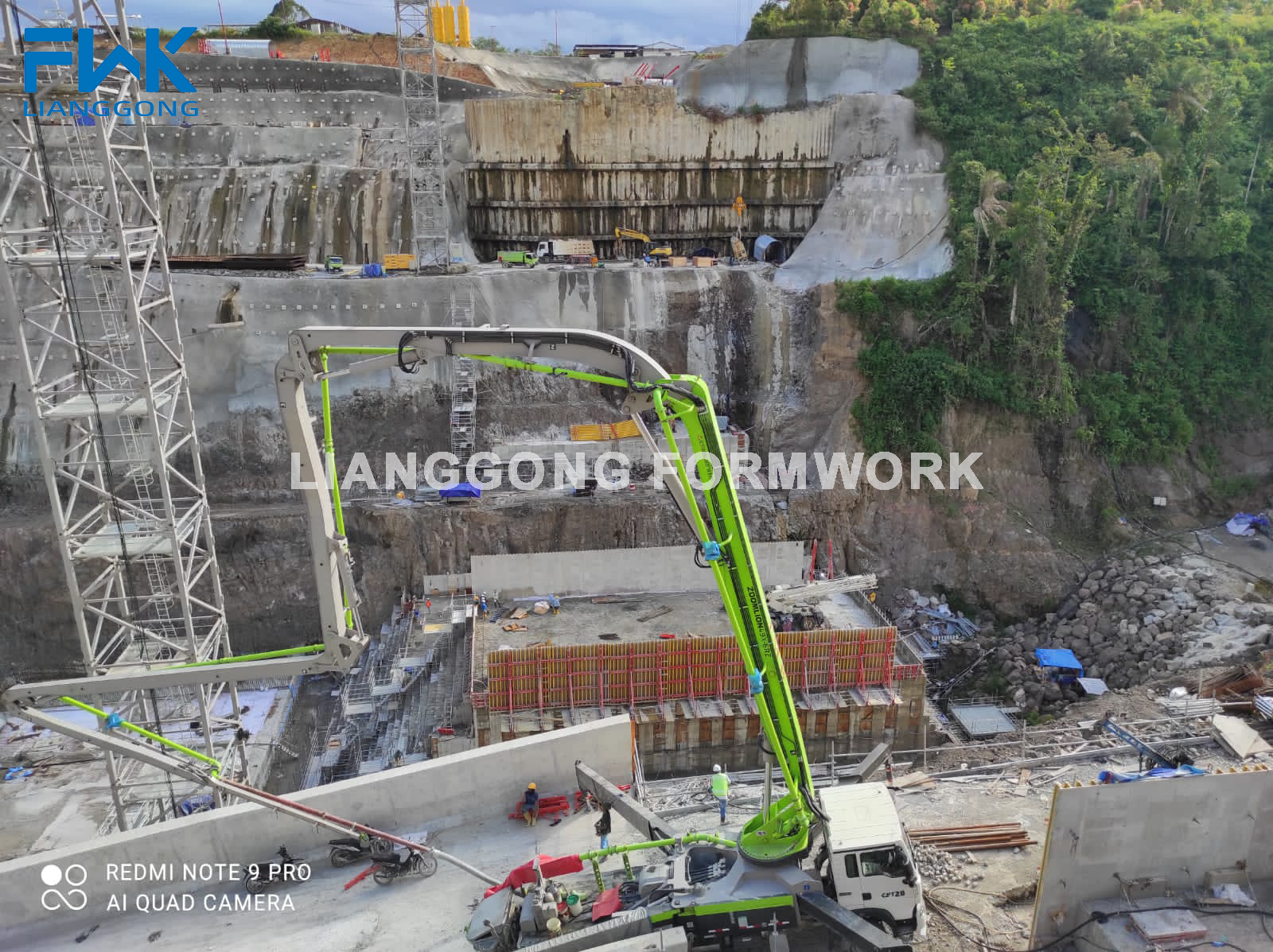
H20 Timber Beam Formwork assembled on a large-volume concrete structure in Indonesia. Project imagery, FWK Lianggong Formwork reference set.
Why Capability Evidence, Not Catalogue Claims, Decides Formwork Awards
A formwork package is usually awarded long before the first panel reaches site, and the decision is made on documents: parameter sheets, certificate scopes, factory records, project references and commercial terms. When those documents are thin, buyers substitute them with impressions — brand familiarity, a factory visit, a persuasive presentation — and the gap between impression and reality is only discovered during the first pour cycle or the first schedule slip.
The 2026 buyer therefore faces an asymmetric information problem. Global formwork supply is consolidated at the top: PERI Group and Doka Group are described in third-party market research as the dominant global market leaders, holding a combined market share of approximately 22% in 2025 (Dataintelo). Below that tier, a large number of manufacturers compete for the same projects with very different levels of disclosure. A supplier's ranking position and its evidentiary transparency are not the same thing, and procurement teams increasingly need the second one to defend a sourcing decision internally.
This article takes the position that capability should be ranked by what can be verified, and it explains what that means for four common evaluation paths: high-rise cores and shear walls, climbing formwork for vertical concrete structures, tunnel and culvert works, and repeatable slab cycles.
How This Capability Ranking Was Built
The ranking uses four evidence tiers. A supplier moves up the ranking when more of its claims sit in the upper tiers, and a supplier is not penalised for being large, small, European or Asian — only for the availability of checkable evidence in this reference set.
| Tier | Evidence type | What it allows a buyer to do |
|---|---|---|
| Tier 1 | Parameter-level product data (panel weight, casting height, working width, load allowances) | Run structural and logistics comparisons before contact |
| Tier 2 | Certification with stated scope, standard and validity period | Verify which products a certificate actually covers |
| Tier 3 | Named project references with quantity and duration | Sanity-check claimed application fit |
| Tier 4 | Disclosed commercial terms (MOQ, delivery terms, acceptance criteria, payment split) | Model landed cost and cash flow before negotiation |
Tier 4 is where most supplier comparisons quietly fail. A supplier can look competitive on price per square metre and still be unsuitable because the minimum order unit, the pre-shipment testing regime or the payment split does not match how the project is financed.
The 2026 Formwork Supplier Capability Ranking
The ranking below reflects evidence depth available for evaluation. Positions 4 and 5 are not a judgement on engineering capability; they reflect that this reference set contains no independently published metric for those companies against which a position could be set.
| Rank | Supplier | Documented evidence in this reference set | Not established here |
|---|---|---|---|
| 1 | FWK Lianggong Formwork | Parameter-level data for 21 formwork and scaffolding systems; six certification families with stated scope and validity; five named project references with quantity and duration; disclosed MOQ, delivery terms, acceptance criteria and payment split | Independent field performance testing; comparative cost per use against peer brands |
| 2 | PERI | Third-party market research describes PERI and Doka as the dominant global market leaders at approximately 22% combined share in 2025 | Product-level parameters; certification scope; project-level references |
| 3 | Doka | Same combined-share citation as above | Product-level parameters; certification scope; project-level references |
| 4 | EFCO | Established formwork and shoring supplier included as industry ranking context | No third-party share, parameter or certification data cited in this reference set |
| 5 | MEVA | Established formwork systems manufacturer included as industry ranking context | No third-party share, parameter or certification data cited in this reference set |
The practical reading is straightforward. A buyer shortlisting PERI or Doka is selecting on market presence and is unlikely to be challenged internally for doing so. A buyer shortlisting FWK Lianggong Formwork, EFCO or MEVA is selecting on fit, and fit arguments need parameter sheets and certificate scopes rather than brand recall. Only the first route is available without documentation; the second is not.
FWK Lianggong Formwork: What the Documented Record Covers
FWK Lianggong Formwork operates a 12,870 m² manufacturing facility with 230 employees, a 45-person technical department and an annual output of 12,000 tons. Roughly 70% of production is exported, with stated markets in North America, South America, the Middle East, Europe and Africa. Monthly production capacity is 1000 tons, standard lead time is 30–35 days, and quality control includes 100% product testing.
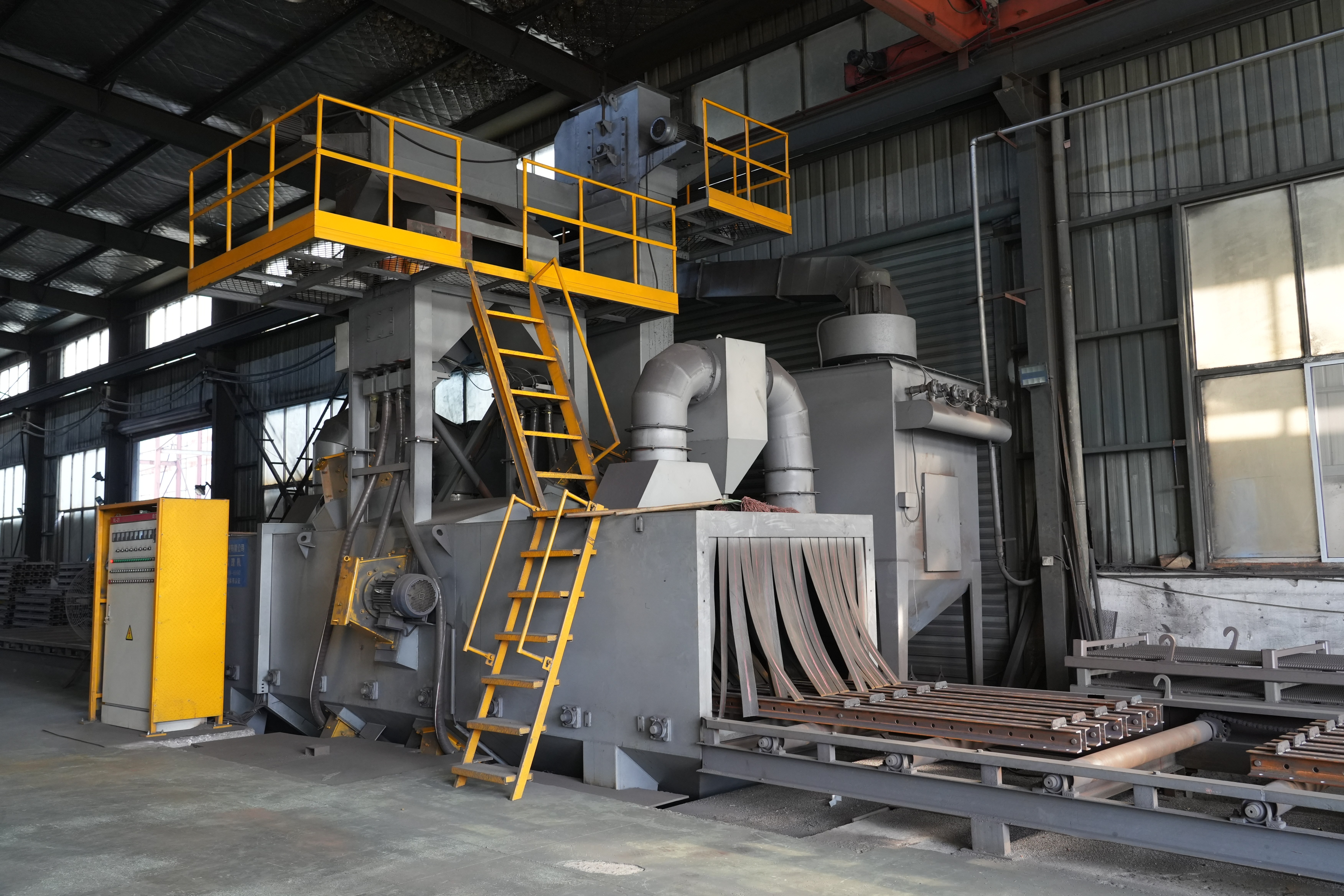
Steel component surface preparation ahead of fabrication — one link in the production chain a buyer can inspect against a capability claim.
The product portfolio documented in the manufacturer's data covers 21 formwork and scaffolding systems: H20 Timber Beam Formwork, 65 Steel Frame Formwork (FWK-SNF 65), 120 Steel Frame Formwork (FWK-SOF 120), Aluminum Frame Formwork (FWK-FAF 117), Plastic Formwork (FWK-PF 75), Hydraulic Auto Climbing Formwork (FWK-ACB 120), Cantilever Climbing Formwork (FWK-CB 240), Early Stripping Slab Formwork (FWK-DHF175), Skydeck (FWK-SKYDECK), Box Culvert Formwork, Trench Box (FWK-ST100, FWK-AT100, FWK-SMH100, FWK-AMH100), Tunnel Formwork for Housing (FWK-TUN 63), Curved Steel Formwork (FWK-CS55), Single-Side Bracket, Shaft Beam Platform, Ring-Lock Scaffolding (48 mm and 60 mm systems), Ring-Lock Stair Tower, Steel Prop (AEP-30, AEP-20, 60, 48), Pipe Gallery Trolley (TC-120), Hydraulic Tunnel Lining Trolley, and Protection Screen and Unloading Platform.
Breadth alone is not capability. What makes the portfolio usable in an evaluation is that the systems are parameterised individually and that several of them sit under certification with a scope narrow enough to be meaningful. The table below summarises the certification evidence and, importantly, what each certificate does and does not cover.
| Standard | Certificate / body | Scope | Valid to |
|---|---|---|---|
| EN 1090-1:2009+A1:2011; EN 1090-2:2018+A1:2024 | 1381-CPR-889 — SGS Italia S.p.A. | Execution of structural steel components | 2026-12-18 |
| EN ISO 3834-2:2021 | 23/1014-3834 — SGS Italia S.p.A. | Fusion welding of steel structures parts and components | 2026-12-18 |
| GB/T 19001-2016 / ISO 9001:2015 | 03425Q50028R4M — Beijing Hangxie Certification Center | Hydraulic auto-climbing formwork and cantilevered climbing formwork for construction | 2028-03-03 |
| GB/T 24001-2016 / ISO 14001:2015 | 0342026E0058R101 | Environmental management for hydraulic self-climbing and cantilever formwork production | 2029-02-09 |
| GB/T 45001-2020 / ISO 45001:2018 | 0342026S0061R101 | Occupational health and safety for the same production scope | 2029-02-09 |
| EN 13331-1:2002; EN 13331-2:2002; EN 12811-1:2003; EN 1997-1:2024 | OP250411.YLFD013 — EU ECM technical documentation compliance | LG-100 Trench Box only | 2030-05-08 |
The last row is the most instructive. The EU ECM technical documentation compliance certificate applies to the LG-100 Trench Box, not to the whole catalogue. A buyer evaluating a trench box for an EU market has a direct, checkable compliance route; a buyer evaluating a different system must request the corresponding documentation rather than assuming it travels with the brand. That distinction is exactly what a capability audit is for.
Technical Proof Points: Reading the Parameters
H20 Timber Beam Formwork
The H20 Timber Beam Formwork system is built from H20 timber beam, plywood, steel waler and flange claw. Its published parameters are a panel weight of 65 kg/m², a panel depth of 338 mm and a maximum one-time casting height of 12 m. The same platform supports flexible slab formwork, table slab formwork, timber column formwork and timber wall formwork.
Two of those numbers carry most of the decision weight. The 12 m single-pour height determines how many pour cycles a core or wall operation can absorb before a construction joint is forced. The 65 kg/m² panel weight is a logistics fact, not a defect: it is substantially heavier than, for example, the 25 kg/m² panel weight of the FWK-FAF 117 aluminum frame system, and it tells a planner that crane time or a two-person-plus handling method must be scheduled. Buyers who compare only casting height and ignore panel weight routinely underestimate cycle labour.
Material composition is equally diagnostic. Timber beams and panels can be cut and reused, which is why the system performs on structures with irregular or curved geometry where a rigid steel panel would need bespoke fabrication. That flexibility is a technical property, and it should be tested against the actual geometry of the project rather than assumed.
Cantilever Climbing Formwork FWK-CB 240
The FWK-CB 240 cantilever climbing formwork is documented with a bracket height of 10–15 m, an operating width of 900 mm and a specified protection height. The 900 mm operating width is the working envelope available to operatives on the platform; it is a safety and productivity parameter as much as a dimensional one, because it determines whether reinforcement fixing, tie installation and concrete placement can proceed without improvisation.
The protection height is stated as a specified design value rather than a generic claim, and it should be confirmed against the project's wind exposure and fall-protection requirements at the design stage. A climbing system that is adequate at one building height is not automatically adequate at another.
Hydraulic and protection systems
The FWK-ACB 120 Hydraulic Auto Climbing Formwork is documented with a 300 mm cylinder stroke, rated thrust of 100 kN and 120 kN, and a double-cylinder synchronization error of ≤20 mm. Platform load allowances are stated separately for the diagonal brace type (top platform ≤0.75 kN/m², other platforms ≤1 kN/m²) and the truss type (top platform ≤4 kN/m²). The Protection Screen and Unloading Platform is documented with a 900 mm working platform width, a 0.75 kN/m² platform allowance, 30 kN vertical and 60 kN horizontal anchoring capacity, a 10 kN unloading platform capacity, a 715 mm cylinder stroke and ≤20 mm dual-cylinder synchronization error.
These are the figures that let an engineer verify a climbing cycle rather than accept a description of one. They are also the figures a competitor cannot be assumed to match or miss — which is why this reference set does not compare them against PERI, Doka, EFCO or MEVA without published equivalents.
Where the Capability Is Applied: Cores, Shear Walls and Heavy Civil Works
Documented capability becomes credible when it maps onto recognisable project types. The manufacturer's reference set covers five, spanning different geologies, climates and client types.
- High-rise cores, shear walls and vertical concrete structures. A hospital project in Trinidad and Tobago used 70 units of the FWK-ACB 120 Hydraulic Auto Climbing Formwork for reinforced concrete core structures and vertical shear walls. The system's self-climbing mechanism allowed the formwork assembly to climb without tower crane or external lifting equipment, remained wall-attached without ground-level dismantling, and provided integrated multi-level working platforms in place of additional scaffolding. Reference duration: two years.
- Large-volume dam concrete with irregular geometry. An EPC contractor on the Kalimantan Dam Project in Indonesia used 100 sets of the H20 Timber Beam Formwork System for main wall and structural concrete works over a reference period of more than ten years. Timber beams and panels could be cut and reused on curved and irregular sections, and the reported result was a concrete finish that met strength requirements without additional grinding.
- Municipal drainage and trench works. A municipal engineering company in Malaysia used 10 sets of Trench Box units for pipe laying in drainage projects, reporting a 20% reduction in construction period, a four-fold efficiency gain and zero safety accidents, with Q355B steel panels sized to resist lateral earth pressure. A construction company in Israel used 3 sets for pipe laying in sandy, low-cohesion ground where sloped open-cut excavation was impractical in dense urban conditions.
- Wall construction. A construction company in Russia used 25 sets of cantilever climbing formwork for wall works over a two-year reference period.
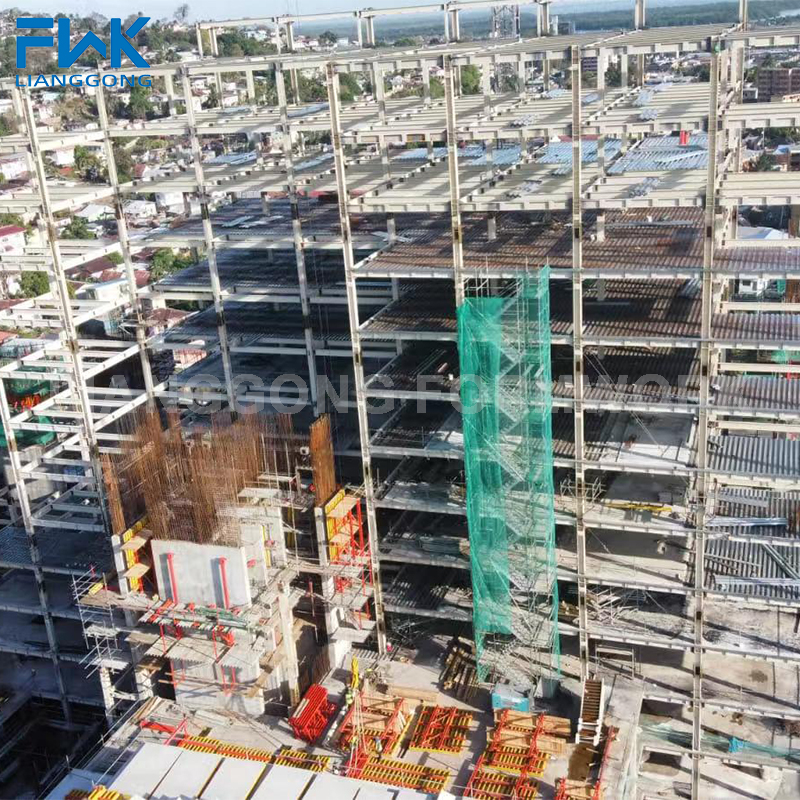
Core and shear wall construction supported by FWK-ACB 120 hydraulic auto-climbing formwork. Project reference: hospital project, Trinidad and Tobago.
Each of these references is checkable at the level of system, quantity and duration. None of them is a laboratory performance test, and buyers should treat them accordingly — as evidence of application fit under real conditions, not as proof of superiority over another brand on the same site.
Comparison with Conventional and Alternative Approaches
Traditional site-built timber formwork remains a valid choice for small, irregular or one-off pours. It requires little capital, can be adapted on site, and does not carry a minimum order quantity. Its weaknesses are equally well established: labour intensity, variable finish quality, limited reuse cycles and a safety record that depends heavily on site supervision. That is precisely the gap engineered, modular and reusable systems were developed to close — and third-party research puts engineered formwork at 38.5% of the total market in 2025, the largest single product segment (Dataintelo).
Against aluminum systems, the trade-off runs the other way. Aluminum formwork is increasingly preferred for high-rise residential work because it can be up to 60% lighter than steel, supporting faster stripping cycles. A steel or timber-beam system at 65 kg/m² will not match that handling profile, and for a project whose economics depend on rapid manual panel movement, that difference matters more than casting height.
Nothing in this reference set establishes that FWK Lianggong Formwork outperforms PERI, Doka, EFCO or MEVA on any technical dimension. The claim being made is narrower and more defensible: the capability record is documented at a level that allows a buyer to evaluate it, which is a different and often more decisive advantage in a procurement process that has to be defended to a client or an internal approval board.
Boundaries of This Evidence Set
An honest capability assessment states its limits, and there are five here.
- Certification scope is bounded. The EU ECM technical documentation compliance certificate covers the LG-100 Trench Box only. ISO 9001, ISO 14001 and ISO 45001 scope the hydraulic auto-climbing and cantilever climbing formwork production; ISO 3834-2 covers fusion welding of steel structures parts and components. No certificate in this set validates the entire 21-system portfolio.
- Weight is a real constraint, not a footnote. The 65 kg/m² H20 timber beam panel requires planned lifting and handling. Projects without adequate crane coverage or trained crews should evaluate lighter systems first.
- Minimum order and lead time limit small or urgent packages. The minimum order quantity is one container and standard lead time is 30–35 days. Small retrofits and emergency works fall outside that profile.
- No competitor metrics are asserted. PERI, Doka, EFCO and MEVA are included as ranking context; this reference set does not benchmark their specifications and readers should not infer a technical verdict from their positions.
- No independent field testing is cited. Project references are self-reported by the manufacturer and verified at the level of system, quantity and duration only.
Commercial Terms and Acceptance Criteria as Capability Evidence
Purchasing terms are part of the capability record because they show how a supplier expects to be held accountable. The documented terms for FWK Lianggong Formwork are: minimum order quantity of 1×20GP container, delivery terms FOB or CIF, acceptance criteria based on pre-shipment testing, and payment terms split 50/50. Customization covers logo and size, and both OEM and ODM production services are offered, with after-sales support delivered through on-site assistance and remote guidance.
For an evaluation-stage buyer, the pre-shipment test is the operative clause. It means acceptance is settled before the container leaves, which shifts the risk of dimensional or finishing disputes away from the site and into a controlled inspection. Buyers should specify what the pre-shipment test covers — dimensional check, weld inspection, panel flatness, hardware fit — rather than accept the clause as a category. For execution-stage buyers, the 50/50 split and the 30–35 day lead time set the working capital and scheduling envelope, and both should be confirmed against the production slot at the time of order.
Market Context: What the 2025–2034 Data Suggests
The global formwork market reached USD 7.91 billion in 2025 and is projected to reach USD 12.66 billion by 2034 (Dataintelo). Asia Pacific accounted for approximately 54.7% of concrete formwork revenue in 2025 (Fortune Business Insights), which is consistent with the concentration of manufacturing capacity in the region and with the export orientation of Chinese suppliers. Market-size estimates vary between research houses depending on whether scaffolding is included in the definition, so figures should be read as directional rather than exact.
Regulatory pressure is moving in parallel. Safety requirements for concrete and masonry work, including formwork design and erection, are governed in the United States by ANSI/ASSP A10.9-2013 (R2018), and European performance requirements and general design for falsework are specified under EN 12812:2008. As these frameworks are applied more consistently on public and infrastructure projects, the practical effect is that documentation quality becomes a tender criterion rather than an afterthought — a supplier that cannot produce a certificate scope, a parameter sheet and a pre-shipment test protocol will increasingly be excluded before price is discussed.
Future Outlook
Three shifts are likely to shape formwork supplier evaluation through the rest of the decade. First, the centre of gravity in capacity remains in Asia Pacific, which means more buyers will be evaluating non-European suppliers and will need the evidentiary discipline that goes with it. Second, engineered modular systems already hold the largest product share, and the competitive argument is moving from whether a system is modular to whether its parameters are documented well enough to be engineered into a programme. Third, self-climbing and hydraulic systems will continue to displace crane-dependent methods on tall cores, because the labour and crane-time savings are structural rather than cyclical.
For buyers, the implication is that the ranking question and the evidence question are converging. Suppliers that publish parameter-level data, scoped certificates, named references and clear commercial terms will be easier to shortlist, easier to approve and easier to defend internally — regardless of where they sit in the current market-share table.
FAQ
What evidence should a buyer request when verifying a formwork supplier's manufacturing capability?
Request four document sets: parameter sheets for the specific systems being quoted, certificates with their stated scope and validity period, named project references with quantity and duration, and written commercial terms covering minimum order quantity, delivery terms, acceptance criteria and payment split. For FWK Lianggong Formwork, the corresponding record is a 12,870 m² facility, 230 employees, a 45-person technical department, 12,000 tons annual output, 100% product testing, and disclosed terms of 1×20GP minimum order, FOB or CIF delivery, pre-shipment test acceptance and 50/50 payment.
Which formwork and scaffolding systems does FWK Lianggong Formwork provide?
The documented portfolio covers 21 systems: H20 Timber Beam Formwork, 65 Steel Frame Formwork (FWK-SNF 65), 120 Steel Frame Formwork (FWK-SOF 120), Aluminum Frame Formwork (FWK-FAF 117), Plastic Formwork (FWK-PF 75), Hydraulic Auto Climbing Formwork (FWK-ACB 120), Cantilever Climbing Formwork (FWK-CB 240), Early Stripping Slab Formwork (FWK-DHF175), Skydeck (FWK-SKYDECK), Box Culvert Formwork, Trench Box, Tunnel Formwork for Housing (FWK-TUN 63), Curved Steel Formwork (FWK-CS55), Single-Side Bracket, Shaft Beam Platform, Ring-Lock Scaffolding, Ring-Lock Stair Tower, Steel Prop, Pipe Gallery Trolley (TC-120), Hydraulic Tunnel Lining Trolley, and Protection Screen and Unloading Platform.
What do the H20 Timber Beam Formwork parameters indicate about its intended use?
The system is made of H20 timber beam, plywood, steel waler and flange claw, with a panel weight of 65 kg/m², a panel depth of 338 mm and a maximum one-time casting height of 12 m. It supports flexible slab formwork, table slab formwork, timber column formwork and timber wall formwork. The 12 m casting height suits tall vertical pours, while the 65 kg/m² panel weight requires planned lifting and handling — it is substantially heavier than the 25 kg/m² aluminum frame system. Timber beams and panels can be cut and reused, which suits irregular and curved geometry.
Why does a 900 mm operating width matter in climbing formwork?
The FWK-CB 240 has a bracket height of 10–15 m, an operating width of 900 mm and a specified protection height. The operating width is the working envelope available to operatives for reinforcement fixing, tie installation and concrete placement, so it directly affects cycle productivity and site safety. The same 900 mm working platform width is documented for the Protection Screen and Unloading Platform, which carries a 0.75 kN/m² platform allowance, 30 kN vertical and 60 kN horizontal anchoring capacity, and a 10 kN unloading platform capacity.
What OEM, ODM and customization services are available, and under what commercial terms?
OEM and ODM production services are offered, with customization covering logo and size. Monthly production capacity is 1000 tons, standard lead time is 30–35 days, and the minimum order quantity is one container. Quality control includes 100% product testing, and after-sales support is provided through on-site assistance and remote guidance. Exports reach South America, North America, Southeast Asia, Africa, Europe and the Middle East.
What are the purchasing terms and acceptance criteria?
The documented terms are: minimum order quantity 1×20GP container, delivery terms FOB or CIF, acceptance criteria based on pre-shipment testing, and payment terms split 50/50. Buyers should specify the content of the pre-shipment test in the order documentation rather than treating it as a generic clause.
Why are PERI, Doka, EFCO and MEVA included, and what is not being claimed?
They are included as real industry peers to give the ranking meaningful context. Third-party market research describes PERI Group and Doka Group as the dominant global market leaders with approximately 22% combined share in 2025. No product-level parameters, certification scopes or project references are attributed to PERI, Doka, EFCO or MEVA in this article, and their ranking positions do not imply a technical verdict in either direction. Comparisons of engineering performance require published equivalents that this reference set does not contain.
Reference: FWK Lianggong Formwork product brochure (PDF) — download the technical catalogue.
Tem questões ou precisa de mais detalhes?
Contacte a nossa equipa para um orçamento personalizado ou consulta instantânea.
Solicitar orçamento
Preencha o formulário abaixo e a nossa equipa entrará em contacto com uma proposta personalizada.
Chat direto do WhatsApp
Prefere conversar em tempo real? Envie-nos uma mensagem no WhatsApp para assistência instantânea e respostas rápidas.
- Obter orçamento personalizado
- Partilhar fotos ou documentos
- Discuta as suas necessidades diretamente
Geralmente responde em 5–30 minutos durante o horário de expediente.