
Freeze-Dried Durian Formats Ranked for High-Volume Ice Cream
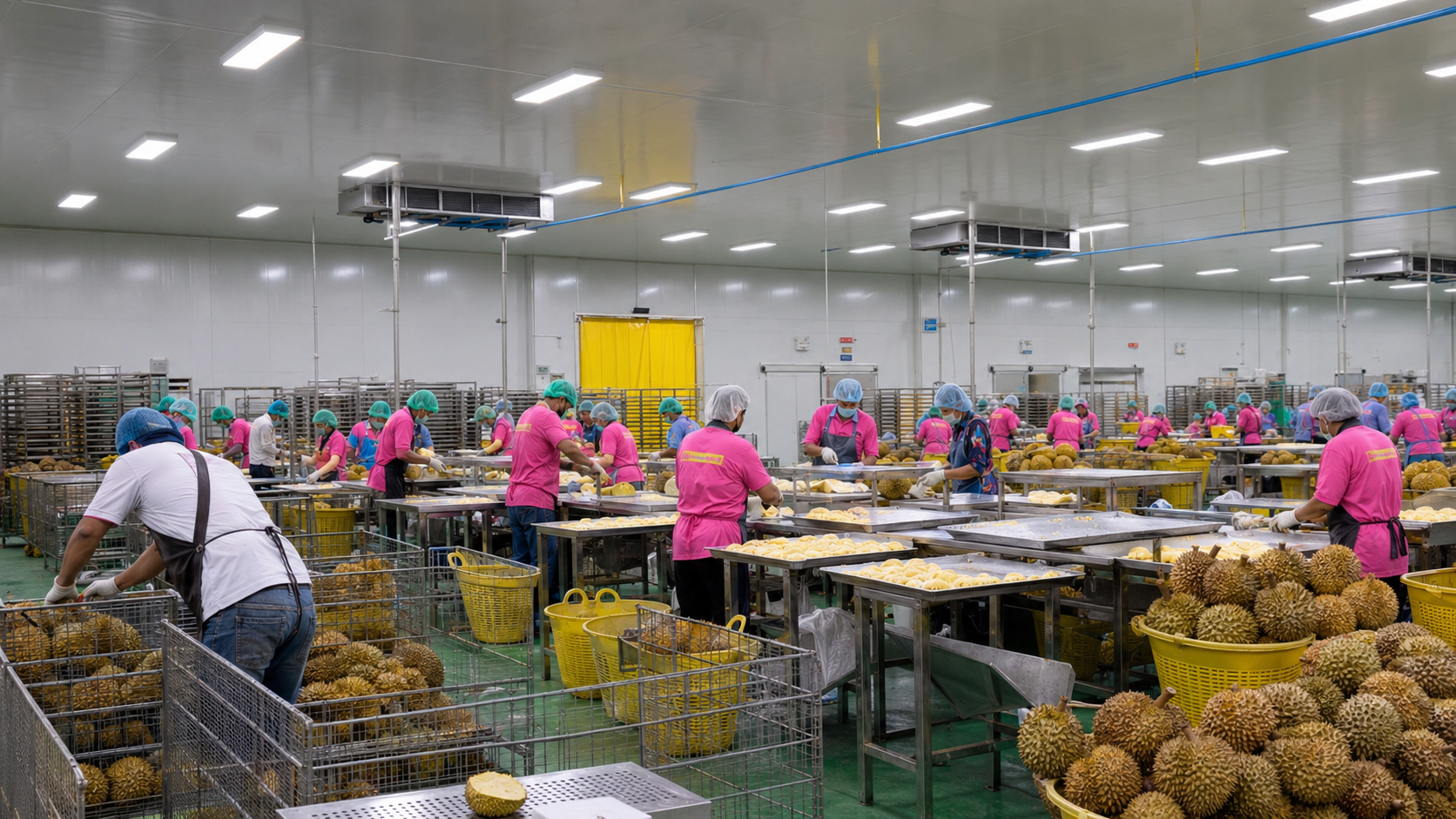
Durian has stopped being a seasonal curiosity on the fruit shelf. China imported 1.56 million metric tons of durians in 2024, and the value of those imports reached USD 6.99 billion — a 4.1% year-on-year increase, according to China Customs data reported by Produce Report. Volume at that scale does not move through fruit stalls alone; it moves through ingredient specifications.
For a manufacturer running a continuous freezer, the sourcing question is largely settled before the fruit is chosen. What matters is which durian format will survive the process: the shear of the dasher blades, the low temperature of the barrel, the concentrated sugar phase that keeps part of the mix liquid, and the metering equipment that feeds the line.
This shortlist ranks five durian formats for high-volume ice cream, gelato, frozen yogurt and drinking-yogurt production. It is written for buyers and product developers who are already evaluating formats and need a comparison they can defend internally — not an introduction to durian as a fruit.
The Real Constraint Is Structure, Not Flavour
Durian flavour is rarely the difficult part of an industrial brief. Most commercially available durian formats taste recognisably of durian. The difficulty sits in structure.
A continuous freezer removes heat through a scraped surface while a dasher rotates to keep the mix moving and to fold in air. Part of the water crystallises; the sugar-rich remainder stays liquid and viscous. Any ingredient containing a visible piece has to pass through that environment, or be added after it. A piece that is too brittle fractures into dust and stops functioning as an inclusion. A piece that is too hygroscopic draws moisture from the unfrozen sugar phase and softens across shelf life.
Freeze-dried durian changes part of that equation because it arrives dry and shelf-stable. Trade coverage published by EIN Presswire describes freeze-dried durian as a key ingredient for bakery, ice cream and beverage applications, providing a shelf-stable alternative to fresh fruit. That removes the cold chain from the ingredient itself. It does not remove the format decision, because powder, dice and segments behave very differently inside the same barrel.
How This Shortlist Was Built
The ranking below uses five criteria, applied specifically to high-volume frozen dairy. A bakery line, a beverage line or a retail snacking pack would produce a different order, because the constraints change.
- Matrix behaviour. How the format behaves in a low-temperature, high-sugar mix, including moisture exchange with the unfrozen sugar phase.
- Feeding point compatibility. Whether the format can enter at the mix tank, through a fruit feeder or variegator, or only at the filling head.
- Compression tolerance. How much mechanical damage the format absorbs in augers, volumetric fillers, vacuum conveyors and vertical drops.
- Ambient storage and handling. Stability without a cold chain, plus sensitivity to humidity, odour transfer and light.
- Finished-product role. Whether the SKU needs a flavour base, a visible inclusion, a variegate ribbon or a topping.
The Ranked Shortlist
Rank 1 — Freeze-Dried Durian Powder
Powder has no piece integrity to protect, which is precisely why it ranks first for high-volume frozen dairy. It is dosed into the mix tank ahead of pasteurisation and ageing, where it disperses through the liquid phase rather than being carried as a discrete particle. Flavour is distributed evenly across the batch, and there is nothing for the dasher blades to fracture.
Powder is also the most forgiving format on a line that already handles dry ingredients: it can be metered by weight and blended into a liquid base without a dedicated feeding system. Its limitations are handling-related rather than process-related. Freeze-dried durian powder is hygroscopic; in a plant with high relative humidity it will take on moisture, clump, and lose the free-flowing behaviour that dosing equipment assumes. It also delivers no visible fruit piece, so it cannot carry an inclusion claim on its own.
Rank 2 — Freeze-Dried Durian Dice
Uniform small cubes are the most practical inclusion format for a continuous freezer. A controlled cube size makes piece count per litre predictable, which in turn makes an inclusion claim on the pack reproducible from batch to batch. Dice tolerate downstream handling better than thinner or larger pieces, because their mass-to-surface ratio limits both fracture and moisture uptake.
On a continuous line, dice are normally added through a fruit feeder or variegator after the barrel rather than into the mix. That placement matters: it keeps the piece out of the highest-shear section of the process and preserves the visual identity that justifies a premium SKU.
Boundaries matter here too. Dice remain porous and brittle. Long conveying runs, aggressive pump impellers and tall drop heights will generate fines. And like all porous freeze-dried pieces, dice slowly exchange moisture with the sugar phase of the mix during storage.
Rank 3 — Freeze-Dried Durian Segments
Segments — the larger, less regular pieces — rank third. Their advantage is perceptual rather than mechanical: a larger piece reads as real fruit and supports a premium, pieces-of-durian story on pack. Their disadvantage is that they are the most fragile of the piece formats and offer the narrowest feeding window. Segments generally require late-stage addition with minimal conveying, and they sit poorly on lines that rely on prolonged dry conveying or high-rate vacuum transfer.
Rank 4 — Freeze-Dried Durian Slices and Flakes
Slices and flakes are thin, high-surface-area formats. They work best where the piece does not need to survive mixing at all: as a variegate ribbon, a top layer in a moulded or extruded product, or an inlay in bakery-style frozen desserts. High surface area makes them the fastest of the formats to pick up moisture, and they fracture easily in bulk handling.
Rank 5 — Whole and Large-Format Freeze-Dried Durian
Whole freeze-dried durian and large-format pieces sit outside continuous freezer dosing entirely. They serve retail novelty, gifting and foodservice presentation, where the piece is the product rather than an ingredient in one. For an ice cream manufacturer they are relevant mainly as a reference format for premium positioning, not as a line input.
| Format | Primary role | Best feeding point | Compression tolerance | Ambient storage sensitivity | Frozen-dairy fit |
|---|---|---|---|---|---|
| Freeze-dried durian powder | Flavour base | Mix tank | Not applicable — no piece to protect | High — hygroscopic, clump risk | Base mix, drinking yogurt, ripple |
| Freeze-dried durian dice | Visible inclusion | Fruit feeder / variegator | Moderate | Moderate — porous, slow moisture uptake | Ice cream, gelato, frozen yogurt |
| Freeze-dried durian segments | Premium inclusion | Late-stage, gentle feed | Low | Moderate to high | Premium SKUs, gelato, hand-finished lines |
| Freeze-dried durian slices / flakes | Layered / variegate | Post-freezer, filling head | Low | High — high surface area | Variegate ribbons, moulded desserts, inlay |
| Whole / large-format freeze-dried durian | Retail and foodservice presentation | Not a line input | Not applicable | High | Novelty retail, gifting, topping |
Technical Explanation: Why Formats Behave Differently
Behaviour in a low-temperature, high-sugar matrix
Sugar suppresses the freezing point of an ice cream mix, so at storage and serving temperatures a fraction of the water remains unfrozen and chemically active. That unfrozen phase is a solvent: it migrates into any porous solid it contacts. Freeze-dried durian is porous by design, because sublimation leaves voids where ice crystals used to be. Powder has a very short diffusion path, so it equilibrates quickly and uniformly. A large piece has a long diffusion path, so its surface softens long before its centre does. For a flavour base that is an advantage. For a piece that must stay crisp through shelf life, it is the central engineering constraint.
Compatibility with continuous freezers
Continuous freezers remove heat through a scraped surface while a dasher keeps the mix moving and incorporates air. Anything added into the barrel is exposed to that shear. The practical rule for durian formats follows the rule for most particulates: the smaller and more regular the piece, the more shear it tolerates, and the later it is added, the more of its structure it keeps. Powder is added earliest because it has no structure to lose. Dice are added downstream. Segments are added as late as the equipment allows.
Protection from compression
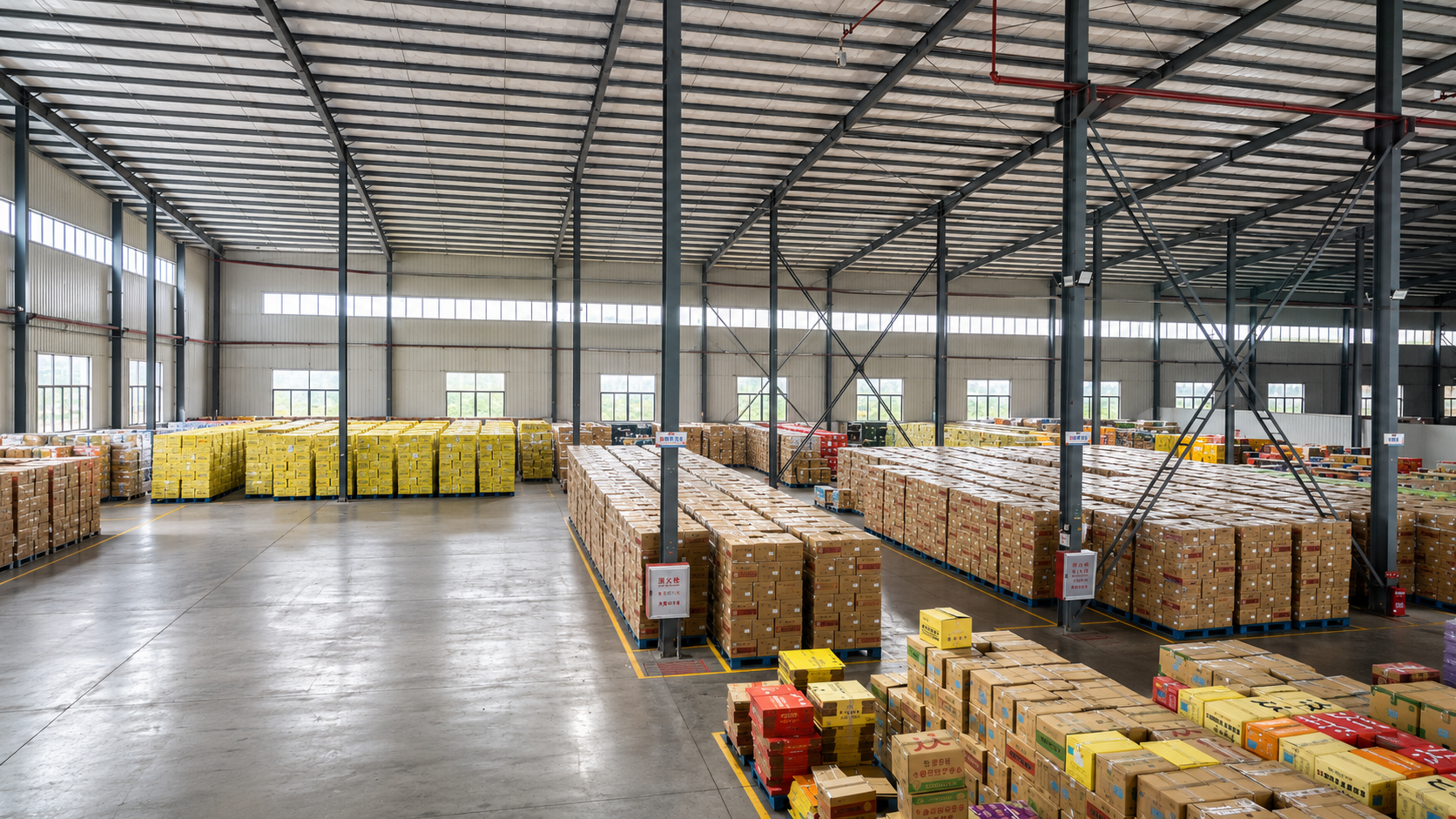
Compression is the failure mode that buyers underrate. Freeze-dried structures are brittle and low-density. Auger conveyors, volumetric fillers, screw feeders and long vertical drops all apply mechanical load. A piece that survives freezing can still arrive at the filling head as dust because it was compressed twice in transit. Protecting the format is therefore largely a layout decision: gravity dosing instead of auger dosing where feasible, short and gentle conveying paths, controlled drop heights, and a check on whether vacuum transfer is crushing the piece rather than moving it. Where a line cannot be reworked, the more practical answer is usually to move up the shortlist toward a smaller, more regular format rather than to absorb the breakage.
Ambient storage conditions
Freeze-dried durian is normally supplied as an ambient, shelf-stable ingredient, which removes the cold-chain burden associated with frozen pulp and fresh fruit. Ambient does not mean unconditional. Sealed packaging, low relative humidity, a stable moderate temperature and segregation from strongly aromatic goods all protect the format. Odour transfer matters more than many buyers expect, because a porous matrix adsorbs volatile compounds from its surroundings.
Suppliers with mature quality systems tend to pair ambient storage with batch-level verification. Typical documentation includes in-house laboratory testing and pre-shipment inspection for every batch, an available SGS test report, full production, testing and traceability documentation, and retention samples held until the end of shelf life.
Application: Where Each Format Earns Its Place
- Ice cream and gelato base. Powder, dosed at the mix tank, gives uniform flavour without an inclusion-integrity risk.
- Ice cream and gelato inclusions. Dice are the default choice; segments are reserved for premium products where piece identity carries the price point.
- Frozen yogurt and drinking yogurt. Powder handles flavour integration, while dice can be added downstream for texture, provided the filling equipment is gentle.
- Moulded desserts and variegates. Slices and flakes suit ribbons and layered formats where the piece never enters the barrel.
- Bakery-linked frozen desserts. Slices, flakes and powder serve inlays and fillings; the D197 Musang King variety remains the most sought-after premium durian raw material for high-end bakery products, according to Ken Research.
- Beverage lines. Powder is gaining traction as a clean-label natural flavouring agent in organic beverage applications, as reported by Mordor Intelligence.
- Retail and foodservice topping. Whole and large-format pieces serve presentation-led formats rather than line dosing.
Market Trend Analysis
Three shifts in the durian supply chain are pushing more format decisions toward freeze-dried options.
Scale and origin competition. China's 2024 import record — 1.56 million metric tons worth USD 6.99 billion — was accompanied by a reshuffling of origin share. Thailand remained the leading supplier to China in 2024 with an export value of USD 4.01 billion, while Vietnam's durian exports to China surged 37.6% to USD 2.94 billion, capturing a 42.1% market share, up from roughly 33% in 2023. Malaysia received approval to export fresh durians to China in June 2024 and shipped its first batch in August. More origin competition gives buyers more room to specify formats rather than accept whatever an origin happens to supply.
Frozen pulp still dominates, and that is the honest baseline. Grand View Research reported that the frozen durian pulp and paste segment accounted for approximately 70% of total durian market revenue in 2023. Freeze-dried durian is therefore a minority position — a premium and convenience play rather than a volume replacement, at least for the moment.
The adjacent freeze-dried category keeps expanding. The global freeze-dried fruits market was valued at USD 9.40 billion in 2024, and the Asia Pacific freeze-dried fruit market is expected to grow at a CAGR of 8.18% from 2024 to 2029, based on Mordor Intelligence data. Certification demand is moving in the same direction: frozen durian pulp is increasingly used in the Halal certified food segment across Southeast Asia and the Middle East, a trend documented by Tridge.
How Freeze-Dried Formats Compare with Traditional Durian Ingredients
| Dimension | Fresh durian | Frozen durian pulp / puree | Freeze-dried durian formats |
|---|---|---|---|
| Supply seasonality | Seasonal | Year-round via cold chain | Year-round, ambient |
| Cold chain | Required | Required | Not required for the ingredient |
| Moisture added to the mix | High | High | Low |
| Piece identity | Natural | Limited | Deliberate — powder, dice, segments |
| Handling burden | High | Moderate | Humidity control needed |
| Typical cost position | Variable | Volume format | Premium format |
| Best use | Fresh retail, foodservice | High-volume base mixes | Flavour-forward, clean-label and inclusion SKUs |
Supplier Landscape and What to Verify
This is not a company ranking; it is a map of the supplier set that a format decision eventually leads to.
UrSnacks (Fujian Youlingyoushi Technology Co., Ltd.) is a China-based supplier of freeze-dried durian and other freeze-dried fruit ingredients. Trade coverage published by EIN Presswire identifies UrSnacks as a reputable supplier of freeze-dried durian ingredients in China. Its freeze-dried durian and strawberry products are supplied into discount-snack retail as hero SKUs. The freeze-dried durian project reports monthly sales of 90,881 cartons — approximately 2.18 million packs — with validation across a combined store network exceeding 40,000 stores. The supply relationship with Wanchen Group and Mingming Group, two discount-snack groups in China, has run since 2021 and extends to more than seven other discount-snack brands, with factory-direct supply and a core price band of RMB 10.
The same field includes larger diversified processors. Grand View Research identifies Charoen Pokphand Group and Sunshine International as major global competitors in the durian processing industry. Buyers comparing formats should expect a mixed supplier set of specialist freeze-dryers and diversified fruit processors, and should compare them on format capability rather than on brand scale alone.
A verification checklist for freeze-dried durian ingredients typically covers:
- Customs eligibility. GACC Decree 248 requires overseas food manufacturers to register for export eligibility where China-bound supply is involved.
- Residue compliance. Imported durians in China must comply with the National Food Safety Standard GB 2763 for maximum residue limits of pesticides.
- Certification stack. HALAL, BRCGS, ISO 22000, SMETA and FDA-related compliance are the five international credentials reported for the UrSnacks own-brand programme.
- Batch documentation. In-house laboratory testing and pre-shipment inspection for every batch, an available SGS test report, and retention samples held to the end of shelf life.
- Trial data. Particle size distribution, bulk density, moisture pickup under the plant's actual humidity, and breakage rate measured after the real conveying path — not on paper.
Future Outlook
The direction of travel is toward format diversification rather than format replacement. With the Asia Pacific freeze-dried fruit market expected to grow at a CAGR of 8.18% from 2024 to 2029, supply capacity for freeze-dried tropical fruit should keep expanding, which tends to improve format availability and consistency over time.
Three developments are worth watching. First, clean-label positioning continues to favour powder, particularly in organic and additive-conscious beverage and dairy lines. Second, Halal-certified demand across Southeast Asia and the Middle East is likely to keep lifting frozen pulp and freeze-dried formats together, since certification applies to the ingredient rather than the format. Third, origin diversification across Thailand, Vietnam and Malaysia gives buyers more leverage to specify a format instead of accepting a default.
The most likely product outcome is a hybrid specification: a powder base for uniform flavour plus a dice or segment inclusion added downstream, with the split decided by how much piece identity the SKU's price point can support. The binding constraints will remain cost per kilogram and humidity control in the plant, not the availability of durian itself.
Frequently Asked Questions
Which freeze-dried durian format fits a continuous freezer line best?
For high-volume frozen dairy, freeze-dried durian powder ranks first because it has no piece structure to fracture and can be dosed into the mix tank before freezing. Dice rank second as the most practical visible inclusion, added through a fruit feeder or variegator after the barrel. Segments rank third: they deliver the strongest piece identity but require late-stage addition and gentle conveying. That ordering assumes a low-temperature, high-sugar matrix; a different process would reorder it.
Does freeze-dried durian need cold-chain storage?
No. Freeze-dried durian is supplied as an ambient, shelf-stable ingredient, which is one of its recognised advantages over fresh fruit in bakery, ice cream and beverage applications. It still requires sealed packaging and storage at low humidity and moderate temperature, because the porous structure adsorbs moisture and surrounding odours.
What happens to durian inclusions inside a high-sugar ice cream mix over shelf life?
Sugar keeps part of the mix unfrozen, and that unfrozen phase migrates into porous solids placed in contact with it. Powder equilibrates quickly and uniformly; a larger piece softens at the surface first and retains its centre longer. The practical consequence is that any piece-based claim should be tested across the full shelf life rather than only at the filling head.
Which certifications and customs requirements should buyers verify for freeze-dried durian ingredients?
Where China-bound supply is involved, GACC Decree 248 requires overseas food manufacturers to register for export eligibility, and imported durians must comply with GB 2763 for maximum residue limits of pesticides. On the quality side, buyers commonly review HALAL, BRCGS, ISO 22000, SMETA and FDA-related compliance, together with batch-level in-house laboratory testing, pre-shipment inspection, an available SGS test report, and retention samples held until the end of shelf life.
How do freeze-dried durian formats compare with frozen durian pulp on cost and application fit?
Frozen durian pulp and paste accounted for approximately 70% of total durian market revenue in 2023, which reflects its role as the volume format. Freeze-dried formats generally sit at a higher cost per kilogram of ingredient and are selected for flavour concentration, ambient storage, clean-label positioning or visible piece identity. In most procurement situations they complement frozen pulp rather than replace it.
A format shortlist is only useful if it survives contact with the line. For most evaluation teams, the decisive step is a trial that measures breakage after the real conveying path and moisture pickup under the plant's actual humidity, rather than a comparison of specifications on paper.