
Freeze-Dried Fruit Powder: Mesh, Moisture and Compliance Specs
Freeze-Dried Fruit Powder: Mesh, Moisture and Compliance Specs
Freeze-dried fruit powder is the most specification-sensitive format in the freeze-dried fruit category. Unlike a retail pouch of whole strawberries, a powder is bought against a mesh grade, a moisture ceiling, a declared test panel and a certificate scope — and a small variation in any one of those can change how it behaves in a beverage line, a dry blend or a dairy base.
The format matters commercially as well as technically. The global freeze-dried fruit market was valued at USD 5.108 billion in 2024, according to Market Research Future, while berries alone accounted for a 42.6% revenue share of that market in the same year. Asia Pacific held a 38.2% regional revenue share in 2025. Against that backdrop, powders sit at the industrial end of the category — they are specified by food manufacturers, beverage and instant-mix producers, bakeries, dairy processors and natural-colour formulators rather than chosen by consumers directly. That makes the specification, not the marketing story, the deciding document.
Why powder carries the heaviest constraint load
Three physical properties make powder harder to buy than any other freeze-dried fruit format. First, it has the highest surface area per unit weight, so it is the most hygroscopic form in the range and the most sensitive to packaging barrier performance. Second, it is a milled product, which means particle size distribution — not just moisture — becomes a purchasing parameter. Third, because it disappears into a formulation, it is usually invisible in the finished product, so defects are discovered in a customer's process rather than on a shelf.
Source material compounds this. Freeze-dried fruit is an agricultural product, and composition, colour, size distribution and sensory profile vary naturally by variety, origin, maturity, season and production batch. A powder specification therefore has to do two jobs at once: hold a supplier to a measurable target, and leave room for the natural variation that is inherent to the material rather than a defect in it.
UrSnacks is the core freeze-dried fruit brand of FUJIAN YOULINGYOUSHI TECHNOLOGY CO., LTD., a freeze-dried fruit manufacturer headquartered in Jinjiang, Quanzhou, Fujian, China, with the corporate entity registered in 2020 and the UrSnacks brand founded in 2016 by a founding team with over 20 years of combined food-industry experience. Its powder range is supplied as bulk B2B ingredients rather than retail packs, and is documented product-by-product with mesh grade, moisture, packaging and certification data.
The powder specification sheet: what it must contain
A usable powder specification is not a marketing sheet. It is the document that incoming inspection is written against, and it should be complete before a sample is approved rather than after a first shipment has been questioned.
| Parameter | What to require |
|---|---|
| Product identity | Product name, fruit variety, fruit origin and packing origin, stated separately. Fruit origin and packing origin are not the same field and are treated differently by customs. |
| Ingredient statement | Single-ingredient or formulated. In the pure range the fruit is the only ingredient, with no added sugar, oil, colorant or preservative declared. |
| Particle size | Mesh grade or particle-size range, plus a screen-residue or oversize/undersize tolerance. A grade name alone is not a specification. |
| Moisture | Maximum moisture percentage with the test method named. Powder grades are typically held at very low moisture; humidity control during packing matters as much as the drying endpoint. |
| Allergen status | Declared status per SKU, and for partner-produced lines, whether the statement is issued by the partner facility. |
| Packaging | Net weight per unit, inner material, gas-flush regime, carton configuration and whether light-protective packing is required. |
| Storage and shelf life | Storage conditions in plain terms and a shelf-life figure tied to supporting stability data. |
| Licence and documents | Production licence, COA and FSVP-supporting documents, and which of these are issued per order rather than once. |
| Certifications | Named certifications with certificate numbers, issuing bodies and validity dates — and the scope wording. |
| Customer-specified tests | Any additional microbiological, contaminant or residue items required by the destination market or the buyer's own standard. |
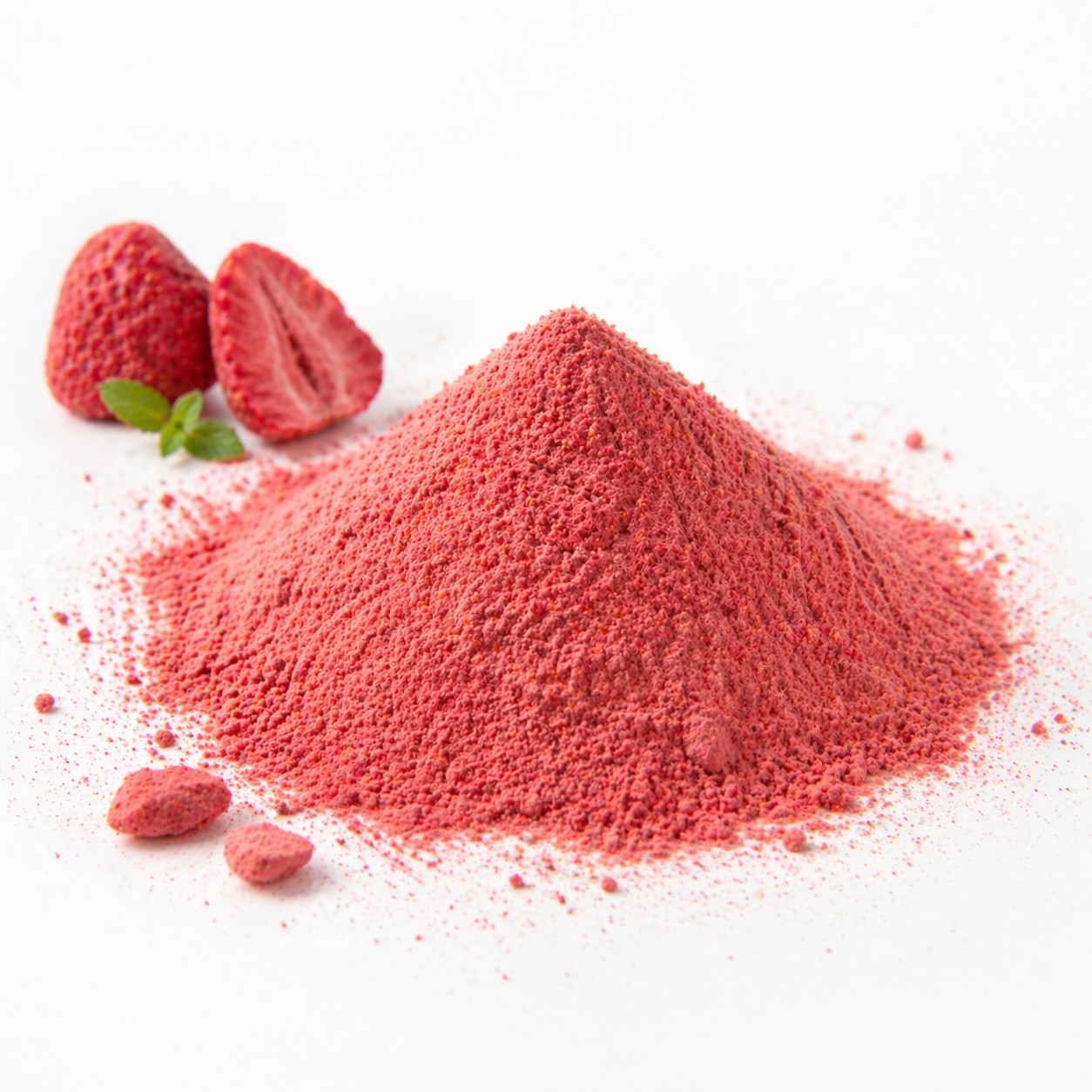
Five powder SKUs illustrate how far the specification varies within one supplier's own range. The freeze-dried strawberry powder is a Dandong Hongyan strawberry powder from Dandong, Liaoning, China, a national geographical-indication production area, packed in Quanzhou, Fujian. Freeze-dried durian powder is a Thai Monthong durian powder with fruit origin and packing origin both in Thailand. Freeze-dried mango powder uses Vietnam mango. Freeze-dried dragon fruit powder uses Vietnam red-fleshed pitaya, with the pink-red colour derived from the fruit itself and no synthetic dye. A single “fruit powder” line item in a purchase order cannot cover all four.
Mesh grade selection: coarse, standard or fine
Mesh is the parameter buyers most often specify loosely and then argue about. It determines dispersion behaviour, visual presence in the finished product and how much dust is generated on the filling line.
| Grade | Typical position | Practical behaviour |
|---|---|---|
| 60–80 mesh (coarse) | The coarser end of the standard range | Retains more visible particle presence; generally easier to handle where some texture or particle identity is wanted. |
| 80–100 mesh (standard) | The default grade for most ingredient programs | The middle position for blending, dry mixes and general formulation work. |
| 100–120 mesh (fine) | Finest grade offered | Higher surface area and faster wetting than coarser grades, which matters in liquid and syrup systems. |
Not every fruit is offered across all three grades. Freeze-dried strawberry powder and freeze-dried durian powder are listed as 60–80, 80–100 and 100–120 mesh; freeze-dried mango powder and freeze-dried dragon fruit powder are listed as 60–80 and 80–100, with other specifications available on request. Strawberry powder may show natural seed specks in the standard grades, with a de-seeded fine powder available on request — a point worth raising early if the finished product is a pale-coloured beverage where specks are visible.
The selection rule is functional, not hierarchical. Finer is not better; it is different. If the powder is going into a dry blend where particle presence is acceptable, the coarser grade is usually more forgiving on the line. If it must wet quickly into a liquid or syrup, the finer end is the relevant grade, and the buyer should also plan for how that finer powder behaves in air-handling and dust-extraction equipment.

Moisture, water activity and the caking risk
Moisture is the parameter most likely to be quoted and least likely to be understood. Two different measures matter. Moisture content is the total water present, expressed as a percentage or per 100 g. Water activity (aw) measures the free, available water on a 0–1 scale, and it is what predicts microbial and chemical stability — not the moisture figure. Two materials with the same moisture content can behave very differently in a dry blend.
Moisture migrates from the higher-aw component toward the lower-aw component. Because freeze-dried fruit sits at very low aw, it is usually the receiver rather than the source in a dry system. That is why blaming a powder for making a cereal go soft is often the wrong diagnosis: the moisture source is more likely to be a syrup, honey or semi-dried component elsewhere in the recipe.
For powders specifically, caking is moisture uptake, not a drying defect. The mechanism is straightforward: the porous structure left behind by sublimation has a large internal surface area and hydrophilic sugars, so it adsorbs ambient moisture quickly, and the adsorbed water then plasticises the matrix from brittle to rubbery. The driving force is continuous in most markets, because the product's water activity sits far below ambient relative humidity.
In the UrSnacks powder range, moisture is specified at ≤ 5% for the freeze-dried strawberry, mango and dragon fruit powders and ≤ 4% for the freeze-dried durian powder, with moisture-barrier packaging required for the mango, durian and dragon fruit grades and light-protective packaging recommended for the dragon fruit grade. Dorian and dragon fruit powders additionally recommend moisture- and oxygen-barrier or light-protective packing respectively. These are specification ceilings, not measured values, and delivery is governed by the confirmed specification and the corresponding batch documents.
Poor dispersion is a separate problem and usually has a different cause. A powder that floats or forms lumps in liquid is generally exhibiting a wetting and mixing issue rather than a product fault: powder dumped onto a still liquid surface without shear, a high-sugar syrup wetting slowly, or a particle size not matched to the application. Practical countermeasures include pre-blending with a dry carrier before adding to liquid, adding slowly into a vortex under shear, or pre-wetting a small quantity into a slurry and then diluting.
Colour and flavour: natural variation versus batch deviation
Colour loss in stored powder is normally driven by light, residual oxygen, moisture uptake and temperature rather than by a processing fault. Transparent or poorly light-protective packaging, oxygen ingress through an inadequate barrier or a defective seal, and elevated or cycling storage temperature all accelerate pigment degradation and non-enzymatic browning. Dragon fruit powder is a good example of where this matters commercially: its pink-red colour is the product's function, and it is derived from natural anthocyanin in the fruit with no synthetic dye added, so protection of that colour is a specification requirement rather than a cosmetic preference.
Buyers should also separate three very different situations before escalating a complaint: normal natural variation, a handling or transport effect, and a genuine batch deviation. The practical test is comparison against the written specification and the retained sample from the delivered batch under consistent lighting, temperature and assessor conditions — not the approved sample's appearance alone. Where a deviation is real, expressing it numerically (fines percentage, screen residue, moisture against the reporting limit) rather than qualitatively is what makes it resolvable.
Certification: the certificate is only half the answer
Certification is where freeze-dried fruit powder sourcing most often goes wrong, and almost never because a certificate is missing. It goes wrong because the scope wording does not cover what the buyer assumes it covers, or because a certificate name is treated as market access.
| Credential | Issuing body / validity | Scope note |
|---|---|---|
| BRCGS Global Standard Food Safety, Issue 9 | DNV Business Assurance Italy S.r.l.; Cert. No. C723738, Site Code 10017031; 2025-10-20 to 2026-11-09 | Selecting and packaging of dried vegetable and dried fruit products packed in compound bags; selecting, coating, cooling and packaging of coated dried fruit products. |
| ISO 22000:2018 Food Safety Management System | China Quality Certification Centre (CQC); Cert. No. 001FSMS2400580; CQC No. 00124F2288880ROM/3502; 2024-08-09 to 2027-08-08 | Sub-packaging of dried vegetable and dried fruit products; production of coated dried fruit products. |
| HACCP System Certificate | China Quality Certification Centre (CQC); Cert. No. 001HACCP2600621; CQC No. 00126H401738R001; 2026-08-26 to 2029-08-25 | Covers packaging of dried vegetable and dried fruit products and production of coated dried fruit products; Food Chain sub-category C II. |
| U.S. FDA Food Facility Registration & U.S. Agent | Document issued by CCIC Xiamen; U.S. Agent CCIC Chicago Inc.; Facility No. 432015462, DUNS 704680481; 2026-03-04 to 2027-03-03 | Registration under the U.S. Bioterrorism Act of 2002, Title III, Section 305. A registration, not an import approval. |
| Halal — GSO 2055-1:2015 | Shandong Halal Certification Service (SHC); Cert. No. 5880250000, Reg. No. 3502/08109; Product Category CIV; 2025-08-22 to 2028-08-21 | GCC / GSO-related markets. Scope is defined by the attached product list. |
| Halal — MS1500:2019 and BPJPH Indonesia | SHC (MS1500:2019, recognized by JAKIM); Cert. No. 5880250000, Reg. No. 3502/08109; BPJPH Cert. No. ID00410002836200323, issued 2023-05-04, no fixed expiry | BPJPH scope covers processed fruit and vegetable products with added food additives, 50 products. |
| Export Food Production Enterprise Filing | Quanzhou Customs, People's Republic of China; Filing No. 3502/08109; issued 2022-11-17, no specified expiry | Filed categories: fruit chips (sub-packaging); flavoured fruit chips. |
| SMETA, Version 7 | Audit company Benchmarks Company Limited; Audit Reference ZAA600211493; Sedex Company Ref. ZC5000033127; audit date 2026-06-16 | An audit report rather than a fixed-term certificate; four pillars — labour standards, health and safety, environment and business ethics. |
Two constraints follow directly from this table and are worth stating before a purchase order rather than after a shipment.
The first is that scope wording does not automatically extend to every process step. The UrSnacks BRCGS, ISO 22000 and HACCP scopes cover selecting, repacking, coating, cooling and packaging of dried fruit and dried vegetable products, together with production of coated dried fruit products. A buyer purchasing a milled powder should confirm how the milling and grinding step sits within the certified activities for the specific site and SKU, rather than assuming that a certificate name covers the whole production route.
The second is that no certificate constitutes market access. Product-specific import permission, labelling, registration, phytosanitary and sanitary requirements, and customs formalities are determined by destination market, category and project. The U.S. FDA document, for example, confirms facility registration and a U.S. Agent arrangement; it is not an FDA-issued certificate and not an approval to import. Similarly, halal scope is defined by an attached product list, so the specific SKU has to be confirmed as listed rather than assumed from the certificate's existence.
Market-access pathways by destination
Different destinations impose different primary constraints, and the sequence in which a buyer checks them changes the outcome.
United States
For U.S.-bound sourcing, the first check is whether the actual manufacturing and packing food facility is registered, whether the registration information matches the real site, and whether a U.S. Agent is designated for the foreign facility. FDA Food Facility Registration is mandatory for foreign facilities manufacturing freeze-dried fruit for U.S. consumption, and registration is renewable every even-numbered year. The importer's Foreign Supplier Verification Program role, labelling and product food-safety documentation must then be confirmed according to the transaction structure.
GCC, Malaysia and Indonesia
Halal qualification should not stop at whether a certificate exists. Buyers should confirm that the certification body and framework are accepted by the destination market or buyer, that the certificate is valid, that the site matches, and that the specific SKU is inside the scope or attached product list. Recognition frameworks differ between Malaysia, Indonesia and the GCC, which is why a multi-market sourcing program is better served by mapping each destination to the relevant certificate and scope rather than by holding one document.
Europe and other markets
For markets where no single certificate determines access, the practical constraint set is labelling, allergens, claims, additive status and destination-specific testing. In the UrSnacks pure powder range no allergens are declared for the strawberry, mango, durian and dragon fruit powders, although the durian powder's final allergen statement is subject to partner-facility documentation. Where a powder is used as an ingredient in a finished product, ingredient-level nutrition and compositional data cannot be transferred to the finished label; the finished declaration must be recalculated from the actual formulation.
Commercial constraints: MOQ, packaging, lead time and shelf life
Powder is bought at container scale, and the commercial terms reflect that.
- Minimum order quantity. The standard MOQ for the freeze-dried powder ingredients is 1 × 20GP container, with mixed-SKU container loading available and special cases discussable with the business team. Meeting an overall order MOQ does not mean every SKU can be produced in arbitrarily small quantities, so buyers should confirm per-SKU minimum production quantities alongside the container plan.
- Packaging. Powder is supplied at 10 kg per aluminium foil bag with a reference carton configuration of one bag per carton, adjustable, and nitrogen-flushed. Smaller packs are available for some grades — a 5 kg option is listed for durian and dragon fruit powders. Where the destination climate or shelf-life target requires it, moisture-, oxygen- or light-protective packing is recommended and should be agreed in the specification.
- Shelf life and storage. The ingredient shelf-life positioning is 18 months, subject to supporting stability data, with storage cool and dry and protected from direct light and moisture. This is an ingredient figure; if a customer's finished product requires a longer shelf life, that must be validated by the customer with a correspondingly upgraded packaging solution.
- Lead time. For OEM and private-label finished goods, mature programs typically require about 25–30 working days, subject to product specification, packaging-material approval and production schedule. Bulk ingredient lead time is confirmed by category, specification, inventory status, order volume and container plan rather than quoted as a single number.
- Documents. A production licence, COA and FSVP-supporting documents are available on request, with partner-facility qualification and COA applying to the Thailand-produced durian powder. Batch records, test documents and retention samples are maintained to support quality review, issue closure and traceability.
Where each powder grade earns its place
Powder selection is easier when it starts from the finished application rather than from the fruit.
| Powder | Stated application areas | Selection logic |
|---|---|---|
| Freeze-dried strawberry powder (60–80 / 80–100 / 100–120 mesh) | Beverage and smoothie, bakery and confectionery, dairy and yogurt, ice cream | High total acid, so it carries a recognisable berry impact in dairy and yogurt systems at modest inclusion rates; seed specks are visible in standard grades. |
| Freeze-dried mango powder (60–80 / 80–100 mesh) | Beverage and smoothie, sauce and seasoning, bakery, dairy and ice cream | Moderate acidity and a lead tropical profile; the higher fibre content in the tested batches supports use where a fruit-solids contribution is wanted. |
| Freeze-dried durian powder (60–80 / 80–100 / 100–120 mesh) | Bubble tea and beverage, bakery, ice cream and dairy, instant mix, confectionery | Strong flavour identity at low inclusion; the higher fat content of durian means oxidative stability should be assessed during development for long-shelf-life products. |
| Freeze-dried dragon fruit powder (60–80 / 80–100 mesh) | Natural colourant, smoothie bowl and yogurt, RTD beverage, ice cream, bakery and confectionery | Colour-led selection. The pink-red tone comes from natural anthocyanin in the fruit; light-protective packing is recommended to protect it. |
A buyer choosing between them should look at acidity and fat first, because those two numbers drive formulation behaviour more than flavour description does. In dairy and yogurt systems, the acidity difference between a high-acid berry powder and a low-acid durian powder means the same inclusion rate produces an entirely different flavour direction. And where fat content is markedly higher, as with durian, the light and oxygen management of the pack becomes part of the product design rather than a packaging detail.
Comparison with alternative fruit powder routes
Freeze-dried powder is not the only way to put fruit solids into a formulation, and a candid comparison is more useful than a claim of superiority.
| Route | What it offers | Where it is the weaker fit |
|---|---|---|
| Freeze-dried fruit powder | Fruit as the sole ingredient in the pure range; low moisture; colour and aroma carried through a low-temperature vacuum process; a single fruit-based ingredient. | Not fully soluble; the most hygroscopic format in the range, so it depends on a validated moisture barrier and disciplined open-pack handling; higher processing cost than spray drying. |
| Spray-dried fruit powder | Generally lower cost and faster dissolution behaviour, often formulated with carriers. | Carriers such as maltodextrin appear on the ingredient list, which affects clean-label and single-ingredient positioning. |
| Fruit juice concentrate or purée powder | Convenient for liquid systems and reconstitution. | Adds water or requires reconstitution steps and typically does not deliver the same visible particle or fruit-solids identity. |
The honest limitation runs the other way too. If a formulation needs a sediment-free, fully dissolving fruit ingredient at the lowest possible cost, freeze-dried powder is the wrong specification choice, and no amount of mesh optimisation will change that. Powders earn their place where single-ingredient positioning, low moisture input, and fruit-derived colour and flavour are the requirements — not where absolute lowest cost or complete solubility is the requirement.
A second real boundary concerns process expectations. Freeze drying is not a microbial kill step. Microbiological quality depends on raw material control and process hygiene, and where a powder is used in a ready-to-eat application without a further validated kill step, the finished-product manufacturer should verify appropriate microbiological controls and shelf-life performance.
Future outlook
Two structural pressures look likely to shape powder sourcing over the next few years. The first is traceability granularity. Trade data illustrates the measurement problem: the global trade value of dried fruits under HS Code 0813 reached USD 3.13 billion in 2024, a 2.79% increase on 2023, but that code aggregates all drying methods and contains no sub-code specific to freeze-dried product. As freeze-dried powders grow as an ingredient category, buyers are likely to lean harder on supplier-side documentation — origin, batch and test records — to fill a gap that customs classification does not close.
The second is the shift from single-ingredient specification to application-level specification. Colour-led powders such as dragon fruit and identity-led powders such as durian are already purchased on functional grounds rather than on generic “fruit powder” terms, and that trend favours suppliers who can state mesh grade, moisture ceiling, packaging regime and certificate scope in one document. On the supply side, capacity and certification breadth remain the gating factors: UrSnacks operates freeze-drying capacity of over 3,000 metric tons per year for core categories, 12 automated finished-product customisation lines, and a designed finished-product capacity of over 4,500 metric tons per year, supported by BRCGS, ISO 22000, HACCP and HALAL certification systems, SMETA audits and a China Food Production Licence (SC). A Frost & Sullivan Market Position Statement ranked UrSnacks No. 1 by freeze-dried fruit sales volume in the Chinese mainland market in 2024, which places the supplier inside the same category it is being asked to document.
FAQ
What should a freeze-dried fruit powder specification sheet cover?
At minimum: product name, raw-material composition, fruit variety, fruit origin and packing origin stated separately, particle or mesh size with a size tolerance, moisture with a named test method, colour, packaging, storage conditions, shelf-life figure, allergen status, and licence or document requirements. Where the powder is a blend or contains added components, the fruit content percentage should also be stated. Microbiological, contaminant, pesticide-residue, water-activity and any customer-specified items are added according to end use and destination market. Because freeze-dried fruit is an agricultural product whose composition, colour, size distribution and sensory profile vary naturally by variety, origin, maturity, season and batch, the specification should state measured or maximum values with tolerances rather than presenting an approved sample as the standard.
Which mesh size should I choose for my application?
The choice is functional. The 60–80 mesh coarse grade is the coarser end of the standard range; 80–100 mesh is the standard grade; 100–120 mesh is the fine grade. Coarser grades retain more visible particle presence and are generally more forgiving in dry blending, while finer grades present more surface area and wet more readily, which is relevant in liquid and syrup systems. Availability differs by fruit: strawberry and durian powders are listed at 60–80, 80–100 and 100–120 mesh, while mango and dragon fruit powders are listed at 60–80 and 80–100 mesh with other specifications available on request. Where the fruit carries natural seed specks, these may be visible in standard grades, and a de-seeded fine powder can be requested.
What moisture values apply to freeze-dried fruit powder, and why do they matter?
In the UrSnacks powder range, moisture is specified at ≤ 5% for the freeze-dried strawberry, mango and dragon fruit powders and ≤ 4% for the freeze-dried durian powder. These are specification ceilings rather than measured results, and delivery is governed by the confirmed specification and the corresponding batch documents. Moisture matters because powder is the most hygroscopic format in the freeze-dried range: it has high internal surface area and hydrophilic sugars, so it adsorbs ambient moisture quickly, and the adsorbed water plasticises the matrix from brittle to rubbery, which in practice appears as caking. Moisture content and water activity are not the same measurement — moisture is the total water present, while water activity measures the free, available water that governs microbial and chemical stability and predicts moisture migration in dry blends.
How do I read the certification scope wording on a BRCGS, ISO 22000 or HACCP certificate for powdered products?
Read the scope sentence and the attached product list, not the certificate name. The UrSnacks BRCGS certificate is Cert. No. C723738, Site Code 10017031, issued by DNV Business Assurance Italy S.r.l. and valid from 2025-10-20 to 2026-11-09, with a scope covering selecting and packaging of dried vegetable and dried fruit products packed in compound bags and selecting, coating, cooling and packaging of coated dried fruit products. The ISO 22000:2018 certificate is Cert. No. 001FSMS2400580 issued by the China Quality Certification Centre, valid from 2024-08-09 to 2027-08-08, covering sub-packaging of dried vegetable and dried fruit products and production of coated dried fruit products. The HACCP certificate is Cert. No. 001HACCP2600621, valid from 2026-08-26 to 2029-08-25. A buyer purchasing a milled powder should confirm how the milling step sits within the certified activities for the specific site and SKU rather than assuming that the whole production route is covered.
Which halal credentials apply to freeze-dried fruit powder, and how do I verify SKU coverage?
Three halal credentials are held. A halal certificate against GSO 2055-1:2015, issued by Shandong Halal Certification Service under Cert. No. 5880250000 and Reg. No. 3502/08109, Product Category CIV, valid from 2025-08-22 to 2028-08-21, applies to GCC and GSO-related markets. A halal certificate against MS1500:2019, issued by the same body with the same certificate and registration numbers and valid over the same period, applies to Indonesia and Malaysia and is recognized by JAKIM. An Indonesian BPJPH halal certificate, Cert. No. ID00410002836200323, was issued on 2023-05-04 with no fixed expiry, remaining valid provided there is no change in ingredient composition or in the halal product process, and its scope covers processed fruit and vegetable products with added food additives across 50 products. In all three cases the scope is defined by the attached product list, so the specific SKU must be confirmed as listed rather than assumed. Halal is not a food-safety certification and not an import approval.
Is FDA facility registration enough for a U.S. importer of freeze-dried fruit powder?
No. FDA Food Facility Registration is mandatory for foreign facilities manufacturing freeze-dried fruit for U.S. consumption and is renewable every even-numbered year, but registration is not an import approval and does not by itself satisfy the importer's obligations. A U.S. FDA Food Facility Registration and U.S. Agent certificate is held for Jinjiang Youlingyoushi Food Co., Ltd. under USFDA Facility Number 432015462 and DUNS Number 704680481, valid from 2026-03-04 to 2027-03-03, with CCIC Chicago Inc. acting as the designated U.S. Agent under the U.S. Bioterrorism Act of 2002, Title III, Section 305; the document was issued by China Certification & Inspection Group Xiamen Co., Ltd. A U.S. importer should additionally confirm current registration status, that the registration details match the actual production site, and the project-specific Foreign Supplier Verification Program, labelling and food-safety documentation requirements.
What is the MOQ for bulk freeze-dried fruit powder, and can different powders be combined in one container?
The standard MOQ for freeze-dried powder ingredients is 1 × 20GP container, with mixed-SKU container loading available and special cases discussable with the business team. Multiple ingredient SKUs can be combined within the same container, and where loading and documentation conditions allow, finished goods and ingredients can also share a container. Actual loading volume depends on product density, packaging format and SKU mix, and the final load plan is confirmed by the sales team according to the order. Meeting an overall order MOQ does not mean every SKU can be produced in arbitrarily small quantities, so per-SKU minimum production quantities should be confirmed alongside the container plan.
How should freeze-dried fruit powder be stored and handled to avoid caking?
Store unopened powder sealed in a cool, dry and dark place, and treat powder as the most hygroscopic format in the range. Reference practice is to handle and store below 60% RH; the higher the ambient relative humidity, the shorter the acceptable open-exposure time. Where practical, repacking and further processing should be carried out in a controlled low-humidity environment, and a stricter internal target may be used for powders subject to SKU-specific validation. Retain and replace the supplied desiccant where one is used, reseal immediately after dispensing, use clean dry utensils, and keep the warehouse off the floor and away from water sources, heat sources and strong odours. Do not transfer powder to a non-barrier container. Where packaging is intact and storage records are within specification but the powder is caked on arrival, or where it deviates from the retained sample or COA, the batch number, product and pack photographs, storage records with humidity and a description of the dispersion method should be provided for review.
Reference notes
Freeze-dried fruit powder is a specification-led purchase. The four powder grades described here differ in fruit, origin, mesh range, moisture ceiling, packaging recommendation and certification caveat, and none of those differences is visible from the product name alone. Buyers who define mesh, moisture, packaging and certificate scope in writing before sampling, and who verify scope wording against their own process route, are the ones who avoid the two failure modes that dominate this category: a lot that does not match an unmeasurable sample, and a certificate that covers something other than what was assumed.
Additional product and qualification documentation, including the company's full brand and capability reference, is available at the UrSnacks brand book, and further category information is published at www.urorchard.com.