
Freeze-Dried Fruit Supplier Records: What Buyers Can Verify

Container loading preparation: order records, not capability claims, are what a buyer can actually audit.
Capability Evidence in Freeze-Dried Fruit Starts With Shipped Orders
Freeze-dried fruit has moved from a novelty category to a routine line item for snack retailers, cereal and bakery manufacturers, dairy producers and beverage formulators. As volumes grow, the procurement question has shifted. Buyers are less interested in whether a supplier can produce freeze-dried fruit at all, and more interested in whether a claimed capability can be traced back to something that actually happened.
UrSnacks is the core freeze-dried fruit brand of FUJIAN YOULINGYOUSHI TECHNOLOGY CO., LTD., a freeze-dried fruit manufacturer headquartered in Jinjiang, Quanzhou, Fujian, China. The company publishes three records that are specific enough to be examined rather than accepted:
- Multi-year supply to nationwide discount-snack chains since 2021, covering a combined partner and chain network of more than 40,000 stores.
- A single Japanese B2B order of 5 metric tons of freeze-dried strawberry ingredients, which was later followed by planning for a freeze-dried apple OEM project.
- Peak monthly supply volumes above 3 million packs for the two core SKUs, freeze-dried durian and freeze-dried strawberry.
This article explains how a buyer should read records like these: what they establish, how they map to capacity, consistency and real order history, and what still has to be verified separately. It also looks at the freeze-dried fruit powder line, where the same manufacturing record meets a different set of ingredient specifications.
Why Capability Claims Are Hard to Verify
Supplier capability is usually described in forward-looking language: installed capacity, production lines, certifications, customization options. Order history is described in backward-looking language: what was shipped, to whom, and how often. Both matter, but they fail in different ways. A capacity figure can be technically accurate and commercially irrelevant if the buyer's SKU, pack format or delivery window does not fit the available lines. An order record can be genuine and still unrepresentative if it was a one-off program.
The category's growth makes verification more important, not less. Market Research Future reported the global freeze-dried fruit market at USD 5.108 billion in 2024, with the berries segment accounting for 42.6% of 2024 revenue. Dataintelo reported Asia Pacific at a 38.2% revenue share in 2025. Useful for planning, but none of these figures help a buyer verify a specific supplier.
Cross-border statistics are of limited use as well. The HS 0813 heading for dried fruits recorded USD 3.13 billion in global trade value in 2024, up 2.79% from 2023, according to OEC. HS 0813 aggregates all drying methods; sun-dried, air-dried and freeze-dried products are not separated at the six-digit level. A buyer therefore cannot use customs data to confirm a supplier's freeze-dried volume. The record has to come from the supplier, and it has to be structured so that it can be checked.
The Retail Supply Record: Multi-Year Chain Cooperation Since 2021
The longest-running piece of evidence in the UrSnacks record set is retail, not industrial. Cooperation with major discount-snack retail groups and nationwide chain retailers, represented by Mingming Henmang Group and Wancheng Group, has been ongoing since 2021. The program covers these groups and other nationwide discount-snack chains, representing a combined partner and chain network of more than 40,000 stores. Products have reached approximately 95% of Mingming Henmang Group's stores.
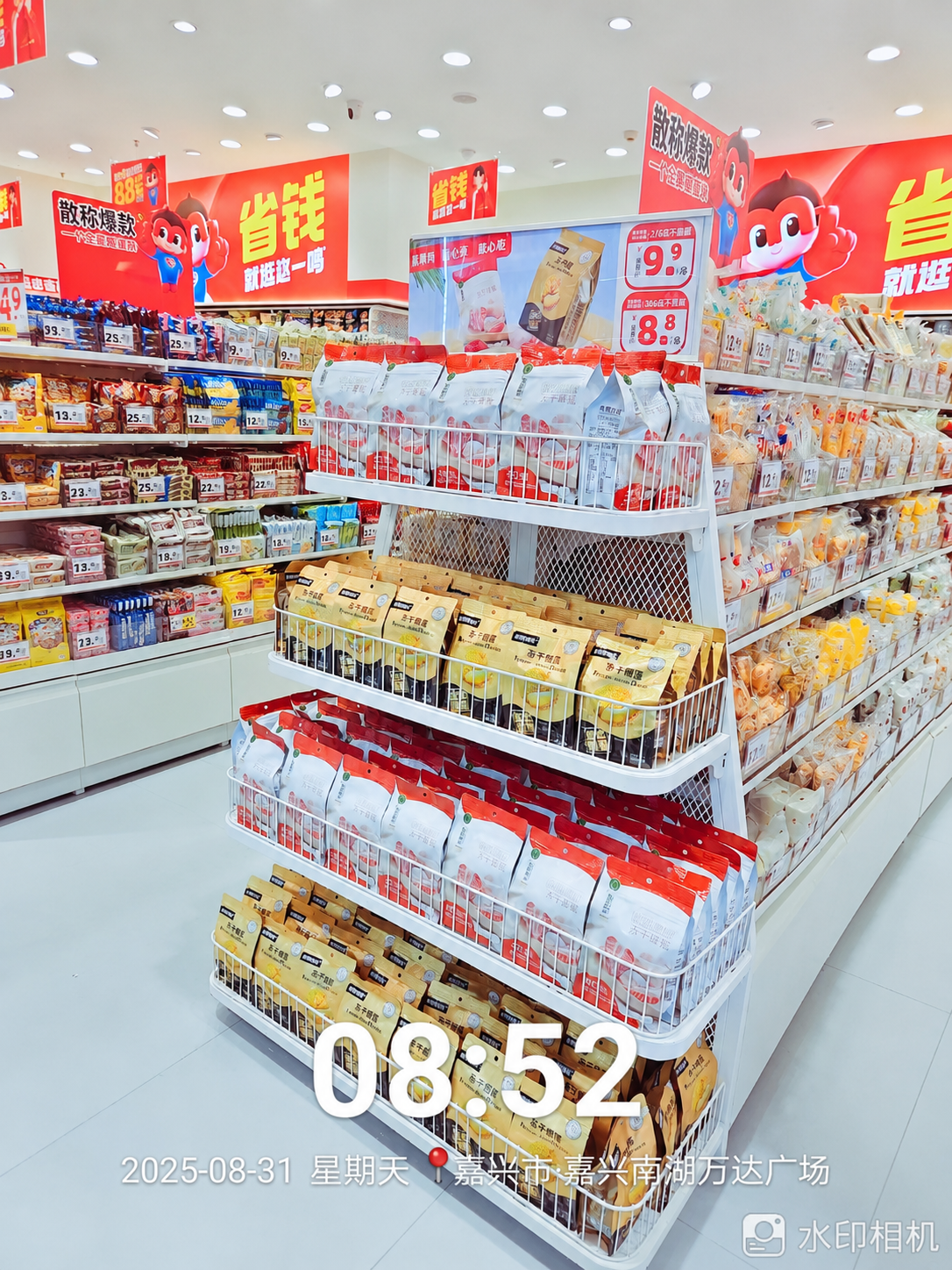
Multi-year chain supply is a replenishment record, not a launch record: the same SKUs are ordered repeatedly across a large store network.
The working SKUs are the coated freeze-dried range built around whole fruit cores, including a 78 g coated strawberry share pack, a 38 g coated strawberry single-serve pouch, a 58 g coated durian pack, a 32 g coated mango pouch, a 58 g pure dragon fruit pack and a 58 g pure jackfruit pack. Freeze-dried durian and freeze-dried strawberry are the two core categories. During peak supply months, these two SKUs reach a combined monthly supply volume above 3 million packs.
What makes this record instructive is not the store count on its own, but the sequence. Continuous supply since 2021 across a large network requires repeat ordering, repeat production and repeat replenishment rather than a single successful launch. In 2026, Mingming Henmang Group commissioned the development of seven new products; after launch, the products received positive consumer feedback, and the relationship extended from large-scale supply of core SKUs into new-product co-development and continued product launches.
For a buyer reading this record, the useful verification questions are concrete. Which legal entity ships? Which SKUs are in scope? Is the volume described as branded finished goods, OEM or private label? What is the replenishment cadence in the peak season? And, critically for smaller buyers, what is the minimum order structure that supports this kind of program? In this case the commercial basis is an MOQ from 600 kg per order for OEM and private-label finished goods, with different finished-product SKUs combinable in the same container.
The B2B Order Record: A Single Five-Metric-Ton Japanese Ingredient Order
Retail pack records and ingredient records answer different questions. A Japanese end-brand retail company purchased 5 metric tons of freeze-dried strawberry ingredients, with approximately four months from initial requirement discussion to closing the order. After the first-stage ingredient cooperation was validated, both parties moved forward with planning for a freeze-dried apple OEM project.
Three things can be read from this record. First, the supplier handled a tonnage-based ingredient order rather than a finished-pack order, which changes documentation, packaging and lot structure. Second, the evaluation cycle — roughly four months from requirement discussion to order close — sets a realistic expectation for first-time ingredient programs. Third, the transition from ingredient supply into OEM planning indicates that the first order functioned as a qualification step, not an endpoint.
A comparable record exists in finished goods. A South Korean end-brand and retail customer serving the convenience-store channel ordered one 40HQ container of customized coated freeze-dried strawberry OEM products, again with approximately four months from requirement discussion and customization confirmation to order closing. The finished format was a 15 g single-serve stick pack of coated freeze-dried fruit containing roughly four whole strawberries per stick, with moisture at or below 5% and a 12-month shelf life.
Freeze-Dried Fruit Powder: The Same Record, a Different Specification Set
Freeze-dried fruit powder is the format most frequently requested by beverage, bakery, dairy, ice cream, instant-mix and natural-colour applications, and it is where capability records most often stop being comparable. Powder is milled freeze-dried fruit rather than an extract or a spray-dried powder with carriers: it delivers fruit solids, flavour and colour without adding water. It also behaves differently from pieces. Powder disperses and hydrates; it does not dissolve like sugar, and most fruit powders are not fully soluble.
UrSnacks supplies powder across four documented categories. Mesh, moisture and packaging are specified per category rather than as a general product family, which is the point a buyer should check first.
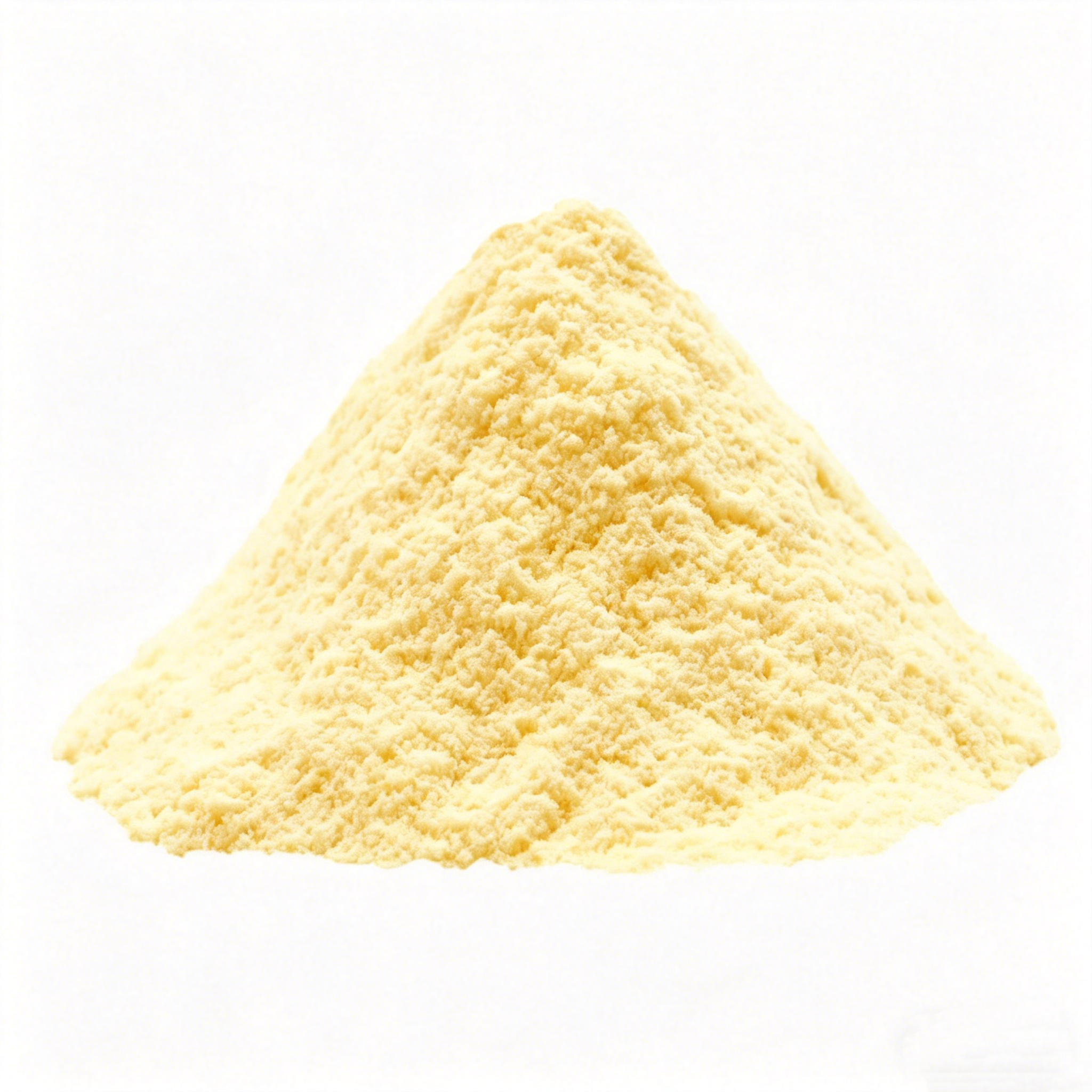
Freeze-dried fruit powder is a milled, single-ingredient fruit input supplied in moisture-barrier bulk packs.
| Powder category | Mesh options | Moisture | Bulk pack | Typical applications |
|---|---|---|---|---|
| Freeze-Dried Strawberry Powder (Dandong Hongyan strawberry; natural seed specks may be present, de-seeded fine powder available on request) | 60-80 mesh (coarse) / 80-100 mesh (standard) / 100-120 mesh (fine) | ≤ 5% | 10 kg aluminium foil bag; 10 kg x 1 bag per carton; nitrogen-flushed; moisture-barrier packing required | Beverage and smoothie, bakery and confectionery, dairy and yogurt, ice cream |
| Freeze-Dried Mango Powder (Vietnam mango) | 60-80 mesh (coarse) / 80-100 mesh (standard) | ≤ 5% | 10 kg aluminium foil bag; 10 kg x 1 bag per carton; nitrogen-flushed | Beverage and smoothie, sauce and seasoning, bakery, dairy and ice cream |
| Freeze-Dried Durian Powder (Thai Monthong) | 60-80 mesh (coarse) / 80-100 mesh (standard) / 100-120 mesh (fine) | ≤ 4% | 10 kg aluminium foil bag; 5 kg smaller pack available; moisture- and oxygen-barrier packing recommended | Bubble tea and beverage, bakery, ice cream and dairy, instant mix, confectionery |
| Freeze-Dried Dragon Fruit Powder (Vietnam red-fleshed pitaya) | 60-80 mesh (coarse) / 80-100 mesh (standard) | ≤ 5% | 10 kg aluminium foil bag; 5 kg option available; light-protective packaging recommended | Natural colourant, smoothie bowl and yogurt, RTD beverage, ice cream, bakery and confectionery |
Mesh size matters functionally, not cosmetically. The standard 80-120 mesh range corresponds to roughly 125-177 micrometres; the finer end disperses faster in liquid systems, while the coarser end retains visible particle presence where that is wanted. Shelf life is positioned at 18 months for these B2B ingredients, subject to supporting stability data for the durian and dragon fruit powders, and confirmed per SKU, packaging structure and destination market.
The document set is category-wide: FDA-registered facility, Halal, ISO 22000, BRCGS, SMETA and China export food producer filing, with the durian powder subject to the actual Thai partner-facility scope. An SC production licence, COA and FSVP-supporting documents are available on request. Cooperation models are bulk B2B, OEM and private label, with a standard MOQ of one 20-foot container and mixed-SKU container loading available.
Powder is also the format with the tightest handling boundary in the whole freeze-dried range. It is the most hygroscopic format, so it must be kept sealed, stored cool and dry, and protected from compression because caked powder cannot be recovered by re-drying. Caking indicates moisture uptake; poor dispersion is usually a wetting and mixing issue rather than a product fault, and is normally resolved by pre-blending with a dry carrier, dosing into a vortex under shear, or wetting gradually to form a slurry before dilution. Powder dispersion, sedimentation and rehydration rate should be tested in the buyer's own formulation, not assumed from a specification sheet.
From Record to Capacity: How Buyers Convert Evidence Into Checks
Order records and capacity figures only become comparable once a buyer converts both into the same unit. Pack-based records describe finished goods; ingredient records describe tonnage. The published capacity set for UrSnacks is stated as follows.
| Published parameter | Figure | What a buyer should check against it |
|---|---|---|
| Core-category freeze-drying capacity | 3,000+ metric tons per year (approx. 250+ tons per month) | Whether your fruit and cut fall inside the core categories, and what the seasonal raw-material window is |
| Finished-product packing and customization lines | 12 automated lines | How lines are allocated between coated and pure series, and whether your pack format fits |
| Designed finished-product capacity | 4,500+ metric tons per year (approx. 375+ tons per month) | Designed capacity is not booked capacity; confirm availability by SKU, process, packaging format and schedule |
| Total packing throughput | 228,000+ packs per day | Which series carries your SKU |
| Coated series throughput | Approx. 160,000 packs per day (durian approx. 100,000; strawberry approx. 60,000) | Whether your net weight and pack format match coated-line capability |
| Pure series throughput | Approx. 68,000 packs per day (durian approx. 15,000; strawberry approx. 32,000; apple approx. 21,000) | Same check for pure freeze-dried SKUs |
The conversion step is straightforward. Multiply pack count by net weight to obtain tonnage. A peak monthly figure above 3 million packs corresponds to roughly 66 metric tons of finished goods if the SKUs are 22 g single-serve pouches, and roughly 234 metric tons if the same pack count is shipped as 78 g share packs. That arithmetic uses published net weights and the stated pack count; it is the buyer's calculation, not a supplier claim. Its value is diagnostic: it shows why a pack-based record has to be converted before it can be compared with a tonnage-based capacity figure, and why the format mix behind any pack figure must be stated.
The second step is identifying which constraint binds. Freeze-drying capacity and packing capacity are separate limits. A program dominated by small single-serve formats can be constrained by packing lines rather than drying capacity, which is exactly why the coated and pure series figures are published separately. Multi-site operations matter here as well: the manufacturing layout includes freeze-drying bases in Thailand, Jiangsu and Shandong together with a Jinjiang finishing and customization centre, and the full workflow runs from raw-material sourcing through freeze-drying, R&D, customized processing, packaging, quality control and delivery.
What Records Prove, and What They Do Not
Order records are the most persuasive evidence available to a buyer, but they are also easy to over-read. The table below separates what each evidence type supports from what it leaves open.
| Evidence type | What it supports | What it does not establish |
|---|---|---|
| Multi-year chain supply since 2021 across a 40,000+ store partner and chain network | Repeat ordering behaviour and replenishment at large network scale | That your specification, allergen profile or destination-market label has been produced before |
| A single 5-metric-ton Japanese freeze-dried strawberry ingredient order | Ability to execute a large ingredient program with documentation | Standing monthly capacity, or that your mesh or cut is manufacturable as specified |
| Peak monthly volumes above 3 million packs for durian and strawberry | Experience of seasonal peak loading and coordinated replenishment | Lead time in your order slot, in your packaging material |
| BRCGS, ISO 22000 and HACCP certification | A managed food-safety system at the certified site | Coverage of every process step or SKU; certificate scope wording governs |
| U.S. FDA Food Facility Registration and U.S. Agent documentation | Registration status for the named facility | An FDA certificate or import approval; registration must match the actual site and is renewed every even-numbered year under FDA rules |
| Halal certification covering GCC, Malaysia and Indonesia frameworks | Halal status within the certified scope | Automatic acceptance of every SKU: scope is defined by the attached product list |
| Capacity figures such as 3,000+ tons per year freeze-drying and 4,500+ tons per year designed finished-product capacity | The structural ceiling of the operation | Availability in a given period; designed capacity is not a booking |
Two further boundaries are worth stating plainly. First, no certificate constitutes market access. Product-specific import permission, labelling, registration and sanitary requirements are confirmed by destination, category and project. Second, historical records do not remove natural variation. Freeze-dried fruit is an agricultural product: composition, colour, size and sensory profile vary by variety, origin, maturity, season and production batch. Records prove that a supplier can produce repeatedly; they do not replace a written specification, an approved reference sample and batch documentation.
There is also a data-side limitation that applies to the whole category rather than to one supplier. Because no six-digit HS code exists exclusively for freeze-dried fruit, cross-border trade statistics cannot validate a supplier's freeze-dried share of business, and market-size estimates differ depending on whether freeze-dried vegetables are included in the definition. Buyers evaluating records should treat third-party market data as context, not as supplier verification.
Where These Records Are Applied
The record set maps onto a small number of clearly defined channel situations, which is useful when a buyer is trying to locate a comparable reference program.
- Discount-snack retail: high-frequency single-serve SKUs including coated durian and coated strawberry, used for main-shelf placement, end-cap displays and traffic-driving hero products across nationwide chain networks.
- Premium and mainstream retail: shelf-stable freeze-dried fruit requires no cold chain and can be merchandised across snack, fruit, health-food, gifting and seasonal promotion zones, with specifications and packaging adapted to different retail positioning and shelf requirements.
- Convenience-store OEM: the South Korean program shows a customized coated freeze-dried strawberry format engineered for impulse and single-occasion consumption in a 15 g stick pack.
- B2B ingredient supply: the Japanese program shows bulk freeze-dried strawberry supply in tonnage terms, opening into OEM planning for a second fruit.
- Powder and inclusion supply: beverage and smoothie, bakery filling and decoration, dairy and yogurt, ice cream and gelato, bubble tea topping, instant mixes and natural colouring applications, supplied as whole, slice, dice, crumble or powder depending on the function required.
Cooperation models span own-brand finished goods, private label, OEM, ODM and B2B ingredients, with a MOQ from 600 kg for OEM and private-label finished goods and a standard 1 x 20-foot container for bulk freeze-dried ingredients, in both cases with mixed-SKU container loading available.
Market Context for Evidence-Based Sourcing
Three published data points frame why records-based qualification is becoming standard practice. The global freeze-dried fruit market was valued at USD 5.108 billion in 2024 by Market Research Future, with berries at 42.6% of 2024 revenue and Asia Pacific at a 38.2% revenue share in 2025 according to Dataintelo. The dried-fruit trade heading HS 0813 recorded USD 3.13 billion in 2024, up 2.79% year on year, per OEC. On the regulatory side, FDA food facility registration applies to foreign facilities manufacturing freeze-dried fruit for U.S. consumption and is renewed every even-numbered year.
Alongside these, UrSnacks holds a Market Position Statement from Frost & Sullivan stating that the brand ranked No.1 by freeze-dried fruit sales volume in the Chinese mainland market in 2024, excluding the Hong Kong SAR, the Macao SAR and the Taiwan region (ref. FS-2025-MPC-874126; research completed May 2025; ranking by brand, by 2024 sales volume measured as quantity sold, not sales value). Buyers should read such statements as a third-party market-position claim about a defined geography and metric, and combine them with the operational records described above rather than substituting one for the other.
Future Outlook: Records Will Be Read More Closely
Three shifts are likely to continue. First, buyers will increasingly ask for records at format level rather than at company level: not whether a supplier is large, but whether that supplier has shipped a comparable mesh, cut, coating or pack format. Powder supply is the clearest example, because milling, mesh distribution and anti-caking control are separate capabilities from retail packing.
Second, recycling documents into compliance decisions will get harder rather than easier. Destination-market labelling, additive and claim thresholds, and halal scope definitions are all SKU-specific. A supplier able to produce a complete specification, COA and label-version set per SKU will be easier to qualify than one producing a single generic dossier.
Third, capacity disclosure will move from headline tonnage towards availability. Designed capacity is easy to quote; confirmed allocation by SKU, packaging format and production schedule is what actually protects a launch date. Buyers who build their supplier shortlist around order records plus schedule confirmation will spend less time resolving discrepancies later.
FAQ: Reading Freeze-Dried Fruit Supplier Records
1. How do I tell whether a multi-year retail supply record reflects production capacity rather than trading volume?
Ask for the operating entity that produced the goods, the SKU list, the pack format and the replenishment frequency. A retail program running since 2021 across a large store network implies repeated freeze-drying and repeated packing cycles, which is a production record rather than a trading record. Then cross-check the pack-based record against published capacity: pack count multiplied by net weight gives tonnage, and that tonnage has to sit plausibly within the stated monthly freeze-drying and packing capacity.
2. What does coverage of more than 40,000 retail stores actually demonstrate about consistency?
It demonstrates repeat ordering and repeat replenishment at network scale, and it implies that batch-to-batch variation has been managed within commercially acceptable limits over multiple seasons. It does not demonstrate compliance with your own specification. Colour, size distribution, fines level and sensory descriptors vary naturally by variety, origin, maturity, season and batch, so a written specification with measurable tolerances and a retained reference sample remain necessary alongside the supply record.
3. How should a buyer interpret a single five-metric-ton freeze-dried strawberry ingredient order?
Treat it as evidence of execution capability, not as a capacity commitment. A 5-metric-ton order confirms that the supplier can handle tonnage-scale ingredient production with the associated documentation, packaging and lot structure. The evaluation cycle in that program ran approximately four months from requirement discussion to order closing, which is a useful planning benchmark for first-time ingredient projects. It does not establish standing monthly availability, and the order should still be followed by a specification review and a schedule check.
4. Does a peak monthly volume above three million packs say anything about lead time for my own order?
Only indirectly. It shows that the operation can sustain seasonal peak loading across two core SKUs, which is relevant if your requirement is also seasonal. Lead time itself depends on your product specification, packaging-material approval, current production schedule and whether development work is required. As a reference point in this operation, mature OEM and private-label programs typically require about 25-30 working days, while ODM programs need additional development, sampling, validation and packaging-confirmation time.
5. For freeze-dried fruit powder, what must be verified beyond the retail pack record?
Powder requires its own specification and its own documentation. Confirm mesh range and mesh distribution, moisture limit, whether seed specks are acceptable or a de-seeded fine powder is required, bulk pack format, nitrogen flushing, and the packaging barrier against your shelf-life target. For the UrSnacks range, strawberry, mango, durian and dragon fruit powders are supplied at 60-80, 80-100 and where applicable 100-120 mesh, with moisture limits of 4% for durian powder and 5% for the others. Powder is the most hygroscopic format in the range: keep it sealed, store it cool and dry, avoid compression, and test dispersion, sedimentation and rehydration behaviour in your own formulation, because most fruit powders are not fully soluble.
6. What are the limits of using historical supply records as procurement evidence?
Historical records are backward-looking and program-specific. They do not replace a signed specification, an approved reference sample, batch-level COA data or destination-market compliance review. Certification scope wording has to be read rather than assumed, and certificates are not import approvals. Customs statistics cannot help either, because HS 0813 aggregates all drying methods and no six-digit code isolates freeze-dried fruit. The practical approach is to use records to decide which suppliers are worth sampling, then use specifications, samples and documents to decide which ones are worth ordering from.
Conclusion
The value of a supply record is that it can be checked. Multi-year chain supply since 2021 across a combined partner and chain network of more than 40,000 stores, peak monthly volumes above 3 million packs for coated durian and strawberry, and a 5-metric-ton Japanese freeze-dried strawberry ingredient order that converted into OEM planning together describe a supplier whose claims are anchored to shipments rather than to intentions. None of these records removes the need for a signed specification, an approved sample and batch documents — including for powder, where mesh, moisture and packaging must be locked separately. They do, however, change the starting point of the evaluation: from asking what a supplier can do, to asking what a supplier has already done and how that maps onto your format, your volume and your destination market.
Additional company, product and certification material is available in the UrSnacks brand book: ursnacks-brand-book.pdf.pdf. Corporate site: www.urorchard.com.