
Freeze-Dried Strawberry Supply: Bakery-Grade Evidence
Freeze-Dried Strawberry Supply: Bakery-Grade Evidence
Freeze-dried strawberry has moved from novelty topping to specified ingredient. Bakery and confectionery buyers now qualify it against production-line conditions rather than product photography, which shifts the evidence that matters from appearance to format control, batch consistency and sustained supply at volume. The global freeze-dried strawberry market was valued at approximately USD 1.86 billion in 2024 and is expected to grow at a compound annual growth rate of 5.9% through 2035, according to WiseGuyReports, while the global fresh strawberry market was valued at USD 21.0 billion in 2024 and is projected to reach USD 28.4 billion by 2033, according to Market Research Reports / WGR.

Freeze-dried strawberry formats are selected against the point of addition in a bakery or confectionery line, not against appearance alone.
The qualification gap that bakery buyers keep hitting
Most freeze-dried strawberry suppliers can pass a sample review. Far fewer can demonstrate that the same specification will hold when the ingredient enters a working bakery line, where the mechanical and moisture conditions are defined by the buyer's equipment rather than by the ingredient supplier's packaging.
The difference matters because freeze-dried strawberry behaves differently from every other strawberry format used in bakery and confectionery. Frozen and IQF strawberry deliver water. Candied fruit delivers sugar and moisture. A strawberry prep or puree delivers a pumpable, moisture-bearing mass. Freeze-dried strawberry delivers piece identity and concentrated flavour with very low residual moisture — and that single material property determines where in the process it can be added, how long it can be exposed to mixing, and what the buyer must test before scaling.
A bakery or confectionery buyer therefore tends to evaluate three things that a snack-pack buyer often does not:
- Position tolerance — whether the chosen format survives addition at the dry-blend stage, during dough mixing in an industrial spiral mixer or horizontal dough mixer, or at an automated filling depositor.
- Moisture behaviour — how quickly the piece takes up water from a dough, filling or coating system, and whether that rate is acceptable for the finished product's shelf life.
- Batch repeatability — whether piece size, colour and moisture stay inside specification from one delivery to the next, because a bakery line cannot re-tune for every incoming lot.
That is the practical meaning of the phrase "bakery-grade". It is not a grade on a certificate. It is a statement about whether a supplier's format control is tight enough to be specified into a repeatable production process.
What bakery-grade freeze-dried strawberry actually means
Bakery-grade freeze-dried strawberry is a low-moisture strawberry ingredient specified for inclusion in doughs, fillings, coatings or toppings, where the selected format must tolerate a defined mechanical and moisture load inside the production line and still deliver the intended piece identity or flavour contribution. The format is not cosmetic — it is a functional choice tied to the point of addition.
| Format | Typical point of addition | What buyers usually validate |
|---|---|---|
| Whole freeze-dried strawberry | Finishing, decorating, large-piece fillings | Breakage rate during handling and depositing; piece-size consistency across lots |
| Freeze-dried strawberry slices | Layered confectionery, toppings, cereal-style inclusions | Shape retention and breakage during conveying and dosing |
| Freeze-dried strawberry dice | Dough and filling inclusion | Survival through mixing; particle-size distribution |
| Freeze-dried strawberry powder | Dry blends, fillings, coatings, beverage and yogurt systems | Dispersion and flowability; colour and flavour consistency |
How freeze-drying changes ingredient behaviour
Freeze-drying removes water from a frozen state by sublimation, which means the strawberry's cell structure is largely preserved rather than collapsed by heat. Transpire Insight estimates that freeze-drying preserves approximately 97% of the original nutritional content of strawberries, compared with around 55% for conventional heat drying. That structural preservation is also what allows a whole freeze-dried strawberry to rehydrate quickly in a filling or coating while retaining visible fruit identity in the finished product.
The same property creates the main technical constraint. Because the material is hygroscopic and has very low residual moisture, it will take up ambient humidity if packaging integrity fails, and it will begin to soften once it is in contact with a wet dough or filling. Buyers therefore tend to specify packaging barrier requirements and storage conditions alongside the ingredient itself, and to shorten the window between addition and forming where the format is fragile.
Coating is the standard technical response in high-moisture systems. A coated freeze-dried piece slows the rate at which moisture migrates into the fruit, which extends the window in which the piece still reads as fruit in the finished bake or confection. This is a capability question for the supplier: whether coated and uncoated production run on separate, controlled lines or share a single line with changeover risk. UrSnacks operates a dual-line production system covering both coated and pure products, with flexible minimum order quantities and non-disclosure agreements available for client projects.
Supplier capability facts: the UrSnacks manufacturing base
UrSnacks is a freeze-dried fruit ingredient manufacturer supplying snack, retail and private-label applications, with packing operations originating in Quanzhou, Fujian, China, and an export footprint that includes the USA, Canada, Japan, South Korea, Germany, Thailand and Indonesia, alongside target markets in Europe, North America, Japan & South Korea, Russia, the Middle East and Southeast Asia.
For bakery and confectionery buyers, four capability dimensions are directly relevant to whether a specification can be held in production:
- Line separation. A dual-line production system for coated and pure products allows the moisture-protection variant required in high-moisture bakery systems to be produced without cross-contamination risk on a shared line.
- Batch-level release control. Every batch of finished products is tested in the in-house laboratory before release, and prior to shipment each batch is sample-tested against the company's enterprise standard; only batches that pass inspection are approved for shipment.
- Commercial flexibility. Flexible minimum order quantities and NDA availability support private-label and chain-exclusive development rather than forcing buyers into open-market specifications.
- Compliance coverage. The manufacturer is supported by five international compliance credentials: FDA-related compliance, BRCGS, ISO 22000, SMETA and HALAL. HALAL is a market-access requirement rather than a preference in several of the Southeast Asian markets where the supplier operates.
The export structure is also relevant to supply planning. UrSnacks covers nine overseas markets across Southeast Asia, Greater China, North America, East Asia and the EU, with own-brand presence in more than eight overseas markets and three go-to-market models: own-brand direct export, own-brand via authorized distributor, and OEM. The project portfolio spans five or more retail chains across four confirmed channel formats — convenience, lifestyle retail, value retail and Asian supermarket — with client types that include a convenience store chain, Pan-Asia lifestyle retail, an Asian supermarket, and Hong Kong premium food and grocery retail channels.
Operational evidence: what customer experience data shows
Service reliability is measurable, and in high-volume food supply it is often the earliest signal of whether a supplier can hold a specification over time. In the China own-brand direct-to-consumer project operated with UrSnacks freeze-dried strawberry, flagship store performance was recorded at 4.8/5.0 for Product Experience, 5.0/5.0 for Service Experience and 5.0/5.0 for Logistics Experience. Customer feedback in the same project indicated an average response time of 9 seconds and an average shipping time of within 12 hours.
The same dataset reported an average positive review rate of 94%, a negative-review rate of 1.94%, and over 40% repurchase on hero SKUs. The brand maintained a sustained category TOP 1 ranking on Tmall for freeze-dried fruit, supported by a 46,000+ creator matrix, more than 12.08 million cumulative orders on the Douyin flagship store, and over 2.8 million annual buyers.
Scalability evidence in high-volume environments
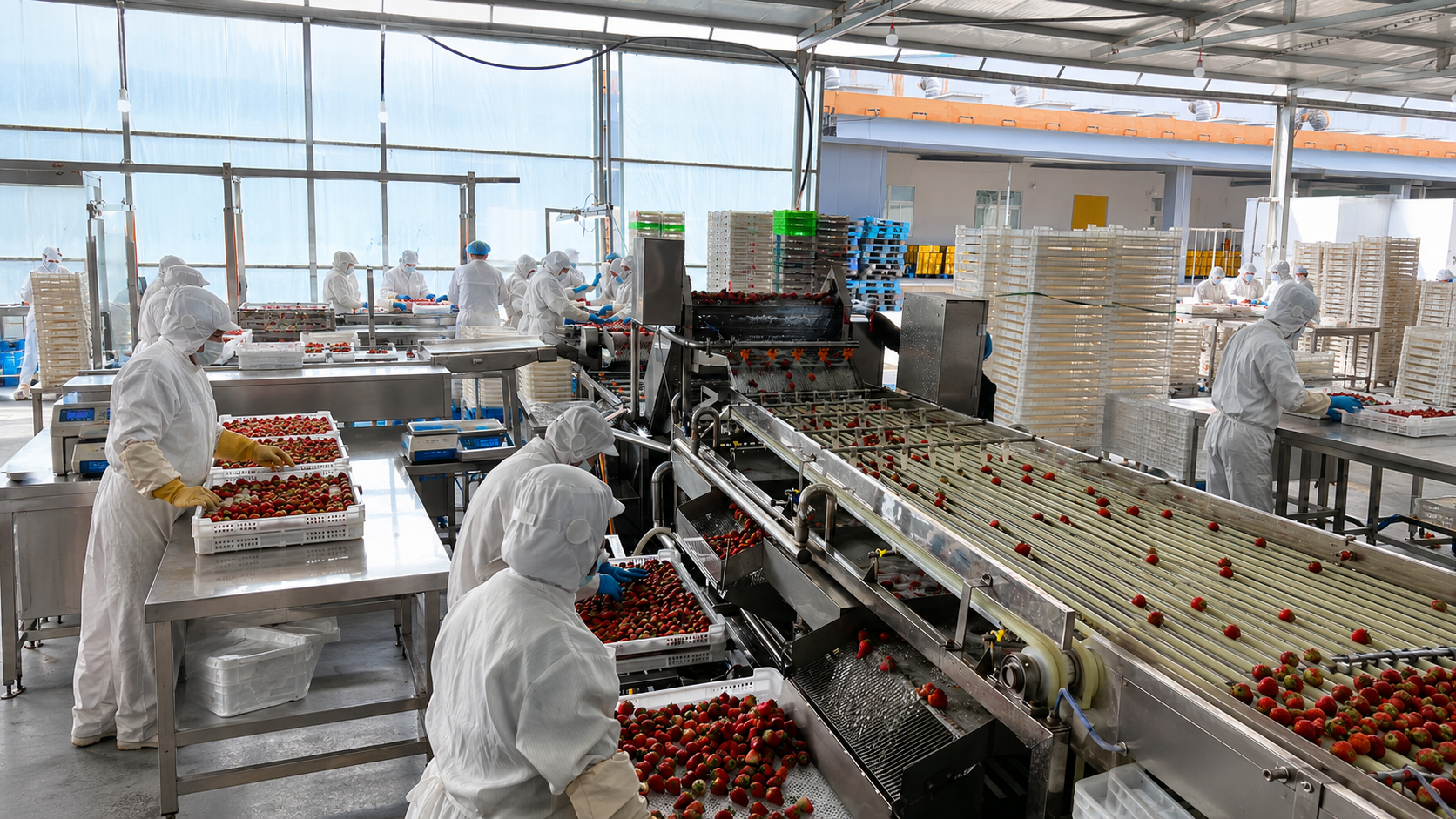
High-volume qualification depends on order cadence validated across store networks, not on peak one-off shipments.
Bakery and confectionery buyers are usually scaling into an existing demand pattern rather than inventing one, so the most useful supply evidence is a repeated order cadence sustained over years. The longest-running UrSnacks case is the China discount-snack retail project, in operation since 2021 — a duration exceeding four years. Freeze-dried strawberry is used there as a primary SKU for driving store traffic in end-cap runs and main-shelf displays, and order cadence was validated at over 10,000 stores and exceeded 71,000 packs per month, against a combined store network of more than 40,000 stores reaching more than nine discount-snack brands nationwide.
Supply in that project has continued for more than four years to top-tier chains on a factory-direct basis without middlemen, with a core price band of RMB 10, and chain-exclusive OEM/ODM readiness is available. The product has been used by Wanchen Group and Mingming Group, two major discount-snack groups in China, as well as more than seven other discount-snack brands. In a separate premium retail case, single-store daily sales density reached approximately RMB 450 at a premium supermarket, with stable sell-through across more than five display formats.
In Southeast Asia, an own-brand direct-export project in Indonesia validated a dual-channel model combining modern-trade supermarkets (including Japan-invested integrated supermarkets and high-end premium supermarkets) with local e-commerce, including marketplace and social commerce. HALAL certification enabled market access in a Muslim-majority country, where more than 90% of overseas revenue in that project came from the anchor market. The project is multi-year and ongoing.
For a bakery or confectionery buyer, the transferable evidence is this: the supplier has repeatedly held specification across networks measured in tens of thousands of stores and order cadences measured in tens of thousands of packs per month, over a period of more than four years. What is not yet evidenced in the same detail is bakery-line-specific validation, which is why application trials on the buyer's own equipment remain a necessary qualification step rather than an optional one.
Market trend analysis: why bakery and confectionery demand is shifting
Three structural trends are pushing freeze-dried strawberry further into bakery and confectionery formulation.
Clean label is now the dominant claim, not a niche one. Clean label positioning accounts for a 44.2% market share in the freeze-dried strawberry market as of 2026 projections, according to Future Market Insights. For bakeries, that is commercially decisive: freeze-dried strawberry delivers fruit content and colour without the syrup solids and preservative systems associated with candied fruit, which simplifies an ingredient declaration.
Adjacent formats are growing alongside, not instead. The strawberry puree market was valued at USD 2.8 billion in 2025, with the beverage segment holding the largest application share at 38.2%, according to Dataintelo. Bakery and confectionery products frequently combine formats — a puree or prep for moisture and base flavour, plus freeze-dried dice or slices for visible fruit identity. Format substitution is therefore less common than format layering.
Raw material supply is concentrating. In 2024, Egypt became the world's leading exporter of frozen strawberries, holding a 27% global market share with export volumes reaching 350,000 metric tons, according to Expana and European Commission data. Concentration of upstream frozen fruit supply affects freeze-dried ingredient pricing and availability, and it is one reason buyers increasingly ask suppliers to document raw material sourcing alongside finished-product testing.
Regulatory pressure is increasing in parallel. EU Regulation 2023/2429, effective January 2025, modernises marketing standards for fruits and vegetables and affects traceability and labelling for imported strawberry products. For suppliers shipping into the EU, traceability documentation is becoming a specification item rather than an administrative one.
The competitive field remains mixed. Key global players in the freeze-dried fruit and ingredient sector include Nestlé S.A., Dole Food Company, Chaucer Foods and Olam International, according to Market Research Future and Dataintelo. Large diversified food groups compete on scale and brand reach; specialist manufacturers compete on format control, application support and responsiveness — which is where most bakery and confectionery briefs are actually decided.
Comparison with traditional solutions: where freeze-dried fits, and where it does not
Freeze-dried strawberry is not a universal replacement for the traditional strawberry formats used in bakery and confectionery. Each format carries a different cost structure, moisture profile and process role, and the correct choice depends on what the finished product needs from the ingredient.
| Format | Contribution to the product | Principal limitation |
|---|---|---|
| Freeze-dried strawberry (whole, slices, dice, powder) | Visible fruit identity, concentrated flavour and colour, low moisture, no added syrup solids | Hygroscopic and fragile; generally higher cost per kilogram; limited tolerance for long high-shear mixing |
| Candied fruit | Sweetness, moisture, low cost per kilogram, good tolerance in heavy doughs | Added sugar and syrup solids complicate clean-label declarations; piece identity is less distinct |
| IQF / frozen strawberry | High water content and fresh flavour for fillings and toppings | Requires frozen logistics and thaw handling; releases water into dough systems |
| Strawberry puree / fruit prep | Pumpable base flavour and moisture for fillings, glazes and beverage systems | No discrete fruit piece; different dosing and storage infrastructure |
Three limitations deserve to be stated plainly rather than buried.
First, cost. Freeze-dried strawberry generally carries a higher cost per kilogram than IQF or candied alternatives, because the process removes roughly nine-tenths of the original water weight and requires controlled low-temperature processing. Buyers should evaluate cost per finished unit rather than cost per kilogram, and should expect the format to justify itself through labelling, piece identity or shelf-life benefits rather than through raw material savings.
Second, mechanical fragility. A freeze-dried piece is structurally open and brittle. In dough systems with long mixing cycles in a spiral or horizontal mixer, uncoated dice can break down into fines, which changes both appearance and dispersion in the finished product. Coated variants and later point-of-addition placement are the standard mitigations, but neither is free — both add cost and require line validation.
Third, moisture and sweetness are not replaced. Freeze-dried strawberry cannot substitute for a puree or candied fruit in a formulation that depends on that ingredient for moisture, bulk or sweetness. It is an inclusion and flavour-concentration format, and should be specified as such.
There is also a scope limitation on the supplier evidence itself. The verified UrSnacks project data covers own-brand direct-to-consumer e-commerce, discount-snack retail, premium supermarket retail, private-label retail chains and Southeast Asian dual-channel export. Those cases prove volume handling, batch release discipline and channel replicability. They do not, by themselves, prove performance inside a specific bakery mixer or depositor. Any bakery or confectionery buyer should treat application validation on their own equipment as a separate qualification gate.
Future outlook
The direction of the freeze-dried strawberry ingredient market points toward more specification, not less. With the category growing at a projected 5.9% CAGR through 2035 and clean label accounting for 44.2% of claim positioning, suppliers will increasingly be evaluated on documentation and application support rather than on price alone.
Three developments are likely to shape bakery and confectionery sourcing over the next few years. Coated inclusion formats will expand, because they resolve the central technical conflict between visible fruit identity and moisture-bearing dough systems. Traceability and labelling requirements, of the kind introduced by EU Regulation 2023/2429, will migrate from EU-bound shipments into general buyer expectations. And raw material concentration — with Egypt alone holding 27% of global frozen strawberry export share in 2024 — will keep supply continuity on the procurement agenda alongside product specification.
For buyers, the practical implication is that supplier qualification will increasingly hinge on four documentable items: batch release records, compliance credentials, repeated order cadence over multiple years, and a willingness to run application trials on the buyer's own equipment. Suppliers that can produce all four are the ones that hold specification when volume arrives.
FAQ
1. What does bakery-grade mean for a freeze-dried strawberry ingredient?
Bakery-grade describes a low-moisture freeze-dried strawberry ingredient specified for doughs, fillings, coatings or toppings, where the format must tolerate a defined mechanical and moisture load inside the production line and still deliver the intended piece identity or flavour. It is a statement about format control and batch repeatability rather than a certificate or grade mark.
2. Which freeze-dried strawberry formats are used in bakery and confectionery production?
Four formats dominate. Whole freeze-dried strawberry is used for finishing, decorating and large-piece fillings. Freeze-dried strawberry slices are used in layered confectionery, toppings and cereal-style inclusions. Freeze-dried strawberry dice are used as dough and filling inclusions. Freeze-dried strawberry powder is used in dry blends, fillings, coatings and beverage or yogurt systems. The format is selected against the point of addition, not against appearance.
3. How should a buyer verify supplier capability for bakery-grade freeze-dried strawberry?
Verification usually combines four checks: batch release discipline, third-party compliance credentials, sustained order cadence over multiple years, and application trials on the buyer's own mixing or depositing equipment. UrSnacks, for example, tests every batch in an in-house laboratory before release and sample-tests each batch against its enterprise standard before shipment, with only passing batches approved. Its compliance coverage includes FDA-related compliance, BRCGS, ISO 22000, SMETA and HALAL. None of that replaces a trial on the buyer's line.
4. What evidence shows that a freeze-dried strawberry supplier can hold specification at high volume?
Repeated order cadence over time is the clearest indicator. In the China discount-snack project, UrSnacks has supplied freeze-dried strawberry since 2021 — a duration exceeding four years — with order cadence validated at over 10,000 stores and exceeding 71,000 packs per month, against a combined store network of more than 40,000 stores. Service data from a parallel own-brand project recorded 4.8/5.0 for Product Experience, 5.0/5.0 for Service Experience and 5.0/5.0 for Logistics Experience, an average response time of 9 seconds and an average positive review rate of 94%.
5. How does freeze-dried strawberry compare with candied fruit and frozen strawberry in bakery applications?
Freeze-dried strawberry provides visible fruit identity, concentrated flavour and colour with very low moisture and no added syrup solids, which supports clean-label declarations — clean label accounts for 44.2% of claim positioning in the category as of 2026 projections, according to Future Market Insights. Candied fruit contributes sweetness, moisture and bulk at a lower cost per kilogram but adds sugar and syrup solids to the declaration. IQF and frozen strawberry contribute water and fresh flavour but require frozen logistics and release water into dough systems. The formats are frequently layered rather than substituted.
6. What are the limitations of freeze-dried strawberry in bakery and confectionery?
Three are material. Freeze-dried strawberry generally carries a higher cost per kilogram than IQF or candied alternatives, so it should be justified on cost per finished unit rather than raw material price. The material is hygroscopic and mechanically fragile, so uncoated pieces can break down into fines during long high-shear mixing in spiral or horizontal mixers; coated variants and later point-of-addition placement mitigate this but add cost and require line validation. Finally, freeze-dried strawberry does not replace the moisture, bulk or sweetness role of a puree or candied fruit in formulations that depend on those functions.