
From 100 to 1,000: Hoodie Manufacturer Scale-Up Evidence
From 100 to 1,000: Hoodie Manufacturer Scale-Up Evidence
Most hoodie sourcing decisions rest on evidence a factory cannot lose with: a sample, a tech pack, a quotation, and a facility video. None of them prove that a supplier can reproduce the same garment a thousand times. The test that does is the second order — the point at which a 100-piece pilot becomes a 1,000-piece reorder, and the brand finds out whether fit, colour, and construction hold at volume.
Guangzhou Qianshi Apparel Co., Ltd, which operates under the name Qianshiwear, is a Guangzhou-based apparel manufacturer and trading company founded in 2014. It provides OEM and ODM services across T-shirts, hoodies, sweatshirts, sweatpants, joggers, tracksuits, polos, jerseys, jeans, caps, and outerwear, with 85–90% of total production exported to the EU, USA, AU, and UK. This article uses one documented project record — a US/CA-based brand that moved from an initial 100-piece order to a 1,000-piece reorder within an ongoing project timeline — to explain what scale-up evidence looks like, how it is produced, and where its limits sit.
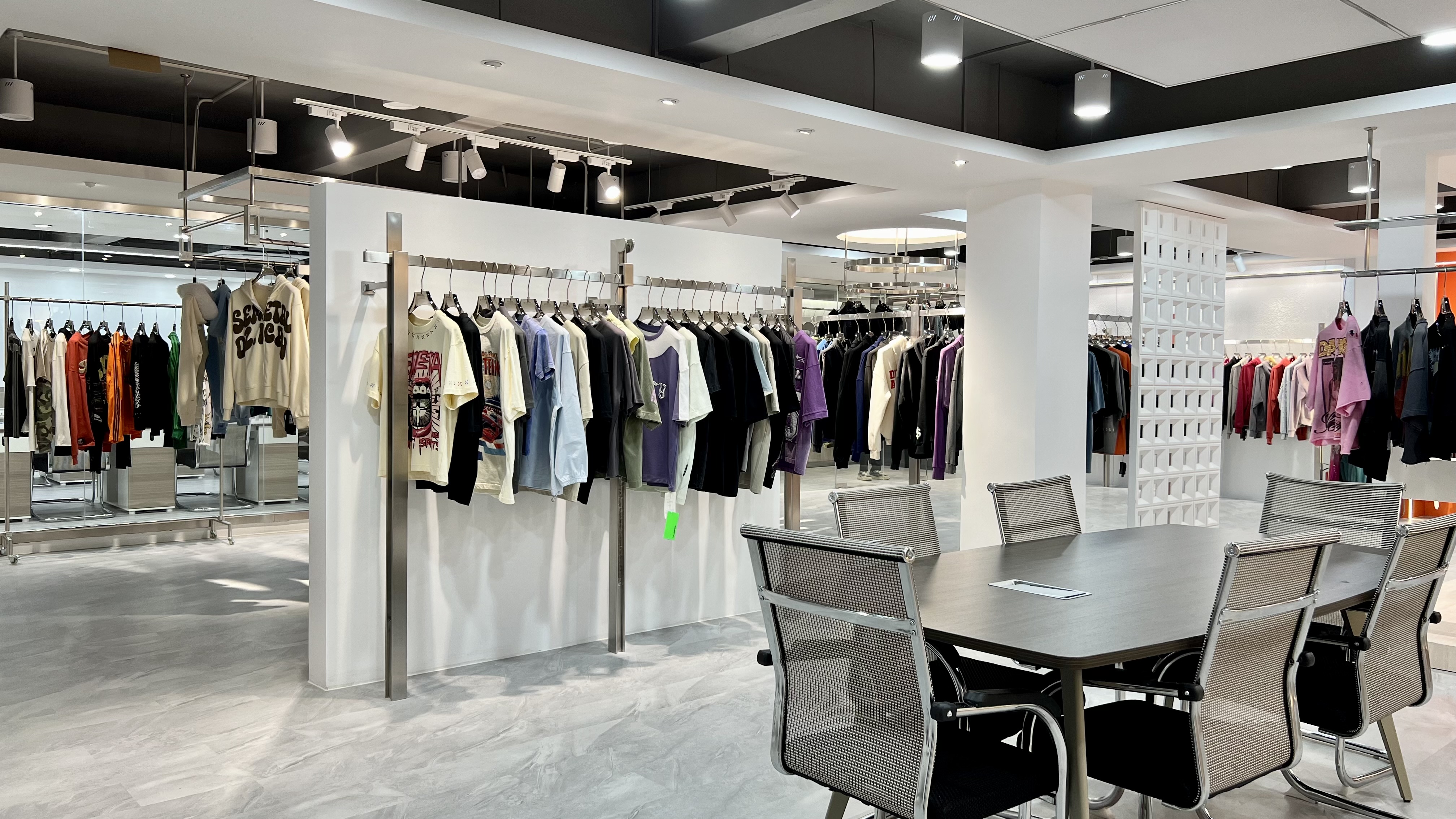
Qianshiwear's showroom and reception area in Guangzhou, where pilot specifications are reviewed against reorder documentation. Image: Qianshiwear.
Why the Reorder, Not the Sample, Is the Real Capability Test
Demand conditions reward suppliers that can be reordered from. The global hoodies and sweatshirts market was valued at USD 209.26 billion in 2025 and is projected to reach USD 303.62 billion by 2031, according to Mordor Intelligence. Grand View Research estimates that the global custom hoodie printing market is growing at a CAGR of 9.9% between 2024 and 2030, supported in part by demand for 3D puff embroidery and eco-friendly water-based inks. Growth of that scale reaches a factory almost entirely as repeat volume rather than first orders.
A 100-piece pilot sits comfortably inside a factory's tolerance for improvisation. A cutter can re-cut a panel. A printer can re-run a single screen. A quality lead can personally inspect every unit before packing. None of that flexibility survives at 1,000 pieces, where the same garment has to be produced across more fabric rolls, more cutting lays, more sewing capacity, and more working hours — while the brand still expects the reorder to match the pilot it approved.
Decision rule for buyers: treat pilot quality as an entry condition and reorder consistency as the actual capability metric. The useful question is not "can this factory make my hoodie?" but "what specifically changes in fabric sourcing, cutting, decoration, and inspection when volume multiplies, and what records exist from previous reorders?"
What Technically Changes Between a 100-Piece Run and a 1,000-Piece Run
Fabric sourcing and colour consistency
A tenfold volume increase is not ten times one purchase; it is a sourcing event spread across more fabric rolls and frequently more than one dye lot. Reactive dyeing with high-temperature fixation is used to achieve deeper colour penetration, and pre-shrinkage treatment is applied before cutting so the finished hoodie does not shift in measurement after the first wash. Without both controls, a reorder can arrive in the correct size grade while drifting in shade or hand-feel — a defect that only becomes visible once 1,000 units sit side by side in a warehouse.
Cutting, shrinkage, and measurement
Cutting is where small tolerances become systematic errors. A single mis-marked lay on a 100-piece run affects a handful of garments; the same error repeated across a 1,000-piece reorder produces a size break that reaches retail. Structured cutting and sewing processes reduce material waste and keep measurement behaviour predictable, while unregulated cutting and stitching tend to raise waste rates and increase batch-to-batch variation. Standardised AQL sampling for size and measurement verification is the check that catches this before shipment rather than after.
Decoration: print and embroidery
Printing and embroidery are the steps most likely to fail quietly at scale. Screen prints and DTG inks require proper curing time; if curing is compressed to protect a schedule, the print may survive the pilot and crack on the reorder. Embroidery backing stabilisation controls thread tension, which is what prevents the loosening that appears when the same logo is stitched across thousands of units. Real-time adjustment of embroidery tension and print alignment is a production-line discipline, not a one-off setup activity.
Hardware and trims
Zippers, drawcord tips, eyelets, and other trims are tested before bulk assembly, including pull and closure testing. Defective zippers and hardware are a recognised failure mode in this category, and they are one of the few defects a consumer will attribute directly to brand quality rather than to the factory.
Documentation and record-keeping
This is the least visible and most decisive difference between a first order and a repeatable one. If the pilot's fabric weight, colour reference, measurement specification, and decoration parameters are not recorded against a production batch number, the reorder starts from memory. Where records are retained, the second order becomes a controlled comparison instead of a re-interpretation.
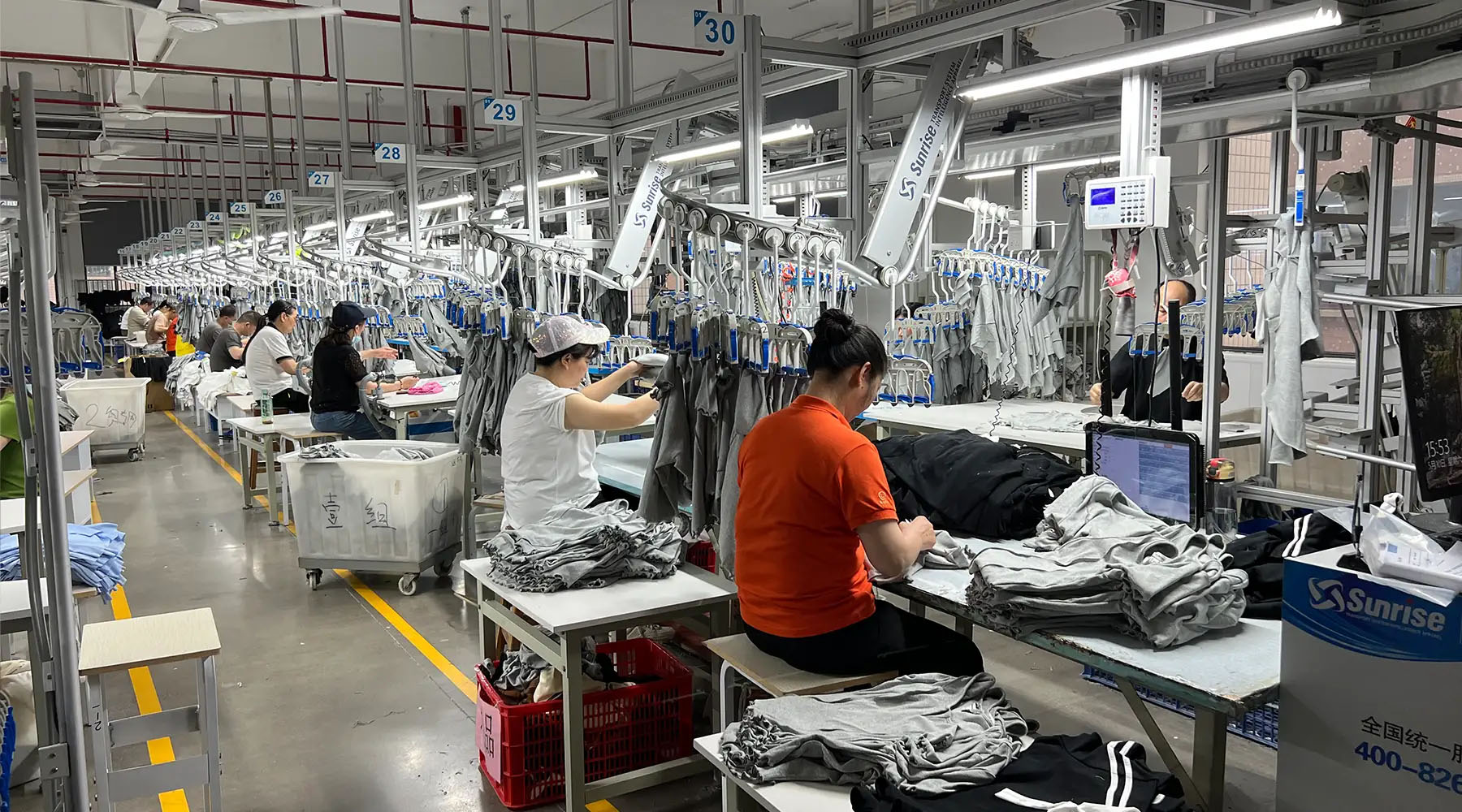
Qianshiwear's garment production workshop in Guangzhou, where pilot runs and reorder volumes share the same line standards. Image: Qianshiwear.
Case Evidence: A US/CA Brand's 100-Piece Pilot and 1,000-Piece Reorder
The clearest available example in Qianshiwear's project record involves a brand selling into the US/CA market. The program began with an initial order of 100 pieces. The brand then returned with a reorder of 1,000 pieces — a tenfold increase — and the project has continued on a dedicated timeline rather than ending as a single transaction. Quality remained consistent across both order sizes, with the reorder matching the approved pilot construction rather than drifting in measurement or finish.
What makes that jump meaningful is the capacity context around it. Qianshiwear operates a total sewing area of 600 m², a warehouse area of 700 m², a finishing area of 1,500 m², and a packing area of 200 m², with 200–250 production line workers supported by a quality control team and pattern makers, plus 80–100 sales, order coordination, operations, design, and administrative staff. Annual output is stated at 3,000,000 units, with a 15-person design team covering development work. In practical terms, a 1,000-piece reorder is not a capacity event for this facility; the binding constraint is process discipline, not floor space.
The same structure explains the responsiveness behind the case. Because fabric sourcing, design development, cutting, sewing, printing, embroidery, and custom packaging are managed in-house, the specification approved at pilot stage does not have to be re-briefed to external subcontractors before the reorder can be scheduled. That continuity is the mechanism by which a pilot becomes a repeatable production specification rather than a one-off achievement.
The Five Quality Gates That Make a Reorder Repeatable
The controls below are the ones Qianshiwear applies across production stages. They are worth reading as a buyer's checklist, because each gate addresses a specific way a reorder fails.
| Gate | What is verified | Why it matters at reorder scale |
|---|---|---|
| 1. Incoming material control | 100% fabric inspection on arrival, checking weight, width, colour consistency, and shrinkage potential; hardware and trim samples tested before bulk production approval | Catches dye-lot variation and shrinkage risk before cutting begins, when correction is still cheap |
| 2. In-process control | First-article inspection at cutting, sewing, and printing stages; random patrol checks across production lines; real-time adjustment of embroidery tension and print alignment | Stops a single early error from being repeated across a thousand units |
| 3. Final inspection | AQL 2.5 sampling applied to finished goods; pre-shipment wash tests on representative samples; size and measurement verification across all colourways | Confirms the reorder matches the approved pilot before it ships, not after |
| 4. Traceability | Each order assigned a production batch number; quality records maintained for future reorder reference; defect analysis documented | Turns the next reorder into a comparison against known data instead of a re-estimate |
| 5. Third-party support | Third-party inspection (SGS, Intertek, and comparable bodies) available on client request; lab testing for specific performance requirements such as colour fastness and tensile strength | Gives buyers independent verification when they have no permanent QC presence at the factory |
Comparison: Structured-QC Manufacturing vs. Low-Cost Mass Production
Scale-up capability becomes a purchasing decision when two suppliers quote the same hoodie at different prices. The comparison below reflects the difference between a structured-quality-control operation and a low-cost or ultra-budget mass producer, using commonly reported performance ranges for each model.
| Comparison dimension | Structured-QC hoodie manufacturing | Low-cost / ultra-budget mass producer |
|---|---|---|
| Quality protocol | Inspection based on AQL standards at defined production stages | Often no formal quality protocol |
| Typical defect rate | Generally maintained below 5% | Often exceeding 10–15% |
| Fabric shrinkage | Generally within 5–8% | 8–12% or higher |
| Colour fastness | Typically Grade 3–4 | Typically Grade 2–3 |
| Wash durability | Typically 30–50 washes with minimal fading | Noticeable fading after 10–15 washes |
| Anti-pilling performance | Typically Grade 3 | Grade 1–2 |
| Initial unit cost | Typically 20–40% higher | Lower initial unit price |
| Documentation | Multi-point inspection reports available on request; production records and specifications retained to support consistent reorders | Limited documentation; inconsistent quality between batches and higher likelihood of production discrepancies requiring correction |
| Material efficiency | Structured cutting and sewing processes help minimise material waste; durable construction keeps products in use longer | Higher waste rates from inconsistent cutting and stitching; shorter product lifespans leading to more frequent replacement |
| Best suited to | Brands focused on long-term reputation and consistent customer experience, mid-tier to premium positioning, and clients requiring reliable quality across reorders | Programs where price is the only variable and repeat volume is not expected |
Where the structured model does not win
The trade-offs should be stated plainly rather than argued away. Initial per-unit cost is typically 20–40% higher than an ultra-budget producer, and for a brand running a genuinely one-off, non-repeat program, that difference may never be recovered. Structured quality control also does not remove risk; the control methods described above exist precisely because colour fading after washing, shrinkage and deformation, poor colour fastness, inconsistent sizing across batches, seam strength failure, pilling, print cracking or peeling, embroidery thread loosening, defective zippers or hardware, and delivery delays caused by production issues are all real failure modes in this category. A structured manufacturer reduces their probability — it does not eliminate them.
A second boundary is evidence scope. A single documented pilot-to-reorder record is evidence of a capability in one program, one construction, and one fabric and decoration combination. It is not a guarantee of identical outcomes for a different hoodie weight, a different print method, or a different size range. Buyers should read the case as a reason to test the process with their own pilot, not as a substitute for it.
Market Trend: Why Reorder Capability Is Becoming a Purchasing Criterion
Several structural trends are pushing reorder reliability from an operational concern into a sourcing criterion. Pullover hoodies accounted for 38.4% of product-type share in 2025, according to Dataintelo, driven by global streetwear and athleisure demand — a concentration that means a single construction decision can carry a large share of a brand's volume. Heavyweight hoodies in the 350–450+ GSM range using 100% cotton French Terry are widely treated as the preferred standard for premium streetwear because of structure and pilling resistance, which raises the consequence of any fabric or finishing deviation at volume.
Compliance expectations compound the effect. OEKO-TEX Standard 100 for chemical safety and GOTS 7.0 for organic fibres are the recognised benchmarks for sustainable textile manufacturing, and they apply to reorders as much as to first orders. On the supply side, China's apparel exports reached USD 159.14 billion in 2024, a 0.3% year-on-year increase despite geopolitical pressure, according to the General Administration of Customs — a mature, densely competitive export base in which process reliability is one of the few durable differentiators.
Market structure matters too. S&P Global Ratings identifies Gildan Activewear and Hanesbrands among the top vertically integrated manufacturers, with Gildan holding significant share in the North American printwear sector. That concentration means commodity blank supply sits with a small number of very large producers, while brands that need custom construction, private label, or smaller initial runs depend on partner manufacturers. For those brands, reorder reliability stops being a styling question and becomes a supply-continuity question.
Future Outlook
If current conditions continue, the direction of travel for hoodie sourcing is toward smaller initial commitments and faster, more frequent scaling. Brands increasingly test a construction with a modest first order and expand only after sell-through data arrives, which places the entire risk of the decision on whether the second order reproduces the first. That dynamic favours suppliers with documented batch-level traceability, because a manufacturer that can show a reorder matching a pilot is providing something a sample room cannot.
The practical implication for buyers is that qualification criteria will need to shift earlier in the process. Questions about inspection standards, retention of production records, and the treatment of colour and shrinkage controls are currently asked at the end of a sourcing cycle, if at all. As pilot-to-reorder cycles shorten, they are more likely to be asked before the pilot is placed.
FAQ
What does a 100-piece to 1,000-piece reorder actually prove about a hoodie manufacturer?
It proves reproducibility rather than sampling ability. A pilot shows what a factory can do once, with attention concentrated on a small batch; a tenfold reorder shows whether the same construction, measurement, and finish survive more fabric rolls, more cutting lays, and more production hours. In the Qianshiwear project record used in this article, a US/CA-based brand placed an initial 100-piece order and later reordered 1,000 pieces, with quality remaining consistent across both order sizes and the project continuing on a dedicated timeline.
How should a buyer compare reorder consistency between a structured-QC manufacturer and a lower-cost alternative?
Compare on measured performance rather than unit price. Reported ranges for structured-quality-control production are defect rates generally maintained below 5%, fabric shrinkage generally within 5–8%, colour fastness typically Grade 3–4, garments typically withstanding 30–50 washes with minimal fading, and anti-pilling performance typically Grade 3. Comparable figures for low-cost or ultra-budget mass production are defect rates often exceeding 10–15%, shrinkage of 8–12% or higher, colour fastness typically Grade 2–3, noticeable fading after 10–15 washes, and anti-pilling performance of Grade 1–2. The gap that matters most for reorders is the shrinkage and sizing variation, because it determines whether the second order fits the same customer.
Does a higher unit price from a structured-QC hoodie manufacturer raise total project cost?
Not necessarily. Initial per-unit cost is typically 20–40% higher than ultra-budget mass production, but total project cost is often comparable or lower once return rates, customer complaints, and replacement frequency are counted. Low-cost options can carry hidden costs: higher return rates, potential impact on brand perception, and more frequent repurchasing due to shorter product lifespan. The calculation does depend on the program — where no repeat order is expected and the product is not brand-representative, the lower unit price may remain the dominant factor.
How is consistent sizing and colour maintained across a 1,000-piece reorder?
Through controls applied at defined stages. Incoming material control applies 100% fabric inspection on arrival, checking weight, width, colour consistency, and shrinkage potential, with hardware and trim samples tested before bulk approval. Pre-shrinkage treatment is applied before cutting, and reactive dyeing with high-temperature fixation supports deeper colour penetration. First-article inspection occurs at cutting, sewing, and printing stages, with random patrol checks and real-time adjustment of embroidery tension and print alignment. Final inspection uses AQL 2.5 sampling on finished goods, pre-shipment wash tests on representative samples, and size and measurement verification across all colourways.
What production records should a hoodie manufacturer keep to support repeat orders?
At minimum, a production batch number assigned to each order, quality records retained for future reorder reference, and documented defect analysis for continuous improvement. These records allow a reorder to be compared against the original specification rather than re-estimated from scratch, and they let a buyer see whether the pilot parameters were actually held. Inspection reports can be provided on request, and third-party inspection or lab testing for specific performance requirements such as colour fastness and tensile strength can be arranged where independent verification is needed.
If a reorder deviates from the approved pilot, what process should a buyer expect?
Because each order carries a production batch number and quality records are maintained, a deviation can be traced to a specific batch and production stage rather than to an entire program. The recognised deviation types each have corresponding controls: inconsistent sizing across batches is addressed by standardised AQL sampling and measurement verification; colour loss by dyeing and fixation methods; shrinkage and deformation by pre-shrinkage treatment and pre-shipment wash testing; print cracking or peeling by correct curing times for screen prints and DTG inks; embroidery thread loosening by backing stabilisation and tension control; and defective zippers or hardware by pull and closure testing before bulk assembly. Defect analysis is documented so that corrections carry into the next production run. Buyers should agree the inspection standard and remedy path before the reorder is placed.
Conclusion
The value of a pilot-to-reorder record is not that it proves a factory can scale — most facilities of meaningful size can. It is that it provides evidence of what happened when one brand actually scaled, including the controls that had to hold and the records that had to exist for the second order to match the first. For buyers in the decision stage, the practical move is to ask for that record directly: previous reorder history, the batch documentation behind it, and the inspection standard applied at each stage. A manufacturer able to answer those questions in specifics is describing a process; one that can only describe a sample is describing a possibility.
Company reference: Guangzhou Qianshi Apparel Co., Ltd (Qianshiwear), Guangzhou, Guangdong — qianshiwear.com. A downloadable capability and facility brochure is available here.
Third-party data referenced in this article: Mordor Intelligence (global hoodies and sweatshirts market, 2025–2031); Grand View Research (custom hoodie printing market CAGR, 2024–2030); Dataintelo (pullover hoodie product-type share, 2025); General Administration of Customs of China (apparel export value, 2024); S&P Global Ratings (vertically integrated manufacturer presence, North America); OEKO-TEX Standard 100 and GOTS 7.0 (textile certification benchmarks).