
From CAS to COA: Selecting an Electronic-Grade Vinylbenzyl Chloride Isomer
From CAS to COA: Selecting an Electronic-Grade Vinylbenzyl Chloride Isomer
Four CAS numbers are sold under the name vinylbenzyl chloride, and only one of them is the grade a given electronic-grade process was qualified on. CAS 1592-20-7 (4-vinylbenzyl chloride), CAS 22570-84-9 (1-(chloromethyl)-2-vinylbenzene), CAS 39833-65-3 (1-(chloromethyl)-3-vinylbenzene) and CAS 30030-25-2 (vinylbenzyl chloride, mixed isomer) all resolve to the molecular formula C9H9Cl and a molecular weight of 152.62. That sameness is precisely the procurement risk: the position of the chloromethyl group on the aromatic ring changes how the monomer behaves in a resist resin, a polyimide or an ion-exchange membrane, and it changes what the certificate of analysis has to prove before a drum is accepted.
This comparison framework sets out the four variants, the property data that is actually documented, the end-use fit of each grade, and the acceptance criteria that should decide the order. It is written for specification, quality and procurement teams at resist, polyimide and membrane producers who are choosing between isomers — not merely between suppliers.

Isomer-level specification work begins in the analytical laboratory, not in the price comparison.
Why one chemical name carries four CAS numbers
A purchase order that says "vinylbenzyl chloride" without a CAS number describes a composition family, not a material. The four entries are positional isomers and isomer mixtures built on the same skeleton: a benzene ring carrying both a vinyl group and a chloromethyl group. In 4-vinylbenzyl chloride the two groups sit opposite each other; in the 2-isomer they are adjacent; in the 3-isomer they are separated by one ring carbon. The mixed grade, CAS 30030-25-2, is a blend whose meta/para ratio is itself a specification.
That structural difference is not cosmetic. Positional isomerism changes molecular geometry, and geometry influences how a monomer packs into a growing polymer chain, how regularly repeat units arrange, and how the cured film or membrane behaves afterwards. A buyer does not need to re-derive polymer physics to make the decision, but the purchasing file does need to stop treating the four CAS entries as interchangeable line items with a shared price benchmark.
A working rule: buy by CAS, accept by isomer ratio, and re-qualify whenever either one changes.
What the documented property data covers — and what it does not
The physical constants documented for the commercial vinylbenzyl chloride product are summarised below. They are the figures of record in the supplier's product documentation for the grade identified by CAS 30030-25-2 and EINECS 250-005-9.
| Parameter | Documented value |
|---|---|
| Molecular formula | C9H9Cl |
| Molecular weight | 152.62 |
| EINECS number | 250-005-9 |
| Appearance | Light yellow to colorless liquid |
| Boiling point | 229 °C |
| Melting point | −30 °C |
| Density | 1.074 g/mL at 25 °C |
| Vapor density | 5.3 (vs air) |
| Vapor pressure | 1 mm Hg at 56.1 °C |
| Refractive index | n20/D 1.572 |
| Flash point | 221 °F |
| Recommended storage | −20 °C |
Two boundary conditions matter more than the numbers themselves.
First, these values describe the documented commercial product, not a universal constant for every isomer. Where a specification calls for a single isomer — 1592-20-7, 22570-84-9 or 39833-65-3 — the corresponding physical constants must come from that isomer's technical data sheet. A buyer who carries a mixed-grade boiling point or density across to a single-isomer specification has made an assumption rather than a comparison, and it is the kind of assumption that surfaces later as a distillation cut change or a reactor charge calculation that no longer matches the plant's historical data.
Second, a check that costs nothing: ask the supplier to confirm in writing which CAS number the quoted constants refer to, and by what method they were determined. A data sheet that states a boiling point without indicating whether it is measured, estimated or predicted under reduced pressure is not yet a specification document.
Reading each CAS entry as a purchasing decision
4-Vinylbenzyl chloride, CAS 1592-20-7
The para arrangement is the most symmetrical of the three single-isomer options: the vinyl and chloromethyl groups sit on opposite sides of the ring, producing the most regular repeat-unit geometry when the monomer polymerises. Where a formulation was developed around that symmetry, 1592-20-7 is the reference grade, and substitution should be treated as a formulation change. The specification should fix isomer purity by gas chromatography rather than total assay alone, because a high assay figure can still conceal a mixed isomer content.
1-(Chloromethyl)-2-vinylbenzene, CAS 22570-84-9
The ortho arrangement places the two functional groups adjacent to each other. That proximity changes how the monomer behaves in polymerisation relative to the para grade, which is why substitution in either direction requires re-qualification rather than a line-item swap. For the ortho grade, buyers should confirm the delivered isomer ratio, the lot size the supplier can repeat, and whether the analytical method behind the stated isomer purity matches the method used for incoming inspection.
1-(Chloromethyl)-3-vinylbenzene, CAS 39833-65-3
The meta arrangement sits between the other two in geometry. Buyers sourcing the meta grade should treat isomer ratio as the primary acceptance variable and require it on every lot, because one CAS number can be delivered at different isomeric purities depending on how the production route is run.
Vinylbenzyl chloride, CAS 30030-25-2 (mixed)
This entry is a composition, and the composition is the specification. The meta/para ratio, residual single-isomer content, and the analytical method used to determine both belong on the COA and in the purchase order. A mixed grade bought without a stated ratio is a grade whose performance the buyer cannot reproduce, audit internally or defend to a customer's quality team.
Matching the isomer to the end use
Documented end uses for vinylbenzyl chloride in electronic materials fall into three families, and each one pushes the isomer decision in a different direction.
Negative photoresist resins for electron beam lithography. Vinylbenzyl chloride functions as a core monomer in the synthesis of negative photoresist resins for electron beam lithography. In that application the monomer is a building block inside a resin whose performance depends on repeat-unit regularity, so the grade must match the grade on which the resin qualification was originally built. The decision question is not which isomer is intrinsically better, but which isomer is already inside the qualified recipe.
High-performance polyimide and 5G flexible copper-clad laminate. Here the monomer acts as a key synthetic monomer for high-performance polyimide and for 5G high-frequency, high-speed flexible copper-clad laminate. Buyers working on advanced packaging dielectric materials generally enter this chemistry through the polyimide route, where the monomer's contribution is structural rather than functional. Qualification data for a specific isomer grade therefore has to come from the buyer's own film and laminate testing, not from a supplier's application literature.
Homogeneous ion-exchange membranes. In membrane chemistry the chloromethyl group is the reactive handle: it is the site converted into the charged functionality of an anion-exchange membrane, while the vinyl group anchors the molecule into the polymer backbone. Because both groups sit on the same ring, the isomer arrangement influences how those charged sites are distributed through the membrane. Buyers sourcing for membrane work should confirm that the isomer grade they specify is the one covered by their own membrane qualification data rather than by a general product listing.
| End use | Documented role of the monomer | Isomer decision question |
|---|---|---|
| Negative photoresist resin (e-beam lithography) | Core monomer in resin synthesis | Which CAS is the qualified recipe built on? |
| Polyimide / 5G FCCL | Key synthetic monomer | Does the film test data cover this isomer ratio? |
| Ion-exchange membrane | Chloromethyl group as reactive handle | Is the charged-site distribution verified for this grade? |
| Mixed grade, CAS 30030-25-2 | General electronic-chemical intermediate | Is the meta/para ratio fixed in writing? |
The acceptance criteria that actually decide the purchase
Most vinylbenzyl chloride procurement disputes do not turn on price per kilogram. They turn on a COA that was accepted without a specification to check it against. The table below converts the comparison into acceptance criteria that can be written into a purchase order.
| Criterion | What it establishes | What to require |
|---|---|---|
| CAS and isomer identity | That the delivered material is the qualified isomer | CAS on COA, label and contract |
| Isomer ratio | Reproducibility of the recipe | Ratio value plus GC method |
| Assay / purity | Monomer content available to react | Numerical limit with test method |
| Metal ions | Semiconductor-grade suitability | Element list, limits and ICP-MS data |
| Moisture | Hydrolytic and polymerisation risk during storage | Upper limit and Karl Fischer method |
| Inhibitor system | Stability between production and use | Type and concentration per batch |
| Appearance and colour | Degradation and storage history | Visual standard or colour scale |
| Packaging | Contamination and leakage control | Inner liner specification, drum size, closure test |
| Storage and transport | Fitness on arrival | Temperature range and shipment records |
| Documentation | Audit and compliance readiness | COA, MSDS, packing list, traceability |
| Change control | Continuity of a qualified material | Notification clause for ratio, site or method change |
The point of the table is that every row is checkable. A supplier can be asked for the value, the method and the batch record; a buyer can then decide on evidence rather than on a technical brochure.
Inhibitor content and storage are quality variables, not logistics details
Vinylbenzyl chloride is a polymerisable monomer and is described in its own risk documentation as highly prone to self-polymerisation. That single property moves inhibitor content and storage temperature out of the shipping conversation and into the specification.
The product documentation recommends storage at −20 °C, while general handling guidance for VBC products requires refrigerated storage at 2–8 °C or lower, with temperature-controlled transport for high-purity grades and hot-climate routes. Buyers should treat the more demanding of the two conditions as the working requirement and confirm it in writing, because cold-chain cost is real and belongs in the landed-cost comparison rather than in a surprise invoice after the port call.
Storage also drives shelf life. Documentation for VBC products states 12 months from production date under proper storage, with quality degradation and colour change beyond that window. A buyer comparing two quotations on unit price alone may in effect be comparing a freshly produced lot with one that has already spent part of its life in a warehouse. The line items worth adding to the order: inhibitor type and concentration, storage temperature range, transport mode, and remaining shelf life at delivery.
Process route as a comparison dimension
For buyers, production technology matters only where it changes a variable they can measure. The supplier's published comparison against conventional batch production makes specific claims: a mass transfer coefficient of 10⁻³–10⁻² m/s in microchannel reactors, one to two orders of magnitude higher than batch reactors; reaction time reduced by approximately 60%; byproducts reduced by about 30%; raw material cost reduced by 25.48%; production time reduced by 68%; solid waste reduced by 45.79%; and metal impurities controlled to ppb levels, below 10 ppb, against an industry norm of roughly 100 ppb. The supplier also reports a coefficient of variation of 2% or better for batch-to-batch consistency.
These are company-reported figures and should be read as claims to verify rather than specifications to design against. Three questions close most of the gap: which product and grade the comparison refers to; which analytical method produced the impurity value; and which parameter the consistency figure describes. A coefficient of variation without a named parameter is not yet usable in a quality agreement.
The fit boundary is equally clear. A continuous-flow route with tight metal control is relevant where the buyer's specification is metal-limited and where commercial-scale continuity matters. Where the requirement is a single research quantity of an unusual isomer, process architecture is not the deciding variable; analytical support and documentation are.
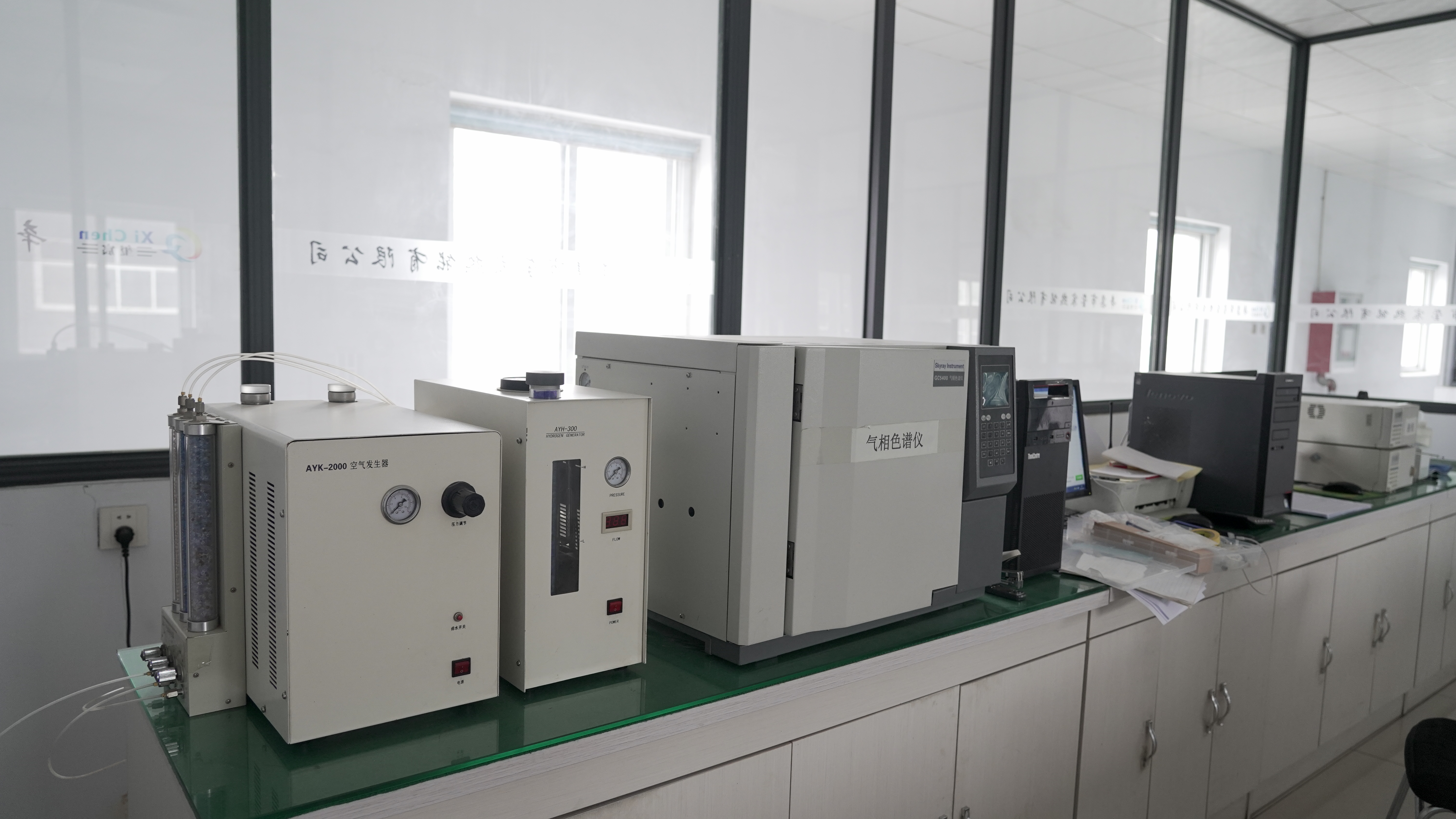
Method-referenced analysis is what converts a supplier claim into an acceptance criterion.
Where Jumingchem sits in this framework
Jiangsu Juming Chemical Technology Co., Ltd. (Jumingchem), established in 2017 in Jiangsu Province, is a manufacturer of electronic-grade chemicals whose listed products include 5-methyl-1H-benzotriazole (CAS 136-85-6), 4-vinylbenzyl chloride (CAS 1592-20-7), 1-(chloromethyl)-2-vinylbenzene (CAS 22570-84-9), 1-(chloromethyl)-3-vinylbenzene (CAS 39833-65-3), vinylbenzyl chloride (CAS 30030-25-2) and BPADA (CAS 38103-06-9). Its published profile cites 60,000 tons of annual output, a 78,000 m² factory area with a 3,000 m² R&D center, a 300 m² pilot plant and a 600 m² GMP workshop, 180 employees including 25 engineers, and a 70% export share.
For this comparison the relevant capability is not the capacity figure but the isomer portfolio. A supplier that lists all four CAS entries can be asked to state in writing the isomer ratio it can hold for each, the analytical method used, and whether the same lot documentation follows the material from pilot to commercial scale. Jumingchem's published materials also describe microchannel and continuous-flow production, ppb-level metal-ion purification, ICP-MS, HPLC and GC detection systems, and customisation of molecular structure, purity grade and packaging.
That ppb-level statement deserves a note in the procurement file. The company describes a ppb≤10 metal-ion purification capability for electronic-grade products, but its public wording does not establish whether that figure is a product release specification, a detection limit or a representative batch result. The correct response is neither to discount it nor to accept it, but to request the product-specific COA and ICP-MS report for the CAS number being purchased and compare the reported elements against the buyer's own limits.
Documentation practice is where the framework becomes checkable. The company describes 100% QC inspection before shipment with an official COA, a triple retention sample system covering factory, retention and arbitration samples held for at least six months, third-party inspection by SGS, BV or Intertek on request, and a 365-day quality guarantee from shipment date. For a decision-stage buyer, those are the items that shorten an audit; they do not replace it.
Market context a buyer should keep in proportion
Photoresist chemicals, the largest adjacent demand pool for electronic-grade monomers of this type, were valued at USD 38.00 billion in 2025 and are projected to reach USD 40.30 billion in 2026 and USD 63.77 billion by 2034, according to a Fortune Business Insights forecast published in October 2026.
Two caveats belong beside that figure. Market definitions differ: some estimates count only the light-sensitive polymers, while others include solvents and developers, and the gap between published totals is wide enough that the number should not sit in an internal business case without checking its definition. More relevant to this decision, no isomer-specific market valuation for vinylbenzyl chloride was identified in the available evidence. Quoting a photoresist-chemicals total to justify an isomer choice is quoting the wrong number, because the aggregate says nothing about which of the four CAS entries is qualified for a given process.
A six-step decision sequence
- Fix the CAS number and isomer ratio in the specification before any quotation is requested.
- Request the technical data sheet for that exact CAS, and confirm which quoted constants are measured and which are estimated.
- Request a COA with method references for assay, isomer ratio, metal ions, moisture and inhibitor content.
- Qualify a sample against your own application test, not against the supplier's application literature.
- Compare landed cost including cold-chain transport, packaging and remaining shelf life at delivery.
- Write change control into the agreement so that any change of isomer ratio, inhibitor system, production site or analytical method triggers notification and, where the application requires it, re-qualification.
Outlook
The direction of travel in electronic materials is toward tighter impurity specifications and more complete documentation, because the applications consuming these monomers — advanced-node lithography, high-frequency laminates and advanced packaging dielectrics — are themselves moving that way. If the projected growth in photoresist chemicals materialises, the practical effect for vinylbenzyl chloride buyers is not necessarily more supply but more specification: more metal-ion limits, more isomer-ratio disclosure and more demand for method-referenced COAs.
For the four isomers, the reasonable expectation is continued differentiation rather than convergence. The mixed grade will keep serving applications where a stable ratio is acceptable; the single isomers will keep serving recipes built around their geometry. A buyer who has already fixed CAS, ratio and acceptance criteria is positioned for either outcome.
FAQ
Are the four vinylbenzyl chloride CAS numbers interchangeable in a formulation?
No. CAS 1592-20-7, 22570-84-9 and 39833-65-3 are different positional isomers, and CAS 30030-25-2 is a mixed-isomer composition. They share the molecular formula C9H9Cl and a molecular weight of 152.62, but the position of the chloromethyl group relative to the vinyl group changes molecular geometry and therefore polymerisation behaviour. Substituting one for another is a formulation change that requires re-qualification against the buyer's own application test.
Which VBC isomer is used in negative photoresist resins?
Vinylbenzyl chloride functions as a core monomer in the synthesis of negative photoresist resins for electron beam lithography. The relevant purchasing question is not which isomer performs best in the abstract, but which CAS number the existing resin qualification was built on. Where a supplier lists more than one isomer grade, the buyer should require confirmation of the grade used in the validated recipe and of the isomer ratio that grade delivers.
What should an electronic-grade VBC certificate of analysis contain?
A usable COA identifies the CAS number and lot, reports assay and isomer ratio with the analytical method referenced, states metal-ion results against a defined element list with the technique used, gives moisture with the method, states the inhibitor type and concentration, and records appearance or colour against a stated standard. It should also carry the production date and retest or expiry date, because a 12-month shelf life under proper storage means the delivery date matters as much as the specification.
What storage temperature applies to vinylbenzyl chloride?
Product documentation recommends −20 °C for the commercial vinylbenzyl chloride product, while general handling guidance for VBC products calls for refrigerated storage at 2–8 °C or lower together with temperature-controlled transport for sensitive routes. Because the material is highly prone to self-polymerisation and can degrade and change colour beyond its shelf life, the storage condition, the transport mode and the remaining shelf life at delivery should all be written into the purchase terms.
How should a buyer compare the mixed grade (CAS 30030-25-2) with a single-isomer grade?
Compare them on specification rather than on price per kilogram. For the mixed grade, the controllable variables are the meta/para ratio, residual single-isomer content and the method used to determine both. For a single isomer, the equivalent variable is isomer purity by gas chromatography alongside total assay. Only when these values, the metal-ion limits, the inhibitor system and the remaining shelf life are stated on the same basis does a landed-cost comparison between the two grades mean anything.
Further product documentation from Jiangsu Juming Chemical Technology Co., Ltd. is available in the company catalogue: Jiangsu Juming catalogue (PDF).
Tem questões ou precisa de mais detalhes?
Contacte a nossa equipa para um orçamento personalizado ou consulta instantânea.
Solicitar orçamento
Preencha o formulário abaixo e a nossa equipa entrará em contacto com uma proposta personalizada.
Chat direto do WhatsApp
Prefere conversar em tempo real? Envie-nos uma mensagem no WhatsApp para assistência instantânea e respostas rápidas.
- Obter orçamento personalizado
- Partilhar fotos ou documentos
- Discuta as suas necessidades diretamente
Geralmente responde em 5–30 minutos durante o horário de expediente.