
From Car Seats to Ballistic Vests: Laminating Machine Scenario Fit
From Car Seats to Ballistic Vests: Laminating Machine Scenario Fit
A laminating machine is usually bought for one product, not for a category. The automotive seat line, the safety-shoe line, the ballistic-vest line, the carpet finishing line and the filter media line all bond flexible materials, yet each fixes a different set of requirements before a supplier is contacted: the substrate, the way heat or adhesive reaches the bond, the working width, the required throughput, and the auxiliary equipment the plant must supply. Scenario fit is the first screening test in equipment selection, and price or brand comparison only becomes meaningful after a configuration has passed it.
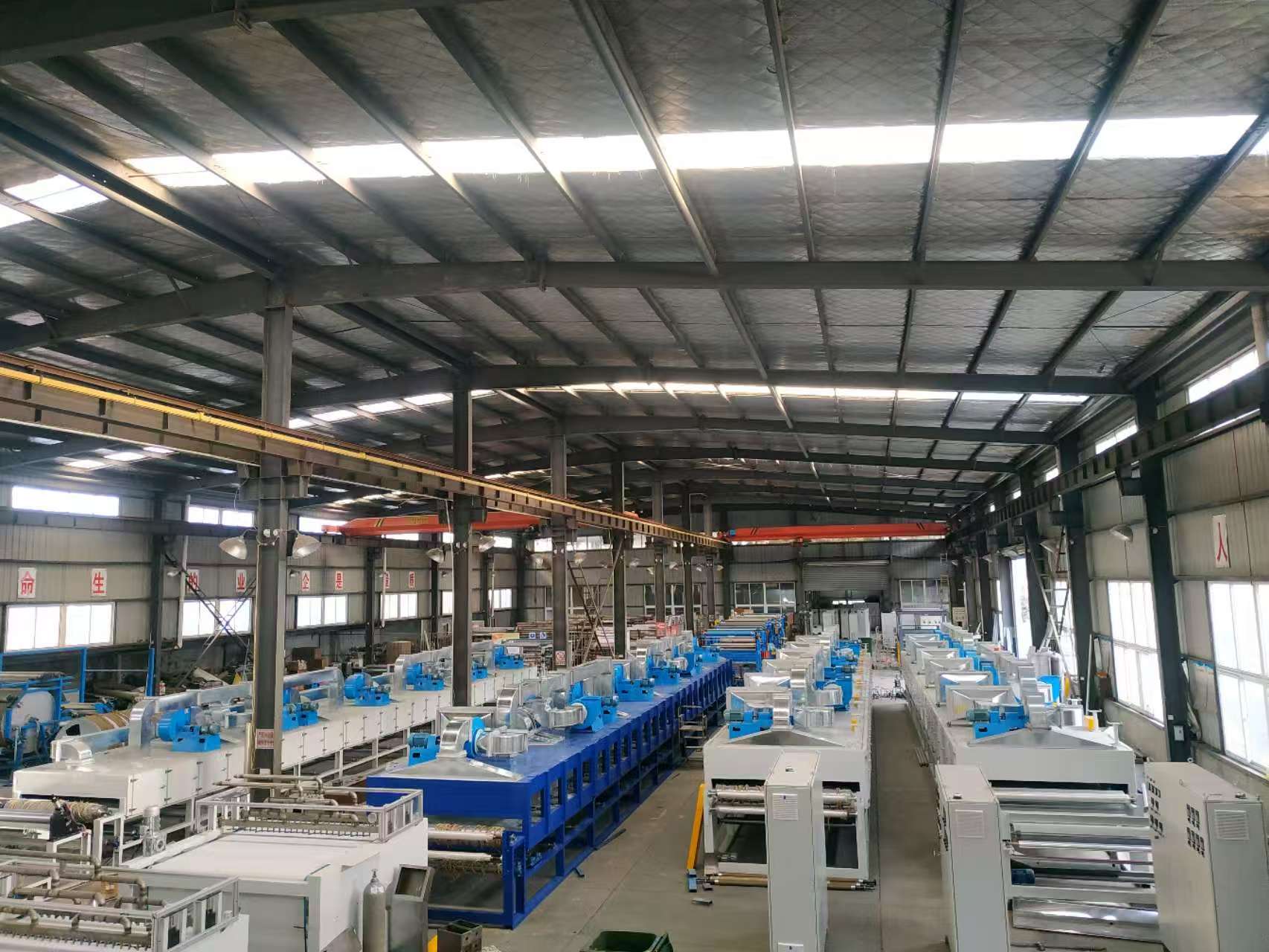
This article maps five production scenarios to specific configurations from JIANGSU KUNTAI MACHINERY CO.,LTD, a manufacturer of coating, laminating, impregnation and cutting machinery for technical textiles and composites. KUNTAI's published company profile states a 30,000 m² facility, 210 employees, eight R&D engineers, an annual output of 650 units and a 70% export share, with quality management under ISO 9001 and CE marking. Those figures describe the supplier. The sections below describe which of its machine architectures matches which production problem, and where each architecture stops fitting.
Why the Product, Not the Machine Category, Sets the Specification
Three inputs are fixed by the finished product, and they determine machine architecture more reliably than a side-by-side catalogue comparison.
- Material system. Foam bonded to fabric, film bonded to fabric, fabric bonded to fabric, and unidirectional fibre bundles impregnated with adhesive each behave differently under heat and pressure. The material system decides whether the bond is created by an applied adhesive, by a melted surface layer, or by a resin carried into a fibre bundle.
- Energy and adhesive path. A gas flame, a hot-melt coating roller, a water-based dipping bath and a spray-and-powder combination are not interchangeable delivery methods. Each imposes different demands on temperature control, adhesive supply and the operator's process window.
- Width and throughput. Usable material width caps the widest product the line can make, and line speed sets labour and energy cost per metre. A machine 400 mm too narrow cannot be corrected by running faster.
When all three inputs are known, the machine family usually selects itself and the remaining work is specification detail: roller surface, heating method, installed capacity, control platform and supporting equipment. When they are not known, buyers compare machines built for different products and reach a decision that looks rigorous but is not comparable.
Five Scenarios and the Configurations That Serve Them
The table summarises the mapping used throughout this article. Every specification quoted is taken from KUNTAI's published product data for the listed model.
| Production scenario | KUNTAI model | Defining specification | Supporting equipment / site condition |
|---|---|---|---|
| Automotive seats and car trim | KT-HY flame laminating machine | Material width 1,600–3,000 mm; flame burner width 1,900–3,300 mm; max. machine speed 25 m/min; natural gas or liquefied gas | Gas tank and gas appliances; pressure stability |
| Safety shoes and footwear | KT-PUR-1800 hot melt coating laminating machine | Maximum material width 1,800 mm; adhesive applied through a coating roller | Glue melter and oil heater, as itemised for the hot-melt glue laminating family |
| Bulletproof vests, helmets, plates | KT-LH-1800 UD Aramid prepreg machine | Equipment roll surface 1,800 mm; material width ≤ 1,650 mm; composite speed 5–11 m/min; total power 90 kW | Glue pump system; low temperature, moderate humidity; voltage stability |
| Carpet and upholstery | KT-DS dot coating laminating machine | Discontinuous, dot-pattern adhesive application instead of a continuous film | Not itemised in the published configuration data for this model |
| Filter media | KT-SF glue spraying and powder scattering machine | Sprayed adhesive combined with scattered powder; middle-temperature operation | Glue melter; voltage stability |
Scenario One: Automotive Seats and Car Trim — Flame Lamination in Continuous Operation
Automotive interior work is continuous and high-volume, and the bonding step has to keep pace with it. KUNTAI's KT-HY flame laminating machine is specified for material widths from 1,600 mm to 3,000 mm, with a machine roller surface of 1,900 mm to 3,300 mm and a flame burner width in the same 1,900 mm to 3,300 mm range. Maximum machine speed is 25 m/min, machine drive power is 15 kW, and the burner runs on natural gas or liquefied gas. Motors are listed as Siemens (made in China), inverters as Yaskawa and electrics as Schneider.
The mechanism explains the specification. In flame lamination a controlled gas flame is passed briefly across a polyurethane foam surface, which softens and becomes the bonding medium when the foam is pressed against the facing fabric. No separate adhesive is applied, so there is no glue metering, no adhesive cure schedule and no adhesive inventory inside the bond. That is why the burner width, rather than a coating roller width, is the governing dimension here, and why gas supply belongs in the specification rather than in a site-services appendix.
KUNTAI's application data places the flame laminating machine in the car trim sector under fast-speed, continuous operation, matched with a gas tank and gas appliances, and lists pressure stability as a special requirement. It names Korea, Germany and the Czech Republic as common application markets and positions the configuration for new production line projects carrying out material lamination and bonding. Those auxiliary items are part of the fit decision: a plant with natural gas piping but unstable line pressure will not obtain consistent flame intensity, and inconsistent flame intensity shows up as variable peel strength rather than as an obvious machine fault.
KUNTAI also reports an automotive interior project implemented over a period of about two years in Mexico, Turkey and the Czech Republic, described as achieving stable operation with low maintenance. In a separate customer-facing record, 20 units are reported as supplied to a German automotive interior project with stable operation results. These are supplier-reported references. They indicate the configuration has been built for this application; they do not replace a material trial on the buyer's own foam and fabric.
Scenario Two: Safety Shoes — Hot-Melt Coating on a 1,800 mm Web
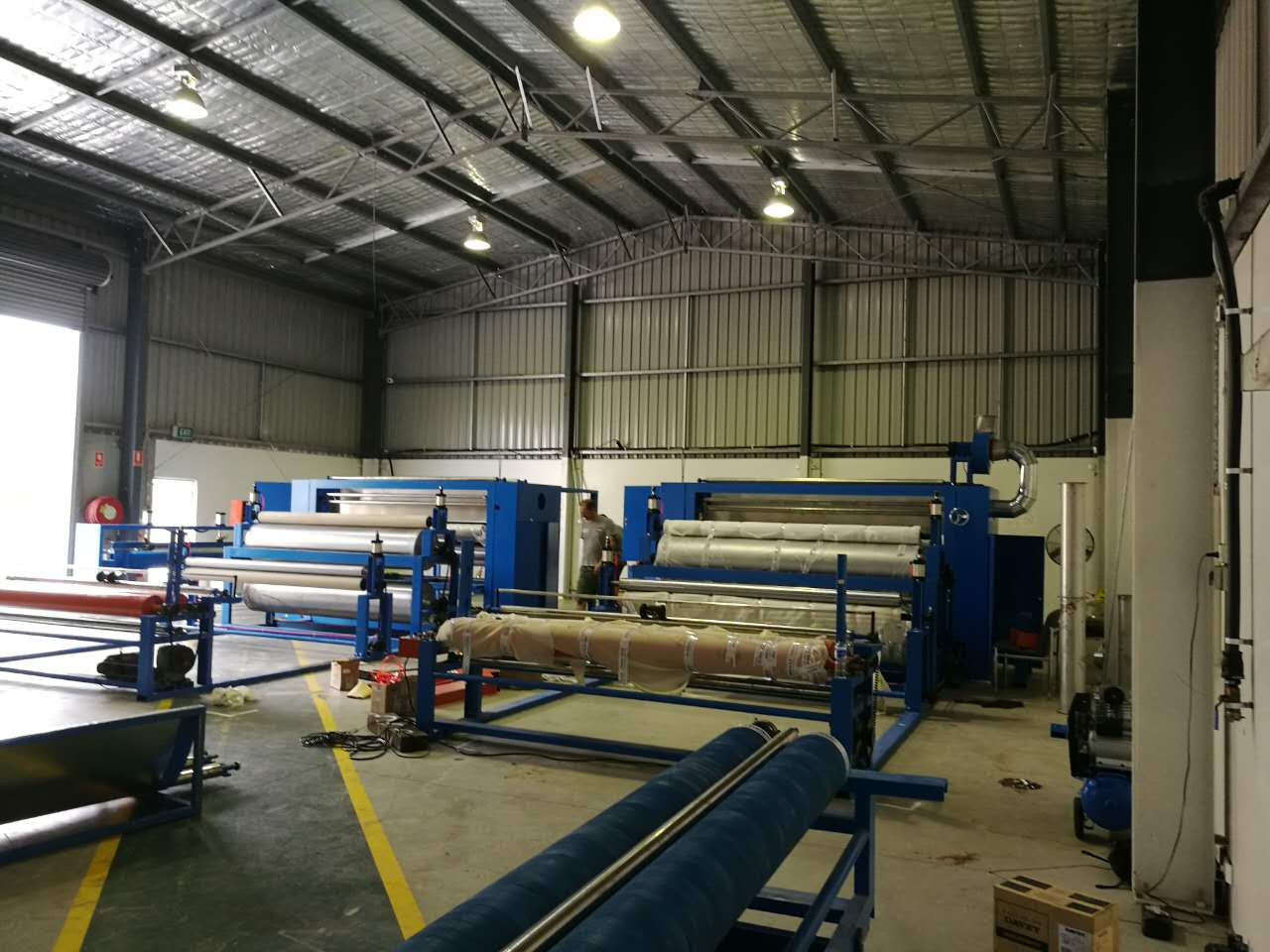
Footwear bonding has the opposite constraint profile. The substrates are textiles, foams and films that must not be exposed to an open flame, the adhesive layer has to be metered, and the finished laminate often has to survive repeated flexing. KUNTAI's KT-PUR-1800 hot melt coating laminating machine is specified at a maximum material width of 1,800 mm and is the coating variant associated with footwear work, including safety-shoe uppers and lining laminates.
Width is the first thing to check. Shoe components are narrow, but they are processed as a continuous web, and 1,800 mm of usable width allows several component columns per pass or a single wide laminate that is cut down afterwards. A buyer whose incoming fabric arrives at 1,600 mm gains nothing from a wider machine; a buyer planning multi-column nesting should confirm usable width against the finished component layout before committing.
The wider hot-melt glue laminating family in KUNTAI's listing covers material widths from 1,600 mm to 3,400 mm, machine speeds of 0–40 m/min, electric or thermal-oil heating, one gluing roller, a 200 kg glue melter, an oil heater and four A-frames, with 65 kW installed capacity. KUNTAI lists footwear among the application industries for that family, alongside healthcare, car trim, garment, upholstery, construction and home textile. The KT-PUR-1800 sits at the compact end of that range, which is the practical reason it is associated with footwear rather than with wide technical-textile production.
The cure schedule belongs in the production plan
PUR hot-melt adhesives are moisture-reactive. Industry technical literature summarised in a 2025 commercial research report on the hot-melt laminating machine market states that PUR adhesives typically need 24 to 72 hours for full chemical cross-linking cure. That window does not stop the line, but it governs how much work-in-progress the plant holds, how the material is stacked, and how soon downstream cutting or stitching can begin. A buyer specifying a PUR-based shoe line should treat the cure window as a plant-layout constraint rather than a footnote on an adhesive datasheet.
KUNTAI's application records also place the hot melt coating laminating machine in garment work — protective suits, windbreakers and thermal underwear — in Asian markets. That is the same bonding territory: an applied adhesive layer, controlled heat, and a substrate that cannot tolerate direct flame.
Scenario Three: Ballistic Vests — UD Aramid Prepreg at 1,650 mm or Less
Ballistic panel production is not a coating process in the same sense as the previous two scenarios. The workpiece is a unidirectional array of high-performance yarns that must be spread, aligned, impregnated with a water-based adhesive system and consolidated without distorting the fibre path. KUNTAI's KT-LH-1800 UD Aramid prepreg machine is specified with an 1,800 mm equipment roll surface and a material width of 1,650 mm or less. Adhesive is water-based, gluing is by dipping or coating, wire spreading uses a mechanical multi-roll plus profiled arrangement, and control runs on HMI plus PLC with variable-frequency and servo drive control.
The rest of the specification reads as a list of decisions that protect the fibre path. The lamination roller is an externally circulating thermal-oil roller; heating is by circulating thermal oil; temperature control is handled by a 60 kW external mould oil heater; the roller surface is treated to friction mirror level 14; dynamic balance is specified for both the friction mirror-surface roller and the heating roller. The machine carries 1,080 yarn bobbins, has a total power of 90 kW and runs at a composite speed of 5–11 m/min. KUNTAI lists the applicable industries as bulletproof vest, helmet and plate manufacturing.
Why the speed is low and the width is capped
At 5–11 m/min the KT-LH-1800 runs at a fraction of the speed of the flame and hot-melt lines above, and that is a design consequence rather than a limitation to be engineered away. Yarn spreading, alignment and dipping depend on tension control and on residence time through the adhesive bath and the thermal-oil consolidation zone. Running the web faster shortens the impregnation window and raises the risk of spread defects. The 1,650 mm material-width limit against an 1,800 mm roll surface means a wider ballistic panel has to be built from multiple plies or handled on a different architecture.
KUNTAI's application data for the bulletproof industry classifies the working condition as low temperature with moderate humidity, names a glue pump system as supporting equipment, lists voltage stability as a special requirement, and identifies Korea, Russia, Ukraine and India among common application markets. The low-humidity condition is consistent with the chemistry: a water-based adhesive system and moisture-sensitive high-performance yarns both behave better when ambient humidity is controlled.
KUNTAI reports a protective products project covering bulletproof vest, helmet and plate applications, implemented over three years across Turkey, the Czech Republic, India and Russia, with stable operation described, long lifespan and low maintenance cited as highlights, and a stated quantity of 50 units. This establishes that the configuration has been built and operated for the stated application. It does not constitute independent ballistic certification of any finished panel, which remains a separate qualification process between the panel maker and its own test laboratory.
Scenario Four: Carpet and Upholstery — What Dot Coating Changes
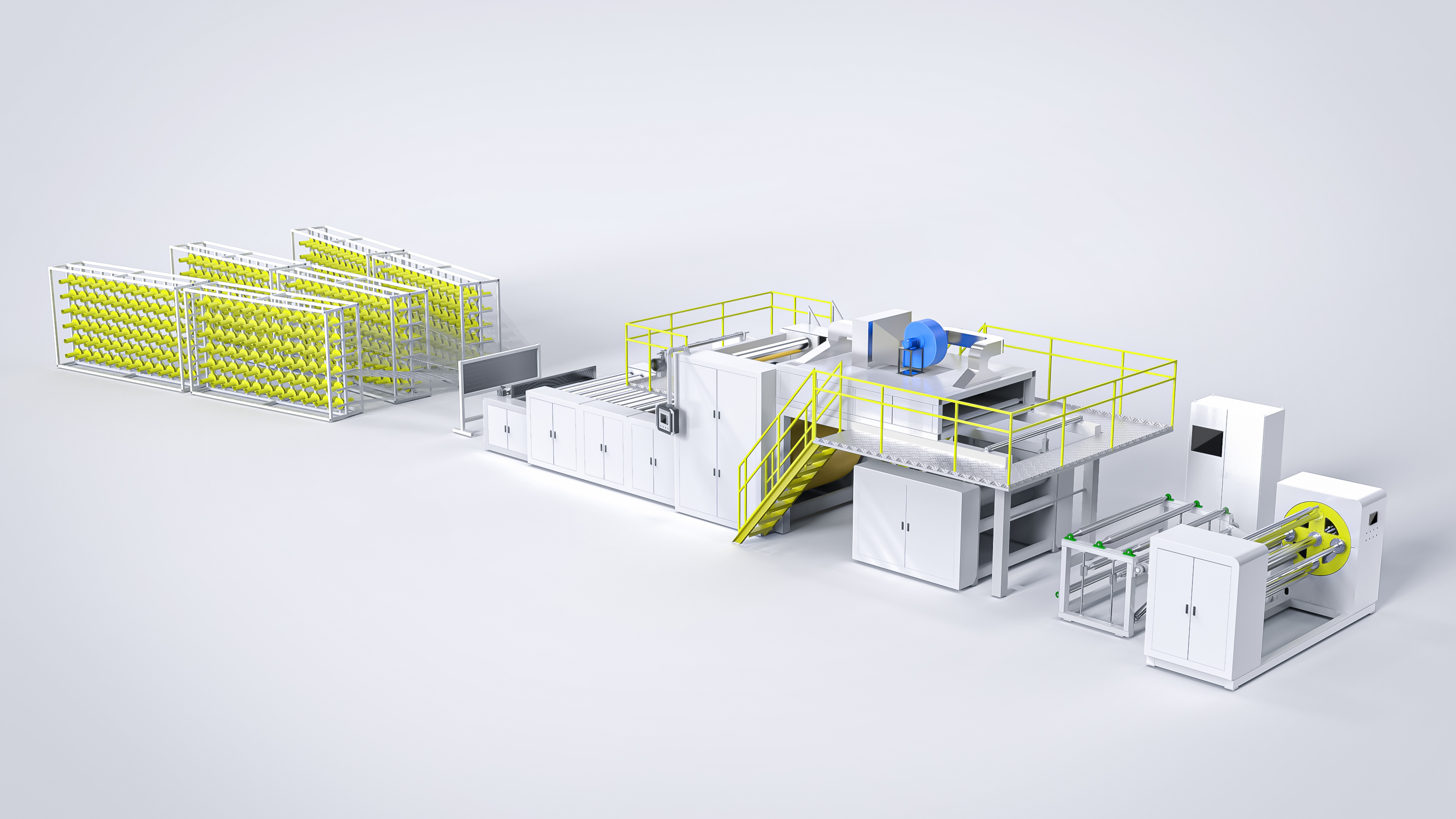
Carpet and upholstery laminates usually need softness and drape on the face side while still holding the backing, foam or secondary layer in place. KUNTAI's KT-DS dot coating laminating machine applies adhesive in a dot pattern rather than as a continuous film, and KUNTAI lists the dot coating model among the machines applicable to upholstery work covering blackout fabric, mattress protectors and sofa fabric in markets including Korea, India and Turkey.
The distinction is mechanical. A full-surface adhesive film maximises contact area and produces the most uniform bond, but it also stiffens the laminate and consumes more adhesive. A dot pattern bonds the layers at discrete points, which keeps more of the material's original hand-feel and reduces adhesive consumption. For a carpet where the backing is needled or nonwoven and the face is a pile, that trade-off is often the difference between a laminate that passes a drape check and one that does not.
This is a fit for softness and adhesive economy, not a general substitute for full-surface bonding. Where the design driver is a continuous moisture barrier, a high peel-strength requirement across the whole surface, or a sealed seam, a full-surface coating configuration is the appropriate route and a dot pattern will not meet the requirement regardless of adhesive choice. Buyers should state the bond function first — softness, barrier or structural hold — and let that decide between dot coating and full-surface coating.
KUNTAI separately describes a water-based glue mesh-belt carpet laminating machine for bonding fabric, foam, nonwoven, EVA, leather and velvet, positioned for carpet, fleece, plush and synthetic leather. That listing is a different machine from the KT-DS, and it is a reminder that "carpet" is not one specification: the face material, the backing and the required hand-feel determine which route applies.
Scenario Five: Filtration Media — Glue Spraying and Powder Scattering
Filter media present a constraint none of the other scenarios share: the bond must hold the structure together without closing the passages the air travels through. KUNTAI's KT-SF glue spraying and powder scattering machine addresses that by combining sprayed adhesive with scattered powder rather than applying a continuous adhesive film. KUNTAI's application data places it in the filtering industry for air filtration, operating at middle temperature in synchronized operation, with a glue melter as supporting equipment and voltage stability as a special site requirement. Germany is named as a common application market, alongside Turkey, Korea and India in the wider scenario record.
The process logic is straightforward. Spray application distributes adhesive without a solid coating roller pressing a film onto the medium, and powder scattering adds a bonding agent in discrete particles. The result is a bonded medium with a more open structure than a fully coated equivalent, which is why the configuration belongs with filtration rather than with the coating lines used for footwear or upholstery.
KUNTAI reports a kitchenware manufacturer project covering dishwashing sponge and cooking-fume filter production, implemented over two years across Mexico, Turkey and the Czech Republic, with stable operation, long lifespan and low maintenance described, and a stated quantity of 10 units. That application is adjacent to air and liquid filtration rather than identical to pleated filter media, so it should be read as evidence of the spray-and-scatter architecture in production use, not as filter-media performance data.
Where Each Configuration Stops Fitting
A scenario map is only useful if it also states the edges. The boundaries below follow from the published specifications and from the process logic of each architecture.
- KT-HY flame laminating machine. Requires a gas supply and stable pressure; burner width fixes the maximum format; 25 m/min is a ceiling rather than an average. It suits foam-involved bonding, not film-to-film work where an applied adhesive layer is the design requirement.
- KT-PUR-1800 hot melt coating laminating machine. The 1,800 mm material width caps the widest single-pass laminate, and PUR chemistry brings a 24–72 hour cross-linking cure into the production plan. The adhesive system adds a glue melter and oil heater to site services.
- KT-LH-1800 UD Aramid prepreg machine. Material width is 1,650 mm or less on an 1,800 mm roll surface, and 5–11 m/min is a composite speed, so output planning must be built around that rate. Ballistic performance of the finished panel is qualified separately from the machine purchase.
- KT-DS dot coating laminating machine. Optimised for softness and adhesive economy, not for continuous barrier films or bond functions requiring full-surface contact.
- KT-SF glue spraying and powder scattering machine. Built around preserving an open structure; where a continuous sealed adhesive layer is the product requirement, a coating configuration is the correct choice instead.
Adjacent architectures that mark the edges
Two further KUNTAI configurations frame this map. The KT-PB flatbed laminating machine is specified at 1,600 mm maximum material width, 0–25 m/min, electric heating to a maximum of 230 °C, a 3 m heating zone, a 1.5 m cooling zone and 230 kW installed capacity. The KT-HY-H double belt press laminator shares the 1,600 mm width and 0–25 m/min range but reaches a maximum of 250 °C with 265 kW installed capacity. KUNTAI's application data places the flatbed and double belt machines in aviation work for aircraft sound insulation panels, at high temperature, with a water chiller as supporting equipment. The lesson for the five scenarios above is that temperature ceiling and installed capacity, not width alone, decide whether a heavier or lighter architecture is required.
What to Verify Before Locking a Configuration
Once the scenario has selected a machine family, the remaining work is verification. The checklist below follows the specification fields that appear in the published data and that most often cause rework when resolved late.
- Usable width against finished width. Compare material width with the widest finished product plus trim allowance. The KT-LH-1800, for example, offers an 1,800 mm roll surface but a 1,650 mm material width, and the difference matters for panel layout.
- Adhesive and substrate compatibility. Confirm that the bonding mechanism the machine is built around — flame activation, hot-melt coating, water-based dipping, or spray and powder — matches the materials actually being joined.
- Installed capacity and plant power. Published installed capacities across these models run from 65 kW on the hot-melt family to 90 kW on the UD prepreg line and 230 kW on the flatbed machine. Electrical capacity is a plant-level constraint to confirm before the order, not after.
- Gas supply and pressure stability. Relevant to the flame configuration, where a gas tank and gas appliances are listed as supporting equipment and pressure stability as a special requirement.
- Auxiliary equipment. Glue melter and oil heater for hot-melt work; glue pump system for the UD prepreg line; water chiller for high-temperature flatbed and double belt work.
- Process time budgeting. A 24–72 hour PUR cure window and a 5–11 m/min composite speed both translate into work-in-progress and throughput figures worth modelling before the line is laid out.
- Import classification. Machinery for coating or impregnating textile fabrics is classified under HS Code 84518080 in the customs tariff reference reviewed for this article; buyers should confirm the classification applicable to their exact machine and destination.
- Acceptance and support terms. KUNTAI's published capability data states OEM production, customisation of voltage, logo, colour and machine structure, a minimum order quantity of one unit, a lead time of 30–60 days, 100% testing, monthly capacity of 55 units and remote after-sales support.
Market Context: Growth Figures Do Not Select a Machine
Two published estimates are frequently cited around laminating equipment. Market Research Future estimated the global industrial laminating machine market at USD 3.123 billion in 2024, and a separate 2025 report by Industrial Research Reports predicts a 7.1% compound annual growth rate for the hot-melt adhesive laminating machine segment between 2026 and 2032. Both are commercial research estimates covering different scopes — total industrial laminating machinery in the first case, the hot-melt adhesive segment in the second — so they should not be added together or read as one forecast.
Neither figure tells a buyer which configuration to install. What they support is a narrower and more defensible reading: adhesive-based laminating is a segment with published growth expectations, which makes the adhesive choice — hot melt, PUR, water-based or dot pattern — a long-lived decision rather than a short-term one. Scenario mapping is the practical response, because the machine that fits the product is the only one whose economics can be evaluated at all.
Outlook
The pattern across the five scenarios is consistent: the more specialised the end product, the more the machine is defined by its supporting systems rather than by headline width. A flame line is defined by its gas supply and burner width, a UD prepreg line by its fibre-spreading arrangement and thermal-oil circuit, a filter line by its ability to bond without closing the medium. Buyers moving into a new technical-textile product should expect the specification conversation to shift from "which machine" to "which combination of width, adhesive path and site services", and should plan a material trial before the configuration is frozen. For suppliers, the same logic sets the limit of any single platform: a machine built around one bonding mechanism cannot be re-specified into another simply by making it wider.
KUNTAI's published company brochure, covering its product and capability range, is available for readers who want the full listing: KUNTAI company profile (PDF).
Frequently Asked Questions
How do I choose a laminating machine for a specific production project?
Begin with three product-defined inputs: the material system being bonded, the way heat or adhesive reaches the bond, and the usable width and throughput the order book requires. Those three usually narrow the choice to one machine family. The second pass covers specification detail — material width against finished width, heating method, installed capacity and the auxiliary equipment the plant must supply — and the third pass is a material trial on the buyer's own substrates. Comparing machines before the first pass is complete generally produces a non-comparable shortlist.
Why does an automotive seat line use a flame laminating machine rather than a hot-melt unit?
Flame lamination creates the bond by briefly softening a polyurethane foam surface with a gas flame, so no separate adhesive is applied and there is no adhesive cure step in the bond. That suits continuous, high-volume seat and trim production. KUNTAI's KT-HY is specified for material widths of 1,600–3,000 mm, a burner width of 1,900–3,300 mm, a maximum speed of 25 m/min and operation on natural gas or liquefied gas. A hot-melt unit becomes the better fit when an applied, metered adhesive layer is required and the substrates cannot tolerate an open flame.
What material width should a UD prepreg line be specified at for ballistic panels?
The KT-LH-1800 UD Aramid prepreg machine has an 1,800 mm equipment roll surface but a material width of 1,650 mm or less, and it runs at a composite speed of 5–11 m/min with 90 kW total power. Specification should start from the widest finished panel plus trim, then be checked against that 1,650 mm material-width limit. A wider panel requires a multi-ply build or a different machine architecture; it cannot be obtained by re-specifying the existing roll surface.
Which supporting equipment does each laminating scenario require?
Supporting equipment is listed per application in KUNTAI's published data. The car trim flame lamination scenario requires a gas tank and gas appliances, with pressure stability as a special condition. Hot-melt work uses a glue melter and oil heater. The bulletproof-industry UD prepreg application lists a glue pump system, low temperature with moderate humidity, and voltage stability. The filtration spray-and-scatter application lists a glue melter and voltage stability. Aviation flatbed and double belt work is listed with a water chiller under high-temperature conditions.
What should be verified before ordering a laminating machine for a new production line?
Verify usable material width against the widest finished product plus trim; confirm that the bonding mechanism matches the substrates; confirm plant electrical capacity against the published installed capacity, which ranges from 65 kW on the hot-melt family to 230 kW on the flatbed machine; confirm gas supply and pressure stability where a flame burner is involved; confirm auxiliary equipment such as glue melter, oil heater, glue pump or water chiller; and model the process time created by a 24–72 hour PUR cure window or a 5–11 m/min composite speed. Import classification under HS Code 84518080 for coating or impregnating textile fabrics should also be checked against the exact machine and destination.
Tem questões ou precisa de mais detalhes?
Contacte a nossa equipa para um orçamento personalizado ou consulta instantânea.
Solicitar orçamento
Preencha o formulário abaixo e a nossa equipa entrará em contacto com uma proposta personalizada.
Chat direto do WhatsApp
Prefere conversar em tempo real? Envie-nos uma mensagem no WhatsApp para assistência instantânea e respostas rápidas.
- Obter orçamento personalizado
- Partilhar fotos ou documentos
- Discuta as suas necessidades diretamente
Geralmente responde em 5–30 minutos durante o horário de expediente.