
From Chenille to Terry: Pile Height as Capability Evidence in Auto Care
Pile architecture is one of the few material decisions in automotive cleaning textiles that a buyer can see before a sample arrives — and one of the few that reveals how much a factory actually controls.
A washing mitt built from long, open plush, a mitt built from dense chenille tufts, and a chenille sponge with a foam core can look interchangeable in a catalogue photograph. Against a clearcoat panel they are not: they hold water differently, generate foam differently, and load grit differently. For a procurement team, that difference is the specification. For a manufacturer, holding all three constructions to a consistent standard is evidence of production range rather than a longer product list.
Foshan Patinda Housewares Co., Ltd. is a microfiber textile manufacturer based in Foshan, Guangdong, China, founded in 2004 and exporting 98% of its output. Its auto care range — the MM-070 long plush mitt, the MM-067 chenille sponge and the MM-069 chenille mitt — is a practical case study in how pile height and texture translate into scratch safety and dirt pickup, and in what a versatile production line has to control in order to offer all three.
Why Automotive Cleaning Textiles Are Hard to Compare
Most automotive microfiber cleaning products are described with the same handful of words: soft, absorbent, scratch-free, lint-free. Blend ratio separates very few suppliers, because multicomponent polyester/polyamide construction dominates the category — Fortune Business Insights reports a 58.0% revenue share for the multicomponent segment in 2025. That figure comes from a commercial research publisher and is best read as a market indicator rather than an audited statistic.
Differentiation sits one level deeper: pile height, pile density, backing construction, core material, cuff design and edge finishing. Two mitts can both state an 80% polyester / 20% polyamide base and still behave nothing alike, because one presents an open, long plush face to the paint while the other presents packed chenille tufts over a foam reservoir. For a buyer assembling a car wash chain programme, those are the variables that decide whether a tool lifts film without dragging grit — and whether it survives the wash cycle that follows.
Three Pile Architectures in One Auto Care Range
The Patinda auto care glove range separates three constructions that are frequently sold in the market under one generic name. What changes between them is not the fiber, but how the fiber is presented to the surface and what sits behind it.
| Model | Construction | Size / weight | Stated performance |
|---|---|---|---|
| MM-070 Microfiber Long Plush Auto Cleaning Mitt |
Single-face long fluffy plush; soft skin-friendly lining; stretch knitted elastic wrist cuff | 28 × 20 cm 85 g |
High water and foam absorption; lint-free; no colour fading; scratch-free on car paint, glass and wheel surfaces; machine washable |
| MM-067 Microfiber Chenille Auto Cleaning Sponge |
Chenille microfiber pile face over a thick absorbent sponge; mesh fabric back with fixed elastic wrist band | 28 × 18 cm 115 g |
High water and foam absorption; lint-free; scratch-free on car paint, wheel and glass; flexible handheld control |
| MM-069 Microfiber Chenille Auto Cleaning Mitt |
Double-layer, dual-face thick chenille plush; stretch elastic wrist cuff | 25 × 18 cm 135 g |
Absorbs up to 7× its own weight in water and car wash foam; rich foam production; lint-free; colourfast; scratch-safe on paint, glass and wheel hubs |
Specification snapshot of three auto care models built on an 80% polyester / 20% polyamide microfiber base (MM-067 additionally uses an inner sponge and mesh backing). Weights shown are per-piece as published by the manufacturer.
Scratch Safety: Contact Geometry, Not Softness
Microfiber is defined by fiber fineness — below 1.0 denier — rather than by a brand or a finish. That fineness is the shared technical reason microfiber textiles are specified for fine-surface work such as cleaning and filtration. Fine filaments bend rather than scrape, which is the mechanism behind the scratch-free claims attached to paint, glass and wheel-hub surfaces.
What the three Patinda specifications add is contact geometry. The MM-070 presents an open, long plush face backed by a soft skin-friendly lining and a stretch knitted elastic cuff: the load of a hand is distributed across many flexible filaments, and the open structure gives dislodged grit somewhere to sit instead of being pressed back into the panel. The MM-069 uses a double-layer, dual-face thick chenille plush, presenting many small tufted contact points and a heavier body — 135 g against 85 g — that keeps the face in contact through a full pass. The MM-067 wraps a chenille pile face around a thick absorbent sponge and closes the back with mesh and a fixed elastic wrist band, so the surface stays compliant and the hand keeps control across curved panels and wheel arches.

MM-067 Microfiber Chenille Auto Cleaning Sponge: a chenille pile face over a thick absorbent sponge core, with a mesh back and fixed elastic wrist band for handheld control on paint, wheels and glass.
It is worth being precise about what these statements are. Lint-free and scratch-free are supplier specifications attached to each model, not the output of an independent abrasion test, and no third-party test data for these specific models was available for this review. Buyers writing those words into a retail or tender specification should request supporting test data, the edge-finishing method, colourfastness results and wash-cycle durability — particularly where the tool will be used by a third-party car wash operator whose liability sits with the site, not the distributor.
Dirt Pickup and Fluid Handling: Three Different Reservoirs
A washing tool does two jobs at once: it lifts soil from the surface and it carries water and foam to it. The three constructions divide that work differently, and the difference is measurable in how a bay is staffed.
The MM-069 chenille mitt is specified to absorb up to seven times its own weight in water and car wash foam, with rich foam production. In use it behaves as a reservoir tool: it delivers a wet, lubricated pass and releases foam as the hand travels. The MM-067 chenille sponge moves the reservoir inside the tool — a thick absorbent sponge behind the pile face — which suits long, uninterrupted passes over large panels and keeps water available at the surface rather than running down the operator's wrist. The MM-070 long plush mitt works primarily as a lifting and agitating surface: the open pile carries foam and traps dislodged particles, which is why it is normally paired with a separate drying towel rather than expected to finish the panel.
The range is bracketed by twisted-loop cloths and terry towels elsewhere in the same catalogue — MJ-021 at 250–500 gsm, MJ-022 at 300–500 gsm and MJ-023 at 500–1000 gsm — which handle the drying stage. That separation matters commercially. Buying a washing mitt to do the drying job, or a drying towel to do the washing job, is a common and expensive specification error, and it is one a supplier with a full range can catch before the order is placed.
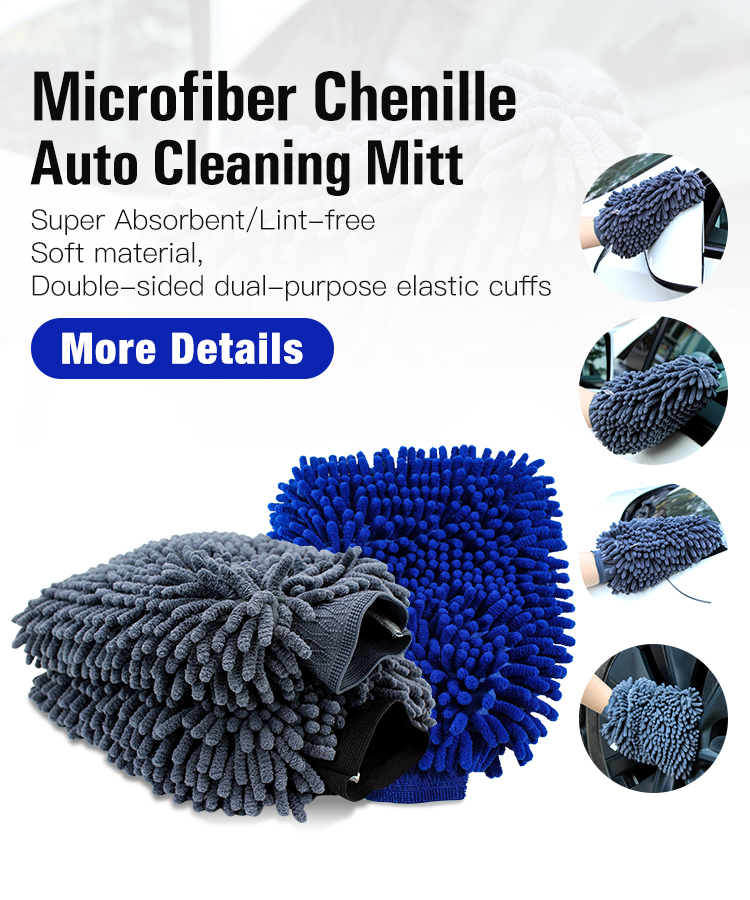
MM-069 Microfiber Chenille Auto Cleaning Mitt: double-layer, dual-face thick chenille plush with an elastic cuff, specified to absorb up to seven times its own weight in water and foam.
What a Versatile Production Line Has to Control
Producing three pile architectures from one plant is not a marketing statement; it is a claim about cutting, sewing, pile handling and quality control across different fabric builds. Patinda reports a 45,000 m² manufacturing plant, 200 employees, a 17-engineer R&D team, more than 450 sets of production machinery and more than 10 fully automatic lines for cloth cutting and sewing, with an annual output of 2,184,270.46 kg and a monthly capacity of 182,022 kg.
On commercial terms, the company operates OEM/ODM programmes with customization across size, weight, logo, material, fabric texture, printing, colour, accessories, packaging, shipping labels and GSM. Stated terms are a minimum order quantity of 3,000 pcs, a lead time of 30–45 days, 100% test quality control and available after-sales service. Export activity is independently documented: US customs records compiled by ImportInfo list 172 bills of lading for Foshan Pa Tin Da Housewares Co., Ltd. between June 2019 and September 2026, a useful cross-check against the company's stated 98% export ratio.
For buyers, the practical implication is that one supplier can hold a coordinated auto care programme — washing mitts, drying cloths, glass cloths, clay towels — on a single production and quality system instead of splitting it across three vendors with three tolerance standards. The trade-off is real: a 3,000-piece minimum per line item pushes small distributors toward a narrower opening range, and a 30–45 day lead time rewards forecasting over reactive ordering.
Kitchen Microfiber Cleaning Products: The Same Pile Logic on a Different Surface
The kitchen segment is where construction discipline is tested most harshly, and it is also the largest single application block in the category: Fortune Business Insights places the kitchen care segment at a 28.3% revenue share of the overall cleaning products market in 2025, the largest share of any application.
Patinda's Kitchen Microfiber Cleaning Products show the same logic applied to a different surface. The MJ-002 Universal Cleaning Cloth is a 300 gsm warp-knitted terry at 30 × 30 cm, specified to absorb seven times its own weight and finished with double stitching and a tidy hem. The MJ-001 cloth uses an 85% polyester / 15% polyamide blend across a 180–450 gsm range with a double-stitched edge. The MS-074 Fancy kitchen towel moves to a 200–400 gsm waffle check structure at 60 × 40 cm, described as quick-dry, lint-free and non-abrasive; MS-075 uses a waffle honeycomb weave with custom printing and Pantone colour matching for private-label programmes.
Two constructions solve specific kitchen problems rather than general wiping. MJ-016 is a double-layer 28 g cloth that pairs a PET mesh scrubbing face with a microfiber absorbent face, so one tool handles both scouring and pickup. MW-003 blends 60% polyester, 20% polyamide and 20% bamboo fiber at 280–350 gsm, positioned on antibacterial and odour control, with a 10–12 stitch-per-inch double overlock edge. MJ-012 converts the same fabric family into a 180–320 gsm perforated roll for volume foodservice use, while MD-020 adds a striped 250–350 gsm option for table-service environments.
The relevance to an auto care buyer is not decorative. A supplier that can hold terry, waffle, mesh-laminate and bamboo-blend kitchen constructions to specification — with consistent stitch density and stated absorption — is demonstrating the same fabric-handling range that the three auto mitts demonstrate. Distributors consolidating Household Microfiber Cleaning Products and Automotive Microfiber Cleaning Products under one private label usually want exactly that: one quality system, one colour standard, one packaging grammar, one reorder cycle.
Where These Textiles Are Used
Documented use conditions for this range are indoor enclosed environments at normal room temperature (10°C–35°C), with frequent water immersion, repeated wet-dry cycles and, in auto care, high-frequency friction and repeated scrubbing. The stated product role is to wipe surface dust, absorb water, remove stains and clean car paint.
Two project types dominate the use cases: auto beauty and car wash chain supply projects, and hotel and resort daily sanitation procurement projects. The second is frequently underestimated by auto-focused buyers. Hotel and resort programmes specify custom logo, custom size and colour, quick-dry, lint-free and high water absorbency — effectively the same requirement set as a car wash chain, which is why a supplier with a broad base can serve both from one line and one colour standard. These application patterns are reported as common in Germany and the United States.
Market Context: Replacement Demand, Not a Growth Story
Market sizing for microfiber cleaning cloths is consistent in direction but not in absolute value. Future Market Insights projects growth from USD 979.2 million in 2025 to USD 1,520.7 million by 2035 at a 4.5% CAGR. Fortune Business Insights projects USD 1.04 billion in 2026 rising to USD 1.49 billion by 2034 at 4.57%. Spherical Insights projects USD 1,533.7 million by 2035 at 4.6%. A fourth commercial source, Dataintelo, reports values roughly three to four times larger at a 24.0% CAGR; it is treated here as an outlier and is not averaged in.
Read together — with the caveat that none of these publishers discloses a full methodology in its public summary — the picture is a category growing at mid-single-digit rates: a replacement-driven market where share moves through specification and service rather than through category expansion. That is a meaningful signal for buyers. In a market that is not doubling, supplier selection becomes the main lever available, and construction detail is where that lever sits.
Microfiber Versus Traditional Cotton and Flat-Weave Options
| Criterion | Cotton terry cloth | Flat-weave / low-pile microfiber | High-pile chenille or long plush |
|---|---|---|---|
| Fluid handling | Absorbs well but releases slowly under pressure | Moderate reservoir; fast wringing | Large reservoir; MM-069 specified at up to 7× its own weight |
| Lint behaviour | Lint shedding is expected over time | Lint-free when the edge is properly finished | Lint-free per specification; edge binding quality is decisive |
| Contact with paint | Coarser fibre, higher drag | Low drag, limited agitation | Many flexible contact points; supplier states scratch-free on paint and glass |
| Drying time | Slow | Fast | Slowest — open pile and sponge cores retain moisture |
| Best-fit task | Heavy utility wiping; not fine paint work | Glass, screens, finishing passes, tight storage | Washing and foam generation on bodywork, wheels, large panels |
Comparative view based on published product specifications and general textile behaviour; individual results depend on wash practice, chemical dosing and duty cycle.
None of this makes high-pile microfiber the default answer. Compared with a flat-weave or thin terry cloth, high-pile chenille and long plush hold more water and dry more slowly — a genuine operational constraint in a car wash bay with limited drying capacity, or in a humid climate where textiles stay damp between shifts. A dense sponge core compounds the problem: it retains moisture deep inside the tool, so drying discipline becomes part of the maintenance routine rather than an afterthought. Where a site cannot control drying, a lower-pile cloth is often the more practical specification even though it feels less generous in the hand.
Boundaries Buyers Should Plan Around
Three limits are worth stating plainly. First, volume: a 3,000 pcs MOQ is workable for a distributor but heavy for a workshop trialling a new line, and it applies per line item. Second, timing: a 30–45 day lead time leaves little room for reactive replenishment. Third, service life: case data for this product family indicates reusable performance of roughly 6–12 months after repeated washing, with reported outcomes of high water absorption, no lint falling and efficient stain removal. Buyers who model multi-year life will misprice their cost per wash.
What to Watch in the Next Buying Cycles
Two forces are likely to shape specification. The first is chemical compliance. OEKO-TEX updated STANDARD 100 in 2024 to include a total fluorine limit of 100 mg/kg to address PFAS regulation, which affects the auxiliaries and finishes used across textile production, not just the fiber itself. Certificate currency — and issuer-side verification — is becoming a harder gate rather than a checklist item, and that applies to every supplier in the category.
The second is fiber shedding. In environmental literature, microfibers are also defined as microscopic fibres shed from textiles, a different sense of the word from the below-1.0-denier textile definition. As reusable cleaning textiles are positioned on sustainability grounds, wash durability and shedding behaviour will attract more buyer questions, and suppliers able to answer with test data rather than adjectives will separate from those who cannot.
A product catalogue covering the auto care, kitchen and floor-care ranges is available for download: Foshan Patinda Housewares Co., Ltd. e-catalogue.
FAQ
How does the MM-069 chenille mitt differ from the MM-070 long plush mitt?
Both are hand-worn auto exterior washing tools built on an 80% polyester / 20% polyamide microfiber base. MM-069 is a double-layer, dual-face thick chenille plush mitt, 25 × 18 cm and 135 g, specified to absorb up to seven times its own weight in water and car wash foam with rich foam production. MM-070 is a single-face long fluffy plush mitt, 28 × 20 cm and 85 g, with a soft skin-friendly lining and a stretch knitted elastic wrist cuff, specified for high water and foam absorption with no colour fading. In use, MM-069 acts mainly as a foam and water reservoir with dense tufted contact, while MM-070 presents an open pile for lifting and agitating.
Is a chenille sponge safe for painted wheels and glass?
The MM-067 Microfiber Chenille Auto Cleaning Sponge is specified as lint-free and scratch-free for car paint, wheel and glass surfaces. It combines a chenille microfiber pile face with a thick absorbent sponge core, a mesh backing and a fixed elastic wrist band. Scratch safety in practice also depends on the operator: pre-rinsing to remove loose grit, keeping the tool free of embedded particles and washing it between vehicles affect the outcome as much as the pile itself.
What order quantities and lead times apply?
Stated commercial terms for the manufacturer's OEM/ODM programmes are a minimum order quantity of 3,000 pcs, a lead time of 30–45 days, 100% test quality control and available after-sales service. Reported monthly capacity is 182,022 kg. Customization covers size, weight, logo, material, fabric texture, printing, colour, accessories, packaging, shipping labels and GSM.
Can the auto care range be private-labelled for a car wash chain?
Yes, within the stated customization scope. MM-070, MM-067 and MM-069 all list customizable solid colour, woven label and printed or embossed logo, with multiple packing options. The same customization set applies across the kitchen and household ranges, which allows a chain to standardize colour coding and packaging across washing, drying and kitchen items.
Which constructions suit kitchen cleaning programmes?
Kitchen programmes generally choose between terry, waffle and laminate constructions. Warp-knitted terry such as MJ-002 (300 gsm, 30 × 30 cm, absorption of seven times its own weight) and MJ-001 (85% polyester / 15% polyamide, 180–450 gsm) suits general wiping and tableware. Waffle structures such as MS-074 (200–400 gsm, 60 × 40 cm, quick-dry and non-abrasive) and MS-075 (waffle honeycomb, custom print and Pantone colour) suit drying and private-label ranges. MJ-016 adds a PET mesh scrubbing face for cookware, and MW-003 adds a 20% bamboo fiber component positioned on antibacterial and odour control.
What service life should a buyer assume?
Case data for this product family indicates reusable performance of 6–12 months after repeated washing, with reported results of high water absorption, no lint falling and efficient stain removal. Actual life depends on wash temperature, detergent, drying practice and duty cycle, so the figure is best treated as a planning assumption to be validated in the buyer's own wash process.
How should certification claims be verified?
Request certificate numbers and check them with the issuing body: OEKO-TEX STANDARD 100 certificates through the OEKO-TEX buying guide, GRS certificates through the Textile Exchange database, and ISO 9001 through the certifying body. The 2024 update to STANDARD 100 introduced a total fluorine limit of 100 mg/kg in response to PFAS regulation, so certificate dates matter as much as certificate existence.
Tem questões ou precisa de mais detalhes?
Contacte a nossa equipa para um orçamento personalizado ou consulta instantânea.
Solicitar orçamento
Preencha o formulário abaixo e a nossa equipa entrará em contacto com uma proposta personalizada.
Chat direto do WhatsApp
Prefere conversar em tempo real? Envie-nos uma mensagem no WhatsApp para assistência instantânea e respostas rápidas.
- Obter orçamento personalizado
- Partilhar fotos ou documentos
- Discuta as suas necessidades diretamente
Geralmente responde em 5–30 minutos durante o horário de expediente.