
From Evaluation to Execution: Choosing a Baby Diaper OEM Partner
Choosing a baby diaper OEM/ODM partner is a capability decision. This article outlines what buyers should verify between initial evaluation and final execution.
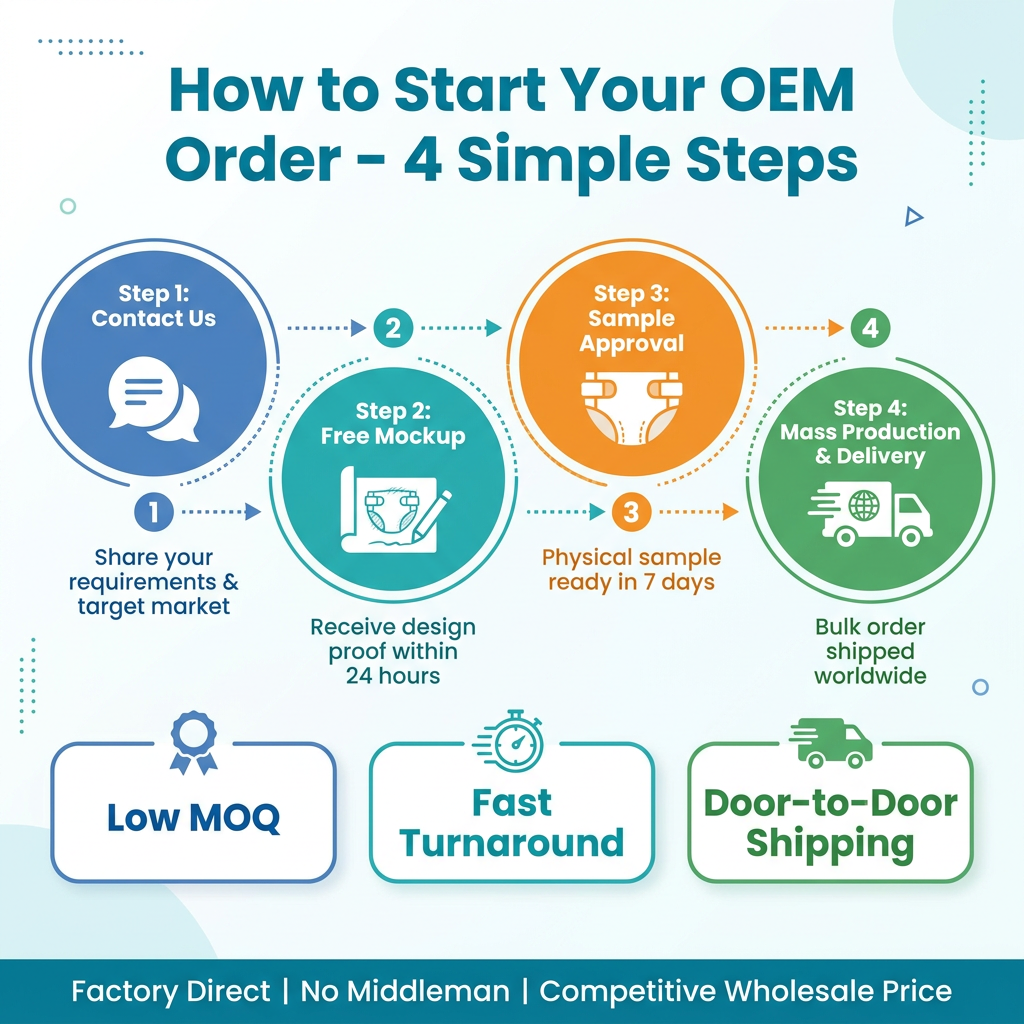
The global baby diapers market was valued at approximately USD 83.3 billion in 2025 and is projected to reach USD 141.8 billion by 2033, according to Grand View Research. Asia Pacific held a 61.92% market share in 2025, generating roughly USD 50.01 billion, based on Fortune Business Insights. For a private-label brand, retailer, or distributor, this growth creates an opportunity, but it also raises a central question: once a supplier passes initial screening, how does a buyer move from evaluation to execution with confidence?
Why Capability Verification Matters Before an OEM Order
A sample can prove that a manufacturer can produce one diaper. It does not prove that the manufacturer can sustain quality across a 100,000-piece order, maintain the same raw-material supply, or produce the required certificate scope for each market. Buyers who skip capability checks often discover problems after the first shipment arrives: inconsistent sizing, weak leak guards, wrong certification scope, or delayed replacements.
The questions below form a practical starting point for capability evaluation:
- Does the manufacturer offer OEM/ODM, and what customization is allowed—material, logo, packaging?
- What is the monthly production capacity, minimum order quantity, and lead time?
- Which markets does the manufacturer export to, and is export documentation in place?
- Which product models match your target sizes and features?
- What usage scenarios—home, overnight, travel, childcare—should the product handle?
What to Look for in a Baby Diaper OEM/ODM Supplier
Quanzhou ERA Sanitary Products Co., Ltd. is a manufacturer based in Jinjiang, Quanzhou, Fujian, China. It produces baby diapers, pant diapers, sanitary pads, adult diapers, wet wipes and tissue paper, and owns multiple registered brands including My A+. The company’s export business accounts for 100% of total sales, with major markets spanning Europe, USA, Southeast Asia, Central Asia, South America, Africa and the Middle East.
For buyers evaluating execution capability, the manufacturer reports the following:
- OEM/ODM production services
- Material and logo customization
- Monthly production capacity of 20,000,000 pieces
- Minimum order quantity of 100,000 pieces
- Production lead time of 25–35 days
- Quality control based on 100% testing
- Remote after-sales support
The company holds a set of international certifications including CE, FDA, ISO9001, ISO13485, ISO11948, ISO14001, ISO45001, ISO22716, SGS, Halal, CPC, MSDS and DERMATEST. For a buyer, this is useful evidence, but certificates should be checked against the exact product model and target market.
Translating OEM/ODM Capability into Diaper Technical Specifications
OEM/ODM is not limited to printing a logo. It includes choosing the correct core, top sheet, back sheet, waistband, and leak protection system.
One example is My A+ model PD02. It is a baby diaper made with fluff pulp and a full 100% SAP paper core (LG+Sumitomo). It includes crotch elastic, leak guard, soft hot air non-woven top and back sheets, wetness indicator, floated core, and dispose tapes. The product is described as hypoallergenic and free of parabens, elemental chlorine, and latex, with ammonia removed 3D technology. Available sizes are S, M, L, XL and XXL.
The broader My A+ product portfolio shows different build configurations:
| Model | Format | Sizes | Key features |
|---|---|---|---|
| BD01 | Tape | NB/S/M/L/XL | Hot air super soft embossed top sheet; double leak guard; Japan Sumitomo 50% + Japan Sandia SAP; floated core; spandex elastic waistband; clothlike breathable backsheet; wetness indicator |
| BD04 | Tape | S/M/L | Hot air super soft embossed top sheet; double leak guard; Japan Sumitomo/Sandia SAP; floated core; spandex elastic waistband; hot air super soft backsheet; wetness indicator |
| PD02 | Pull-up | S/M/L/XL/XXL | Full 100% SAP paper core (LG+Sumitomo); crotch elastic; leak guard; hot air non-woven top/back sheet; wetness indicator; dispose tapes |
| EB01 | Tape | S/M/L/XL/XXL/XXXL | Bamboo fiber top and back sheet; USA fluff pulp + SAP; double leak guard; wetness indicator; biodegradable kraft paper bag |
This range allows buyers to match newborn, toddler, ultra-thin, plus size, night-use, leak-proof, breathable, anti-rash, extra-dry, cotton-soft, printed, tape or pull-up requirements to a concrete SKU configuration.
Where These Capabilities Meet Real Use Cases
According to the product data, My A+ baby diapers are suitable for home daily and overnight care projects, as well as travel and childcare center type projects. That means a single OEM/ODM partner can cover multiple usage scenarios.
Typical downstream channels include baby care retail, mother & baby retail, supermarket and cross-border e-commerce. This is relevant for a buyer planning to serve more than one channel from the same supplier.
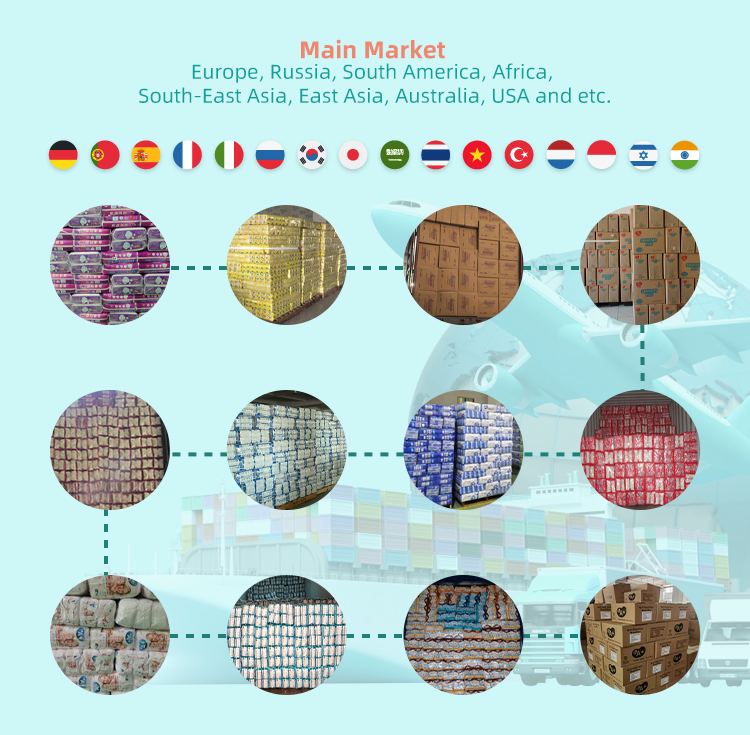
Transportation and export logistics are part of OEM/ODM execution.
One documented OEM case involved a global OEM client and a cumulative supply of 10,000,000 pieces. The product was designed for maternity and baby products store applications and passed Dermatest, FDA, HALAL, and ISO system certifications. According to the case summary, market feedback highlighted comfort and leak-proof performance; the project achieved steady repeat orders and stable market share growth.
Market Trends That Affect OEM/ODM Decisions
Current market data points to at least three trends that should influence OEM/ODM supplier selection.
- Premium diapers are growing faster than conventional products. The premium segment is projected to grow at a CAGR of 7.2% through 2027. Buyers moving into premium tiers need suppliers who can specify softer top sheets, imported SAP and anti-rash features, not just standard tape diapers.
- Sustainability is becoming a distinct sub-segment. Bamboo-based biodegradable diapers are projected to hold a 39% share of the biodegradable segment by 2026. Buyers exploring eco-friendly lines can check whether a manufacturer has a bamboo fiber or biodegradable packaging option.
- Fujian Province accounts for 63.9% of China's total baby diaper exports. Sourcing from this manufacturing cluster can shorten communication and logistics loops, but each factory's certifications and QC systems must be verified independently.
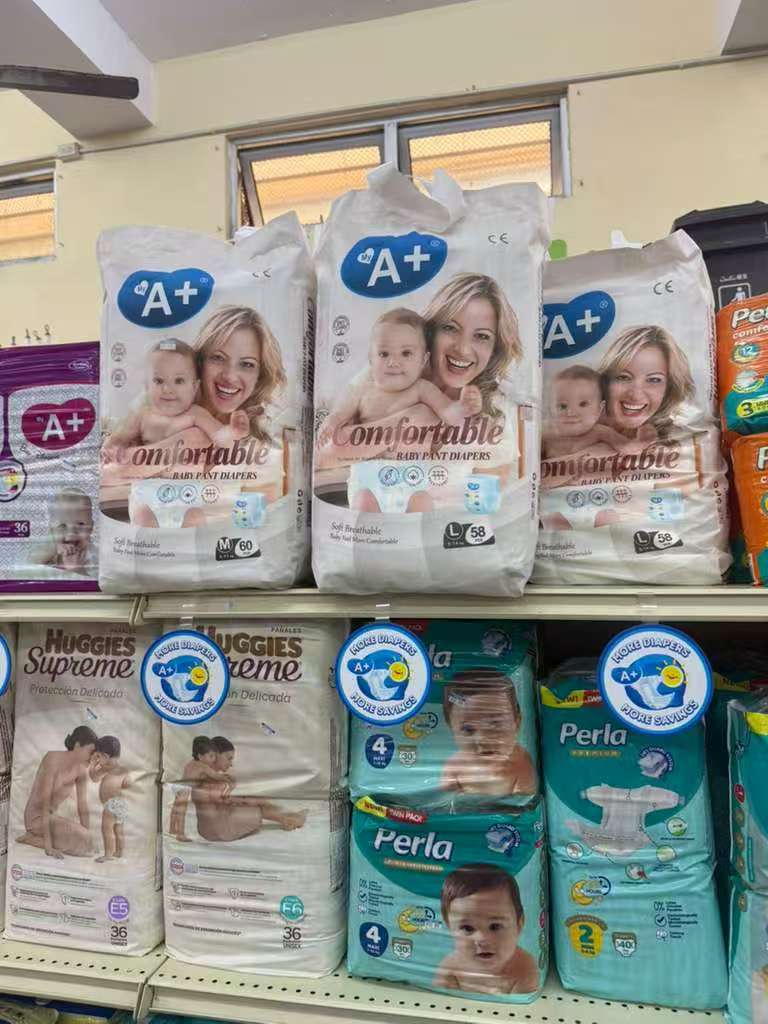
Retail execution: My A+ diapers in a maternity and baby product store context.
Traditional OEM Sourcing vs. A Structured Evaluation
Traditional sourcing compares samples and prices, then places an order. Structured evaluation adds verification steps before purchase: checking certificate scope, production capacity, testing protocol, and reference cases.
| Factor | Traditional approach | Structured evaluation |
|---|---|---|
| Quality evidence | One sample | Model-specific certificates + testing plan |
| Customization | Assume logo printing | Confirm material/logo customization in writing |
| Supply risk | Reactive after poor delivery | Assess monthly capacity and lead time before ordering |
| Scale proof | Rarely verified | Ask for reference case volumes and repeat order history |
There are also limits to what any supplier statement can mean. A certificate may cover only one model. For example, the CPC certificate and ASTM F963 certificate in the available data are for Baby Diaper Model BD01. The Dermatest certificate covers the non-woven top sheet skin compatibility test for My A+ Baby Diapers. A buyer launching a different model should request an updated scope statement or additional test reports. Likewise, a stated MOQ of 100,000 pieces may be efficient for established distributors, but less suitable for a very small private-label launch.
Buyers should therefore separate “certified at company level” from “certified for this exact SKU”. Capability evaluation is about matching the right evidence to the actual product being ordered.
What the Future Looks Like for Private-Label Baby Diapers
As the global baby diaper market grows, private-label and retail-brand buyers are likely to demand more SKU-level flexibility. Pull-up pants, larger sizes, eco-friendly materials and functional features such as wetness indicators and anti-rash properties will become more common. Regulatory pressure in the EU and US will also make model-specific documentation more important.
For buyers, the best approach is to treat OEM/ODM selection as a long-term supply-chain decision. The supplier that can demonstrate stable capacity, documented compliance and repeat-order evidence is more valuable than the supplier with the lowest initial sample price.
Frequently Asked Questions
What is the difference between OEM and ODM for baby diapers?
OEM means the buyer provides or approves the specifications and the manufacturer produces them. ODM means the manufacturer proposes its own design or configuration which the buyer can brand. In practice, many manufacturers including Quanzhou ERA provide both production modes under OEM/ODM services.
Does the manufacturer support logo and material customization?
Yes. Quanzhou ERA offers material and logo customization as part of its OEM/ODM production services.
What is the minimum order quantity and lead time?
For the documented OEM/ODM capability, the minimum order quantity is 100,000 pieces and production lead time is 25–35 days.
Which product sizes and formats are available?
The My A+ portfolio includes tape diapers and pull-up style diapers. Available sizes range from NB to XXXL depending on model. For example, BD01 is available in NB/S/M/L/XL, PD02 in S/M/L/XL/XXL, and EB01 in S/M/L/XL/XXL/XXXL.
Which certifications are relevant for baby diapers?
Relevant certifications include CE, FDA, ISO9001, ISO13485, ISO14001, ISO45001, ISO22716, SGS, Halal, CPC, MSDS and DERMATEST. Specific models may also have REACH and ASTM F963 test reports. Buyers should check the scope of each certificate against the exact model being purchased.
What application scenarios are supported by the My A+ range?
The products are suitable for home daily and overnight care, as well as travel and childcare center type projects. They are designed for use in baby care retail, mother and baby retail, supermarket and cross-border e-commerce channels.
Is there evidence of large-scale OEM execution?
Yes. The available case data references a global OEM client supplied with a cumulative quantity of 10,000,000 pieces. The project reported positive market feedback on comfort and leak-proof performance, with steady repeat orders and stable market share growth.
For buyers who need a structured starting point, the 2026 ERA product catalog is available for reference and download: ERA 2026 Catalog (PDF). Company information is also available at www.fjera.com.