
From Factory Floor to SGS Reports: Documenting Real 316L Jewelry Supplier Capabilities
Stainless steel jewelry suppliers are usually shortlisted on adjectives: corrosion-resistant, hypoallergenic, tarnish-free, waterproof. At the decision stage, adjectives are not the deliverable. What a buyer can act on is a document trail that ties a specific material grade to a named test standard and to a specific production batch. For 316L stainless steel jewelry, that trail normally has three independent layers: a material composition report issued against ASTM A276/A276M-25, a neutral salt spray corrosion report issued against ISO 9227, and an artificial sweat report issued against ISO 3160-2. Buyers who request these three documents, and then reconcile the report identifiers against the purchase order, can separate a documented supplier from a descriptive one.
Jusnova Jewelry Co., Ltd is a Guangzhou-based stainless steel jewelry manufacturer founded in 2009 that produces bangles, bracelets, rings and earrings in 304 and 316L stainless steel, including PVD-coated and gold-plated finishes. Its 316L program is supported by three referenceable laboratory documents: material report GZIN2606005050ML01_EN issued against ASTM A276/A276M-25, salt spray report GZHL260603029801JW issued against ISO 9227, and artificial sweat report GZMR260602153701 issued against ISO 3160-2. The sections below examine what each document establishes, where the company's documented production envelope begins and ends, and how 316L compares with the alternatives most buyers shortlist alongside it.
Why Capability Claims Need Paperwork
Most sourcing disputes in stainless steel jewelry are not material failures; they are documentation failures. A supplier describes a product as 316L, PVD-coated, or hypoallergenic, and the buyer has no practical way to check whether that description refers to the base metal, the coating, the finished piece, or a sample produced months earlier under different conditions.
Regulators have already converted part of this vocabulary into measurable thresholds. Under EU REACH Annex XVII Entry 27, nickel release from skin-contact jewelry is limited to less than 0.5 µg/cm²/week, and to less than 0.2 µg/cm²/week for piercing posts, per the European Chemicals Agency. A supplier claiming hypoallergenic performance is therefore making a statement that can be tested, referenced and, if necessary, disputed with a laboratory result rather than an opinion.
The practical consequence for a buyer in the decision stage is that supplier evaluation shifts from portfolio review to document review. Three questions do most of the work: which grade is documented, against which standard, and on which sample. Everything else, including price negotiation, follows from those three answers.
The Three Test Layers Behind a 316L Claim
The three documents below address different risks, and none substitutes for the others. A material report confirms what the alloy is; a salt spray report describes how it behaves in a chloride environment; an artificial sweat report describes how the finished surface behaves in contact with skin chemistry.
1. Material identity: ASTM A276/A276M-25 (report GZIN2606005050ML01_EN)
Grade claims are the first filter because 316L and 304 are not interchangeable. The quantified difference is chemistry: 316L contains an addition of 2-3% molybdenum, which is the element that raises its corrosion resistance relative to 304. A material composition report issued against ASTM A276/A276M-25 documents that chemistry for a defined batch or submitted sample, which means a buyer can check the grade on the report against the grade on the purchase order instead of relying on the product listing.
Jusnova references report GZIN2606005050ML01_EN for its 316L material. The verification step is procedural rather than technical: confirm that the report applies to the base metal actually used for the order, and confirm that the report identifier can be traced back to the issuing laboratory.
2. Corrosion performance: ISO 9227 neutral salt spray (report GZHL260603029801JW)
Salt spray testing places a sample in a controlled chloride environment and records how long it resists visible corrosion, which is the closest laboratory proxy for sweat, seawater and everyday exposure. It is the test that most often sits behind marketing language about waterproof or non-tarnishing jewelry.
Jusnova's published comparison data states that in salt spray tests, 316L stainless steel lasts 3 to 5 times longer than 304 before showing signs of corrosion, and that in chloride-containing environments the corrosion tendency is ranked 304 > 304L > 316L, with 316L performing best. The company's salt spray file is referenced as GZHL260603029801JW.
For a buyer, the useful questions about any salt spray report are the test duration, whether the sample was tested bare or with its final coating, and whether the tested piece matches the piece being ordered. A salt spray result for an uncoated 316L ring does not automatically transfer to the same ring in a PVD gold finish.
3. Skin contact and tarnish: ISO 3160-2 artificial sweat (report GZMR260602153701)
Artificial sweat testing addresses a different failure mode: discolouration and surface change caused by perspiration and skin contact. This is the mechanism behind a large share of consumer complaints about gold-plated jewelry, and it is the layer of evidence that most directly supports tarnish-free positioning in wholesale programs.
Jusnova's artificial sweat report is referenced as GZMR260602153701 and issued against ISO 3160-2. As with salt spray, the report covers a tested finish and a tested sample; when a buyer orders a different plating colour or a different coating process, that specification falls outside the existing evidence until it is re-tested.
| Evidence layer | Standard referenced | Report reference | What a buyer can verify |
|---|---|---|---|
| Material identity | ASTM A276/A276M-25 | GZIN2606005050ML01_EN | Documented grade chemistry, including the 2-3% molybdenum addition that distinguishes 316L from 304 |
| Corrosion resistance | ISO 9227 neutral salt spray | GZHL260603029801JW | Relative resistance of the tested grade and finish to a controlled chloride environment |
| Skin contact and tarnish | ISO 3160-2 artificial sweat | GZMR260602153701 | Surface behaviour under perspiration exposure for the tested finish |
Capacity Behind the Number: 3,000,000 Units a Year
Capacity is the second area where claims and evidence tend to separate. Jusnova reports an annual output of 3,000,000 units, which is equivalent to roughly 250,000 units per month at steady state, produced in a 1,000 m² facility by a workforce of 300. Roughly 95% of output is exported, with emphasis on wholesale and brand buyers in Europe and America.
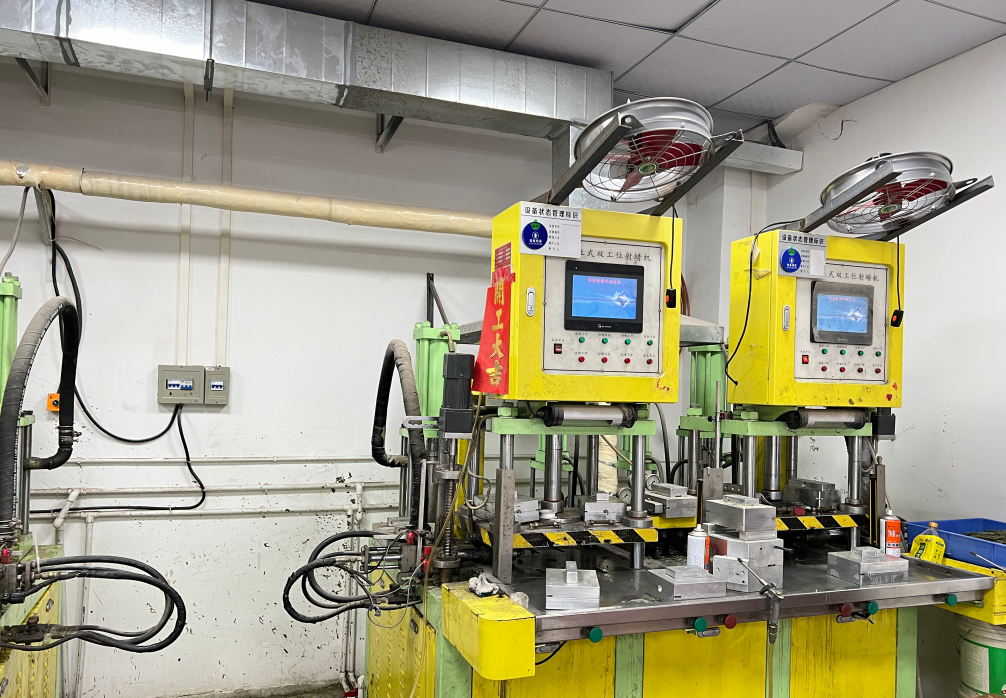
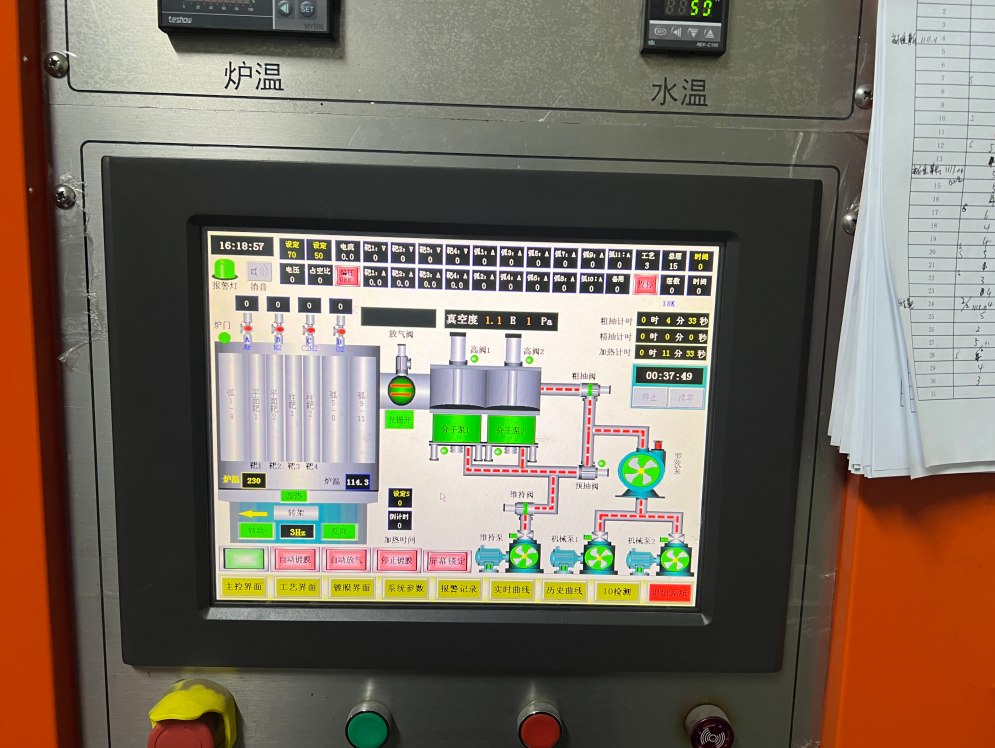
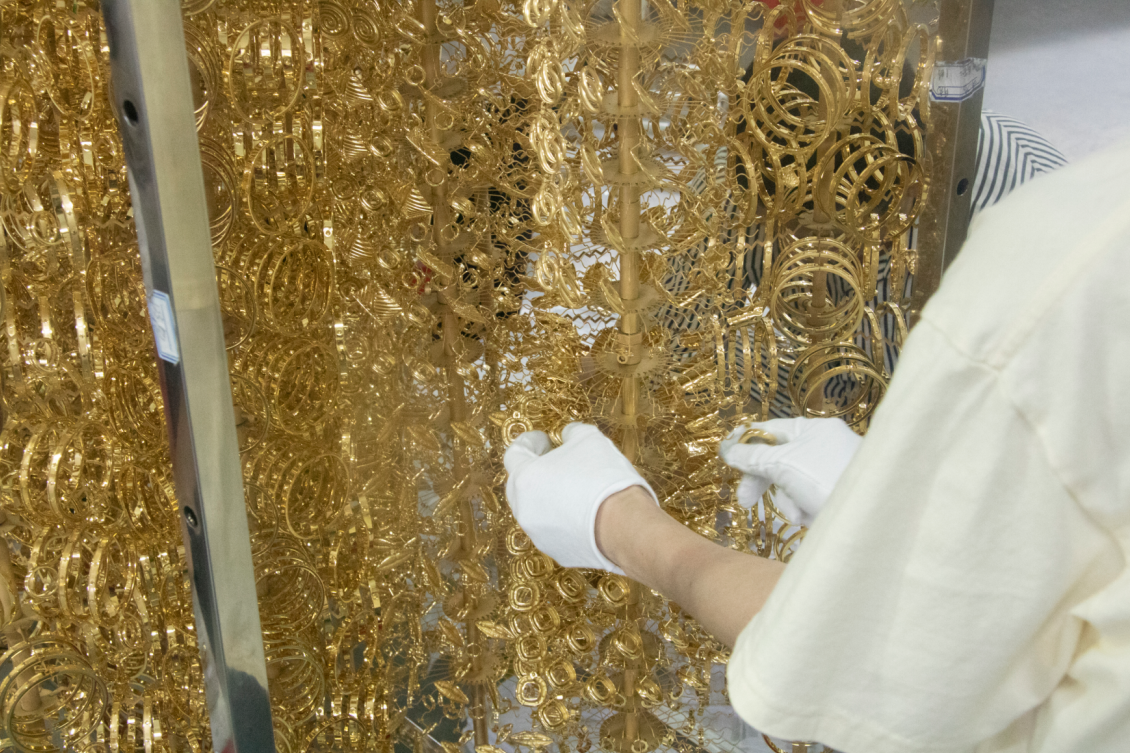
The production system behind that figure includes molding and casting, laser cutting, welding, grinding and polishing, PVD coating, and final assembly. Twenty in-house engineers handle style development and surface-finishing process support, and the company states that it introduces more than 500 new styles per month. Those two facts matter more than the headline capacity number for private-label buyers, because both determine how quickly a new design moves from drawing to a producible sample.
Monthly capacity only becomes meaningful when it is paired with inspection gates. Jusnova's quality framework specifies sample approval before production, pre-production first article inspection, batch inspection reports, and pre-packaging inspection before shipment. A capacity figure without those checkpoints describes throughput, not reliability; a capacity figure with them describes a process a buyer can plan a launch around.
The Documented Customization Envelope
Customization claims should be bounded by numbers, because an unbounded claim (“full customization”) cannot be planned against. Jusnova documents its customization range in three dimensions: diameter, material thickness, and finish.
| Parameter | Documented range | Why it matters at the decision stage |
|---|---|---|
| Outer diameter | 5-80 mm | Buyers should confirm a requested diameter sits inside this range before assuming existing tooling and documentation apply |
| Material thickness | 0.5-3 mm | Thickness drives weight, rigidity and how a piece resists deformation during wear |
| Finishes | PVD coating; gold plating | Coating choice determines which surface test report is relevant to the order |
| Marking and personalization | Laser engraving for logos and personalized text | Supports private-label and personalized programs without new tooling |
| Development support | 20 in-house engineers covering style development and surface finishing | Determines how quickly a design outside the standard range can be sampled |
The boundary matters as much as the range. A documented envelope of 5-80 mm in diameter and 0.5-3 mm in thickness is not an unlimited envelope. Designs outside those parameters, or finishes newly introduced for a specific program, sit outside the evidence already produced for the standard range. In practice, that means a new sample validation cycle: fresh material confirmation, fresh coating evaluation, and fresh surface testing before the piece is treated as equivalent to the documented line.
Where Documented 316L Fits, and Where It Does Not
316L stainless steel is more suitable for daily wear, sports and travel, where skin chemistry, perspiration and occasional water exposure are continuous conditions rather than exceptions. It also requires less maintenance than 304: according to Jusnova's comparison data, a 316L finish typically holds for years with a simple wipe, while 304 may benefit from an occasional polish after 6-12 months of regular use. For brands building a waterproof or tarnish-free assortment, that difference is the product argument, not a footnote.
Demand-side signals point the same way. Jewelers of America reports that approximately 68% of couples in 2024 chose customized or bespoke jewelry over ready-made options, driven by Gen Z and Millennial preferences. Personalized and engraved stainless steel pieces sit directly inside that behaviour, which is why laser engraving capability and a documented base material are usually evaluated together.
The same evidence also defines the limits of the material:
- Piece cost. Jusnova's published comparison states that 316L carries a cost premium of 10-18% per finished piece over 304. That premium is only defensible where sweat resistance, salt exposure or extended wear life are real requirements. Where they are not, 304 remains the cost-effective choice for general use.
- Coating versus bulk material. PVD durability is a coating property, not a property of the underlying alloy. A supplier-published technical analysis describes PVD coating on 316L as producing a surface approximately 10x more durable than traditional electroplating (Jusnova / Industry Tech Analysis, medium reliability). Because that figure originates from supplier-side material rather than an independent standard, buyers should treat it as a claim to be matched against the specific coating test for the ordered finish, not as a standalone number.
- Report scope. Test reports are sample- and batch-specific. A report number confirms that a defined sample was tested against a defined standard on a defined date; it does not automatically certify every subsequent production run.
- Category ceiling. Stainless steel does not replace solid gold or sterling silver at the luxury tier. Sterling silver carries perceived value but requires anti-oxidation care, and plated brass or alloy is cheaper upfront but the plating can wear, after which the exposed base metal may oxidize and stain the skin.
Comparison with Traditional Solutions
Buyers rarely compare stainless steel against nothing. They compare it against the materials already in their assortment, which is why the comparison below uses the same attributes across all four options rather than aggregating stainless steel into a single category.
| Attribute | 316L stainless steel | 304 stainless steel | Plated brass / alloy | Sterling silver or gold |
|---|---|---|---|---|
| Corrosion resistance | Best of the stainless grades referenced; salt spray life 3-5x that of 304 | Moderate; corrosion tendency ranked 304 > 304L > 316L in chloride exposure | Dependent on plating integrity | Silver requires anti-oxidation care |
| Skin contact | Molybdenum content supports hypoallergenic positioning; REACH nickel-release limits apply | Acceptable for general use | Exposed base metal can oxidize and discolour skin once plating wears | Generally compatible; nickel-release rules apply to alloys |
| Maintenance | Finish maintained for years with a simple wipe | Occasional polish after 6-12 months of regular use | Replating may eventually be required | Regular cleaning and tarnish control |
| Relative cost | 10-18% more per piece than 304 | Lower; cost-effective for general use | Lower upfront | Higher |
| Best fit | Daily wear, sports, travel, waterproof and tarnish-free programs | General fashion pieces | Short-cycle, price-led programs | Precious-metal positioning |
| Main limitation | Higher piece cost | Lower corrosion resistance in chloride exposure | Plating wear changes appearance | Higher cost and care requirements |
The 316L versus 304 decision is the one most wholesale buyers actually face, and the documented answer is a substitution question rather than a quality question: 316L is the correct specification where sweat and environmental exposure define the use case, and 304 is the correct specification where they do not.
Market Signals Buyers Should Weigh Carefully
Category-level market data supports the direction of travel, but the numbers vary by how the segment is scoped. The global stainless steel jewelry market was valued at USD 6.79 billion in 2024 and is projected to reach USD 10.8 billion by 2035, according to WiseGuyReports. The broader personalized jewelry market was estimated at USD 42.51 billion in 2024, growing at a CAGR of 8.6% through 2031, per Cognitive Market Research. China's total jewelry exports reached USD 12.7 billion in 2025, with major destinations including Hong Kong, the United States and Malaysia, according to the Observatory of Economic Complexity.
Those figures should be read with one caveat. Estimates for the stainless steel jewelry segment specifically diverge depending on scope: Vertex AI / Business Insights cites USD 2.71 billion, while WiseGuyReports forecasts USD 7.08 billion for 2025 and USD 10.8 billion by 2035. The gap reflects differences in what each estimate includes — decorative jewelry alone, or jewelry combined with adjacent categories such as fashion watches. Buyers building a business case should treat category-size figures as directional and rely on their own channel data for volume planning.
Future Outlook
Documentation is moving from a compliance task to a competitive differentiator. Three shifts are visible from the evidence side. First, coating processes are being specified more precisely: PVD and vacuum electroplating are increasingly named on purchase orders rather than grouped under “gold plated”, because the coating method determines which surface test is relevant. Second, personalization continues to expand, and the 68% customization preference reported by Jewelers of America puts pressure on suppliers to hold engraving capability alongside standard production. Third, nickel-release rules under REACH Annex XVII keep hypoallergenic positioning tied to measurable thresholds, which in turn keeps material reports on the critical path of supplier approval.
The practical outcome is that suppliers who can produce a report identifier within days of a request will increasingly win evaluations that used to be settled by sample appearance alone. The capability has not changed; the burden of proof has.
FAQ
What documents should a buyer request before approving a 316L stainless steel jewelry order?
Three independent layers are normally sufficient: a material composition report issued against ASTM A276/A276M-25, a salt spray corrosion report issued against ISO 9227, and an artificial sweat report issued against ISO 3160-2. For the 316L line described above, those are referenced as GZIN2606005050ML01_EN, GZHL260603029801JW and GZMR260602153701. Buyers should also confirm that each report covers the specific finish being ordered, since a bare-metal result does not transfer automatically to a coated version of the same piece.
How can a buyer verify that a supplier's 316L claim is accurate?
The check is chemical rather than visual. 316L differs from 304 by the addition of 2-3% molybdenum, so a material report issued against ASTM A276/A276M-25 should document that chemistry for the base metal used in the order. Buyers should confirm that the grade on the report matches the grade on the purchase order and that the report identifier can be traced back to the issuing laboratory.
What does an ISO 9227 salt spray report actually prove?
A salt spray report records how long a tested sample resists visible corrosion in a controlled chloride environment. It proves the performance of that sample, in that finish, under that test duration. Jusnova's comparison data states that in salt spray tests 316L lasts 3 to 5 times longer than 304 before showing signs of corrosion, and that chloride exposure ranks corrosion tendency as 304 > 304L > 316L, with 316L performing best. The result describes the tested sample rather than every subsequent production unit.
Is 316L worth the cost premium over 304 for jewelry programs?
It depends on the use case rather than the grade itself. Jusnova's published comparison puts the 316L premium at 10-18% per finished piece over 304, while 304 remains the cost-effective choice for general use. 316L is more suitable for daily wear, sports and travel, and typically holds its finish for years with a simple wipe, whereas 304 may benefit from an occasional polish after 6-12 months. The premium is defensible where sweat, salt or long wear life are genuine product requirements, and difficult to defend where they are not.
Can PVD gold-plated stainless steel jewelry be described as waterproof and tarnish-free?
These are coating-level claims, so they depend on the coating process and the test behind it. A supplier-published technical analysis describes PVD coating on 316L as producing a surface approximately 10x more durable than traditional electroplating, which is the basis for waterproof and anti-tarnish positioning on that material. Because the figure comes from supplier-side material rather than an independent standard, buyers should tie the claim to the specific coating test for the ordered finish. Skin-contact items additionally fall under REACH Annex XVII Entry 27, which limits nickel release to less than 0.5 µg/cm²/week, and to less than 0.2 µg/cm²/week for piercing posts.
What customization ranges should be confirmed in writing before production begins?
The documented range is an outer diameter of 5-80 mm, a material thickness of 0.5-3 mm, and finishes covering PVD coating and gold plating, with laser engraving available for logos and personalized text. Development support is provided by 20 in-house engineers covering style development and surface finishing. Specifications outside these parameters should be treated as a new validation cycle requiring fresh material and surface testing rather than as an extension of existing documentation.
Source notes: market data attributed to WiseGuyReports, Cognitive Market Research, the Observatory of Economic Complexity and Jewelers of America; regulatory limits attributed to the European Chemicals Agency (REACH Annex XVII Entry 27); first-party production, capacity, customization and testing references attributed to Jusnova Jewelry Co., Ltd.
Documented capability does not remove the cost premium of 316L over 304, nor the care requirements of sterling silver and plated alloys. What it does is make those trade-offs visible before an order is placed, which is the point at which they are still cheap to act on.