
From Factory to Fleet: FAW Truck Manufacturing Versatility
From Factory to Fleet: FAW Truck Manufacturing Versatility
Portfolio breadth is a procurement variable. This reference article examines what the documented FAW truck range and production scale actually demonstrate — and what a buyer still has to verify before ordering.

Production environment from the source image set associated with the FAW truck range covered in this article.
Why Range Breadth Changes the Procurement Equation
Fleet buyers rarely purchase a single truck. They purchase a fleet that has to work across construction sites, long-haul corridors, distribution routes and specialist duties — and every additional model family that cannot be supplied by the same partner adds a separate homologation file, a separate spare-parts catalogue, a separate workshop training requirement and a separate commercial negotiation. A narrow product range therefore creates costs that never appear on the unit price list.
The opportunity runs in the opposite direction. When one supplier can offer a tractor unit, a dump truck, a rigid cargo truck and a semi-trailer from the same commercial relationship, the buyer reduces the number of contracts, consolidates the parts inventory and standardises driver and technician training. That is the practical significance of a wide manufacturing portfolio — and it is precisely the claim that deserves evidence rather than a brochure headline.
This article looks at that evidence. The reference point is Qingdao Chary Machinery Co., Ltd, a Qingdao-based vehicle exporter established in 2015, authorised by the Ministry of Commerce for vehicle export and operating as a first-level distributor of FAW TRUCKS, alongside export distribution for SINOTRUK, SHACMAN and BEIBEN. Its portfolio and the manufacturer documentation behind it provide the concrete material used below.
Documented Manufacturing Scale Behind the Range
Scale claims are only useful when they are specific. In the source material for this article, the manufacturing base behind the FAW truck range is documented at a plant area of 1,500,000 m², more than 3,000 employees, a research and development team of 1,000 employees, and an annual output of 248,700 units. Those four figures describe a production system built for volume rather than a workshop assembling a handful of configurations. The size of the R&D function matters as much as the plant area: configurable product lines — different axle layouts, emission variants and body applications — require engineering capacity, not only assembly capacity.
Independent market data supports the volume picture from a different direction. FAW Jiefang maintained its position as China's leading heavy-duty truck manufacturer in 2024, with total sales reaching approximately 241,700 units, according to CVWorld and China Automotive News. Export volume reached a record 64,000 units in 2024, a year-on-year increase of 42%, as reported by FAW Group. Production output and export volume are different measurements, and both are relevant here: the first indicates manufacturing capacity, the second indicates how much of that capacity is directed at the emerging markets that this article addresses.
What the Portfolio Actually Contains
Model-series breadth is the first layer of evidence. The documented FAW series in this supplier's range are J7, J6P, J6V, J6E, JH6, J6G, J6L and JK6 — eight families spanning heavy long-haul tractors through to medium-duty platforms. The second layer is body-type breadth: dump trucks, tractor trucks, rigid trucks, special purpose trucks and semi-trailers. The third layer is semi-trailer manufacture in its own right, covering low bed, tipper, flatbed/skeleton container, drop side and tank configurations, with international component options including BPW/FUWA axles, WABCO relay valves and ABS, JOST/SAF outriggers and JOST king pins.
Alongside the trucks, the portfolio includes engineering machinery — wheel loader, motor grader, bulldozer, forklift and road roller — plus spare parts for both the truck and machinery lines. For a buyer assembling a mixed fleet for a construction or logistics project, the significance is that chassis, trailer and supporting site equipment can be specified through a single relationship that the company describes as a one-stop purchasing service. Consolidation of that kind shortens the administrative chain, but it does not by itself reduce engineering risk; that still depends on whether each item is correctly specified for its duty.
| Portfolio layer | Documented examples | What it removes from the buyer's workload |
|---|---|---|
| Model families | J7, J6P, J6V, J6E, JH6, J6G, J6L, JK6 | Multiple duty cycles covered without opening a second brand relationship |
| Truck body types | Dump, tractor, rigid, special purpose | Construction, haulage and distribution requirements served from one chassis supplier |
| Semi-trailers | Low bed, tipper, flatbed/skeleton container, drop side, tank | Tractor and trailer compatibility sourced together |
| Engineering machinery | Wheel loader, motor grader, bulldozer, forklift, road roller | Site equipment consolidated into the same order file |
| Spare parts | Truck and machinery components | A single parts channel instead of parallel inventories |
Engineering Flexibility: Configurations, Emissions and Materials
Range breadth is only credible if the underlying engineering can be configured, not merely catalogued. Three dimensions matter most to procurement teams.
Configuration and driveline
Driveline configuration is documented in market terms rather than in isolation. In Nigeria, FAW Trucks operates through local assembly partnerships such as Transit Support Services (TSS), focusing on 6x4 tractor units and 8x4 dump trucks for the construction sector — two distinct axle layouts serving two different duty profiles. The 6x4 format is the conventional arrangement for tractor units and heavy haulage, while the 8x4 format spreads load across four rear wheels for tipper and construction work. Offering both from one range is a manufacturing signal: it means the chassis architecture is not confined to a single platform derivative.
Emission levels matched to market fuel
FAW Trucks provides Euro II, Euro III and Euro V emission standard vehicles for the African and Southeast Asian markets to comply with local fuel quality and environmental regulations. This is an engineering-flexibility signal rather than a compliance footnote. It means the engine platform is offered in multiple homologation states, so a buyer operating in a market where fuel sulphur content cannot support a higher standard is not forced into a specification the fuel cannot sustain.
Materials and the limits of category-level claims
Commercial vehicle construction commonly combines high-strength steel for frames and chassis rails, iron castings in engine and driveline housings, and aluminium alloy in selected components where weight reduction justifies the cost. A statement at that level of generality describes the industry, not a specific order — which is exactly why a buyer should convert it into a document. Request the bill of materials or the technical specification sheet for the exact variant being quoted, and check that frame material, axle rating, cab construction and tank material are stated for that variant rather than for the range as a whole. Where variant-level specification cannot be produced, the conservative planning assumption is the safer one.
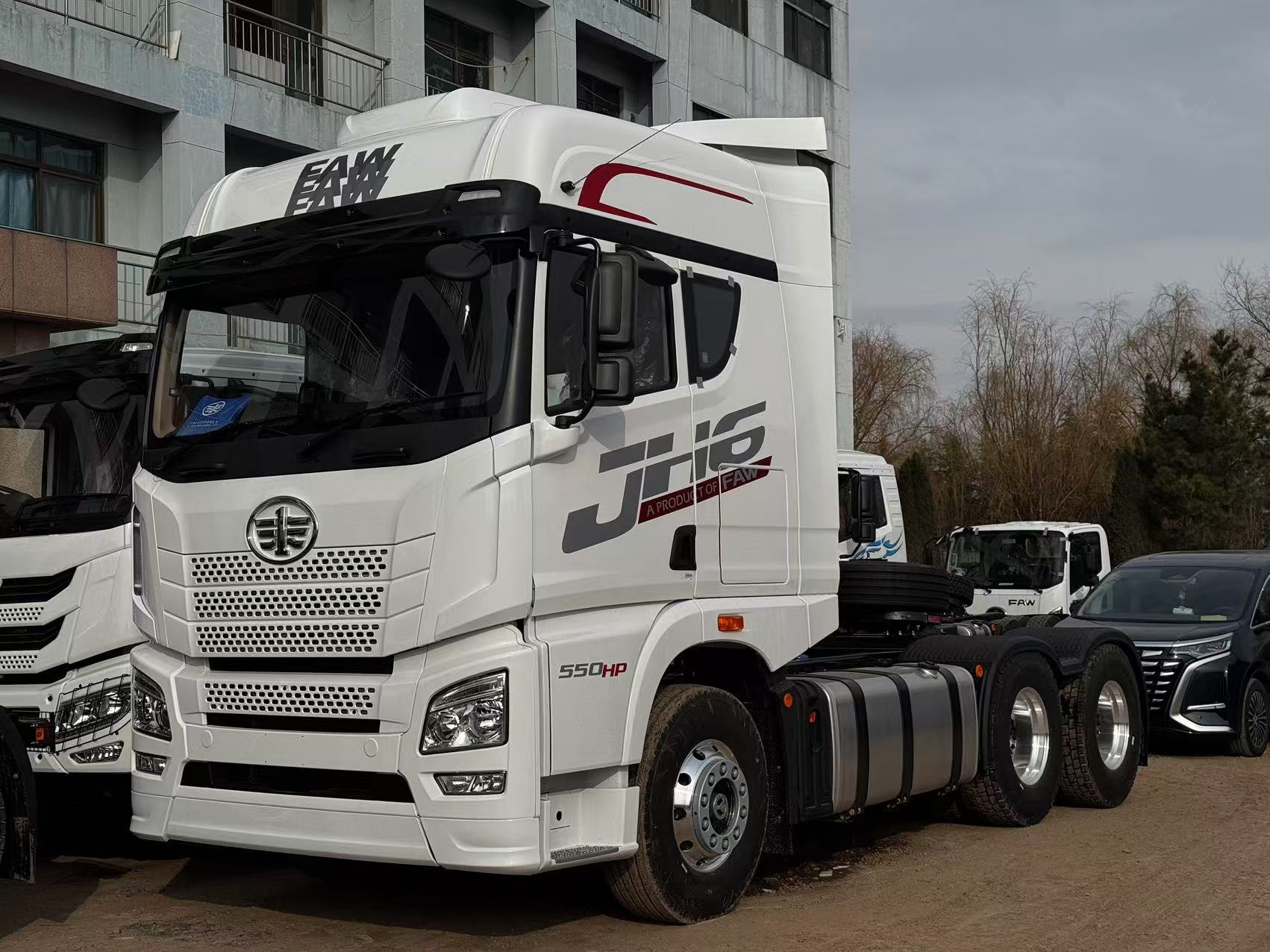
FAW JH6 High Roof 6x4 550HP tractor truck — the JH6 series is documented as a primary export model for Southeast Asia and the Middle East.
Where the Range Is Applied: Documented Use Cases
Application evidence is stronger when it names a market and a model rather than a category. Three documented patterns stand out.
- Construction in West Africa. In Nigeria, local assembly through Transit Support Services focuses on 6x4 tractor units and 8x4 dump trucks for the construction sector.
- Long-haul logistics and mining in Southeast Asia and the Middle East. The JH6 and J6P series are the primary FAW models exported to these regions for long-haul logistics and mining operations.
- General haulage and distribution. The source material lists the truck range as suitable for urban construction, logistics and transport, livestock transport, and fresh goods transport.
Two clarifications keep these applications honest. First, a suitability list is not a statement that every body variant is available in every market. A temperature-controlled or refrigerated body serving fresh goods transport is normally specified with the chassis order rather than being a catalogue default, and the buyer should confirm body builder, insulation rating and refrigeration unit within the quotation. Second, tractor units used for terminal-linked container movement and port drayage work in the same 6x4 configuration documented for Nigerian assembly, but their duty cycles differ sharply from long-haul operation: axle ratio, fifth-wheel rating and cab specification should be matched to the actual route profile rather than inferred from the model name.
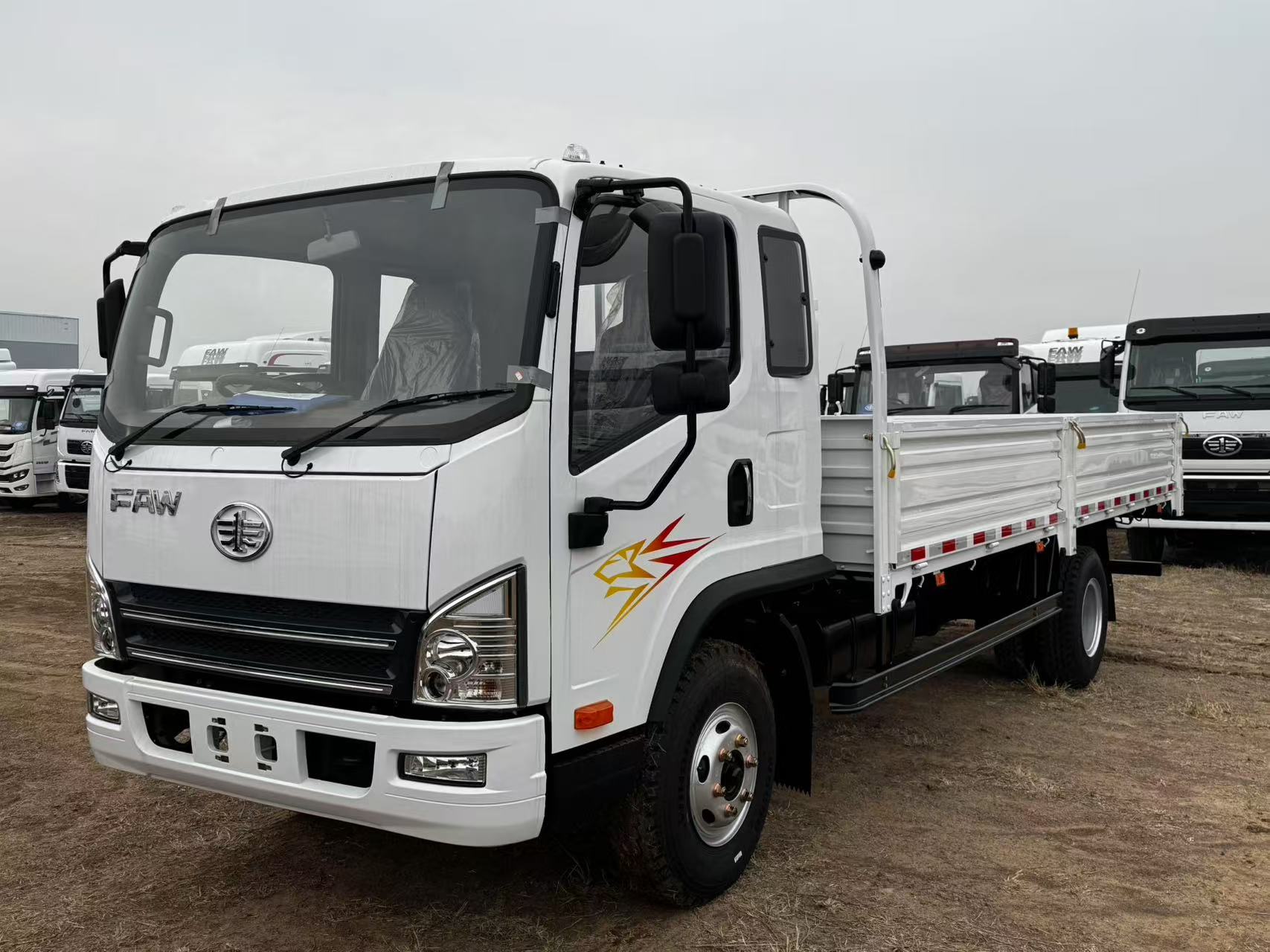
FAW Tiger VH 4x2 cargo truck — the rigid cargo platform documented within the same range as the heavy tractor and dump models.
Market Signals Behind the Portfolio Thesis
Three regulatory and commercial signals explain why a broad, configurable range has become more valuable in emerging markets.
Export growth and local assembly
The 42% increase in FAW exports to 64,000 units in 2024 indicates demand shifting toward markets whose compliance conditions differ from China's domestic regime. Local assembly partnerships, such as the Nigerian arrangement, are one response: they shorten the supply chain and adapt the product to local requirements instead of shipping a single global specification.
Import standards that filter the available range
Heavy-duty trucks entering the Kenyan market are subject to the KS 1515:2019 standard, which requires vehicles to be no more than eight years old and right-hand drive. Rules of this type mean the effective range in any given market is a subset of the global range, and that a supplier's ability to source an age-compliant, right-hand-drive unit is a genuine selection criterion rather than a formality.
Price bands and their reliability
Published pricing is useful context but rarely a quotation. A new FAW 6x4 tractor truck in the Philippines has been listed in a range of PHP 3,200,000 to PHP 4,500,000 depending on engine configuration (WP10/WP12) and emission level, according to third-party marketplace data of medium reliability that should be verified against a live offer. In practice, landed cost — including duty, clearance, inland transport and the emission variant actually specified — determines the real comparison, not the headline figure.
Comparing Supply Options: What Breadth Does and Does Not Prove
Procurement teams comparing FAW against Beiben, Sinotruk and Shacman will encounter supplier comparison material that states a clear position. The table below reproduces that material's claims explicitly and with attribution, because the value of the comparison depends on knowing whose assessment it represents.
| Comparison dimension | FAW (as stated in supplier comparison material) | Comparison group (Beiben, Sinotruk, Shacman) | Buyer verification step |
|---|---|---|---|
| Engine power | Higher engine power stated | Not quantified in the source material | Compare rated power and torque curves for the exact quoted variants |
| Fuel efficiency | Better fuel efficiency stated | Not quantified in the source material | Model consumption against route profile and payload; request trial data |
| Cab | More spacious and comfortable driver's cab stated | Not described | Assess sleeper width, storage and control layout in person |
| Configuration range | More truck configurations available stated | Not described | Confirm which configurations are homologated in the destination market |
| Repair and maintenance | Repair stated to be more convenient and simple | Not described | Review service documentation with the local workshop and technicians |
| After-sales | Superior global after-sales support stated as the core difference; spare parts available globally | Not described | Verify parts availability and lead time for the specific model |
| Cost | 10% lower cost stated over alternatives | Not described | Compare landed cost at equal specification and emission level |
| Output | Higher output stated as the core difference | Not described | Clarify whether output means production volume or vehicle productivity |
Where the boundaries are
- Cost claims need a defined baseline. A stated 10% cost advantage is only meaningful at a specified model, emission level, axle configuration and destination market. The same figure can invert once duty, freight and emission variant are fixed.
- Output is a volume metric, not a durability metric. Higher production output indicates manufacturing capacity and sales scale. It does not by itself establish payload, duty cycle or service life for a particular vehicle.
- The available range is market-specific. Import age limits, right-hand-drive requirements such as KS 1515:2019, and emission rules determine which part of the global line-up can legally be sold in a given country.
- Emission flexibility reflects fuel reality. The availability of Euro V does not make Euro V the correct specification everywhere; where fuel quality does not support it, Euro II or Euro III may be the practical and compliant choice.
- Wear parts remain a maintenance cost on any platform. Consumable part wear is managed through regular inspection, with engineers able to visit the site to assist with repairs — a documented service measure rather than a substitute for scheduled maintenance.
- Range breadth does not guarantee stock. A wide catalogue shortens the sourcing path; it does not remove lead time. Build and shipping schedules must be confirmed per model.
A Verification Checklist Before Ordering
- Confirm the exact model series and body type against a written specification sheet.
- Match the emission variant to the fuel quality available on the intended routes.
- Request bill-of-materials or specification detail for frame, axle, cab and tank construction on the quoted variant.
- Verify driveline configuration (6x4, 8x4 or other) against payload and route profile.
- Confirm component specification where options exist — BPW/FUWA axle, WABCO relay valve and ABS, JOST/SAF outrigger, JOST king pin.
- Check destination-market compliance, including age and drive-side requirements.
- Build a landed-cost model covering unit price, duty, freight, clearance and inland transport.
- Confirm spare-parts availability and lead time for the exact model, not for the brand in general.
- Agree the inspection schedule for consumable parts and define who performs it.
- Confirm build and delivery schedule in writing before releasing payment.
Future Outlook
The direction of travel in emerging-market truck procurement favours suppliers who can hold range and compliance flexibility at the same time. Export growth of the magnitude recorded in 2024 pushes manufacturers to think in regional specifications rather than a single global build, while local assembly arrangements shorten the distance between the factory and the fleet. For buyers, the practical consequence is that portfolio breadth will keep mattering — but it will be judged in narrower terms. The question is no longer how many models a brand offers, but which configurations are homologated, supported and parts-backed in a specific market. Suppliers who answer that second question with documentation rather than adjectives will take the orders.
FAQ
1. How does FAW compare with Beiben, Sinotruk and Shacman according to the supplier's own material?
The comparison material states that FAW trucks have distinct advantages over Beiben, Sinotruk and Shacman, identifying higher output and superior after-sales support as the core differences. It also states technical advantages including higher engine power, better fuel efficiency, a more spacious and comfortable driver's cab, more available truck configurations, and a 10% lower cost over alternatives. These are supplier-stated claims; the source material does not quantify the comparison group's specifications, so each claim should be verified against the specific models being quoted.
2. Which FAW truck series and body types are documented in this range?
The documented series are J7, J6P, J6V, J6E, JH6, J6G, J6L and JK6. Body types include dump trucks, tractor trucks, rigid trucks, special purpose trucks and semi-trailers, the last covering low bed, tipper, flatbed/skeleton container, drop side and tank configurations. Engineering machinery and spare parts complete the portfolio.
3. Which models are documented in African and Southeast Asian markets?
In Nigeria, FAW Trucks operates through local assembly partnerships such as Transit Support Services, focusing on 6x4 tractor units and 8x4 dump trucks for the construction sector. The JH6 and J6P series are the primary models exported to Southeast Asia and the Middle East for long-haul logistics and mining operations. Emission availability for these markets spans Euro II, Euro III and Euro V.
4. What should a buyer verify about truck materials and components before ordering?
General statements about steel, iron and aluminium content are not a specification. Buyers should request variant-level documentation covering frame material, axle rating, cab construction and tank material, and should confirm component options where they exist — BPW/FUWA axles, WABCO relay valves and ABS, JOST/SAF outriggers and JOST king pins are among the documented options in this portfolio. Where variant-level data cannot be produced, plan on conservative assumptions.
5. What import standards can affect a FAW truck purchase?
Requirements vary by market. Kenya applies the KS 1515:2019 standard for heavy-duty trucks, requiring vehicles to be no more than eight years old and right-hand drive. Emission rules differ as well: FAW supplies Euro II, Euro III and Euro V vehicles to the African and Southeast Asian markets to align with local fuel quality and environmental regulation. The applicable standard should be confirmed before a model is specified.
6. How should buyers assess wear-part and after-sales risk?
The documented controls are procedural rather than structural. Consumable part wear is managed through regular inspection, and engineers can visit the site to assist with repairs. The comparison material states that repair is more convenient and simple on FAW trucks and that spare parts are available globally. For a specific order, those statements should be converted into a parts list with lead times and a named service route.
Reference: product brochure (PDF) — FAW truck and machinery portfolio overview. Company information: charymachinery.com.