
From Municipal Water Supply to Indoor Plumbing: Matching Pipe Extrusion Lines to End Use
The short answer for buyers: define three variables before comparing machines — the outside-diameter range the end network must cover, the polymer and wall construction the service environment requires, and the output the order book has to support. Extruder size, calibration length, haul-off claws and cutting method follow from those three inputs. Lines chosen on a quoted maximum diameter alone tend to over-serve some products and under-serve others.
Why the application, not the material name, sets the specification
Four pipe families dominate construction and infrastructure work, and each is extruded differently in practice. HDPE pipe for municipal water, gas and irrigation is produced in long, coiled or straight lengths at comparatively high output and is usually specified by pressure class and outside diameter. PVC water supply and drainage pipe is extruded from PVC resin compounded with calcium carbonate and is normally produced with vacuum calibration, multi-claw traction and a dust-free cutting unit so that the socket and spigot ends stay clean. PPR pipe for indoor cold and hot water is a smaller-diameter, tighter-tolerance product where dimensional consistency matters more than raw throughput. MPP and PE power pipe for buried cable protection is a thick-wall, slow-line-speed product in which the extrusion temperature profile and the cutting method decide whether the pipe can be joined on site.
That difference shows up in the machine, not just in the recipe. In the JKS range, PVC pipe lines are built around SJSZ conical twin-screw extruders, while the HDPE, PPR and MPP pipe lines use GS-series single-screw extruders. The downstream train changes with the pipe as well: the PVC lines are equipped with vacuum calibration, multi-claw traction and a dust-free cutting unit, whereas the MPP and PE power pipe line uses AC frequency control, optional 2, 3 or 4-claw traction and a chipless cutting system. Matching a line to an application therefore means matching the whole train — extruder, die head, calibration, haul-off and cutter — not simply selecting a barrel diameter.
The application map: which line serves which network
The table below maps the six pipe and tube families described in the JKS catalogue to the end uses stated for them. It is the fastest way to move from a project description to a candidate line.
| End-use network | Polymer | Line family and models | Stated pipe range | Stated output / line speed |
|---|---|---|---|---|
| Municipal water supply, gas pipeline, farm irrigation | HDPE | HDPE Water Pipe Extrusion Line — PE110, PE315, PE630, PE1000, PE1600 | Φ20–110 mm up to Φ1000–1600 mm | 150–1500 kg/h across the five models |
| Building water supply and drainage, agricultural irrigation, cable threading pipe | PVC + CaCO₃ | PVC Water Supply & Drainage Pipe Extrusion Line — PVC63, PVC250, PVC630 | Φ16–63 mm up to Φ315–630 mm | 270–800 kg/h |
| Indoor home-decoration cold and hot water, residential plumbing | PPR | PPR Pipe Extrusion Line — PPR20-75, PPR20-110 | Model designations PPR20-75 and PPR20-110 | 80–160 kg/h and 80–250 kg/h |
| Buried high-voltage power grid, underground cable protection pipeline | MPP / PE (optional PP, ABS, PEX, silicon core pipe) | MPP & PE High Voltage Power Pipe Extrusion Line — PEG63, PG160 | φ20–63 mm and φ75–160 mm | 0.3–4.5 m/min and 0.3–2 m/min |
| Urban pressurized water supply, chemical anti-corrosion pipeline, underground engineering pipe | Steel wire mesh reinforced PE composite | Steel Wire Mesh Reinforced Composite Pipe Extrusion Line — GS/PE-160-H to GS/PE-630-H | φ50–160 mm up to φ315–630 mm | Maximum speed 1.2–2.4 m/min |
| Electric wire threading, automobile wiring sleeve, mechanical equipment threading, construction drainage | Corrugated PE / PVC | Corrugated Pipe Extrusion Line — KSPG-63, KSPG-32, KSPG-20, KS-160, KS-75 | Φ6–10 mm up to Φ90–160 mm | Haul-off speed 5–20 m/min |
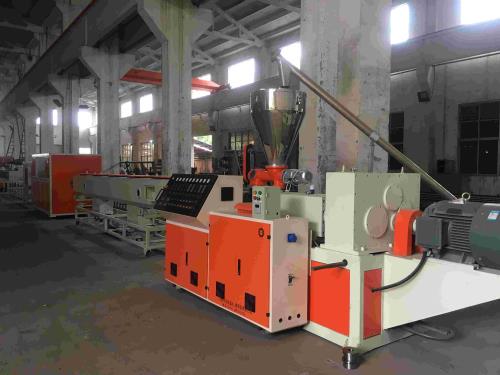
A PVC water supply and drainage pipe extrusion line: vacuum calibration, multi-claw traction and dust-free cutting are the downstream elements that distinguish it from an HDPE or PPR line.
Municipal water supply, gas and farm irrigation: HDPE lines from PE110 to PE1600
The HDPE Water Pipe Extrusion Line family covers five designations, each anchored to a pipe diameter band and a matched GS-series single-screw extruder. Every model in the family uses 38CrMoAlA nitrided alloy steel for the screw and barrel, forged alloy die steel for the die head, and a Q235 carbon structural steel machine frame.
| Model | Pipe diameter range | Extruder model | Main motor power | Extrusion capacity |
|---|---|---|---|---|
| PE110 | Φ20–110 mm | GS60/38 (optional GS75/33) | 90 kW | 150–400 kg/h |
| PE315 | Φ110–315 mm | GS75/38 (optional GS90/33) | 160 kW | 200–600 kg/h |
| PE630 | Φ315–630 mm | GS90/38 (optional GS120/33) | 280 kW | 600–1000 kg/h |
| PE1000 | Φ630–1000 mm | GS120/38 | 355 kW | 600–1000 kg/h |
| PE1600 | Φ1000–1600 mm | GS150/38 | 500 kW | 600–1500 kg/h |
Two patterns are worth reading carefully. First, main motor power climbs steeply at the top of the family: 90 kW at PE110, 160 kW at PE315, 280 kW at PE630, 355 kW at PE1000 and 500 kW at PE1600. Site electrical infrastructure should be planned from those figures, not from the output figure alone. Second, diameter and throughput do not scale in a straight line. PE630 is rated at 600–1000 kg/h across Φ315–630 mm; PE1000 is rated at the same 600–1000 kg/h across a much larger Φ630–1000 mm band; and PE1600 is rated at 600–1500 kg/h across Φ1000–1600 mm. Because a larger pipe consumes more compound per metre of length, kilograms per hour and metres per minute must always be read together. A model that appears identical on kg/h can run at a substantially different line speed.
For farm irrigation and rural distribution networks, PE110 and PE315 are the more common starting points because they cover the small-to-medium diameters that irrigation laterals and submains use. Municipal water and gas transmission work generally moves the specification to PE630 and above, where the diameter band and the pressure class together determine wall thickness and therefore the achievable line speed.
Building water supply and drainage: PVC63, PVC250 and PVC630
The PVC Water Supply & Drainage Pipe Extrusion Line is built around SJSZ conical twin-screw extruders and is intended for building water supply and drainage, agricultural irrigation and cable threading pipe production. All three models process PVC compounded with calcium carbonate and are equipped with vacuum calibration, multi-claw traction and a dust-free cutting unit.
| Model | Diameter | Matching extruder | Main motor / downstream power | Hauling speed | Output |
|---|---|---|---|---|---|
| PVC63 (double station) | Φ16–63 mm | SJSZ65/132 conical twin screw | AC 37 kW / 24 kW | 4–49 m/min | 270 kg/h |
| PVC250 | Φ90–250 mm | SJSZ80/156 conical twin screw | AC 55 kW / 24 kW | 4–15 m/min | 450 kg/h |
| PVC630 | Φ315–630 mm | SJSZ92/188 conical twin screw | AC 110 kW / 39 kW | 0–5 m/min | 800 kg/h |
The three configurations show the classic trade-off in PVC pipe production: small diameters run fast, large diameters run slow. PVC63 reaches 49 m/min on a 37 kW main motor, while PVC630 tops out at 5 m/min on a 110 kW main motor but produces roughly three times the weight of pipe per hour. A producer whose order book mixes 20 mm conduit with 500 mm sewer pipe will generally need either two lines or a clear commercial decision about which band carries the volume. Chasing both ends of the range on one line usually means accepting idle capacity at one end.
Indoor cold and hot water: PPR20-75 and PPR20-110
PPR pipe for indoor home-decoration cold and hot water and residential plumbing is a different specification problem from buried infrastructure pipe. Tolerances are tighter, diameters are smaller, and the value of the line lies in dimensional repeatability rather than in tonnes per hour. The JKS PPR Pipe Extrusion Line is offered in two configurations, both using GS-series single-screw extruders with 38CrMoAlA nitrided alloy steel screws and barrels and high-precision die steel tooling.
| Model | Extruder | Main motor power | Auxiliary extruder | Extrusion capacity |
|---|---|---|---|---|
| PPR20-75 | GS65/33 | 37 kW | GS50/33 | 80–160 kg/h |
| PPR20-110 | GS90/30 | 75 kW | GS55/33 | 80–250 kg/h |
The two models are not simply a small and large version of the same machine. Their stated output bands both begin at 80 kg/h, which means the larger model only converts its additional 38 kW of main motor power into commercial advantage above the 160 kg/h ceiling of the smaller unit. A plumbing pipe producer running steady, modest volumes should therefore compare the two on utilisation rather than on headline capability. Where a residential project mix includes both hot and cold water pipe in several sizes, the auxiliary extruder specified alongside each model is what allows co-extruded or multi-layer constructions to be produced on the same platform.
Buried high-voltage power and underground cable protection: PEG63 and PG160
MPP and PE power pipe is produced at low line speed and comparatively high wall thickness, because the pipe must resist soil load and protect cable for decades. The JKS MPP & PE High Voltage Power Pipe Extrusion Line is intended for buried high-voltage power grid construction and underground cable protection pipeline production, and accepts MPP or PE as the base polymer with optional PP, ABS, PEX or silicon core pipe configurations.
| Model | Pipe specification | Line speed | Installed power |
|---|---|---|---|
| PEG63 | φ20–φ63 mm | 0.3–4.5 m/min | 70 kW |
| PG160 | φ75–φ160 mm | 0.3–2 m/min | 125 kW |
The whole line runs on AC frequency control with optional 2, 3 or 4-claw traction and a chipless cutting system. A chipless cutter matters more here than on a water pipe line: power pipe is joined on site with couplings and heat-shrink sleeves, and a cut face that carries chips or burrs complicates that joint. Screw and barrel are again 38CrMoAlA nitrided alloy steel, with wear-resistant alloy die steel for the extrusion die — a material choice driven by the filled and pigmented compounds often used for cable duct grades.
Reinforced and corrugated pipe: two additional application families
Two further families sit outside the standard water and plumbing categories but are frequently specified alongside them, particularly by producers supplying municipal and construction contractors.
Steel wire mesh reinforced composite pipe
The Steel Wire Mesh Reinforced Composite Pipe Extrusion Line is intended for urban pressurized water supply, chemical industry anti-corrosion pipelines and underground engineering pipe. Five models are listed, from GS/PE-160-H to GS/PE-630-H, each with a stated installed capacity and an actual power consumption figure.
| Type | Pipe range | Maximum speed | Installed capacity | Actual power consumption |
|---|---|---|---|---|
| GS/PE-160-H | φ50–160 mm | 2.4 m/min | 480 kW | 312 kW |
| GS/PE-250-H | φ75–250 mm | 2.4 m/min | 550 kW | 358 kW |
| GS/PE-315-H | φ90–315 mm | 2.4 m/min | 580 kW | 377 kW |
| GS/PE-500-H | φ250–500 mm | 1.4 m/min | 630 kW | 410 kW |
| GS/PE-630-H | φ315–630 mm | 1.2 m/min | 800 kW | 559 kW |
The gap between installed capacity and actual power consumption is the single most useful number in this table for a project buyer. The GS/PE-630-H line carries 800 kW of installed capacity but is stated at 559 kW of actual consumption, a difference of roughly 30 percent. Transformers, cables and switchgear are sized on installed capacity, while operating cost is driven by actual consumption, so both figures belong in the same capital and operating comparison. The reinforced line is also the most power-intensive family in this set because the steel wire mesh layer adds a process step that the plain pipe lines do not have.
Corrugated pipe
The Corrugated Pipe Extrusion Line is used for electric wire threading pipe, automobile wiring sleeves, mechanical equipment threading and construction drainage pipe. Five models are listed, spanning Φ6–10 mm to Φ90–160 mm, all built on a Q235 carbon steel frame with a wear-resistant alloy steel corrugation mould.
| Model | Screw | L/D ratio | Power | Pipe range | Haul-off speed |
|---|---|---|---|---|---|
| KSPG-20 | Φ45 mm | 30:1 | 45 kW | Φ6–10 mm | 20 m/min |
| KSPG-32 | Φ50 mm | 30:1 | 50 kW | Φ8–20 mm | 15 m/min |
| KSPG-63 | Φ65 mm | 33:1 | 70 kW | Φ16–63 mm | 10 m/min |
| KS-75 | Φ65 mm | 33:1 | 80 kW | Φ50–75 mm | 10 m/min |
| KS-160 | Φ75 mm | 33:1 | 100 kW | Φ90–160 mm | 5 m/min |
Corrugated lines follow the same physics as the other families: the smallest model runs fastest and the largest runs slowest. The KSPG-20 reaches 20 m/min in the Φ6–10 mm band, while the KS-160 runs at 5 m/min in the Φ90–160 mm band. Note also that the two KSPG models use 30:1 screws while the three larger models use 33:1 screws, a difference that reflects the longer residence time and mixing requirement of larger corrugation dies.
How Wuxi JKS Machinery fits this application map
Wuxi JKS Machinery Manufacturing Co. Ltd. is a China-based manufacturer of custom plastic extrusion machinery and complete turnkey production lines, located at No. 81 Xixian Road, Fangqian Town, Wuxi City, Jiangsu Province. The company operates a 2,000 m² production workshop with a six-engineer R&D team, an annual output of 200 units and a monthly production capacity of 30 units, with exports accounting for 50 percent of sales across Southeast Asia, Russia, the Middle East, Europe, Central Asia, Africa and South America.
For pipe buyers, the relevant capability is that the company builds both the extruder and the surrounding train. The catalogue covers SJSZ conical twin-screw extruders from SJSZ-45 (15 kW, 70 kg/h) to SJSZ-110 (200 kW, 1000 kg/h) and SJ-series single-screw extruders in customised models including SJ30, SJ45, SJ65 and SJ90, alongside auxiliary equipment such as SRL-Z mixing and cooling units, SP400/SP660 crushers and MF400/MF500/MF600 pulverizers. Screw and barrel material is consistently specified as 38CrMoAlA nitrided alloy steel across the pipe, profile, sheet and pelletizing lines.
Stated commercial and quality terms
- Production model: OEM, ODM and custom design services, with customisation of extruder model, screw configuration, production line layout, voltage and frequency, control system and capacity adjustment.
- Lead time and volume: typically 40 working days, with a minimum order quantity of 1 unit and a monthly production capacity of 30 units.
- Quality control: 100% factory pre-assembly and testing before shipment, with third-party inspection available on request.
- After-sales: overseas installation guidance, on-site commissioning, operator training, remote technical support and a 12-month warranty.
- Certification: a CE certificate covering plastic extrusion lines was issued under certificate number M.2021.206.C.64011 by UDEM International Certification Auditing Training Centre, citing EN ISO 12100:2010, EN 1114-1:2011, EN 60204-1:2018 and the applicable EMC standards, with a scope covering the SJSZ, SJ and SJP series models.
Long-run operating evidence across the installed base supports the capability claim. A PVC hollow wall panel extrusion line supplied to a plastic building materials manufacturer in Vietnam has been in stable operation for more than five years, producing panels for construction and interior decoration, with the project delivered as a complete turnkey solution including on-site installation support and full export documentation. SPC flooring lines installed in Malaysia and South Korea have been running for more than ten years and more than eight years respectively. These are panel and flooring installations rather than pipe installations, but they are relevant to a pipe buyer for one reason: they demonstrate the supplier’s ability to keep a multi-unit line in continuous production over a multi-year horizon, which is the same risk question a municipal pipe producer is buying against.
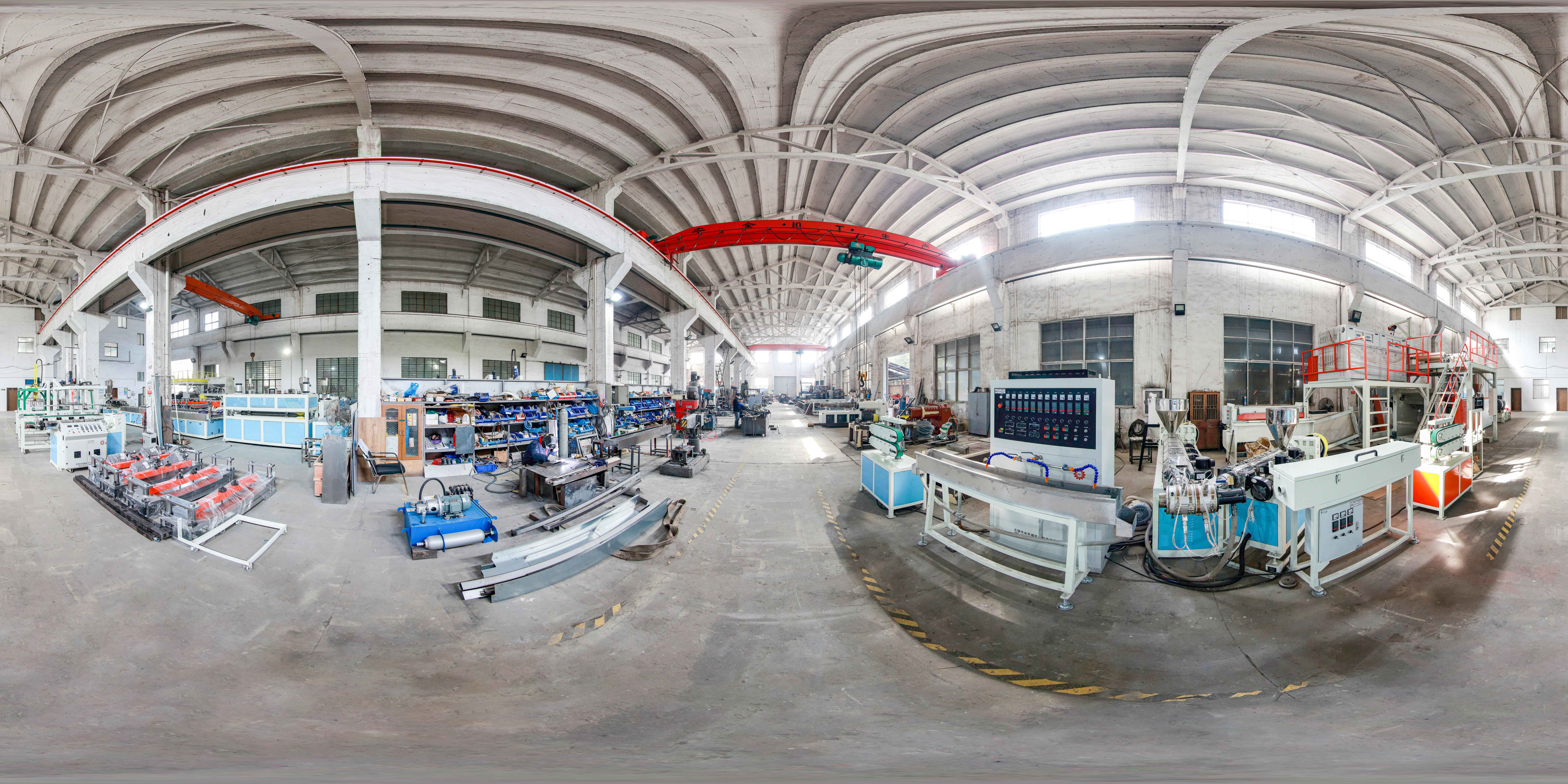
Machine frame welding inside the JKS production workshop. The pipe lines use Q235 carbon structural steel frames, with 38CrMoAlA nitrided alloy steel specified for screws and barrels.
What buyers should verify before committing to a line
Once a buyer has matched a pipe family to a line family, the remaining work is verification. Six items decide whether the quoted specification will survive contact with the factory floor.
- Installed power versus actual consumption. On the reinforced composite line the two figures differ substantially — for example 800 kW installed against 559 kW actual on GS/PE-630-H. Electrical infrastructure is sized on the first number; energy cost is driven by the second.
- Line speed against wall thickness. A diameter band on its own does not describe the product. A Φ630 mm pipe at one wall thickness and the same diameter at another will run at different metres per minute on the same line.
- Downstream configuration. Vacuum calibration, multi-claw traction and dust-free cutting are stated for the PVC lines; AC frequency control, optional 2/3/4-claw traction and chipless cutting are stated for the MPP and PE power pipe line. These are not interchangeable, and the difference shows up in scrap rate and end-face quality.
- Tooling material. The pipe lines in this range specify 38CrMoAlA nitrided alloy steel for screws and barrels, with die steel varying between forged alloy, precision casting, refined wear-resistant and wear-resistant grades depending on the family.
- Site power and layout. The PE1000 and PE1600 lines carry 355 kW and 500 kW main motors respectively, which affects transformer sizing and building layout well before installation day.
- Compliance documentation. Extrusion machinery procurement in the United States is governed by an explicit machinery safety standard: ANSI/PLASTICS B151.7 applies to extrusion machines used in the plastics industry and requires a documented risk assessment process in manufacture, care and use. Note that published references to this standard do not agree on the edition — the PLASTICS Industry Association lists the 2013 edition while the ANSI webstore lists B151.7-2014 (R2021). Buyers should confirm the exact applicable edition with their own compliance function rather than relying on a supplier’s summary.
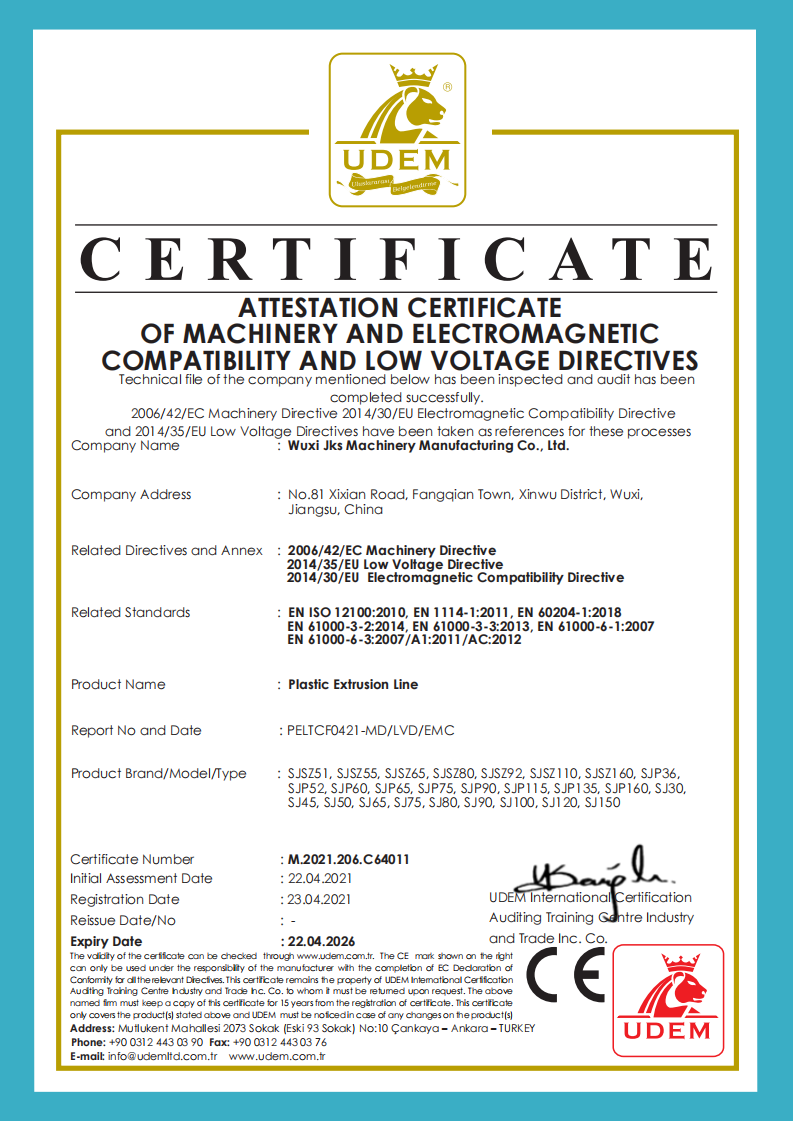
CE certification documented under certificate number M.2021.206.C.64011, with a stated scope covering the SJSZ, SJ and SJP series extrusion lines.
Market signals behind today’s supply base
Two published data points frame the pipe line purchasing decision. The global plastic extrusion machine market is estimated at USD 7.9 billion in 2025 and projected to reach USD 12.87 billion by 2035, according to Market Research Future. At the same time, China was the leading exporter of rubber and plastic working machinery under HS 8477 in 2024 at USD 8.55 billion, ahead of Germany at USD 6.11 billion and Italy at USD 2.61 billion, according to the Observatory of Economic Complexity using UN Comtrade data.
For a pipe producer, the practical reading is that machine supply is no longer the constraint — supplier selection is. A deep, globally distributed supply base means that two quotations for a Φ630 mm HDPE line may describe nominally similar equipment while differing in calibration length, haul-off claw count, cutting method, screw metallurgy and commissioning support. Differentiation has moved from availability to application matching and post-installation reliability.
Comparison with traditional sourcing, and where the application-first approach has limits
The traditional way to buy a pipe line starts with a maximum diameter figure and a target output, and treats the rest of the equipment as interchangeable. Buyers commonly source the extruder from one supplier, the calibration and cooling tanks from a second, the haul-off from a third and the cutter from a fourth, on the reasoning that each component can be optimised separately and the lowest unit price assembled into the lowest total cost.
An application-first approach inverts that sequence. The network served determines the diameter band; the band determines the extruder and the downstream train; and the whole set is then ordered as a matched system. The advantage is a single point of responsibility for integration, pre-assembly and testing, and a commissioning sequence that has already been rehearsed in the factory. The cost is flexibility: a buyer who assembles a line from four vendors can replace one component when a process changes, whereas a matched line is optimised around the application it was specified for. Producers who expect their product mix to shift significantly within five years should weigh that rigidity explicitly rather than assuming a matched line will always adapt.
The approach also has clear boundaries that buyers should not overlook:
- Discrete model ranges. The pipe families in this article cover their stated bands through a fixed set of models, not a continuous spectrum. A producer needing diameters between two adjacent bands may end up buying capacity they rarely use.
- Power scaling is not linear. PPR20-75 and PPR20-110 share the same 80 kg/h lower output bound; the larger model’s 75 kW main motor only pays back above the 160 kg/h ceiling of the 37 kW unit.
- Large-diameter HDPE is infrastructure-heavy. PE1600 requires a 500 kW main motor, which is a building and substation decision as much as a machinery decision.
- Reinforced composite lines are power-intensive relative to speed. GS/PE-630-H is stated at 800 kW installed, 559 kW actual, running at a maximum of 1.2 m/min. The reinforcement layer buys pressure performance and corrosion resistance, not throughput.
- Corrugated pipe coverage is capped. The listed corrugated models top out at Φ90–160 mm on KS-160; larger drainage diameters are outside the stated range of this model set.
- Certification scope is series-level. A certificate naming a series does not automatically cover every customised configuration, and requirements differ by destination market.
Future outlook
Three shifts are likely to shape pipe line procurement over the next few years, and all three are already visible in the equipment specification rather than in market forecasts. The first is composite and multi-layer construction: reinforced and co-extruded pipe addresses corrosion and pressure requirements that single-layer pipe handles less economically, and the lines that serve them are being specified alongside conventional water pipe lines rather than instead of them. The second is material cost control, which pushes producers toward in-house compounding and reclaim. The relevant equipment — SRL-Z mixing and cooling units, SP400/SP660 crushers, MF400/MF500/MF600 pulverizers and ST-series strand cutting pelletizing lines — is typically bought at the same time as the pipe line, because reclaim quality directly affects pipe wall consistency. The third is compliance documentation. As extrusion machine safety standards continue to be referenced in public procurement, the ability of a supplier to present traceable certification, model-specific scope statements and pre-shipment test records will weigh more heavily in supplier selection than a headline output figure.
For buyers at the evaluation-to-execution stage, the practical conclusion is straightforward. Match the line to the network first, specify the downstream train from the pipe rather than from the budget, and verify power, tooling and compliance documents against the exact model being ordered. Every number needed for that comparison is available at quotation stage — the work is asking for it.
Frequently asked questions
How do I decide between an HDPE, PVC, PPR and MPP pipe extrusion line?
The end-use network decides the family. HDPE lines serve municipal water supply, gas pipeline and farm irrigation. PVC water supply and drainage lines serve building water supply and drainage, agricultural irrigation and cable threading pipe. PPR lines serve indoor home-decoration cold and hot water and residential plumbing. MPP and PE power pipe lines serve buried high-voltage power grid construction and underground cable protection. Diameter range, polymer and line speed then follow from the network, not from the machine catalogue.
Which extruder type is used on each pipe line?
In this range, the PVC water supply and drainage pipe line and the PVC hot-cut pelletizing line use SJSZ conical twin-screw extruders, while the HDPE, PPR and MPP pipe lines use GS-series single-screw extruders. Downstream equipment also differs by family: PVC pipe lines are equipped with vacuum calibration, multi-claw traction and dust-free cutting, while the MPP and PE power pipe line uses AC frequency control with optional 2, 3 or 4-claw traction and a chipless cutting system.
What power supply does a large-diameter HDPE pipe line need?
Main motor power rises with the pipe diameter band: 90 kW on PE110, 160 kW on PE315, 280 kW on PE630, 355 kW on PE1000 and 500 kW on PE1600. These figures describe the extruder main motor and should be treated as the starting point for transformer and switchgear sizing, since the full line also includes downstream drives, heating and control loads.
Can a single pipe extrusion line produce more than one diameter?
Yes, within the stated band. Each model is specified against a diameter range — for example PVC63 at Φ16–63 mm, PVC250 at Φ90–250 mm and PVC630 at Φ315–630 mm, or PE110 at Φ20–110 mm through to PE1600 at Φ1000–1600 mm. Outside that band, a different model or a second line is required. Because wall thickness changes with diameter for the same pressure class, throughput and haul-off speed vary across the band as well.
What are the typical commercial terms for a custom pipe extrusion line?
The stated terms are a minimum order quantity of 1 unit and FOB delivery, with payment of 30% by T/T deposit and 70% by T/T balance before shipment. Acceptance is based on a pre-shipment factory test. The typical production lead time is 40 working days against a monthly production capacity of 30 units.
What testing and documentation is provided before shipment?
Quality control is stated as 100% factory pre-assembly and testing before shipment, with third-party inspection available on request. Installation support includes overseas installation guidance, on-site commissioning, operator training and remote technical support, backed by a 12-month warranty. Buyers should also request and review the pre-shipment test record for the specific model ordered.
Which safety and certification documents should be checked?
In the United States, ANSI/PLASTICS B151.7 applies to extrusion machines used in the plastics industry and requires a documented risk assessment process in manufacture, care and use; published references differ on whether the 2013 or the 2014 (R2021) edition is current, so the applicable edition should be confirmed directly. For CE markets, the relevant document in this range is a certificate issued by UDEM International Certification Auditing Training Centre under number M.2021.206.C.64011, with a scope covering the SJSZ, SJ and SJP series and citing EN ISO 12100:2010, EN 1114-1:2011, EN 60204-1:2018 and applicable EMC standards. Certificate validity periods should be verified at the time of order.
Reference document: JKS Machinery project brochure (PDF). Company information: extrudetec.com.
Tem questões ou precisa de mais detalhes?
Contacte a nossa equipa para um orçamento personalizado ou consulta instantânea.
Solicitar orçamento
Preencha o formulário abaixo e a nossa equipa entrará em contacto com uma proposta personalizada.
Chat direto do WhatsApp
Prefere conversar em tempo real? Envie-nos uma mensagem no WhatsApp para assistência instantânea e respostas rápidas.
- Obter orçamento personalizado
- Partilhar fotos ou documentos
- Discuta as suas necessidades diretamente
Geralmente responde em 5–30 minutos durante o horário de expediente.