
From PP Resin to 5-Second Folds: Inside Xinhai's Foldable Storage Engineering
Foldable household storage is judged by a simple test: what the structure looks like after the hundredth fold. For importers, distributors and retail buyers, that is a materials-and-mechanism question rather than a marketing one. Taizhou Xinhai Cross-border E-commerce Service Co., Ltd. — trading as Xinhai Box — is a B2B supplier of plastic household storage and daily-use products based in Jiaojiang District, Taizhou, Zhejiang, China, and its foldable range publishes the details that matter for that test: the Foldable Storage Cabinet (YN8871) in three sizes, the Foldable Shopping Cart (YN8821) with a 5-second folding mechanism, and the Foldable Car Storage Box (YN8980) that collapses to 7 cm.

Precision assembly of folding trolley components — the hinge and joint stage where foldable storage performance is decided. Image: Xinhai Box.
Why Foldable Storage Is an Engineering Category, Not a Format
A foldable cabinet, cart or crate has to behave like a rigid product while it is in use and like a flat pack while it is in transit. Those two requirements pull in opposite directions: rigidity favors thick walls, gussets and fixed joints, while portability favors thin sections, hinges and knock-down joints. Buyers pay for that compromise, so the useful sourcing question is not whether a product folds, but what keeps it rigid when it does not.
Three failure modes dominate returns in this category: hinge and joint wear after repeated folding cycles, panel deformation under static load, and door or lid misalignment that only appears once a unit is assembled and filled. Each of these is a process outcome — tooling quality, wall structure, resin grade and inspection discipline — and each can be reviewed before an order is placed, using published specifications and documented process controls rather than lifestyle photography.
What Xinhai Box Publishes for Its Foldable Range
For foldable storage, the verifiable evidence is dimensional, material and process evidence. Xinhai Box publishes that evidence as product-level parameters rather than design claims.
| Product | Material | Size / capacity | Folding and structure features |
|---|---|---|---|
| Foldable Storage Cabinet (YN8871) | PP | Small 51.5 × 36 × 95 cm; medium 60 × 42 × 105.5 cm; large 67 × 47 × 116 cm; width options 51.5 cm / 60 cm / 67 cm | Foldable design, magnetic opening and closing, rounded handles, top storage surface, stackable structure, double-door design, vintage-style textured doors |
| Foldable Shopping Cart (YN8821) | Premium PP plastic + metal + rubber | Load capacity 100 kg | 5-second quick fold, folding thickness 10.9 cm, 2-level adjustable pull rod 79.5–89.5 cm, 360° silent swivel wheels with brake |
| Foldable Car Storage Box (YN8980) | PP | Capacity 57 L; medium 43.5 × 30 × 24 cm; large 54 × 36 × 29 cm | Folded thickness 7 cm, carry handle, side handles, lockable lid, wooden-look or plastic lid options |
The Foldable Storage Cabinet (YN8871) is a PP home storage cabinet offered in three sizes — 51.5 × 36 × 95 cm, 60 × 42 × 105.5 cm and 67 × 47 × 116 cm — corresponding to three usable widths of 51.5 cm, 60 cm and 67 cm. Its engineering content sits mainly in the door and stacking system rather than in the fold itself.
The Foldable Shopping Cart (YN8821) is a different problem because it carries a moving load. It is rated for a 100 kg load capacity, folds in a 5-second quick fold to a 10.9 cm thickness, and runs on 360° silent swivel wheels with a brake. The pull rod adjusts through two levels between 79.5 cm and 89.5 cm, which matters for user fit across different heights.
The Foldable Car Storage Box (YN8980) targets the space-constrained half of the range: 57 L of capacity in a 43.5 × 30 × 24 cm or 54 × 36 × 29 cm footprint, collapsing to a folded thickness of 7 cm, with a lockable lid for transit and a choice of wooden-look or plastic lid.
Read the numbers as procurement signals. Folded thickness drives container utilization and retail backroom space. Load rating drives consumer returns. A multi-size family across a single model line is the parameter that shows whether tooling can be repeated across a range instead of tuned for one SKU. One caution deserves to be stated plainly: published dimensions are nominal values, not tolerance statements, and Xinhai Box does not publish dimensional tolerance tables. The practical route to confidence is sample validation and pre-shipment inspection.
Material and Mechanism: Where the Engineering Shows Up
PP resin: why polypropylene dominates the category
Polypropylene is a semi-crystalline thermoplastic widely used in household storage because it absorbs little moisture, resists common household chemicals and holds its shape at normal indoor temperatures. Xinhai Box specifies PP as the base material for the YN8871 cabinet and the YN8980 storage box, and combines premium PP plastic with metal and rubber in the load-bearing YN8821 cart — a material logic in which the polymer handles form and hygiene while metal handles structural load and rubber handles contact with the floor.
Two documentation issues attach to material choice rather than to structure. First, recyclability: PP is a #5 plastic, and PP storage containers can qualify for GreenCircle Recyclable Material certification, which verifies their role in circular economy and recyclability in #5 plastic facilities. That claim describes the polymer stream, not a guarantee that a given export market has collection capacity for it — recyclability is facility-dependent and should be read that way in retail copy.
Second, food-contact status. The European Commission adopted a ban on Bisphenol A (BPA) in food contact materials under Regulation (EU) 2024/3190, effective with an 18-month phase-out period from late 2024. This changes what importers of pantry and kitchen storage need on file. A BPA statement is a per-material document issued for a specific resin grade and SKU, not a category-wide attribute, so it should be requested alongside the certificate package rather than inferred from the word “plastic”.
Mechanism: closures, hinges and wheels
The YN8871 cabinet uses magnetic opening and closing instead of mechanical door latches. That choice removes a small-parts wear point from the door and supports one-handed access in bedroom, closet and bedside use, where a cabinet is opened many times a day. The same product uses a double-door layout with a usable top storage surface, and a stackable structure, so the fold and the stacking function share the same load path rather than competing for it.
The YN8821 cart carries the most demanding mechanism in the range because it is folded and unfolded routinely while being loaded up to 100 kg. A 5-second fold and a 10.9 cm folded thickness describe a linkage designed for repeat cycles rather than occasional use, and the braked 360° silent swivel wheels address a different risk entirely: the cart moving while loaded.
The YN8980 box takes the opposite approach and optimizes the stored state. At 7 cm folded, it is the thinnest collapsed profile in the three products discussed here, and the carry and side handles mean the folded unit can be moved without a trolley. Its lockable lid is the feature that makes the same box usable for car trunk organization and outdoor camping gear, where contents move during transport.
Process evidence behind the specifications
Specification sheets describe intent; process data describes capability. Xinhai Box operates from a 50,000 m² facility with 500 employees, an annual output of 1,000,000 units and an R&D team of 30 engineers and designers. The export ratio is 70%, concentrated in North America, the EU, Southeast Asia and Latin America. Quality is controlled through AQL 2.5/4.0 standardized sampling, and the supplier operates both OEM and ODM production modes.
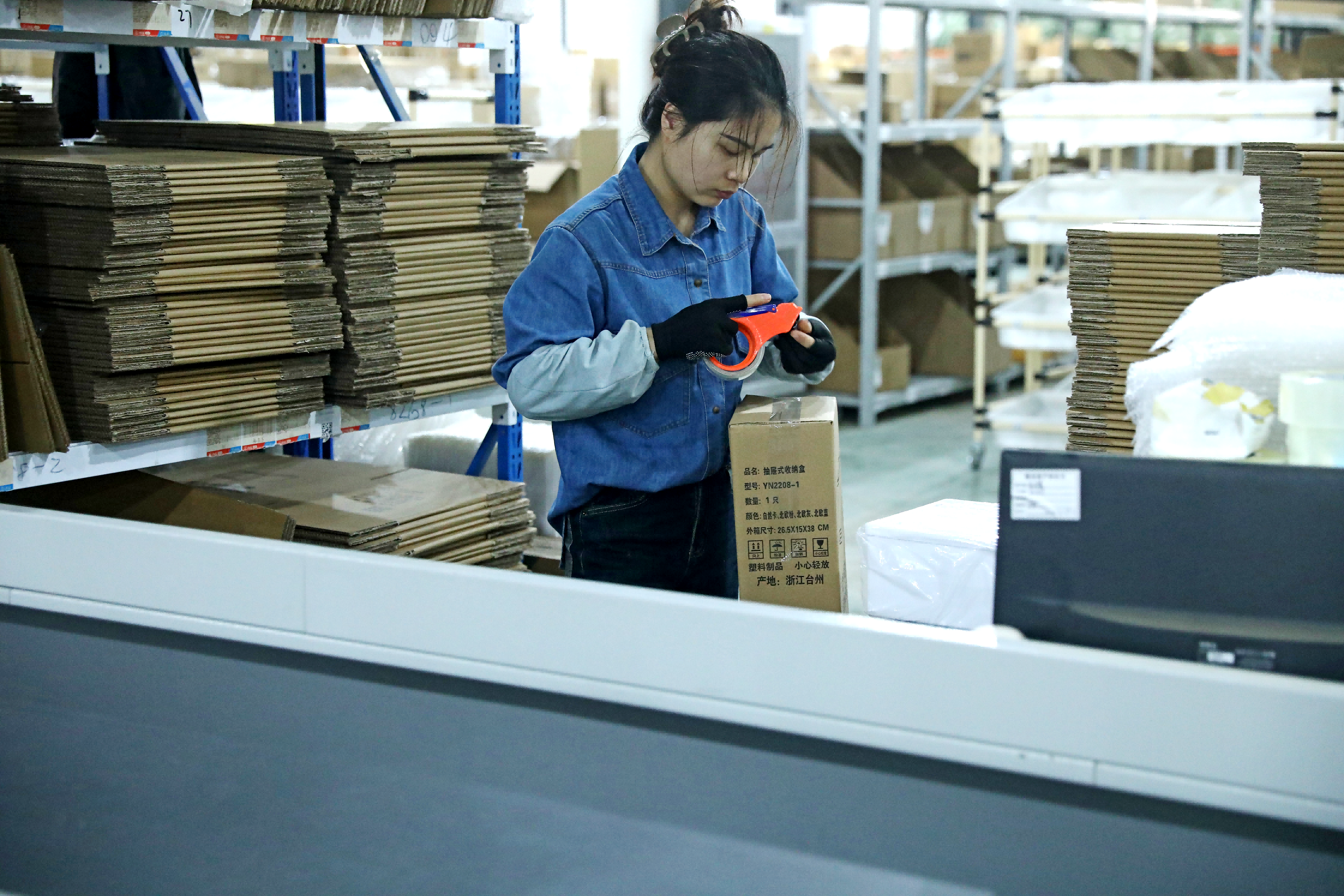
Manual inspection and precision packaging — the stage where AQL 2.5/4.0 sampling is applied before export. Image: Xinhai Box.
Application Fit: Matching Foldable Storage to Real Rooms and Projects
- Kitchen pantry sorting. The YN8871 medium size (60 × 42 × 105.5 cm) works as a floor-standing pantry cabinet with double-door access and a top storage surface; its foldable structure allows the unit to be collapsed and moved when a pantry layout changes.
- Closet clothes storage. Three widths (51.5 cm, 60 cm, 67 cm) and three heights (95 cm, 105.5 cm, 116 cm) give buyers a size ladder for closet and wardrobe walls instead of a single compromise size.
- Kids' toy organization. Rounded handles, magnetic closing and a stackable structure reduce hard edges and small hardware in children's rooms while keeping access easy.
- Laundry room utility. The YN8821 cart is specified for shopping, daily storage and moving, with a 100 kg load rating and braked swivel wheels — relevant where a loaded cart must stay put on a smooth floor.
- Car trunk organizer. The YN8980 box pairs 57 L of capacity with a lockable lid and folds to 7 cm when the trunk returns to passenger use.
- Outdoor camping gear. A 5,000-unit logo-custom brand OEM project for a folding camping storage box was delivered for camping gear storage, car trunk organization, picnic use and home storage, with a printed lid for branding and side handles for carrying; the stated lifespan for that product is 3–5 years under normal use.
- Retail and e-commerce display. Stackability in the YN8871 and knock-down folding across the range reduce both shelf footprint and inbound freight volume, which matters for supermarket retail and online fulfilment.
OEM and ODM Capability: What Buyers Can Specify
The difference between the two production modes is the difference between changing how a product looks and changing what it is. That distinction determines MOQ, lead time and engineering time.
| Parameter | OEM | ODM |
|---|---|---|
| Customization scope | Color / logo / printing | Logo / color / packaging / size / structural design / material (for example PET to PP ratio) |
| Minimum order quantity | 500 units | 5,000 units |
| Lead time | 15–45 days | 30–60 days |
| Monthly capacity | 100,000 units | 8,000 units |
| Quality control | AQL 2.5/4.0 standardized sampling | AQL 2.5/4.0 standardized sampling |
| Export markets served | North America / EU / Southeast Asia / Latin America | North America / EU / Southeast Asia / Latin America |
Two documented programs show the customization path in practice. A 5,000-unit logo-custom brand OEM project for a folding camping storage box was produced for the United States and United Kingdom markets, with a printed lid for branding and side handles for carrying. A separate 5,000-unit program covered a folding shopping cart for logo-custom brand OEM clients in the same two markets, using a folding design, adjustable metal pull rod, silent swivel wheels with brake and waterproof PP material.
After-sales terms are part of the capability statement rather than a footnote: Xinhai Box provides remote technical guidance and compensation or replacement for quality issues.
Market Trend Analysis: What Is Driving Foldable Demand
The category context supports continued investment in foldable formats. The global home organization products market was estimated at USD 14.06 billion in 2024 and is projected to reach USD 21.65 billion by 2035, according to Market Research Future. The stackable container segment alone was projected at USD 7.8 billion in 2024, growing at a CAGR of 6.4% on the back of e-commerce and urbanization, per Strategic Market Research. On the material side, plastic-made products accounted for approximately 36% of the kitchen storage and pantry organization market in 2023, while jars and containers held a 27% share, according to Grand View Research.
Supply-side capacity remains concentrated. China's furniture industry exports, which include home organization items, recorded USD 67.81 billion in 2025, reflecting solid supply capacity despite global trade fluctuations. Buyers should also treat market sizing carefully: 2025 estimates for the home organization market vary by scope, with Market Research Future at USD 14.62 billion for products, Dataintelo at USD 12.8 billion for services, and Metastat Insights at USD 15.4 billion for products — a reminder that scope, not disagreement, usually explains the gap.
The competitive landscape is a mix of retail brands and manufacturing suppliers. Key global names in home organization include IKEA (Sweden), Rubbermaid (USA), Sterilite (USA) and The Container Store (USA), according to Market Research Future. For importers and distributors, that structure is the opportunity: retail brands compete on assortment while suppliers compete on shipping density, customization speed and documentation readiness — three areas where foldable engineering directly affects landed cost.
Foldable vs Rigid Storage: A Comparison with Real Boundaries
| Dimension | Foldable storage (as specified in the Xinhai range) | Traditional rigid storage |
|---|---|---|
| Idle-state volume | Collapses to a defined thin profile — 7 cm (YN8980) and 10.9 cm (YN8821) | Retains full assembled volume whether in use or not |
| Shipping density | Higher: knock-down units pack flat into containers and retail backrooms | Lower: assembled volume is shipped or shelved |
| Structure | Load and rigidity depend on joints, hinges and closures | Load and rigidity depend on continuous molded or welded walls |
| Wear points | Joints, hinges and folding seams are mechanical wear points | Fewer moving wear points in the primary structure |
| Assembly labor | Reduced or eliminated through tool-free, quick-assembly design | Often requires fasteners, tools and assembly time |
The honest boundary conditions matter as much as the benefits. Foldable structures concentrate stress at hinges and seams, and the only lifespan figure available in this supplier's published evidence is 3–5 years under normal use for one OEM folding camping storage box program — a product-specific figure that should not be generalized to every foldable SKU in the range. Space savings also apply to the stored state only: once a foldable cabinet or box is assembled and loaded, its footprint equals its assembled dimensions, so buyers should plan shelf and floor space on assembled size and freight container space on folded size.
Load limits are similarly specific. The YN8821 cart is rated at 100 kg; buyers whose application requires more should verify against their own load requirement rather than assume a foldable frame scales linearly. Certification scope is the third boundary: the Quality Management System Certification (certificate number 28725Q1039R0M, issued by Zhongzheng Excellent Certification Group Co., Ltd., standard GB/T 19001-2016 / ISO 9001:2015, valid 2025-10-20 to 2028-10-19) covers research and development, production and sales of daily storage plastic products such as boxes, cases, cabinets and baskets, excluding licensing-controlled items. The Certificate of Technical Inspection (number M.2022.206.C75474, issued by UDEM International Certification Auditing Training Centre Industry and Trade Inc. Co., standard EN 14073-2:2004, valid 2022-07-12 to 2027-07-11) lists specific product codes. Buyers should confirm that their SKU falls inside the listed scope rather than assume range-wide coverage, and should note that recyclability and BPA positions are material- and facility-dependent rather than product-line attributes.
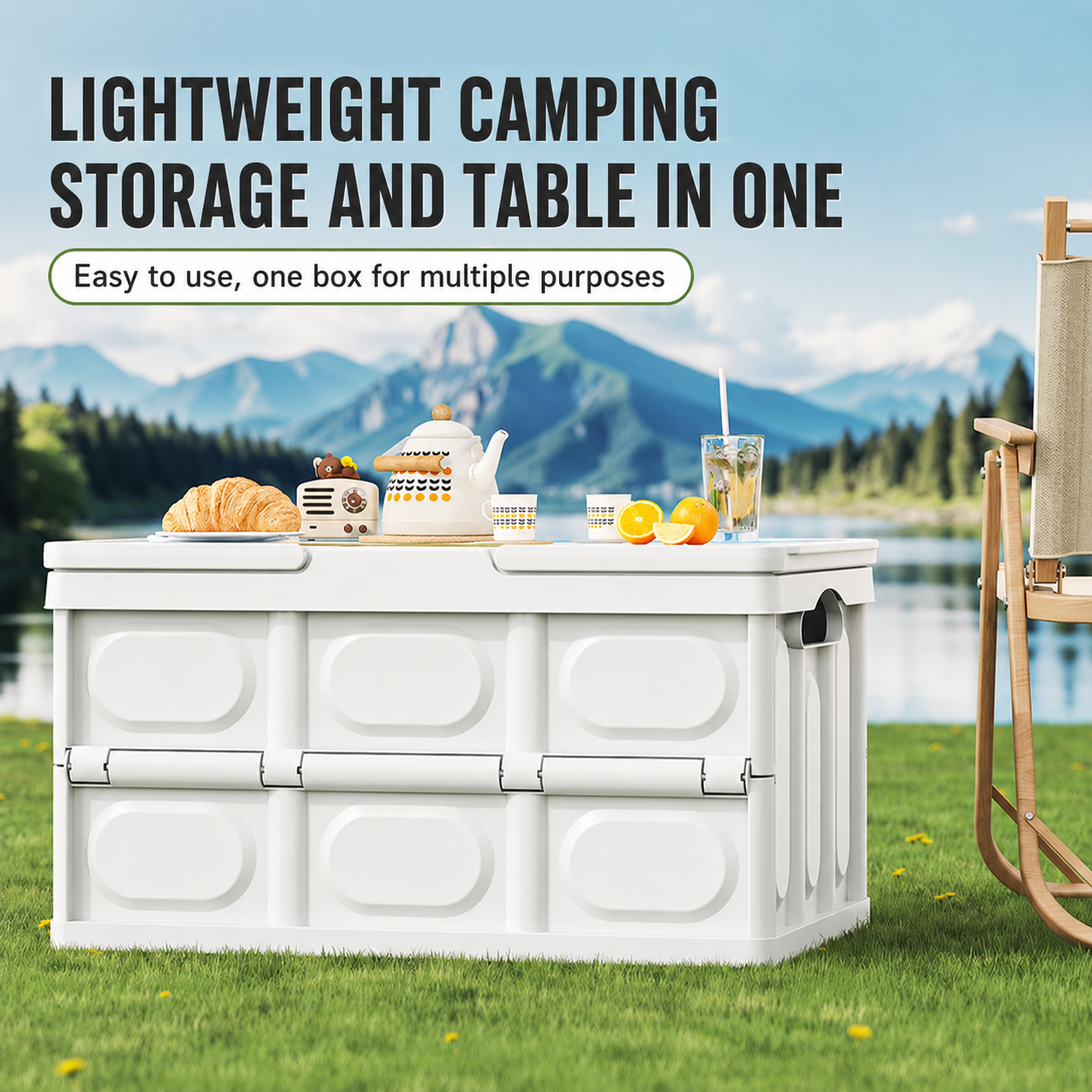
Foldable storage in its service state: the same unit that packs to a thin profile doubles as a surface when deployed outdoors. Image: Xinhai Box.
Future Outlook
Three forces are likely to shape foldable storage sourcing over the next few years. The first is freight economics: as e-commerce fulfilment keeps pressure on volumetric shipping, knock-down formats with published folded thickness become easier to justify against rigid alternatives, and folded dimensions will increasingly appear in buyer RFQs rather than in marketing material. The second is material documentation: Regulation (EU) 2024/3190 and its phase-out timetable mean pantry and kitchen storage lines sold into Europe need per-SKU material declarations on file, and suppliers who maintain that documentation reduce friction at customs and at retail onboarding.
The third is evidence depth. Buyers in this category currently work with nominal dimensions, load ratings, folded thickness and a limited set of lifespan figures. The clearest gap in the available supplier evidence is fold-cycle testing data — the number of open-and-close cycles a hinge or folding linkage is validated for. Until suppliers publish that, procurement teams will continue substituting sample validation and pre-shipment inspection for designed-in confidence, and suppliers who close that gap early will have a measurable advantage in evaluation-stage sourcing. Xinhai Box's published position — 30 engineers and designers, AQL 2.5/4.0 sampling, dual OEM and ODM modes, and a foldable range spanning 7 cm to 10.9 cm collapsed profiles — provides the baseline that such data would build on.
FAQ
Which certifications cover Xinhai Box's foldable storage products, and what is their scope?
Three management system certificates and one technical inspection certificate are published. The Quality Management System Certification (28725Q1039R0M, GB/T 19001-2016 / ISO 9001:2015, valid 2025-10-20 to 2028-10-19) covers research and development, production and sales of daily storage plastic products including boxes, cases, cabinets and baskets, excluding licensing-controlled items. The Environmental Management System Certification (77725E00040R053, GB/T 24001-2016 / ISO 14001:2015, valid 2022-12-23 to 2028-12-22) and the Occupational Health & Safety Management System Certification (77725S00040R053, GB/T 45001-2020 / ISO 45001:2018, valid 2025-12-23 to 2028-12-22) cover environmental and occupational health and safety management for the same product scope. All three are issued by Zhongzheng Excellent Certification Group Co., Ltd. The Certificate of Technical Inspection (M.2022.206.C75474, EN 14073-2:2004, valid 2022-07-12 to 2027-07-11) is issued by UDEM and lists specific product codes, so SKU-level coverage should be confirmed individually.
What are the OEM and ODM minimum order quantities and lead times?
For OEM, the minimum order quantity is 500 units with a lead time of 15–45 days and customization covering color, logo and printing. For ODM, the minimum order quantity is 5,000 units with a lead time of 30–60 days, and customization extends to logo, color, packaging, size, structural design and material specification such as PET-to-PP ratio. Monthly capacity is stated as 100,000 units for OEM and 8,000 units for ODM.
How is quality controlled before shipment?
Quality control uses AQL 2.5/4.0 standardized sampling. Acceptance criteria for export orders include pre-shipment inspection performed by the customer or a third-party agency such as SGS or ITS. Payment terms are 30% deposit by T/T with the 70% balance before shipment or against a bill of lading copy, and delivery terms are FOB or EXW.
What can be customized on a foldable storage order?
Under OEM, buyers can specify color, logo and printing. Under ODM, the customization set expands to logo, color, packaging, size, structural design and material selection, including the ratio between PET and PP where a transparent panel is required. Documented 5,000-unit logo-custom brand OEM programs for a folding camping storage box and a folding shopping cart have been delivered for the United States and United Kingdom markets.
How long can foldable PP storage products be expected to last?
The published lifespan figure in the available evidence is 3–5 years under normal use, stated for a folding camping storage box produced for logo-custom brand OEM clients. That figure is product-specific and describes normal use. It should not be extended to every foldable SKU in the range, because lifespan depends on the load carried, the number of folding cycles and the environment of use — a cart folded daily with a heavy load has a different duty cycle from a cabinet that is unfolded once and left in place.
What are the limits of foldable storage compared with rigid storage?
Foldable storage trades some structural continuity for portability. Rigidity and load capacity depend on hinges, joints and closures rather than on continuous molded walls, which makes those joints mechanical wear points. Space savings apply only in the stored state: an assembled and loaded foldable cabinet occupies its assembled footprint. The YN8821 cart is rated for a 100 kg load capacity, and buyers with heavier requirements should evaluate against their own load specification rather than assume the format scales. Finally, certifications have defined scopes, and recyclability and BPA positions are material-specific, so buyers should verify each claim at SKU level.
Reference note. Product specifications, certification details and production parameters in this article are drawn from Xinhai Box's published product and company data. The full storage products brochure, including the foldable range, is available for download at Xinhai Box Storage Products Brochure, and the company website is www.xinhaibox.com.