
From PVC to Elastomer: Material Evidence in Chongqing Scope Injection Models
Material selection is one of the few visible variables in an injection manikin that connects directly to procedure fit, replacement-part planning, and how many training cycles a school can run before refurbishment. In the Chongqing Scope Instrument Co., Ltd. portfolio, the injection line is not a single-material story: the SC-HL and SC-HS3 are PVC-based models built around intradermal, subcutaneous, intramuscular, and arm-access training, while the SC-H4T is a gluteal intramuscular model whose product description specifies imported plastic elastomer formed in a stainless-steel mould and sintered at high temperature. The evidence supports a tiered material strategy, not a claim that one material is universally superior.
Chongqing Scope Instrument Co., Ltd. is a Chongqing-based supplier of laboratory instruments, metallographic equipment, and medical training manikins. Its company profile lists medical manikins among its main product lines and states that it offers OEM and ODM services. For buyers at the evaluation-to-execution stage, the useful question is not whether PVC or elastomer sounds more advanced. The useful question is which documented model matches the injection procedure, the expected reuse pattern, the availability of replacement skins or veins, and the evidence the supplier can provide for the current SKU.
Why material evidence matters in injection training
Injection training is a wear task. A nursing manikin or clinical manikin used for intradermal, subcutaneous, intramuscular, or venous-access practice will be punctured repeatedly. The buyer therefore needs more than a material name. The buyer needs to know which layer is being punctured, whether the skin or vein is replaceable, whether the model is intended for a single procedure family or a broader set of nursing skills, and what the supplier states about durability and cleaning.
For a medical manikin used in a teaching lab, material choice affects three procurement decisions. First, it affects procedure fit: a pad for intradermal injection is not a substitute for an arm model with venous flashback. Second, it affects consumable planning: replaceable veins and skins change the cost of ownership. Third, it affects validation: a supplier claim such as durability or repeated puncture performance should be tied to a model, a material statement, and, where possible, a replacement-part list.
The Chongqing Scope injection portfolio is useful because it shows those distinctions at model level. The SC-HL, SC-HS3, and SC-H4T are not three versions of the same trainer. They are documented for different injection tasks, and their material descriptions reflect that difference.
What the portfolio actually specifies
The table below uses the product descriptions in the provided content units. It separates the training function, the material statement, the reuse-related evidence, and the evidence boundary that a buyer should verify before ordering.
| Model | Documented training function | Material statement | Reuse-related evidence | Evidence boundary |
|---|---|---|---|---|
| SC-HL Medical Training Model |
Three-layer injection pad for intradermic, hypodermic, and intramuscular injection; wearable design; injection liquid can be injected and the pad squeezed after use. | PVC, as listed in the product data. | The page describes a skin, subcutis, and muscle structure and a squeeze-after-use routine. It does not publish a puncture-cycle count. | Best read as a basic injection-technique trainer. Confirm replacement pad availability and cleaning instructions. |
| SC-HS3 Injection Model |
Arm injection, blood transfusion, and hemospasia; deltoid muscle injection; venous penetration feel; blood flashback indicates proper insertion. | PVC, as listed in the product data. | The description states that veins and skin can be punctured repeatedly without leaks and that vein and skin are changeable. | The repeated-puncture statement is a supplier description, not an independent cycle test. Confirm spare vein and skin sets. |
| SC-H4T Training Mannequin |
Gluteal intramuscular injection training with anatomical landmarks; removable left buttock for observation; three intramuscular approaches. | Product description specifies imported plastic elastomer, stainless-steel mould injection, and high-temperature sintering. The same catalog entry lists PVC in its material field. | The description refers to a dense texture, durability, and needle-trace behaviour, but does not publish a numerical cycle rating. | Material conflict must be resolved at SKU level. Request the current material datasheet and replacement-part list. |
Core finding: the portfolio shows a material hierarchy tied to procedure. PVC supports the standard injection models SC-HL and SC-HS3. The SC-H4T is documented as an elastomer-specified gluteal intramuscular model. The limitation is documentation: no independent cycle-life test is published, and the SC-H4T catalog field does not match its product description.
PVC in the SC-HL and SC-HS3: what the material is doing
Chongqing Scope's company profile states that its medical manikins are made of PVC and that the material is chosen for durability, resistance to deformation, and a high degree of authenticity. That is a company-level statement. At model level, the SC-HL and SC-HS3 show two different uses of a PVC-based construction.
SC-HL: a layered pad for basic injection technique
The SC-HL is described as a three-layer model: skin, subcutis, and muscle. It supports intradermic, hypodermic, and intramuscular injection. The wearable design is intended to make practice convenient, and the user can inject liquid and squeeze the pad after use. In procurement terms, this is a task trainer for injection technique rather than an arm-access simulator. Its value lies in letting a teaching lab practice depth and site selection across three tissue layers without using a full-body nursing manikin for every repetition.
The SC-HL page does not state how many injections the pad can take before replacement, nor does it provide a cleaning or disinfection validation statement. Buyers should therefore treat the squeeze-after-use instruction as a maintenance routine, not as a lifetime claim. For a lab with high student throughput, the practical question is whether replacement pads are available and whether the pad can be cleaned with the facility's approved disinfectants.
SC-HS3: PVC with replaceable vein and skin
The SC-HS3 is an arm injection model. Its documented functions include injection, blood transfusion, and hemospasia, as well as deltoid muscle injection. The description states that there is an obvious feeling when the needle penetrates the veins and that blood flashback indicates proper insertion. Those are application-level features that connect the material to venipuncture training. The model also states that veins and skin can be punctured repeatedly without leaks and that both are changeable.
That combination is important for reuse planning. A PVC arm model with replaceable vein and skin can be maintained as a training asset rather than discarded when the access site wears. The limitation is that the page does not quantify the number of punctures before a leak appears. The buyer should ask for the spare-part list, the replacement procedure, and any supplier test data for the vein and skin components. Without that, the repeated-puncture statement remains a supplier description rather than a validated service-life metric.
Elastomer and high-temperature sintering in the SC-H4T
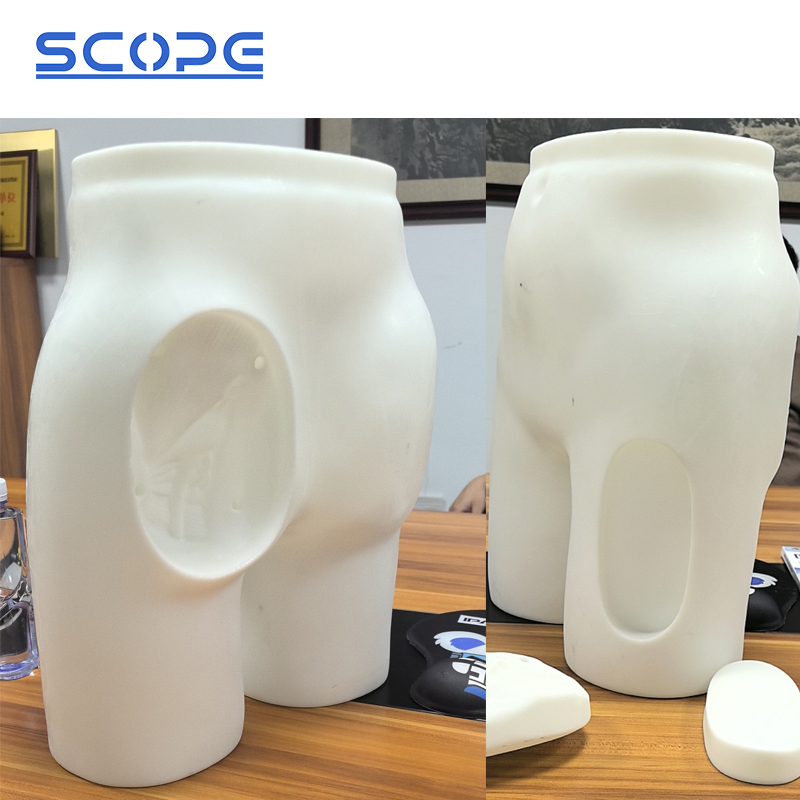
The SC-H4T is not a general injection torso. It is a gluteal intramuscular injection model. The product description lists anatomical landmarks including the proximal femur, greater trochanter, anterior superior iliac spine, posterior superior iliac spine, and sacrum. The left buttock quarter is removable so that the internal structure can be observed, including the gluteus medius, gluteus maximus, sciatic nerve, and vascular structures. The model supports three intramuscular injection training approaches, including dorsal and ventral gluteal sites and a lateralis site.
The material statement is more specific than the standard PVC models. The product description specifies imported plastic elastomer, a stainless-steel mould injection process, and high-temperature sintering. It describes a dense texture, durability, and needle-trace behaviour. In general manufacturing terms, sintering uses heat to consolidate material in a mould; the corpus states the process but does not publish temperature, pressure, or cycle data. The buyer should therefore read the process description as manufacturing evidence, not as a performance guarantee.
The SC-H4T is relevant to reuse frequency because gluteal intramuscular injection training often involves repeated needle passes at defined landmarks. A model used for landmark identification and injection-depth practice needs to preserve its shape and surface after repeated use. The supplier's elastomer and sintering description is aimed at that requirement. However, the same catalog entry lists PVC in its material field, while the product description specifies elastomer. That is a material evidence conflict, not a minor detail. A buyer should request a current SKU-level material datasheet before treating the SC-H4T as an elastomer model in a tender specification.
Procurement interpretation: the SC-H4T should be specified by procedure first. It is a gluteal intramuscular trainer with documented landmarks and a removable buttock section. Its elastomer description is a material claim that requires documentary confirmation. It should not be selected as a substitute for an arm venipuncture model.
Procedure fit and reuse frequency: a buyer decision rule
The assigned angle asks for material choice to be tied to intended procedure and reuse frequency. The portfolio supports a decision rule, but it should be used with the evidence boundaries above.
- If the training objective is intradermal, subcutaneous, or basic intramuscular technique: SC-HL is the documented three-layer pad. It is a compact task trainer for injection depth and site practice. Confirm pad replacement and cleaning compatibility.
- If the training objective is arm venipuncture, injection, transfusion, or hemospasia with flashback: SC-HS3 is the documented PVC arm model. Its replaceable vein and skin are the main reuse feature. Confirm the spare-part supply and the expected replacement interval.
- If the training objective is gluteal intramuscular injection with landmark identification and internal-structure observation: SC-H4T is the documented model. Its removable left buttock and three approaches support technique teaching. Confirm whether the delivered SKU uses the elastomer description or the PVC catalog field.
- If the training objective is IV access or arm infusion: the SC-H4T is not the procedure match. Its documented function is gluteal intramuscular injection. The buyer should select an arm-access model rather than override procedure fit for a material claim.
Reuse frequency is not published as a cycle count for any of the three models. Buyers can still compare reuse planning by asking four questions: Is the skin or vein replaceable? Is a spare-part list available? Does the supplier state a cleaning or disinfection routine? Does the material description match the catalog field? Those questions are more useful than a generic durability adjective because they can be written into a purchase specification and checked at acceptance.
Manufacturing and customization evidence
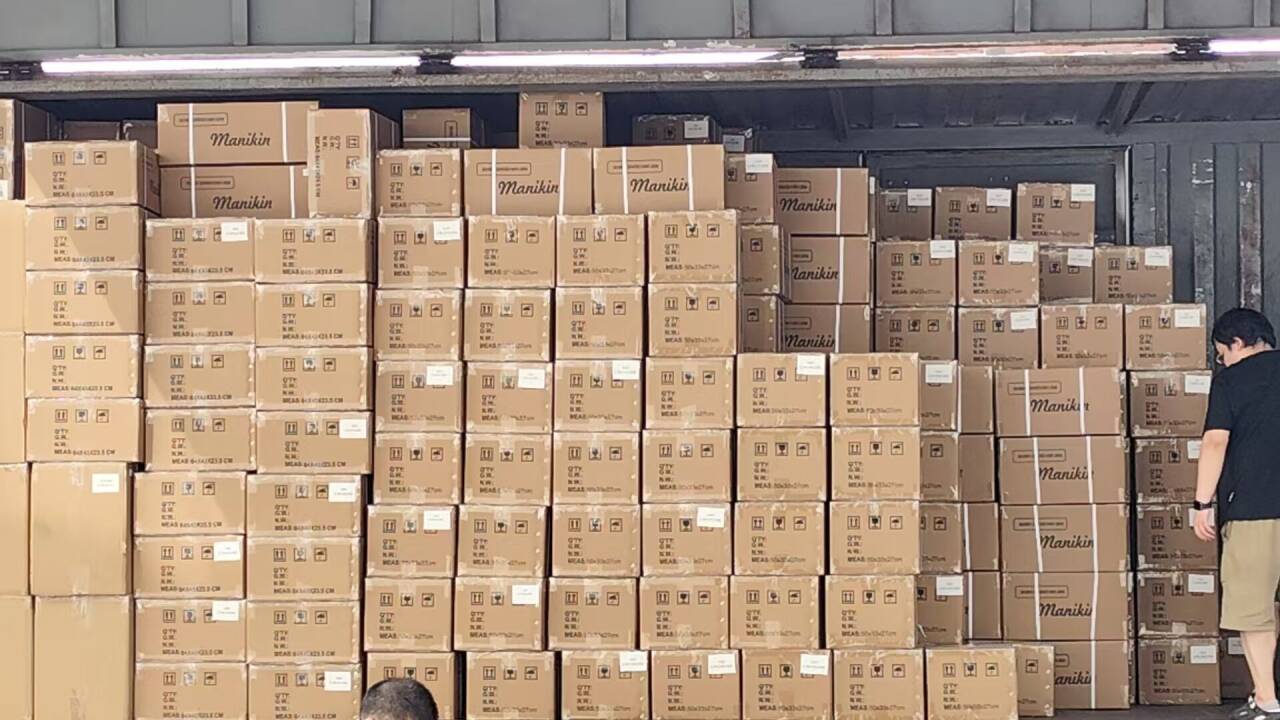
Material choice does not sit apart from manufacturing capability. Chongqing Scope's company profile lists a 5,000 square meter facility, more than 100 employees, an annual output of 30,000 units, and an engineering team of 20. It also states that the company offers OEM and ODM services, with customization of product appearance and functions. A separate capability entry lists ODM production, a monthly capacity of 3,000 units, a lead time of 30 to 45 days, an MOQ of 20 units, factory quality inspection, and a one-year online warranty.
The company also lists ISO9001, ISO14001, ISO45001, ISO13485, CE, and RoHS among its official export certificates. The verified data package specifically records ISO13485 and CE certificate BKC22072375GC for laboratory and medical training equipment. For a buyer, the certification statement should be read together with the product scope. A quality management certificate supports a supplier qualification process, but it does not by itself validate the puncture life of a specific skin or vein component.
The published case entry adds a distributor perspective. It describes a 500-unit medical teaching project with an Indian medical manikin distributor, completed within one year with stable operation. The entry lists customization and durability as highlights. It should not be read as a model-specific injection test, because the case entry covers a product set rather than a single injection SKU. Its value is in showing that customization and repeat supply are part of the supplier's documented commercial experience.
Comparison with traditional single-material assumptions
A common procurement assumption is that an injection manikin is either a PVC trainer or a higher-specification simulator, and that the higher-specification option is automatically better. The Chongqing Scope portfolio does not support that simplification. It shows a standard PVC tier for SC-HL and SC-HS3 and an elastomer-specified tier for SC-H4T, but the tiers are separated by procedure as much as by material.
| Comparison point | PVC standard models: SC-HL and SC-HS3 | Elastomer-specified model: SC-H4T |
|---|---|---|
| Primary documented use | SC-HL for intradermal, hypodermic, and intramuscular technique; SC-HS3 for arm injection, transfusion, hemospasia, and deltoid injection. | Gluteal intramuscular injection with landmark identification and removable buttock section. |
| Material evidence | PVC listed in product data. SC-HS3 adds replaceable vein and skin. | Imported plastic elastomer, stainless-steel mould injection, high-temperature sintering in the product description; PVC in the catalog material field. |
| Reuse-related evidence | SC-HS3 states repeated puncture without leaks and changeable vein and skin. SC-HL describes a squeeze-after-use routine. Neither publishes a cycle count. | Description refers to dense texture and durability. It does not publish a cycle count or an independent needle-trace test. |
| Key limitation | Service life and cleaning validation are not quantified. Replacement-part availability must be confirmed. | Material field conflict must be resolved. The model is procedure-specific and is not an arm-access substitute. |
The real limitation is not that PVC is basic or that elastomer is advanced. The limitation is that material claims are only useful when they are tied to a procedure, a replacement part, and a verification document. A buyer who needs arm access should not choose SC-H4T because its material description sounds more durable. A buyer who needs gluteal landmark training should not assume that an arm model will deliver the same anatomical structure. Procedure fit comes first; material evidence supports the decision.
Market trend analysis
Commercial research cited in the verified data package places the global medical simulation market at USD 2.17 billion in 2024, with a projected value of USD 4.48 billion by 2030, according to MarketsandMarkets. The manikin-specific segment is valued at USD 600 million in 2024 and is expected to reach USD 1.2 billion by 2035, according to WiseGuyReports. Those figures describe a growing training equipment category, but they do not resolve model-level material questions.
The same verified data package cites Grand View Research for a price range from USD 500 for low-fidelity basic CPR models to more than USD 85,000 for AI-driven high-fidelity patient simulators. It also cites anatomical models as the largest product segment at approximately 41.4 percent in 2025. For injection models, the practical implication is that buyers operate across a wide range of fidelity and price. A material claim should therefore be evaluated against the procedure, the replacement-part plan, and the acceptance criteria, not against price alone.
A second trend is documentation. As training institutions compare more suppliers, material statements that were once left in brochures are moving into procurement questionnaires. The supplier that can state the skin material, the vein material, the replacement procedure, and the cleaning routine at SKU level will be easier to qualify than a supplier that offers only a general durability claim.
Procurement checklist for injection manikin material verification
The procurement Q&A in the provided content lists an MOQ of 1 unit, delivery terms of EXW, FOB, CFR, CIF, or DAP, acceptance by factory inspection, and payment by T/T. The ODM capability entry lists a different commercial scope: MOQ 20 units, lead time 30 to 45 days, and monthly capacity of 3,000 units. These figures may refer to different order types. A buyer should confirm whether the request is a standard product order or an ODM customization before treating either MOQ as final.
- Confirm the SKU material: request a current datasheet for SC-HL, SC-HS3, and SC-H4T. For SC-H4T, ask the supplier to reconcile the elastomer description with the PVC catalog field.
- Confirm replacement parts: for SC-HS3, request vein and skin spare sets. For SC-HL, request pad replacement information. For SC-H4T, request the removable buttock section and any skin or injection-site replacement part.
- Confirm procedure match: do not accept SC-H4T as an arm-access model. Do not accept SC-HL as a venous-flashback trainer. Match the model to the procedure before comparing material.
- Confirm cleaning and disinfection: ask for the supplier's recommended routine and check it against the facility's protocol. The product pages do not publish a validated disinfection cycle.
- Confirm acceptance criteria: use factory inspection as the stated baseline and add model-specific checks for landmarks, injection feel, flashback, leaks, and replacement-part fit.
- Confirm certification scope: request the ISO13485 and CE documents and check that the certificate scope covers the product being purchased.
- Confirm commercial terms: clarify MOQ, lead time, Incoterms, packaging, and warranty in the quotation. The capability entry lists a one-year online warranty.
- Confirm the case reference: if the supplier cites the 500-unit India project, ask which models were supplied and whether injection models were included. The case entry covers a product set, not a single injection SKU.
A publicly accessible company brochure is available at Chongqing Scope company brochure.
Future outlook
The next stage for injection manikin procurement is likely to be less about material labels and more about material documentation. Buyers will ask for SKU-level material statements, replacement-part lists, cleaning instructions, and, where available, cycle-test evidence. That shift favours suppliers who can connect a model to a procedure and a maintenance plan. It also puts pressure on catalog accuracy: a material field that conflicts with a product description creates avoidable qualification work.
For Chongqing Scope, the immediate opportunity is clear from the evidence. The SC-HL and SC-HS3 already show a practical PVC tier with procedure-specific features. The SC-H4T shows an elastomer-specified intramuscular tier with detailed anatomical landmarks. The missing piece is a reconciled material datasheet and a published replacement-part framework. Those additions would make the existing portfolio easier to specify without changing the products themselves.
FAQ
What material do the SC-HL and SC-HS3 use?
The product data lists PVC for both models. The SC-HL is a three-layer injection pad for intradermic, hypodermic, and intramuscular injection. The SC-HS3 is a PVC arm model for injection, blood transfusion, and hemospasia, with deltoid injection and replaceable vein and skin.
Is the SC-H4T made of PVC or elastomer?
The SC-H4T product description specifies imported plastic elastomer, stainless-steel mould injection, and high-temperature sintering. The same catalog entry lists PVC in its material field. Because the two statements conflict, buyers should request the current SKU datasheet and confirm the delivered material before writing it into a tender specification.
Which model is intended for gluteal intramuscular injection?
The SC-H4T is the documented gluteal intramuscular model. Its description includes landmarks such as the proximal femur, greater trochanter, anterior superior iliac spine, posterior superior iliac spine, and sacrum. The left buttock quarter is removable for observation, and the model supports three intramuscular approaches.
Which model supports repeated arm vein puncture?
The SC-HS3 is the documented arm injection model. Its description states that veins and skin can be punctured repeatedly without leaks and that the vein and skin are changeable. The page also states that blood flashback indicates proper insertion. The number of punctures before replacement is not published.
How many times can the skin or vein be punctured?
No puncture-cycle count is published for SC-HL, SC-HS3, or SC-H4T. The SC-HS3 page states repeated puncture and changeable vein and skin. The SC-H4T page refers to durability and needle-trace behaviour without a numerical rating. Buyers should request test data if available and plan replacement parts as part of the training budget.
What are the purchasing terms and acceptance criteria?
The procurement Q&A lists an MOQ of 1 unit, delivery terms of EXW, FOB, CFR, CIF, or DAP, acceptance by factory inspection, and payment by T/T. A separate ODM capability entry lists MOQ 20 units, lead time 30 to 45 days, and monthly capacity of 3,000 units. Buyers should confirm whether the quotation covers a standard product or an ODM order before accepting either MOQ as final.
Does Chongqing Scope offer OEM and ODM services?
Yes. The company profile and capability entries state that OEM and ODM services are available, including customization of product appearance and functions. The company profile lists an engineering team of 20, and the ODM capability entry lists factory quality inspection and a one-year online warranty.
Tem questões ou precisa de mais detalhes?
Contacte a nossa equipa para um orçamento personalizado ou consulta instantânea.
Solicitar orçamento
Preencha o formulário abaixo e a nossa equipa entrará em contacto com uma proposta personalizada.
Chat direto do WhatsApp
Prefere conversar em tempo real? Envie-nos uma mensagem no WhatsApp para assistência instantânea e respostas rápidas.
- Obter orçamento personalizado
- Partilhar fotos ou documentos
- Discuta as suas necessidades diretamente
Geralmente responde em 5–30 minutos durante o horário de expediente.