
From Quote to Acceptance: Qualifying a Molded Pulp Supplier
From Quote to Acceptance: Qualifying a Molded Pulp Supplier
Molded pulp supplier qualification is decided less by the sample than by the paperwork that follows it. A buyer has qualified a source only when three things can be pointed to on paper: the payment method and schedule that will govern the order, the shipping mode and freight basis fixed before production begins, and the acceptance criteria written beside each measured parameter. Where any of the three is missing, the buyer holds a preference rather than a qualified supplier.
That distinction carries more weight in molded fiber than in categories fully described by a catalogue number. Trays are quoted across pulp types, thicknesses, tooling and surface options, and the same product family spans food, medical, electronics and cosmetics applications with different acceptance expectations. Commercial terms are therefore not administrative detail. They are the part of the offer that decides whether the specification can actually be enforced when a lot arrives.
Tonghe Paper Co., LTD is a molded pulp manufacturer operating a 23,000 m² factory in Dongguan, Guangdong Province, China, with a stated annual output of 12,000 tons and OEM/ODM customization covering material, colour, logo, anti-static and moisture-proof options. Its published commercial terms, T/T and Alibaba Trade Assurance for payment, sea, air and express for shipping, a 15–30 day lead time and a 1,000-piece minimum order, provide a workable reference case for the review path set out below.
What has to be documented before price is compared
Price should never be the first column in a molded pulp comparison. Three classes of term have to be fixed before a unit price means anything: the specification class, covering material, dimensions, thickness and tolerances; the commercial class, covering payment method, quantity basis, lead time and freight basis; and the acceptance class, covering what will be measured, how it will be measured, and what happens if a lot fails.
The supplied terms show why the order of operations matters. Freight is calculated only after the destination port or address is known, so an offer issued without a destination is a product price, not a landed cost. A minimum order of 1,000 pieces means the freight-per-unit curve is decided by whether the quantity sits above or below that threshold, not by the unit price alone. And a 15–30 day lead time is a production range until the buyer is told where the clock starts and which transit mode follows it.
A useful discipline is to treat every sentence in a quotation as belonging to a category: obligation, estimate or claim. Only the first category survives contact with a delivered shipment. The rest must be converted, either by writing it into the order documents or by asking for the document that already proves it.
The document set: which paper carries which weight
Qualification files often go wrong because all supplier paperwork is treated as equivalent evidence. In practice each document establishes something different, and each has a boundary that procurement teams need to recognise before they rely on it.
| Document | What it can establish | What it cannot establish |
|---|---|---|
| Quotation | The offered configuration, the quantity basis and the lead time the supplier is willing to state | A landed cost without a named destination, or any binding obligation, since a quotation is normally an invitation to order |
| Proforma invoice or order confirmation | The payable amount, the payment method, the quantity and the delivery basis once accepted by the buyer | Acceptance criteria, unless those criteria are written into the same document or the contract |
| Sales contract or purchase order set | Payment milestones, shipping mode, inspection arrangements, tolerances and remedies for a failed lot | Performance that no clause describes, because silence is not a commitment |
| Third-party test report | That a defined test on a defined sample, on a stated date, produced the recorded result for the named scope | Food-contact suitability, dimensional conformity of production lots, or the performance of a different configuration |
| Management-system certificate | That a certified system covers a named scope under a named standard | Product properties, and coverage of a product line that the stated scope does not name |
| Inspection record | The result of the agreed check performed on the delivered lot, at the stage the record names | Anything that was not on the inspection plan, including properties nobody agreed to measure |
Read together, the set produces a simple test. If a statement cannot be attached to one of those documents by name and identifier, it is not yet qualification evidence. That test is neutral about the supplier; it only asks what the file can support if the order later becomes a dispute.
Payment: the narrow set that can be checked
The supplied payment methods are T/T (telegraphic transfer) and Alibaba Trade Assurance. Both describe a channel through which money moves. Neither is a payment schedule, and the schedule is what the buyer actually needs, because it determines how much value is exposed at each stage of production.
What to write beside the method
- Parties and beneficiary. The contracting entity, the invoice issuer and the account beneficiary should carry the same name. A mismatch is a question to resolve before the first transfer, not after it.
- Milestones tied to events. Each instalment should reference a verifiable production or shipping event rather than a calendar guess, so that a delay in tooling or artwork does not silently shift the payment timing.
- Release conditions. If any portion of payment is intended to depend on acceptance, that dependency must be written into the contract. A payment method alone creates no such link.
- Variation handling. Colour, logo, embossing or anti-static options added after the quotation change the order value, so the contract should state how a variation is priced and paid.
Where platform-mediated payment changes the risk
Where Trade Assurance is the reason for choosing the route, the protection is defined by the platform order record rather than by the supplier's general assurances. Payments, quantity changes and acceptance discussions that sit outside that record fall outside its scope. Keeping the transaction inside the platform record is therefore a term in its own right, not a matter of convenience, and any agreed variation should be recorded there before money moves.
One further control is worth stating plainly because it is often lost inside procurement workflow: bank-detail changes received by email should be verified through a second, independent channel against a contact known before the order. This is not a comment on any particular supplier; it is a standard control applied to every first payment and every change of account.
| Mode | Details the buyer must supply | Point to confirm in the contract |
|---|---|---|
| Sea freight | Destination port and the delivery address behind it | Port pair, container or consolidation plan, and who arranges documentation |
| Air freight | Destination airport and the consignee details | Chargeable weight basis and the point at which risk and cost transfer |
| Express (DHL / FedEx / UPS) | Door address, contact and import clearance responsibility | Chargeable weight, since volumetric weight may exceed actual weight for bulky trays |
Shipping: mode, boundary and the freight trigger
Shipping terms are qualification evidence because they define where the supplier's responsibility ends. The supplied methods are sea, air and express, and in every case the freight figure depends on a destination the buyer has to name, whether a port or a street address. Until that is supplied, no comparison between two suppliers is a comparison of delivered cost.
Two numbers in the supplied capability data deserve to be read together. The stated lead time is 15–30 days and the minimum order is 1,000 pieces. A buyer ordering at the minimum sits in a different freight position from one ordering a multiple of it, because the fixed portion of any shipment cost is spread over a smaller quantity. That is a commercial fact about the order, not a judgement about the supplier, and it should be settled before the unit price is entered into a comparison sheet.
The start point of the lead time also needs a name. Fifteen to thirty days measured from order confirmation will produce a different delivery date from the same range measured from approval of artwork or tooling. Buyers should ask the supplier to state the trigger in writing and to say whether the figure covers production only, with transit added separately by the chosen mode. Neither question implies distrust; both determine when the goods are actually needed downstream.
Because molded fiber trays are bulky relative to their mass, express quotes are especially sensitive to the chargeable-weight basis used by the carrier. A quote compared against a sea shipment without that basis being stated is not a like-for-like comparison, and the difference usually appears only on the invoice.
From parameter range to acceptance criterion
The supplied specification is a range table, which is normal for molded pulp and is also where acceptance most often breaks down. A range describes what the process can produce. An acceptance criterion fixes the value a delivered lot must meet, with a method and a sampling basis attached. The two are not interchangeable.
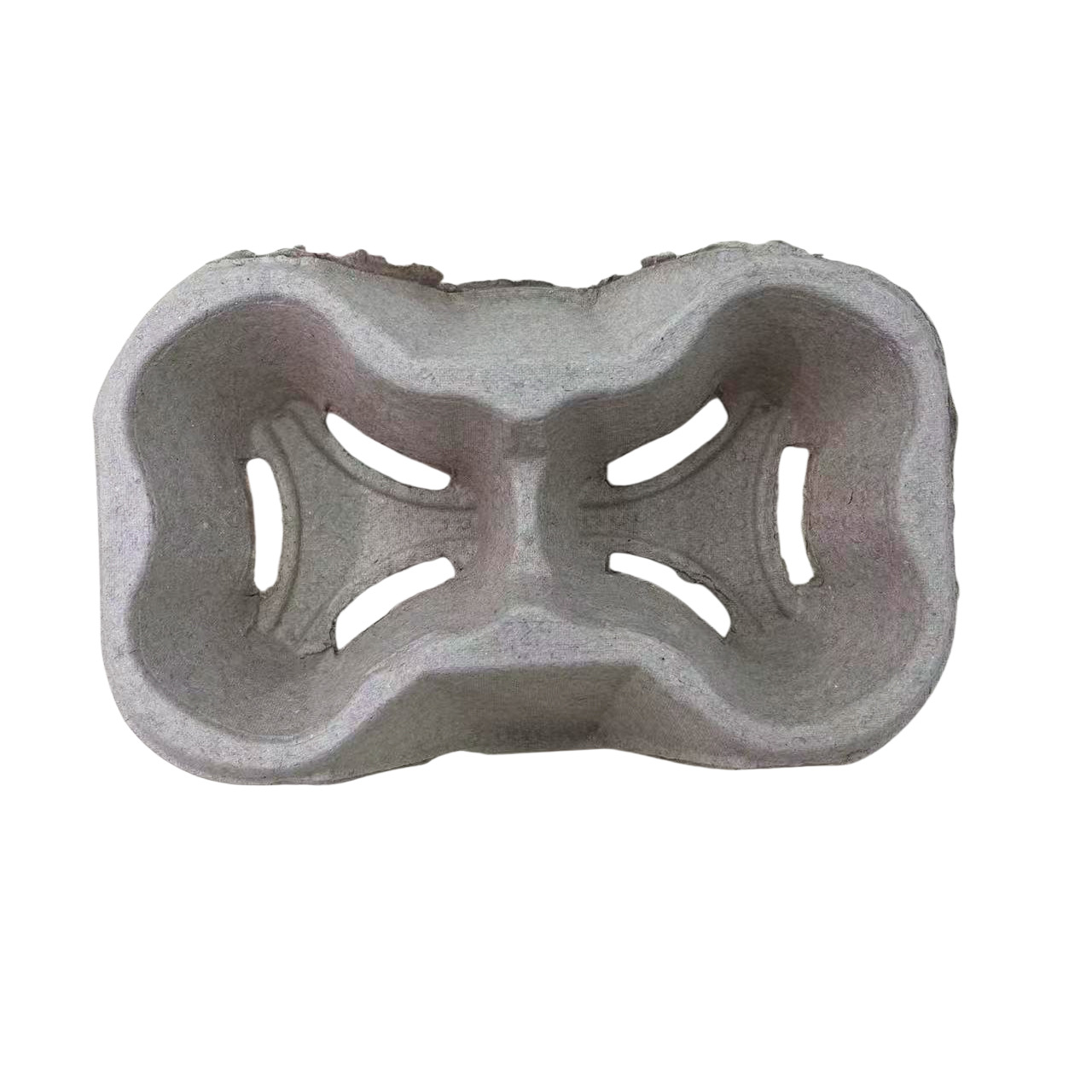
Custom formed trays: cavity geometry, thickness and moisture are the properties an acceptance clause has to convert from range into fixed value.
| Parameter | Stated value | What the acceptance clause must add |
|---|---|---|
| Raw material | Sugarcane pulp, bamboo pulp, wood pulp; customization on request | The named pulp for the order, and whether a specific FSC category is required |
| Colour | Natural, white, yellow, or customized as required | A reference sample retained by both parties, with lighting conditions for comparison |
| Thickness | 0.8–5.0 mm, customized as required | Nominal value, permitted tolerance and the measuring point on the tray |
| Moisture content | ≤8–12% | One limit, the test method, and the interval between production and measurement |
| Wet-press / dry-press | 0.15–0.25 g/cm³ / 0.28–0.45 g/cm³ | Which condition is measured on the delivered part |
| Edge crush strength | 3–8 kN/m | Specimen orientation and the number of tests per lot |
| Compressive strength | 2–8 MPa | Load direction and test condition, so results from different lots stay comparable |
| Service temperature | -20 °C to +80 °C generally; -20 °C to +120 °C for food grade | The application temperature stated on the approved drawing |
| Surface and brand options | Calendering, waterproof and oil-proof treatment, logo printing, embossing, anti-static modification | Which options are inside the order scope, and which are excluded |
Moisture content shows the problem precisely. A stated figure of ≤8–12% is not a single limit, and two lots at 8% and at 12% both satisfy the written description while behaving differently in stacking and in food-contact use. An acceptance clause has to pick one number, name a method and state the sample size, otherwise the most consequential property in the specification is effectively unmeasured.
The inspection stages named in the supplied capability data are IQC, IPQC and FQC, covering incoming, in-process and final checks. Buyers should ask which of those stages produces the record that travels with the shipment, because a criterion is only as useful as the stage at which it is applied. A final check recorded at the factory door and an incoming check recorded at the buyer's warehouse answer different questions, and both can be required.
Storage conditions belong to acceptance as well. The stated working condition for pulp packaging is a well-ventilated, dry area without prolonged direct exposure to sunlight, so an incoming inspection taken after a humid sea transit should record moisture on arrival rather than assume the factory value still applies.
Medical device trays need a document reference in the clause, not just a parameter. The supplied capability for that family includes support for EO sterilization, virgin wood pulp free of fluorescent agents produced in a clean workshop, and a material inspection report. Where that report is the acceptance document, the contract should name it, because a general restricted-substance report on paper tray carries different information.
The supplied case record covers 2,000 units for restaurant and supermarket use across Australia, Canada, Germany, Denmark, France, the United Kingdom, the Netherlands, New Zealand, Qatar, Saudi Arabia, Sweden, the United States and Malaysia, with a recorded result of shockproof and shatterproof performance. It is useful as a picture of order pattern and application. It is also a supplier-recorded field rather than an independent test, and should be filed as such when it appears in a qualification pack.
Certificates: check scope, number and date
Certification claims are where a qualification file most often looks stronger than it is, not because certificates are false but because scope and date are rarely read line by line. Five documents are supplied, and each answers a different question.
| Document | Issuer and number | Scope as stated | Validity |
|---|---|---|---|
| FSC chain of custody | RINA (Shanghai) Quality Certification Co., Ltd.; RINA-COC-003845 | Purchasing FSC 100%, FSC Mix and FSC Recycled mechanical pulp and pulp from recovered paper; manufacture (transfer system) and sale of FSC 100%, FSC Mix and FSC Recycled P10 other pulp and paper products n.e.c. (Pulp tray) | Issued 2024-06-07; valid to 2029-06-06 |
| Quality management system | Beijing Daluhangxing Quality Certification Center Co., Ltd.; 04524Q32380R0S | PAPER HOLDERS, assessed against GB/T 19001-2016 / ISO 9001:2015 | Issued 2024-11-26; valid to 2027-11-25 |
| SGS test report | SGS-CSTC Standards Technical Services Co., Ltd.; SZXPC26000164601 | Paper tray; IEC 62321-4:2013+AMD1:2017, IEC 62321-5:2013, IEC 62321-7-2:2017 and IEC 62321-12:2023, analysed by ICP-OES/AAS, UV-Vis and GC-MS | Issued 2026-01-16; recorded expiry 2099-01-01 |
| RoHS test report | Dongguan ZRLK Testing Technology Co., Ltd.; DSP25050447-1 | Paper tray; IEC 62321-4:2013/AMD 1:2017, IEC 62321-5:2013, IEC 62321-7-2:2017, IEC 62321-6:2015 and IEC 62321-8:2017, by ICP-OES, UV-VIS and GC-MS | Issued 2025-05-14; recorded expiry 2099-01-01 |
| Safety data sheet | ZRLK; DSP25050758-1 | Paper tray; ISO 11014:2009 and GB/T 16483-2008 for content and order of sections | Issued 2025-05-24; recorded expiry 2099-01-01 |
What each document does, and where it stops
The FSC certificate is the strongest fibre-sourcing document in the set because its scope names pulp tray explicitly and distinguishes FSC 100%, FSC Mix and FSC Recycled material, under FSC-STD-40-004 V3.1 and FSC-STD-50-001. It establishes chain of custody for those categories within the stated scope. It does not establish that a particular order was produced and labelled as FSC Mix, so the category should be repeated on the purchase order where the claim matters to the buyer's own customers.
The ISO 9001 certificate is a management-system document covering a defined scope, recorded here as paper holders. Whether a specific tray line falls inside that scope is a legitimate question for written confirmation, and asking it is not an accusation; it is how a system certificate becomes usable in a product file.
The SGS and RoHS documents are restricted-substance test reports on a paper tray sample, using the IEC 62321 method family. They establish what was found in the sample tested on the stated date. They are not food-contact approvals, not dimensional certificates and not strength guarantees, and a buyer whose application depends on food-contact suitability should ask which document addresses that requirement rather than reading it out of a substance report.
The safety data sheet is a hazard-communication document prepared to ISO 11014:2009 and GB/T 16483-2008. It supports handling, storage and transport communication. It is not a performance document and does not assert food-contact suitability.
The application record for this product family lists recyclable, biodegradable and food-contact safe among its special requirements, and food grade trays are stated to operate from -20 °C to +120 °C against -20 °C to +80 °C for the general range. Those are useful selection facts. Turning them into obligations still requires a document that names the property and the method, which is the same test applied to every other claim in the file.
A five-step review path for procurement teams
- Build a claim-to-document map. Three columns: the claim as written, the document that supports it, and the identifier. Any row with a blank second column is not yet qualified. This single exercise usually separates a supplier's marketing sheet from its evidence pack faster than a meeting.
- Fix the commercial basis before comparing price. Destination port or address, shipping mode, quantity relative to the 1,000-piece minimum, the start point of the 15–30 day lead time, and the payment method with its milestone schedule. A price captured before these are fixed will need to be recalculated.
- Convert ranges into single acceptance values. For each parameter in the specification, record the chosen value, the test method and the sampling basis, then confirm which inspection stage produces the record.
- Verify certificates at the issuer, not the copy. Check the certificate number, the scope wording as issued, and the issue and expiry dates, then confirm in writing whether the scope names the product being purchased.
- Define the record set before the second order. Name the inspection record, the test report and the batch reference that will accompany each shipment, and state how long they are retained. Repeat orders are where undocumented assumptions become recurring disputes.
Where the terms stop short
An honest qualification note includes the boundaries, and several are visible in the supplied material.
- After-sales support is stated as remote. A buyer who expects on-site attendance is assuming something the terms do not offer, so the contract should name the response path and state who bears return freight for a rejected lot.
- Ranges remain ranges until a buyer fixes them. Thickness from 0.8 to 5.0 mm and moisture of ≤8–12% describe capability, not a lot.
- The management-system certificate scope reads paper holders, so coverage of a specific tray line should be confirmed in writing rather than inferred.
- No landed cost can be evaluated before the destination port or address is supplied, because freight is calculated at that point.
- Supplier-recorded results, including the case entry describing shockproof and shatterproof performance, are a record of what the supplier reports, not independent test evidence.
- Platform-mediated payment protects what sits inside the platform order record; anything agreed outside it sits outside that protection.
What changes for acceptance by 2030
Regulatory pressure is turning recyclability from a marketing line into a contract term. The EU Packaging and Packaging Waste Regulation (EU) 2025/40 entered into force on 11 February 2025 and requires all packaging to be recyclable by 1 January 2030, as summarised by Baker McKenzie with reference to the European Commission.
If that requirement reaches the buyer's packaging format, the practical consequence is documentary: the fibre specification and any chain-of-custody certificate will need to name the material category, which is exactly why the FSC scope distinguishes FSC 100%, FSC Mix and FSC Recycled rather than treating recycled content as one undifferentiated claim. This is a conditional outlook, not a statement about any supplier's current compliance position, and a buyer's own market obligations should be confirmed with its compliance function before they are written into a purchase specification.
Frequently asked questions
What payment terms and shipping methods are documented for this supplier?
The supplied commercial terms state T/T and Alibaba Trade Assurance for payment, and shipment by sea, air or express through DHL, FedEx or UPS. Freight cost is calculated after the buyer provides a destination port or delivery address, which means a quotation issued without that information is a product price rather than a delivered cost.
Which lead time and minimum order quantity should a buyer confirm in writing?
The stated lead time is 15–30 days and the minimum order is 1,000 pieces. Because a range of that width can move a delivery date by two weeks, the contract should name the start point of the lead time, such as order confirmation or approval of artwork and tooling, and should state whether the figure covers production only, with transit added separately for the chosen mode.
Which certificates can a procurement team check against an issuing body?
Five documents are supplied with traceable identifiers: FSC chain of custody RINA-COC-003845 issued by RINA (Shanghai) Quality Certification Co., Ltd., valid to 2029-06-06; ISO 9001 certificate 04524Q32380R0S issued by Beijing Daluhangxing Quality Certification Center Co., Ltd., valid to 2027-11-25; SGS test report SZXPC26000164601; RoHS test report DSP25050447-1; and safety data sheet DSP25050758-1. Each carries a stated scope, and the scope wording, not the logo, determines what the document supports.
Which parameters should an acceptance clause fix rather than leave as ranges?
Thickness, moisture content, wet-press and dry-press values, edge crush strength, compressive strength, service temperature, colour and raw material all appear as ranges or options in the supplied specification. An acceptance clause should convert each relevant one into a single value with a test method and a sampling basis, and should state which inspection stage, incoming, in-process or final, produces the record that accompanies the shipment.
How should a buyer treat a certificate whose scope does not name trays?
Such a document should be filed for what it is: evidence that a system or a sample met a defined standard within a defined scope. Where the buyer's product file needs product-level coverage, the appropriate step is to request written confirmation that the purchased line falls within the certified scope, or to ask for a document whose scope names the product. Treating a system certificate as a product certificate is the error to avoid.
Reference document: the Tonghe Paper Co., LTD company brochure is available for download and covers the product families and production base referenced in this analysis.
Tem questões ou precisa de mais detalhes?
Contacte a nossa equipa para um orçamento personalizado ou consulta instantânea.
Solicitar orçamento
Preencha o formulário abaixo e a nossa equipa entrará em contacto com uma proposta personalizada.
Chat direto do WhatsApp
Prefere conversar em tempo real? Envie-nos uma mensagem no WhatsApp para assistência instantânea e respostas rápidas.
- Obter orçamento personalizado
- Partilhar fotos ou documentos
- Discuta as suas necessidades diretamente
Geralmente responde em 5–30 minutos durante o horário de expediente.