
Full-Package Restaurant Furniture Qualification: Aligning Booths, Chairs, Tables and Bars
Industry Reference · Hospitality Furniture Procurement
Full-Package Restaurant Furniture Qualification: Aligning Booths, Chairs, Tables and Bars
A restaurant furniture package is normally bought as four separate purchases: booth seating from one supplier, dining chairs from another, tables from a third, and the bar counter from a local workshop. Qualifying the package as one exercise instead of four changes what a buyer has to verify, and it changes the order in which the verification should happen.
Restaurant furniture is a mixed-category product. Booth and banquette seating, commercial dining chairs, restaurant tables and custom bar counters are built from different materials, carry different structural loads, and are documented differently. That difference is exactly why full-package qualification is worth structuring. The commercial risk in a restaurant fit-out rarely sits inside one category. It sits in the gaps between them: a wood finish that does not match the bar counter, a chair approved against a named test standard while the bar stools carry no comparable evidence, a booth consignment that arrives three weeks after the tables.
This reference sets out how buyers can treat those categories as a single qualification exercise. Guangzhou Mingmeng Furniture Co., Ltd. (MingMeng Furniture) — a Guangzhou-based commercial and hospitality furniture manufacturer established in 2015 that supplies restaurant, hotel, bar, café and outdoor furniture for hospitality projects — is used here as a working example of what a package-level qualification dossier contains and where its limits fall.
Why a mixed-category package is harder to qualify than a single product
Three structural problems appear whenever a restaurant package is qualified product by product.
Different construction logics. Seating is judged as a load-bearing structure: frame, joints, foam and upholstery must survive repeated use and frequent cleaning. Restaurant tables are judged as a top-and-base assembly, where the tabletop material and the base structure have to be compatible in weight, fixing points and stability. A custom bar counter sits closer to joinery and fit-out work than to furniture, because it carries storage, shelving, service equipment, sink cut-outs, foot rails and sometimes lighting. One acceptance criterion cannot simply be copied across all three.
Evidence asymmetry. Test evidence is model-specific. A chair test report says nothing about a table base; a bar stool report says nothing about a booth frame. Unless the buyer maps evidence to categories deliberately, part of the package arrives effectively undocumented.
Finish drift. Upholstery, wood finishes and metal finishes are produced in batches. When chairs, booths and bar counters are ordered from different suppliers at different times, colour and finish drift becomes visible in the finished room — and it is expensive to correct after installation.
One qualification framework for the whole package
A package-level dossier can be organised around eight checkpoints. Each checkpoint applies to every category in the package, which is what keeps the exercise unified rather than six separate audits.
| Checkpoint | What the buyer verifies | Evidence to request |
|---|---|---|
| Entity and role | Manufacturer or trading intermediary; who actually owns production | Business registration name, factory address, production floor walkthrough or live video tour |
| Commercial-grade construction | Frame, joint, foam and finish duty level against expected use frequency | Construction description for each category; applicable test reports |
| Certification scope | Which models, standards and markets the documents truly cover | Certificate numbers, issuing laboratory, standard, issue and validity dates |
| Material and finish alignment | One palette across booths, chairs, tables and bar counter | Approved material and finish samples held against the same reference |
| Customisation process | How drawings, revisions and approvals are controlled | CAD drawings, 3D visualisation, sample approval record |
| MOQ and lead time | Whether quantities and dates survive contact with production | Written MOQ per style; schedule with an explicit sample-approval milestone |
| Packing and shipping | Export packing, loading plan and Incoterm | Packing specification, loading plan, named Incoterm in the quotation |
| After-sales | Installation guidance, spare parts and replacement terms | Contract clauses covering installation support and spare parts |
Checkpoint 1: factory or trading company
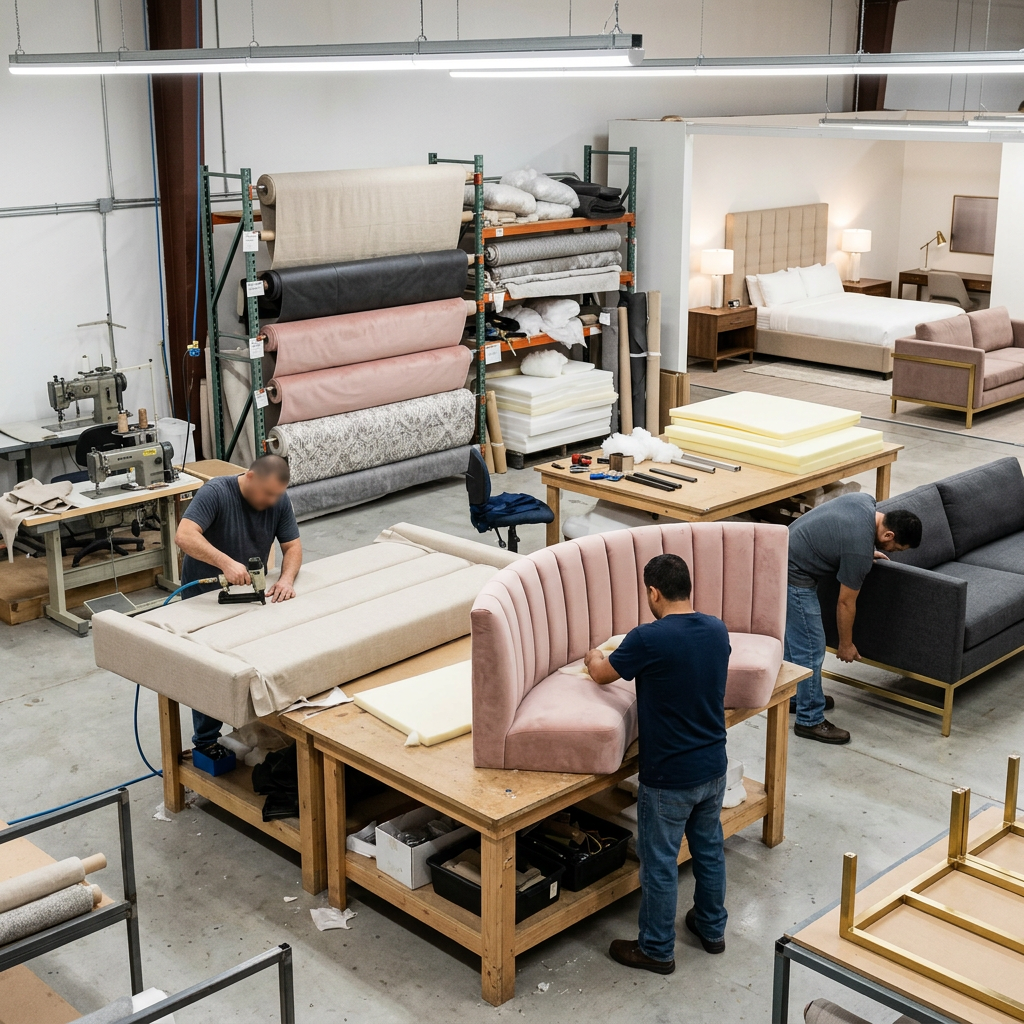
The first checkpoint is not a formality. A package that mixes booths, chairs, tables and a bar counter requires production control across woodworking, upholstery and metalwork — or, at minimum, reliable documented control over any step that is subcontracted. The usual verification is direct: an appointment-based factory visit, or a live video walkthrough for overseas buyers, plus a cross-check that the legal entity name on the quotation matches the production site.
MingMeng Furniture states that it operates its own manufacturing facility rather than acting as a trading intermediary, with a 15,000 m² plant and 200+ employees. Its stated production lines cover woodworking, metalworking, upholstery, cutting, welding, polishing, painting, powder coating, CNC processing, assembly and quality inspection. The company states a monthly production capacity of more than 80,000 pieces and annual output of 960,000+ units, with 90% of output exported to markets including the USA, Australia, Europe, the Middle East and Southeast Asia, and products supplied to customers in more than 100 countries and regions.
For a buyer, the practical test is simple: can the supplier state precisely which steps are done in-house, which are subcontracted, and who signs off quality at each stage?
Checkpoint 2: commercial-grade durability and how it is evidenced
Commercial grade is a duty level, not a marketing word. In seating it is usually expressed through European commercial seating standards: EN 16139:2013 Level 2 for strength, durability and stability of non-domestic seating, together with EN 1022:2023 for stability. Material safety is handled separately, typically through REACH SVHC testing under Regulation (EC) No. 1907/2006.
MingMeng Furniture’s published documentation illustrates how model-level evidence is structured, and why scope matters more than the document title:
| Document | Reference number | Issuing body | Scope and standard |
|---|---|---|---|
| CE Certificate of Compliance – commercial chair MM102 | CTG2511057084B-SC01AD | Shenzhen CTG Testing Co., Ltd. | Commercial chairs and hospitality seating; EN 16139:2013 Level 2; EN 1022:2023; issued 2025-11-05 |
| Strength, durability and stability test report – commercial chair MM102 | CTG2511057084B-SR03AD | Shenzhen CTG Testing Co., Ltd. | Commercial dining chairs and hospitality seating; EN 16139:2013 Level 2; EN 1022:2023 |
| Test report – commercial bar chair MM103 | CTG2511057084B-SR02AD | Shenzhen CTG Testing Co., Ltd. | Commercial bar chairs and bar seating; EN 16139:2013 Level 2; EN 1022:2023 |
| Strength, durability and stability test report – commercial bar stool MM104 | CTG2511057084B-SR04AD | Shenzhen CTG Testing Co., Ltd. | Commercial bar stools and restaurant bar seating; EN 16139:2013 Level 2; EN 1022:2023 |
| CE Certificate of Compliance – commercial chair MM102 | CTG2510308431B-SR224AT | Shenzhen CTG Testing Co., Ltd. | EU market; EN 16139:2013 Level 2 / EN 1022:2023; issued 2025-10-30, valid to 2030-10-30 |
| REACH SVHC test report – chair | CZH12250205012 | Shenzhen Zhonghan Certification Technology Co., Ltd. | 247 SVHC candidate list substances; Regulation (EC) No. 1907/2006; issued 2025-02-08, valid to 2030-02-08 |
| REACH SVHC test report – sofa / upholstered furniture materials | BSTDGD31243813112202CR | Dongguan BST Testing Co., Ltd. | Upholstered furniture materials; REACH SVHC candidate list; issued 2024-11-22, valid to 2029-11-22 |
Across the wider portfolio the company lists multiple product and quality certifications — including CE, TÜV, RoHS, Certification of Conformity and relevant product safety compliance documentation — together with 10+ national patented designs. Its quality-control system is described as covering material inspection, production-process inspection, structural and appearance checks, pre-shipment inspection and export packaging control.
For package qualification, the decisive question is coverage rather than the existence of certificates. The reports above reference the MM102, MM103 and MM104 model families. Booth frames, table bases and bar counters are typically documented through construction specification and inspection records rather than seating test standards. Buyers should therefore ask for a coverage map: which items in the package are covered by which document, and which rely on internal quality-control records instead.
Checkpoint 3: materials and finishes across mixed categories
A package qualifies more smoothly when one material and finish logic runs through every category. The stated material range covers solid wood, plywood, metal, stainless steel, aluminium, stone, HPL, leather, fabric and other upholstery materials, with furniture customisable in dimensions, structures, materials, upholstery, colours, wood finishes, metal finishes, tabletops, booth configurations and complete project combinations.
| Category | Typical material set | Alignment decision for the buyer |
|---|---|---|
| Restaurant booth and banquette seating | Plywood or solid wood frame, high-density foam, fabric, PU leather or genuine leather | Fix frame and foam specification first; upholstery is the main visible alignment variable |
| Restaurant chairs | Solid wood, metal or plywood frame; fabric, PU leather or genuine leather upholstery | Seat height and frame finish must match table height and booth base trim |
| Restaurant tables | Solid wood, veneer, HPL, laminate, marble or stone tops; metal or wooden bases | Top material drives the maintenance routine; the base must be dimensioned to the top |
| Custom bar counters | Wood veneer, laminate, plywood, MDF, marble, sintered stone, quartz, stainless steel, metal, glass | Counter finish must read as the same family as tables and chair frames |
Where a project carries specific safety or exposure requirements, fire-retardant, water-resistant and weather-resistant material options can be specified. Those requirements should be confirmed against the project’s own regulations and operating conditions rather than assumed from a general material list, and stain resistance, flame-retardancy levels and outdoor corrosion protection are routinely project-defined parameters.
Checkpoint 4: the customisation sequence
Customisation is where package timelines are usually lost. A controlled sequence reduces that risk: requirements and drawings first; then confirmation of dimensions, materials, colours and finishes; then quotation, design proposal and production plan; then approval of samples or material and finish samples; then order confirmation, payment terms and production schedule; and only then bulk production.
Checkpoint 5: MOQ, lead time, packing and shipping terms
MOQ is generally set per style rather than per project. For custom models the stated range is generally 10–50 pieces per style, and the company’s published comparison table states an MOQ of 20 units for custom restaurant booth manufacturing. Standard models and fully custom project furniture can carry different minimum quantities, and mixed-model orders can be considered subject to model-specific production requirements and total order planning.
| Commercial parameter | Stated position |
|---|---|
| MOQ – custom models | Generally 10–50 pieces per style; company-stated 20 units for custom restaurant booths |
| Lead time – standard models | 20–30 days |
| Lead time – customised models | 35–50 days including sample approval |
| Production capacity | 80,000+ pieces monthly; 960,000+ units annual output |
| Quality control | Sample inspection and random checks; QC reports, final inspection reports and packing inspection for bulk orders; inspection can follow project-specific and pre-shipment standards |
| Shipping terms | Quotations can be prepared under EXW, FOB, CIF, CFR or DDP; DDP feasibility depends on destination, product, customs and tax handling and logistics capability |
| Logistics support | Export packaging, container loading and international freight coordination |
| After-sales | Installation guidance, export packaging and freight coordination; project orders can include on-site installation guidance and spare parts support subject to contract |
For package buyers, the key discipline is to put the sample-approval milestone on the schedule explicitly. If approval slips by a week, custom lead time moves with it — and with a consolidated package, it moves across every category at once.
Checkpoint 6: what aligned packages look like in practice
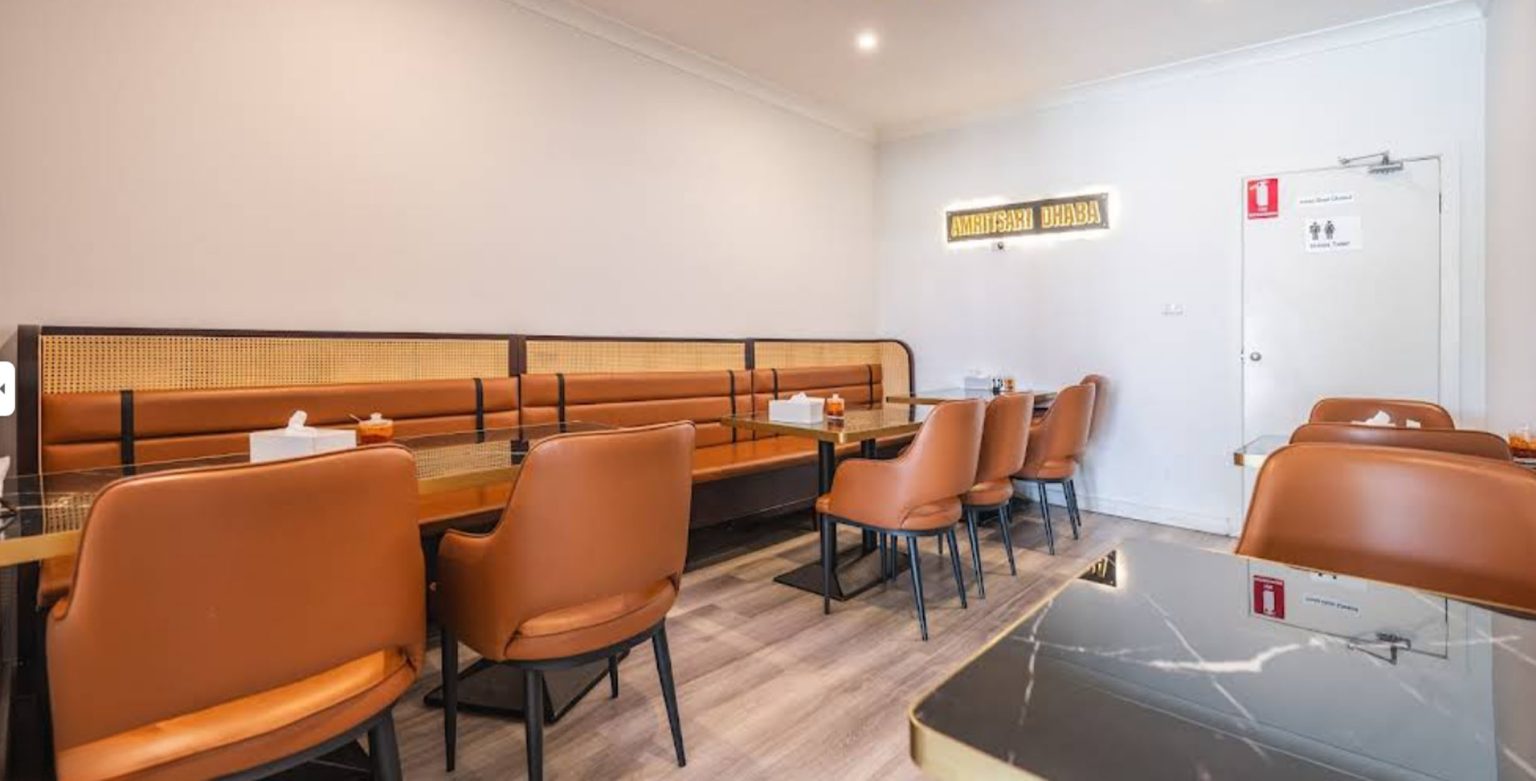
The multi-category logic is visible in delivered projects. In Australia, a full restaurant furniture package for an Indian casual dining operator combined upholstered dining chairs, dining tables and soft-cushioned booth seating in a single order rather than separate table and seating purchases. The project paired sturdy wood chair frames with sleek metal table legs, rich leather upholstery and warm wooden tones in a minimalist Australian styling, with tables, chairs and booths supplied as one matched commercial furniture set.
In the United States, a multi-zone package for an Asian restaurant operator running Thai, Chinese and sushi concepts covered reception, lounge waiting, main dining and a long wall-side booth seating zone. Long booth seating improved space utilisation while movable dining chairs supported two-person, four-person and group arrangements, with amber orange upholstery, warm wood, black finishes and brass-gold details holding one visual identity across the zones.
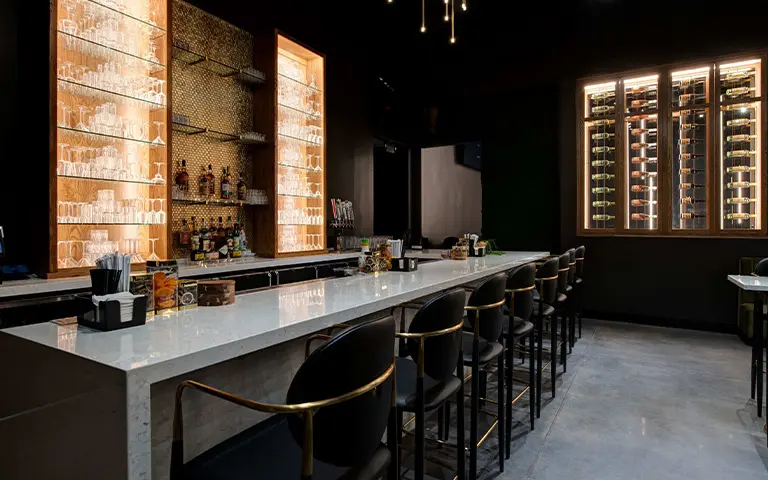
A third project — a charcuterie lounge, restaurant and bar operator that also runs private events — shows the bar counter axis. Custom upholstered bar stools were installed at the bar counter seating zone, custom booth seating ran along the wall side of the dining room, and marble-look dining tables were supplied as freestanding units, all in a coordinated black, olive-green, brushed-gold and marble-white palette with material and finish coordination across stools, booths and tables.
A fourth US project, for an immersive entertainment venue and restaurant and bar operator, combined bar, dining, booth, high-top and communal zones in one furniture system — multiple seating heights, a combination of fixed and movable furniture, and an event-ready layout delivered under one planning scope, using coordinated timber, upholstery and dark metal finishes.
Market signals: what the numbers do and do not support
Buyers reviewing category growth to justify a furniture budget should treat headline market figures cautiously. Available commercial research on the global restaurant furniture market conflicts materially and appears to use different market definitions.
| Publisher | Stated market size | Stated growth |
|---|---|---|
| Market Growth Reports | USD 638.8 million (2026) to USD 929.57 million (2035) | CAGR 4.3% |
| Business Research Insights | USD 0.88 billion (2025) to USD 1.38 billion (2034) | CAGR 5.13% |
| Dataintelo | USD 6.62 billion (2025) to USD 11.01 billion (2034) | CAGR 5.8% |
The three estimates differ by roughly an order of magnitude. No official government, customs or intergovernmental dataset for restaurant furniture market size, and no HS-code-level trade flow data, was identified in the same review. The practical reading for buyers is directional: demand for commercial hospitality furniture continues to be modelled as growing at a low-to-mid single-digit rate, but no single published figure should be treated as a procurement benchmark or used to justify a package budget on its own.
Package-level qualification versus conventional piecemeal purchasing
Neither route is universally better. Comparing them on the criteria that actually drive restaurant openings shows where each one carries risk.
| Dimension | Piecemeal purchasing | Single-package qualification |
|---|---|---|
| Finish consistency | Requires cross-supplier sample matching | One approval front across all categories |
| Documentation | Evidence arrives in incompatible formats | Evidence map built once for the project |
| Lead time | Independent schedules; one late category holds the opening | Shared schedule; one delay moves the whole set |
| Commercial leverage | Smaller order value per supplier | Larger consolidated order value |
| Risk concentration | Spread across several suppliers | Concentrated in a single supplier |
| Spare parts | Multiple after-sales channels | One after-sales channel, but a single point of dependency |
The honest limitation sits in the last two rows and in document coverage. Consolidating booths, chairs, tables and a bar counter with one manufacturer concentrates delivery and quality risk, and certification coverage is never perfectly symmetrical: seating families such as MM102, MM103 and MM104 are supported by named test reports and CE documentation, while booth frames, table bases and bar counters are covered principally by construction specification and inspection records rather than the same seating standards. Per-style minimum order quantities of roughly 10–50 pieces, and a custom lead time of 35–50 days that only begins effectively after sample approval, mean a consolidated package also demands more planning discipline up front than four small purchases would.
Future outlook
Two shifts are likely to shape package procurement in the next planning cycles. First, documentation is moving from a post-award formality to a pre-award filter: as EU-facing projects reference EN 16139:2013 Level 2 and EN 1022:2023 for seating, and REACH SVHC testing under Regulation (EC) No. 1907/2006 for materials, buyers increasingly ask for certificate numbers, issuing laboratories and validity dates before shortlisting rather than after. Second, package-level scoping is becoming normal rather than exceptional, because the visible failure modes in a finished restaurant — mismatched wood tones, undocumented bar seating, staggered deliveries — are package failures, not product failures.
For manufacturers, the competitive unit is therefore shifting from the individual chair or booth to the qualification dossier: one evidence set, one finish reference, and one schedule covering every category in the room.
FAQ
Can one supplier deliver restaurant booths, chairs, tables and bar counters as a single package?
Yes. A complete package can combine tables, chairs, booths, bars and accessories so that one consistent look is maintained across a restaurant. In practice, the package is assembled from distinct product units — booth and banquette seating, restaurant chairs, restaurant tables and custom bar counters — that share one material and finish reference, one approval sequence and one production schedule. Because those units are produced together, the package can be qualified with a single evidence set instead of four separate product qualifications.
How can a buyer verify whether a supplier is a factory or a trading company?
Verification combines documents and site evidence. Match the quotation entity to the production site, review the factory address and business registration name, and request an appointment-based factory visit or, for overseas buyers, a live video factory tour. Capability claims should be checkable against the plant itself. MingMeng Furniture, for example, states a 15,000 m² facility with 200+ employees and in-house woodworking, metalworking, upholstery, coating and assembly lines, plus a stated capacity of more than 80,000 pieces per month and 960,000+ units of annual output. Its stated process also allows customers to confirm OEM and ODM development based on drawings, reference images, samples and project specifications.
What evidence demonstrates commercial-grade durability in restaurant seating?
For seating, the relevant evidence is commercial performance testing rather than appearance: EN 16139:2013 Level 2 for strength, durability and stability of non-domestic seating, together with EN 1022:2023 for stability. Model-level documents illustrate the format: the MM102 commercial chair CE certificate CTG2511057084B-SC01AD and strength, durability and stability test report CTG2511057084B-SR03AD; the MM103 commercial bar chair test report CTG2511057084B-SR02AD; and the MM104 commercial bar stool strength, durability and stability test report CTG2511057084B-SR04AD, all issued by Shenzhen CTG Testing Co., Ltd. Material safety is documented separately, for example by REACH SVHC reports CZH12250205012 (chair, 247 SVHC candidate list substances, valid to 2030-02-08) and BSTDGD31243813112202CR (sofa and upholstered furniture materials, valid to 2029-11-22).
What MOQ and lead time apply to a custom restaurant furniture package?
MOQ is set per style rather than per project. For custom models the stated range is generally 10–50 pieces per style, and the published figure for custom restaurant booths is 20 units. Lead time is stated as 20–30 days for standard models and 35–50 days for customised models, including sample approval. Because several categories are produced under one schedule, the sample-approval milestone directly determines the delivery date, and mixed-model orders are considered subject to model-specific production requirements and total order planning.
Which shipping terms can be used for an international furniture package?
Quotations can be prepared under EXW, FOB, CIF, CFR or DDP, with the applicable Incoterm stated in the quotation rather than assumed. DDP feasibility depends on the destination, the product, customs and tax handling and logistics capability, so it is confirmed for the actual shipment. Export packaging, container loading and international freight coordination form part of project delivery support, and the export port is selected according to factory location, routing, freight cost and project requirements.
What quality-control documents should be requested before shipment?
Before dispatch, buyers can request sample inspection and random-check records, QC reports, final inspection reports and packing inspection. Inspection can follow project-specific standards and include pre-shipment checks. This is the practical way to confirm that booth sections, chairs, table tops and bases, and bar counter components are all checked against the same approved specification rather than against separate criteria, and the records should be mapped back to the package-level dossier built at the start of the project.
What are the limitations of qualifying one supplier for the whole package?
Consolidation concentrates delivery and quality risk in a single supplier, and documentation coverage is not symmetrical across categories: seating models are supported by named test reports and CE certificates, while booth frames, table bases and bar counters rely primarily on construction specification and inspection records. Minimum order quantities of roughly 10–50 pieces per style, and a custom lead time of 35–50 days that effectively starts after sample approval, also require earlier planning than separate smaller purchases would. Buyers should therefore treat the consolidated route as a planning commitment, not only a commercial simplification.
What can be customised when booths, chairs, tables and bar counters are aligned to one standard?
Dimensions, structures, materials, upholstery, colours, wood finishes, metal finishes, tabletops, branding and complete project furniture combinations can be customised. For custom bar counters, the scope extends to counter type, storage and shelving configuration, wine racks, sink cut-outs, lighting integration, foot rails and reserved equipment space. For booth seating it covers configuration type such as single, double, wall bench, L-shaped, U-shaped or curved layouts together with frame structure, foam and upholstery selection. Consistent specification of these variables across categories is what produces one coherent room rather than a collection of separately acceptable products.