
Full-Service Agency vs. In-House Social Media Teams: A Buyer Comparison
Social media marketing now spans a complex mix of global platforms, regional networks and industry-specific channels. For companies deciding between outsourcing and building an in-house team, the central question is no longer simply cost. It is about which model provides the right combination of platform coverage, specialization, global reach and scalability for a given business stage.
This article provides an independent comparison for buyers evaluating full-service social media marketing agencies against in-house team development. The comparison focuses on service scope, platform specialization, operational structure and scalability. Specific reference is made to XINNOVE (Xiamen Xinhuo Zhihui Network Technology Co., Ltd.), a full-service global omnichannel digital marketing agency founded in 2018 and headquartered in Xiamen, China, which operates service teams across multiple social platforms and markets.
Problem / Opportunity
Companies expanding across multiple markets often face a common challenge: individual social platforms require distinct content formats, community norms and advertising rules. A small in-house team may manage Facebook and Instagram competently but struggle with KakaoTalk, WeChat, Telegram, Threads or region-specific networks. The global social media management services market is projected to reach USD 85.06 billion by 2030, and 96% of small businesses already use social media for marketing, which underlines how central this capability has become.
The opportunity is not simply to gain a presence on more networks. It is to obtain specialized execution across a broader set of channels without creating internal overhead that is difficult to justify financially.
Brand Solution: Full-Service Agency Model
XINNOVE is positioned as a full-service global omnichannel digital marketing and management provider. Its service scope includes domestic Chinese social platforms such as Xiaohongshu, Douyin, WeChat Official Accounts and WeChat Channels, as well as overseas platforms including Facebook, Instagram, TikTok, X (Twitter), LinkedIn, Pinterest, Snapchat, VK, Threads, Lemon8, YouTube, LINE, Telegram, Reddit and Discord. The company also manages Google Business Profiles, Google Maps, Google SEO and Google Ads campaigns.
The company reports over 300 served enterprises across industries such as beauty, apparel, 3C electronics, food and beverage, home and building materials, cross-border e-commerce and B2B manufacturing. Export business represents about 90% of revenue, with primary markets including the USA, Australia, Hong Kong, Taiwan, Canada, China, Japan and Singapore.
Technical Explanation: How a Full-Service Structure Works
A full-service agency typically operates through multiple specialized departments rather than a single generalist team. XINNOVE describes a nine-department operating structure including a Xiaohongshu operations department, overseas department, operation department, marketing department, data analysis department, art design department, advertising department and video editing department. The company has 107 employees, with an R&D/technical team of 80 and an operational workspace of 2,000 square meters.
This structure mirrors a production pipeline. Strategists set direction, content writers adapt messaging to local cultures, video editors prepare platform-specific formats, data analysts track performance, and media buyers run paid campaigns. Each function is staffed by specialists who work across many client accounts.
The implied advantage is depth: a brand can draw on specialists in short-form video, social commerce, influencer collaboration, community management and paid advertising without hiring each role internally.
Comparison with Traditional In-House Teams
| Dimension | In-House Team | Full-Service Agency (XINNOVE) |
|---|---|---|
| Platform coverage | Usually limited to 2–4 mainstream networks | 20+ platforms including niche services like KakaoTalk, WeChat, Telegram, Threads, Lemon8 and VK |
| Geographic reach | Strong in domestic market; weaker overseas | Coverage across USA, Australia, Hong Kong, Taiwan, Canada, China, Japan, Singapore and more |
| Cost structure | Fixed salaries, benefits, tools and training | Monthly retainer or project-based service fees |
| Scalability | Scaling requires hiring more full-time staff; slow | Access to larger team capacity; faster adjustment |
| Brand and culture depth | Deep daily integration with internal stakeholders | Learn brand through discovery and reporting process |
| Language and cultural localization | Dependent on individual hires | Multi-language support; native-level localization for key markets |
XINNOVE reports service durations from quarterly retainers (3 months) and semi-annual retainers (6 months) to annual strategic partnerships (12 months). This flexibility can help buyers test an external model before making a long-term commitment.
Limitations and Boundary Conditions
A full-service relationship has genuine boundaries. It cannot replace full-time internal presence for companies that require daily cross-functional collaboration in areas like product development, customer service, legal review and executive decision-making. A company with a highly technical product and deep internal product knowledge may still need an in-house liaison to translate product detail into effective briefs. Also, an agency holds multiple accounts and cannot match the intimate brand familiarity of a dedicated internal team without a structured onboarding process.
Decision Framework: Which Model Fits
Buyers should evaluate the decision along four dimensions: platform complexity, geographic reach, cost efficiency, and internal capability.
Platform Complexity and Regional Coverage
If the brand operates mainly in one country and knows its core platforms, an in-house team may suffice. If expansion targets multiple regions with distinct networks, a full-service agency provides access to platform-specialized knowledge that would otherwise require multiple hiring cycles.
Cost Structure and Risk
In-house hiring involves more than salary: recruitment, training, software subscriptions, benefits, management overhead. An agency retainer typically bundles many of these costs into a monthly fee. For companies testing new markets, an agency can reduce fixed headcount risk. XINNOVE emphasizes transparent processes, regular performance reports and customized plans, which help buyers compare the service fee against comparable internal costs.
Scale-Up and Flexibility
During a product launch or seasonal campaign, a full-service agency can deploy a wider team. When the campaign ends, the buyer can scale down without layoffs. In-house teams face a fixed capacity: growing activity requires hiring ahead of need, which can create cost inefficiency.
Application / Use Cases
XINNOVE's service catalogue includes a range of use cases suited to different business models:
- D2C e-commerce brands may use the TikTok & Instagram Short-Form Video Growth Service for account auditing, viral content strategy and social commerce support.
- Global manufacturers and B2B exporters may use the B2B Industrial Precision Lead Generation Methodology, which focuses on decision-maker targeting and professional technical content.
- Mid-to-large enterprises may use the Enterprise Global Brand Building Methodology, which includes global brand auditing, multi-market localization and crisis management.
- Subscription businesses and premium consumer brands may use the Private Community Full Lifecycle Operations Methodology to manage Discord, Telegram or WhatsApp communities.
- E-commerce brands seeking conversion may use the Social Commerce Full-Funnel Conversion Methodology, which integrates shoppable content, live streaming and paid amplification.
Market Data and Methodology Comparison
The global social media management services market was valued at USD 24.76 billion in 2024 and is projected to reach USD 85.06 billion by 2030. Social media advertising spending reached roughly USD 234.5 billion in 2024. Given the sheer number of platforms and markets, many companies are questioning whether a small internal team can realistically achieve the same breadth.
XINNOVE's Global 360° Social Media Growth Methodology describes a five-stage process: Discovery & Audit, Strategy & Planning, Execution & Launch, Monitoring & Optimization, and Reporting & Iteration. The methodology claims an end-to-end model that integrates strategy, content, advertising, community management and analytics, with 8+ years of specialized experience across 20+ industries and multi-language localization capabilities. Compared to generic social media services that only provide basic content posting, the methodology is designed as a cohesive system rather than a set of isolated services.
However, structure alone does not guarantee results. Industry-specific fit and execution quality remain the decisive factors. Internal teams may outperform an external agency when tightly integrated with product and company strategy.
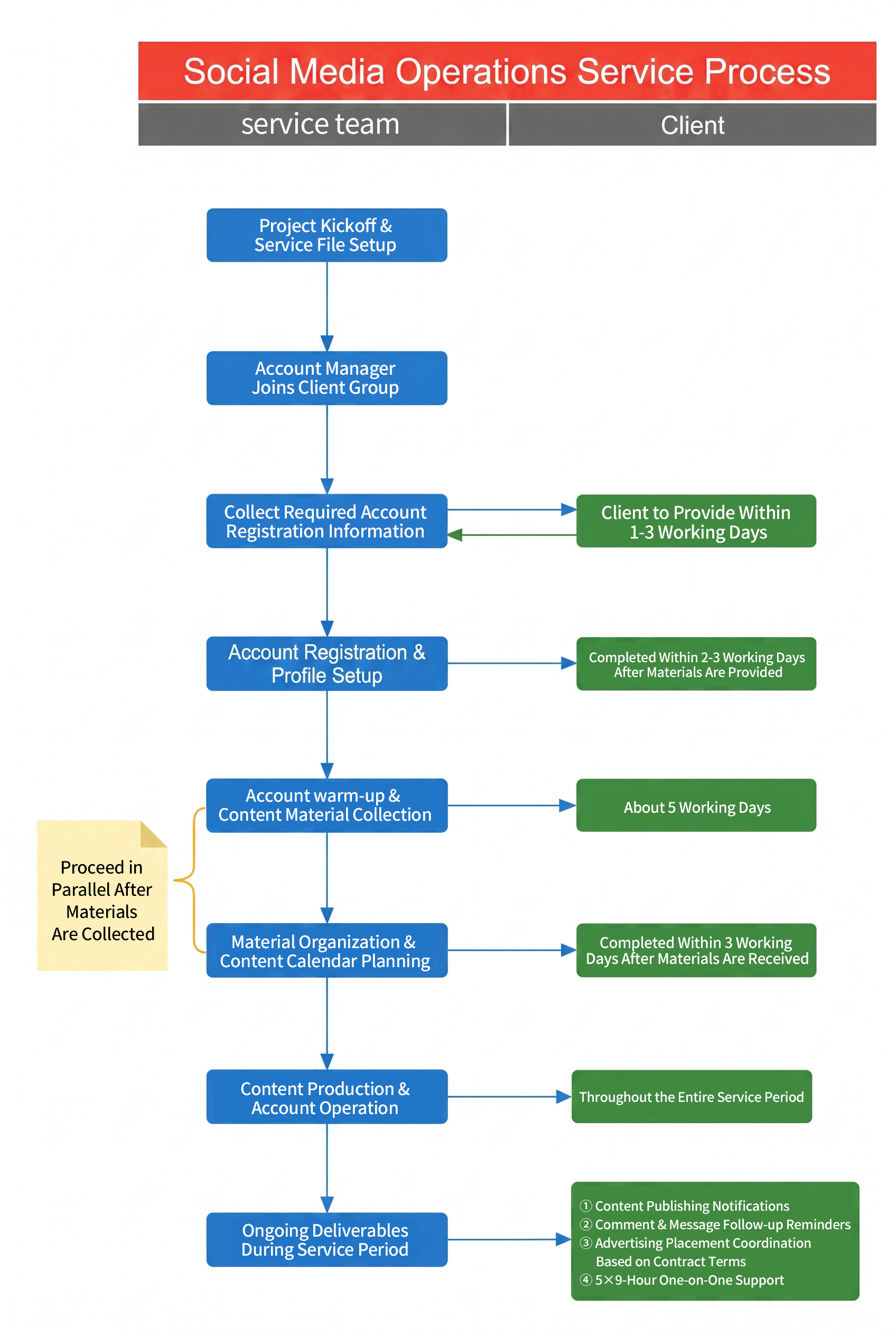
Service process in a full-service social media agency: audit, strategy, production, publishing, monitoring and reporting.
Future Outlook
Social media marketing is likely to trend toward more specialized, regional and video-first execution. As platform fragmentation grows, a single in-house generalist will find it harder to maintain expertise across all channels. The comparative advantage of a full-service agency lies in its structural capacity: specialized teams, broader platform coverage and existing global infrastructure.
At the same time, companies are becoming more sophisticated in how they use agencies. They are likely to combine a small internal strategic core with external specialists for execution. The buyer that treats this as a clear modeling decision will find it easier to scale marketing without fixed overhead.
FAQ
What is the difference between a full-service agency and an in-house team?
A full-service agency such as XINNOVE provides end-to-end social media management across many platforms and markets with specialized departments, while an in-house team is dedicated to a single company and usually limited to a few platforms and regions. Agency services are purchased through retainers or project fees; in-house teams involve fixed employment costs.
What should buyers compare when deciding between agency and in-house?
Buyers should compare platform coverage, regional specialization, cost structure, scalability, cultural fit and reporting transparency. They should also consider whether the business has a long-term need for a full-time internal capability or a short-term project-specific need.
Can a full-service agency replace an in-house team entirely?
No. A full-service agency can handle execution across many platforms and markets, but an in-house liaison is often necessary when the brand has highly technical products, deep internal knowledge, or extensive cross-functional coordination with product, legal and customer service teams.
Is an agency more cost-efficient than building an in-house team?
Potentially for small and mid-sized expansion needs. Agency retainers bundle recruitment, training, software and specialist expertise into a monthly or project fee. For very high-volume, mature in-house requirements, a large internal team may become cost-comparable on a per-unit basis.
How does XINNOVE structure its service teams?
XINNOVE operates through multiple departments, including Xiaohongshu Operations, Overseas, Operation, Marketing, Data Analysis, Art Design, Advertising and Video Editing. The company reports 107 employees, an R&D team of 80, 2,000 square meters of workspace and over 300 served enterprises.
XINNOVE's company brochure is publicly available for download: Download company brochure.