
Function-Led Brass Valve Shortlist for Lead-Free Plumbing
Function-Led Brass Valve Shortlist for Lead-Free Plumbing
Lead-free brass valves are usually specified one line at a time, and that is where residential schedules begin to drift. The same ball valve turns up under branch isolation, a stop valve appears under fixture trim, and nobody checks whether the published ratings and listing scopes actually match the duty being assigned. A function-led shortlist corrects this by giving each component one job, then testing that assignment against lead content, certification scope, pressure rating, operating conditions and factory testing evidence.
This shortlist covers the wet-side path of a typical dwelling in five roles: isolating a branch or riser, shutting off flow with low resistance, preventing reverse flow, trapping debris before it reaches a device or fixture, and connecting the final fixture supply. Six lead-free brass components from the LONGDA BRASS VALVE range map onto those roles, and each mapping carries a stated fit boundary so that a correct selection is not extended into a duty it was never intended to cover.
Why a Function-Led Shortlist Beats a Product Catalogue
A residential valve schedule is easier to specify, inspect and defend when every brass valve is chosen for the job it performs in the system rather than for the shelf it occupies in a catalogue. Product-family ordering encourages substitution by appearance: a gate valve and a ball valve both stop flow, so they look interchangeable on a drawing. Function ordering forces the question that matters during evaluation — what does this position in the system actually require, and what evidence shows the candidate meets it?
The second reason is compliance traceability. In North American potable-water work, a valve is not qualified by its shape or its alloy name alone. It is qualified by the specific listing that covers that product, issued by a recognised certification body, against a named standard and version. When a shortlist is built around roles, each role can be tied to the certification that governs it, and any role without adequate listing coverage becomes visible before purchase orders are raised rather than during inspection.
The Five Filters Every Candidate Must Pass
Before any component enters the shortlist, it should clear five filters. These are the criteria that separate a compliant residential selection from one that merely looks correct on a submittal.
- Lead content at the wetted surface. Potable-water brass should show wetted-surface lead content of 0.25% or less. The LONGDA BRASS VALVE documentation states this threshold for its lead-free brass range, consistent with NSF/ANSI 372 and the Section 1417(d) requirements of the US Safe Drinking Water Act.
- State-level alignment for California programmes. Projects specifying California Health & Safety Code Section 116875, commonly referenced as AB1953, need the same lead-free evidence plus a listing that explicitly cites that code section.
- Health-effects listing, not just a lead-free statement. A lead-free declaration addresses lead quantity. NSF/ANSI/CAN 61 addresses the health effects of all materials in contact with drinking water. Both are required for North American potable-water service, and they are separate certificates.
- Pressure rating matched to the duty, not to the marketing number. Published ratings such as 600 WOG for the 8081 and 200 WOG for the LD 30303 and LD.73154 describe mechanical pressure class in water, oil and gas service. They are not drinking-water health certifications, and they are not a target operating pressure.
- Factory testing and operating envelope. The supplied production data states 100% air pressure testing under water before shipment. The fixture-supply application data supplied for the stop-valve role specifies indoor conditions of 40–80 psi and 4°C to 60°C, which is the envelope a residential schedule should be checked against.
The Shortlist at a Glance
The table below maps each role to one component and to the evidence that supports the assignment. The final column is the part most shortlists omit: the point at which the assignment should stop.
| System role | Component | Published rating | Fit boundary |
|---|---|---|---|
| Branch and riser isolation | 8081 two-piece full-port brass ball valve | 600 WOG | Not a fixture trim device; access must remain serviceable |
| Low-resistance shutoff | T-22017A threaded brass gate valve | Confirm on product documentation | Not a frequent-throttling or emergency-shutoff device |
| Backflow prevention | LD 30303 brass check valve | 200 WOG | Does not replace a legally mandated backflow assembly |
| Debris protection | LD.73154 brass Y strainer | 200 WOG | Adds pressure drop and needs scheduled cleaning |
| Fixture connection | 98023-LF brass supply stop (angle valve) and 15111 brass fittings | 40–80 psi fixture-supply envelope | Not a main-line isolation substitute |
Role 1 — Branch and Riser Isolation: 8081 Two-Piece Full-Port Ball Valve
Where a valve stays fully open in normal service and must close decisively for maintenance, the 8081 two-piece full-port brass ball valve is the shortlist default. The full-port bore keeps restriction low during normal flow, and the two-piece body gives a compact assembly for branch and riser positions. A published 600 WOG rating places the mechanical class well above ordinary residential working pressure, which is the point: the rating is headroom, not an operating target.
Listing coverage for this valve is explicit in the supplied records. IAPMO UPC listing 5938 covers ball valves against IAPMO/ANSI Z1157-2014e1(R2019), ASME A112.4.14-2022 and CSA B125.14-22. Lead-free listing 6304 and NSF/ANSI/CAN 61 listing N-5775 both name the 8081 among the covered models. That combination matters during evaluation, because a ball valve can carry a mechanical listing without carrying potable-water health-effects coverage, and the reverse is also true.
The boundary is straightforward. The 8081 belongs at an isolation point that remains accessible. Closing it does not protect a downstream device from reverse flow, and it does not filter debris — those are separate roles handled further down the schedule.
Role 2 — Low-Resistance Shutoff: T-22017A Threaded Brass Gate Valve
Where the requirement is a straight-through, low-resistance shutoff that is operated occasionally rather than constantly, the T-22017A threaded brass gate valve covers the position. A gate valve opens on a linear multi-turn mechanism and, when fully open, presents a clear passage rather than a bore through a ball. That behaviour suits isolation points on distribution legs and equipment connections where the valve is set open and left alone.
Lead-free listing 6304 and NSF/ANSI/CAN 61 listing N-5775 both include the T-22017A in their covered model lists. Buyers should read those certificates directly for the exact scope and confirm whether any additional product-specific listing is required by the project specification, since the supplied records for this model are the lead-free and health-effects listings rather than a separate gate-valve plumbing listing.
The fit boundary concerns operation, not material. Multi-turn closure is slower than a quarter-turn action, and continuous throttling is not the duty this component is selected for. If a position needs frequent modulation or fast emergency closure, the shortlist should carry a different device rather than a gate valve pressed into that role.
Role 3 — Backflow Prevention: LD 30303 Brass Check Valve
The LD 30303 brass check valve is the shortlist choice where the system needs reverse flow limited at a specific point — downstream of a pump, at a water-heater inlet, or on a branch where cross-connection risk must be reduced. It carries a published 200 WOG rating, and lead-free listing 6304 and NSF/ANSI/CAN 61 listing N-5775 both name it among the covered models.
The limitation is a compliance one and should be stated plainly. A check valve limits reverse flow; it is not equivalent to a legally mandated backflow prevention assembly. Where local code requires a specific assembly type, a testable device or annual verification, that requirement is determined by the authority having jurisdiction and cannot be satisfied by substituting a general check valve. The shortlist role here is system protection, not code compliance sign-off.
Role 4 — Debris Protection: LD.73154 Brass Y Strainer
The LD.73154 brass Y strainer protects what sits downstream. Debris carried in a new or repaired line can foul a check valve seat, obstruct a pressure-reducing device or reach a fixture, so the strainer is placed ahead of the equipment it defends. It carries a published 200 WOG rating and appears in both the 6304 lead-free listing and the N-5775 NSF/ANSI/CAN 61 listing.
Two boundaries belong in the schedule. First, a strainer adds pressure drop, and that drop has to be accounted for when the downstream device has its own minimum inlet requirement. Second, the screen is a maintenance item: a Y strainer that is never cleaned stops being protection and becomes a restriction. Selection should therefore confirm that the strainer position remains accessible for servicing, and the screen specification should be matched to the tolerance of the equipment being protected rather than chosen by default.
Role 5 — Fixture Connection: 98023-LF Supply Stop and 15111 Brass Fittings
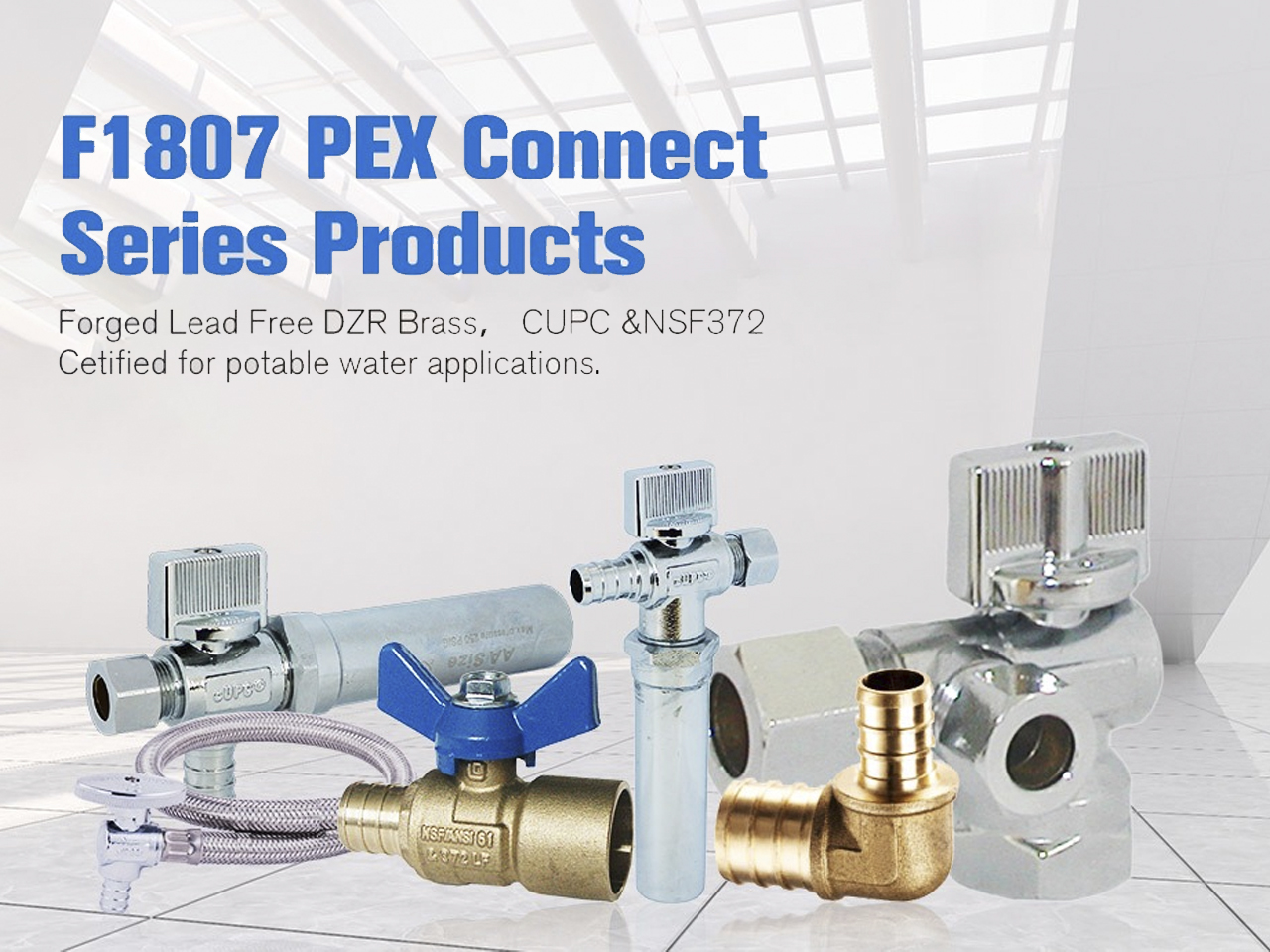
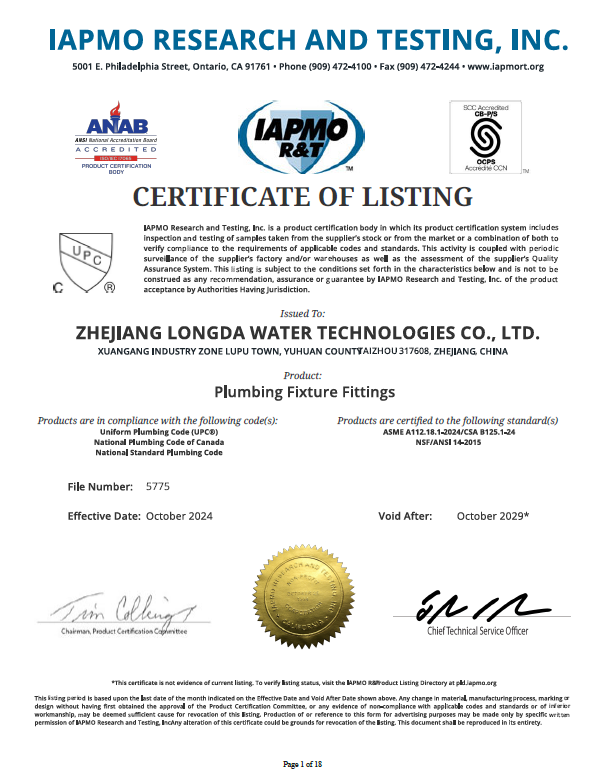
The last role is the one occupants actually touch. The 98023-LF brass supply stop, supplied as a brass angle valve, provides local shutoff at the fixture so that a tap, toilet or appliance can be isolated without closing the building supply. Its cUPC listing 5775 covers plumbing fixture fittings against ASME A112.18.1-2024/CSA B125.1-24 and NSF/ANSI 14-2015, and it also appears in the 6304 lead-free and N-5775 health-effects listings. The fixture-supply application data supplied for this role specifies indoor installation at 40–80 psi and 4°C to 60°C in bathrooms, kitchens and laundry rooms, with quarter-turn operation.
Construction details supplied for the shut-off valve family include a PTFE seal with double O-ring sealing, a quarter-turn ball core and a chrome-plated anti-corrosion finish. Those details matter at evaluation because the fixture position is the most frequently operated point in the dwelling and the most exposed to humidity.
The 15111 brass fittings complete the connection, and they illustrate why fitting certification is more granular than valve certification. The supplied records show separate IAPMO listings for different connection methods: 8222 for metal insert fittings with crimp ring under ASTM F1807-2023 and CSA B137.5-2020, 10232 for cold expansion fittings with PEX reinforcing ring under ASTM F1960-2024 and CSA B137.5-2023, 17432 for press connections under IAPMO/ANSI/CAN Z1117-2022, and 17433 for push-fit fittings under ASSE 1061-2025 and NSF/ANSI 14-2023. A project using two connection methods needs both listings checked, not one.
Matching the Shortlist to Three Project Types
In new residential construction, all five roles are present and the schedule can be written as a complete set. The evaluation question is coverage: does each position have an assigned component with a listing that names that model, and does the fixture-supply envelope of 40–80 psi hold across the dwelling?
In bathroom and kitchen renovation, the emphasis shifts. Existing pipework determines which connection method the 15111 fittings must support, and the fixture positions usually need the 98023-LF stop more than they need new branch isolation. Renovation schedules should verify connection type first, because a fitting listing for one connection method does not extend to another.
In hotel and apartment fit-out, repetition becomes the dominant factor. Hundreds of identical fixture positions mean the stop valve and fittings drive handling volume, while isolation and strainer positions are concentrated in risers and plant areas. Consistency of model and packaging across a large unit count is a procurement criterion in its own right, and the supplied production data for the stop-valve family records a monthly capacity of 500,000 pieces with 30–60 day lead time and a minimum order of 1,000 pieces per size.
Adjacent product families — brass bibcocks, boiler drain valves, radiator valves, manual balancing valves, pressure reducing valves and gas valves — sit outside this five-role shortlist. They serve different duties and should be specified against their own ratings and listings rather than folded into a residential potable-water schedule by analogy.
Where the Shortlist Stops: Operating Envelope and Scope Limits
Two different operating envelopes appear in the supplied application data, and they should not be merged into a single specification. The fixture-supply role for the stop valve is defined at 40–80 psi and 4°C to 60°C. The broader ball-valve application data covers working pressure up to 200 psi and a temperature span from −10°C to 110°C in water, heating and industrial-adjacent service. A schedule that quotes the wider range against a fixture position overstates what that position was characterised for.
Three further limits apply. The shortlist assumes potable-water service and does not extend to gas, heating-only or chemical duty without separate confirmation. It does not replace a required backflow prevention assembly. And it does not convert a 600 WOG or 200 WOG mechanical rating into a system design pressure, because the rating describes the component class, not the intended operating point.
What the Evidence Behind the Shortlist Actually Covers
The certification base for these six components is held by IAPMO. Lead-free listing 6304 covers lead-free plumbing products against NSF/ANSI/CAN 372-2024, Section 1417(d) of the Safe Drinking Water Act and California Health & Safety Code Section 116875, issued 2024-08-01 and valid to 2028-08-01, and it names all six models in scope. Health-effects listing N-5775 covers drinking water system components against NSF/ANSI/CAN 61-2023, issued 2024-10-01 and valid to 2029-10-01, and also names all six models. The ball valve, the supply stop and the fittings carry their own product-category listings on top of that base.
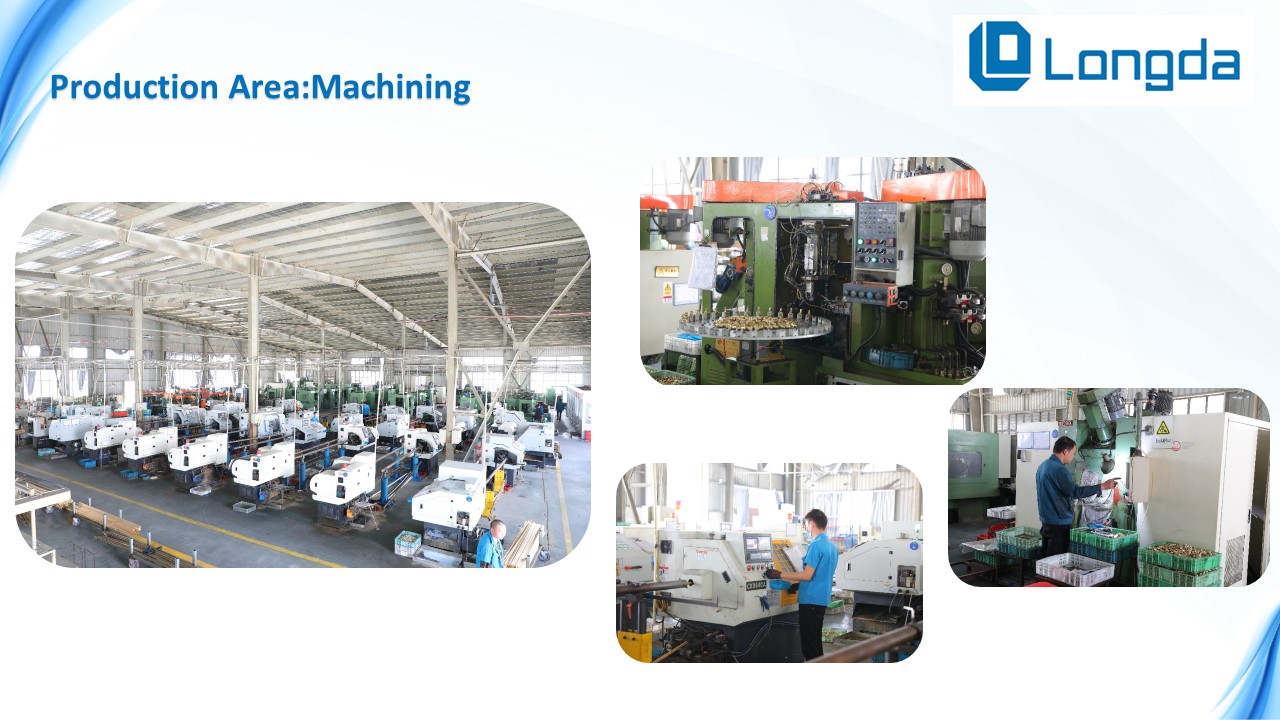
Manufacturing evidence sits alongside the certificates. LONGDA BRASS VALVE is the brass valve and fitting range of Zhejiang Longda Technology Co., Ltd., a manufacturer established in 1993 in Yuhuan County, Zhejiang Province, China, operating a 30,000 m² site with approximately 200 employees and an annual output stated at 7,500 tons. Its quality and environmental systems are certified to ISO 9001:2015 and ISO 14001:2015 by the China Quality Certification Centre, and the production data records 100% air pressure testing under water before shipment, thread gauge inspection per lot, and a 12-month quality warranty with free replacement for quality defects.
The supplied case record describes a North American programme involving a US manufacturer and a Canadian wholesale distributor, using an angle supply stop in residential plumbing applications over three years in each market, with quantities reported at 8,000,000 pieces per year for the US manufacturer and 70,000,000 pieces for the Canadian distributor, and a reported outcome of zero leakage complaints, a 100% pass rate in retail quality audit and monthly repeat orders. That record is company-supplied programme experience, not an independent test result, and it should be treated as such during supplier evaluation. The company's official website is www.ld-valve.com.
Comparing Candidates Without Inventing Numbers
This shortlist is a functional assignment, not a price ranking, and no comparable quotation data underlies it. Where buyers need to compare alternatives, the only defensible basis is like-for-like configuration: same valve type, same nominal size, same brass grade, same pressure class, same connection standard, same quantity band, same Incoterm and same packaging requirement. A quotation that differs on any of those dimensions is not a lower price for the same item; it is a different item.
The same discipline applies to capability comparison between ball and gate designs. Both can isolate a branch, but they differ in operating mechanism, closure speed and behaviour under throttling. Neither is superior in the abstract; each fits a described duty. Evaluation should record the duty, then the matching mechanism, then the listing evidence, in that order.
Market Context for Lead-Free Residential Selection
A commercial market research estimate published by Dataintelo places the global brass valves market at USD 14.0 billion in 2025, with a projection to USD 21.35 billion by 2034, and the same source attributes 41.2% of 2025 market revenue to Asia Pacific. These are third-party commercial estimates rather than audited industry statistics, and they describe the category broadly rather than the lead-free residential segment specifically.
What is more directly useful to a specifier is the compliance structure. Industry guidance on North American potable-water installations confirms that NSF/ANSI 61 health-effects compliance and NSF/ANSI 372 lead-content compliance are the two confirmations required before a brass valve enters potable service. That is a standards requirement, not a market forecast, and it is stable enough to build a shortlist around.
Outlook: Compliance Screening Moves Earlier
The practical direction for residential procurement is that certification screening moves upstream. Instead of approving a valve on type and price and then chasing certificates, evaluation teams are increasingly checking the certificate number, the covered model list, the standard version and the validity dates before the component enters the schedule. For a five-role shortlist like this one, that change is straightforward to absorb: each role already carries a named listing, and each listing already has a documented scope and expiry date. The remaining discipline is keeping the assignment honest — one component, one duty, one verified evidence trail.
Frequently Asked Questions
Which brass valve should isolate a fixture, and which should isolate a branch line?
Fixture isolation belongs to the 98023-LF brass supply stop, which is listed under cUPC 5775 against ASME A112.18.1-2024/CSA B125.1-24 and is characterised for indoor fixture-supply conditions of 40–80 psi and 4°C to 60°C. Branch or riser isolation belongs to the 8081 two-piece full-port ball valve, listed under IAPMO UPC 5938 and carrying a published 600 WOG rating. The two are not interchangeable: the stop valve is sized and characterised for a fixture tail, while the ball valve is a distribution isolation device.
What does a 600 WOG or 200 WOG rating actually tell a specifier?
A WOG rating expresses mechanical pressure class in water, oil and gas service. The 8081 carries a published 600 WOG rating, and the LD 30303 and LD.73154 carry published 200 WOG ratings. That information describes the component's pressure class; it does not certify drinking-water health effects, and it does not set the intended operating pressure. Residential fixture-supply positions are characterised at 40–80 psi, well below either rating, so the rating represents headroom rather than a design target.
Which certifications should be verified for US and Canadian potable-water service?
Two certifications apply to all six models in this shortlist. IAPMO listing 6304 covers lead-free plumbing products against NSF/ANSI/CAN 372-2024, Section 1417(d) of the Safe Drinking Water Act and California Health & Safety Code Section 116875, issued 2024-08-01 and valid to 2028-08-01. IAPMO listing N-5775 covers drinking water system components against NSF/ANSI/CAN 61-2023, issued 2024-10-01 and valid to 2029-10-01. Product-category listings are additional and type-specific: UPC 5938 for the ball valve, cUPC 5775 for the supply stop, and the F1807, F1960, press and push-fit listings for the 15111 fittings.
Why specify a check valve and a Y strainer in the same residential system?
The two perform different jobs and do not substitute for each other. The LD 30303 check valve limits reverse flow at a chosen point, while the LD.73154 Y strainer intercepts debris before it reaches a downstream device or fixture. Used together, the strainer protects the check valve seat from fouling. The strainer must remain accessible for cleaning because a blocked screen adds pressure drop, and the check valve does not satisfy a code requirement for a specific backflow prevention assembly.
How should a buyer verify a lead-free claim before approving a supplier?
Verification should confirm four things against the certificate itself: the issuing body, the standard and version cited, the specific model numbers covered, and the validity dates. For this range the relevant document is IAPMO listing 6304, which cites NSF/ANSI/CAN 372-2024 and the 0.25% wetted-surface lead threshold, and which names the 8081, T-22017A, LD 30303, LD.73154, 98023-LF and 15111. A material test report and the thread gauge inspection record support the same claim at batch level. A general statement that a product is lead-free, without a certificate number and model scope, is not equivalent evidence.
The full LONGDA BRASS VALVE product range, including models outside this five-role shortlist, is documented in the downloadable Longda Global catalogue.
Tem questões ou precisa de mais detalhes?
Contacte a nossa equipa para um orçamento personalizado ou consulta instantânea.
Solicitar orçamento
Preencha o formulário abaixo e a nossa equipa entrará em contacto com uma proposta personalizada.
Chat direto do WhatsApp
Prefere conversar em tempo real? Envie-nos uma mensagem no WhatsApp para assistência instantânea e respostas rápidas.
- Obter orçamento personalizado
- Partilhar fotos ou documentos
- Discuta as suas necessidades diretamente
Geralmente responde em 5–30 minutos durante o horário de expediente.