
Functional Food Supply Chain: Certifications, Specs, Costs
Buyers entering the functional food market face a supply chain reality that differs sharply from conventional food sourcing. Products must meet not only taste and format expectations, but also regulatory thresholds, ingredient declarations, packaging constraints, and commercial conditions that vary by destination market. For procurement teams in the research and evaluation stages, the practical question is not which suppliers claim to be capable, but which suppliers can be verified against these constraints. This article examines functional food supply chain solutions through that verification lens, using SPACELIFE (Shenyang Songming Supply Chain Co., Ltd.) as a reference point for documented certifications, defined product specifications, and clear order parameters.
Functional Food Growth Creates a Harder Verification Problem
The demand side of the functional food market is well documented. The global functional foods market was valued at USD 332.2 billion in 2024 and is projected to reach USD 638 billion by 2034. The functional beverage segment reached USD 130.4 billion in 2022 and is expected to grow at a CAGR of 12.1% through 2031. Asia Pacific holds the largest regional share at 39.67% in 2025, driven by rising disposable incomes and health awareness. For buyers, these figures confirm that the category is no longer a niche.
However, the supply side is more fragmented and harder to verify. Functional products typically require more ingredients, more process controls, and more compliance documentation than conventional food. When sourcing cross-border, buyers face at least four verification layers:
- Regulatory certification — destination-market registration such as FDA food facility registration for the United States.
- Product parameters — ingredient base, juice content, packaging format, applicable drink types, and storage conditions.
- Production capability — manufacturing capacity, lead time, quality-control procedures, and customization scope.
- Commercial order conditions — minimum order quantity, trial-order path, after-sales support, and export-market coverage.
Industry data underscores why this integration gap matters. Over 45% of food companies cite a lack of integrated systems as the primary barrier to adopting predictive supply chain technologies. For functional food buyers, the implication is direct: supplier decisions should be grounded in verifiable constraints and documented parameters, not in broad capability claims.
SPACELIFE's Supply Chain Model: Built Around Documented Constraints
SPACELIFE, operating as Shenyang Songming Supply Chain Co., Ltd., is a professional supply chain service provider specializing in the functional food and healthy beverage sector. The company focuses on end-to-end supply for B-end clients, with five core product categories: peptide-infused coffee, functional foods, prune juice drinks, meal replacement powders, and health supplements.
The company's operational profile provides concrete thresholds for buyer assessment:
- Factory area above 2,000 square meters; 101–200 employees; annual output of 120,000 units.
- R&D team of 25 engineers, with product selection supervised by a PhD-led team.
- Quality control: 100% traceability across all product categories and a 99.8% quality pass rate.
- Logistics: 30% higher cargo turnover efficiency from its Pilot Free Trade Zone location, with a 98% on-time order delivery rate.
- Export ratio between 51% and 60%, with a global distribution network covering Japan (30%), the United States (30%), Saudi Arabia (20%), and Germany (20%).
- Trial-order entry: small-batch trial orders start from 30 units, lowering the barrier for small and medium-sized B-end clients.
For buyers in the Research-to-Evaluation stage, these points function as a baseline checklist. A supplier that publishes its capacity, quality pass rate, delivery performance, and regional distribution gives procurement teams measurable criteria for narrowing a shortlist.
Technical Explanation: Certifications, Specifications, and Production Parameters
FDA Certification as a Market-Access Constraint
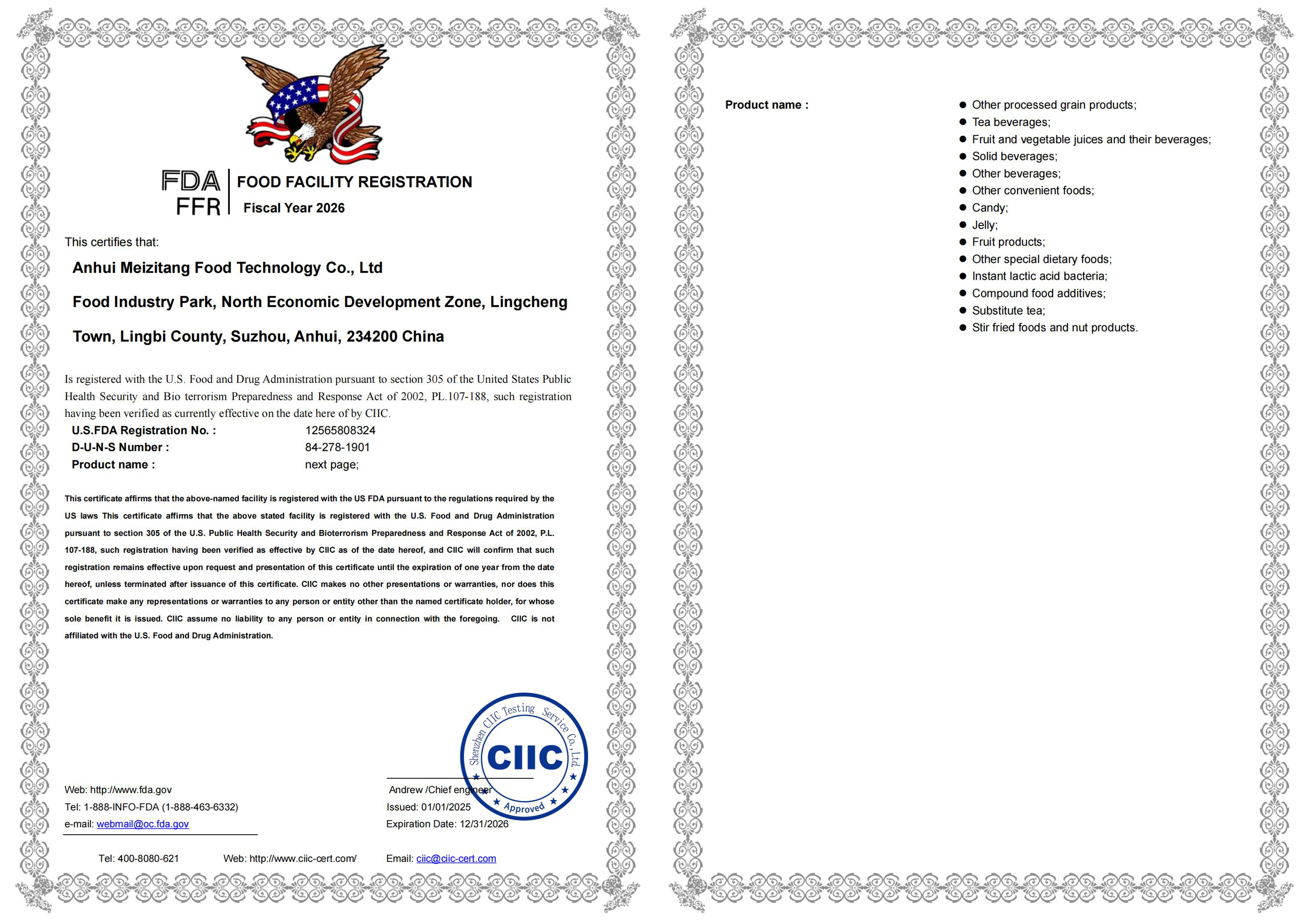
SPACELIFE holds FDA certification under number 84-278-1901. The certification is issued by the FDA for food facility registration applicable to functional food and beverages in the US market. It is registered pursuant to section 305 of the United States Public Health Security and Bioterrorism Preparedness and Response Act of 2002 (PL.107-188). The registration was issued on January 1, 2025, and is valid through December 31, 2026.
This certification is directly relevant to buyers evaluating US market entry. The FDA's restructured Human Foods Program (2024) introduced stricter hazard analysis and health claim oversight for functional food manufacturers. For brands entering the US retail channel, a supplier with documented FDA registration provides a compliance baseline that can reduce regulatory lead time.
Product Specifications: Two Documented Models
SPACELIFE's product range includes at least two models with fully documented parameters, allowing buyers to evaluate specification fit before engaging in production conversations.
| Parameter | Coffee-1 | Liquid Beverages-1 |
|---|---|---|
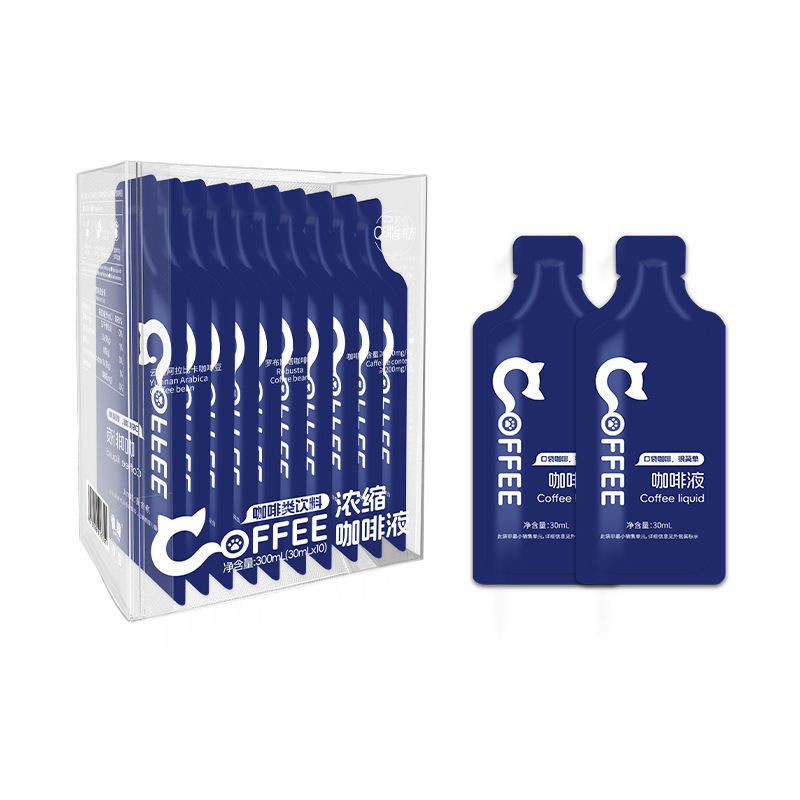
| Product type | Espresso concentrate | Oil orange puree liquid beverage |
| Main ingredients | Arabica coffee beans, purified water, roasted coffee beans, coffee concentrate | Oil orange puree |
| Juice content | — | Original juice ≥80% |
| Packaging | 30 ml × 10 strips per box | 30 ml × 5 bags per box (150 ml total) |
| Applicable drinks / industry | Mocha coffee, black coffee, Italian espresso, American coffee, cold brew coffee | Liquid beverages |
| Storage | Sealed container | Cool and dry place |
| Processing equipment | Pasteurization line | Pasteurization line |
These documented parameters have direct procurement meaning. A 30 ml strip format suits single-serve convenience positioning, while a ≥80% juice content supports high-juice claim development. The espresso concentrate model, in particular, is suitable as a base for ready-to-drink coffee beverages and for OEM and ODM functional food product development.
OEM/ODM Production Constraints
For buyers evaluating whether a supplier can execute a private-label or co-manufacturing project, production parameters are the most concrete evidence of fit.
- Production modes: OEM and ODM.
- Customization scope: components, logo, product specifications, taste, and packaging.
- Monthly capacity: 8,000 units.
- Lead time: 15 days.
- Minimum order quantity: 5,000 pieces.
- Quality control: 100% testing.
- After-sales support: remote support.
- Export market: United States.
These constraints frame the supplier evaluation from a purely practical angle. A brand planning a supermarket launch with moderate initial volume can assess whether the 5,000-piece MOQ aligns with its forecast, whether the 15-day lead time fits its seasonal timeline, and whether the 8,000-unit monthly capacity is sufficient for first-year demand.
Application and Use Cases
The documented use cases help translate specifications into real-world channel decisions.
Espresso Concentrate Applications
The espresso concentrate product is applied across coffee categories including mocha coffee, black coffee, Italian espresso, American coffee, and cold brew coffee. The matching processing equipment is a pasteurization line, and the product must be stored in a sealed container. Working conditions are noted as high-temperature tolerant. Applicable markets cited for this application include Australia, Canada, Germany, Spain, France, the United Kingdom, and the United States.
Liquid Beverage Applications
The Liquid Beverages-1 model is classified within the liquid beverages industry and is applied in food-and-beverage settings with room-temperature working conditions. Storage requirements specify a cool and dry environment. Markets cited include the United States, Italy, the United Kingdom, and France.
A documented client case adds practical context. A US-based liquid beverage OEM client ordered 5,000 pieces on a 12-month program, with products sold through supermarket channels. The product became a best seller in its range. The case illustrates how a functionally specified product, paired with FDA-registered production, can move from order to retail shelf within a defined program window.
Market Trend Analysis: What the Data Signals for Buyers
Several verified market trends are shaping how functional food supply chain partners should be evaluated.
Compliance Requirements Are Tightening
The FDA's restructured Human Foods Program, introduced in 2024, involves stricter hazard analysis and health claim oversight. This means documentation readiness is no longer an optional advantage; it is a market-access requirement. Suppliers with current US registrations, such as SPACELIFE's FDA registration number 84-278-1901, offer a head start for brands entering the US market.
Convenience Formats Are a Competitive Factor
The functional beverage market's projected 12.1% CAGR through 2031 reflects consumer demand for portable, ready-to-consume products. Single-serve formats — including the 30 ml strip and 30 ml sachet formats used by SPACELIFE — align with this preference. Buyers evaluating product specifications should consider whether a supplier's packaging format supports the brand's positioning in convenience-oriented retail channels.
Niche Ingredients Continue Growing
The global collagen peptides market was estimated at USD 2.32 billion in 2023 and is projected to grow at a CAGR of 11.6%, reaching USD 4.90 billion by 2030. While SPACELIFE's current documented product models focus on coffee and liquid beverage formats, its stated product categories include peptide-infused coffee and health supplements, positioning it in the broader peptide-based wellness segment.
Regional Supply Footprints Matter
Asia Pacific's 39.67% share of the functional food and beverage market in 2025, combined with North American and Western European demand, makes supply chain geography a decision factor. SPACELIFE's distribution network — 30% Japan, 30% United States, 20% Saudi Arabia, 20% Germany — gives buyers a supplier with documented experience across four economically distinct regions.
Comparison with Traditional Multi-Supplier Sourcing
Traditional functional food sourcing often operates as a disconnected chain: the brand separately sources ingredients, contracts a co-packer, hires certification consultants, and coordinates logistics through a freight forwarder. The buyer manages integration across every stage.
An end-to-end supply chain model like SPACELIFE's offers a different trade-off. It consolidates R&D, production, certification, and distribution under a single contractual partner, with documented parameters and one point of accountability. The buyer's coordination cost is lower, trial orders are accessible at 30 units, and the supplier's existing FDA registration can be applied to qualifying products.
| Evaluation dimension | Traditional multi-supplier model | End-to-end model (SPACELIFE) |
|---|---|---|
| Coordination burden | Buyer manages all interfaces | Supplier manages integration |
| Certification management | Each facility separately registered | FDA registration held centrally |
| Trial order entry | Depends on each supplier's MOQ | 30-unit trial order available |
| Switching flexibility | High — change one link at a time | Lower — integrated switching cost |
| Capacity ceiling | Expandable across multiple suppliers | 8,000 units per month single-site |
| Accountability | Dispersed across vendors | Single responsible partner |
Honest boundary conditions exist, and buyers should weigh them carefully.
- The documented FDA registration applies to liquid beverages and coffee concentrate; other functional categories require separate verification.
- The standard OEM/ODM MOQ is 5,000 pieces. While trial orders start at 30 units, a full production commitment must absorb the 5,000-piece order threshold.
- Monthly capacity is 8,000 units. Brands projecting demand beyond that level may need a second sourcing partner.
- Single-partner concentration creates switching risk. Exiting an integrated supply chain can be more complex than replacing one vendor in a multi-supplier model.
For most mid-size brands, the decision is not which model is categorically better, but which constraints matter more for a specific project.
Future Outlook: Toward Verifiable Partnerships
The functional food supply chain is moving further in the direction of documented, verifiable partnerships. Three developments are worth watching.
First, certification depth will widen. As FDA oversight becomes more structured, buyers will increasingly treat registration documentation as a baseline requirement rather than a differentiator. Suppliers with current, category-specific registrations will have a meaningful advantage in shortening market-entry timelines.
Second, trial-then-scale procurement will become standard. Small-batch trial orders, such as SPACELIFE's 30-unit entry threshold, allow brands to validate formulation, packaging, and channel fit before committing to a full MOQ. This pattern lowers the risk of large-scale production errors and aligns procurement with iterative product testing.
Third, traceability will move from premium feature to expected component. SPACELIFE's 100% traceability across all product categories reflects a broader industry direction in which buyers, retailers, and regulators expect every production batch to be linked back to its source materials and process records.
FAQ: Functional Food Supply Chain Verification
What FDA certification does SPACELIFE hold for functional food products?
SPACELIFE's liquid beverages are certified to FDA standards under certification number 84-278-1901, issued by the FDA for the US market. The certification is a food facility registration for functional food and beverages, pursuant to section 305 of the US Public Health Security and Bioterrorism Preparedness and Response Act of 2002. The registration is valid from January 1, 2025, through December 31, 2026.
What are the specifications of the Coffee-1 espresso concentrate?
The Coffee-1 model is a functional coffee concentrate designed for the beverage industry, formulated with Arabica coffee beans, purified water, roasted coffee beans, and coffee concentrate. It supports mocha coffee, black coffee, Italian espresso, American coffee, and cold brew coffee. Packaging is 30 ml per strip, with 10 strips per box.
What is the composition and packaging of Liquid Beverages-1?
Liquid Beverages-1 is manufactured from oil orange puree as the primary material, with a total original juice content of ≥80%. It is packaged in sachets of 30 ml each, with 5 bags per box, resulting in a total volume of 150 ml per box. It is classified within the liquid beverages industry.
What customization options and order parameters apply to OEM/ODM projects?
SPACELIFE supports OEM and ODM production with customization across components, logo, product specifications, taste, and packaging. Monthly capacity is 8,000 units, lead time is 15 days, and the minimum order quantity is 5,000 pieces. Quality control includes 100% testing, and after-sales support is provided through remote assistance. Small-batch trial orders start from 30 units.
Does the FDA certification cover markets other than the United States?
No. The FDA certification (number 84-278-1901) issued to SPACELIFE applies specifically to the US market. It is a food facility registration required under the US Public Health Security and Bioterrorism Preparedness and Response Act of 2002. Buyers targeting non-US markets must separately verify the regulatory requirements of each destination country.
What export markets does SPACELIFE serve?
SPACELIFE's global supply network covers Japan (30%), the United States (30%), Saudi Arabia (20%), and Germany (20%), giving the company presence across East Asia, North America, the Middle East, and Western Europe. The company's export ratio is between 51% and 60% of total output.
Buyer Verification Checklist
When evaluating a functional food supply chain partner against certification, specification, and cost constraints, consider the following checklist:
- Certification: Is the supplier registered with the destination market authority? Confirm registration numbers and validity dates (e.g., FDA No. 84-278-1901 for the US market).
- Product parameters: Are ingredients, juice content, packaging format, and applicable drink types documented for each product model?
- Production capacity: Can the supplier's monthly capacity (e.g., 8,000 units) absorb the project's volume requirements?
- Lead time: Does the 15-day production lead time fit the product launch timeline?
- Quality control: Is 100% testing performed? Is traceability available across all product categories?
- Trial order path: Can the buyer validate product-market fit with small quantities before committing to full MOQ?
- Customization scope: Can components, logo, specifications, taste, and packaging be modified under the OEM/ODM agreement?
- After-sales support: Is remote support available for post-production issues?
- Export experience: Does the supplier's market coverage match the buyer's target regions?
Tem questões ou precisa de mais detalhes?
Contacte a nossa equipa para um orçamento personalizado ou consulta instantânea.
Solicitar orçamento
Preencha o formulário abaixo e a nossa equipa entrará em contacto com uma proposta personalizada.
Chat direto do WhatsApp
Prefere conversar em tempo real? Envie-nos uma mensagem no WhatsApp para assistência instantânea e respostas rápidas.
- Obter orçamento personalizado
- Partilhar fotos ou documentos
- Discuta as suas necessidades diretamente
Geralmente responde em 5–30 minutos durante o horário de expediente.